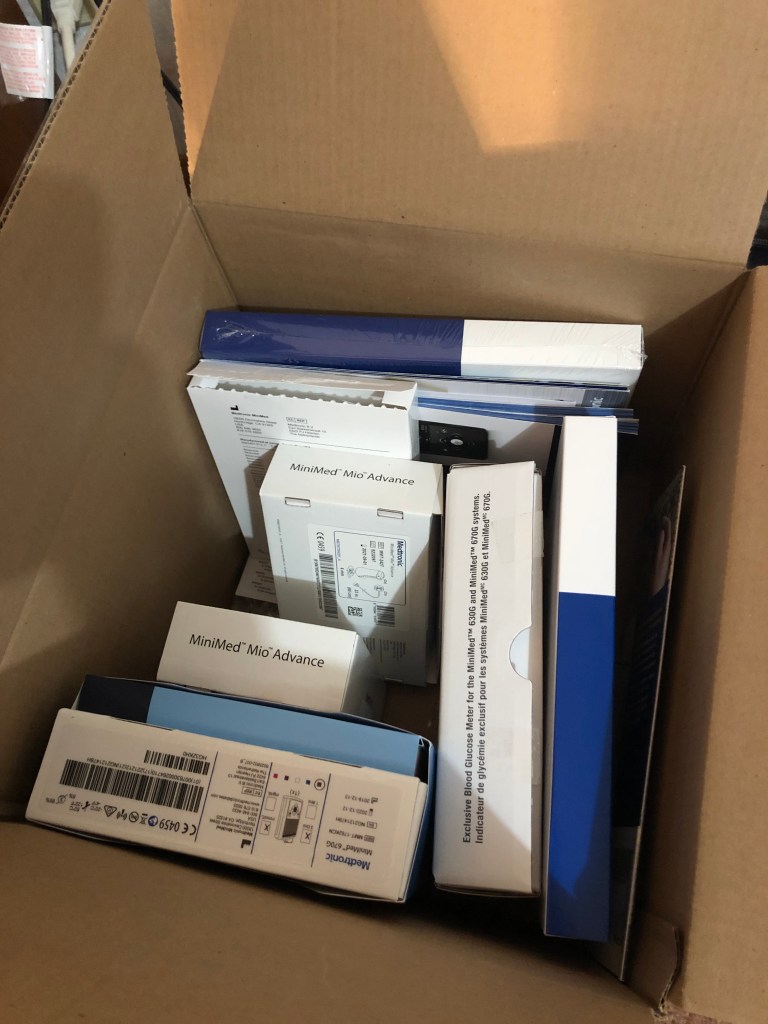
As I mentioned in an earlier post, I received an important package via FedEx on Monday: my Medtronic 670G insulin pump kit. For any non-Diabetics who may not be in the know, an insulin pump is a prescribed, electronic device that holds insulin and delivers it automatically based on your requirements and how many carbohydrates you consume.
There are a number of different brands, models and types, depending on what you’re looking for. Some are pretty straightforward and simply delivers the insulin based on simple calculation. Others have an additional feature called CGM, or Continuous Glucose Monitoring. This allows the user to have their pump track their blood sugar trends on a minute-to-minute basis and the pump makes adjustments accordingly.
My package of supplies, like opening gifts at Christmas!
There are many benefits to this new pump system. The included CGM system checks interstitial blood sugars every five minutes and makes adjustments accordingly. According to new math, that’s 288 time a day! Even with the FreeStyle Libre, I still can’t test that frequently. This allows for better overall control and time in range. The pump has the ability to automatically deliver insulin if your blood sugars are starting to rise, and can halt the delivery of insulin should they begin to drop.
The pump is said to be waterproof up to 12 feet of depth, although the manufacturers still recommend removing it before swimming. The pump uses fast-acting insulin (in my case, Humalog) and eliminates the need for long-acting insulin, acting much more like the pancreas would.
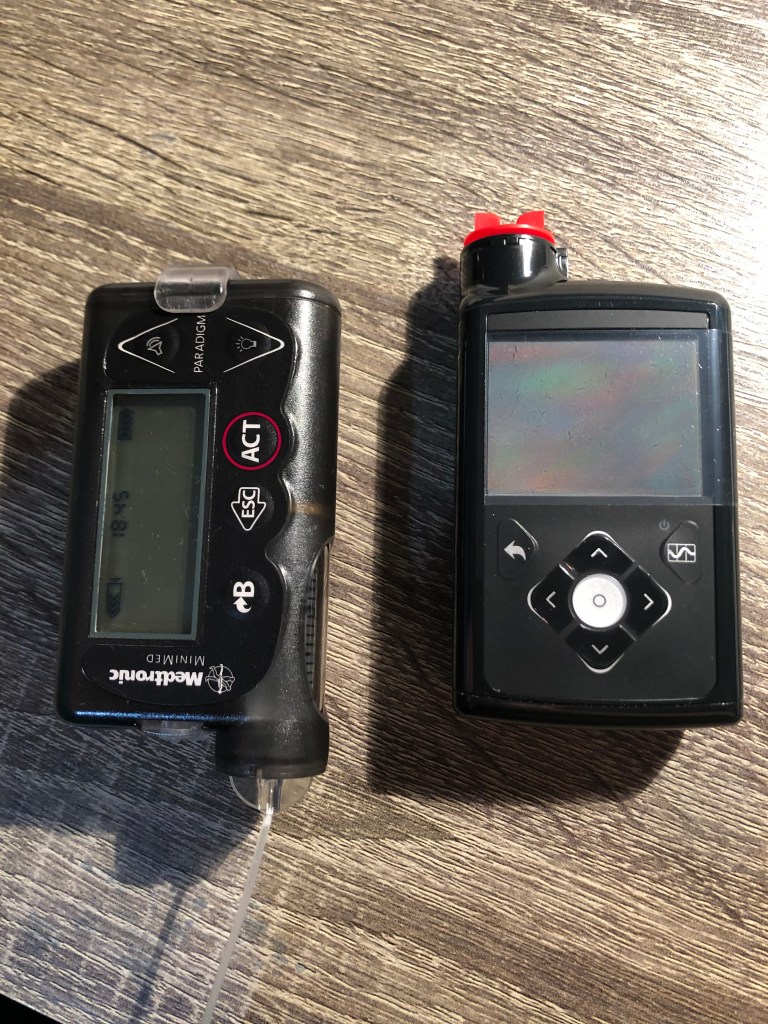
My old MiniMed on the left compared to my new 670G on the right.
Although it’s hard to tell from the photo, the new pump is all shiny and it feels like opening up a new smart phone. There’s a backlit LED screen and a belt clip that attaches directly to the pump as opposed to simply clipping onto the body of the pump.
I have a lot of “homework” to do before I can begin reaping the benefits of this device. There are a number of manuals to read through, some online videos and learning to complete and then I have two sessions with a certified pump trainer before going on automatic mode and letting the pump take control. However, considering this pump has been out for a number of years in the U.S., it’s well known for helping you to maintain an increased amount of time “in range”. I’m looking forward to taking full advantage of this system in the weeks to come. ☯
I was pleased to wake up this morning and discover that I seem to have accumulated 100 followers! I’m not sure exactly when this happened, although I’m guessing it happened with the last person who started following… This is me digressing, first thing in the morning before I’ve had sufficient caffeine!
It’s hard to believe that it’s been a year already, and I started this blog as a way to share the information and knowledge I’ve gathered after dealing with Type-1 Diabetes for over 37 years and studying the martial arts for what will be 32 years, this year! I used to admin a Facebook page that had the same kind of vibe as my blog, but I lost it when I chose to step away from social media in late 2018.
I love writing! Blogging has given me a forum in which to do so, and I intend on continuing for as long as my fingers and mind will allow me. I’ll keep writing what’s cool to me; and hopefully, somewhere along the way, it will also be cool to you! Keep reading, my friends! ☯
If there’s something I’ve seen a lot of in the martial arts, it’s prejudice. Does that surprise you? It shouldn’t. Even in the most classic kung fu movies, you can see one style pitted against another, one clan fighting another or comparisons of one style against another. Prejudice has run rampant throughout the martial arts, as every style tends to believe it has the perfect way, all the while dismissing or belittling other styles in favour of its own.
I gotta be honest, that shit drives me nuts! Yes, the martial arts are thousands of years old. And some styles have a pure lineage that can be traced quite a ways back, as opposed to some others. But every style is descendent of another, almost without exception.
The biggest issue I see is when someone comes out with their own “style” and touts it as something they’ve created from scratch. This is always a bit suspicious and can possibly be a “McDojo”, depending on who and how the style was developed. But let’s examine the concept of developing one’s own style, shall we?
My own style, Uechi Ryu, was founded by Kanbun Uechi and renamed in his honour after this death. The exact history can be easily looked up, but the jist is that he fled to mainland China and studied a style of kung fu for a long period of time before returning to Okinawa and having it develop and evolve into a style of karate do.
My point is, every style comes from SOMEWHERE. So why would you be opposed to it, when someone says that they’ve created their own? There are some pretty famous people that are socially well-known, who have created their own styles of martial arts. I’ve gathered my favourites here:
Jeet Kune Do: It stands to reason that this one would be on the list, and not least of all first… This is a style of Kung Fu that was founded in 1967 by none other than Bruce Lee. Lee had spent his childhood studying Wing Chung and eventually came to feel that there were too many restrictions and classical mess, and founded Jeet Kune Do as a “formless” style, which was considered more of a philosophy for practicing the martial arts. The point is, he used the influence of kung fu to develop his own style and it’s still practiced by many to this day;
Dux Ryu: This is a style of ninjutsu founded by Frank Dux, an American marine who studied several different styles of martial arts. Some people may know him from the movie representation of his victory in a secret full-contact martial arts tournament called the “Kumite”. This movie was a little hit called “Bloodsport”, starring Jean-Claude Van Damme. The movie was released in 1988, and Dux had several martial arts schools in the U.S. Although some of his claims have been disputed, argumented and disproven since the release of this movie, he’s still known as a professional martial artist who founded his own style of martial arts. And the movie is totally awesome! Jus’ sayin’…; and
Chun KuK Do: The last style on this list is a style created by Chuck Norris. Now, I have to be honest, I’ve never been a huge fan of his work (ducks under the desk to avoid being punched, as Chuck Norris is EVERYWHERE). But there’s no denying that the man has studied martial arts… A LOT! In fact, he’s studied Tang Soo Do, Tae Kwon Do, Karate, Jujitsu and Judo. Chun Kuk Do has many aspects of a traditional martial art, including forms and techniques adopted mostly by Korean styles as this is what Norris primarily studied. Chun Kuk Do was founded by Norris in 1990, making it one of the newest styles of martial arts.
There are students currently studying all three of these celebrity-developed martial arts styles, even to this day. And here’s a newsflash: karate is only 150 to 200 years old! In fact, Kyokushinkai is a style of Japanese karate founded in 1964, making it only 56 years old! My point is that it’s an effective style of karate and has made its mark on the world, nonetheless.
I’m not saying that every schmo who studies a martial arts for a few years can suddenly open their own doors and introduce their own “style”. But the ones who have, deserve to have that style explored and examined before being dismissed out of spite. The martial arts is a constantly evolving creature that will always continue, so long as there are serious practitioners who will indulge the way. 200 years from now, Chun Kuk Do may be as widely regarded as karate. ☯
Children are a blessing. Wait, maybe I should replace “are” with “can be”… Because they can also be property-destroying little minions sent by the devil to destroy all your prize possessions, provide a constant source of headaches and teach you why you aren’t the alpha male… But I digress…
My son Nathan came to us after some difficulty and proved to be a miracle for my wife and I, in an otherwise happy life. By the time he was born in 2014, I was firmly convinced that my Type-1 Diabetes had taken its toll (it had been 32 years at that point) and that I would be quite incapable of having children. Imagine our surprise and joy to be proven wrong!
Born in the early hours of the morning after a gruelling night of labour, we gave birth to our wonderful little man, my squishy, my booger, my child of a dozen nicknames and the spitting image of all I’ve done wrong in my childhood, Nathan!
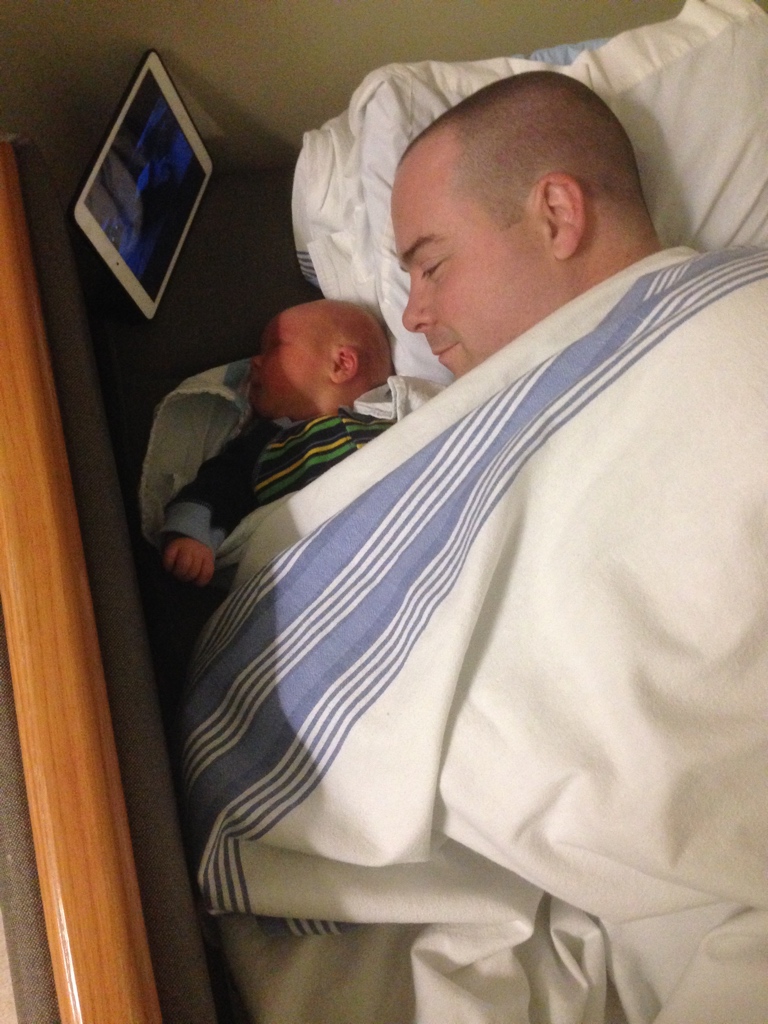
Nathan’s first week, still in hospital, watching the iPad for the first time!
Nathan and I have enjoyed a rather love/hate relationship for the past five years. He’s started kindergarten and is extremely bright and intelligent in some respects, while acting like an absolute goon in others. He puts on his own personal brand of theatre, every morning and every day. This is a common example of how a day in the life of Nathan goes…
I wake just shortly after 6:00 a.m. Both my sons are still asleep, so I take advantage to enjoy a hot shower without Nathan asking a million questions. After my shower, I dress and get upstairs so that I can start working on Nathan’s lunch for school…
NATHAN (7:04): Walks into the kitchen, still in pyjamas, hair all askew. This is a rare occurrence, as it usually takes a wicked amount effort to get him out of bed.
ME: What are you doing, booger?
N: Stares vacantly into space…
ME: Can you go get dressed?
N: Blinks at me a few times and walks away…
N (7:15): Can I have Banana bread for breakfast? (not yet dressed)
ME: If I give you banana bread, can you get dressed and sit quiet until school time?
N: Nods vigorously…
I cut him a small piece of banana bread and he sits at the table and eats contently. I run my usual routine of taking out the recycling, starting the car and bringing both our backpacks out to the vehicle. Then I come back into the house and find Nathan with an empty plate, watching cartoons on Netflix.
ME (7:35): Go brush your teeth, pal…
N: Why?
ME: Because you’ve eaten and you don’t want to go to school with smelly breath.
N: Oh… (walks into the washroom to brush, but does way more singing than brushing)
ME (7:45): Alright, booger! Let’s get our stuff on…
N: I have to go potty first… (runs to the downstairs bathroom)
I notice he’s taking a while, so I go downstairs to see what he’s doing. Rather than pull the front of his pants down like a normal guy would, he’s got everything dropped down to his ankles and is swaying back and forth while singing to himself. he sees me and starts asking me something, causing his urine stream to hit the toilet seat, toilet cover and splash on the floor…
ME: Pal!!! Keep your eyes on what you’re doing!
N: (looks down) Oh, sorry Daddy!
ME (7:55): Okay, let’s go. We need to get to the bus stop.
We load into the vehicle and drive to the intersection where his bus will pick him up shortly.
N: Daddy, can we go to McDonald’s?
ME: No, pal…
N: Why?
ME: Because you have to go to school.
N: Oh. Daddy?
ME: Yeah, buddy?
N: I need my sunglasses…
ME: We’re already at the bus stop!
N: We have many minutes. You can go fast and we can get my glasses from home.
I sigh audibly, and recognize that a parent has to pick his battles and pull away towards our home. I run inside and grab his sunglasses, affording a quick smile for Nathan’s mother, then rush back to the vehicle and hand Nathan his sunglasses. I rush us back to the bus stop with several minutes to spare and settle back into my seat.
N: Now that I have my sunglasses, can we go to McDonald’s?
ME: No, pal…
N: Why?
ME: Because you STILL haven’t gone to school yet.
N: But we can go McDonald’s AFTER school.
ME: No, pal…
N: Why?
ME: Because we’ll have things to do at home when you’re done school…
N: What things?
ME: Just things…
N: Like going to McDonald’s?
Just when I think I’m about to lose my sanity, I see the school bus round the corner and step out of the vehicle, ushering Nathan along the sidewalk to where it will stop. He clambers up the steps that are still too large for his little kindergarten legs, turns and holds his arms out for a hug. I give him a squeeze, which instantly reminds me why I love my son so much. He’s now in the hands of the world and I have the day to myself.
Look at that devilish grin…
I run my usual errands for a Monday morning, which include going to work, making multiple stops and getting home. My wife and I were able to sneak a brief nap in, until the doorbell woke us (I got my new Medtronic 670G today, BTW. But that’s a post for another day!)
At about 3:30 in the afternoon, I leave the house to grab the items we’ll need for supper and make my way to the bus stop to meet with Nathan. I pull up to the curb and read for a while until Nathan’s bus arrives. It pulls up to the curb at about 4:15 in the afternoon and Nathan steps off, proudly wearing his sunglasses.
N: Hi, Daddy!
ME: Hey booger! Did you have a good day at school?
N: Yeah, but I hurt my back today at school.
ME: How did that happen?
N: I fell down some stairs and hurt myself. I think to make me feel better, we should go to McDonald’s.
ME: No, pal…
N: Why?
ME: Because we need to go home for supper?
N: Can we have pizza for supper?
ME: No, buddy…
N: Why?
ME: Because it’s not a pizza day. We’re going to make supper at home.
N: But I don’t like supper, I just like pizza. Hey, can we go to McDonald’s?
It’s a wonder that I don’t bang my head against the steering wheel all the way home. I find out that he didn’t eat his lunch for fear of missing out on recess, so I tell him that this will be supper. I make beef burgers for my wife and I and as Nathan wolfs down the remainder of his supper, he decides our burgers look good and wants one as well. This is what happens when you don’t eat all day, I guess. You become ravenous.
In case you didn’t keep score, in the hour and half that I had spent with Nathan to this point, I was asked “WHY?” six times and also asked to go to McDonald’s six times. And that’s keeping it light. He definitely keeps life interesting, and Anticipate that his infant brother will create just as many comical situations. Children definitely keep you on your toes! ☯
There is suffering in the world. More than we often choose to acknowledge or discuss, but some of this suffering comes at a personal cost and in our personal lives. Because of this, we are usually want to complain. After all, most people feel it’s easier to complain or “vent” then it is to spread positivity.
Depending on what school of thought you adhere to, venting can be beneficial. It allows you to get things “off your chest”, which in turn is meant to make you feel better. Normally, this can be a good practice as long as it doesn’t become your modus operandi. If you make complaining your normal habit, it can also have a number of detrimental effects on you and the people you’re complaining to.
First and foremost, long term complaining can lead to quite a few physiological problems. Increased stress, increased cortisol levels, lack of sleep and weight gain can all be long-term effects of constant complaining. Not to mention that if you’re a constant source of negative, verbal diarrhea, you’ll start to notice your friends, acquaintances and family start to avoid you or make excuses not to be in touch with you. Couple that with the psychological effects of constant negativity, and you’ve got yourself some real problems.
I was reading an article posted by Inc.com that covers the topic of complaining too much. I was entertained by what Dr. Jeffrey Lohr, a psychologist who studied venting, mentioned in the article, “People don’t break wind in elevators more than they have to. Venting anger is… similar to emotional farting in an closed area. It sounds like a good idea, but it’s dead wrong.” Funny and entertaining, but he makes a good point.
I’m still of the firm belief that the occasional venting is important. Sometimes, you just need to get things off your chest. The important thing to remember is that the recipient of your venting should understand what’s happening and why. And even if they’re a trusted family, spouse or friend, it shouldn’t be a constant thing. Otherwise, you could find yourself becoming the subject of THEIR venting as opposed to the recipient of yours. ☯
Anyone who has done even a minute amount of research into the history of Diabetes is aware that insulin was first discovered in 1921. What some, if not most people are not aware, is that it was first used on a dog called Marjorie in that same year. Marjorie had been diagnosed with Diabetes and had her pancreas removed. It was found that she could survive by receiving daily insulin injections. This discovery led to it being administered to the first human recipient in January of 1922. The rest is history.
Not Marjorie. Just a happy pooch!
There are many animals that can contract Diabetes. For the most part, the reason behind their getting it is similar if not identical to how humans get it. These animals include, but are not limited to dogs, cats, apes, pigs, horses, the occasional cow and some rodents.
For the more “popular” household pets, such as dogs or cats, a diagnoses of Diabetes can mean many of the same effects and complications as a human who has Diabetes. Organ and vision problems, obesity and circulatory issues are prominent in pets with Diabetes. For this reason, it’s important to maintain a good exercise regiment for your pets and feed them a veterinary-approved food that will help control their weight and blood glucose levels.
Administering insulin to your pet can be difficult and even intimidating. But once you’ve gained the knack for it, your pet will certainly be appreciative (Unless it’s a cat! They’ll make your life a living hell for the audacity of giving them an injection) Your pet’s vet should be prescribing the insulin that will best suit your pet and provide instruction on its proper administration. That being said, there are tons of instructional videos online that will show you how.
The interesting challenge when dealing with Diabetes in pets, is that they are mostly unable to explain what symptoms they may be feeling or what may be ailing them. This is why it’s important to learn and recognize some of the physical signs that things may not be going well for your pet and how to deal with them.
For most households, their pet is part of the family. So while the treatment of Diabetes and the administering of insulin in pets may seem daunting, one needs to consider that you would do no less for one of your children. Educate yourself, obtain the necessary medications and learn how to provide for your pet. Even though they may not be able to express it verbally, you can believe that they’ll be grateful. 🐶
Travelling can be a real pain in the ass for anybody, whether it’s domestic or abroad. Especially if you’re flying. But any level of travel becomes even more involved when you have Diabetes. Considering the amount of equipment that the average Type-1 Diabetic requires on a day-to-day basis, the preparation required for any trip can be quite involved. When you add in the supplies required for an insulin pump, it can also be quite an ordeal.
Since I’ve recently “indulged” in some cross-country travel, I thought I would take the opportunity to touch on some of the more important aspects of travel preparation for someone with Diabetes.
First, let’s discuss travel by its very nature. Travel is abnormal. At least it is for the modern person. Our ancestors were thought to be nomadic and usually never settled in one place for extended periods of time. But as humans evolved and we developed societies and technologies, we became more sedentary and started establishing permanent homes. This means that we usually find comfort in staying in one place and having daily routines. These routines become important for someone with Diabetes. In fact, routine tends to make the control of Diabetes far easier. When we stray from our usual routine, it tends to rain hell on the Diabetic system.
One of the first things I noticed from my flights home yesterday, was my unusually high blood sugar level. Despite my best efforts to correct and bolus accordingly, my blood sugars stayed in the teens until a while past 10 p.m. when I finally worked it down to 8.6 mmol/L, the highest being 19.4 mmol/L earlier in the day. There are a number of reasons behind these high levels; not least of which being stress, from travel and some bad news.
According to an article posted online by BeyondType1.org, “There have been studies that suggest that higher altitudes can cause insulin resistance due to carbohydrates not being metabolized as effectively. This can be another cause of high blood sugar and it can also lead to ketones/ketoacidosis in extreme cases.” The article goes on to say, “Blood glucose meters, continuous glucose monitors (CGMs) and pumps have been known to not work as effectively in high altitudes.” This could certainly be one of the outlying reasons for my extreme highs. The jury’s still out…(https://beyondtype1.org/altitude-type-1-diabetes/)
An important thing to remember is to calculate your approximate insulin needs prior to your departure and pack two extra sets of everything BEYOND what your requirements will be for the entirety of your travel. For example, my trip to New Brunswick last September saw me run short of supplies for my pump. I ended up having to buy a bottle of Lantus and some syringes in order to maintain myself until I landed back in Saskatchewan. Damned inconvenient!
The next step is to ensure that everything is properly labeled and clearly legible, identifying it as Diabetic prescription medication. Airlines are a bit sticky on the transportation of needles and sharps, so you need to ensure that you’ve dotted your “i’s” and crossed your “t’s”. Wearing your MedicAlert bracelet is also a smart move. I’m told it’s a smart move to wear it at ALL times, but I absolutely hate mine and never wear it unless I travel.
Another issue would be the airport security x-ray machines. Now, opinions about the validity of what I’ll say next has been discussed and debated for years now. But some sources, including some of the manufacturers, seem to indicate that exposing insulin to x-rays can cause damage and even affect its potency. For the most part, airline security SHOULD be reasonably accommodating in allowing for a manual inspection of your person upon request. This should include any bottles of insulin and your insulin pump. That being said, you may encounter some staff who are resistant and will claim it’s unnecessary. Don’t be afraid to ask for a security supervisor to plead your case.
That being said, there’s been no evidence that the same x-rays will affect your insulin pump. Granted, your pump is filled with insulin, so… yeah. At the end of the day, planning ahead and being familiar with your airline’s policies and requirements will go a long way. If you’re like me, you show up two hours prior to your flight’s time of boarding. this provides the extra time required to ensure a manual inspection of your insulin and medical devices and still allow you to make your gate in time to be boarded on your flight.
Test your blood frequently and adjust your insulin accordingly. Although it may seem unusual to bolus so much, the unusual circumstance may require it. Ensure you don’t skip meals. That much is often my mistake. Speaking with your doctor or medical practitioner prior to your travel may be an option as well. As much as having Diabetes may be a major pain, travel can be just as painful if you aren’t prepared. ☯
All things considered, I decided to hit the sack pretty early last night. Given everything that had taken place that day, I thought I should err on the side of caution and keep the evening simple. After over an hour of tossing and turning, with my mind running a mile a minute, I finally gave up and turned on the lamp in my hotel room. I watched a total of two movies and didn’t get back to bed until about 3:30 this morning. Then I woke up at 7:00 to start my long journey home. So much for getting a good night’s rest. I’m just a “little” bit tired!
I stayed at the same hotel I used when I travelled to New Brunswick last September. The nice thing about this location is the complimentary breakfast that’s offered, which normally includes eggs, variations of toast and a meat option. I stepped into the dining room to find flat, fried eggs sitting in an inch of water in a warming tray. I stuffed myself with a piece of toast and a handful of sausage links and packed up my room to check out.
I drove to Fredericton International Airport with my rental vehicle, intent on returning it well ahead of my flight to avoid any complications. This was likely a good thing, as I walked into the rental trailer and found the front counter unmanned. This wasn’t unusual, as these folks are human too, meaning that washroom and food breaks must and do happen. But when twenty minutes elapsed and no one showed up, I started to wonder what was happening. Honestly, patience is a virtue. But since yesterday, it rather seems as though every yahoo and their dog is hell bent on making me wait unreasonable periods of time for simple things.
An employee from my rental agency’s competition explained that she believed the guy working this counter had gone into the city, but that he should be back in about twenty minutes. I checked the time. I had been waiting almost twenty minutes already. I decided to be proactive and looked up the rental chain’s primary office and call. I was directed to a call center.
I totally understand that call centers make sense. For the company. For customers, they often present an obstacle that needs to be overcome in order to achieve one’s goals with that particular business. I explained my situation in great detail to the person on the other end, who ultimately provided that she would direct me to a supervisor. I was on the phone for over ten minutes before I gave up and hung up the phone. My rental agency’s competition jokingly mentioned that had I rented from their company I’d be in the airport by now. I was not amused.
By this point, I had been waiting at the counter for almost half an hour. Under normal circumstances, car rental locations have drop boxes that a person can drop their keys when arriving outside of normal business hours. But this WAS the workday, and I had arrived two days earlier than my rental contract indicated. I didn’t want to take the chance that they would bill me all the way to Saturday, so I felt I should be dealing with someone in person. There had to be something else I could do.
A quick Google search provided three local branches of this same rental agency in the city. Ah, good ‘ol Google comes to the rescue! I phoned the first one that listed a local number as opposed to a 1-800 number that would direct me to a call center. THAT phone call lasted for less than a minute. The person I spoke to apologized and explained that it was his fault as he had asked the employee to run some spare vehicles down to his location. Apparently, as there were no “scheduled” rentals this morning, it was an ideal time to make a run. The person on the other end indicated that he had left about ten minutes ago and it’s a twenty-minute trip. He advised he would call the employee to ensure he made no added stops as I was waiting for him. I politely explained that despite having no “expected” rental pick-ups, there was always the chance of someone stepping in to rent a vehicle that wasn’t pre-scheduled, or someone who would return a vehicle early. Like me! A business had to plan for such contingencies.
I turned in my vehicle and made my way inside the terminal. I was provided with my boarding passes and got through security without issue. My flight also boarded and took off without any issues, which was a nice change. The only exception was that they wouldn’t allow me to bring my carry on bag into the aircraft. I was too exhausted to argue and turned it over but I understood once I was inside the plane.
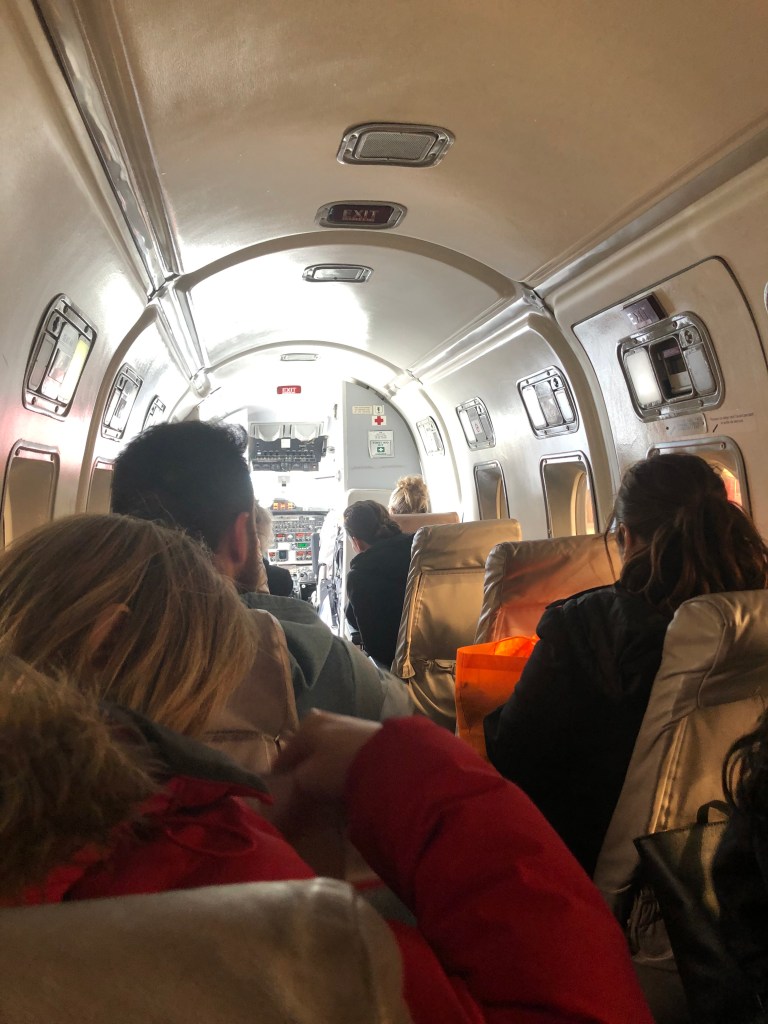
The tiny PVC pipe they were trying to pass off as a plane!
It was without a doubt the smallest aircraft I’ve ever been on. A single row of seats on each side, no overhead bins, no flight attendants and the only staff were the captain and co-pilot. It was a brief, 45-minute flight but the small stature of the aircraft made it so that I could feel every minute adjustment in heading and every little bump of turbulence. Loads of fun, if you don’t mind riding your roller coaster at 15,000 feet above the ground!
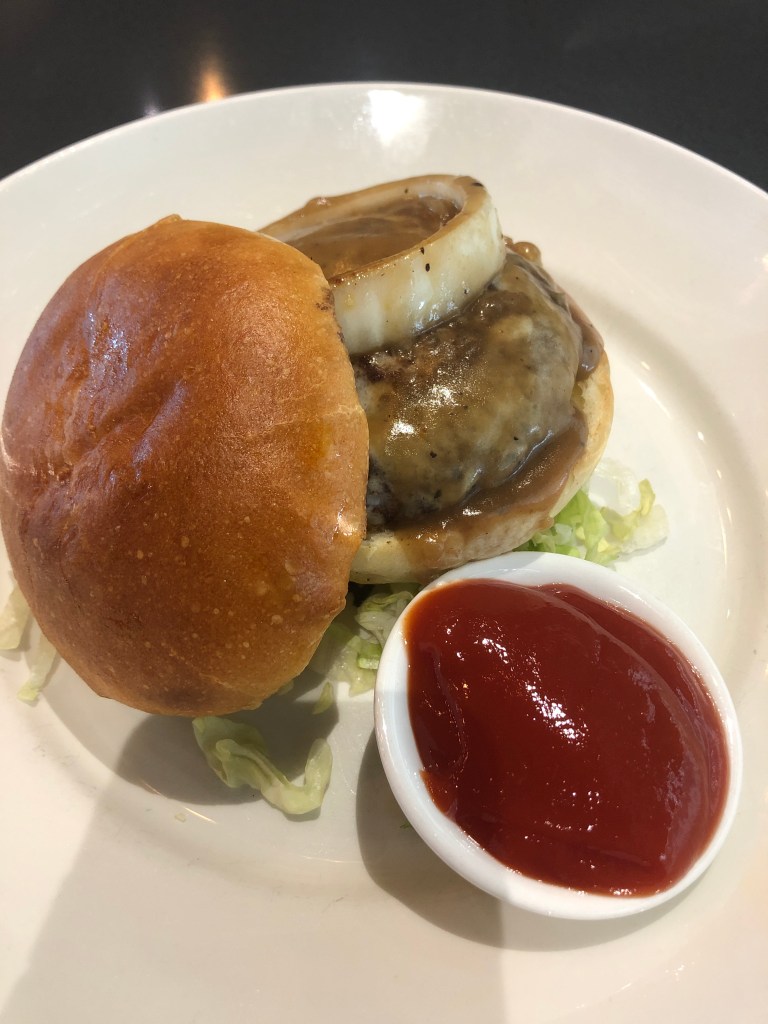
The rest of the trip home, albeit exhausting, went off without a hitch. I had breaks of at least an hour between all stops, which allowed me to rest and caffeinate. Once I reached Toronto-Pearson Airport, I had an excellent burger that was made with lamb and sampled a Toronto IPA.
A patty of lamb, coated with gravy on a soft bun with mayo. Perfection!Some dangerous shopping options, while browsing Toronto-Pearson
I arrived in Regina at roughly 7:45 p.m. this evening and let me tell you, it’s been something. I left on a plane on Tuesday morning. A total of about 7,800 kilometres travelled, including flights and vehicle rental, six different planes, two hotels, passed through at least seven different communities while driving and all of this was accomplished in about 62 hours. All for an interview that lasted an hour and I was dropped from the process about an hour later. Brutal.
I’d like to say this has taught me a lesson, but it honestly hasn’t. I’m too damned stubborn to stop or quit, despite the effect that this trip has had. One thing is guaranteed; as nice as it is to travel back to New Brunswick, nothing topped walking off that escalator and seeing my wife and kids waiting for me. Now if y’all will excuse me, it’s been a slice but I’m gonna go sleep in my own bed now. ☯
You know, I consider myself to be a pretty reasonable man. I believe in hearing both sides of the story and getting to the truth of the matter. This is likely one of the reasons that I work in the industry that I do; because I like getting at the truth. So if there’s one thing that seriously grinds my gears, it’s a lack of communication or lack of clarity on someone’s part. Especially when it comes at my expense! You know, for a Buddhist, I sure do get angry and frustrated a lot… I think I have some work to do! 🙏
To make a long story short, I travelled back to New Brunswick yesterday for an opportunity that I had hoped would see my family and I move back here permanently. My intention was to share the journey with all of you, hence yesterday’s post “Here We Go Again…” The next few days were intended on being chapters of that journey, rather a bit like last September’s “A Strange Odyssey”. That’s not what’s happened.
I attended a scheduled appointment this morning in New Brunswick. That appointment was scheduled for 11:30 a.m. and like the good little soldier that I am, I walked into that appointment at 11:15 and checked in at the reception counter. I was asked to take a seat and wait. So, I waited. 11:30 came and went. 11:45… 12:00… Something must be wrong..? What’s going on..? I text my wife and tell her what’s happening. She asks if I checked in upon arrival. I respond that I did. 12:15… 12:30… Something is definitely wrong… 12:45… Enough is enough. I ask the receptionist to call back and ask about this, because even if I’m the interviewee and should be a good boy and wait, an hour and a half beyond my scheduled appointment time is excessive, even if there is some kind of emergency. Someone should have come to find me by now.
The person with whom I have been corresponding, comes out and tells me that she never received my confirmation email that I was attending. I advise her that I sent one and was willing to show her. She advised that she had called the interviewer back and he would be back shortly. I started my interview almost two hours AFTER my scheduled time and if I do say so myself, crushed it! The interviewer was pretty clear that he shared that perspective. Less than two hours after the completion of the interview, I was emailed and advised that I wasn’t selected to continue with their process.
“I Mean, You Shouldn’t Be Asking People To Come Down Here And Pay The Freight On Something They Paid That Still Ain’t Good Enough. I Mean, You Think That’s Right? I Mean, Maybe You’re Doing Your Job But Why You Gotta Stop Me From Doing Mine? ‘Cause If You’re Willing To Go Through All The Battling You Gotta Go Through To Get Where You Wanna Get — Who’s Got The Right To Stop You? I Mean, Maybe You Guys Got Something You Never Finished, Something You Really Wanna Do, Something You Never Said To Somebody, SOMETHING! And You’re Told No, Even After You Pay Your Dues? Who’s Got The Right To Tell You That? Who? Nobody! It’s Your Right To Listen To Your Gut. It Ain’t Nobody’s Right To Say “No” After You Earned The Right To Be Where You Wanna Be And Do What You Wanna Do.”
– Rocky Balboa
Much like Sylvester Stallone’s character from the above quote mentioned, I fully acknowledge that the older I get, the more things I need to leave behind. That’s life. But eventually it gets just a little exhausting, burning myself out, burning through my family’s savings and constantly riding an emotional roller coaster, simply to have the rug pulled out even when I assume it’s going well and looks promising.
It would have been nice if they could have communicated more… Perhaps provide some reasoning as to why I would not be permitted to continue, especially when one considers flights, hotel, vehicle rentals and meals that are all out of my own pocket from the other side of the country! It’s definitely brutal.
Now, I sit in a hotel room, which was unplanned, to await my flight home to Regina tomorrow, which should have been when the next step in the process I paid the freight to attend would happen. Alone and disappointed; 3,600 kilometres away from my wife and children. Life doesn’t care about your plan. Light knows I’ve repeated that often enough, even in this blog. But man, would it be nice if karma would swing in my direction just once. That’s all I’m asking! Just once… ☯
There are currently more than 12.5 million Canadians with some form of Diabetes at this very moment. Although I wasn’t able to find a source link, this information can be found on Statistics Canada’s website. Given that large number, this means that roughly one out of every three Canadians have some form of Diabetes or pre-Diabetes, with more being diagnosed every day.
One of my biggest pet peeve is hearing or reading about someone with Diabetes who ignores their condition. Although denial is a common and almost expected reaction for some people, there’s enough information and literature out there that no one should just roll over and let this condition take them. But even now, I often hear of people with Diabetes developing serious and severe complication and even dying.
The light knows that I’ve often written about the complications associated with Diabetes. And although I’ve usually focused on Type-1 (because that’s what I have), the complications are usually shared across the board. The reality is that untreated or undiagnosed Diabetes can easily and quickly become fatal.
The most common complications you hear about involve the nervous system, heart, eyes, kidneys and digestive system. Believe it or not, you can even gain complications related to your teeth and gums. Even the strictest control won’t prevent some of the symptoms or complications one can get, making it all the more important to keep a tight reign on your condition in order to mitigate them.
Limb amputation is a common thing you hear about in people with Diabetes. This is because poorly controlled Diabetes will cause blood vessel or nerve damage, leading to the death of certain extremities. Toe and foot amputation is generally the result
Eye and vision issues are also very common, and often for the same reasons when one considers Diabetic Retinopathy. Other issues include, but are not limited to Glaucoma, Cataracts and Diabetic Macular Edema.
Believe it or not, your teeth can even cause issues. Gums and teeth in someone with Diabetes will have a greater tendency towards sensitivity and bleeding, which can lead to increased chance of infection and complications.
Uncontrolled blood pressure and glucose levels will cause damage to the kidneys, ultimately leading to kidney failure. Your cardiac system is twice as likely to suffer complications as someone without Diabetes. Your blood sugar levels are what can cause the most symptoms, complications and issues. Extreme high blood sugar (hyperglycaemia) can lead to the advent of all these complications and can also put you in a coma, if left unchecked. The same can be said of extreme low blood sugar (hypoglycaemia). Once your blood sugar levels drop below a certain level, unconsciousness is almost a sure thing. If you’re unfortunate enough to live alone or not be woken by your drop in blood, death is usually the result.
It’s not all bad news! Although I often write about complications, this is mostly for awareness and to hopefully PREVENT such issues. I often feel that some people simply become overwhelmed by their condition and give up. Some people are just lazy and don’t want to take themselves in hand. But the reality is that the changes required to prevent and repair some of these complications are pretty simple and easy. Eating a healthy diet, testing your blood sugar often and exercising regularly is a big start. Avoiding things such as smoking, drinking alcohol and gaining excess weight will also go a long way towards helping. The bottom line is that there is no excuse for allowing Diabetes to control your fate. Only you can do that. ☯