Anger is an insidious thing. Once one begins to feel it, very few people are able to contain it without some sort of mental and physical training. Don’t believe me? Just check out some road rage videos on YouTube and you’ll see exactly what I’m talking about. Modern society allows its anger to run rampant to the point of rage, with little thought or concern about the effects it has on the people around it. And on the people who express that anger.
The worst forms of anger are the inherited ones. The type of anger that a person has nothing to do with, and technically have no right feeling. But they’ve inherited that anger from their parents and/or predecessors, and they express that anger in various forms and blame others for it, even if its an emotional anger they shouldn’t be feeling at all. Of course, what do I know? I have no inherent right to tell anyone what they SHOULD be feeling, but it’s how you deal with those feeling that matter.
The fact is, anger can have physical effects on your body that can be detrimental to your health. Constant anger can have a negative effect on your blood pressure, heart health, sleep and even your digestion. Anger can cause anxiety, headaches and also depression. Some of the articles I’ve read have even linked anger to skin problems, such as eczema. But I’ll let y’all do your own research on that, as that isn’t the focus of today’s post.
Anger can also be a useful tool in training. I remember during my basic training days when I was doing some bag work with one of my troop mates. He was smaller and slighter than I was and couldn’t seem to muster enough strength to effectively strike the bag. I could tell he was getting frustrated and asked me how it was that I was able to strike the bag so hard, every time. I explained that some of it had to do with the fact I had more mass than he did. But another aspect is that I used my anger.
In true Mark Ruffalo fashion, I explained to my troop mate one of my secrets to effectively working out and fight training is the fact that there’s always a bit of anger bubbling beneath the surface. If one can learn to use and channel that anger and energy into what we do, it can go a long way towards pushing ourselves beyond our comfort zone and improving our physical fitness. Since I knew he was a father, I used what is probably the most sensitive area of a person’s life. I had him close his eyes and asked him to imagine how he would feel if someone abducted his child. Then I challenged him to imagine having the abductor in front of him and what anger he would feel towards that person.
Then I asked him to perform a properly executed punch against the bag using all that anger. The result was far more explosive than anything he had previously done. And that’s the critical point; anger (when properly focused) can be a useful tool and a good motivator. That’s for the training environment, of course. One needs to avoid allowing their anger to turn to rage, fury and violence against others. Although not always avoidable, violence should never be used unless it’s for the protection of yourself or those around you.
A lot of people believe that I fell into Buddhism through the influence of the martial arts. And although this is partially true, I can admit that in my late teens to early 20’s, I developed a pretty intense temper and needed a means to control, temper and maintain it. This is the part where I point out that regular exercise and meditation are important ways towards controlling one’s emotions. But as long as you use it as a source of fuel for your motivation and not against others, anger can be useful. ☯
“I Don’t Fear The Man Who Has Practiced 10,000 Kicks. I Fear The Man Who Has Practiced One Kick 10,000 Times.”
– Bruce Lee
I have no doubt that I’ve practiced most of my kicks more than 10,000 over 32 years of consistent martial arts training, with the exception of back kicks (I hate back kicks!). But sometimes it does some good to keep things light and simply work on basic kicks as an entire workout. Two weeks ago, I was trying to decide on what sort of a workout I could do to burn through an hour and move away from my usual habit of doing either forms, shadow boxing or lifting weights for a straight hour and calling it a day.
I recently spoke with one of the other black belts from the dojo I train with in Regina, and we got to talking about how it’s difficult training alone all the time as the lack of the dojo environment usually sees us working only on the things we like. In his case, striking the heavy bag. In my case, forms and shadow boxing. Without the class environment to motivate and push us (as well as force us to do the other stuff), we can easily fall into a rut where we have trouble climbing out without help.
This is where I decided to focus solely on kicks. As far as fighting skill goes, I have a definite preference for my fists. Although I’m not a boxer, I dislike the concept of leaving my bodyweight on one foot, which is an advantage that a quick and efficient opponent could take advantage of. I’ve trained to kick, I’ve used kicks and consider them an important part of my repertoire. But they definitely take a back seat when I’m not being pushed to drill them into my workouts.
The routine I used was pretty simple:
Choose a kick
Perform that kick 50 times at maximum effort on each leg;
Perform 50 reps of an in-between weight exercise (arm curls, hammer curls, shoulder press, etc…);
Move on to the next kick and repeat everything all over.
The result was each kick being performed at least a hundred times, peppered with some strength training for the arms, since I wasn’t including any punching that day. I took no rest periods between everything, which is either bad or good, depending on your perspective. But it was a fantastic burn and I was exhausted at the end. I only got to four different kicks with the weight sets in between, before I reached over forty minutes of exercise and decided to shut ‘er down.
The workout was a definite success and was a welcome change. That is, until Nathan decided it was a great idea to drop an 8-pound exercise ball onto my stomach while I was lying on my back, stretching. Picture dropping a lead weight into a bowl of jello. I seized an doubled over and could barely speak for a few minutes. Little bastard! I’m sure he thought he was just playing and didn’t mean to hurt me, but I’m sure it bruised my abdominal wall and my stomach aches for a few days. But I digress… At least he hangs out and watches the workouts. Eventually, maybe he’ll join.
The nice and fun thing about karate is that is allows for an endless variety of workout possibilities. There’s always SOMETHING to work on and improve, and there are always different ways to do it. Karate requires a bit of everything. You need cardio to built up your stamina. You obviously need technique and precision. And you also need some strength training, although not too much. You don’t want to get too bulky, as it will decrease your flexibility and speed.
This is why most serious weightlifters always move around stiffly as though they have a stick running from between their Gluteus Maximus all the way up to the base of their necks. They walk around like bloated balloons and I’ve never seen a serious weightlifter last more than a couple of weeks in karate because they’re unable to perform the movements. Not to say that weightlifting isn’t a wicked workout, because it is. Hopefully I haven’t offended any monstrous, buff people. Do you even kick? Come at me, bro!
Don’t be afraid to change it up and do something different. I used Bruce Lee’s quote at the beginning because it kind of represents what I tried to do and because I like it. But Lee was also a firm believer in making a workout out of different and unusual methods. Sometimes the weirdest workouts can be the best. They can offer some interesting results and keeping things varied can keep you from getting bored with a routine, especially if you’re stuck working out at home. ☯
Humanity is a fat, chocolate donut sprinkled with inconsistencies, violence and a lack of appreciation for the little things in life that we all take for granted. Great, now I want a chocolate donut… 37 grams of carbs for one, five-minute treat? No thank you! But I digress… My point is actually that we have a lot of positive things to life that we tend to take for granted. What’s a bit disheartening is that we needed a global pandemic where the world basically ground to a halt before we started to recognize these things.
I was chatting with an old friend last week, when we brought up and discussed the fact that the “little things” are often taken for granted. This has been happening since well before COVID-19 decided to sink its obsidian fangs into society, but the problem is that most of the world’s population is too busy complaining about what they’ve lost as opposed to appreciating what they still have. This makes sense if you’ve lost employment or can’t get enough food to support your family, of course. But when I hear of folks who are financially independent, relaxing in large homes without a care in the world, complaining because they can’t take their yearly trip to Cabo, it makes me wonder about the fate of our race.
I’ve always been something of a loner when it comes to my free time. I’ve had absolutely NO problem being at home with my wife and kids for an extended period of time, with the exception of the occasions where the kids drive me crazy. That’s why I can’t get all these people who suddenly separate or get divorced because they’ve suddenly been forced to stay inside together for long periods of time. Really?? If you can’t stand the person enough to stay inside a house with them, why’d you get married in the first place?
But I’m going off on a rant again, and I need to focus. In the interest of taking nothing for granted, I thought I would list the things that I miss most about when the world was normal and took for granted, despite my limited existence. Here we go…
Sitting In A Coffee Shop With A Book
This one is at the top of my list because before all of this bullshit started, one of my favourite things to do was to sit inside a coffee shop and read a book. I’d supplement that with blogging and basically sitting there alone with my thoughts, of course. Coffee shops allowed a semi-introvert such as myself the benefit of being around people combined with the quiet hush of folks having low-volume conversation and working at their laptops. But distancing and self-isolation requirements have made that impossible. And even though most retail and restaurant locations (especially corporate chains) have re-opened in my area and I likely COULD go sit in a coffee shop, it would be grossly irresponsible of me to do so. Why risk exposing myself to someone who may have ignored the rules and gone out while sick, then drag it back home to my family? I definitely used to take my coffee shop runs for granted!
Going To A Movie Theater
Listen, I’m pretty cheap. I don’t consider that a bad thing, but I’m not fond of paying money for frivolous things in general. So the thought of paying ten to fifteen bucks for a movie ticket when I can just be patient and wait a year for it to come to Netflix seems exorbitant at best. But I would be lying if I said that there aren’t some movies that are simply deserving of the theater experience. For example, I would have paid that amount to see Star Wars: The Rise OF Skywalker in theatres. I think it’s the kind of movie that would have done well for me on the big screen, appealing to my nerdy sensibilities. But obviously sitting in cramped theater seats with people tightly packed on either side of you is even worse than my coffee shop scenario, even if some cheaters have begun opening in limited capacities. In fact, I think the last theater movie I saw would have been Black Panther. And that came out in 2018…
Visiting With Family
It stands to reason that the holidays have been difficult this year, with most people being unable to visit their families and celebrate the way they’ve done it their entire lives. I mean, my folks live across the country in New Brunswick. We don’t see much of them when the world is normal, much less now. What’s harsh is Alexander was born in September of 2019 and rounding the corner of a year and half old, my parents have yet to meet him. The worst is when my father, whose health isn’t great, caught pneumonia some months ago and wasn’t expected to survive the night. My father would have died 3,300 kilometres away from me, having never met his second grandchild and without being able to say goodbye. Even my wife’s family is only 3 hours away, but given restrictions may as well be across the country as well. Many people unfortunately take time with their families for granted.
Play Dates For My Kids
This is one that I definitely took for granted. I’ve always considered it a pain in my ass to bring Nathan somewhere for the sole purpose of hanging out with other kids. I never had any of that shit when I was his age. But his uncontrollable energy mixed with the lack of kids his own age to burn it off with has been difficult on the household as a whole. We used to have the benefit of a couple of boys next door, but they moved away. It’s even worse now for Alexander, as he’s had no exposure to other children other than his brother, who is five years older than him and in a completely different toy/playing bracket than he is. If Nathan is lucky enough, school will re-open soon and he’ll at least be around other kids.
Doing Normal, Everyday Things Without A Mask
I took a walk to the corner store last week to check my lottery tickets (I was sure that day was my day) and enjoyed getting some fresh air and being outdoors. The temperature was a cool 4 degrees, birds were chirping and snow was melting. It should have been a pleasant walk, but despite the fact I was walking down a back street with no exposure to other people and I was completely alone, I felt like a criminal because I was walking without a face mask on! I carried one for when I reached my destination, but I couldn’t help but feel it was just a matter of minutes before a law enforcement officer would come around the corner and give me hell. Doing simple, everyday things like groceries, getting gas and running to a store without having to wear a face mask is definitely something I used to take for granted. Oh, and I obviously didn’t win the lottery, that day…
Last But Not Least,To Cough And Smile In Public
It may sound like a simple thing, but it’s one we definitely take for granted. Any normal, bodily function performed in public is tantamount to being quarantined and treated as though you’re carrying the black plague. COVID-19 has made people forget that sneezing is a normal function of the human body to expel unwanted bacteria and materials from entering the body (and isn’t a symptom of COVID-19 anyway, but it sure doesn’t stop people from thinking it). And coughing? I don’t know about you, but if I breathe the wrong way I’ll start hacking and coughing like a moron who can’t seem to decide how to breathe and swallow separately. But try coughing in a public place right now and you’ll have the people around you scattering as though you’re a leper.
And smiling is an even bigger one. Being unable to see others smile and have them see yours is kind of a big deal, since facial cues are important in human communication. I’ve had retail and grocery store employees help me and greet me in recent months, where I’ve smiled at them in thanks only to realize later on that I probably just looked like I was staring vacantly at them. Being unable to read the facial cues of the people I communicate with in public has definitely been taken for granted.
There are many more I could add to this list. But as I’m sure you can agree (if you’ve read this far) I’ve already ranted long enough for today. The lesson here is that there are a lot of great little things in life that we’ve all taken for granted. And as we begin to move forward and start to look toward the future at how life will settle on a permanent basis, we need to adapt and understand NOT to take fro granted the little things that we’ll start to develop in this new existence. It may not all be perfect, but neither is life. Be sure not to take any of it for granted. ☯
I think one of the more important things we learn in life is that family isn’t always a blood relative. I can certainly attest to the fact that I’ve met a number of people who have had a profound effect on my life and have become family to me, without having any sort of blood relation to me. The best and most obvious example of this would be my wife. She’s family, and I couldn’t imagine what life would be like without her in the daily grind of my life. But often there are people who introduce themselves into our existence unintentionally, and leave a lasting impression.
A couple of years before I started karate, I met Guillaume (we just call him “Guy”). Guy was the same age as me, in the same class at school and lived in the middle of my Point “A” to Point “B” walk to school. We got to know each other reasonably well, and started befriending each other. Although we had some things in common, Guy was a bit of a complemented reflection of me. I was short, he was tall. I was stocky, he was thin. He had an obvious athleticism and was actually able to participate in sports, both at school and intramurally. But he also had a deep curiosity for science and the way things worked; a fact that was made obvious from the time he somehow made an incendiary powder from a kid’s chemistry set. But I digress…
I think one of the things that always drew us to befriend each other was the fact that both of us were outcasts and were picked on and bullied by a lot of people at school who considered themselves better and “cooler” than we were. Back then, there was no such thing as cyberbullying or using words to inflict harm, not that I’m belittling people who feel targeted now. But during my childhood, being bullied meant you were beaten to a pulp by one and/or many assailants. It seemed less prominent with him; maybe because he could walk both sides of the line with the sports side of the social circle and outside of it.
It wasn’t until the late 80’s that I realized he had a lot in common as well. We were sitting in his living room, eating chips and watching a martial arts movie (he was eating chips. I was sitting there snack-less). I had been dabbling in the martial arts for a couple of years at this point and had tried a couple of different schools. Nothing suited my health and purpose. That’s when Guy told me he studied karate. As was my custom, I started asking some key questions such as why he did it, what was required and why I had never seen him use it. He explained that martial arts didn’t require strength or speed, going in. It simply required commitment, dedication and the willingness to concentrate. He went on to explain that I had never seen him use his karate, not even in a bullying situation, because if he harmed someone else using the skills he was taught, he would be no better than they were.
To be honest, I thought he was full of shit and didn’t know karate. I figured he was just talking big and had actually never studied the martial arts. I mean, we were just about ten years old, full of pomp, piss and vinegar. Kids often say the damnedest things, and most often to impress their peers. I thought nothing more on it, until a later time when I called him on it and he challenged me to a “friendly” sparring match… Then he kicked the living shit out of me. Keeping in mind that my martial skills were far from their peak, I still had some rudimentary martial arts skills and should have been able to hold my own. That is, against an untrained opponent who had never actually done karate. This was obviously not the case with Guy.
A few weeks later when I was contemplating the next step in my martial arts journey, I considered the fact that Guy seemed not only skilled and competent, but there seemed to be almost a flow to his movement when we sparred. It seemed effortless. I decided that it might be worth looking into, so I called him. You know, since we’re talking about a time when texting wasn’t a thing and you actually had to dial someone on a shared, home phone and hope that your parents weren’t listening in. I called him up and explained that I was interested in trying out at his karate school. I asked him the usual questions, tuition cost, days and time, etc…
Curiously, he’d say “hold on a second” and talk to someone off the line after every question before providing a response. It didn’t dawn on me at the time that he was asking all these questions to someone who was there in his house. I would come to find out the following week that his instructor was none other than his father, my Sensei. In some ways, a lot of ways, if I had never befriended Guy, I never would have found Uechi Ryu Karate. As Jean de la Fontaine once said, “A person often meets his destiny on the road he took to avoid it.”
From that point on, Guy and I became brothers. We grew up together and progressed together through the many challenges that young life threw at us, including karate. And of course, we enjoyed many more intense sparring matches that became more and more evenly matched as the years and my skills progressed. I was reminded of this last week, when Guy wished me a Happy New Year and sent me this photo:
The photo is dark and old, and I believe it’s from 2000 or 2001, but I’m actually wearing a shirt, tie and vest as we were going to a formal dance. I had my back to him he had my current girlfriend at the time hold a camera at the ready and asked me to turn around. When I did, he delivered a roundhouse kick to my face! Ah, brotherly love! I like to think that the fact I got my hands up in the blink of an eye before the kick was delivered speaks to the level of intensity I had back then, but he rang my bell pretty good.
We’ve grown somewhat apart in the past decade. We both got married and built families of our own. And of course, the fact I live on the opposite end of the country now kind of prevents even the occasional visit. But as is evidenced by the obvious smile on both our faces in that photo (mine might be pain, I honestly can’t remember), the brotherhood and connection will never be lost. And such is the way of it with family. The years come and the years go, but the memories remain. ☯
Spending money is never fun… Unless it’s money you intentionally saved up for something fun, but that’s rarely the case. Bills, debts and monthly obligations take all the joy out of having a bank account and I think we can all agree that money is some of the dirtiest stuff in the world. It makes the world go ’round while throwing rust into the gears, if you will. If you have Type-1 Diabetes (or any other condition requiring regular therapy of any kind) money can be especially important, since Diabetic supplies cost a damn fortune.
I covered expenses in a post I wrote in June of 2019, The Cost Of A life… where I explained that in Canada, insulin therapy involving the use of an insulin pump can run close to $1,000 a month. That was before I got onto CGM, so it would likely tip the scales over that one grand total per month now. If one is lucky enough o have medical insurance (which I do at the moment), this isn’t a big concern. But for those who don’t, cost-cutting methods are often employed that may not be ideal, no matter how necessary they may seem.
This is where the title of today’s post comes in. Before starting my current job, I found myself without medical insurance and as a result, I used to undertake a lot of nasty practices. I’d skip meals so I’d use less insulin. I’d only test my blood once or twice a day to save on test strips. On a few occasions, I even slept through some days to avoid taking insulin as I couldn’t afford it until the next pay check. But one of the habits that I know we all have, regardless of financial situation, is the reuse of needles.
I say “regardless of financial situation” because I’m still guilty of this one. The auto-mode on my most recent pump has seen me testing my blood sugar more frequently than before. It’s almost as though I’m punished for good behaviour. Blood sugars have been stable for four hours? Better check your blood sugar, something must be wrong. Pump hasn’t HAD to deliver insulin for two and a half hours because of regular readings? Something off, check your blood sugar! And that’s not including the mandatory, twice a day calibrations the pump requires.
My point is, the temptation to test my blood via fingerpick and simply leave the lancet in there for next use is very real. Especially if the damn pump wakes me up for a test at 3 o’clock in the morning. I’ve had enough things outside of my body waking me in the middle of the night; I get pretty pissy when it’s a medical device that’s supposed to make my life easier. Waking me up doesn’t make my life easier (or anyone else’s since I tend to get cranky).
As you can see from the photograph I included above, the needle begins to dull and suffer damage to its surface after just one use. After six uses, the tip becomes something that one would never consciously use to inject themselves. But because the damage is microscopic and we can’t see it, we usually succumb to the temptation to reuse needles. I’ve often fallen prey to this and in fact, still do. But there are a lot of problems with doing so.
The multiple reuse of a needle can potentially introduce unknown contaminants into your insulin vials and into your body. Your needles are sterile when they’re opened, but once used and exposed to open air they can be subjected to any number of untold filth and bacteria on surfaces and in the air. When you reuse the needle that second time, you may be pushing something into your insulin vial and contaminating the entire supply. Or you could be pushing it into your fingertip and potentially introducing something to yourself.
A common risk and side-effect of reusing the same needle repeatedly is developing Lypohypertrophy, which I described in great detail in my post The Needle Jammed Into Your Haystack… (Yes, I refer back to my own posts a lot! It’s MY blog, what can ya do???) Basically, the condition describes the accumulated lumpy, scarred tissue that develops under the surface of the skin when it’s pierced by a needle. Since we Type-1’s tend to inject ourselves frequently, the risk of this condition is greater. But reusing a dull, used needle will increase the chances of infection and scar tissue.
I decided to write this post because I’ve often heard other folks with Diabetics sarcastically say things like, “Oh, it’s Sunday! It’s lancet changing day!”The reality, although I fully understand that I represent the kettle in this equation, is your lancet and needles should be changed after EVERY use. Although it’s an easy way to save a buck (sometimes), the complications it can cause are too frequent and serious to risk. And I think we can all agree that Diabetes carries enough complications on its own without intentionally causing more. ☯
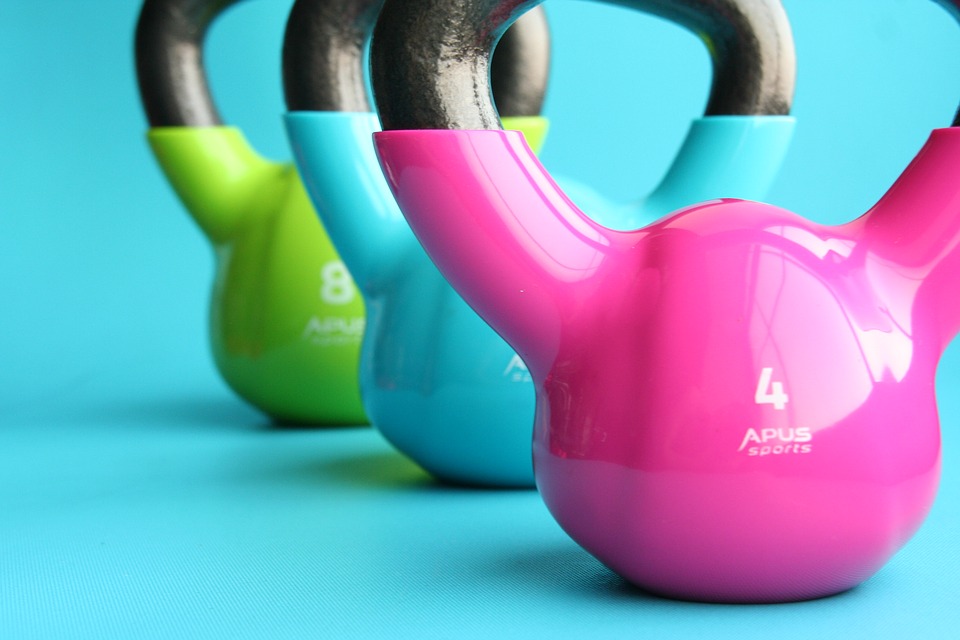
I decided to get myself a belated Christmas gift on Boxing Day and purchase a couple of 10-pound kettlebells and an 8-pound exercise ball. I like to change things up a bit and thought that kettlebells would be the way to go, since I don’t believe I’ve ever used them in an actual workout. The exercise ball was intended for a number of specific exercises but once I had the box open, I discovered it was a soft ball that was partially filled with sand. Not what I was expecting, but it’ll do for some of the exercises I had in mind.
Kettlebells are a special creature, and they seem to add a little “something” to workouts. As opposed to dumbbells, a kettlebell’s weight is focused in one ball with the handle acting as an added lever. Dumbbells have their weight equally distributed at both ends of a handle, making them a little easier to use in some respects. I started by doing a short, circuit workout with my wife on New Year’s day. We each held one bell and went through a series of different exercises, working different areas of the body. It was a good burn.
Some of the benefits is that the added lever created by the shape of the kettlebell works to activate the entire posterior chain of muscles. Dumbbells don’t usually do that. As you swing a kettlebell, different muscle groups are engaged depending on the grip you have and whether you allow the bell to roll with the swing or try and hold it stationary.
What I’ve found is that kettlebells can also be extremely effective at helping to condition and develop martial arts techniques. Different movements as well as some parts of my forms can be performed while holding a kettlebell, which provides a deeper intensity while training. Although the bells I’ve purchased are pretty light in comparison to dumbbells I’ve used (it’s always better to start off small when doing something new), I’m looking forward to using them regularly and increasing the weight as I get acclimated to them. ☯
Without a doubt, one of the hardest aspects of Diabetes HAS to be carb counting. It probably doesn’t help that I really didn’t start carb counting until 2015 when I started using an insulin pump. Before that, the subject of carb counting was never bought up by any medical practitioner or dietitian that I had retained. This likely isn’t any fault of theirs; they no doubt did the best with what they thought was working. But I have to admit that I certainly don’t miss the days of randomly guessing how many units of insulin to inject at mealtimes.
First of all, I’d like to remind everyone that carbohydrates are a necessity for a healthy life. Carbs are a fuel source and in fact, is the body’s primary fuel source. This means that you can’t TOTALLY eliminate carbs from your body, or you’ll suffer the effects. That being said, a reduction in carbohydrates can result in weight loss when the body starts to depend on its secondary fuel source: fat.
But carbs are insidious. They pop up where you least expect them, and not always in the amounts one would assume. A good example would be a vegetarian snack I purchased some week ago. Kung Pao broccoli. Yes, you read that right! I don’t know what’s worse, the “Kung Pao broccoli” part or the fact I bought something vegetarian. Regardless, I decided to try it out (along with its counterpart, “Buffalo Cauliflower.” Totally not kidding!). On a particular day, I decided to try it out as my lunch. I figured, why not? A bowl of broccoli is healthy and there are worse ways to have a reduced carb lunch.
When it was done baking, I mixed it with the Kung Pao sauce and checked the box to see how little I would have to bolus for it. The contents of the small box totalled in at about 80 grams of carbs! I daresay, I was flabbergasted! I could eat half a frozen pizza for the same amount of carbs! The problem is the light coating of batter over the broccoli as well as the sauce itself. It packed a bigger wallop than I thought. Then again, the makers probably didn’t count on someone eating an entire box as a meal; broccoli or not.
The next big problem is family. Not that family IS inherently a problem, but they can be a hindrance to proper blood sugar balance at mealtimes. I’ve lost count of the number of times that I’ve prepared myself a bowl of food, sat down at the table and started eating only to have Nathan come running up, “Daddy, I’m hungry! That looks good, can I have it?” Knowing he has neither the patience nor the attention span to wait, I’ll usually surrender my meal to him and go make something else. In the meantime, the insulin I just bolused in response to the expected meal is coursing through my system and lowering my blood sugar, which will likely result in a low.
Trying out new foods is also a problem. Sometimes I’ll try something new like the broccoli, especially when I see that everyone else is eating or has had their lunch already. But something new will usually result in one of my family members deciding they wants to try some. The Kung Pao broccoli was an example of this. I asked if it was to be split or if they’d just be trying a piece to see what it tastes like. “I’ll see after I’ve tried it” is the usual response, which is the worst thing I can hear. This leaves me in a position where I don’t know if I’m calculating my bolus for half the amount or the entire amount of food.
Last but not least is incorrect or inaccurate nutritional labels. I always check the nutritional information label on the food I eat. Everyone should, Diabetic or not. And sometimes my blood sugars will go crazy despite a precise serving and supposed exact amount of carbs. There can be a lot of reasons behind this, including how quickly specific foods are absorbed, a person’s insulin sensitivity or a score of different physical conditions. But more often than not, bolusing for 10 grams of one type of carbs will require a different insulin dose than 10 grams of another type.
Carb counting is not only important but it prevents problems on a day-to-day basis. I can’t tell you how many meals I’ve consumed where I bolused what I thought I needed, only to suffer a low because the food was processed too slowly or an extreme high because it was more than I thought it’d be. Then I’d take added insulin to correct the high, only to have it boomerang and crash. Diabetes is a lovely roller coaster of bullshit. ☯
This will be a pretty bitter post. And to be honest, I’ve been avoiding it (mostly because I had to finish out the last week and scan the paper) considering some aspects of what I set out to do didn’t go QUITE according to plan. In early December of 2019, I posted Here Comes The New Year… where I outlined my intention to work through a resolution for 2020 that would see me cut down and/or eliminate alcohol, cigars, processed foods and exercise regularly. I tried not to be a pest about it, since most people don’t want/need to hear about someone else’s New year’s resolutions, but this is MY blog and here we are!
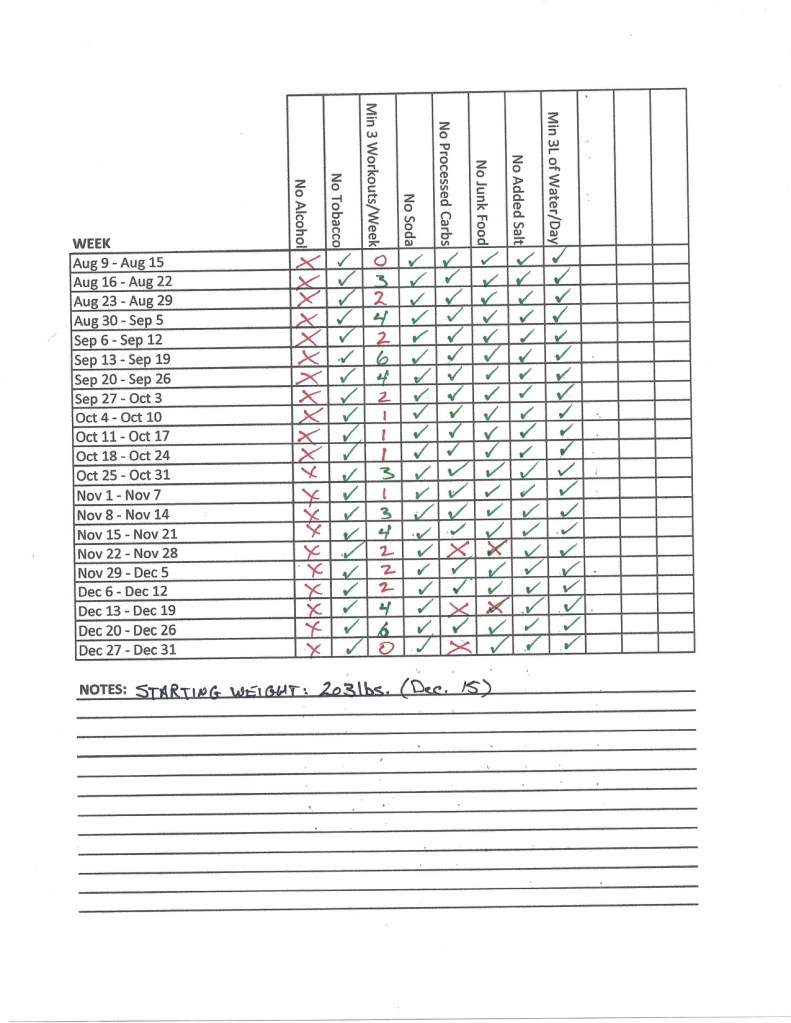
I did provide two updates in the posts Getting Ahead Of The Curve and It’s Going Semi-Well, And I May Have Woken Up. That last one is a touch ironic, since I apparently didn’t wake up quite as much as I should have. But before I get into the meat and potatoes of how I felt this went, let’s take a look at the spreadsheet, which I’ll provide below as two separate images:
Page 1Page 2
Now as you look at this spreadsheet, there are a few things you can notice. The first is that anyone who isn’t blind can obviously see what aspect is my weakness. And I’m quite unhappy about this. Although I’ve had some weeks where I completely abstained from alcohol, the majority of the year sees a red “X” under the “No Alcohol” column. I will admit, and I’ve pointed this out before, that limiting each row to a full week makes things difficult. After all, I can go to Saskatoon for my eyes and have a single beer with my dinner out, and it’ll earn me an “X” even if I abstain for the rest of the week.
What’s funny is that there is only one “X” under the “No Tobacco” column, which was all the way back in March. This is because I decided to treat myself to a cigar right before the world turned to shit and everything started closing because of COVID-19. Since I try not to leave my home for frivolous purposes, the purchasing of cigars hasn’t happened since then. The rest of the columns are self-explanatory, even if most of them are green all the way down.
My water consumption is always within the 3 litre arena, considering all the fluids I take in throughout the day from various sources. I’ve caught myself salting certain foods lately, so I’m admitting that those green check marks aren’t all accurate. And as a wise friend pointed out several months ago, some of the food I’ve consumed is processed even if I haven’t acknowledged it as such (Thanks, Kristen!). The “No Soda” column is likely the one I was the most disciplined with. Workouts are workouts, with some weeks showing as many as 6 workouts and a few that even had none.
All in all, the spreadsheet was top-heavy and tedious to maintain, as I’d forget to fill it some weeks and have to rely on memory in the weeks that followed as to whether I did certain things or not. The end goal wasn’t to completely stop all these things, cold turkey. I like to think that this was more an experiment in order to recognize and document the areas of myself I need to work on. And even though we can blame a certain amount of it on the current state of the world, this only carries you so far.
That’s why this year, there will be no spreadsheet. There will no grandiose blanket declaration of doing one thing or another. All I’m going to try to do better myself. Period. I’ll be cutting out alcohol and excess carbohydrates, working on developing a healthy calorie deficit. Not to be mistaken with starving myself. I’ll eat plenty, but I’ll be reading labels and taking conscious note of how many calories I’m taking in. I’ll re-assert my focus on personal fitness and hope to slim down, even if only a little. ☯
I’ve had Type-1 Diabetes for about 38 years at this point (yes, you read that right). And for the most part, everything I need to do is routine and pretty much happens on auto pilot. Need to test blood sugar? No problem. Calibrate the ol’ CGM? Done deal. I can even change up my insulin pump’s infusion set in the middle of the night while still half asleep, if I had to. I generally try to keep that from happening by checking my insulin remainder BEFORE I go to bed for the night and calibrating my CGM right before I go to sleep.
These are reasonable steps, and ones that I KNOW I need to take and SHOULD be taking. But despite having Diabetes for almost four decades, I’m only human. This means that sometimes I still forget things. And as anyone who has had Diabetes for any number of years will tell you, it doesn’t take long to become physically and emotionally exhausted from all the testing, needle pokes and medical appointments that one needs in order to maintain proper health and blood sugar levels. Which unfortunately means that I also occasionally IGNORE things.
Just before the Christmas holiday, I did what I usually do before any holiday or long weekend; I went through all my supplies prescriptions and ensured I would have enough to make it beyond everyone’s amended schedules. Now, I’m not much of a holiday guy and since I’ve spent the majority of my adult life working through most holidays including Christmas, I’m usually miffed at my routine being messed up because certain locations are closed on Christmas. That’s my “bah, humbug” attitude coming out. But I digress…
As I called into my pharmacy with my refill request, they pointed out that I wasn’t due to renew my Guardian sensors (CGM) for at least another week. Now, being the responsible T1D that I am, I explained that I had one sensor installed on my arm and only one extra in the box. Should I suffer a failure, I’d run out pretty damn quickly with no recourse during the holidays. The pharmacy employee on the phone was quick to point out that in the event of an emergency, I could always go to the hospital. Right. Because I want to sit in a waiting room over the holidays for six hours to get one sensor, which the hospital likely doesn’t carry in stock and I’d need a pharmacy, regardless.
The big problem is that everything is on computer, nowadays. Wow, I just made myself sound SUPER old, but it’s true. So the technician I was speaking to was basically telling me she couldn’t renew my sensors because I was calling a week early. Everything else was fine, but it was too early for the sensors. But this system is meant to be used as a guideline to when prescriptions were filled, not as a limiting tool against patients. And since sensors are not a drug or narcotic, there really shouldn’t be a problem. But I picked my battles and calculated that since I was on Day 1 of my current sensor and had one more in the box, I technically had two weeks’ worth of sensor and told the technician I would simply call back in after the Christmas holiday.
Because life rarely cares about one’s plans and because it’s me, this is what ended up happening after Christmas. I reached the end of the first sensor’s lifespan and installed the second one. Within 24 hours, the second sensor (last one of the box) failed and my pump instructed me to replace it. Once that happens, there’s no getting the freshly installed sensor to work. You basically have no choice but to waste it and move on to the next one. It was late evening, too late to make it to the pharmacy. I would have to wait until the next morning.
In the meantime, I installed a spare Freestyle Libre sensor that I still had. But it wasn’t quite the same. The CGM sensor interacts with my pump and makes minor basal corrections throughout the night. This means that if my blood sugars begin to rise, so will my insulin levels and vice versa. It keeps a reasonably tight control, and I’d be lying if I said that I’ve woken up with bad readings on any given morning in quite a long time. The Freestyle Libre however, allows me to continuously test my blood sugar through my phone but does NOT interact with my pump and makes no adjustment to blood sugar.
The result is that I awoke with blood sugar levels in the high teens, which hasn’t happened in quite a long time. I’m not afraid to admit that I felt like shit. I had to skip breakfast because I didn’t want to introduce more carbohydrates into my system before I brought my levels down a bit. So I spent the morning without food, but made my way to the pharmacy to get my sensors. I had a bit of a discussion with the actual pharmacist about the issue, to which he invited me to speak with him directly the next time I was in a similar situation.
It got me to thinking… I’m addicted to my Diabetic equipment. I lived for decades with CGM and an insulin pump but now, one day without a sensor and my house of cards comes crashing down. It’s surprising how spoiled we become when faced with the use of technology. Compared to the imminent death that Diabetics faced prior to the 1920’s, “spoiled” is a pretty appropriate term, all things considered. It’s made me realize that there’s no turning back for me. I’ve settled into a certain standard of care with the technology I use for my Diabetes treatment, and I don’t think I’d ever be able to return to pen injections and testing my blood only once a day. Here’s to hoping I’ll never have to… ☯
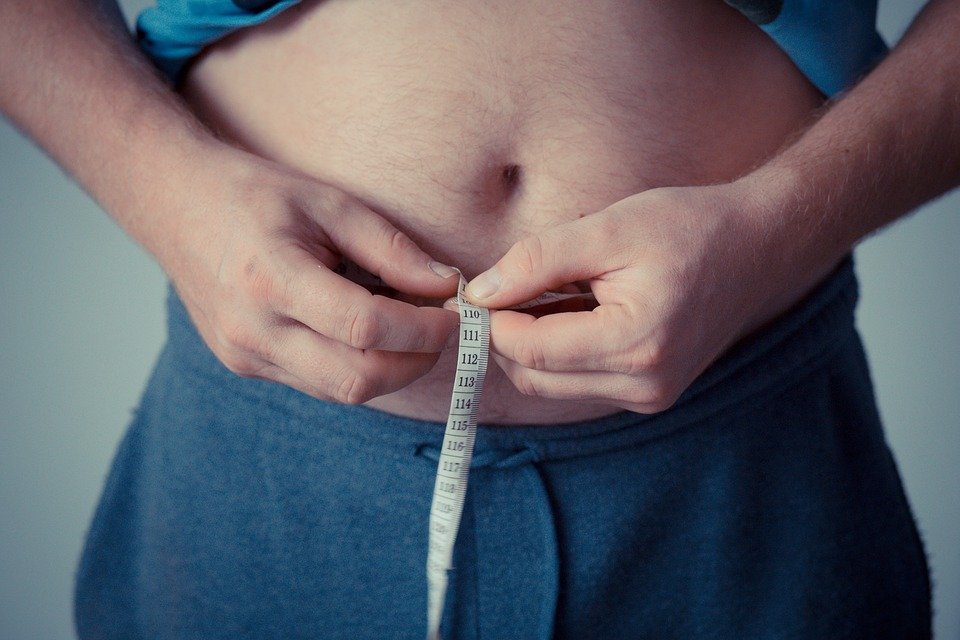
Let’s be honest with each other: it’s the New Year and people are looking at resolutions. Statistically speaking, the largest resolution is usually losing weight. I’d be lying if I said that I wouldn’t LOVE to shed a bit of thickness from my abdomen, although fat loss doesn’t usually work this way. True weight loss will eliminate fat from all areas of the body. Despite what you may have read at your supermarket’s checkout stand, there’s no way to focus JUST on the tummy. Sorry, folks.
I’ve long said that in order to actually lose weight, you can’t depend on gimmick diets or fad workouts. The only true way to burn fat and lose weight to experience a calorie deficit. For those who have no idea what this means, a calorie deficit is when you provide your body with fewer calories than it needs in order to support your daily calorie needs. In that situation, your body starts to burn away fat stores as energy to replace the calories it is no longer receiving.
Conversely, if you consume more calories than what you need for your daily needs, the body will store the excess. Sometimes it gets stored as glycogen, but it usually gets stored as fat. This is where we gain weight. Despite the fact that I’ve been stating this for longer than I’ve been blogging, I finally decided to look into it a bit and found a reasonable article on HealthLine.com. It explains exactly what a calorie deficit is, and how to achieve it.
In addition to the article, most sources I’ve researched indicate that eliminating as little as 500 calories a day is effective in helping to lose weight. In addition to a healthy fitness regimen, it can go a long way towards helping you to burn away at those fat stores that seem to piss you off, every time you slip on a dri-fit shirt. 500 calories is actually much easier than it sounds. Taking small steps, including eliminating processed foods, plan your meals and have them be homemade and exercising three to five times a week will do it.
Another important aspect, especially for Diabetics, is to focus on the reduction of carbohydrates as opposed to fats. Although I’m not a fan of such fad diets, the Paleo Diet is a perfect example of this. Such a diet consists of lean meats, fish, nuts as well as healthy oils and fats. They avoid and/or eliminate processed foods, sugars and grains, which eliminates the majority of carbs. The only problem is the Paleo Diet can cause a dangerous levels of fat and protein, resulting in heart and kidney issues. What else would you expect from a diet based on then human diet from 10,000 years ago?
Cut your carbs and overall calories by about 500 calories a day, exercise regularly and consume plenty of water and fiber to help things along, and you should see some of those love handles start to melt away. Like all good things in life, it will take some time so don’t get discouraged if it takes weeks and even months before results start to show. After all, every person is different. It may only take a week for some, or months for others. The trick is to be patient. This is also helpful for Type-1 Diabetes since increased fat can lead to complications and weight loss will help with blood sugar control.
My wife and I have decided that this year’s resolution will be on the improvement of ourselves. No checklists like I had last year, no fancy declarations of quitting this or quitting that. We’re going to exercise regularly, reduce our caloric intake and as much as it kills me to admit it, my wine intake will be GREATLY reduced as alcoholic beverages can have a negative impact on one’s calorie intake. By the end of it all, I hope to be able to squeeze back into those favoured outfits I have stuffed at the back of my drawers… But time will tell. ☯