What Would You Do With Freedom, If You Had It?

Freedom can mean different things to most people. For some, it means “financial” freedom, whereas one has enough money in the bank to be clear of debts and not require employment to survive. For others, it’s simply NOT being locked up or imprisoned. But in general, it means having the ability to act, speak or think without constraint. It’s being able to go where you want, when you want and do what you want. And I think that we can agree that the vast majority of people who live in North America have that freedom, to varying degrees.

I don’t think I really need to point out that 2020 has been an absolute shit show for the entire world. In fact, some would argue (myself included) that COVID-19 has acted as an ultimate equalizer, since the virus does not discriminate and can be contracted by anyone of any age, race or gender. But we’ve seen a wider variety of people catch the virus than we would have originally thought possible at the beginning, including politicians, celebrities and the elderly. And the effect is that many if not most people feel and are of the opinion that they are losing their freedoms.

It’s been an increasingly stressful time, especially for those who are separated from those they love. One good example is my mother, with whom I speak to on a weekly basis. Yes, yes, I’m a momma’s boy and call my mother often. I’m also an only child, and father to her only grandchildren. So keeping a positive connection is important, one way or another. My father currently resides in a nursing home, where he’s been for about ten years. He voluntarily placed himself there after it became clear that my mother didn’t have the physical capacity to take care of a 330-pound man in a wheelchair.

For the most part they’ve been able to make it work, with my mother renting a small bachelor’s apartment next door to the nursing home and being with him everyday. Then, along came COVID-19. My father’s nursing home has been locked down ever since, despite the fact that many others in the Province of New Brunswick have reopened their doors (intermittently, depending on the status of their cases). This is an affront to my mother, who compares my father’s residence at the home and her inability to see him to being locked up in a prison.

I may have a bit of a jaded and subjective point of view, but I don’t know many prisons that have hardwood floors, picture windows with a view of the bay and serve customized meals, three days a week. But that’s just me. The sick and elderly are among the most vulnerable, and the choice to keep the care home’s doors closed to the public is a clear result of not wanting to potentially spread the virus to every resident there. The irony is that my mother COULD visit my father. The care home is allowing immediate family to visit on an appointment basis, with restrictions in place allowing for no longer than thirty minutes and requiring social distancing during the visit.

One would think that this would be good news. I would consider it so, since I’m on the other side of the country and can’t see my parents regardless of conditions. But my mother refuses to visit my father in this fashion, feeling that they don’t pay the money that they do to be kept separated from one another. It doesn’t matter that no individual has the right to make the choice for other residents and potentially introduce the virus into their environment. She simply refuses to take advantage of what’s offered because it isn’t what she wants.

Don’t get me wrong, I love my parents and I’m simply using them as the most familiar example I can use. But the point is that when this whole mess started, we all foolishly thought the world was grinding to a halt for 30 to 90 days and then things would go back to normal. Oh, how wrong we were! 9 months later, we’re still dealing with restrictions, imposed mandates and the constant yo-yoing on local and Federal governing agencies opening things up then taking them away again as soon as an outbreak happens.

What’s been the most disheartening, is people’s reaction to doing what’s necessary. A blanket attitude of basically not giving a shit has gripped society by the gonads and seems to be keeping a firm hold. People still balk at the very notion of wearing a face mask. I’ve fallen down many a YouTube hole where people have claimed and tried to get out of wearing masks in public places because of medical conditions, despite health professionals publicly declaring that the only conditions that would make wearing a mask impossible would be so severe that the patient wouldn’t be out and about. Customer limits and home school requirements, social distancing and the inevitable folding of privately owned businesses… I wasn’t kidding when I said that 2020 has been a shit show.

The problem is that people hate to be told what to do. You can take a family that’s financially poor, struggles to make rent and has to swallow their pride and accept charity, access food banks and hand-me-down clothing and they’ll do what’s necessary. But tell them they must lawfully wear a face mask while during their weekly Walmart run and all hell breaks loose. Like I said, COVID-19 has been, among other things, the great equalizer.

For my family, it hasn’t changed a great deal of much. My employer has had me at home for almost two years now and my wife works from home. The only significant change was this week, when my son began remote learning due to an outbreak in our local schools. My wife and I weren’t happy about the change, but we complied and adapted as it was necessary to continue my son’s education. But otherwise, the bills get paid, there’s food on the table and we’re taking advantage of being able to spend so much time together.

For those who chose to complain about the government, mask and isolation requirements, consider the following OBVIOUS facts: If this were all a conspiracy on behalf of the government, I’m sure they would chose a much better method of control than making someone wear a paper-thin mask on their face. Things may seem bleak now, but it will only be through the passing of this virus that any of us can hope to experience a normal life again. ☯

yin-yang-4

Help Me To Keep This Permanent!

My content may be free and I absolutely love providing it, but my time is not! I’m trying to make a go of it as a full time writer but obviously, everyone needs to get paid for the time they put in. Your donation to this blog can mean the difference between seeing daily content or wondering “whatever happened to The Blogging Buddhist.” Help me keep this permanent. Any small donation helps and will not go unappreciated.

CA$5.00

Rules Are Meant To Be Followed

What are rules? Webster’s Dictionary defines “rules” as “a prescribed guide for conduct or action.” This prescribed guide is usually written, developed, implemented and enforced by some governing body or agency. Our modern society has a lot of rules, usually delivered in the form of regulations and/or laws. But from the simplest rules, such as “stay off the grass,” to higher laws that have been around forever, such as “thou shalt not kill,” people always seem inclined to break the rules. And why is that? Rules and laws are in place for a reason. There is a purpose behind them and without them, society would fall into total anarchy.

Just to be clear, I’m not innocent of this rebellious nature. In fact, no one is. I haven’t met a motorist yet who hasn’t at some point broken traffic laws. Just about everyone I know has dropped a piece of litter on the ground and opted not to pick it up. While the safe majority of actions people perform are not intended to be harmful and don’t result in anything nefarious, we usually live out our lives from week to week, breaking several rules without even noticing.

So, why do people break the rules? And what happens when those bent or broken rules begin to affect others? One good example I can give is a FaceBook post I recently read, that was shared by a friend of a friend. I don’t keep much of a FaceBook profile these days, so I’m unable to share the exact post or image. But as the post went, a friend shared a meme showing a twined highway where a motorist in the left lane was driving at the same speed as a slower motorist in the right lane, thereby illegally slowing down all the upcoming motorists who intended to overtake the slower vehicles.

In Canada, every individual Province has its own legislature and statutes related to the operation of a motor vehicle and/or one’s behaviour while doing so. In Saskatchewan specifically, slower vehicles are generally intended to stay in the right lane except to pass. This allows the faster-travelling vehicles to get by and is entirely the reason behind double and triple-laned highways. It allows for a smoother flow of traffic.

The meme my friend shared essentially provided a message of how wrong it was to perform this action and hinder traffic. And there are Provincial laws and statutes that make this “not okay.” But a mutual friend who commented on the post made a point of commenting how if he felt that someone was aggressively approaching behind him, he usually makes a point of slowing down in the left lane next to a slower vehicle to hinder these aggressive drivers. Oh, great. So what you’re saying is you violate a few traffic laws in order to satisfy your own inappropriate form of self-justice, which helps no one and could potentially cause a collision? Good on you, bro! Great flex!

I’m being sarcastic, in case no one gets that. Besides the illegality of that action, everyone has a story and there’s no way to know the story of motorists coming up behind this person. Maybe they’re late for work. Maybe a spouse is in labour at the hospital or a loved-one is injured or in danger. You don’t know. And now you’re being an asshole and holding them up just to make a point that not only will they not get but isn’t yours to make. This ties in to that whole “there’s suffering in the world” thing that Buddhist tend to harp about and the fact that suffering is usually caused by humanity.

This is just one example, and I’ll admit I got a little long-winded with it. But it serves to illustrate that many people find it okay to break the rules, so long as they can justify it in their minds. Rationalization of one’s personal actions are often used to get away with petty things, especially when the person believes they won’t get caught. Even though the majority of people don’t inherently mean to do wrong, the fact that they won’t get caught in the act often makes it all the more easy to do.

For others, it can be the fact that some people get something akin to a “cheater’s high” from breaking the rules and it can also provide a sense of freedom. After all, as humans, we usually don’t like to be told what to do. Even the most timid of people feel stifled and restrained by having to obey the rules. Try to interrupt my daily routine by telling me I can’t do a particular thing or go to a particular place and you’ll likely get a taste of my dark side, so I totally understand the impulse. But rules are still in place for a reason, often for the safety and security of society and should be obeyed accordingly. ☯

Push, Improve, Self-Motivate…

I grew up around a lot of ‘roid heads who would constantly pound their chest and brag about their athletic prowess. The joke is that many if not most of them would go to practice once a week and call themselves an athlete. Considering that my home town is in Northern New Brunswick, that usually involved hockey. Hockey and I have always had a bit of a love/hate relationship. Maybe it’s because they always thought they were the kings of the school. Maybe it was because many of them became bullies. Maybe, just maybe, it was because most of them made fun of karate but were still crazy enough to try out…

By the time I had improved and progressed enough that I was starting to teach newcomers, I had the pleasure, cough, cough,… I mean the responsibility of showing these bulky bastards why karate may not be for them. Not all of them, mind you. Just the ones that were known to be bullies. Sensei had no tolerance for that shit and I had even less, especially since I had at some point been the object of their bullying attention. But I’m digressing pretty bad, since the subject of today’s post isn’t bullying. I’ll save that one for another day. Today’s post is about calling yourself an athlete when you go to a one-hour practice, once a week. That thing.

Karate, and in fact martial arts in general, is a very special creature in terms of the kind of commitment you need to provide. If you show up to karate once a week for a one and a half hour practice and then call it a week, you may CALL yourself a martial artist but you’re a far cry from what that term really implies. One of the most important aspects to learning martial arts properly is showing up for every class. Early. And every time.

I remember a particular summer, I think it was 1995. I was 17 at the time and had my own vehicle (self-purchased, thank you very much). It was a particularly hot summer afternoon and a few friends and I decided to grab a swim in a location known to us as the south-east forest. There was a cold river with running water, which was perfect to fend off the summer heat. We had gotten there in the late afternoon and had a blast. Swimming, laughing and joking around, it was the very picture of what a teenage summer should involve. Then, I checked the time…

I noticed that karate class started in about an hour and a half. It would take about a half hour to get home and grab my gear, followed by fifteen to twenty minutes of travel time to get to the dojo. Pair this with the fact I always tried to be in class at least thirty minutes early to stretch, warm up and assist white belts, it made for a sudden urged panic to leave the river and get going. My friends were not impressed. In fact, the girl I was dating at the time was visibly angry at the fact I was cutting the pleasant outing short, just to go to class. The worst part is she was in karate as well. Go figure.

Consistency and commitment are key. This applies not only to karate but to all martial arts and in fact, any sport or hobby you choose to undertake. When I moved to Regina and joined the local Kenpo school, I made a point of attending every class even when it felt tedious, the classes may have been boring or not in keeping with what I wanted to be working on. And that’s what it takes to be a martial artist. You have to be consistent and show up. Every class. Every time.

I have no regrets. I know that a lot of the people I knew spent their free time out with friends, drinking and partying, enjoying their youth before the rigours of adulthood dropped a weighted veil across their eyes and stunted their freedom. I chose to spend my evenings training and building myself up. In a lot of ways, I believe that had I failed to do so, I might have succumbed to Diabetes a long time ago.

Sensei’s classes had a very specific way of running. Students would show up thirty minutes before class, stretch and warm up. Then, the class would be two hours. TWO HOURS! No water breaks, no washroom breaks, no checking your damned cell phone! Your ass was grass from 6:30 pm until 8:30 pm. Some beginners were permitted to leave at the one-hour mark, but all the same restrictions applied, regardless. When class ended at 8:30, many of us would stay in class for at least another thirty minutes, asking questions and practicing techniques.

The most committed of students spent a minimum of three hours in class, three times a week. This was paired with jogging, cycling, weightlifting and practices on the beach on our own time. We were true knights of the martial way. It was glorious. Hey, that sounds like it would make a great movie intro. But seriously, it’s a far cry from the students I see these days that walk into the dojo a minute before opening of class, finishing their Tim Horton’s coffee and chatting on their phone, muscles cold and lagging as they start. It’s a sad state of being. You gotta be committed. Every class. Every time. ☯

Paper Isn’t Just For Airplanes…

I remember my first job. I was just a kid, not even old enough to drive. I had started collecting comic books, which weren’t cheap. That being said, I realize that they cost a fortune today by comparison. But I was starting to come into my own and wanting things that my parents felt shouldn’t just be given, but earned. So, I did what any fastidious kid in my position would do: I went to Service Canada and not only looked for a job but enlisted some help in drafting a resume, despite the fact there was next to nothing on it.

Decades ago, applying for a job required some personality on one’s part. Walking into a physical location, smiling and shaking hands before handing over the coveted document that would lay the baseline for the employer as to WHY they should choose you was the key element in not only securing an interview, but ultimately getting the job. That first interaction would allow a potential employer to see who you were as a person, even before sitting you down to ask questions relating to the job. Oh, how times have changed…

That first summer led to me acquiring a job digging trenches for sewer lines. Yeah, you read that right! At twelve years of age, I was shovelling dirt as a summer job. The labour laws of the time were, shall we say, a touch less strict. Considering my parents had just discovered my involvement in karate and I had to start paying my own way on things, I couldn’t afford to be choosy. And it was excellent exercise anyway.

That first job led to a permanent part-time job throughout the school year where I worked for the catholic church collecting used bingo cards every Thursday night. Except for getting the occasional bingo dabber stain on my fingers, it was pretty easy work and earned me ten dollars every week. That may not seem like a lot, but it paid my monthly karate tuition and kept me in comics.

Getting interviewed was always a nerve-wracking experience. Sitting across a desk from a potential employer who would ask you all sorts of questions that, although professional and pertaining to the job, could often seem a touch on the personal side and maybe even invasive. Some interviews that I’ve sat through have even bordered on the rude side. For example, wondering if you’ve ever been convicted of a criminal offence for which a pardon has not been granted is a pretty standard question for an interview and/or on an application form. But having a stranger verbally ask you, “Have you ever committed a crime? Ever? Tell me!” can be a little unnerving.

But there’s no better feeling than having an interview go well, getting to know your potential employer as they get to know you and allowing you the chance to explain why you’d be a fit for the job. That smile and handshake, followed by an affirmation that you’ll be a great fit or a phone call later in the day indicating the same thing would make it all worthwhile. But this doesn’t seem to be the standard of how things are done anymore.

These days, walking into a physical location and asking to see a manager is a futile move. If and when the manager is available, they’ll usually tell you to go online and apply on the company’s website. Very few places carry paper applications and even fewer bother with accepting a resume. All that stuff is done online. It takes away the human aspect of introducing oneself and shaking hands (although such things are currently a no-go anyway).

Once you’ve completed the online application process, you’re general faced with a structured interview that contains pre-scripted questions. The problem with this is a that such interviews, especially panel interviews where you’re questioned by multiple interviewers, also takes the human aspect out of the interview and really don’t allow a potential employer the benefit of getting to know the applicant. In truth, how can you hope to know if an applicant will be a good fit for your company without getting to know them?

The job industry is made all the more difficult by the fact that even your basic, minimum wage jobs that only require a hand and a heartbeat still require an exorbitant number of hoops to be jumped through. Having a decade or more of experience in a related field is still treated with suspicion and scrutiny and most of the time, it may be for a job that’s below what’s financially required of one’s household since, as is usually the case, everyone starts at the bottom.

Gone are the days where applying in person and having a positive attitude were enough to get you a chance. Should you be unfortunate enough not to be tech savvy or knowledgeable on the use of computers and navigating the workforce online, you either need to throw yourself on the mercy of someone who knows how or find yourself wanting. Although technology has brought us a long way towards progress, it’s also harmed us in others. ☯

And On The 7th Day, No One Rested

One of the biggest aspects of my own core beliefs is that I have a profound respect for other people’s religions and faiths. I mean, as long as your personal faith and/or beliefs don’t bring harm to others or yourself, I’ve always lived by a standard of live and let live. Even if and when they conflict or contradict my own. It makes sense that not everyone sees things the same way, right? But how does one consolidate their beliefs, religious or otherwise, when they conflict with the requirements of the modern world?

The best example I can give, takes me all the way back to the early 2000’s. I was management, third in charge of a location, which for liability purposes I won’t name. But part of my responsibilities included the hiring and discipline of the staff. It was a trying position at times, and I didn’t always enjoy the conversations I had to have with employees, especially given the fact that some of those conversations were dictated by upper management and the owners.

One of the senior management attended a local church, where the youth congregation were invited to apply and based on that manager’s recommendation, most were hired and made up a significant portion of the part-time staff. And although I’m not a big fan of this type of nepotism, I’ll be the first to admit that the staff we hired were quite fantastic. Always on time, worked hard and seemed inclined to make a good name for themselves.

But one of my other responsibilities also included scheduling for a staff of almost a hundred. This task was often made all the more difficult by the fact that many of our part-time staff were involved in extracurriculars like sports, committees and hobbies. Trying to provide them with the three or four shifts a week they required while navigating those extracurriculars often proved challenging. Sometimes I found myself having to tell one of the part-timers that a big part of being a responsible person was deciding their priorities and choosing between work and outside activities.

For the most part, it was a smooth conversation, with both parties coming to some sort of consensus even when that consensus meant they’d be parting ways with the company. But one young lad made a point of providing an extremely tight availability and absolutely refused to work on Sundays. When I explained to him that as a high school student with limited availability, Saturdays and Sundays were integral to ensuring that he got his three shifts, it was an unhappy medium, because he demanded three shifts a week but refused to work on Sundays as it was “God’s day.”

As I was raised in a French Catholic family, I am very aware of the fact that scripture states that on the seventh day, God rested. That being said, the modern world makes very little convention for such observances, nor does the business world accommodate one’s belief that a part-time employee with a limited availability can be choosy about the days he works. And why would he? Buddhists have a number of “observed” dates throughout the year, but I’ve never refused to work on any of them.

This put everyone in an awkward position. Although it was just the beginning of the new millennium, this was my first taste of millennial entitlement as a leader of staff. It would go on to be a phenomenon that would become all too common in most workplaces. It was also a very fine line to walk. Disciplining or correcting someone on the basis of their religious beliefs is a dangerous thing, both inside and outside of the workplace. But despite having signed an employment agreement indicating that he’d work the hours that were given, the employee missed a couple of Sunday shifts in a row.

He was lucky in a way, because the first time he missed the shift he had called in the previous day to say he wouldn’t be coming in. I say that he was lucky because he got me on the phone. Any other manager likely would have told him to show up for work or he’d be fired. I, instead, asked him why he wasn’t coming in. I got the “God’s day” reasoning and told him that he had agreed to work any hours given to him and that church services were also held during evenings and many staff members adjusted to make it work. He made it clear he simply wouldn’t work on Sundays. Well. Fuck.

I’m a firm believer in picking my battles, so I simply documented the absence and reported it to the Store Manager and replaced his spot with someone who wanted a few more hours. The battle wasn’t worth the outcome for a 3-hour shift on a first occurrence. But the following week, he got scheduled a Friday evening, Saturday and Sunday shift as per the availability of being a part-time school student. This time, he chose to test his luck and simply didn’t show up for work on the Sunday at all. That’s when shit got real…

This time, he skipped out on a shift overseen by the Store Manager, who wasn’t having any of it. Our staffing levels were based on projected sales calculated from previous weeks and years, so if we had 5 staff persons scheduled to work, it was because we were expected to need those 5. The Store Manager contacted this employee, who responded with his usual rhetoric about it being a Sunday. The Store Manager advised he would take care of this one, personally. I was grateful for that.

So in all honesty, who’s the asshole here? Is it the employee for providing an availability and then reneging on it? Or is it the employer for failing to respect an organized religion’s day of observance? Is it considered a bit much for that day of observance to be every single week, or was this youth right in his thinking that no one should work on “God’s day?” While I’m here, I apologize if putting “God’s day” in quotation marks offends anyone, but I’m of the opinion that EVERY day is God’s day. But the very fact I the need to apologize for it is the very point behind this post.

There’s nothing wrong with having faith, so long as you’re faithful. So where does the concept of faith fit into the modern world, specifically the working world? There should be room to accommodate a balance of both, right? I’m using the platform of this story as a means of asking for your opinion. If you have thoughts to share, I’d love to hear them. Feel free to share your opinion in the comments. ☯

Zen And The Art Of Toilet Installation

As I’ve previously written, I recently had my basement demolished and the foundation walls braced with steel beams. This was a costly project, but a necessary one. We’ve tried to sell our house twice, with the market deciding to take advantage of us without the benefit of buying us dinner first. We took the house off the market when we realized that almost every potential buyer was commenting on the state of the foundation and the house was more likely to sell with a braced, unfinished basement. I wrote about the excellent work done by Grasshopper Construction here.

One of the big issues we faced because of the basement renovations is the failure of our under sink drinking tap. This is a filtered tap used solely for drinking water. We’ve switched the filter with replacements the previous owner had left for us, but it turns out that the type and model of water filter under our kitchen sink no longer exists. As a result, my wife and I went to Home Depot and found an alternative to replace the outdated filter we currently had. The filter failure occurred when the construction company shut off the water to move piping in the downstairs area and the filter emptied out. Since then, the water’s been clouded and undrinkable. And here we are.

Further to that, I had requested that my downstairs toilet be put back in place when the project was completed. I was assured that it would. It wasn’t. I found myself in a position where I had to replace my upstairs drinking filter and get my toilet re-installed. I phoned in some local plumbing companies, but the estimated costs turned out to be between $550 to $850. This was on top of the fact that I had the toilet, had the water filter system, had all of the hardware they would need to install everything. I couldn’t understand why it had to cost so fuckin’ much.

All that was left of my Buddhist throne!

After a few estimates that ranged in the high hundreds, my wife and I faced the possibility that we would be leaving things as they were, since we simply couldn’t justify the cost with everything being as it was. But considering my level of stubbornness, I couldn’t let things sit as they were. Sure, there were no walls downstairs for the toilet I was trying to get back in place. That was a small detail I could circumvent by throwing a small area rug and buying a couple of Chinese screens to allow for some privacy. But our drinking water was a different story.

I solicited the help of a local neighbourhood FaceBook group, despite my aversion to social media, to help me find a local plumber. They came through quite nicely and I had a number to call. But I was afraid of how much even a local, independent plumber would charge to install something that I already had in the house. I turned to a rather unlikely source to try and learn how to do the work myself: YouTube.

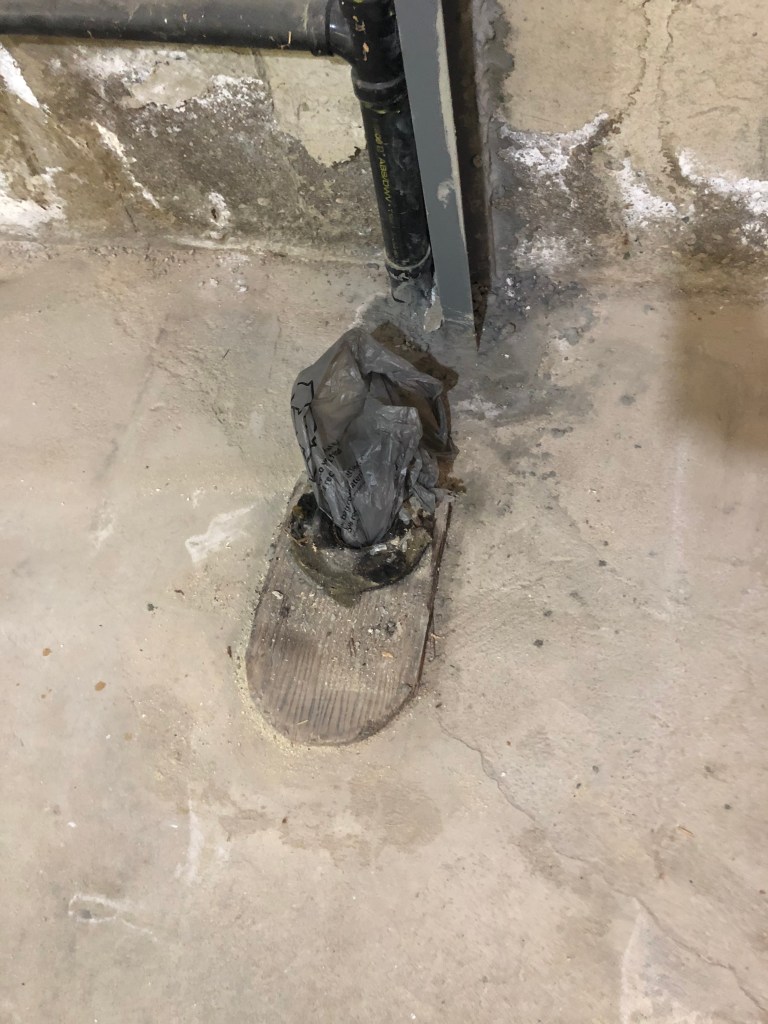
Once I removed as much as the old wax gasket as possible

I watched a number of videos on how to repair and install a toilet bowl from home. I watched about how to properly install bolts on the phalange, properly place the wax ring and properly piping and sourcing water to my toilet. I made a list of all the items I needed and made my way to Home Depot, where the helpful staff were able to help me get all the items together and I left the location, pretty confident I would be able to circumvent hundreds if not thousands of dollars by doing the work myself. After all, there’s nothing I can’t learn, right?

I started by scraping away the remnants of the old wax gasket around the phalange where the toilet sits. Let me tell you, it’s unpleasant work and I can see why plumbers charge so much. It’s rather disgusting. But I got it all scraped away without removing the bag the construction company stuffed into the drain hole, so I didn’t have to deal with any unpleasant smells. Nathan was there to help and bring me tools. I followed up by dragging my toilet near the location so that it would be ready.

Stuck back in its former glory!

The fastening bolts on the phalange were still in excellent shape, so I didn’t have to remove them and install the new ones that came with the new wax ring. I placed the new wax ring and squeezed it in place before lowering the toilet onto the base and twisting it slightly to make a tight seal with the new wax ring. Once this was done, Nathan and I tightened the bolts at the sides of the toilet, ensuring the toilet would be securely fastened to the floor. I ensured the proper placement of the wax seal and the level of the toilet by sitting on it with a level keeping correct measure while I worked.

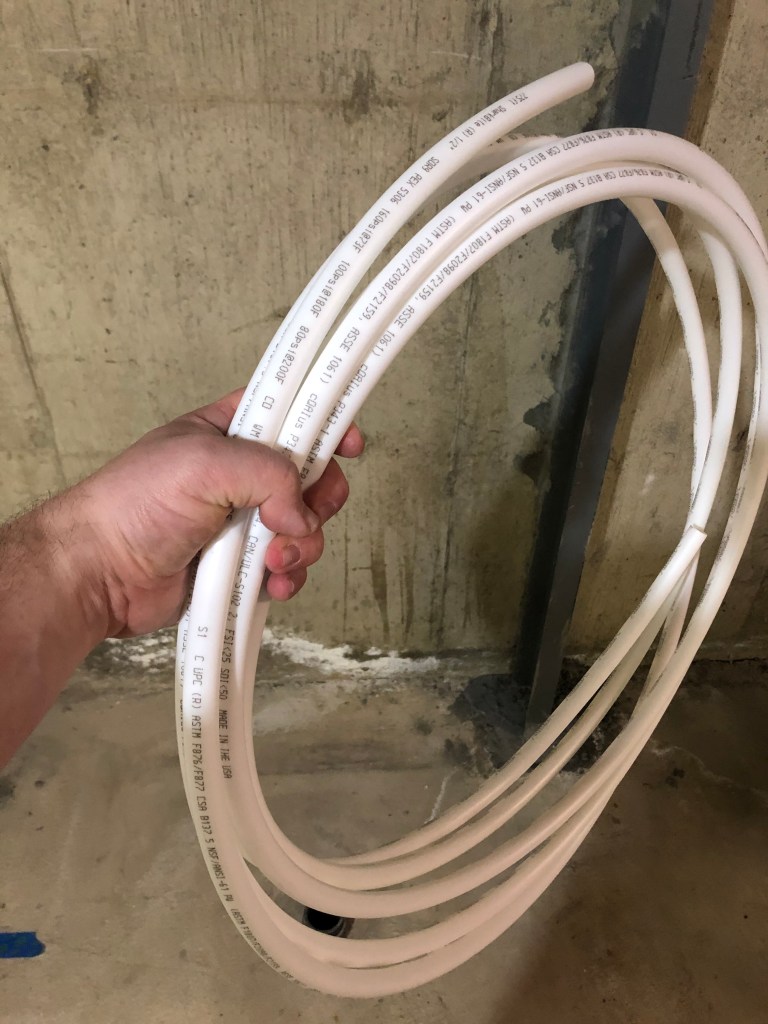
Everything went according to plan, I fastened a water valve to the toilet, attached per tubing from the valve all the way top to the ceiling and reached the water line dedicated to the toilet, only to discover that the cap that had been placed on the pipe wasn’t threaded and I couldn’t remove it. I contacted that local, retired plumber I mentioned an had him come check it out. He agreed to make the proper connection (which was the only piece I was missing) and install my upstairs water filter.

25 feet of Pex tubing to run water to my toilet

At the end of the day, I reinstalled my toilet and my water filter with only minimal intervention from a retired plumber, paid $40 in parts and $100 of off-the-books money to my retired plumber and now have a fully functional toilet downstairs, as well as a source of clean drinking water for my family and I. Considering this was barely an 8th of the total cost of a “professional” plumber, I consider myself blessed to have taken the steps I did. It’s one step closer to getting my basement back to its former glory.

By end-of-day on last Thursday, I had my toilet back to it’s former, running glory and a brand-new filtered source of drinking water for my family and I on our upstairs sink. I have a deep well of respect for people who work in the trades. I understand that they have to study and train, and mostly even apprentice for many years in order to work independently in their respective industries. But considering most sources were trying to charge me nearly a grand to install items I already had in my possession baffles my mind. The $100 I paid to the gentleman who came and helped me seemed like a Godsend by comparison.

This Buddhist’s Throne, in all its former glory!

I’m not a plumber. I could never do what they do, especially when it comes to things like toilets and anything sewer-related, but give me a break! Why gouge people so badly? I was able to save hundreds upon hundreds of dollars by doing the majority of this installation myself. Just goes to show that you can do anything if youngenuinely set your mind to it. ☯

Even A Smile Shows Teeth

There have always been those who would bring harm to others, either physically, emotionally or professionally. Although it may seem like a pretty cynical view, learning to acknowledge and understand that not everyone can be trusted is a significantly important way to protect oneself. I’ve come to realize over the years, through my personal and professional life, that trust is a dangerous commodity, albeit a necessary one.

It can be difficult to know who to trust. Even when a person is nice and welcoming, they can forget you in a heartbeat, or fail to be there when you need them. This can lead to the distrust of people in general. Meanwhile, even when certain people seem like absolute assholes or ignorant, they may give the shirt off their backs if they think it will help you out. It can make navigating the social world extremely difficult.

It reminds me of a story I heard from a character in a movie I watched years ago. The story always stuck with me, and I think it applies quite well to modern society. Here’s the story:

“Once Upon A Time, There Was This Little Sparrow, Who While Flying South For The Winter Froze Solid And Fell To The Ground. And Then To Make Matters Worse The Cow Crapped On Him, But The Manure Was All Warm And It Defrosted Him. So There He Is, He’s Warm And He’s Happy To Be Alive And He Starts To Sing. A Hungry Cat Come Along and Clears Off The Manure And He Looks At The Little Bird And Then He East Him. And The Moral Of The Story Is This: Everyone Who Craps On You Is Not Necessarily Your Enemy, And Everyone Who Gets You Out Of Crap Is Not Necessarily Your Friend, And If You’re Warm And Happy No Matter Where You Are You Should Just Keep Your Big Mouth Shut!”

– Electra, Assassins (1995)

The delivery of this revelation comes during a point in a Sylvester Stallone movie where there’s a lull in the action, and is meant as a mild comedic diversion in the middle of an otherwise dark movie about contract killing. It elicited a laugh from me, the first time I watched the movie. But I feel it provides an important lesson in the modern world as well. Trust, as I said, is a valuable commodity. And it can be extremely difficult and frustrating knowing when to share said commodity.

Although I may once again be showing my cynical side, we live in a world where a date gone wrong may result in claiming sexual misconduct, where online purchases can result in the money being taken without any goods ever being delivered and of promises made but never kept. It makes navigating through all the bullshit not only difficult but somewhat dangerous. It also makes friendships difficult to establish and maintain.

I’ve had so-called “friends” who have smiled and been nice and fantastic in person, but have either stabbed me in the back when I wasn’t looking or simply weren’t there to provide the basic elements of friendship when they were needed. One good example I can provide, is a friend who has good moral value similar to my own, expresses the existence of our friendship, yet time and again I’ve been stood up without warning when trying to meet with them or get their assistance with something. This person may be the nicest person in the world, but they still suck as a friend.

On the flip side, I have associates within my social circle (if I can really call it that) that are often loud, opinionated and rude. But during times when I was lowest, these associates will be the first to step forward and lend a hand. Like I say, it can be confusing. It would be nice to simply have people in one’s life that share common interests, goals and values and that you never have to second-guess. But that simply isn’t how the world works.

Obviously, this doesn’t mean that I’m suggesting in ANY way that one shouldn’t have friendships. Friendships are an integral part of a normal human existence; normal being an extremely subjective term, of course. But the idea is to protect yourself, especially during online interactions where you can’t ever be definitive about a person’s motives. Take your time with people and trust only so far as it allows the association to develop without putting yourself in a compromising position.

Last but not least, appreciate the friendships you do have. My inner circle is so small, it’s basically a dot. But I consider friendship to be a “quality not quantity” consideration. I prefer to have the friends whom I only speak to about once a month but that I can trust wholeheartedly, than the ones I hang out with every week but may be stealing the money out of my swear jar when I’m not looking. And trust me, that fucker’s full! ☯

Home Should Be For Rest

Listen, I’ve heard this argument for well over thirty years. There’s never been a satisfactory answer, at least not to me. But even when I WAS in school, it was a well-worn argument that apparently would never have any resolution. Should homework be included as a part of a child’s education? Should students be expected to perform school work and studies once they leave the classroom and go home? The answer to that question depends on which side of the fence you fall on.

Personally, I was always the kind of student who managed to get most work done within the confines of the classroom. YEs, I know! That sounds like bragging. And it probably is. My parents never really had to pester me to read or study or do anything that would be considered studying, because I usually did it on my own. But when I did get homework, I knocked it out of the park first thing.

But even in modern times, what does this say about our modern educational system? When I know that my son has spent seven to eight hours in the care of the school system, I usually feel that it’s inappropriate that I have to push my child to perform schoolwork outside the confines of his classroom. I consider that if I put in an 8-hour shift at work, I assume I can relax and unwind when I finally get home to my family. Familial obligations considered, of course. So why wouldn’t the sam be true of my son, who is only a child?

Honestly, my personal opinion is that if one’s lesson plan is properly drafted and executed, then students should be in a position where they need to do “school work” once they get home. This doesn’t include studying things that may be coming on a given day. For example, if my son has a spelling test at the end of the week, he can fully expect that he’ll be practicing that shit at home. But serious homework assignments should take a bench and wait for the following day, if the teacher hasn’t managed to fit it in to his or her full day of class.

Do you agree with this perspective? Let’s consider that some students have extracurriculars to consider. In Canada, many students will participate in dance, hockey or martial arts outside of class hours. If they spend an 8-hour day in school then head off to said extracurriculars, that leave very little time for homework. And extracurriculars are extremely important. They can help train and groom a perspective youth for the future. But by the time I usually got home from karate, I was ready for a hot shower and bed. Homework was about as far from my mind as it could get.

Nowadays, I deal with my 5-year old who complains that if he isn’t in school, he shouldn’t be doing schoolwork. I hate to agree, but he has a point. You wouldn’t be expected to put in a shit-ton of work beyond your 8-hour shift. So, why are our children expected to do schoolwork once at home? It’s definitely food for thought, because I’m straddling a sharp, splintery fence where this issue is concerned. I think there are some things that NEED to be passed on to be completed at home. But for the most part, home should be where kids can do what they do best: be kids. ☯

Best Of The Best

Listen, anyone who reads my blog regularly, knows that I’m not here to endorse any specific source or product. But once in a while, I feel it necessary to speak about particular books or films that have had an impact on my life, training or beliefs. A few days ago, I had the opportunity to re-watch a movie from my youth that had a definite impact on my choices regarding the martial arts. I’m talking a little movie called Best Of The Best…

Released in 1989, the movie follows the journey of five American fighters who are chosen to be part of an American Karate Team intent on competing against five fighters from the Korean team… In Korea! The team couldn’t be any different from each other, with a traditional Korean Tae Kwon Do champion, a dedicated karate practitioner who has a young son (sound familiar?), a chubby, hillbilly asshole who challenges everyone’s patience and even includes a caucasian Buddhist to add some flavour to the group.

I tried to find a promotional poster to share with the post, but there was nothing that was free or wouldn’t have cost me a ridiculous amount just to share, so I’ll satisfy myself with sharing the movie’s IMDB link here. IMDB is a phenomal tool for reading about a movie, but if you have Canadian Netflix, it’s on there right now and you should stop what you’re doing and watch the movie immediately! Starring Eric Roberts and Philip Rhee, the movie includes many aspects that I can relate to (minus competing, of course) in relation to my own martial arts journey.

This’ll be a short post, especially since I don’t want to provide any spoilers. But if you want a decent, realistic martial arts movie, Best of the Best is definitely the movie for you. It can feel like a bit of a slow burn at times, but the story is solid, the training is realistic and factual and the message is timeless. I’ve seen this movie almost a dozen times, and I never hesitate to sit through it when I see it cross my path. If you want a story of true martial arts prowess and dignity, pop a bag of Orville’s best and fire up your Netflix and watch Best Of The Best. If you love martial arts, you won’t be disappointed. ☯

Life May Move Fast, But Its Speed Should Be Slow

Anything one experiences in life should be taken slow. This isn’t without exception, of course. I could barely wait to put a ring on my wife’s finger and did so quite a period of time sooner than most other guys would have. But in terms of life in general, sometimes it’s better to take it slow. Consider a fine bottle of wine… Perhaps it’s a blend you’ve never tried before and maybe it cost a little more than you’d usually pay. Are you going to simply chug it down like a $9 bottle of wine cooler, picked up on the fly? Or will you take the time to breathe in the bouquet, sip it slowly and enjoy it?

“Life Moves Pretty Fast. If You Don’t Stop And Look Around Once In A While, You Could Miss It.”

– Ferris Bueller

All things in life involve a balance. The same can be said for the speed at which the world turns. The REQUIREMENTS of life come at you pretty fast. Getting to work on time, paying your bills and making sure your kids get on the bus. All the more reason for the PREFERENCES of life to be taken slowly. Enjoy your meal and take time to chew. Taste and enjoy that ethnic food you’ve decided to try. Shed a few tears at the sad scene in the movie you watch with your significant other.

As Mr. Bueller indicated in one of my favourite movies, “Ferris Bueller’s Day Off,” life can come at you pretty fast. It’s important to stop and smell the roses once in a while. Whether it’s choosing to read a book, slowly enjoying a glass of wine or simply taking an hour to play on the floor with your kids without looking at your phone, it can make a difference in the level well-being you experience in your daily life. ☯