Is Free Will An Illusion?

Once and a while, I start to dwell on things and ask questions of myself as they apply to life. One of these questions is the title of today’s post: Is free will an illusion? I think that most people would agree that for the most part, people in the western world live as free people with all the choices and entitlements associated with our lifestyles.

But how much of it is real? And how much of it is simply a comforting dream that we allow ourselves to have in order to cope with the prison of our own reality? Not to sound totally morose, but sometimes one needs to question things. This appears to be the mood I’m in today.

As usual, I’ll start by defining what it is I’m referring to. Free will is defined as “the power of acting without the constraint of necessity or fate; the ability to act at one’s own discretion.” This is according to the Oxford Dictionary, which also provide the action of doing something voluntarily.

So, how much of our free will is real and how much is the illusion. I like thinking that I walk through life doing whatever the hell I want, but I may be incorrect in some respects. Allow me to explain…

For the most part, we get to decide and choose what we will do with our lives. As long as we work hard and study (or so we’re told) we can choose an avenue of post-secondary study and embark on a career that will make us happy and fulfilled. If one is lucky enough to become successful in that endeavour, then we usually slip into the expected and often wanted aspects of societal norm; a home, a spouse, children and vacations…

But what if you happen to lack the financial means to make that post-secondary study happen? You can be as good at schooling as you want to be but if you can’t afford college or university, some of your chosen professions will be off limits to you. Or the other side of the equation would be if you don’t have the best grades in school, some post-secondary opportunities will be off limits, regardless of your financial means.

But is this truly free will? I use schooling as an example, but there are many others. For example, if you decided you wanted to drop everything and spend your life travelling the world as a nomad, could you? Or would there be societal, governmental and familial obligations that would prevent you and potentially ruin you if you tried?

Let’s say that you get everything you wanted: complete your chosen studies, obtain the job of your dreams and everything falls into place. Is everything one in your life now dictated by your free will or is some of it still imposed by outside factors? Things such as work schedules and paying taxes are required of people and are usually outside the purview of our free will.

The importance behind free will isn’t so much in getting to do what you want, so much as it relates to the ability to make a choice. Choice is the true aspect of free will that every person has. In truth, even doing nothing is still making a choice. And even in the face of constraints or restrictions, making a choice will always be the true free will. Food for thought… ☯
Shake It Off 🤝

There are hundreds, if not thousands of different cultures and religious beliefs around the world. Each and every one of these have their own set of traditions and habits that they follow, based on their scriptures and/or cultural and societal habits. But in a lot of cases, some of these traditions can conflict with those of other cultures and religions.

Although this should be fine, and everyone should simply adopt a modus operandi of live and let live, it continues to surprise and fascinate me how some people appear offended or even insulted, when someone does something different than what they do. Although this would make sense if you did something heinous like blowing your nose with a holy scripture or something, I’m talking about the little things…

Flashback to an incident that happened last year when I visited my parents in New Brunswick. My mother happens to be French Catholic and as such, I have the habit of attending a church service with her whenever I visit. I am appreciative of all people’s faith, so it’s always a pleasure to be able to share in the experience with my mother.

One of the Catholic church’s traditions during a typical service is to turn and wish peace and well-being upon your neighbours in a practice referred to as “Passing the Peace.” This is usually done by shaking peoples’ hands while saying “Peace be with you.” From my understanding, it’s a practice that’s observed by a number of Christian sects and churches.

This is an interesting topic, considering the advent of social distancing and most people trying to avoid physical contact with others. For the most part, and considering the nature of my job, I don’t avoid shaking hands as a rule but I do tend to restrict physical contact with total strangers to an extent. My mother is very much the same, and has long discontinued the practice of shaking hands and simply says “Peace be with you” and moving on.

For most people, there’s nothing wrong with this. But some people always seem to see the negative in a situation. During this particular service, my mother and I were seated behind some people who took some… liberties with their time within the church. The woman took her shoes off and appeared to be picking at her feet throughout most of the service.

I’m not here to judge. I wasn’t THERE to judge. Especially in a church whose holy Bible reads, “Judge not lest ye be judged.” But perhaps shaking your hands after you’ve been picking the light knows what from the crevices in your feet is NOT in my best interest. So when the time came for Passing the Peace, I respectfully bowed to the woman while saying “Peace be with you.” The look of utter shock and judgement on that woman’s face caught me completely by surprise.

Now to my mother’s credit, she makes a point of telling people that she doesn’t shake hands. Pretty clear cut. But in my case, I don’t know if it was my refusal to stick out my hand, the woman’s embarrassment because she HAD stuck out her hand or the bow, but I had somehow rubbed her the wrong way. To the point where she felt it necessary to approach me after the service to say that it was customary to follow the church’s customs when visiting.

Here’s the joke: I grew up in the Catholic church. Up until my teens, when I started making my own way, I followed my mother to church every week. So I knew her point of view was skewed and incorrect. Could I have corrected her? Sure. Could I have explained my religious views? Probably. Was it easier to leave her in her ignorance and walk away? It was, and you bet your keister I did!

Unless your traditions and beliefs bring harm to yourself and other people, we should all be able to share a respect for each other’s faith. They may all be different, but they should all be meant to evoke acceptance and understanding. Otherwise, what is faith for? The appropriate response from this woman would have been to ask questions and perhaps learn about our respective differences in faith. Given the way the world has evolved, haven’t we reached a point where said acceptance and understanding rule the day? Food for thought… ☯

Time Is Of The Essence

One of the biggest love/hate relationships I have with modern society is people’s use of their time. Not how they occupy or entertain themselves, but the ACTUAL use of time, as in getting to an appointment, making deadlines and adjusting for outside factors when doing so. People are horrible at it, and I would be lying if I said I wasn’t, on occasion, guilty of what I’ll write about as well. But for the most part I FEEL immune to it, which is why I often don’t understand why others aren’t as well.

As you can tell, today’s post may be a bit of a soapbox rant. But in today’s fast-paced environment, society needs to learn and understand the importance of time-management and being on time. For some, time management comes easily. You set an appointment, you keep the appointment. Rinse and repeat. For others, it often feels as though they have no clear concept of time or how to be ON time.

According to an article posted by Psychology Today, some people may be late or have difficulty managing time for a number of reasons, including but not limited to enjoying the attention they get when showing up late, being indifferent to the effects of their tardiness on others or lacking some of the time-management skills that the average person uses, such as checking the time and leaving early. (https://www.psychologytoday.com/ca/blog/the-homework-myth/201107/why-are-some-people-always-late-and-other-human-puzzles)

A good example of this, is a girl I dated some years ago. She had a nasty habit of not only showing up late to pre-determined appointments, she would often makes others wait for unnecessary periods of time while she got ready, thereby causing them to be late as well. I’ll admit that I was guilty of providing a much earlier appointment time in an effort to have her actually reach the appointment at the correct time. This tactic did not always work.

Friends and family members would tell me that she had always been this way, and that they believed that it was a subconscious way for her to see if you cared enough NOT to leave her behind. She’s obviously not the woman I’m married to, so we can all see how THAT worked out for her. But this could easily fall under the category of the attention-seeking mentioned in the linked article above.

In some respects, people can also be slaves to their routine. For example, if you’re used to waking at 6 a.m. every morning to get through your routine and reach work by 8 a.m. then you likely won’t consider waking 30 minutes earlier even if the roads are snow or ice covered and may require extra time. It isn’t until you’re trying to reach the office as usual, that you notice your inability to travel at normal speeds, resulting in showing up late for work.

This is only one example of course, but there are many. I’ve never been a fan of using traffic as an excuse, unless you’re from out of town. “Sorry I’m late! Traffic was brutal, this morning!” Bro, haven’t you lived here for years? How can you be late because of a gathering of vehicles on your route to work, that you probably see EVERY FREAKING MORNING? Shouldn’t you have an idea of the required time by now?

I used to have an instructor who said, “If you arrive on time, you’re already late!” I have to admit that this saying has stuck with me for years. I always attempt to show up at least fifteen minutes early. To everything. This helps prevent any issues that may be caused by outside obstacles, or having the person you’re meeting show up first and have to wait for you.

Time management and getting to someplace at an agreed time are not only important in order to maintain some semblance of order in your own life. It’s also an important factor to reaching milestones, getting ahead in life and making life in general work for you. At the end of the day, it isn’t just your time. It’s the time of the people waiting. Rant over… for now. ☯

National Beer Day… 🍺

This morning’s post was a bit short and I thought that was fine for a change, but it wouldn’t be me if I didn’t provide something longer to read. And here we are. Last year, I covered a number of different “holidays” in April and May that come around every year. You’ll notice the quotation marks, because these so-called holidays are generally not recognized and are just for fun.

Some of these are pretty weird (like National Ferret Day), but some are pretty interesting and decent (like National Siblings Day and Deep-dish Pizza Day). Although the majority of these come out of the United States, I can promise you that most of them are celebrated here in Canada as well; there’s no way in hell that Canadians WOULDN’T celebrate National Donut Day (that’s coming on June 5th, BTW).

But today is National Beer Day, and yes, it IS an American holiday but it’s well-observed in Canada as well. National Beer Day is celebrated on April 7th marking the day that the Cullen-Harrison Act was enacted after being signed into law by President Franklin Roosevelt in 1933. Although this didn’t mark the end of prohibition in the US, which took place later on in the year, it was the beginning of the end.

National Beer Day was created by an American named Justin Smith in 2009, who started the “holiday” as a Facebook page at the behest of his friends. Since then, it has become a recognized holiday by the Commonwealth of Virginia (where Smith is from). I checked Wikipedia for these facts, so take them for what you will: https://en.wikipedia.org/wiki/National_Beer_Day_(United_States)

Beer holds a particular interest for me. And unlike the average consumer, I enjoy consuming it for the different flavours and different blends, as opposed to the intoxicating effects (that’s my story and I’m sticking to it). I’m an odd duck in comparison to my counterparts in Canada, as I only start drinking beer when I was 23 years of age in Japan of all places, as opposed to early in my teens like most of my friends. This is mostly because of beer’s significant carb-count and effects on the waistline.

Depending on what history book you read, the first beer is thought to have been brewed by the Chinese almost 9,000 years ago. But beer as it’s brewed today (or close to it) is believed to have been started by the Mesopotamians around 3,500 to 3,100 BCE. Although some scholars think it may have been accidentally discovered when grains used for bread fermented, some postulated that not only was it brewed for its intoxicating effects but also as a dietary staple.

Regardless of who did it first, beer is here and most of us couldn’t be happier. And believe it or not, beer may have some particular health benefits in addition to being the beverage of choice for guitar-playing teens sitting by the fire on a beach. I found an article on a website called EverydayHealth.com, which lists 8 ways that beer is good for you. Here are the ways…

  1. Beer Fights Inflammation. The article suggests that some of the hops used in beer can contain bitter acids that help fight inflammation;
  2. Beer Aids Digestion. Those same bitter acids can also help with the release of stomach acids, essentially helping you to digest;
  3. Beer May prevent Some Cancers. Beer contains Lupulone and Xanthohumol, which have shown promise in fighting tumours. Most of these are just in the study phase;
  4. Beer Builds Bones. Beer contains silicone, which is said to be important for the building of strong bones. The article suggest India Pale Ale (my favourite) as the best source for this;
  5. Beer Is Heart-Healthy. A study in 2012 apparently links the consumption of one or two beer a day as beneficial for the prevention of heart issues, and the prevention of further issues in those who already have them;
  6. Beer “Polishes” Your Teeth. Beer apparently beats out tea and other methods of eliminating the biofilm that accumulates on your teeth if you haven’t brushed for a while, according to another study done in 2012 (were we all just drinking THAT much in 2012?);
  7. Beer Protects Brain Cells. A 2015 study from China describes some benefits in this regard. Finally, a study that WASN’T done in 2012;
  8. Beer Prevents Kidney Stones. Some studies have shown that consuming beer may help prevent the formation of kidney stones.

Here’s that EverydayHealth page, should you want to get further details, and perhaps read some of the linked studies I mentioned above: https://www.everydayhealth.com/pictures/ways-beer-good-you/

So there you have it! Beer isn’t all bar fights and hangovers but can actually do some good for you. As with all things, the idea is moderation. Too much consumption can lead to the reversal of some of the benefits listed above, and can also include increased blood pressure and weight gain. So the idea isn’t to down a twelve-pack thinking you’ve found the secret to eternal life! And bear in mind that the average can of beer can be anywhere between 11 to 25 grams of carbohydrates, depending on the blend and size of container. So, know what you’re drinking and how to bolus accordingly.

Enjoy National Beer Day and treat yourself to a cold one! I’d say wait until 5 p.m. but believe it or not, that’s not an actual rule and is mainly a social norm because the majority of people end their work day at 5. So, if you’re sitting at home binge-watching your preferred streaming service and you have nothing else to do considering quarantine measures, enjoy a beer (in moderation). I miss going out for beers with my occasional beer buddies (you know who you are!) so hopefully the state of the world will change soon and we can get back to the norm. ☯

I’ll Just Leave This Right Here…

I found this online a few days ago and I thought I’d share it. Its probably surprising to read a post of mine that doesn’t involve lists or long convoluted explanations about something, but sometimes you just gotta keep things simple. Enjoy! ☯

Don’t Fear The Reaper, Kick His Ass Instead

When faced with a medical condition you know nothing about, people will often make their own assumptions. One can hardly blame them, especially if their education and/or upbringing has provided some “seeded” information that they believe to be true. This is one of the reasons why I find it extremely interesting when someone decides to get past the fear voicing those questions, especially to someone living with the condition.

Enter the big question of the week: “What will happen to you if you don’t have insulin?”

The short answer is that I’ll die. There you go. Thanks for reading. It’s actually a bit more complicated than that, but that’s the short of it. The answer not so much involves the “if” I’ll die so much as it involves what I’ll die from. The bottom line is that before the arrival of insulin, people with Diabetes just didn’t survive. Simple as that. Once diagnosed, they slipped into a coma and died.

Just to be clear, I’m referring strictly to Type-1 Diabetes. For people with Type-2, whether using insulin therapy or not, their life expectancy can extend as long as years, depending on the specifics of their condition, diet, age, exercise and all that fun stuff. But for the average Type-1 Diabetic that can recognize early symptoms and takes precautions, the average life expectancy without insulin is believed to be about 7 to 10 days at most. Nice, eh?

“But why don’t you just diet and restrict yourself from carbohydrates, and exercise more when your blood sugar rises?” Very good question, anonymous person! Here’s the answer…

According to an article posted on Healthline.com, without insulin, your body can’t use glucose as fuel and begins to break down fatty tissue as a replacement, which causes those fats to turn into acids called ketones. These ketones build up in the bloodstream and eventually get expelled through one’s urine. However, when these ketones accumulate in the bloodstream, the blood starts to become acidic. This causes a condition called Diabetic Ketoacidosis.

Ketoacidosis is usually the condition that winds up killing the patient, but some of the symptoms may get to the patient first. These symptoms can include dehydration, shock and slipping into a comatose state. Here’s the HealthLine article, if you want more details: https://www.healthline.com/diabetesmine/ask-dmine-lifespan-sans-insulin#How-did-people-with-type-1-diabetes-survive-historically?

So no, the easy answer is that I can’t simply stop eating carbs and exercise more if my blood sugars rises to dangerous levels. The unfortunate reality is that this would be like sticking a piece of duct tape to stop a crack on the Hoover dam! Eventually, DKA would take over and my blood would turn acidic, effectively killing me despite my best efforts. This is why good blood sugar control and proper insulin therapy is so necessary.

The best way to maintain your health and stay alive, other than proper insulin therapy, is to stay hydrated and recognize the symptoms of DKA before they hit. Your body will cramp and ache everywhere, you’ll fall into the “endless diabetes cycle” of drink, pee, repeat and you’ll likely have confusion and bad breath. This is why it’s important to check for elevated ketone levels if you’ve suffered extreme high blood sugar, as the ketone process may have begun even if you’ve corrected your high with insulin.

Just one more aspect of Type-1 Diabetes that we have to worry about! But this is an easy one to prevent and manage, so long as you adhere to your insulin therapy, stay hydrated and watch your blood sugar levels carefully. Diabetes is already believed to shorten a person’s life expectancy; no need to give it any further opportunities. ☯

There Is No Keurig In The Apocalypse ☕️

We recently suffered a loss in our family… It’s been hard and we’ve been coping as best we can, but there’s little that can be done to get past the deep feelings of grief and loss… from our Keurig machine breaking down! Alright, my apologies for tugging at your heart strings, but coffee is pretty damn important in my daily routine.

I’ve had a coffee pod machine for years, in some iteration or another, and I got the first one in 2013 as a gift to my wife. We’ve had one model or another since then. A few weeks ago, we started to notice that our Keurig machine started brewing a much lower amount than it used to. All “pod”-based coffee machines tend to succumb to various issues over time, including erosion or corrosion of their inner tubings and workings. Most of them have to be descaled and clean on a regular basis, but eventually even that no longer works.

I had the genius idea of taking our current machine apart and seeing if I could clean its inner workings myself. But once the bottom panels were removed and I got a look inside, I was taken aback by the amount of electronic components it contained. I’m not a big fan of trying to fix something electronic that uses water, so we “retired” the machine. It was a pretty nice one, as it only held enough water for a single cup, preventing the usual issues that come with a large canister of water.

It got me to thinking about the little, everyday pleasures that we take for granted. With most things closed for business, doing something as simple as enjoying an espresso on the terrace of a local coffee shop can’t happen. So, it’s important to find some new “little pleasures” in your everyday life that you can indulge, despite the current issues facing the world.

Coffee and caffeinated drinks are a pretty customized and personalized experience in our household, with my wife and I preferring different blends and brews of coffees. This presents a challenge when faced with only one coffee machine. But we’re making it work (especially since I enjoy an energy drink, first thing in the morning) and their are bigger problems in life. Stay caffeinated, people! ☯

A Little Light Shines Through…

Having Type-1 Diabetes is expensive! I’ve spent the majority of my life saying, “I can’t afford to have Diabetes…” And with good reason, considering the cost and expense that goes into everything required to help keep us not only alive, but in good health.

In Canada, the average cost for a bottle of long-acting insulin such as Lantus (this is the type of insulin that would provide basal coverage over a full day) is about $80. A bottle of short-acting insulin, like Humalog, will run you anywhere between $35 to $40 a bottle. And if you’re anything like me, you may require two to three bottles of that sweet stuff in a month.

Now if you’re lucky, a bottle of long-acting stuff will get you through the month. So according to new math, you’d be looking at well over $200 a month for JUST the insulin. Don’t even get me started on the cost of syringes, needles, blood glucose sticks and various other supplies required to maintain oneself in the wonderful odyssey that is Type-1 Diabetes. If you don’t have some sort of medical coverage or benefits, it can be a life-threatening issue.

This is why it’s always so heart-warming to hear about something that helps to alleviate or lessen the burden, financial or otherwise. I just recently read about a bill passed by the Illinois state legislature in November of 2019, which puts a price cap on out-of-pocket cost for insulin at $100. Illinois’ Governor signed the bill into state law in January, with the law taking effect in Illinois in january of 2021.

Illinois will be the second state to pass such a law after Colorado, with several other states beginning to follow suit with bill of their own. An article posted by Newsweek provides further details, including outlining the increasing issue of some people dying from rationing their insulin supplies or skipping doses, to being unable to afford their insulin. Here’s the article: https://www.newsweek.com/illinois-becomes-second-state-cap-monthly-insulin-prices-more-states-are-considering-it-1483987

This is a fantastic step, but obviously it’s only a beginning. To be clear, this price cap applies to a patient’s co-pay, and not to the cost of insulin when purchase over-the-counter. This does not prevent drug manufacturers from charging increased prices for the sale of their products. It is said that in the United States, the price of insulin has tripled over the past decade.

Although this article is based on pricing and laws from the United States, the situation is very much the same in Canada. I remember the difficulties and financial strain I had to deal with, all through my 20’s and into my 30’s, due to the fact that I had no medical benefits to help take the burden of cost off my shoulders. It will be a wonderful time, when governments come to realize that life-saving therapies such as insulin should be made available, free of cost. ☯

Keep On Rolling

If you’re anything like me, the day or two after an extreme workout will have you feeling like hell. For the most part, this sensation is temporary (see my post from four days ago entitled, Grin Through The Pain) but it can often feel as though you need an extra little something to help your tired and sore muscles along; especially if you work out frequently.

Under normal circumstances, one could easily include certain medical professionals in their training routine such as massage therapists, acupuncturists and chiropractors, bearing in mind that the three provide different functions. But with the current state of the world, it’s difficult to find a productive way of getting the same relief for your muscle tissues. Heating pads and over-the-counter pain killers can only take you so far.

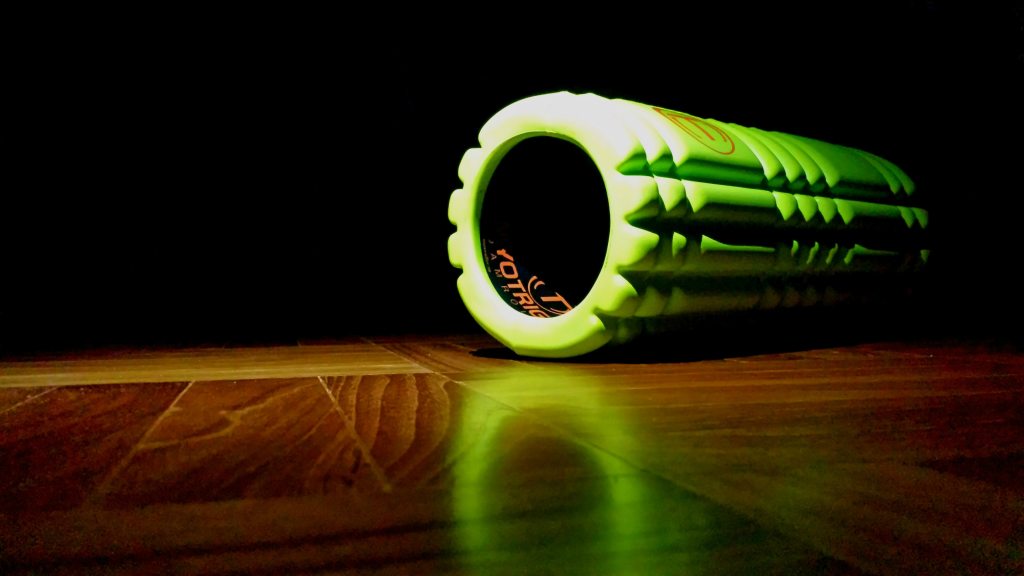
This is where foam rollers come into play. Foam rollers are reasonably popular with athletes nowadays, and they first came into play in the late 1980’s when physical therapist Sean Gallagher began using it as a self massage tool. But like everything else, there’s some good, bad and ugly associated to using one.

Example of a textured foam roller

The proper use of a foam roller will help to ease knots and tightness, increase blood flow through the muscle tissue and help loosen scar tissue. All of these things will significantly help with recovery time after an intense or gruelling workout. You can use a roller before and after a workout, to help with stretching and the prevention of injury.

Another good use for a foam roller is if you spend your day working in a sitting position or if you got a kink somewhere from improper sleeping positions. According to an article posted on Healthline.com, foam rolling has a number of benefits including but not limited to easing muscle pain, increasing your range of motion, temporary reduction of the appearance of cellulite, relieves back pain, helps to manage fibromyalgia and is a handy tool for relaxation.

It is advised that one needs to be careful when rolling and that one should avoid rolling over joints and to avoid foam rolling if you have a muscle tear or a break. There different types of foam rollers, including smooth rollers that are suggested if it’s your first time rolling and textured rollers that work deeper into the muscle tissue. Here’s the Healthline article: https://www.healthline.com/health/foam-roller-benefits

Like anything else, consult your doctor or medical professional before starting any new fitness routine. But foam rolling can be a reasonable addition to your at-home workout routine. It won’t completely replace a registered massage therapist, but it can provide some relief during trying times. ☯

Xenophobia, It’s Not An Obscure Country In Europe…

Having all this free time as a result of self-isolating, I’ve found myself surfing the web and doing things that I generally wouldn’t do. And no, before any of you perverts get the wrong idea, I don’t mean anything lewd or weird. One of the things I’m referring to, is looking up old friends. Since I don’t have Facebook or any other form of mainstream media, this is a bit of challenge and required the people in question to actually have searchable aspects available through Google and such. I found one such friend a short time ago…

Since I’m not a big fan of being sued, I’ll keep the identity of this person to myself, especially since we haven’t spoken in over ten years. But I found a Twitter feed that I was quite certain was a friend I used to work with in Ottawa about twelve years ago. I was optimistic and looking at possibly reconnecting with him, until I read a recent post on Twitter he sent which read, “Thanks China, for fucking our planet!” I was taken aback and quietly hit the back button and got the hell out of there!

Ignorance and lack of education on specific topics can often lead to such assessments as this Twitter feed. And there seems to be a movement taking place, where people of any Asian descent are starting to be discriminated, judged and blamed for the current pandemic. Like the virus itself, it’s already spread enough that you can Google “China” and “blame” in the same search string and find TONS of links related to this very thing.

According to an online article posted by The Guardian, “[…] Chinese Americans, and other Asians, are increasingly living in fear as the Coronavirus spreads across the country amid racial prejudice that the outbreak is somehow the fault of China.” It doesn’t help that the American President is promoting this racism by referring to COVID-19 as the “Chinese Virus”, a term that he’s repeated and confirmed on more than one occasion since all of this started.

This trend is spreading, with incidents of negative reactions to Asians who happen to be wearing face masks or cough in public, racial harassment and even cases of assault against Chinese and Asian people in general. Here’s the article if you want to check it out: https://www.theguardian.com/world/2020/mar/24/coronavirus-us-asian-americans-racism

The big problem is that people have been focusing their anger against the people instead of the problem. And believe me, there’s plenty of blame to go around. Between the time it took for accurate and complete information to be shared with the World Health Organization, people who are STILL hanging out in groups in public and refuse to self-isolate or the ones who continued to travel, either through ignorance or from a sense of needing to get home, society’s inability to take this pandemic seriously and choosing to blame others instead, there are plenty of contributing factors behind the continued spread of the virus.

Racism has always been a problem. And despite how far we’ve come as a society, racism isn’t dead yet. There’s still a lot of work to do. And we can’t let the current issue cause us to slide backwards. I saw an image of an Asian woman holding a placard that read, “My ethnicity is not a virus.” This is an important message, because people need to stop believing that the Asian people are at fault. One does not lead to the other. As stated in the article I linked above, “We have to acknowledge everyone’s humanity at this time because the virus doesn’t know race or colour.”