I’m usually pretty loud and wordy, a trait that I’m quite confident I inherited from my mother. Although I usually have the ability to control my volume and she’s pure-blooded French-Acadian and for a gentle woman, her voice not only carries volumes, it never stops. ANYWAY… I sincerely love my mother, so don’t interpret the above-comment as something negative.
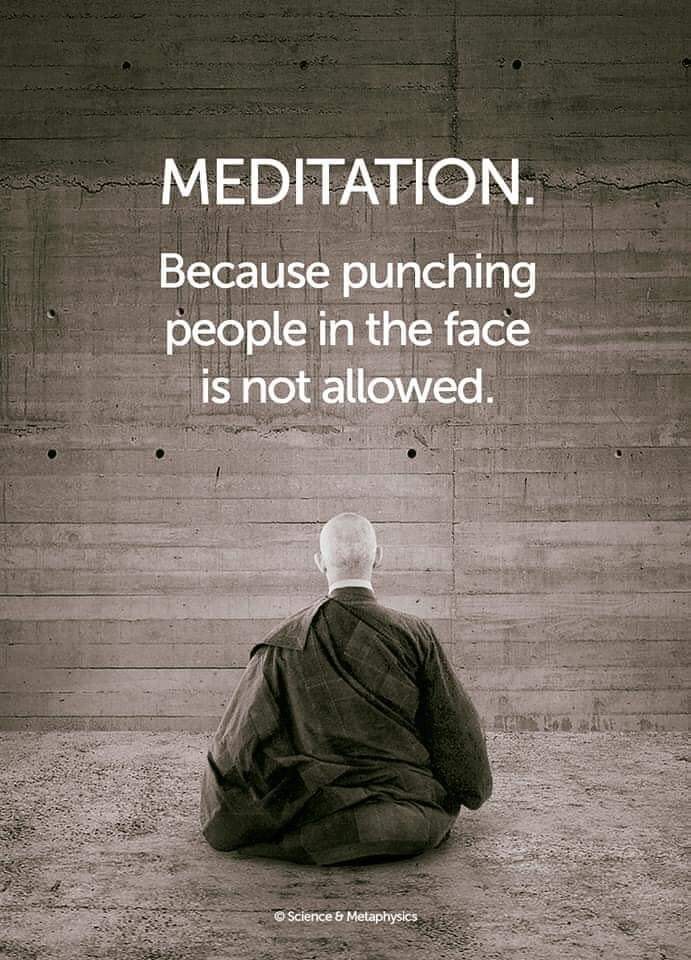
I simply bring this up because I realize that my posts can often become long and convoluted and can be quite the read. So today, I’m keeping it simple with the above illustration. I forget where I found it; it was a couple of week’s ago. But I think it carries an important message about controlling one’s emotions and maintaining self-control when faced with the obstacles of daily life. Enjoy! ☯
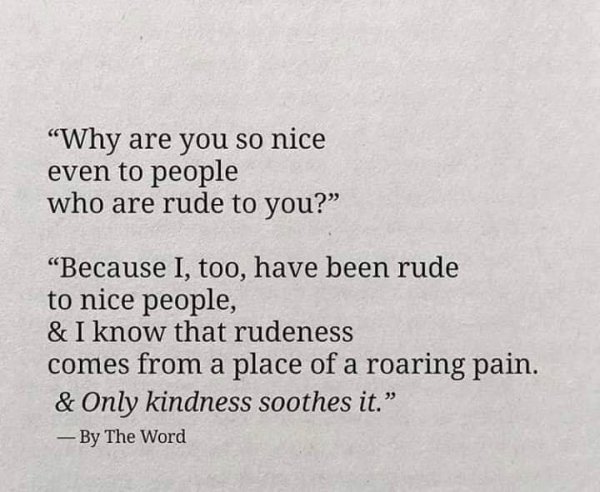
Do you remember the last time someone was intentionally rude to you? How did it make you feel? Did you dwell on it? Did it sit on your mind for a period of time after the exchange was over? Maybe not. Perhaps you’re the type of person who has thick enough skin that other people’s comments simply slide right on off your shoulders. Or maybe you’re in denial. I don’t know, I’m not a therapist or psychologist. But I DO know that most people who say they aren’t affected by rudeness, still are.
To be rude is defined as being offensively impolite or ill-mannered. The best example that comes to mind is several months ago when I pulled out into traffic into the path of an oncoming vehicle (allegedly). The person took active steps to follow me to a red light and went on to call me by a plethora of inappropriate names and insult me for cutting him off. To this day, I can neither confirm nor deny that I ACTUALLY cut him off, as it’s not my nature to go pulling out into traffic if there’s a risk of a collision. But whether he pulled into my lane or was speeding or I DID cut him off, I can’t be responsible for other people’s perception.
So, why are people rude? Rudeness breeds suffering, the elimination of which is at the very heart of my beliefs, yet it seems that people do it with impunity. As much as we often don’t like to think so, many of us are rude to others in the way we interact with others, the things we say and the things we do. Sometimes this rudeness happens without our knowledge that we are doing it.
Most of us spend our childhood being taught by our parents (and grandparents) that’s it’s wrong to be rude, disrespectful even. But as we reach adulthood, a sense of entitlement often makes us disregard those teachings in relation to how we interact with others and how we treat them. Although none of this is anything new, it’s important to remember not to escalate the situation or reciprocate the behaviour.
A person’s behaviour, whether rude or not, will often be rooted in their own self-esteem and perspectives. That person who bumps into you in a public place without apologizing may be going through something that actively occupies their thoughts. There’s a good chance they weren’t even aware they bumped into you. The person who screams or swears at you in public for taking a parking space or possibly cutting them off in traffic has likely forgotten about you ten minutes later and the interaction isn’t worth the stress you allow yourself to feel as a result.
As difficult as it may be to smile and walk away sometimes, rudeness is one of those behaviours that feeds on itself. If you let someone’s rudeness get to you, you’ll likely be rude to someone else and so on and so forth. Kindness is the best reaction to rudeness and walking away from the situation is always best. Don’t contribute to the suffering in the world. Light knows, there’s enough of it as it is. After all, you can only control your own words and actions; never those of others. ☯
Last week, I awoke to a quiet house. I’m never a fan of Monday mornings… They usually mean I have to get some work done and the week has started, the calm and free time of the weekend has evaporated and dealing with the outside world sets in. But anyone who has children and lives in a “typical” family-oriented home will understand why silence can be a bit of a surprise, sometimes even concerning.
My usual Monday mornings involve a colourful choice between an infant wailing for food or a parent’s attention or my rambunctious five-year old son who thinks that my abdomen makes a pretty good trampoline if I’m quietly sleeping. In fact, since the advent of COVID-19, I’ve set an alarm every weekday morning but have never reached it as my children usually wake me up before I get there. Which is fine, right? That’s pretty normal for a family household.
But last Monday, I awoke to the dulcet sound of Joe Satriani’s “Always With Me, Always With You,” which is my morning wake-up alarm. It’s a smooth, guitar-based instrumental that allows me to wake without being jolted out of my slumber as though someone has connected a car battery to various parts of my body. Anyway, after a moment’s confusion I realized that I couldn’t hear a sound, which in this household is an abnormality.
A mild sense of panic set in as I wondered what was going on. The temperature was in the low teens with a steady rain, so I knew my oldest wouldn’t be playing outside (at least I hoped he wouldn’t) and Monday is a day off for my wife. I stepped out of my bedroom to find my son snoring softly in his bed with his iPad playing cartoons next to him. This is an oddity in itself because he went to sleep here in my downstairs office, last night. This means that at some point, he transitioned upstairs to his bedroom without waking anybody; a miracle unto itself.
The baby was quietly sleeping in his crib and I found my wife sitting on the couch, tinkering on her phone. We said good morning and chatted for a few minutes before it was agreed that my wife should go back to bed and sleep while the baby sleeps. I got a cup of coffee and toasted an english muffin and escaped to the solitude of my basement, which is where I do all my research, indoor workouts and my writing. I settled in and enjoyed my breakfast in a quiet solitude that any parent can agree rarely happens.
So, I sat there… Took sips of my coffee and actually played Mega Man 2 on a badly coded game emulator on my computer. I read a few chapters of a book and checked out a few things online and enjoyed the silence. And you know what? I honestly don’t understand the folks who claim they can’t stand being in silence. It’s wonderful. You can be alone and collect your thoughts, you can enjoy some much needed down time and it’s good for your overall mental well-being.
Eventually the bubble bursts, and it didn’t take long for my son to track me down and begin demanding breakfast. But having that little bit of quiet time every now and again can make a huge difference in one’s life. I highly recommend it. Whether you have a workout, read a book or flat out do NOTHING and just relax, everyone should enjoy a little calm and quiet. Every once in a while. ☯
Something important to bear in mind is that inspiration and learning can come from some very unlikely sources. Every Sunday, I try to choose someone that has taught me something, guided me or inspired me throughout my life. I hate to admit it, but it’s been a challenge. I’ve mainly tried to keep this contained to martial artists, including the likes of Michele “The Mouse” Krasnoo, Bill “Superfoot” Wallace, Ronda Roussey and even Miyamoto Musashi. All of these folks have had an impact on my life and have inspired what paths I’ve chosen.
But I’ve also made a point of including people who have inspired or guided me in other ways, like my father. Ultimately, we can find inspiration in negative places as well. I only say this because the subject of this week’s “inspiration” post is someone who has had about as much negative (if not more) influence on the general public as positive. I am referring to a reasonably well-known action star named Steven Seagal.
It may be considered an unpopular opinion by some, but Seagal played an integral role in my interest of the martial arts. After all, he’s a master of Aikido, studied/taught in Japan and starred in a number of action movies that came out during those impressionable years when I was young enough to be impressed but old enough to think, “Hmm, this martial arts stuff is pretty cool!” He moved to Japan and studied Aikido there, and claims to have also been the “first non-Asian to open a dojo in Japan.” Whether this is true or not is anyone’s guess, but he’s had a colourful life prior to returning to the United States where he began acting in movies.
He has starred in almost five dozen movies, although a good number of those beyond the mid-90’s went straight to video. I first saw him when I was ten years old in a movie called Above The Law. In it, he plays a police officer and martial artists who uncovers a government conspiracy and helps put an end to it. Sounds pretty heroic, right? In fact, the majority of his movies have involved the protagonist being some sort of military/police/operative who ultimately saves the day. But that’s the whole point, right? We usually WANT to see the hero win. As a kid, I was awe-struck by Seagal’s ability to use grappling and striking as a means of defeating even the most difficult of enemies. And all of his films up until the late 90’s were pretty bad-ass. I can still watch some of them with deep enjoyment, although much more criticism on his martial arts technique.
Then it gets a bit convoluted. Seagal identifies as a Buddhist and martial artist. This holds some special meaning to me, being a Buddhist and martial artist myself. But it stands to reason that someone who practices a religion devoted to the elimination of suffering in the world should be doing just that, shouldn’t they? Seagal has been the subject of a lot of controversy recent decades, including allegations of sexual assault, violence against the people he works with and has ongoing feuds with the majority of his Hollywood counterparts, notably Jean-Claude Van Damme, as a prime example. Not a very Zen-like approach to life, especially a blessed one such as his.
In recent decades, Seagal has become something of a walking joke when one considers his strange political views, ongoing opinions about how other martial artists aren’t “true martial artists” and his apparent lack of self-care where his body is concerned. The man has ballooned up to the point that he almost looks like a cartoon character! My wife and I recently watched him on Netflix in a film called Maximum Conviction, where he starred alongside Steve Austin. Once again, he was portrayed as some sort of specialist who simply couldn’t be defeated. The movie basically starts out by having him beat up a prison inmate who happens to be over twice his mass!
I’m not saying that a genuine martial artist would be unable to defeat a larger opponent, but given the fact that he was 60 years of age in that movie, couple with how he’s let himself go physically, one needs to face reality at some point. It’s no surprise this was yet another straight-to-DVD movie. Even WITH Diabetes, I consider it a point of health, personal care and importance to try and maintain my physical fitness to the best of my ability; a task I feel that I’m still on top of, despite my gut slowly trying to overtake my efforts. But I digress…
My point is, Seagal helps to provide guidance in a very specific way: he’s shown me how NOT to be. His behaviours definitely don’t fall in line with someone who is a true student of the Buddhist or Martial Way. His concepts and abilities with the martial arts have been questioned for decades, both for their authenticity and truth behind his claims. None of this is how a true martial artists or Buddhist would be intended to behave. When I need to know how NOT to comport myself, I need only think of Steven Seagal. ☯
I remember a story from years ago when I was a manager at my hometown’s local pharmacy. Yes, I was a pharmacy manager… In general, it was an uninteresting job. But like most things in life, there can be lessons to learn behind the scenes, if you’re willing to listen. This is one of those lessons…
I was helping the merchandising staff get some stock out to the floor and I was working in the painkillers and vitamins section with one of the pharmacy technicians. The pharmacy staff were always a little “holier than thou” with the front store staff as they believed that the dispensary was the only reason for the location’s existence. So, there would sometimes be a BIT of tension there. Especially since I technically had no direct authority over them as they fell under the umbrella of the Pharmacist/Owner.
Anyway, I was shelving painkillers (Ibuprofen and Acetaminophen) and the tech was shelving some vitamins. We had a plastic bin for damaged and expired goods on a wheeled cart between our two respective aisles. At one point, we took a break and I glanced down into the bin and noticed a coupled of expired items I had tossed. I also noticed a full, unopened box of multivitamins sitting in the bin. I picked them up and checked the expiration date. They were good until the following year.
I asked the tech why the vitamins were sitting in the throwaway bin. The tech took the box from my hand and showed me where the cardboard was slightly damaged on one end. That was it. The ends were still sealed and by proxy, the bottle of vitamins inside was still sealed tight and the vitamins were in perfectly good condition. I explained to the tech that we couldn’t throw out the box of vitamins based on a bit of scratched cardboard as there was nothing wrong with the bottle inside (part of my responsibility included shrinkage).
The tech pursed her lips and turned her nose up, explaining that she wouldn’t buy a damaged box and couldn’t see any customer doing so either. I asked her, “Why not?If the bottle and the vitamins are intact, there’s literally nothing wrong with it, why would you not still purchase it? Who cares if the box has some scratched up cardboard on it?” She simply shrugged and had no viable answer to give me. I was at a loss and a little bit confused, as my feeling was that the little bit of damage on the outside didn’t take away the value of what was contained within. Apparently, she didn’t agree…
This is an important lesson for the world in general, especially in today’s society of social media filters, photoshopped pictures and everybody’s immediate obsession with their outside appearance. Bullying is at an all-time high, and people’s ability to resist or stand up to it is at an all-time low. But the unfortunate reality is that the first thing people see when meeting us is what’s on the outside. And more often than not, their assessment of you is over before they get to know what’s inside the package.
The Buddhist in me thinks that this is a sad state for the world to be in. The loud, French martial artist with the attitude in me thinks that I don’t give a shit what other people think about me one way or another, but not everyone is as thick skinned. Either way, the important thing to remember is that first impressions are simply that: a first impression. Until you’ve taken the time to look beneath the surface and see what the second, third and fourth impressions may yield, judgements should be reserved and withheld. ☯
Alright, so this is a re-post of last year’s Canada Day. But in reviewing it, I decided that there was little I could add or modify that does this post any justice, so I’m sharing it again.Other than the fact that July 1st carries a bit of a dark stain in my personal life (those close to me know what I’m referring to), my country holds a big place in my heart and I think our national holiday is an important observation on the yearly calendar. Enjoy…
O, Canada! My home and native land… Alright, for those of you who know the anthem, that was pretty cheesy. But today is our National holiday, celebrated on July 1st because Canada became a country on July 1st 1867. For my fellow bloggers and loyal readers who may not be from the Great White North, here are some quick facts about Canada to help you understand what makes us awesome…
The common misconception is that Canada was first discovered in 1534 by French mariner Jacques Cartier. Although it is the accepted belief, the discovery of an abandoned outpost in the Province of Newfoundland suggests that Vikings may have come to Canada as early as 500 years before Cartier.
Vikings aside, French and British settlers began colonizing in 1602. British colonies and territories joined together in 1867 through confederation to become a self-governing country that we know today as Canada.
Although self-governing, Canada continued to be ruled by the British Crown until as recently as 1982, when our Constitution was patriated. The British Monarchy is still considered our head of state.
Our country has the second largest landmass of one country, in the world. Our borders touch three oceans (Atlantic, Pacific and Arctic) and our country has 10 Provinces and 3 Territories. As of today, Canada has a population of over 37 million people and we boast a unique multiculturalism unseen anywhere else in the world.
What else is Canadian? Well, I’m glad you asked… Five pin bowling, the wonder-bra, Trivial Pursuit, the vehicle Odometer, the egg carton, North American time zones, the electric wheelchair, the first plastic garbage bags, the paint roller, the first internet search engine, the first pacemaker, basketball, ringette and hockey, the world-renown Royal Canadian Mounted Police and of course, insulin! (You’re welcome world!)
We thoroughly enjoy our food. In fact, we’ve invented a mouthful of it (see what I did there?)… Poutine, Nanaimo bars, instant mashed potatoes, the California Roll, Chinese buffets, peanut butter and butter tarts, caesars (the drink), Hawaiian Pizza and Coffee Crisp bars!
And contrary to popular belief, we didn’t invent donuts but Tim Horton’s donuts is Canadian and its coffee brand is world-renown. One of the fun and unique things about Canada is that you’ll find local cuisine and dialects specific to particular corners of our nation.
There’s so much more, but I’d need more than a blog post to cover it all. Suffice it to say that Canada has a lot more to it than beavers, moose and donuts. If you have the benefit of living here, hopefully you’re doing something to celebrate today.
If not, come pay us a visit! I’ll grab a two-four of Molson Canadian and some Timbits and I’ll tell you the rest of the story. Stop on in, eh? ☯
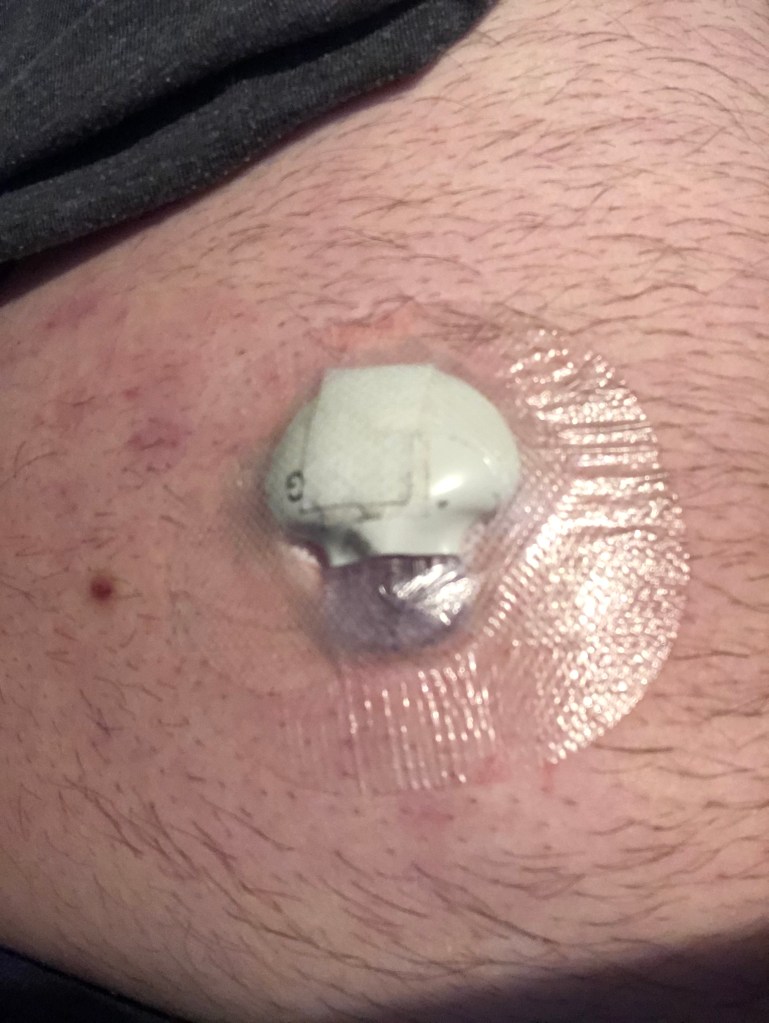
I started CGM last week. For those of you who may be unfamiliar, CGM stands for Continuous Glucose Monitoring, and it’s a device that measures my blood glucose levels every five minutes and communicates them with my insulin pump. In some ways, it’s the same as my FreeStyle Libre, with the exception that my FreeStyle doesn’t communicate with my pump.
Although having a device that instantly tells my pump whether it needs to suspend basal delivery because of a low and maintain a better percentage of “time in range,” it stands to reason that a more complicated device will theoretically have more issues. And I have found this to be true with CGM. The FreeStyle Libre has been good to me overall, providing little in the ways of problems and interfacing with my phone for a quick, easy means of checking my blood sugars.
When I started the insulin pump in early 2015, I was resistant to CGM. Hell, I was resistant to the pump itself, but the medical professionals through my work kept “encouraging” it, and since they were footing the bill I figured, why not? And no, that isn’t a brag about the fact my pump was covered by my medical insurance. I’m well aware that most people don’t have that benefit, so I’m grateful rather than bragging.
But given the potential violence of my work, I felt that it wouldn’t be ideal to have a device hanging off my gut, around the clock. I also didn’t want to feel tethered to a machine, having grown up watching my brother hooked to machines all his life. I conceded to try the pump, but I refused the CGM as it would be a second module attached to the body and I felt as though one was enough. I mean, come on! Life with Diabetes is difficult enough without turning myself into a cyborg, am I right?
Hello, CGM! Welcome to the party! (Pointing out my freckle is not necessary, thank you!)
My endocrinologist did it right; sneaking the FreeStyle Libre into my life, calling it the “poor man’s CGM” (although it’s far from being cheap, by any means) and allowing me to get comfortable with the prospect of a second device on my person. I have been using FreeStyle for about two years now, and with the advent of my new pump that I started mid-March (Presenting, The Medtronic 670G), I decided to stop being such a stubborn princess and try the CGM that my pump is designed for. (Don’t get any ideas, I’m the only one allowed to call me a princess… And maybe my wife…)
So, here are the problems… Because this is me, and of course there are problems… The first glucose sensor I installed at my pump training failed within hours. Either from a faulty sensor or from scar tissue (which I’ll be covering the day after tomorrow) we don’t know. But it was a pain in the ass, nonetheless. Installing the sensor is tedious, involving more steps than refilling the insulin pump AND using enough adhesive to make Red Green‘s duct tape jealous. (If you don’t know who that is, click on the link and I apologize for aging myself so severely)
This happened last Monday. I was frustrated and I already felt as though the CGM would cause more problems than it was worth, so I shut the option off on my pump. I’m also a bit old school and it takes me a while to put the fate of my well-being in a machine I’m unfamiliar with (Not today, SkyNet!). On Tuesday, I went cycling with a friend and felt it wasn’t a great day to re-install, so I went without it. On Wednesday, I realized that I was actively avoiding it, so I installed a new sensor and started the whole thing up.
I also needed to demo the installation for my wife, who will be the one helping me install it on my tricep, should I decided to use that as a potential site (cue the naughty nurse jokes, here.) Here’s the thing: it’s been helpful. I’m eating an entire murder of crows admitting this, but having the ability to simply glance at my pump screen and see my trends and know what I may be currently sitting at has been nice. Also, my pump is set to automatically suspend my basal rates if I hit 4.0 mmol/L, making it a whole lot safer for me at night. Now, I just need to see how the device will hold up to extreme exercise or cycling, and how I’ll handle a punch to the gut when I return to karate, for the jury to fully have a verdict.
I guess my point behind all of this, besides pointing out how stubborn I am, is that although we don’t have a cure for Diabetes yet, technology has carried us lightyears beyond where we were in the early 80’s when I was diagnosed. When I think about the brick of a glucometer I used to carry around, only testing my blood once a day, “eat no sugar” being my only mantra and the fact that I was excused from most if not all sports due to the fact that “Diabetes makes it dangerous to play sports…” Pffft… what bullshit! If I only knew then what I know now. But I digress…
My point is that we’re getting there. Different technologies are at least making Diabetes manageable in ways it never could be, before. Will we have a cure someday? Like a significant percentage of the Canadian population, I sincerely hope so. I just don’t know if it’ll be within my lifetime. In the meantime, I’m well on my way to becoming a cyborg. ☯
Way back at the end of the greatest decade ever… the 80’s, in case you’re wondering… I met an individual who would change and improve my life. In fact, I would go well beyond saying that he’s saved it, on more than one occasion. I am speaking, of course, of the subject of this week’s inspirational individual: My Sensei, Jean-Guy Levesque.
Sensei began his martial arts journey right around the same time I was born (ironic, isn’t it?). He worked in my home town of Dalhousie, New Brunswick and began studying the art of Judo at a young age. Although he achieved the rank of black belt, he never quite felt as though Judo was the right art for him. This would be where he did his research and discovered an Okinawan style of karate he wanted to pursue. The only problem was that it wasn’t taught in the Maritimes back then.
He found a teacher in Boston, of all places. Sensei packed up his red mustang and left his wife and newborn child behind in order to travel to the U.S. and pursue his martial arts ambitions. He travelled to Boston and found himself under the tutelage of Sensei Robert Blaisdell. At the time, Sensei Blaisdell was taken aback by the Canuck who randomly landed at his doorstep, seeking karate lessons. In fact, Sensei Blaisdell tried to convince my Sensei to seek out a teacher back in Canada as it made no sense for him to travel to Boston several times a year to maintain the skills he would learn.
Sensei wouldn’t be deterred and continued to travel to Boston regularly, eventually reaching the rank of brown belt. At that point, people in my home town of Dalhousie started asking Sensei to teach, which he did, opening his first school of karate in the attic space of an old Catholic School convent. He named the school the New England Academy of Karate & Judo, a name that ne can still see adorning some of my gear to this day.
Sensei and I in 2007
Sensei grew in skills and rank, and starting climbing the black belt ladder. He’s taught hundreds of students in the North Shore of New Brunswick. He fathered two children, a daughter and a son; both of whom have studied karate under his guidance. Sensei became THE leading source of self-defence and discipline back home, and was known as the karate no one stuck with, mostly due to the severe level of discipline and commitment required to keep up with the curriculum.
I walked into his dojo for the first time in early 1989, months before I would celebrate my 11th birthday. I had been diagnosed with Type-1 Diabetes six years prior. I was dangerously underweight, I suffered from severe insulin resistance and had already been through a number of comatose events in the previous years. My parents didn’t want me joining karate and were unaware that I was attending class, having left the house on the premise that I was simply going for a bike ride.
Due to my poor health, Sensei could have easily turned me away, claiming that I wouldn’t be able to keep up or train with the class. But instead, he chose to take me in, guide me, train me and help me develop. Over the next year, my health and blood sugars improved, my appetite and my mass increased and I began to hold my head up as opposed to being the quiet, withdrawn ghost that most only noticed when they needed someone to pick on.
Throughout the decades, Sensei has been a mentor, teacher, guide and father figure. He’s given me advice on almost every aspect of life and has helped in all areas of my growth. he’s taught his students with only the bare minimum of tuition fee, the strict minimum required to keep the doors open and the lights on. He has never charged any of his students for belt tests, additional training or even the physical belts themselves. His tutelage has always been about the art and never about the profit, the way any traditional teacher SHOULD be.
A few years ago, after more than forty years of teaching, he closed the doors to his dojo due to rising rental costs imposed by the local school board for the facilities he used. He now trains in private in a small dojo built into his home. He still trains with a couple of the students he once had, but it’s mostly on a one-on-one basis.
Sensei continues to be an inspiration to me because he sought out to pursue his dreams of learning karate and did so, regardless of the obstacles he faced. He managed to build a career and raise a family while doing it. We should all be so dedicated and committed to something. Even if we now live more than two thirds of the country apart, we communicate often and he continues to train me. I’m still learning from him. I don’t anticipate that will ever change. An email here, a photo or video clip there; he continues to add to my puzzle of a million pieces… One piece at a time. There are many who would say that I improved my life through my own efforts. Although they would right, I likely wouldn’t have made it with a lesser instructor with less dedication. Domo Arigatoo gozaimashita, Sensei! ☯
I’m sure we’ve all been there… Or at least, I have! You’re standing in line somewhere, perhaps a retail location, grocery store or the bank. The person behind you is basically at your heels, forcing you forward until you’re almost on top of the person ahead of you. Then it happens; the person behind you coughs or sneezes. Maybe they cover up properly. Maybe they don’t. Even IF they do, you may still be faced with the prospect of a fine mist of someone else’s bodily fluids impacting with the back of your bare neck and onto your clothing. Whatever typhoid they may be carrying makes its way into your pores and then you spread it all over the bloody place by dragging it along on your clothing…
Lovely, eh? As disgusting as that prospect may sound, we haven’t even discussed what the terminals, debit pinpads and counter at the location may be carrying as a result of people like that. And having someone essentially riding the spot on your shoulder where your conscience should be also puts you at risk for having less-than-trustworthy folks watching for your debit pin as you pay for your purchase. It may sound pessimistic (and maybe it is) but this happens far more often than we care to think about. And speaking of thinking, that’s exactly what this concept has had me doing recently…
As the world slowly begins licking its wounds amid the lovely beast that is COVID-19, some of society’s strict quarantine measures are beginning to slacken. But as I’ve recently seen from my excursions into the urban wilds to obtain groceries, plenty of people are still wearing masks and gloves and washing their hands despite these requirements no longer being in place. And despite some industries re-opening their doors and some measures being lessened at essential ones, place markers are still present on the floors and directional arrows can still be seen for circulation in the aisles.
Will these things ever go away? A better question is, should they? All things considered, I’ve always felt that maintaining an appropriate distance in public lines has always been important. Not only for hygiene but for personal safety. I’ve often found myself asking the person behind me to take a step back when using my debit and/or credit card. I’ve gotten mixed responses to this, ranging from “sure, no problem” to “go fuck yourself.”
I don’t think I need to clarify that I’m a firm advocate of frequent hand washing, especially if you’ve read any of my posts related to hand washing. But I don’t think that frequent hand washing should have only become a “thing” because of the current pandemic. It’s something that everyone should have been doing all along, for their own personal health and to prevent the propagation of germs.
Masks and gloves are a different story. The first problem is that people need to understand that wearing gloves doesn’t protect you much beyond the immediate moment. Even medical professionals and first responders switch up their gloves often and between patients, so when you see someone using a pair of rubber gloves ALL FREAKIN’ DAY, it becomes easy to forget that whatever you pick up on those gloves stays there. And unless you switch them up, you’ll just spread that stuff the same as you would with your bare hands.
I get a kick out of the photo I’ve seen online, where there’s a man standing in line to pay for groceries. He’s got a face mask hanging off his chin and he’s eating what appears to be a small bag of chips. The joke is he’s eating the chips while wearing latex gloves intended to prevent the spreading of germs and protect himself. But I digress…
Masks are particular, since they’ve been explaining that it’s mostly to protect OTHERS since the beginning of this whole thing. And in fact, many countries have a large percentage of the population that have been using face masks all along. A neat YouTube video I recently watched, entitled Why Do Japanese People Wear Masks? is a good example, as the interviewees reveal reasons ranging from everything including having a cold and not wanting to spread it, to simply not liking the way they look. And that video was released in 2017, well before the advent of COVID-19.
I’m no boy in the plastic bubble, but some health and safety practices should have been implemented as a general part of daily life a long time ago. Maintaining one’s distance from the people ahead of us is a practice that people should have been doing in the first place. So, as strange and unusual as all of this may have seemed in the beginning, will social distancing become the new normal? Are we all going to develop a reflex for staying far away from the people in line with us and learn to distance? It will be interesting to see how society learns to adapt and adjust once it returns to “normal”… ☯
I’m a big fan of including variety in my fitness routines. Besides martial arts, I like to include cycling, running, swimming and various forms of cross-training. In order to maintain one’s health and fitness, it’s of the utmost importance that one works on various aspects of physicality. I’m usually not one for specifically endorsing one product or another, especially since I consider my blog to be a forum for passing on information that can be interpreted freely by the reader, without direct influence.
Despite that fact, I’d like to share a 21-day DVD workout plan that I’ve used on several occasions. I’m referring to the 21-day MetaShred. Created by BJ Gaddour, it includes 9 workouts over 21 days and boasts unique workouts that never repeat themselves over the course of those 21 days. I first got it after seeing it featured in Men’s Health magazine and decided to order it. I’m usually not one for “fad” workouts, but I’ve done the full 21 days on a number of occasions and I have to admit that it never disappoints.
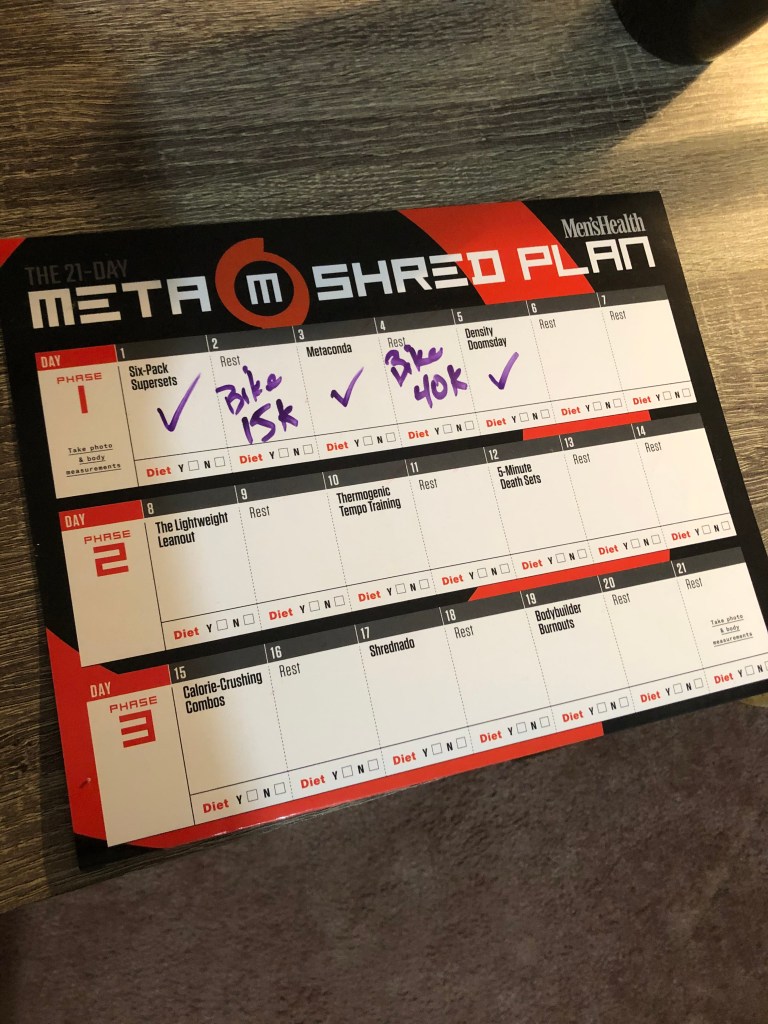
It’s been a few years since I ordered it, and I can’t seem to find a link to ordering it here in Canada. But I know that you can find the program on E-Bay, Amazon and various other online shopping forums. It includes a box with 3 DVD’s (3 workouts per DVD), a reusable water bottle that I use for cycling and a dry-erase 21-day calendar to track your progress and what workouts you’ve been doing.
As you can see from above, I recently decided to get back into MetaShred. I’m not one for sitting still, so I’ve been including my cycling between the actual workout days. Each workout is only 30 minutes, making it extremely manageable. My wife has joined me on some of these workouts often. It’s a nice way to work up a sweat when you need a change from your usual routine.
There are a lot of popular DVD workouts available on the market. I’ve tried some different things like Insanity, P90X and Body Beast. MetaShred just happened to be the one that suited me and works best with what I’m trying to accomplish. One of my friends has (or had) P90X and I’ve done a couple of those workouts with him, but I found the movements awkward and uncomfortable. My best suggestion would be to find friends, associates or co-workers who have some of these workouts and see if you can either join them or borrow the kit so you can try it for yourself.
They say variety is the spice of life. I’ve heard that on a number of occasions and I’ve often found it to be true. Don’t be afraid to branch out and try different things. on the road to fitness, there are very few wrong turns. ☯





 The Blogging Buddhist