What Would You Do With Freedom, If You Had It?

Freedom can mean different things to most people. For some, it means “financial” freedom, whereas one has enough money in the bank to be clear of debts and not require employment to survive. For others, it’s simply NOT being locked up or imprisoned. But in general, it means having the ability to act, speak or think without constraint. It’s being able to go where you want, when you want and do what you want. And I think that we can agree that the vast majority of people who live in North America have that freedom, to varying degrees.

I don’t think I really need to point out that 2020 has been an absolute shit show for the entire world. In fact, some would argue (myself included) that COVID-19 has acted as an ultimate equalizer, since the virus does not discriminate and can be contracted by anyone of any age, race or gender. But we’ve seen a wider variety of people catch the virus than we would have originally thought possible at the beginning, including politicians, celebrities and the elderly. And the effect is that many if not most people feel and are of the opinion that they are losing their freedoms.
It’s been an increasingly stressful time, especially for those who are separated from those they love. One good example is my mother, with whom I speak to on a weekly basis. Yes, yes, I’m a momma’s boy and call my mother often. I’m also an only child, and father to her only grandchildren. So keeping a positive connection is important, one way or another. My father currently resides in a nursing home, where he’s been for about ten years. He voluntarily placed himself there after it became clear that my mother didn’t have the physical capacity to take care of a 330-pound man in a wheelchair.

For the most part they’ve been able to make it work, with my mother renting a small bachelor’s apartment next door to the nursing home and being with him everyday. Then, along came COVID-19. My father’s nursing home has been locked down ever since, despite the fact that many others in the Province of New Brunswick have reopened their doors (intermittently, depending on the status of their cases). This is an affront to my mother, who compares my father’s residence at the home and her inability to see him to being locked up in a prison.

I may have a bit of a jaded and subjective point of view, but I don’t know many prisons that have hardwood floors, picture windows with a view of the bay and serve customized meals, three days a week. But that’s just me. The sick and elderly are among the most vulnerable, and the choice to keep the care home’s doors closed to the public is a clear result of not wanting to potentially spread the virus to every resident there. The irony is that my mother COULD visit my father. The care home is allowing immediate family to visit on an appointment basis, with restrictions in place allowing for no longer than thirty minutes and requiring social distancing during the visit.

One would think that this would be good news. I would consider it so, since I’m on the other side of the country and can’t see my parents regardless of conditions. But my mother refuses to visit my father in this fashion, feeling that they don’t pay the money that they do to be kept separated from one another. It doesn’t matter that no individual has the right to make the choice for other residents and potentially introduce the virus into their environment. She simply refuses to take advantage of what’s offered because it isn’t what she wants.

Don’t get me wrong, I love my parents and I’m simply using them as the most familiar example I can use. But the point is that when this whole mess started, we all foolishly thought the world was grinding to a halt for 30 to 90 days and then things would go back to normal. Oh, how wrong we were! 9 months later, we’re still dealing with restrictions, imposed mandates and the constant yo-yoing on local and Federal governing agencies opening things up then taking them away again as soon as an outbreak happens.

What’s been the most disheartening, is people’s reaction to doing what’s necessary. A blanket attitude of basically not giving a shit has gripped society by the gonads and seems to be keeping a firm hold. People still balk at the very notion of wearing a face mask. I’ve fallen down many a YouTube hole where people have claimed and tried to get out of wearing masks in public places because of medical conditions, despite health professionals publicly declaring that the only conditions that would make wearing a mask impossible would be so severe that the patient wouldn’t be out and about. Customer limits and home school requirements, social distancing and the inevitable folding of privately owned businesses… I wasn’t kidding when I said that 2020 has been a shit show.

The problem is that people hate to be told what to do. You can take a family that’s financially poor, struggles to make rent and has to swallow their pride and accept charity, access food banks and hand-me-down clothing and they’ll do what’s necessary. But tell them they must lawfully wear a face mask while during their weekly Walmart run and all hell breaks loose. Like I said, COVID-19 has been, among other things, the great equalizer.

For my family, it hasn’t changed a great deal of much. My employer has had me at home for almost two years now and my wife works from home. The only significant change was this week, when my son began remote learning due to an outbreak in our local schools. My wife and I weren’t happy about the change, but we complied and adapted as it was necessary to continue my son’s education. But otherwise, the bills get paid, there’s food on the table and we’re taking advantage of being able to spend so much time together.

For those who chose to complain about the government, mask and isolation requirements, consider the following OBVIOUS facts: If this were all a conspiracy on behalf of the government, I’m sure they would chose a much better method of control than making someone wear a paper-thin mask on their face. Things may seem bleak now, but it will only be through the passing of this virus that any of us can hope to experience a normal life again. ☯
yin-yang-4

Help Me To Keep This Permanent!

My content may be free and I absolutely love providing it, but my time is not! I’m trying to make a go of it as a full time writer but obviously, everyone needs to get paid for the time they put in. Your donation to this blog can mean the difference between seeing daily content or wondering “whatever happened to The Blogging Buddhist.” Help me keep this permanent. Any small donation helps and will not go unappreciated.

CA$5.00
Self-Care Doesn’t Mean Self-Importance

Taking proper care of yourself is one of life’s top priorities. This is true for any person, but especially true for someone suffering from Type-1 Diabetes. Although you can certainly find medical practitioners to help you navigate the complicated labyrinth of medications, treatments and methodologies required to properly balance your Diabetes, the ownership of your care ultimately falls to you. And even when people are fully aware of this, they very rarely recognize and acknowledge it.

In order to be healthy, you need to be happy. In order to be happy, you need to be healthy. As Sensei would say, these two go hand-in-hand and it’s very difficult to truly have one without the other. Over the years, I’ve found myself sacrificing my wellbeing for the betterment of others, often going as far as damaging my health, exhausting myself and/or making myself sick. Although sometimes duty, honour and obligation requires it, it’s pretty difficult helping others if you first don’t help yourself.

So what does self-care look like? I don’t necessarily mean taking your medications or frequently testing your blood, although these are every important. I mean the self-care that includes one’s mental wellbeing as well as the physical. For example, did you know that if you’re tired in the middle of the day and decide you want a nap, you really don’t need to explain yourself to anyone? (Unless you’re at work, in which case I don’t recommend trying it. And if you do, please don’t name drop me…)

In order to illustrate my point I’ll provide two examples from my personal life, which took place some years ago. The first is work. I don’t think I need to to explain that work is a necessary part of modern life. Unless you happen to have been born into a wealthy family, most of us are forced to punch a clock and usually contribute somewhere in the range of 2,100 hours a year to help line someone else’s pocket. When I used to work for a certain popular franchise, who shall remain nameless for liability reasons, I let myself fall victim to my attempts at being an all-star.

Although not always the case, most employers are not only more than happy when an employee goes above and beyond, they come to expect it without any form of additional remuneration or praise. If you happen to be a prospective go-getter, this plays havoc with your health. This was me, up until a little over a decade ago. I would never miss a shift, driving in dangerous, inclement weather, going in to work when I felt ill and even going as far as passing out twice on the job, to be brought to the hospital for diagnosis, only to return the next day.

Despite the fact I was in management (and in light of that fact), it really gave me no benefit to be sacrificing myself this way. I ignored critically low blood sugars, worked through bleeding polyps and even did the work of two people when I was short and couldn’t replace them. And it wasn’t until I finally put my foot down and tried to call in sick that I got the ever-popular retort from my boss. I’m sure you’ve all experienced it; it was a dialogue that went a little something like this:

ME: “I won’t be coming in today. I’ve been ill all morning…”
BOSS: “Well, just how sick are you? I need you for tonight’s shift.”
ME: “Sick enough that I don’t feel I should be coming in to work…” (Bearing in mind that Canadian Labour laws take a dim view of an employer asking about ANY medical condition, my answer was more accommodation than was required)
BOSS: “Alright, fine. I’ll see if I can replace your shift. I’ll call you and let you know.”
ME: “Let me know what?”
BOSS: “Whether I can replace your shift or not!”
ME: “Why do I need to know that?”
BOSS: “Because if I can’t replace your shift, I need you to come in…”
ME: “Maybe I’m not being clear. I’m calling in sick. I won’t be in tonight.”
BOSS: “Well, if you’re going to be like that, you’ll have to bring me a doctor’s note.” (Also against the Labour Code)
ME: “I’m not going to a hospital! I just need to get some rest and I’ll probably feel better tomorrow. THAT part, I will let you know…”
BOSS: “If you aren’t sick enough to go to the hospital or see a doctor, then you aren’t sick enough to miss your shift.” (Also not a permissible statement, unless you HAPPEN to have “M.D.” after your name, but what do I know)

Any of my readers or followers from back home can probably guess at what employer this was and would likely be nodding their heads furiously right now. But given my propensity for picking my battles, I would foolishly go into work despite feeling like absolute shit. I can’t tell you the number of times I’ve worked through a shift with frequent trips to the washroom where I would accommodate either end of my anatomy (Enjoy getting THAT image out of your head). Was it worth it? Definitely not. It didn’t result in a pay increase or any advancement to my career. All it did was cause damage to an already damaged body. Not smart, on my part.

The next story is about relationships. For the most part, relationships on their own can be rough and challenging waters to navigate, especially when dealing with someone who has little concern or understanding for your wellbeing. This brings me back to my earlier comment about napping. You all know that I’m a big fan of napping, but for this story, I’m referring to the need for actual sleep.

You see, as an adult, there really isn’t any reason why you should have to explain yourself, should you decide you’re tired and want to go to bed. Tired means tired, and is about the farthest thing from selfish that I can think of; next to needing rest from illness. But this was something of an alien concept to the woman I will identify simply as “Ex” (my ex-wife).

Ex had a nice, cushy daytime job, 9 to 5, Monday to Friday. I worked shift work, which often included overnights. This is not to say that she didn’t work hard AT her job, the issue mostly arose from her time at home. The scenario would involve working overnight and getting off work at 6 a.m. By the time I’d get home, it would be closer to 7 a.m. and I would sneak carefully into bed as to not wake Ex. But one’s circadian rhythm can be a bitch, and she’d often wake up less than an hour later, despite being on a day off.

Now, one would be inclined to think that any reasonable person would understand that someone who’s worked throughout the night would need more than an hour or two’s sleep. Not Ex. She’d wake me shortly after she’d have breakfast in order to “get the day started.” When I’d argue that I needed a solid period of proper sleep because I had to work overnight again that night, it would be met with argument, including but not limited to the fact that I “was not to waste her entire day off sleeping.” Nice, eh? There’s a reason WHY she’s an ex.

I’ve provided both these scenarios, not because I wanted to complain about these two negative aspects of years past (despite the fact that venting about it was kind of nice), but to point out that both these scenarios wreaked havoc on my health, my blood sugar levels and even my mental wellbeing. The stress and anxiety associated with always having to explain yourself for things that should be an understandable requirement of physiological survival can have permanent repercussions on your sense of self-worth, value and confidence.

That’s why it’s important to take time for yourself and do things that are uniquely for yourself. Have that nap. Run out to grab a coffee. Take an hour a day to meditate or work out. None of that makes you selfish, it simply guarantees that you’ll be in a better state of health and a better state of mind to help take care of the daily grind, whether that includes family, work or whatever. And should you encounter an obstacle in your life that prevents your self-care, whether work or personal, that makes them a cancerous cyst that you need to down a shot of whiskey and quickly slice off in one quick swipe. You’ll be all the better for it. Surround yourself with people who will not only accept your needs, but will encourage them, as well. I know I did. ☯

It Won’t Happen On Its Own…

The past couple of years have been particularly hard on my family and I, with work difficulties wreaking havoc on our future, my family living on the other side of the country and my father almost passing away a few months ago. My father has been suffering for years, and he feels that his passing would be a relief, but what would be particularly tragic is the fact that I would be unable to be there for my family due to the pandemic, should it happen. That, and the fact that he’s never met his second grandson, Alexander.

That’s why in the midst of all the pain and difficulties, it’s important to be happy. People walk through life, often aware that they aren’t happy but do nothing about it. An important lesson of life that people tend to forget about is the fact that happiness is a practice, not a given. It won’t happen on its own, it’s something you have to take active steps in order to achieve.

Now, I could blabber on about my usual go-to’s, how exercising regularly, maintaining a healthy diet and working on personal goals will all help to promote happiness. And these things are all true, don’t get me wrong. Keeping your fitness levels up releases a whole mess of crap inside your body that will make you feel good on its own. Getting a full night’s sleep and being well-rested will also be of great help. But ultimately, you should be trying to do one little thing that makes you smile, every day.

Personally, since I’m a YouTube addict, I’ll usually try to watch a motivational or inspirational video every morning. My thinking is that if I can start my day by seeing something positive, it will tip the scale and arm me with the positivity I need in order to tackle the negativity of the day I may face. This doesn’t always work, but for the most part, I’m successful in putting a grin on my face. This morning for example, I watched a video posted by a YouTube channel called “The Dodo” of an obese dog losing half its body weight to become healthier. It’s a small thing, took only a few moments of my time and made me smile. I’ll link it below:

Sometimes I’ll do something as simple as sit there and watch my 1-year old (who doesn’t quite walk yet) stand on his own two feet for a full minute because he’s so occupied with the toy he’s holding that he doesn’t realize what he’s doing. Then he notices he’s standing and suddenly can’t maintain balance and flops down onto his rump. Heartwarming and entertaining. Other days, it’s as simple as watching two squirrels frolicking on the tree outside my kitchen window while doing dishes.

My point is that there is still plenty of reason to smile, one simply needs to look for it. And with the current state of the world and one’s personal circumstances, it becomes important to work diligently at one’s own happiness. It won’t happen on its own. And you’ll come to find that when you’re happy and in a good mood, others around you may be a little brighter as well. Happiness can be contagious. But it’s a practice, not a given. ☯

Confusion Can Be Good

I like to think that one is never too old to learn something new. The prospect of being unable to “teach an old dog new tricks” is something of a myth, as is the concept I’ll be speaking about today. I’ve spent decades believing this was actually a thing, and incorporating it in many, if not most of my workouts. I’m referring to a term known as “muscle confusion.” The term, which is arguably not a scientific one, describes the act of changing up your workout routine frequently in order to “confuse” your muscles in order to prevent hitting a plateau.

But how effective is it? I’ll admit that I’m a really big fan of variety in one’s workouts, if for no other reason than to keep things interesting. But if I’m training in something, I’ll keep at it until I master it. A decent article posted by Men’s Journal explained it best by saying, “One big problem with the muscle confusion principle is that you don’t spend enough time working on an exercise to really master it. It’s like training to ride a bike one day, then a skateboard the next, and then rollerblading after that. Your skills on the bike aren’t really going to get better.”

Traditional karate is really big on repetition in order to master movements, techniques and fitness methods. As Ziad K. Abdelnour once said, “Don’t practice until you get it right. Practice until you can’t get it wrong…ever.” So there’s heavy importance in doing things properly. But I would be lying if I said that we often have tons of material and new techniques piled on at the same time. But the way to prevent or get past hitting a plateau is simple: increase your weights, increase your time and push yourself harder.

An article I just read by HealthLine.com states that the theory of muscle confusion is just a myth, created to help propagate popular fitness programs. The article goes on to say that muscle confusion is hype when compared to other fitness theories that are grounded in science. I highly recommend reading the article; it has some really good information.

So despite the fact that I’ve been on board the muscle confusion train for years, every reputable source that I’ve found seems to agree that it’s a myth and the better method is to remain consistent. At the end of the day, there’s nothing wrong with changing up your routine. It’s especially important to experience new fitness routines and programs, if for no other reason than to keep things interesting and have some fun. Your chances of reaching your fitness goals will increase exponentially if you enjoy what you do. ☯

Take A “Shot” At Some Facts…

It’s no secret that people have been enjoying the added opportunity to partake in, shall we say, “adult beverages” during this whole pandemic thing. I’ve jumped on that bandwagon myself, allowing my repressed inner teenager who never got to enjoy a drunken evening out with friends in his youth to indulge a bit as I generally have nowhere to go, nothing to do and no reason to worry, should I find myself a touch over the legal limit.

So acceptable has become the hobby of enjoying a daytime drunk, that most Provincial governments have elected not to close licensed premises for fear that the alcohol withdrawals will cause an overabundance of strain on the health care system. And this is probably accurate, if we’re being true and honest. But I’m not here to discuss the pros and cons of alcohol consumption or its continued sale throughout the pandemic. I’d here to focus on the consumption of alcohol for someone who has Diabetes. Of any type.

First and foremost, I’d like to point out that every person is different, as is their management of Diabetes. Everyone’s journey is unique, despite the condition being similar. Some of this will apply to all the types and subtypes of Diabetes, with some only applying to specific ones. For example, should you have Gestational Diabetes, I pray to the Light that you aren’t consuming alcohol. But that’s a totally separate issue. Since I’m Type-1, that’s the one I’ll mostly be focusing on.

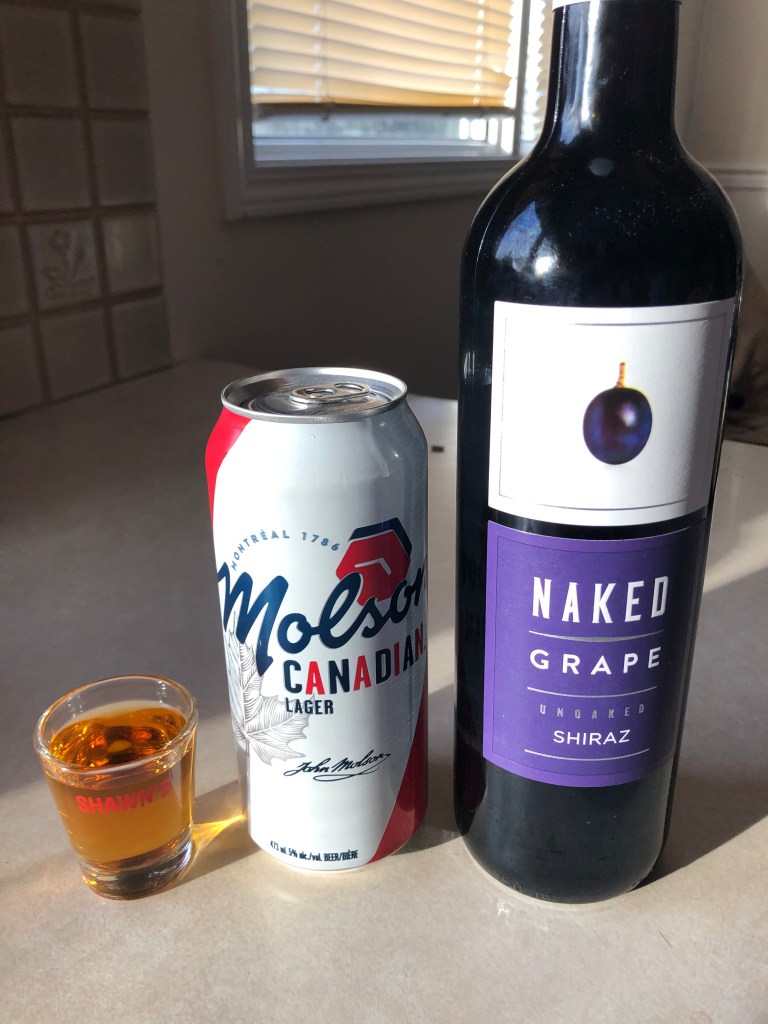
Let’s start with some basic nutritional information. Alcoholic beverages contain carbohydrates. There are some spirits or “hard alcohols” that find themselves sitting at the 0 carbs level, but most bottle drinks you purchase at your local store will contain some, if not a lot, of carbohydrates. Although every blend, type and amount will differ, I offer the following comparison through the use of a photo I took a few days ago:

Spirits, beer and wine

Now, ignoring the fact that I had all three of these items available on a sunny afternoon in order to take the photo, I’ll ask the following question: Which of these contain the most carbohydrates? Most people would likely think it would be the shot (it’s FireBall, BTW). This would be a natural conclusion, since most flavoured liquors are loaded with sugar. But believe it or not, you would be wrong. I’d like to point out that I’m using these three specific drinks/brands because they are what I had on hand and are no reflection as to whether one should consume these brands or not. This is just for educational purposes.

Let’s start with the shot. The average shot glass is approximately 1.5 fluid ounces. A small bottle (375 mL) contains approximately 10 shots. I contacted the parent company who makes FireBall and was informed that a shot sits at approximately 11 grams of carbohydrates. 11 grams, for a tiny gulp that does nothing more than burn the throat! This means that the entire bottle sits at about 110 grams of carbohydrates. Not that one would necessarily drink an entire bottle… Although I did experience this last year, as explained in my post A Decade Of Blood, Sweat And Literal Tears…, FireBall is not something typically consumed in large quantities. But it packs a solid carb-punch!

Next, we’ll discuss the beer. Believe it or not, the beer has the most carbohydrates per single drink. Sitting at approximately 25 grams of carbohydrates (this is not specific to the brand illustrated in my photo) per can, it can make having a six-pack pretty difficult as it totals at 150 grams of carbohydrates. This can range anywhere from 20 to 28 grams, depending on the brand and blend of beer you drink. It also tends to fill you more.

Finally, the wine. Ah, my beloved wine… Although nothing close to being a connoisseur, I do enjoy tasting the different blends of wine and comparing them. What’s nice is that an entire 750 mL of red wine averages between 12 to 15 grams of carbohydrates. For the entire bottle! Since one whole bottle sits at less than one shot of spirits, I tend to favour wine. Also, it’s important to bear in mind that white wine will contain significantly more carbohydrates red. But since I’m a Malbec or Shiraz man, I don’t have to deal with that issue.

If we quickly do the math, FireBall sits at 0.25 grams of carbs per millilitre. Despite the wallop packed by a can of beer, it’s only 0.05 grams of carbs per millilitre. The red wine is the big winner at the lowest amount, sitting at 0.02g/mL. Per mill, the wine is still the lowest. Per expected drink, the beer is the highest. It all depends on whether you’re having a casual drink or planning to drown your woes.

Most of this could easily be interpreted as useless facts, but the take-home lesson is that any alcoholic beverage you consume will require some blousing and calculation on your part. If you have Diabetes. Moderate alcohol consumption will likely result in increased blood sugars if you don’t bolus correctly. However, a heavy night of drinking will likely lead to hypoglycaemia, since alcohol will inhibit your liver’s ability to release glycogen and your body won’t receive the glucose it should.

These are just guidelines, but there’s a pretty good chart that’s put out by Diabetes Canada. It provides information and guidelines about the consumption of alcohol if you have Diabetes, as well as some baseline carb counts for the majority of drinks. These are guidelines only, and you should lean on your specific drink’s nutritional information combined with your specific insulin sensitivity to deal with all of it. As usual, moderation is key. Consume safely, my friends. ☯

200 Followers!

Sometimes, it’s the little things in life that can bring a smile to your face. When I started this blog in February of 2019, I did so because I had shut myself out from all sources of social and traditional media. I did so, because an incident through social media in my workplace threatened the safety of my employment. And in fact, still does. I felt that I needed something to help keep my mind sharp and my skill to research and creatively write intact. I would like to think that I’ve been successful in that regard.

I started by sharing the blog with the few people I had direct contact with. They liked and followed and before I knew it, some of their friends started following, other bloggers started following, strangers looking to read about Buddhism, martial arts and Diabetes started following. I’ve seen some blogs with thousands, even tens of thousands of followers. 200 may seem like a small number, but I consider it to be 200 people who are interested in what I write. And that’s no small thing.

I’ll take a break from my usual long rants and soapbox opinions today. I think maybe I’ll go sledding with my son. But as I step forward into a new day with another small milestone in regards to my blog, I need to thank everyone who’s followed me, as well as everyone who has inspired and given me ideas on how to produce content. Last but not least, I need to thank my wife, who not only puts up with my shit but puts up with me isolating myself into my little corner to write everything that I do. If you’ve enjoyed the blog, suggest it to others. I intend to keep this train rolling for a LOOOOOONG time… ☯

Fill ‘Er Up, Please!

One of the bigger problems in regards to fitness, especially when you have Diabetes, is the consumption of food in tandem with your workouts. There’s nothing I dislike more than having an hour earmarked for a workout, only to realize that my blood has significantly dropped and I have to treat the low before doing anything. This often (although not always) results in a feeling of being full and depending on what you’ve eaten, mildly bloated and is not conducive to a productive workout. So this begs a question: Is it better to work out on an empty stomach?

There are a few schools of thought on this, but none of them provide an easy answer. In my mind, I’ve always thought that working out without eating first was an easy way to ensure that your body used its stored fat as a source of fuel and help to trim down. But the flip side to this is that one needs energy in order to effectively exercise, and depending on one’s fat stores is not as effective a way of doing this as having food in your system. So, which perspective is the correct one? I call it “perspective” because in my experience, their preference is one that’s adhered to by most people, regardless of the information provided.

According to an article posted by the Mayo Clinic entitled Eating and Exercise: 5 Tips to Maximize Your Workouts, “studies suggest that eating or drinking carbohydrates before exercise can improve workout performance and may allow you to workout for a longer time or at a higher intensity.” It goes on to say that not eating may result in sluggishness or light-headedness. If you workout in the morning, ensure to have finished your breakfast for at least an hour before exercising.

The article touches on portion size, explaining that large meals should be eaten three to four hours prior to exercising, with smaller meals being eaten one to three hours before a workout. Snacks effectively won’t provide any energy if you have them immediately before a workout, especially if your workout if less than 60 minutes in length. The article also makes two important point about eating AFTER a workout in order to help your body recover and repair itself, as well as staying properly hydrated. Which you should be doing, anyway.

According to what I’ve read in relation to the body’s fat stores and how they’re used, if you’ve fasted before a workout, you’re essentially guaranteed to be in calorie deficit, leading to the burning of fat. This is because the body’s only available fuel source IS your fat stores, if you’ve skipped a meal before exercising. And that’s all well and good, so long as you monitor your blood sugars and make sure you don’t crash from low levels, depending on the type of workout you’re doing.

If you’re doing a shorter workout, an empty stomach likely won’t affect performance. A quick, 30-minute workout over your lunch break won’t send you into a frenzy. But if your workout is one or even two hours long, working out on an empty stomach can lead to a whole bunch of nasty symptoms like dizziness, light-headedness, nausea and will likely make you drag your ass throughout your routine. Better to have something to eat prior to a long workout.

No matter what your preference is (and it should be based on your preference), the important takeaway is to make certain to eat after your workout to aid in recovery, stay hydrated and make certain that whatever you do doesn’t interfere with proper blood sugar control. At least no more than exercising usually does. One issue I’ve often had with karate, is that weekday classes have ALWAYS been around the 6 to 6:30 pm timeframe, meaning I might be in the middle of digesting supper when we start up. That’s when you want to ensure that your meal is light and easily digested, otherwise you’ll inevitably face difficulties during class.

In closing, I’ll point out that most sources have stated that even if working out on an empty stomach promotes the burning of fat as fuel, it may not provide the amount of fat reduction a person is looking for. But being in a calorie deficit is the only genuine way to truly get slimmer. Also, there’s no way to focus on just ONE area. For example, you can’t do hundreds of crunches for the purposes of burning belly fat. That’s a myth. Your abs will get strong enough to crack walnuts, but your fat stores will burn equally throughout your body. ☯

Brotherly Love

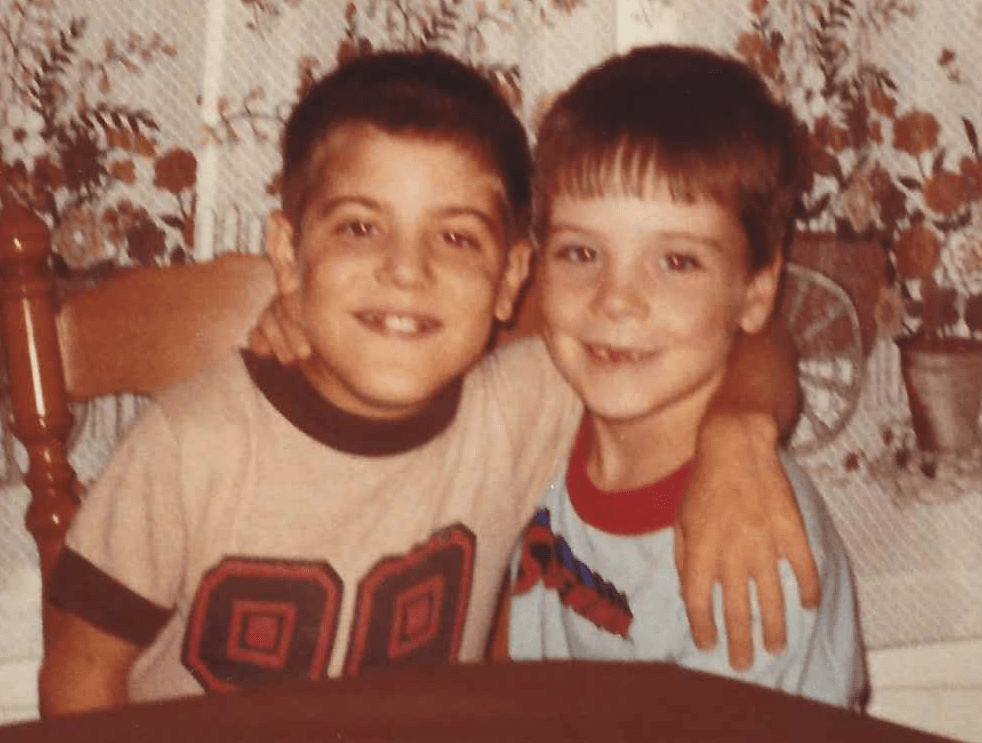
My brother and I. He was 12 in this photo, believe it or not.

Today is always a bit of a difficult day for me. It’s my brother’s birthday. Born on December 3rd 1972, he would have been 48 years old today, had he lived. Born with both kidneys in failure, epilepsy and fanconi syndrome (Google it!), he didn’t survive to see his 19th birthday. Despite all his health problems and constantly riding the rail between life and death, he was always quick to a smile and always ready to tell his family he loved them.

I was 11 or 12 years old when my brother passed away. They say that when someone loses a limb, they’ll often feel pain in that limb. Like a phantom pain, gone but still felt. This is how it’s been for the past 29 years. My brother may be gone but I feel the pain every day, like a phantom limb. Gone but never forgotten. Happy birthday, bro. ☯

Don’t Fall Asleep While Reading This…

Naps are awesome. In many ways, I prefer napping over a nighttime sleep. If you think about it, going to sleep at night is a requirement. You’re basically forced to put yourself into a state of unconsciousness for seven to nine hours every night in order to maintain your health and keep from going insane. The how’s and why’s behind that can be a post for another day, but my point is that napping is a choice (mostly). It just fells cozier. And one usually makes the decision to curl up on the couch or lounger for an hour, or even a single bed, which is conveniently in your living room because you no longer have a room in the basement. But I digress…

There are a number of potential benefits to grabbing a quick snooze. According to an article I read on The Mayo Clinic‘s website, napping can help with relaxation, reducing fatigue, increasing alertness and improving mood and performance. Considering that many people find themselves stuck at home day after day in recent months, the possibility of adding naps into one’s daily routine is a definite possibility.

Given that my 6-year old son goes to school five days a week and we have an infant who typically naps twice a day, my wife and I have fallen into a routine where we usually join him on at least one of those naps. Problematically, it has gotten to the point where we experience pretty hefty fatigue towards the dinner hour if we haven’t managed to get OUR nap in, which can be a bad thing despite the benefits of napping.

I’ve checked with a number of different sources and leaned on all my usual go-to’s (WebMD, HealthLine.com and The Mayo Clinic) and they all pretty much make the same recommendations:

  1. Don’t nap for long durations: If you nap long enough for it to start looking like a full night’s sleep, it’s not napping anymore. Most sources recommend no longer than 30 minutes to an hour, with one post indicating no longer than 20 minutes. Screw that noise. And hour is normally my preference, otherwise I feel there’s no point;
  2. Don’t nap past 3pm: This is a tough one for me, because I have a tendency of sitting on the couch in the late afternoon and suddenly BAM! I’m out like disco. But napping past 3pm may interfere with the upcoming nighttime sleep;
  3. Nap in a restful environment: Ever try to nap in an airport while awaiting a flight? I have! It usually results in waking up feeling like a bag of smashed ass, coupled with severe bodily pain due to those uncomfortable termination seats. Travelling is one example of when one may not have a choice, but if you’re napping at home, be sure to do it in a calm, quiet, restful environment.

Having a nap can be a an effective way of boosting work performance and improving your chances of furthering your career. In fact, an article posted by the Japanese Times (I couldn’t find the damn article again in order to link it) explains that a growing number of Japanese companies are making possible for staff to grab quick snoozes at the office in order to help manage their health and improve productivity.

Of course, the average Japanese employee only sleeps about six and a half hours a night, so there’s that. But I certainly wouldn’t object to having a sleep pod in my office in order to close my eyes for thirty minutes over lunch. That would certainly help get me over my usual afternoon slumps. But the Japanese have turned to creating nap rooms and having sleep pods in their break rooms. Innovative bunch, those Japanese. I mean, hey, they created karate, so that was a foregone conclusion…

Naps are okay. They don’t mean you’re lazy and they don’t necessarily mean you’re lacking sleep. But they are a good way to plan ahead and stave off the effects of “expected” lost sleep, especially with things like shift work or getting up frequently with babies. But if you find yourself in a situation where you simply CAN’T get through the day without sprawling for a couple of hours, you may want to consider speaking with your doctor about it. Certain prescription medications will not only make you groggy but could potentially be interfering with your nighttime sleep, resulting in the requirement for a nap.

Consider also, that if you have a genuine sleep disorder such as insomnia, night terrors or depression to name a few, it can leave you feeling exhausted the following day. One should also avoid the boomerang effect where you don’t sleep well at night so you nap, which results in a bad nighttime sleep. Wash and repeat. Now if you’ll excuse me, I need to wear out the baby so he’ll go to bed. Daddy needs a nap! ☯

Push, Improve, Self-Motivate…

I grew up around a lot of ‘roid heads who would constantly pound their chest and brag about their athletic prowess. The joke is that many if not most of them would go to practice once a week and call themselves an athlete. Considering that my home town is in Northern New Brunswick, that usually involved hockey. Hockey and I have always had a bit of a love/hate relationship. Maybe it’s because they always thought they were the kings of the school. Maybe it was because many of them became bullies. Maybe, just maybe, it was because most of them made fun of karate but were still crazy enough to try out…

By the time I had improved and progressed enough that I was starting to teach newcomers, I had the pleasure, cough, cough,… I mean the responsibility of showing these bulky bastards why karate may not be for them. Not all of them, mind you. Just the ones that were known to be bullies. Sensei had no tolerance for that shit and I had even less, especially since I had at some point been the object of their bullying attention. But I’m digressing pretty bad, since the subject of today’s post isn’t bullying. I’ll save that one for another day. Today’s post is about calling yourself an athlete when you go to a one-hour practice, once a week. That thing.

Karate, and in fact martial arts in general, is a very special creature in terms of the kind of commitment you need to provide. If you show up to karate once a week for a one and a half hour practice and then call it a week, you may CALL yourself a martial artist but you’re a far cry from what that term really implies. One of the most important aspects to learning martial arts properly is showing up for every class. Early. And every time.

I remember a particular summer, I think it was 1995. I was 17 at the time and had my own vehicle (self-purchased, thank you very much). It was a particularly hot summer afternoon and a few friends and I decided to grab a swim in a location known to us as the south-east forest. There was a cold river with running water, which was perfect to fend off the summer heat. We had gotten there in the late afternoon and had a blast. Swimming, laughing and joking around, it was the very picture of what a teenage summer should involve. Then, I checked the time…

I noticed that karate class started in about an hour and a half. It would take about a half hour to get home and grab my gear, followed by fifteen to twenty minutes of travel time to get to the dojo. Pair this with the fact I always tried to be in class at least thirty minutes early to stretch, warm up and assist white belts, it made for a sudden urged panic to leave the river and get going. My friends were not impressed. In fact, the girl I was dating at the time was visibly angry at the fact I was cutting the pleasant outing short, just to go to class. The worst part is she was in karate as well. Go figure.

Consistency and commitment are key. This applies not only to karate but to all martial arts and in fact, any sport or hobby you choose to undertake. When I moved to Regina and joined the local Kenpo school, I made a point of attending every class even when it felt tedious, the classes may have been boring or not in keeping with what I wanted to be working on. And that’s what it takes to be a martial artist. You have to be consistent and show up. Every class. Every time.

I have no regrets. I know that a lot of the people I knew spent their free time out with friends, drinking and partying, enjoying their youth before the rigours of adulthood dropped a weighted veil across their eyes and stunted their freedom. I chose to spend my evenings training and building myself up. In a lot of ways, I believe that had I failed to do so, I might have succumbed to Diabetes a long time ago.

Sensei’s classes had a very specific way of running. Students would show up thirty minutes before class, stretch and warm up. Then, the class would be two hours. TWO HOURS! No water breaks, no washroom breaks, no checking your damned cell phone! Your ass was grass from 6:30 pm until 8:30 pm. Some beginners were permitted to leave at the one-hour mark, but all the same restrictions applied, regardless. When class ended at 8:30, many of us would stay in class for at least another thirty minutes, asking questions and practicing techniques.

The most committed of students spent a minimum of three hours in class, three times a week. This was paired with jogging, cycling, weightlifting and practices on the beach on our own time. We were true knights of the martial way. It was glorious. Hey, that sounds like it would make a great movie intro. But seriously, it’s a far cry from the students I see these days that walk into the dojo a minute before opening of class, finishing their Tim Horton’s coffee and chatting on their phone, muscles cold and lagging as they start. It’s a sad state of being. You gotta be committed. Every class. Every time. ☯