We’re Only Human

We all get old, eventually.  It’s one of those few uncontrollable aspects of life that none of us can escape.  We can, however help to alleviate what happens as we age.  Most of this involves having good eating and fitness habits and staying away from the nasty things that can potentially bring our existence to an end.

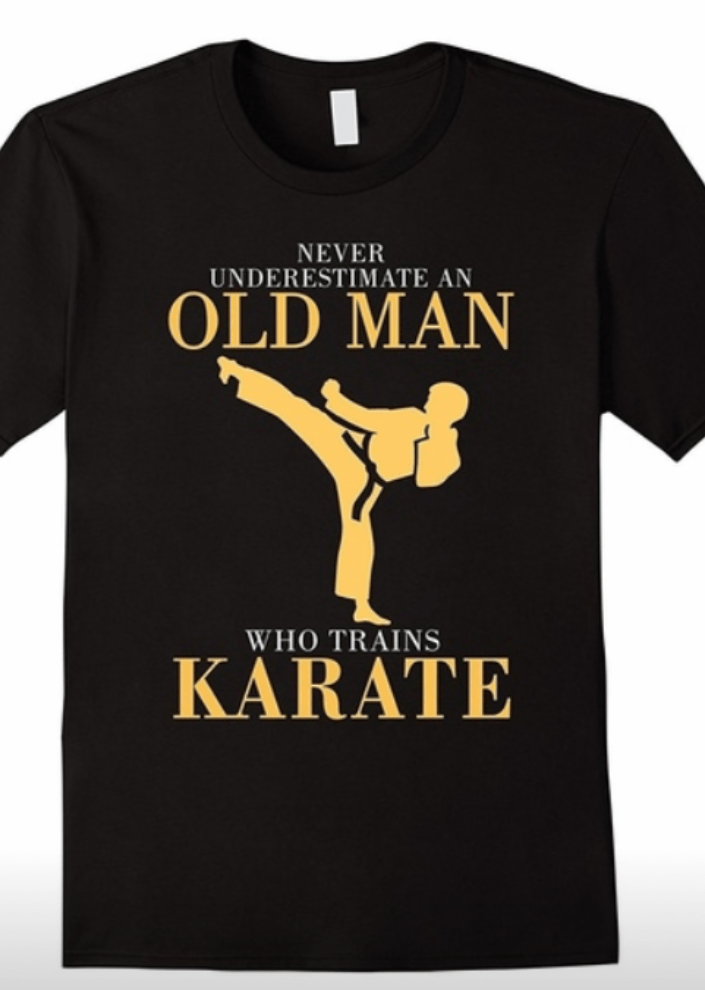
Don’t get me wrong, I have no illusions of being “old” per se, but some age is often felt rather than gained.  I have to admit that in recent years, my blocks have gotten a bit slower, my techniques a little sloppier and my ability to get up and go has got up and gone (Yes, I just referenced an earlier blog post of mine!)

The shirt I just got yesterday

It really doesn’t take a great deal…  A few too many break days, skipping meals or lack of sleep and your health can easily start to fall off the rails as you get older.  This is especially true for Type 1 Diabetics who depend on a proper balance to keep things in check.  And balance really is the key!

Start by getting proper rest.  The average adult requires between 7 to 9 hours of sleep every night.  As long as you’re getting it all at once (unlike me, who occasionally cluster naps) it should go a long way to helping you rejuvenate yourself.  Many of your body’s systems are working at resetting and/or resting while you do. This is one of the reasons why you shouldn’t eat heavily before bed.

And while we’re talking about food, make sure you’re getting your three meals a day and that they’re properly balanced with vegetables and proteins to help with muscle repair and growth.  It’s okay to have some cheat days now and again, as long as you don’t go overboard.

Last but not least, get some damn exercise.  Even when you’re sore, tired and just plain fed up… it gets exponentially worse if you just sit back and do nothing.  You have to keep moving.  Movement is life.  Even if you just start by doing some light stretches first thing in the morning, it’ll help to get the blood flowing, make you more alert and start your day off properly.

All of these points become increasingly important as you collect more birthdays. Muscles become less flexible, joints are less limber and if you don’t keep up with everything, you may find yourself seizing up. ☯

“Sight” Is More Than Just What You See…

The room is dark, impossibly dark.  The only light comes from a small 40-Watt black light that almost causes my white karate gi to glow in the gloom…  My eyes can’t adjust and I can’t see a thing.  There are audible creaks in the floorboards, telling me that I am not alone in the room.  I sit still, trying to let my ears, nose and skin “feel” the room.  My legs are braced and my hands are posted. I close my eyes, since I can’t see anything anyway.

Then I feel it: an almost imperceptible movement of air against my skin…  I instinctively block, but I’ve miscalculated.  Something strikes at my calves and I fall to the floor.  I roll out of the way before the strike I know is coming drops down on my chest.  I turn and post in the direction of the attack but nothing reaches my ears but silence. Then, something strikes my head. Suddenly there is too much light as all I can see are stars fluttering in the darkness.  I can feel my body twist around as my head snaps from the punch…

Once again, my other senses try to fill in the gaps of information caused by the darkness; a light movement of the air and a rustling of sanforized cotton coming towards me.  I block and feel the strike of another person’s limb against my arm. Without through, I grip the opposing limb and throw out a focused front kick that impacts against something that feels like concrete.

“Enough.”  The lights come on and I’m temporarily blinded by the sudden change.  I see my Sensei standing there in a dark, black gi, removing a black face mask that covers everything but his eyes.  My head is ringing from the punch he delivered and I’m grateful that the lesson is over, despite the impression it left…

That was a sparring match I had with Sensei almost twenty years ago.  Most of us are limited by the visible light we see around us. We rarely consider that the world exists, whether the light bounces off of it or not.  This means that the world can still be perceived if we’re willing to open our other senses to it.

No, I’m not gifted with some mystical skill and I wouldn’t bet sure money I’d win a fight, fought in total darkness.  But because of the light that surrounds us, we often take our other senses for granted. There is so much of the world that can be opened to us if we acknowledge our other senses; our hearing, sense of touch, sense of smell…

Don’t forget that the world doesn’t exist because of the physical light that allows us to see it.  If you open yourselves up to the other possibilities, you’ll be surprised at what you may have been missing. ☯

All About The Books, But…

It’s been a quiet few days and all things considered, it’s good to take a step back and let your mind cool and relax a bit.  This is not the easiest task in the world with a newborn and a destructive 4-year old in the house.  But one of my very favorite hobbies just happens to be reading.

I’ve tried not to limit myself in regards to what medium I use when I read.  I have an e-reader, my laptop, my smart phone and I share a collection of several hundred books (likely close to a thousand if not more) with my wife.  Our books cover just about every genre imaginable to some extent or another.

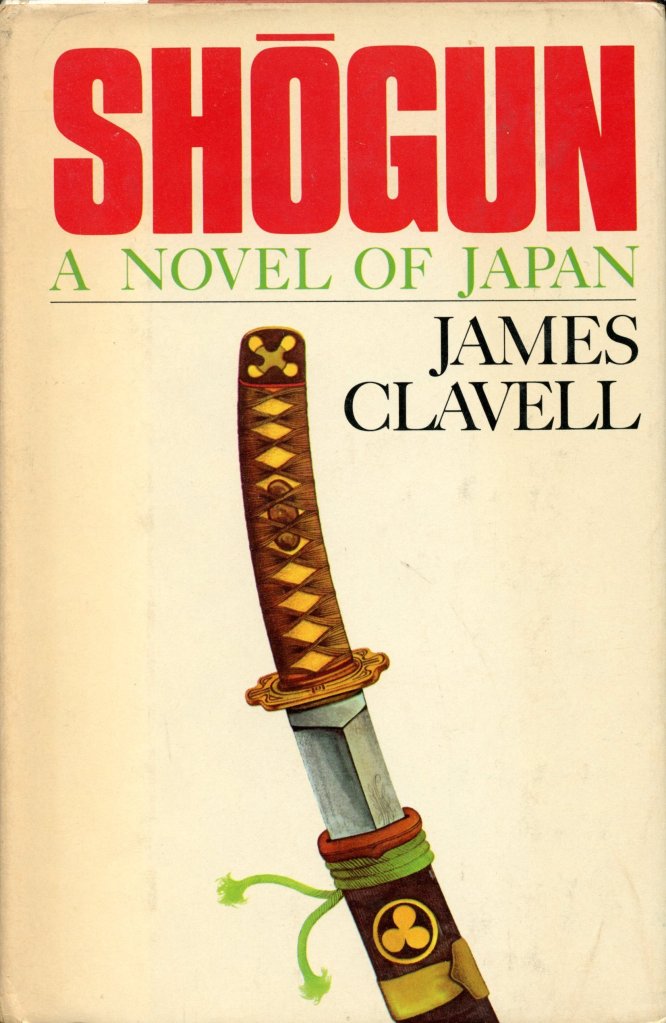
But the book I want to talk about in this post is James Clavell’s Shogun.  Written in 1975, it’s the story of a Dutch ship that gets lost during a sea storm, only to land in feudal Japan.  The English pilot, John Blackthorne, ends up befriending many of the samurai and daimyos and becomes a trusted advisor to one of the local Regents who retains him as a trusted advisor.

Cover of the 1st Edition, which is the one I originally read.

The book is quite lengthy and I read it for the first time in the mid-90’s.  When I eventually made my way to Japan and subsequently Okinawa, I had the opportunity to really appreciate how accurately the book portrayed some of the Japanese culture and how many similarities Clavell included in the novel.  The novel is about 1200 pages long, but if you’re looking for a solid read, I would highly recommend it.  I’ve read it three times since first picking it up, and the rich story allows for something new to be noticed every time I read it.

The book was made into a television miniseries that was a little over 9 hours long, in 1980.  I didn’t discover it until years after the first time I read the book.  I’ve always been a touch leery about movies based on books, considering how much they usually shave away from the full story of the book. But the television series covered just about everything as accurately as possible.  It was impressive, considering the lack of special effects and such in the early 80’s.  They also released a 2-hour feature length movie, but if you’ve seen the mini series, the movie pretty much sucked.  They cut out so many important details it no longer resembled the actual book.

I focus on this book because the story covers many aspects of life that I hold dear.  This includes aspects of Buddhism, martial arts and Bushido’s code.  But whatever genre of book you enjoy, reading helps to reduce stress, has a calming effect and can even lower blood pressure and help you sleep better.  Not least of which is the fact that it allows a person to stretch their imagination and explore worlds that would otherwise be impossible. ☯

I Practice The Way Of The Empty Hand, But I’m Not Always Empty-Handed

For the most part, when people ask me what martial arts I study, I tell them I do Karate Do, or the Way of the Empty Hand. “Karate”, as it’s known in the Western hemisphere, is a striking art that predominantly includes punching, kicking, knee and elbow strikes as well as a variety of blocks and open hand techniques (hence the name).

Although different schools will tell the history differently, all karate is descendent from Chinese martial arts.  This is a hard reality.  In fact, karate was create and adopted on Okinawa in the mid to late 1300’s, after large groups of Chinese families moved to the Ryukyu Islands and introduced aspects of their culture, including martial arts.  There have been some mild exceptions, such as the originator of my style having migrated to China and studied with the monks, who subsequently taught him the style of Kung Fu he brought back and adapted to become a style of karate.

But before I get lost in a history lesson, many schools of karate include the use of weapons, but they mainly focus on empty-hand fighting because, well… karate MEANS “empty hand”!  But there have been a number of weapons incorporated over the decades including, but not limited to the tonfa, bo staff, sai and nunchaku.  But the primary style I’ve studied over the past three decades, Uechi Ryu,has not included the use of weapons.

So what do you do if you find yourself in a self-defense situation where your opponent has a weapon in his/her hand?  Sure, it’s great to have confidence in your hands and feet but let’s be realistic: if someone swings a baseball bat at me, I’d feel a lot better if I could block it with a similar weapon (especially if getting the hell out of there isn’t an option).

An aspect of my martial arts training that I have rarely spoken of, is my weapons training.  I’ve always been a firm believer that one must focus one’s attention on one style at a time.  But realistically, should you be lacking a piece to this puzzle, you should make every effort to fill that gap.  That’s what brought me to Kendo.

Without slipping into ANOTHER history lesson, Kendo or “The Way of the Sword” is a Japanese martial art that focuses on the use of the sword.  It is a descendent of Kenjutsu.  The carrying of swords by the samurai and warrior class was outlawed in the late 1800’s during the Meiji Restoration, but police and military were still permitted to carry a sword. In an attempt to try and standardize the style of sword techniques that police would use, certain techniques and forms were uniformly adopted, and this birthed the art of Kendo.  More or less.  There’s a long history involved, but it’s too long for me to write all of it.

Back in 1994, I began studying the sword under an instructor back in New Brunswick. I had a couple of options, such as a local school of Kobudo,which is the Okinawan style of weapons training.  I felt this would be a good addition to my repertoire, since I was studying an Okinawan style of karate anyway.  Made sense, right?  But the multiple weapons and all their associated forms and techniques left me confused and I quickly lost interest.  It flew in the face of my belief that one must focus on one aspect in order to master it.  So when I found the Kendo school, I was enthused.

I studied for about 11 years, if memory serves correct.  During that time, I was exposed to techniques, forms and strengthening exercises that used the sword.  I thought a sword was pretty badass, if I’m being honest.  I had the benefit of focusing my attentions on one weapon, and it was a cool one.  If you think about it, most civilizations have had swords included in their history at some point.  So it was a fluid and practical weapon to learn.  My parents even bought me my first sword, as they had learned their lesson many years before about how effective “forbidding” me to study any fighting art had been for them.

I also considered it the best weapon to adapt to non-bladed situations.  What I mean by this, is if I find myself in a self-defense situation, the Kendo techniques can be applied to just about any length of material I wrap my hands around; a stick, broom handle, a pipe… anything!  In fact, even though it’s been almost 20 years I still remember enough of my Kendo training to apply some of the basic concepts to the kali sticks I use in Kendo while doing escrima.  And one of the defense tools I use on the job also allows for the application of Kendo techniques, even if it is not a sword.

So yes, it’s always best to focus your attentions on one style of martial arts at a time.  It’s exceptionally hard to master techniques from multiple style at the same time. Eventually, the techniques and forms begin to blend together and become convoluted.  But there’s nothing wrong with allowing yourself to keep an open mind to other possibilities.  And supplementing one “type” of training with another is certainly not a bad idea either. ☯

Shut Up, Kryptonite!

In all my travels, I’ve yet to meet someone who isn’t at least VAGUELY familiar with Superman.  Even folks who aren’t into comic books and such will have at least some idea of who this iconic superhero is.  And why wouldn’t they?  Incredibly powerful, but still noble and true…  The best of all things with none of the bad.  Truth, Justice and the American Way… (you’d never guess that Superman is actually Canadian!)

But my point is, as strong and powerful as Superman may be, he still has a weakness: Kryptonite.  Able to weaken and even kill him, kryptonite was the one thing that Superman could never overcome.  And even though it’s a comic book, there’s an important lesson, there.

The importance behind how hard you train should be directly related to the fact that no matter how strong or skilled you get, there will always be someone stronger.  That’s just a fact of life.  But by giving your training the maximum effort you can muster, you ensure that you can continue to grow and progress, and should the day ever come that you face an opponent, your odds of getting out in one piece are much better.

One good example of this is Diabetes.  Diabetes is my kryptonite.  It weakens me, leaves me vulnerable and gets in the way of even some of the simplest joys in life.  But I’ve trained and conditioned myself for decades to overcome and outsmart my kryptonite. And through training, education and help from the appropriate healthcare professionals, I’m much better prepared to deal with it (even though at times, it still weakens me!)

Sometimes overcoming our weaknesses means taking steps and pursuing treatments that we personally don’t approve of.  I can certainly attest to having been prescribed medications or been put on diets or treatment regiments that I haven’t liked or wanted to do. But sometimes getting over one’s kryptonite requires swallowing our pride, and recognizing that it’s for the greater good.  It’s not a weakness to accept these treatments or the help that comes with them.  In fact, recognizing that you need the help and accepting it takes more strength than we usually care to acknowledge.  Especially if you find yourself in a life situation where there are many loved ones who depend and count on you.

There are always ways to be fit, get stronger and stay healthy.  The trick is finding what works for you, then sticking with it no matter whether you like or not.  Because no matter what personal kryptonite you face today, there may be bigger fish to fry tomorrow. ☯

Go With The Flow

Energy is a strange thing.  We can’t see it, under most circumstances.  We fail to acknowledge its presence and some even doubt its existence. But everything is made of energy. From the eraser on your pencil to the very core of your physical being, it’s all energy!

George Mattson, a karate practitioner from the United States, once wrote, “A workout should be like a painting.  Each one has a characteristic of its own.”  The meaning behind this is that a classroom workout is much like a painting as well.  Each and every student is a separate characteristic of the class as a whole and lends one more piece to the workout.

Each and every student in the class affects the overall tone of the workout.  Think about it; have you ever participated in a class where the instructor was less than motivated?  Maybe he or she had a low, baritone voice with no enthusiasm behind it…  You can easily guess how motivating THAT would be to the students.

The same can be said about the students themselves.  If every student doesn’t put forth their best effort, they drag on the overall energy of the class.  The top students will no doubt put forth their best effort and potentially raise the bar, if you will.  But it’s up to each and every student to put in his or her maximum effort.

We all have bad days.  Some days we may be feeling ill, tired or simply lack the motivation to give it our all. This leaves us with two options: dig deep to find the energy needed to get through the night’s training, or take a break and stay home.  There’s no shame in that.  Everyone needs a break on occasion, so long as it doesn’t become extended or start interfering with your overall progress. ☯

“Strike First. Strike Hard. No Mercy!”

Ah, who didn’t enjoy the original 1984 movie The Karate kid?  I was six years old at the time, and starting get into the martial arts groove.  The movie described a scenario where the underdog was able to train and develop himself to become a champion, a scenario that pretty much described me to a T (minus the champion part, but I still trained and developed myself).

A new series came out last year called Cobra Kai. It takes place thirty-four years after the events of The Karate Kid.  If you haven’t seen it, I highly recommend it, especially if you grew up in that decade.  It airs on YouTube.  The Cobra Kai had a slogan in their dojo: Strike First.  Strike Hard. No Mercy.

Depending on what side of the argument you fall on, some people believe that the protagonist in the movie was the ACTUAL villain for winning a tournament against the antagonist with an illegal kick to the face (I won’t apologize for providing a spoiler to a movie that came out thirty-five years ago!)  No matter what way you chose to view their story, the Cobra Kai’s slogan holds a reasonable level of merit.

First and foremost, I don’t agree with the “no mercy” part.  I believe that being merciful shows us our humanity and sets us apart from the evil we like to pretend doesn’t exist.  But the concept of striking first and striking hard is an important one in the martial arts.

I often like to compare most martial arts aspects to real-life scenarios because, well… the real world is where you would have the most practical and violent application of whatever fighting art you may be studying.  We want to avoid these types of confrontations as much as possible, but should they happen we need to be prepared to respond.  After all, why do we train so intensely if not to protect others and ourselves?

A lot of fighting styles teach students certain techniques that are intended to stun and/or surprise the opponent in order to allow the student to deliver the power strike that will end the confrontation.  A good example of such a technique is the jab.  Throwing a jab at someone allows you to set yourself up for the second power punch.  That’s a cute concept on paper (or in the dojo, I guess) but what if the only strike you get against an opponent is the first one?

I wrote a post some time ago about the actual length of a fight in the real world, and what the realities of such a fight usual are.  So here’s some enlightenment: in a real fight, you’ll have a chance to deliver one, maybe two strikes before you either get struck yourself or need to get the hell out of the way!  That’s it!  The concept of a long, drawn out battle where both participants are blocking and exchanging blows for long periods of time simply doesn’t happen.  

First of all, unless you’re a professional fighter who trains to fight for long periods, such as a boxer, you’ll become exhausted within minutes.  Fighting tires you out, and doing it in the streets when it isn’t planned or expected can be even worse.  And since the idea is to simply end the threat so you can get out of there, more than a few strikes will usually decide whether or not you’re going to be the victor or if you need to run.

That’s why it’s important to make every strike count.  If you intend on doing a “one-two” combination, both strikes should have equal force and power.  If you only have time to deliver one strike, you want it to be as powerful as the second one was intended.  It only makes sense.

Although you want to try and avoid physical confrontations as much as possible, if there is no other option and you get backed into a corner you want to make sure you avoid injury and be the one to get home safely.  Strike first and strike hard. ☯

F = ma

Ten years ago, I was training with a couple of colleagues and we were using boxing gloves and punching bags.  As I led them through some drills, one of the guys I was training with asked me how it was that I could strike with such force and veracity, considering I was about the same weight and size as he.  I ended up explaining the concept of what makes an actual strike within the martial arts…

You see, a strike is simply a strike.  This is true of any fighting art, but the reality goes much deeper than we assume. I’ve seen 90-pound “weaklings” deliver a knockout punch to individuals many times their size and mass.  I’ve seen “behemoths” that couldn’t throw a proper punch to save their lives.  So what makes the difference?

The formula I’ve used for today’s title is one of the fundamental formulas of physics. Basically it means that Force is measured by multiplying Mass by Acceleration.  The layman’s explanation for this formula is that is doesn’t matter the size or power of the object performing the strike, provided the acceleration and technique are correct.

Think about it for a second…  If I palmed a 9mm bullet and tossed it at you, you’d likely look down at where the bullet struck and wonder what was wrong with me.  It’s nothing but a tiny piece of brass, affixed to a metal shell filled with a small amount of gunpowder.  However, if I accelerate that bullet to the 1500 feet per second that it comes out of a pistol, suddenly you find your life in jeopardy.  It’s the same concept with a punch or kick.  It doesn’t matter whether you’re tiny or a massive weight lifter (except the bulky weight lifter likely has trouble moving freely).

Once you recognize these facts, performing powerful strikes becomes child’s play. So long as you factor in proper technique, bone alignment and stance, your strikes will become more powerful, regardless of strength or power.  But it takes practice.  Much like anything else, you have to be taught the proper way and then… practice, practice, practice! ☯

Allow Me To “Weigh” In On Your Fitness…

Time is a fleeting thing. It’s the one commodity that humanity can’t create or make more of, so when we run short of time it tends to be firmly and distinctly out of our control. But despite that fact, the amount of time we have in a day is fixed. So one would be inclined to think that we would plan and organize our day based on that fact. At least in regards to most people’s fitness routine, this is rarely the case.

“I don’t have the time…” This has to be, hands down, my favourite excuse. And my most hated one. And it is an excuse, because no matter how hectic your day may be, no matter how busy your schedule, there is ALWAYS a small period of time somewhere in your day that will allow you to work on your fitness. Wake up five minutes earlier in the morning and hammer out ten push-ups, ten sit-ups and twenty five jumping jacks. That’s it! Start with that. Granted, that won’t get you ripped like some of the athletes you may see on television, but it will jump start your day, encourage and increase blood flow, get your metabolism started and help you through the rigours of your day.

I was visited by an old friend recently, one who works in the same field as I do. It was an unexpected visit and I hadn’t seen him in months going on a year’s time. We stepped down to my basement where I have an open area I use as an at-home dojo/workout area. I sat down on a futon that sort of slants downward towards the backrest. It’s only moderately comfortable and sometimes requires effort to get off of.

I will freely admit that a person’s weight can be attributed to a number of different factors and is rarely ever the first thing I notice on someone. But considering that my friend looked markedly different than he had months prior made it a difficult fact to overlook. He and I took one look at the futon and both realized simultaneously that if he sat in that thing he wouldn’t be able to get up from it unassisted. He opted instead to have a seat on the solid weight bench I had placed next to the couch. The back was raised at better than 45 degrees and made an adequate alternative. As he sat, his gut bulged out from between his items of clothing. His breathing seemed slightly laboured and his pants appeared to be strangling parts of a man that should never be strangled (if you get my meaning).

It was heartbreaking. This man had done karate with me in his teens, back in New Brunswick. He had played hockey, golf and spent summers camping and kayaking. He took stock of his positioning and realized he could breath easier if he sat back and relieved the pressure on his abdomen.

I have this personal policy about never asking someone about their weight and/or fitness unless they ask, but considering I’ve known this guy for most of his life, I felt I needed to offer some advice. I asked him what he had been doing with himself in recent months. He replied by telling me about his work schedule, time spent camping with his family and what game his favourite hockey team was in.

I let him go on for a few minutes and when he was done, I said, “I think you know that’s not what I mean… What have you been doing to get yourself into shape?” The fact I said “get into shape” and not “to keep in shape” was not lost on him, and he cast his eyes downward to the floor. I told him that my intention wasn’t to make him feel bad or shame him, but considering his line of work, being in good, fit physical condition was rather important. He essentially explained that he worked long shifts and that when he got home, he just wanted to crash on the couch and do nothing; a feeling that as a Type 1 Diabetic, I know all too well. He also explained that while home, he contributed his time to his significant other and he didn’t feel he had time to workout. Boy, what a self-destructive way to think…

Folks, there will always be something getting in the way of proper fitness. Especially if you let it! Whether it’s your work, your family or just sheer fatigue, something will ALWAYS be there to prevent you from achieving the fitness level you need. Not necessarily the fitness level you want, but the one you NEED! You gotta move, folks! You can eat twenty pounds of kale a week, and I promise you that your health will still falter if you don’t get yourself off the couch and get moving!

Remember the formula I’ve blogged about in previous posts: everything living has some form of movement. Movement creates energy. Energy sustains life. You can’t have one without the others. There are days that my Diabetes has me so exhausted I have difficulty getting myself off the bed. When blood sugars run rampant and adjustments have to be made, all I want to do is curl into a tight little ball and go to sleep. But giving myself that extra little push of determination, I’m able to make my way to the scheduled karate class, or lift some weights, or bring my son around the neighbourhood on the bicycle.

The trick is to understand that fatigue and pain are temporary. But a faltered health that jeopardizes your health and overall life may be quite a bit more difficult to come back from. Most people think that once they get in shape, their work is done. Nothing could be further from the truth. Ultimately, it’s not enough to reach a certain level of fitness; you also have to maintain it. And in order to do that, you need to get off the couch and get at something. You can still watch your hockey game, but maybe do it on a stationary bike or with some free weights. Get your kids and your spouse involved! Speaking from experience, my wife has hammered through a number of workouts with me. She’s a trooper! And of course, my son mimics every little thing he sees me do, so that part is usually easy.

Make a start. That’s it, just start! There are tons of “body weight only” workouts on the web that you can download, so buying equipment and weights isn’t even necessary. As my brother in law has often said, “why put off until tomorrow the workout you could do today.”

“But I Don’t Wanna Train With A White Belt…”

Some of the masters in Japan used to have a saying: “Black belts don’t sweat.” Not only is this an incredibly inaccurate statement, it’s an ignorant one as well. Reaching black belt level is genuinely only the tip of the iceberg and the beginning of one’s in-depth training in the martial arts. My Sensei used to say that passing your black belt test was a way to finally and formally ask your Sensei to teach you karate. That perspective always stuck with me.

But the sweating perspective is one that has been circulated and that I’ve heard on occasion during my time in Japan. What I have found over the years, both in Japan and in Canada, is that advanced students will often have a stigma against students of a lower rank. Especially white belts.

Some schools have an established standard in which green or blue belts will take time to provide introductory instructions to new students and white belts. This is reasonable, since black belts and the head instructor are likely to be smaller in number than lower ranked students. So for the most part, it’s a matter of structuring. Which is fine.

The problem begins when one holds any sort of stigma against lower ranked belts simply for the sake of their inexperience. I’ve seen some advanced belts who have made their feelings clear, “my forms and techniques are way too advanced to be spending time with a white belt…” Terrible, terrible…

I’m reminded of a story that originated out of a school related to my style, in the United States. They put on a seminar and were teaching a variety of techniques and weapons and students could partner up or work alone and learn a little bit from every station. At one point, an older gentleman (I wouldn’t begin to guess at his age) came into the dojo wearing a white belt. He began stretching and warming up, and I noticed a number of younger students chuckling among themselves and making jokes. It seemed the majority of students were of the opinion that the man was too old to be starting karate and that his presence at the afternoon’s class was a waste of time.

We paired off for some light sparring at one point and a green belt was left with the old white belt as a partner. It was almost like one of those scenarios where you get chosen last during a dodgeball game… You could tell the green belt felt pretty confident about his odds and squared off with a smirk in his face.

I won’t bore you with the play-by-play of how the match went, but I will tell you this: the old white belted man kicked the living s&*t out of the green belt and made him yield! We came to find out that the old man was actually a master from Okinawa who had attended the seminar. He had a personal philosophy against the ranking system and chose not to wear a black belt. The look on the green belt’s face was priceless.

The lesson here is that there is always a lesson. That is to say, no matter what rank one holds, you can always learn from someone higher. You can always learn from someone lower. Some of the best lessons I’ve learned have come from training with lower ranked belts. Especially since their lack of experience often provides an unpredictability that we often don’t get, through structured martial arts. In the real world, things won’t always be structured and will rarely be rehearsed. So take the lessons where and when you can get them, and don’t be afraid to give up some of your time to teach when needed. In fact, the martial arts ladder requires it. You only get what you’re willing to give. And don’t forget that at one time or another, you WERE a white belt…

I’ve taken a break from writing about my strange odyssey for the next couple of days, since I’m essentially enjoying some down time and have nothing pertaining to the journey happening until next week. But rest assured I’ll keep you all updated once things get back into the swing of it! ☯