What Are You Doing With Your Hands?

The human hand is a wonderful thing and is comprised of almost three dozen bones. Some of those are pretty damn small, making your hands some of the most delicate appendages on your body. Our hands are used for a number of things that we often don’t realize and take for granted. For example, your arms and hands are responsible for helping you with balance when you walk, run and even while standing. None of which mentions that you need your hands to pick your nose and eat burgers. But I digress…
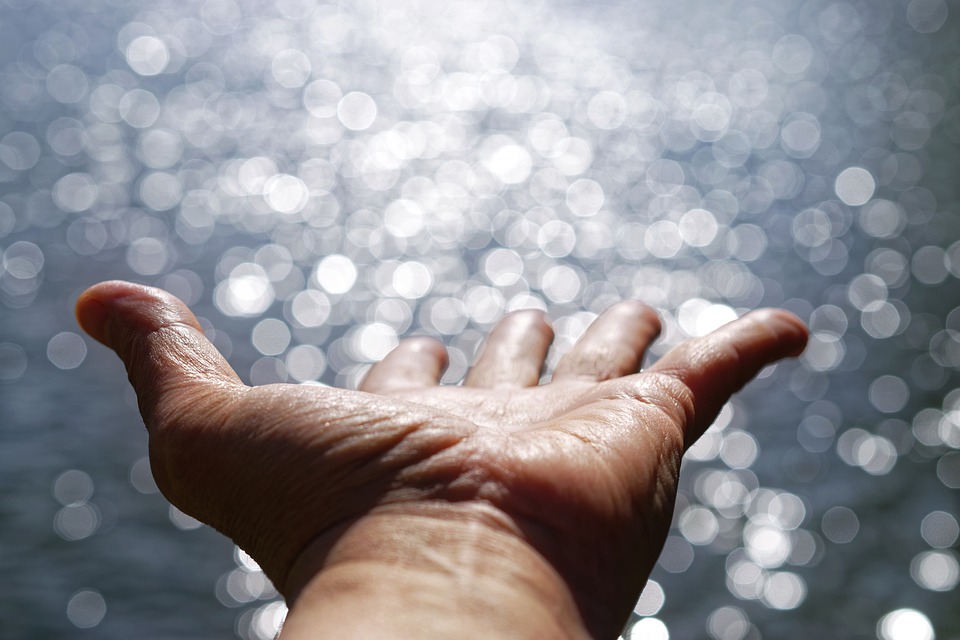
Given that they’re comprised of so many small bones and have those brittle, breakable fingers on them, why do we depend on hands so much in the fighting arts? This is pretty bold talk, coming from the guy who studies a martial arts style directly translated as the “way of the empty hand.” But it’s not so much the use of one’s hands that’s the issue. It’s the WAY and manner in which we use those hands that’s important. And that reminds me of a story. Buckle up!

Decades ago, I was a green belt in class with Sensei and one of the brown belts. It was a quiet night of just the three of us, and the brown belt was slated to test for black belt within the next month or so. As such, Sensei’s attentions were focused on him for the evening while I was relegated to a corner to practice forms on my own. I was fine with this since, as you all know, I love forms. But I was also keeping an unseen eye on the two of them as they were caught in a rather heated sparring match.

As their speed and movements increased, the brown belt tried to perform a grab of some sort. I can’t be sure if he was trying to grab Sensei’s sleeve of gi jacket, but it didn’t work. Sensei isn’t one for sitting still and he kept moving as the brown belts hands was still trying to get a grip (pun fully intended). Two things happened simultaneously: Sensei executed a strike against the brown belt AND the brown belt’s pinkie finger snagged in the open mouth of Sensei’s sleeve and snapped.

An example of Master Uechi’s hand positioning for Uechi Ryu

The brown belt made every effort to conceal how much pain he was in, but it was very clear that the finger had broken. He and Sensei stepped out so that Sensei could drive him to the hospital to get splinted. It was one of the first times I was left completely alone in the dojo, which was interesting to say the least. And it gave me a wake-up call very early (or what felt early) in my martial arts career about the importance of hand placement and guarding one’s fingers.

Depending on the style you study, an open hand may be necessary. It rather hard to perform proper technique in a grappling style with closed fists. On the flip side, it can be a bit difficult to practice a striking art with your hands wide open. For a style like Uechi Ryu, that combine strikes, grappling and pressure points, it can become a little bit convoluted as you’ll need to combine all of those things. But even while using ANY open-hand technique, the important part is to properly protect your fingers. A broken finger isn’t lethal, by any means. But the pain can be enough of a distraction to cost you dearly in a real fight.

I’m not often a big fan of kicks and I usually favour hand techniques in lieu, especially since raising one’s foot off the ground places all your weight and your centre of gravity on one leg. This leaves you vulnerable and isn’t a comfortable position to be in. That being said, I usually prefer a solid punch or an elbow to using open-hand techniques because I like my fingers and don’t want them breaking. At the end of the day, there’s no easy solution to this dilemma, if you study the martial arts.

You can see Master Uechi’s hand positioning in the photo above. Notice the open left hand while he delivers an empi (elbow strike) with the right arm. Far be it from me to question the way a master places his hands, but those spread fingers make me nervous. Sensei has taught us that above all else, keep the thumb tight against the palm and the fingers pressed together. It’s comparable to bamboo; a single finger can be weak but all four fingers combined will be much stronger.

So, that’s the take home lesson in this instance. I always like to relate things back to the street and in an actual street-based altercation, technique and style usually go out the window in favour of just staying alive. This is why muscle memory and training drills are so important. And if it means life or death, a distraction can mean the difference between walking away or being put down. Protect those fingers, people!
Self-Inflicted Harm…

Objectively-speaking, I’m a bit of a weirdo… I can already hear my friends arching an eyebrow while saying, “Objectively???” But seriously, I tend to dip into the strange and unusual on occasion, but today’s post will be simply something to gross most people out. If you have an aversion to feet, you may want to back out of this post now without proceeding any further.

A couple of weeks ago, I was enjoying a nice half hour of shadow boxing in my home dojo. As I’ve written in previous posts, I purchased a whole batch of black foam mats that interconnect, making for a nice, open-concept area with a padded floor. Perfect for karate, wrestling, circuit workouts and more. During a particularly spirited portion of shadow boxing, I decided to execute a tuck ‘n roll where I come to a stop, delivering an elbow strike to my “opponent” on the floor. During the roll, I discovered an important detail about those foam mats. Toenails don’t slide on them…

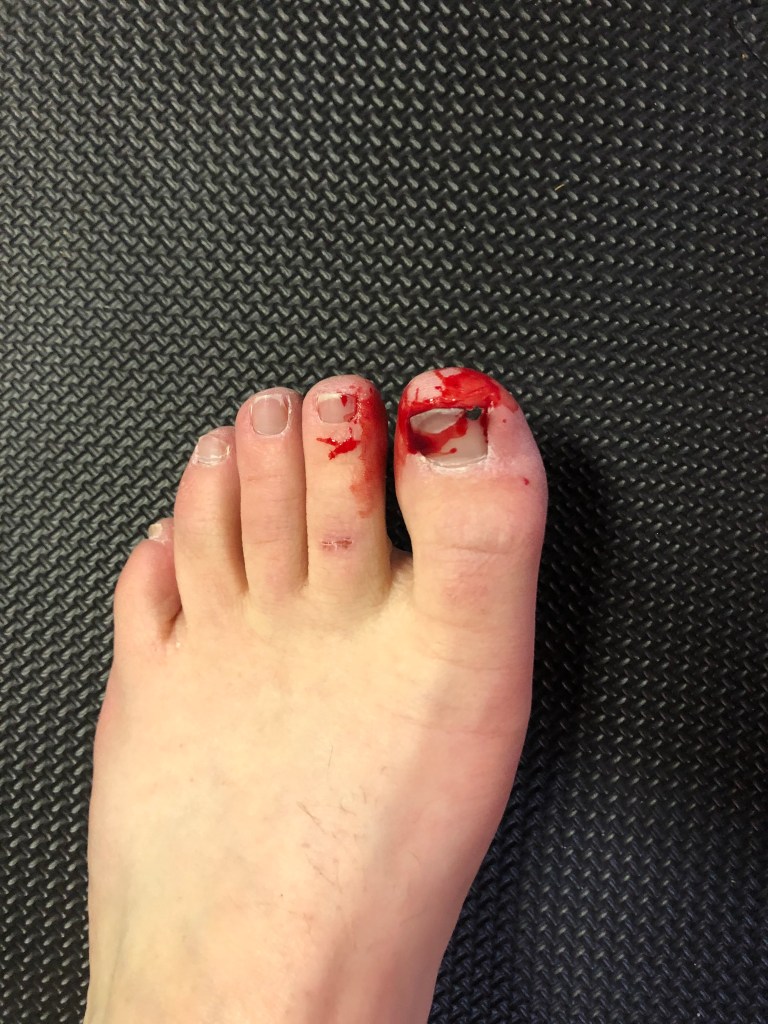
My left foot, in all its bloody glory!

When I executed my roll, I pushed off with my left foot. My big toe was the last thing to leave the mat, which caused the nail on my big toe to press down against the mat. When my toe continued moving, the nail decided to stay with the mat. The bloody line that’s clearly visible along the middle of the nail is where the toenail lifted. I completed the technique and continued on my merry way. It wasn’t until a minute or two later when I threw a front kick with the left foot that I noticed a bright, red drop fly out towards the wall. I looked down and discovered the mess you see above.

It’s not a secret that proper foot health is important to anyone with Diabetes. Over time, most people with Diabetes will develop SOME level of Diabetic Neuropathy, which can lead to all sorts of complications with the body’s extremities, namely the feet. The main concern with Neuropathy is that it can cause a loss of feeling in said extremities, meaning you may not feel the injury when it happens and delayed care can lead to infections or worse.

Another particular concern, is that Diabetes can also lead to lessened blood circulation. With less blood circulation (or slower blood circulation) the required platelets, nutrients and cells required for healing will be delivered much slower to someone with Diabetes, hence the reason you always hear that foot injuries take longer to heal. And that’s if they heal at all. For someone with extremely poor blood sugar control, medical intervention can be required in order to help the wound heal as it may not be likely to do so on its own.

A close-up, just because I’m a sick bastard…

For those of you who may be wondering: Yes, I felt the injury. Albeit not immediately. There was a delay due to the music and adrenaline. I was kind of in the zone. But I noticed the blood BEFORE I felt the sting. No, I didn’t halt my workout. I probably should have, in the interest of cleaning the wound and bandaging it appropriately. But I was about 20 minutes into a 30-minute shadow boxing routine and I didn’t feel the 10-minute delay would result in the loss of my toe.

But it’s important to recognize that if you have Diabetes, wounds should be cleaned and bandaged in a timely manner, even if they don’t hurt. Poor circulation issues and Neuropathy are sneaky bastards and can cause damage if you ignore injuries. Like the freshly forged blade of the samurai, my training mats have now been anointed in blood. Even if it’s mine. Damn it. Nathan plays on those mats. Looks like I’ll have some cleaning to do, once I’ve mended my toe… ☯

I Swear, I’m Not Stretching The Truth…

Stretching is an important requirement to proper health and fitness, and it continues to amaze me how many people don’t take it seriously. For example, I see a lot of karate students who show up to the dojo five minutes before start of class and jump into it cold. There are significant risks to such a practice, which many students seem to forget. Yes, I know what you’re thinking… In the street, you won’t have time to stretch if you get into an altercation and had to defend yourself. While this is certainly true, we stretch and train our body so that in the event of a cold start such as a street fight, your body is conditioned and muscle memory kicks in.

There’s a significant balance between too much and too little, when it comes to stretching. Have you ever gone a full week without doing any exercise? Notice how everything feels tight and it seems a bit harder to move? This is because over time, your muscles will shorten and tighten up if you don’t stretch regularly. This is why stretching is required in order to stay flexible and mobile and to allow full and proper motion of our joints. In fact, some would argue that stretching is more about mobility than fitness. But I believe it holds some importance in both.

The key thing is to not overdo it. You should aim to stretch for anywhere from about five to ten minutes in order to ensure your muscles are warm and pliable. Not to be mistaken with an actual warmup, of course. But after about a ten to fifteen minute warmup, get to the actual workout. It is actually possible to stretch TOO much, and this can lead to injury, damage to ligaments and tendons, pulled muscles and even hypermobility.

Although most people have some form of hypermobility somewhere in their body, it’s not a good thing. Hypermobility refers to the ability of certain joints to move beyond their supposed range of motion, which is a problem that can cause it’s own batch of complications and issues. So it’s important to find a correct balance in stretching and warming up the body.

Stretching should be done right before a workout, although some argument has been made for stretching afterwards, as well. Depending on the type of workout you do, stretching after the workout can help keep the muscles flexible and help prevent stiffness and injury. But you should start by finding a comfortable corner and stretching slowly, breathing and moving comfortably. Although it can be useful to try reaching a bit, it’s important not to extend beyond what’s comfortable. Stretching can provide a feeling of tension, but it shouldn’t be consistently painful or stinging.

Once you’ve stretched and warmed up all the required muscle groups, you’ll want to slip into a warmup. Warmups can contribute to stretching and mobility, but depending on the workout you’re doing are meant to get your heart rate up and the blood pumping. So it’s important to keep the two separate, in terms of completion. Start small, going no further than what your body can comfortably reach. As you fall into a routine, you’ll likely notice that your flexibility is increasing and you can stretch farther. But don’t push it! It isn’t one of those things where if you reach it once, you can reach it again. Muscle tissues will tighten and loosen depending on how frequently you stretch and exercise and how often you don’t.

If you’ve managed to overstretch or stretch too much, you’ll notice a number of symptoms including swelling, redness and weakness of the muscle in question. In fact, it may even hurt while you’re at rest and you may not be able to use that particular overtaxed muscle for a period of time. At home treatment can include some over-the-counter anti-inflammatory pain meds, resting the muscle in question and using the PRICE method (Protection, Rest, Ice, Compression and Elevation) until the injury subsides. The important thing is not to return to stretching the damaged muscle before its had a chance to heal.

If you hear a sharp popping sound while stretching, feel pain at a level that can’t be tolerated or ignore or are completely unable to move the limb associated to the muscle group, you should seek immediate medical care. You may have torn something that can only be repaired at the hospital. It’s important to use your judgement but don’t try to “tough it out,” and injuries can be become aggravated easily. You can stretch after a workout as I mentioned earlier. But if you do, keep it to a minimum as your body will already be tired and it can be easy to overdue it. ☯

Don’t Judge A Baseball Bat By The Matted Hair…

For years, I’ve heard an old adage that says if you’re going to carry a baseball bat in your car for protection, be certain to include some balls and a baseball glove; your lawyer will thank you. The implication there is that the inclusion of balls and a glove will potentially show your intention to use the equipment for their intended purpose as opposed to as a weapon. It’s always made me smile a little when I’ve heard or read it, because my thinking is the SITUATION should dictate if you’re justified, not the tableau that you create around an item you potentially intend to use as a weapon.

The use of weapons is a thing as old as humanity itself, from our ancestors’ humble beginnings with a wooden stick or club to the shiny ol’ red button that world leaders press to annihilate countries. I don’t think it’s a “red button,” actually. I think that’s just something that’s portrayed in the movies. But my point is that humanity has always used weapons in some way, shape and form. And a weapon may be an important tool for one’s self-defence, depending on the situation.

A lot of people think that a weapon needs to be something structured and specific. The baseball bat analogy is a great one because, a bat is intended as an implement for sport. Its use as a weapon is incidental. Or at least it should be. I know some people keep a bat SPECIFICALLY as a weapon. The reason I bring this up is because I’ve often heard people say that a weapons-based martial art is basically useless because you’ll rarely be caught walking around with a sword or a staff. The weapons one trains with won’t usually be readily available.

Depending on where you live and what specific laws outline, it can cause a delicate situation if someone breaks into your house and you’ve run them through with a samurai sword. But setting the legalities aside for a moment, a weapon can be pretty much whatever you put your hands on. Using the example of a sword, I think we can agree that unless you lived in Japan prior to 1868, you’re not walking around carrying a samurai sword nor do you have one readily accessible in your home.

But all the cutting and strike training you take while studying the sword will be just as effective if you manage to wrap your hands around a broom or mop handle and scythe it across your opponent. It won’t gash them open like a sword would but in a self-defence situation, striking with a blade or a stick can potentially yield the same life-saving result. And that’s the important part. That’s the benefit of karate. It’s a weapon all its own and certain movements, blocks and strike are easily transferable to a weapon, should you manage to obtain one in a life threatening situation.

Weapons are a catch-22 because if things get out of hand, they can be taken away from you and used by the very opponent you were defending yourself against. Another great beauty of karate. No one can disarm me of it, so even if I’m empty-handed I always have multiple weapons at my disposal. Obviously, we’re talking about a home invasion or a situation where you believe your life is in imminent danger. One shouldn’t be looking towards the use of a weapon, per se.

Just Because It’s Buffed Doesn’t Mean It’s Nice…

Lifting weights is an important part of health & fitness, even if you’re not necessarily trying to bodybuild. And to be clear, weightlifting and bodybuilding are not one and the same; weightlifting is only one of the activities that a bodybuilder performs in order to build upon themselves, with a score of other important factors at play. I’m certainly no bodybuilder, nor do I aspire to be. I use dumbbells and kettlebells freely, as gaining and maintaining true muscle strength is important in the martial arts and in maintaining the bodily strength required to keep healthy.

And before I go too far into my opinionated rant, let me just say that I have a reasonable amount of admiration for those who are able to sculpt and develop their bodies the way you’d see on a sports network. The old-school Schwarzenegger look may even suit some people, although I find it altogether exaggerated and a bit much. And there’s a significant difference between true strength and bodybuilding. In actual strength training, a person will use the lifting of weight to increase muscle size in order to increase strength, and can use that strength functionally. Bodybuilders are lifting weights solely for the purpose of increasing their size. Although there will be increased strength during the process, it may not be as effective as proper strength training.

The purpose of today’s post isn’t to bash on bodybuilding. As I mentioned earlier, kudos to the folks who are able to sacrifice and work hard towards making their bodies the way they want them to look. Today’s focus is on increasing the mass/size of your body and how it relates to the martial arts and proper health. As it just so happens, being a little too “buff” can have some negative and even detrimental side effects on the human body.

Let’s cover off the martial arts aspect, well… just because! I’ve seen a number of heavily-muscled people walk into the dojo throughout my youth, only to walk out after a few classes. And why do you suppose that is? Well for one thing, increased size will DECREASE your flexibility, mobility and range. You’re stiffer and tend to move much less easier. Just to be clear, I’m referring to people who are REALLY muscled. But in a combat art such as karate, flexibility and mobility are extremely important, for obvious reasons. Are there exceptions to that rule? Absolutely. But the really buff people who still have all the flexibility and mobility are VERY far between.

Speed is another. Your punch may have all the strength of those massive arms behind it, but it means nothing if I can casually avoid your fist because you’re moving like melting butter. The bigger you are, the slower you’ll move. Physics says so. You can only move so fast, as speed equals distance over time. The bigger you are, the more time it takes you to cover the distance, hence slower speed. Picture the difference between a 2-door coupe and an 18-wheeler. It’s easier to achieve a specific speed with the coupe because it takes less time to cover a specific distance due to less weight. There’s your high school physics lesson for tonight. But in the event of a real fight scenario where a person’s wellbeing hangs in the balance, expect that I’ll kick in your knee caps while you’re trying to take a swing. You won’t see it, as your field of vision won’t reach over your massive chest, but you get the idea…

And that’s the other problem is the excess size. You’ll be restricted by your own clothing, for Light’s sake! You’ll have less ability to maneuver in tight spaces, leaving the advantage to the smaller, trained fighter. This is why it’s always been a bit of an issue for me, when people automatically say things like, “Look at how buff that person is. I wouldn’t want to mess with them!” Having big muscles is only one small part of the equation that allows you to use them effectively to protect yourself and others.

And now, because I write about Diabetes, let’s discuss how increased muscle mass relates to health. Don’t forget that the bigger the engine, the more fuel is required to operate it. The human body is very much the same way. The bigger you are, the more calories you’ll need to consume to maintain your body on a daily basis. For someone with Type-1 Diabetes, who needs to calculate carbohydrate intake and take insulin dosages accordingly, this can be a significant problem. I’m not saying it can’t be done; I’m saying that finding that proper balance will be all the harder. And you may cause damage in the process, from a Diabetes-standpoint.

The next issue is the toll it takes on the body. Being too muscular is just as bad as being obese. Don’t believe me? Weight is weight, and your skeletal structure doesn’t grow stronger to accommodate your increase in mass. Your bones, organs and vital bodily systems may not be able to accommodate become too buff. Just think of your heart and how much hard it has to work to maintain all the added mass. That’s why bodybuilders will frequently suffer heart and organ issues. Schwarzenegger himself has had heart surgery. That should tell you something.

There’s nothing wrong with increasing one’s muscle mass. In fact, it’s one of those “happy medium” things where lifting weights a few times a week can decrease the chances of cardiac issues while doing it too much will tax your heart. take it with grain of salt. If we’d pay attention to absolutely EVERYTHING that can be harmful, we’d die of worry instead. Ultimately, the point is that muscle mass for strength good/ Muscle mass for size, bad. Especially from the martial arts standpoint. Just for shits and giggles, here’s a commercial from 2011 for Planet Fitness that makes me laugh every time I see it… ☯

This Is NOT The Way…

I started watching the Mandalorian a short while ago, so I have the main character’s catchphrase “this is the way,” somewhat at the forefront of my subconscious. Hence the title, in case you haven’t seen the show. But what I’m referring to with today’s title, is the use of force or violence. As a martial artist, people have a tendency to believe that I can kick ass on a whim and at my leisure. I certainly have the capabilities and training, despite the detail that stating that fact doesn’t make me out to be very humble. But humble I am, and my training doesn’t mean that I’m like an action hero who will clear a pub of multiple opponents simply for the indignity of looking at me the wrong way.

The world is a violent place, and there are many people who will make a point of BEING violent for very little reason. And those reasons are generally bullshit, anyway. As a martial artist, I take pride in the fact that I have the ability to protect myself and my loved ones. As a Buddhist, I abhor the idea that I would ever have to use it. And use it, I have. I have the benefit of the fact that for the majority of my life, my violent encounters have been in the line of duty. This certainly has never done anything to soothe the dislike I’ve felt or the memories I carry of every encounter, but it’s an important factor nonetheless.

Unfortunately, I’ve also had encounters that have taken place in my civilian life. And those have carried just as much weight as the ones that happened on the job, if not more so. How does one who believes in the prospect of a peaceful life but trains in a fighting art deal with such a scenario? Never the same way twice, is the first answer that comes to mind. That’s mostly because no two situations will ever be the same. And no two opponents will ever be the same, either. But there are some pretty common misconceptions, when it comes to defending oneself.

There are many reasons why people fight. In many cases, a person feels that he or she has no choice. It may be a question of ego, personality or even honour. Maybe the person just has a shitty personality, temper or outlook on life. Maybe, just maybe, that person is dealing with something in their lives and that something is the final straw and they’re taking it out on you. But the reality is that none of those reasons qualify. If you make the conscious decision to step up to someone and fight them, you’ve already lost. AND you’re in the wrong.

First, let’s examine the concept of self-defence. The term seems to imply that you need to fight someone else off in order to ensure your safety and well-being. Basically, you’re trying to prevent harm to yourself or another. But here’s the thing: that prevention doesn’t mean that you HAVE to fight. That’s what most people seem to misunderstand. You may eventually reach a “point of no return” where you’ll no longer have a choice than to fight, and I’ll get to that. But there are other steps you can take to defend yourself.

Diffusing the situation is a good one. Never underestimate the power of using your voice. Although it may not always be possible to calmly discuss the matter, especially with some liquored up hothead who thinks you were making googly eyes at his lady (true story). But there will be times when you’ll be able to talk your way out of things. The other good one, is getting up and leaving. And I know some fellow martial artists may disagree with this one, but why stick around? If there’s someone there who wants to do me harm, I sure as hell wouldn’t want to stick around.

Sure, some people may call me coward or chicken, but who cares? Know where I am while they’re calling me that? In the safety of my car or home. Away from harm, without broken bones, bloody appendages or criminal charges pending against me for beating the living fuck out of some asshole. But while we’re on the subject of criminal charges, it’s important to know what your rights are and what the laws may apply to your situation.

In Canada, Section 34 of the Criminal Code reads, “A person is not guilty of an offence if they believe on reasonable grounds that force is being used against them or another person or that a threat of force is being made against them or another person, the act that constitutes the offence is committed for the purpose of defending or protecting themselves or the other person from that use or threat of force and the act committed is reasonable under the circumstances.” Section 34, Criminal Code of Canada.

Those are a lot of fancy words, and you can check out the Section yourself to read the before and after, as it can sometimes lend pertinence. But the layman’s version of it, is that if someone comes at you and you genuinely believe that they mean you harm, you can use force in response as long as it’s for your own defence or the defence of another person. They also refer to it being “reasonable under the circumstances,” which basically means you can’t shoot someone in the chest because they try to punch you. But everything is circumstantial to the totality of the situation.

Patrick Swayze had a great line in his movie Roadhouse where he said, “Nobody ever wins a fight.” Kind of ironic, since the movie is all about being a bouncer in a violent bar. But realistically, there’s no shame in walking away. Unless your life or the life of someone else is on the line, fighting just isn’t worth it. Besides navigating the law, which can be open to interpretation, getting into violent altercations will change you in ways you may not anticipate. Peace is easier. ☯

Feel The Burn, But Don’t Ignore The Growl…

In recent months, I’ve been trying to reduce my daily caloric intake in the hopes of slimming down a touch. You’ll notice I said “reduce,” and I mean just that. I don’t allow myself to get hungry and I’ll still permit the occasional snack-based indulgence when I feel it’s warranted. In fact, most research I’ve read has confirmed that this is the best course of action, since denying yourself cravings will usually lead to a slippery slope of binging on junk food. But I digress…

If you work out often and consistently, I’m sure you’ve been there… You’ve got a good sweat going, decent music is blaring on your iPhone, your son is destroying everything in his path… or maybe that’s just me! But suddenly, you feel a hollow gurgling coming from your gut, followed by the telltale growl of hunger. What to do? Do you stop your workout simply to go grab a snack? Out better yet, is it okay to start your workout on an empty stomach? That, dear readers, is the important question!

Speaking strictly from a personal perspective, going into any kind of intense workout on an empty stomach can be somewhat problematic, bordering on the dangerous. After all, depending on the type of workout I perform and for how long, my blood sugars will either drop to the floor or skyrocket. As a simple matter of planning, I usually need to decide what type of workout I’ll be performing before I do it so that I can decide what food (if any) I should be consuming prior to feeling the burn. But the question I posed is whether or not it’s “okay” to work out on an empty stomach.

There’s a prevailing theory out there that if you work out on an empty stomach, your body will be forced to burn fat as fuel and you’re more likely to lose weight through the burning of fat. This is a concept known as fasted cardio and like everything else in the world, its effectiveness has been debated back and forth by various studies over recent years. In fact, according to an article posted by HealthLine.com, a 2016 study showed an increased fat burn and a lower daily caloric intake. But the same article also points to a 2014 study where there was no measurable benefit to doing so.

One of the big problems with working out on an empty stomach is that your body may not necessarily use fat as the next fuel source. An article posted by WebMD explains how the body may lean towards burning the sugars in your muscle tissue, which will actually lead to sacrificing some muscle mass in order to try and lose fat. And both articles agree that even IF your body burns through some fat as energy, it’ll likely just adapt to doing this by storing MORE fat when you finally do eat.

As with most things in life, it’s all about balance. You want to try and consume whole foods that are healthy and prepared at home as opposed to foods that are processed and high in sodium and unhealthy fats. Knowing your body and how your blood sugars respond to specific workouts will go a long way towards helping to ensure you get maximum bang for your buck during your workout. A fasting workout also means that your energy levels and stamina will be much lower, causing you to be far less effective DURING your workout. The flip side is to keep your portions small, which will ensure that you don’t get nauseous during an intense workout from a full stomach.

Personally, I’m not a fan of jumping out of bed first thing in the morning and hammering at it. I’ve done it. But I hate it. But if you keep your portions small and healthy, you’ll have the fuel you need to power your engine and you’ll still hit the fat-burning threshold once you’ve depleted that fuel. I’ve always said that there are no shortcuts or easy steps to losing weight. One needs to be patient and work towards it. And whether you choose to work out on an empty stomach or not, remember that you’ll need to eat in order to replenish yourself within the couple of hours following the workout. Check your blood sugars before and after your workout (and during, if you simply don’t feel “right”), stay hydrated and don’t forget to consult your medical practitioner if you’re starting a new workout routine and you aren’t sure if it’s right for you. ☯

The Difference Between The Dojo And The Street

There’s a significant difference between training in the dojo and getting into an actual conflict on the street. For one thing, the dojo should (hopefully) be a controlled environment and includes a gi or other garment that’s inherently designed to promote proper movement. And dojos usually involve training barefooted. So what happens when you get into an altercation where your movements may be restricted by street cloths and shoes or boots? In this video, I briefly explain some of the issues you may face when trying to use karate while dressed for street instead of the dojo. ☯

What To Look For When Joining A Dojo

The decision to join martial arts can involve navigating some pretty choppy waters. And knowing what to look for in order to ensure you’ll get what you want/need out of martial arts can be important. The video below explains what I believe you should be watching out for, when you walk into a dojo for the first time with the intentions of joining. This is not an exhaustive list, by any means. And if any of the martial artists reading this post and watching the video have anything to add, please feel free to include them in the comments. Enjoy!

“Seiza” The Opportunity For Meditation Facts…

A couple of weeks ago I was chatting with a fellow blogger who asked me an interesting question in relation to how I meditate. We had been discussing the ability and opportunity to meditate in the midst of being at home with family, pretty much around the clock. This discussion led to a question about what posture I use and how I deal with comfort issues and positioning during meditation. Since I effectively never do anything the easy way, the answer is not as simple as one specific pose or position.

The kneeling position, known in martial arts circles as “Seiza”

For the most part, I sit in a kneeling position during meditation. That doesn’t mean that this is always the OPTIMAL position, and I do tend to use a few different ones. But the position you see illustrated above is one that’s also associated with karate and some formal Japanese settings, so I’ve had most of my life to get used to it. Named “Seiza,” this position requires the person to kneel on the floor, placing their calves beneath their thighs and pointing the toes out behind them. The big toe on the right foot overlaps the left one, and the butt rests on the heels of the feet.

There’s a bunch of pomp and ceremony that goes into how to sit down and get up when using this posture, as well as when it’s appropriate and/or required to use it. But this post ain’t about all that. This is a posture that Sensei would often have us close out in, as it allows for a few moments of deep breathing and contemplation at the end of a workout. It also makes it significantly easier to bow respectfully when karate class closes. This posture is also used at the current karate school I train with, both at the beginning and the end of class.

From a meditation standpoint, I like this posture because it effectively forces me to sit up straight. I can breathe fully and unlike the lotus position, which I’ll cover off next, this posture doesn’t allow much room for me to slouch or slump. The downside is that sitting on one’s legs for more than about 20 or 30 minutes can lead to a condition called “paresthesia,” which is where some of the nerves and the blood flow in the legs become compromised resulting in the “pins and needles” sensation when a limb falls asleep. It’s never a good thing to block circulation, and since a Type-1 Diabetic’s circulation isn’t all that great to begin with, this can be a concern if you plan on meditating for a long period of time.

The next important posture is the lotus position. This is the classic and most recognizable posture in meditation. In fact, any time you see a statue of Buddha, he’s likely seated in the lotus position. This involves sitting with your butt on the floor with the left foot resting on top of the right thigh and the right foot resting on top of the left thigh in a cross-legged position. The hands are generally resting on top of the thighs, usually with the index and thumb of each hand joined together. This pose is not only used in meditation but is also used in forms of yoga, and is thought to promote the proper channeling of the body’s energy.

This can be a more comfortable posture to assume if you plan on meditating for a half hour or longer, as it won’t necessarily constrict blood circulation the way Seiza does. The problem I find with this posture is that unless I’m propped against a wall, I tend to let my shoulders slump or I start slouching at the upper back, which can become uncomfortable and damaging to the spine over long periods of time. Lotus has many variations to it and I usually favour the “half lotus,” which involves only setting one of the feet on top of the opposing knee with the other one simply being on the floor. This prevents the usual possible circulatory issues.

If you have Diabetes (or any other circulatory issues) there are a few things you can do to help facilitate meditation, regardless of what pose you use. You can get a meditation pillow. These are great as they keep your butt about four to six inches up off the ground, putting less stress on the knees, hips and various joints associated with meditative postures. The Japanese have special little folding stools that allow for the appearance of the kneeling position while taking the stress off of joints and allowing proper circulation.

Last but not least, you can try traditional postures, such as sitting in a chair. This is fine and I’d be lying if I said that I’ve NEVER done it. It just feels weird to me. Probably because I’ve spent my entire life using formal postures. Sitting in a chair just feels like it takes something away from the experience. You can also try lying flat, either on the floor, a yoga mat or on your bed. The only problem with this is if you lie on your bed and start breathing deeply with your eyes closed, you face the risk of falling asleep. Although I’m a big fan of naps and falling asleep isn’t necessarily a bad thing, it also usually isn’t my goal when I meditate. So I try to avoid this posture unless I’m having difficulty sleeping and I’m intentionally trying to meditate my way to dreamland.

Obviously, there are different types of meditation and postures that go along with them. Depending on what your goal is with meditation, you can’t really go wrong. The important thing is to find a posture that’s comfortable and suits YOU. It should accommodate your body and allow you to relax so that breathing, energy and blood flow are facilitated and you can focus on the mindfulness required for proper meditation. As I’ve often written, every person is different so it should be no surprise that each person’s needs and preference may be different from a meditative standpoint. ☯