
Training in the martial can involve a number of different bags, pads and striking surfaces. It can be a bit confusing as to which one you should use. Should you have something firm and moveable? Should you have a punching bag, which allows some variety and movement? Maybe your best option is to have someone hold some striking mitts… Watch the video below that posted to my YouTube channel for my thoughts and opinions on what striking surfaces you can use. ☯
Category: Martial Arts
Progress, Not Perfection
The title is a quote from a favoured movie of mine, The Equalizer. It stars Denzel Washington who plays the protagonist, a retired secret agent/assassin who seeks vengeance for harm brought against an innocent. At some point in the movie, he’s helping a fellow co-worker get into shape in order to become a security guard, and he states, “Progress, not perfection.” The quote has stuck with me since I watched the movie, and I use it often in my daily life. Wisdom from unlikely sources, right?
A couple of weeks ago, I started using a newly-purchased punching bag in my garage. As an ending to the workout, I also started hammering out a fast, 1-kilometre sprint on the bike. It’s been rough, with most of my sprints ending with me gasping for dear life and being unable to catch my breath for several minutes. It’s a fantastic measure of progress, as opposed to cycling for 10 kilometres or more, where I potentially get exhausted after the third or fourth kilometre.
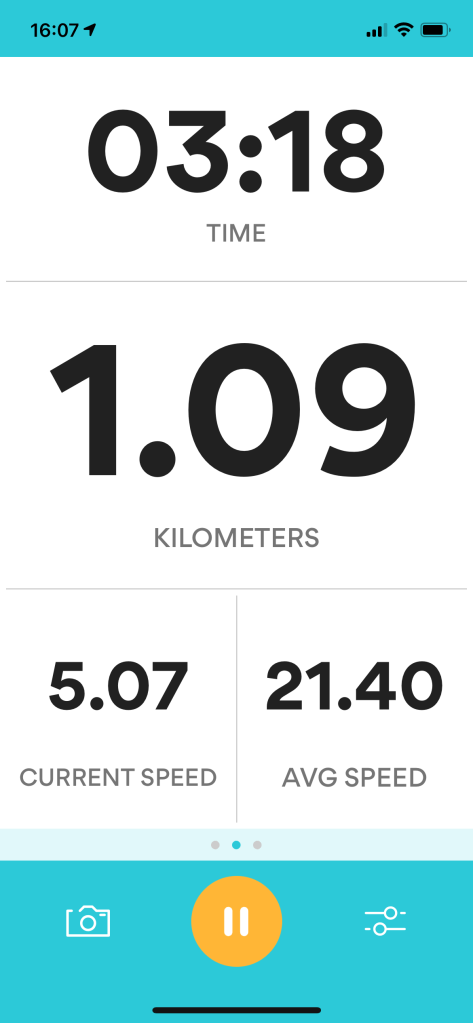
A few days ago, I hammered out a kilometre in just 3:02. My best time prior to that was a dozen seconds short of 4:00 minutes. Although this doesn’t seem like a big deal, the number of seconds shaved serves to tell me how far I’ve been progressing and how much faster I’m becoming. Hopefully, once summer kicks into high gear, I can reach last year’s failed goal of 200 kilometres in a single run. Last year, I was reaching nearly 80 kilometres in one afternoon, which is still a far cry from 200. but as the title says, progress, not perfection.

As you can see, my pace reads as 3:02/km, which is why I say I completed the kilometre in 3:02 instead of the 3:18 that’s displayed in the previous photo. The previous photo is the total time for the 1.09 kilometres. I’m hoping to shave it down to below the 3:00 minute mark before starting longer journeys throughout the summer.
Persistence and perseverance can serve you well, in all things related to self-development. If you’re willing to push yourself a bit, you can climb, ever so slowly. Progress, not perfection. Its the only way to increase one’s health, skills and well-being. ☯
The Chi Effect
There’s no arguing that positive energy is contagious. Ask yourself how many times you’ve felt in a bit of a foul mood, only to be lifted up and singing along with a great, upbeat song on the radio… Positive energy creates positive results; a fact that more people should be able to recognize. By the same token, you can be in an excellent mood, only to be brought down by someone negative who is in a bad mood or spreading sad information. I was chatting about this very thing a short while ago with a colleague of mine from work.
I’ve never been one of those martial arts practitioners who put a great deal of stock into being able to “project” energy or that my Chi or Hara could be used as a weapon. There’s are plenty of idiots on YouTube professing that kind of thing. But there’s no arguing that we are all and everything is energy. Not only do basic physics say so, it’s probably one of the few points of existence that both science and religion agree on. At my core, I’m made of energy. You’re made of energy. The screen you’re reading this post on is energy. The entire world and all things are composed and made of energy.
If you’re still reading and aren’t convinced that I’m nuts, I bring this up because although I don’t believe in projecting energy to knock down opponents (There are seriously people who believe they can do this! Google it!), I can admit to being able to focus my energies into my strikes, my focus and my concentration. This is an entirely different ball game, and I’ve experienced it firsthand while training in karate. Just imagine those times when you’ve been floored by a workout but somehow dug deep and found the strength to carry on for that last little bit. That’s tapping into your energy!
For the purposes of this post, I refer primarily to Chi, because it’s more widely recognized as the vital energy flow that all people have. In karate, we usually refer to the Hara, which is defined as the focused centre of the body where the person’s true nature and vitality reside. But when I say “Hara,” I usually get confused looks. And I can admit that there are some differences, so since we’re discussing energy I’ll simply stick with Chi. Still with me? Good.
Decades ago, when I was younger and more about the skill than the meaning, I began noticing a certain phenomenon around my Sensei. Random people would often approach him and speak to him, sometimes to take photographs or simply ask how his day was going. I never thought much about it beyond considering it odd, considering there was usually a number of us around but he would usually be the only one approached. Then one day, such an encounter finally had me ask the question.

We were in Naha, Okinawa. The year was 2001 and I was 23-years old. I was full of the ol’ proverbial piss & vinegar and I was raring to train. But since the temperatures in Okinawa during the month of October reached somewhere in the low 40 degrees Celsius, Sensei felt our afternoons could best be spent relaxing on the beach. I should have been willing to relax and enjoy the sun and sand, but like I said: I was too focused on the skill than the meaning. So it irked me to no end that we were just sitting there, when we were actually in a Japanese prefecture and there was so much to see.
Anyway, Sensei was walking along the beach with a towel around his shoulders when five or six Okinawans approached him and started talking to him and asked to take photographs with him. I had seen similar things happen with him on numerous occasions, so I asked his wife, who was on the beach with us why this always seemed to be happening. She explained that it seemed as though people had always been drawn to him, without him ever trying or drawing attention to himself. It struck me as an odd thing. Until some years later, when it started happening to me.
Once my youthful shenanigans started dying away and I became more of an instructor and more about the art than the skill, I started to notice that people would often approach me without reason. Sometimes it would just be a general “Hi, how’s your day been?” But sometimes I would have random strangers approach me and talk to me at length without reason, without knowing me and without begging for change or trying to sign me up to their multi-level marketing scheme. It seemed as though I could manage to provide advice, encouragement and perk people up without much effort. Folks would often even come to me for advice, even if I never put myself out as someone who would provide it. I never paid much attention to it; until it went away.

The last three years have been the most difficult years of my life. I’ve been depressed, despondent and at my lowest. I’ve had some good times during those three years, such as the birth of my son Alexander. But it’s been rough waters and it’s taken some time for me to see bright shores ahead. They say you never know what you’ve got until it’s gone. I never noticed the effect I described above disappearing, until last weekend when it came back out of nowhere.
I was at the local corner store, checking my lotto ticket. Yeah, yeah, I know… Let’s move on as the lotto ticket isn’t the topic of the post. As I was walking towards my vehicle, a random elderly lady walked towards me and asked me how my day was going. I replied that it was going well. I thought it strange that she was walking towards me, specifically since there were about a dozen vehicles and people milling about. I thought that perhaps she’d ask me for money or something. I hate that I even think this way, but the world has made me this way. She approached and told me she was feeling very happy today as it was Mother’s Day and her children would be bringing her supper.
We chatted for several minutes about her children and how her day was going as well. When I mentioned my own children, she asked me to wish my wife a Happy Mother’s Day as well. I promised that I would. We wished each other a great remainder of our weekend and she carried on her way. When I got into the car, I recognized the phenomenon for what it was and when my wife asked, I explained that it was the “Chi Effect,” and sat in bewilderment for a few moments as I recognized that I had been lacking it for the past few years. It made me happy. It renewed my sense of how my life had changed.
I’m not a guru or a sage. I don’t profess to project my aura, I don’t practice Reiki and I believe my energy is my own and no one else’s. I’m not deeply rooted in metaphysics, although I will confess that I’ve studied it a bit. But what I do believe is that positive energy is contagious, and I believe that when you’re happy and you give off that positive energy, others will pick up on it. And I think that’s what happened with this lady and I, last weekend.
My life and existence have involved the martial arts in every respect. I’ve learned and developed to a level that I realize that the same aspects I’ve seen in Sensei in my younger years are now being reflected in me. The past couple of months have seen some of the shadows lifted from my soul. And the past month in specific has seen me happier than I’ve been in a long, long time. And I think that people can sense that, albeit in a passive way. As my wife once said, many years ago, “happiness heals.” Perhaps some new wounds are starting mend, with some old wounds beginning to make way for new happiness. Food for thought… ☯
Punch Your Way To Fitness
One of the things I miss most about training at my local karate dojo is dealing with the lack of a punching bag. I’ve written on occasion about the importance of actually striking something during training. This is important, because form is all well and good but the effectiveness of your strike can’t be achieved unless you learn how it feels at point of impact and get used to it. Further, your knuckles also need to develop; something that can’t be done through forms. Knuckle push-ups will only get you so far and won’t contribute to experiencing the impact. But I digress…
My point is, having a punching bag or a striking surface can be integral to proper martial arts training. I’ve been considering getting my own punching bag ever since we moved to Regina, but there’s always been a lack of location and opportunity. My basement had no spot to safely install a punching bag, and I had to deal with fact that my continued pounding would cause chaos for the rest of the family, upstairs. Not least of which is the fact that our basement was recently demolished, leaving a bare basement with no safe area to work out in.

With the warmer weather becoming more prominent, the time has come to shake some of the cobwebs off and start doing more physical activity outside. As such, I decided to stop being such a cheapskate and purchased a punching bag. Although the garage was effectively full last year as we demolished and braced our basement, we’ve moved enough stuff back into the house that I now had the available space to set up a bag. It didn’t take me long to run out to my local sports outlet and purchase what I needed.
The punching bag stand is made by Century, which if you recall is the same martial arts equipment company that makes the karate gi that we wear at Kenpo. It only took about a half hour to assemble, with nuts, bolts and washers included for easy assembly. The stand is unfortunately required, since the beams of the garage would no doubt hold a heavy bag but likely wouldn’t last under the constant barrage of strikes and impact I would inflict upon it.
Interestingly enough, the sports outlet that sold the stand had no punching bags available. Since it was the last stand they had in stock, I gambled and purchased it, sans punching bag. I really wanted a 100-pound bag, but I knew I would have to do some searching in order to find one. The first place I stopped at was a local retail store, which I won’t name for liability issues but it involves the color blue and usually has a fast food or coffee outlet inside. Draw your own conclusions from that.
Anyway, I managed to find a nice little kit containing a 70-pound bag, bag gloves, hand wraps and binding cords. Not too shabby. I added it to my cart so that I had a bag with which to start training and made my way home. I figured I could wok on getting a heavier bag later, depending on how much time I actually put in on it. I lifted the bag up to the hook and my wife helped by attaching it. A few experimental punches and kicks told me I would be enjoying some garage time, this summer.
Despite the fact that I usually enjoy cycling and swimming, a punching bag offers a wide variety of workouts that one can perform. These can include circuits and drills and even workouts where you incorporate the bag as a “set,” meaning you go do a number of sets of other exercises and keep coming back to the bag. Nathan and I like doing a back-and-forth where one of us punches the bag for a straight minute while the other is on a jump rope for that minute. Then we switch. It makes for a wicked sweat. This is what we did yesterday. Little bugger actually held his own for the whole half hour!
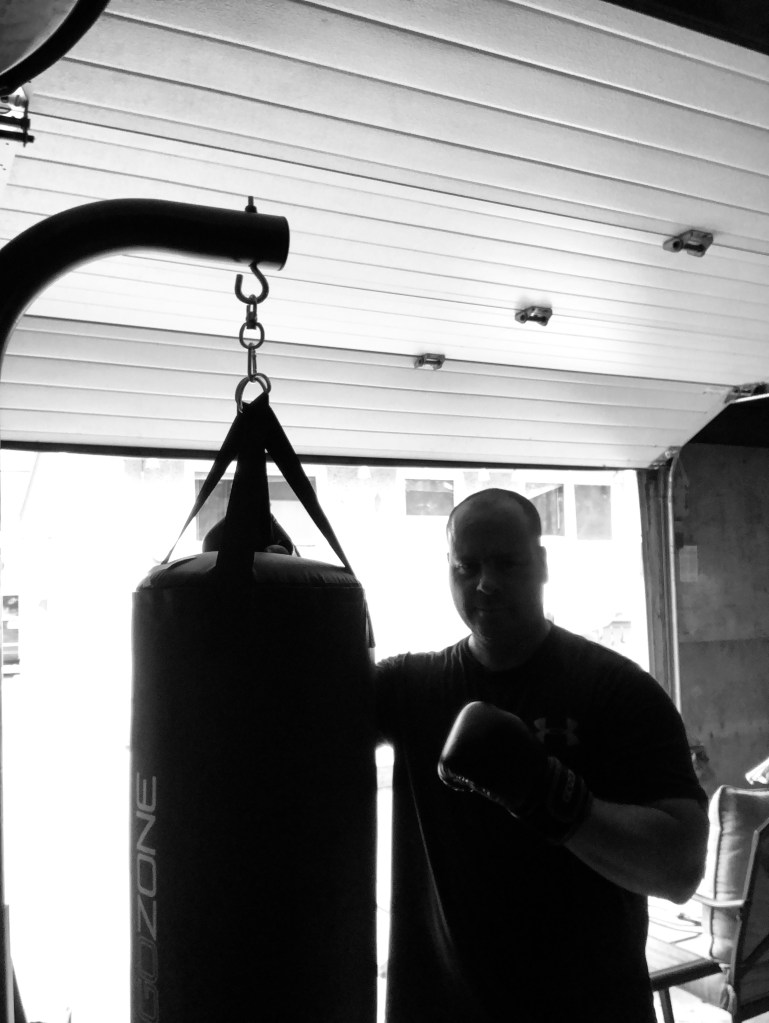
Punching bags can be nice as they allow you to experience the impact of your strike and help to properly develop them. But it also works almost all your muscle groups, provided you maintain correct posture, stance and incorporate punches AND kicks into your workout. Last but not least, sticking it out on punching drills makes it so that you end up with a killer cardio aspect, as well.
I’ve been in a bit of a fitness slump in recent weeks, which I attribute to the fatigue of starting a new job and having no access to my actual karate dojo. So I’m looking forward to doing something that will allow me to work up a sweat and start building back some arm strength. With our basement renovation plans expected to happen over the summer, the next step will be to get a bench and some free weights. here’s hoping it’ll be a good summer… ☯
The “What’s It For?” Side Of Food…
I’ve been writing this blog for a few years at this point and I have some posts that I like more than others. And one of the best posts I feel I’ve ever written is one that describes the purpose and use of most vitamins and minerals that we get through our food. People usually focus on what they can eat that’s healthy, can make them lose weight or accommodates certain food allergies or aversions. But very rare is it do people take the time to consider what the actual nutritional aspects of food provide for the human body.
We ultimately consume food for two reasons: for energy, which we obtain through the consumption of calories, and nutrition. As a Type-1 Diabetic, I usually focus on the energy side of things, things carbohydrates are the form of fuel we obtain that affects blood sugars. But the nutritional aspect is important. Because if you’re taking in tons of calories but getting none of the nutrition, you could be causing issues for your body that nobody wants.
So, what do all of these vitamins and minerals do? Each one can serve a purpose and provide something for the body, and I compiled a list about two years ago that walks us through all of them. It’s a bit of a long read, but the good news is the list is mostly in alphabetical order, so you can go straight to the vitamin and/or mineral you’re looking for. And without further ado, here’s the regurgitated list:
Vitamin A: This is an all-around vitamin that provides a number of functions including but not limited to the proper health of various bodily functions, tissues and helps to fight chronic disease and is known to be good for the eyes.
Vitamin B: This one is a bit complicated, as there is a large grouping of enzymes, vitamins and minerals that fall under the “B” category. In general, B-vitamins are used for energy production, immune function and absorbing iron. Some them include B2 (riboflavin), B3 (niacin), B9 (folate) and B12. There are a few more that I can’t recall, but B12 is considered amongst one of the most important of vitamins overall because it helps you turn food into energy.
Vitamin C: At some points, this one has been referred to as the sunshine vitamin. I’m thinking that’s mostly because people’s main source of Vitamin C is from citrus fruits. But this vitamin also helps with iron absorption, immune function and is a natural antioxidant that helps with the elimination of free radicals. Eating citrus fruits are also what sailors used to eat on long voyages to prevent scurvy.
Vitamin D: This vitamin helps with the strengthening of bones and teeth. Our bodies are designed to self-generate this vitamin naturally through exposure to sunlight, but obviously that needs to be done in small doses. Modern life has created an environment where more people spend their time indoors, away from the sun. So supplementation becomes important.
Vitamin E: A pretty straight forward vitamin, this one helps with proper blood circulation and clear skin.
Vitamin K: This vitamin is essential for blood-clotting. In order words, if you’re deficient in this vitamin, small cuts or injuries can cause excessive bleeding that can become dangerous.
Folic Acid: We hear people speak about this one as being necessary during pregnancy. And they would be correct! Folic Acid helps to prevent certain complications during childbirth but is important to everyone for proper cell renewal. This one is also known as Folate, or Vitamin B9 (as listed above).
Calcium: Most people should be familiar with this one. Teeth and bones, people! Teeth and bones! Good calcium levels are required to keep those body parts healthy.
Iron: This helps to build muscle tissue naturally and helps with proper health of the blood. As an interesting sidebar, it’s also what makes your blood red through the reflection of light!
Zinc: Immunity and Fertility. I’m a little unfamiliar with this one and haven’t had the opportunity to research it a great deal.
Chromium: This one is near and dear to my heart. Because it helps to control blood sugar levels. Chromium is what helps all the systems of your body to get the energy they need when they need it. Some traditional medicine practitioners will suggest Chromium supplements for Type 1 Diabetics who may have difficulty in maintaining proper levels.
Magnesium: This one helps your body to absorb all the other vitamins and minerals. It also acts as something of a relaxant to muscle tissue and play a role in proper muscle contraction.
Potassium: This mineral helps with the proper hydration of your body and helps to control blood pressure.
These are really just the major ones and there are plenty more. But these are the common ones that you’d be looking for in your food and your multi-vitamin. There’s a lot of mixed opinion about multivitamins, with some believing that you get nothing out of them and some swearing by them. Although we’d like to think we get everything we need out of our daily meals, such is not always the case and a multivitamin can help. My doctor has always sworn by them, so I make a point of taking a daily capsule. This can be of particular importance, especially if you’ve had a lazy day where your meals may not incorporate everything your body may need. ☯
A Pressure Cooker Of Opinions
One of the benefits of having trained in the martial arts for as long as I have, is that I’ve mostly seen it all and have almost tried it all. You’ll note that I don’t make a point of saying I’m “good” at it all… Martial arts is a marathon, not a race and there’s always something further to be learned, experienced and discovered. So, I’ve seen a lot and the important distinction that needs to be made is that not everything that’s taught is effective. And this is where pressure points come in.
I’ve written about pressure points before; in fact, it may have been in recent months. Age and the drafting of daily posts tends to make one forget what they have written the month prior. But it’s always a good topic to cover, especially for new students or practitioners who may be interested in learning karate or martial arts. In simplest terms, a pressure point is where you use one or several fingers to strike an area of the body where it will cause pain, compliance and/or dysfunction. Although knocking someone out is a very real possibility in a fight, things like the Vulcan nerve pinch, which render an opponent unconscious with a mere touch, aren’t actually a thing.
The thing about pressure points, is that they’re what I tend to refer to as a “support mechanism.” What I mean by this is that they aren’t intended to be used on their own. Usually, one would need to deliver a strike or two and get control of the individual BEFORE trying to hit a pressure point. Although there are some pressure points that you can access through an actual strike (hitting the groin is a good example), these are the rarer ones. Although learning them is all well and good, and I should point out that I’m a big fan of drills in class, the use and execution of pressure points in a real life situation is a whole different ballgame.
Picture this, if you will… You get into a situation that has escalated to the point where it appears that the need to defend yourself is imminent. You no longer have the option of walking away; at least not without getting struck from behind and getting injured. So, you square off against your opponent and try to evaluate what your first move should be. Here’s the thing: it should DEFINITELY not be a pressure point. The dojo environment allows you the opportunity to feel around, locate the pressure point and practice using it.
That’s all well and good, but one needs to recognize the fact that every person’s body is different. Some people will be more sensitive to certain points than others and what worked quite well on your partner in the dojo likely won’t have the same effect on an opponent in the street. Especially since your dojo partner will just stand there and let you grope around for the pressure point. The opponent on the street doesn’t plan on standing still. In fact, if you walk up and try to access a pressure point, you’ll likely be flattened on your ass before your finger jabs ANYTHING.
I like pressure points as they can be very handy as a control mechanism through pain compliance. And they’re sure fun to poke lightly when I’m wrestling with my son. The best part is seeing him trying to duplicate the effect on me. But they should never be used as a standalone technique. Should you miss, can’t locate the specific point you’re trying for or a particular opponent has a body type or muscle tone that won’t let you access a point, you could place yourself in a compromised position where you face serious injury. Food for thought… ☯
Clash Of The Styles…
If there’s one thing that everyone knows, regardless of whether they’ve studied martial arts or not, is that there’s a HUGE family tree spanning several thousand years when it comes to the martial arts. Different styles, different schools and different families can sometimes make it difficult to know and understand if one style is better than the other or which one you should pursue, if you’re looking to do so. The reality is that there isn’t so much one style that’s better than the other; it’s about how it’s taught and how it works for you. I’ve written about this on a few occasions.
It can be difficult two schools of opposing view come face-to-face, especially if they happen to be training in the same complex or their respective dojos are on the same city block or something. It’s reminiscent of those old, corny kung fu movies where you’d always get one clan or style that would be feuding with another. “Our kung fu is stronger than yours!” I used to love those movies. No stunt doubles or CGI, just clean, semi-realistic fighting fun. It was a guilty pleasure of mine as a kid. But I digress…
If we were to use generalized terms to describe TYPES of martial arts, we can easily classify them under four categories: Traditional, Modern, Weapons-based and Hybrid. I’m sure that some fellow martial artists would divide these categories differently, so I should likely point out that this is a personal perspective and not necessarily something official and/or recognized. But when I hear of any given style, I usually find myself able to place them in any one of these four categories. Still with me? Good. Moving on…
Traditional martial arts describes “pure” styles that were developed at the start of of a specific martial art’s existence and usually involves a lot of protocol, ceremony and tradition. Further, they rely on training methods that many mainstream fighters consider ineffective, such as forms. It can cover a variety of methods including striking, grappling, pressure points and joint manipulation. In my experience, I’ve found that teachers of a traditional art tend to be the most difficult and inflexible, claiming their style to be the best one and everyone else’s is junk. They’ll usually discourage their students from exploring other styles and learning or adapting techniques from elsewhere as it would “cloud” their own techniques.
Modern styles are ones that are pretty recent in their development and often include the combining and amalgamation of one and/or several traditional styles. Although there’s nothing inherently wrong with modern styles, they often boast a slew of benefits when compared to traditional styles, even when this is not always the case. It also won’t necessarily be a combination of a pre-existing style but can be something created by someone else, using previous martial arts training as a starting point. Jeet Kune Do is a very good example, with his foundational use of Wing Chun Kung Fu as the starting point, although JKD is seen by many as more of a philosophy than and specific style. But an applied philosophy, if nothing else.
Hybrids are a different type of creature. These are the ones that usually a mixture of something that’s pre-existing. What differentiates them from the modern category? Mostly the fact that a given school will provide certifications for any of those combined styles. Although Kyojushinkai (a modern style) is a style of karate developed by combining various other deeper-rooted karate styles, one would only train to achieve belts IN Kyokushinkai. But hybrids will allow you to achieve belts in various styles. For example, if you work out in a dojo that trains in karate and judo and the instructors can/will issue belts in either of those disciplines. Although some options can be nice and it can be useful to add some variety and incorporate techniques from other styles, trying to achieve belts in two styles simultaneously can be confusing and difficult. And many new age styles of “academies” actually follow this practice.
Weapons-based is pretty straight forward. We’re talking your Kobudo, Kendo, Iaido, Kyudo, Escrima… Anything style of martial art that primarily teaches the use of some sort of hand-held weapons. Are any of these four inherently better than the other three? Not necessarily. I would say it depends on what you genuinely hope to get out of your martial arts experience. Each one has their benefits and disadvantages. Traditional styles can be very rewarding. I study and train in a traditional style, myself. But it can also be pretty restrictive if you’re training under someone who doesn’t allow the flexibility of exploring techniques outside of the existing curriculum. Modern styles can be more accommodating but may lack some of the traditions and history of a traditional style.
Hybrid styles or schools, I would say, carry the most disadvantage. This is a personal opinion of course, but hybrid schools can “muddy the waters” for a beginner trying to properly train in the martial arts. Although variety is the spice of life, it can be very difficult to properly master one style when studying many in tandem. If you happen to join a martial arts academy that carries this hybrid philosophy, my recommendation would be to choose ONE discipline and stay with it (unless you hate it or it doesn’t work for you) with some cursory or occasional visitation to the other styles in order to gain some variety.
Take all these descriptions with grain of salt. As I’ve often written before, the choice of style and training method has to work for you. It can be frustrating, but it can take trying and training with a few different schools before you find one that suits your purpose and goals. And be wary of instructors who bad-mouth or speak negatively of other schools or dojos. Respect and positivity should be ever-present values in ANY dojo. If those don’t exist in a given school, you likely won’t have a good experience, regardless of what your training goals may be. Train hard, my friends. ☯
Taking A Little Respite…
I’m an incredibly long way from what I would consider to be lazy. Between my continued efforts towards fitness, Diabetes control and giving my maximum in everything I do, I very rarely sit still. The fact I have difficulty sitting still in general tends to help, as well… But once in a while, even the most dedicated person needs to take a step back and throttle back on life and take a rest. And mental exhaustion being a very real thing, it can lend a heavy impact on one’s motivation.
A couple of weeks ago, I found myself skipping karate classes and performed personal workouts a lot less than usual. I’ve had the pleasure of throwing a couple of quick, 10-kilometre bike rides into the mix, which was nice. But with the warmer weather coming along, the opportunity for different and increased number of workouts is becoming a thing. The recent heavy snows we’ve had in Regina notwithstanding, of course. But a severe lack of motivation has unfortunately thrown a monkey wrench in my otherwise rusty gears.
I’m a big advocate of pushing oneself, and of making an effort to workout, even when you don’t feel like it. Given the nature of Diabetes and the effects it has on a person’s body, it’s no surprise that there are days where either the body or the mind simply don’t want to put in the effort. I had both my body AND my mind gang up on me in recent weeks when I’ve skipped the majority of my workouts. Even while acknowledging that I should have been doing something, I just didn’t want to. To use the vernacular of today’s younger generation, I can’t even…
And you know what? That’s okay. Even if it may feel like you’re being lazy, stepping back and taking a break from your fitness habits can have a lot of benefits. Yes, yes, I know… The benefits of doing SOMETHING definitely outweigh doing NOTHING. But here are some quick benefits that I’ve noticed, whenever I’ve taken a break:
- You Can Relax: I think we can all agree that being “switched on” all the time can take a toll. There is such a thing as over-training, and it’s important to recognize that point. Taking a break week can let your body fully recuperate and allow you to relax a bit and maybe focus on other interests, such as reading or playing with your kids;
- You Can Regroup: Honestly, there’s something to be said for having the time to just sit back and contemplate things. Whether you want to take the time to meditate, focus on work or even come up with some new workouts, taking a break can allow you the time to figure it out. Personally, I get bored of doing the same workout over and over and I like to design new circuits and try new things. Otherwise, I feel my fitness is becoming stagnant;
- You Can Heal: Constantly working out can be taxing on the human body, and even more so when you’ve reached my age. Even though you can continue to work out with mild injuries (with limitations), it can be nice to allow some extra time for the systems on your body to reset themselves and for any outstanding injury to heal completely.
Given the particular life changes and adjustments tat have taken place within my household in the past week, it’s no surprise that I continue to be exhausted. Like many people, I’ve spent the last little while hibernating at home while COVID-19 has marinated on the outside. The result of this has been that waking at 5 in the morning every day is no longer something I’m used to. I’m slowly getting adjusted o it, now. But I’d be lying if I said that I haven’t been sneaking off to bed as soon as my wife and I get the kids down. Surprisingly, my blood sugars have fared quite well during all of this. I think that can be attributed to routine, since I eat my meals at pre-planned times and don’t snack or eat outside of those times.
As one always does, I’ll adjust. I usually find that taking a “lazy week” once in a while will allow me to reap all those benefits mentioned above. The important thing to remember is not to go on some sort of junk food bender while you’re sitting around doing nothing. And I’m definitely not saying that you should do this indefinitely. Or often. Especially since a sudden change in your level of fitness and activity will play hell with even the best balanced blood sugars. But if you allow yourself the occasional break, it can even help improve your mood and energy levels for when you DO get back to it. And one always needs a little time to adjust to any new routing. Food for thought… ☯
Rules Are Meant To Be Imposed, But At What Cost?
We live in a society of rules, with the regulation, application and enforcement of said rules being a dominant trait in the modern world. If you don’t believe me, just try to walk through a populated street without a facial covering right now. I, myself, have always been a firm advocate of following rules. But sometimes I can’t help but ask myself if the overall cost is worth the reward in relation to some rules and how they are imposed. If you live in the world of martial arts, the existence and in fact, necessity of these rules can be like swimming through murky waters without a flashlight.

I always refer to my karate as a “traditional” martial art. And what’s usually meant by this is that our students follow traditions and training methods that are as original to the style and methods of when karate was created as possible. When I used to train in Sensei’ dojo, everything was done pretty much on par with how the Okinawans developed it and how they still do it to this day (or at least as they were still doing it in 2001 when I was there, last). But as time has gone by, certain rules and regulations have become part of the martial arts world. I always like to say that it only takes one idiot to ruin things for others, and this is where I’m going to vent about some of those.
Setting aside for a moment that karate is a fighting art… Yes, it is… YES, IT IS!!! As much as I prefer to focus on the “art” aspect and not so much the fighting, the reality is that karate teaches you how to fight. And unlike most traditional sports where contact with another person CAN occur, karate is something where contact SHOULD occur. If you’re in my dojo, contact WILL occur. I bring this up because there seems to be a growing number of dojos that have abolished physical contact; and I don’t mean because of CoVID-19.
When I came up in the dojo, we used to have many practices that involved things that could be painful. Body conditioning, checking, semi-contact and full contact sparring… There were plenty of activities that had the potential to bruise, pull and crush muscle tissue. And we sometimes got injured, albeit lightly. But it was a common understanding that this is something involved with learning a combat art. Like Mr. Miyagi mentioned in the first Karate Kid movie, it’s difficult learning karate from a book. Training in a combat art without striking and/or being struck will leave definitive gaps in one’s ability to properly learn their respective art.
In recent years, there’s been a tapering of such practices, especially since society is quickly developing the inability to let things go and become offended and affronted by almost everything. In the final years before he closed his dojo, Sensei halted all body conditioning and sparring was a rare thing, except with other black belts. His reasoning was quite simple; when new students would get those first whacks on their forearms or legs, they’d soon quit. In my day, we toughed it through because the end result was worth the momentary pain.
But now, there a number of different reasons why dojos have reduced or eliminated contact with students except for the occasional sparring match with senior belts, which often and usually includes the dojo’s insurance policies. Yup, that’s right! Most modern karate schools have “sport insurance” where an injured practitioner can be compensated for specific things, based on the circumstances of the injury. I think that this is a fuckin’ joke as it relates to karate… I don’t understand how you can properly learn WITHOUT some form of injury. But I’m old school.
I once read the stipulations of a particular dojos insurance policy that read (and I’m paraphrasing) that the policy wouldn’t pay out if the injury was found to have been caused by an intentional strike. FOR A MARTIAL ARTS DOJO!!!! Every strike is intentional… So this policy was restrictive to the proper teaching of the school and would not even cover a martial arts-related injury. This is just one type of “modernization” that is slowly eroding the fabric of traditional martial arts, which makes me sad since I’ve spent my entire life training in one.
An easy comparison is to look at it this way: If you join a knitting circle, you don’t expect to get a black eye. It wouldn’t make sense, as it has nothing to do with the skills you’re practicing and using. But if you join a FIGHTING ART, the safe assumption is that you’ll be getting struck at some point. Imagine someone going into boxing with the expectation that they’ll never get hit? Same kind of dynamic. The problem is that some person at some point, made a big stink after getting struck/injured while training and it caused a shit storm from the insurance and/or liability standpoint and many modern dojos have had to adapt.
As I mentioned earlier, this kind of adapting or “modernization” is slowly killing traditional martial arts. And if it continues in this direction, “contactless” dojos may become the standard as opposed to the exception. If that happens, most arts that have seen their teachings watered down in recent decades will suffer even further. And this is one of the reasons why I’ve opted not to bother opening my own dojo where I am. I would never allow myself to teach karate in any other way than how it was meant to: unfiltered and unabridged. The last thing I would need is some snowflake suing me or my dojo because they couldn’t take a hit… ☯
Oh, There’s An App For That…
I know that I’m usually the first to rag on people’s addiction to technology and their smart devices. That being said, I also acknowledge that my health wouldn’t be what it is today, if not for advancements in the technology that make things like my insulin pump and continuous glucose monitor possible. So, I’m also the first one to swallow my words when technology works in my favour. Maybe that sounds like a double standard, but what are you gonna do? It’s my blog! Moving on… Anyone who reads my blog on a regular basis is also aware that I’m a big fan of fitness, exercise and maintaining one’s health. And these are all things that can work great in tandem with said technology.
It seems not a week goes by without hearing someone say “Oh, there’s an app for that…” And that’s usually pretty accurate. From finance to planing and organizing, dieting to social media, smart devices have pretty much opened the spigot on the market for programmers to put out an app for just about everything under the sun. This includes health & fitness. Now, I’m usually one to endorse working out and maintaining one’s health ‘au natural,” if you will. This means that I have no issues working up a solid sweat by using a small square of floor space and using nothing but my own body weight in order to work up a solid sweat.

All this being said, I’ve also gotten into the routine of enjoying a number of different apps on my phone, which I use to track fitness and health habits in my daily life. Most of you know this already, as I use one particular app to prominently track my walking, running and cycling workouts. And since I’ve always used an iPhone, these apps will be ones that are available through iTunes and the App Store. I can’t speak to what equivalents may be available for Android users. But without further ado, here are my top five apps that I use to help improve my health & fitness habits:
- LibreLink: Of course, I have to include something directly related to Diabetes, here. This is a free app that works in conjunction with the FreeStyle Libre, which as my Endocrinologist puts it is the “poor man’s CGM.” The FreeStyle Libre works by being injected into the tricep and held in place by an adhesive and can be read by specialized software. If you’re old school and don’t have access to a smart phone, you can purchase the Librelink Reader for roughly $50 (depending on the pharmacy you shop at) but you can definitely save the cost by using the app. Simply hold the phone up to the Freestyle Libre and it will read your sensor glucose, same as a CGM would. The app is fantastic as it allows you to input your age, weight and a bunch of other stats and will show you trends, graphs and even has an A1C calculator based on the readings held in its memory;
- Noisli: If you have a whole bunch of brain-burning acronyms attached to your name like I do, sleep can be a fleeting thing. And even more fleeting when Diabetes issues keep you up as well. It can be difficult to find something to help you sleep that doesn’t involve medication or gets drunk. That’s where Noisli comes in. This is a free “white noise” app that allows you to use and customize a wide variety of sounds to help you drift off to la-la land. Sounds include rain, thunder, wind, rustling trees, leaves, trickling and dripping water (those ones would make me need a diaper overnight), crackling fire and even some more eclectic sounds like the background of a coffee shop and a train clacking on railroad tracks. The aspect I enjoy most is having access to white, pink and brown noise, which are all varieties of a static-like sound that are designed to help calm your mind and help you drift off. I actually did a full post on white noise, which you can read here. My favourite aspect of this app is that you can combine any combination of those sounds and even save them as specific profiles so that they’re available the next time you open the app, without having to combine them all together every time;
- My Water Balance: If you guys aren’t tired of hearing me say how important it is to stay hydrated, you haven’t been paying attention! This app is a fun little program that allows you to set goals and track your daily intake of fluids. You can input your weight and hydration goals and the tracker will keep a tally of how much you’ve drank throughout the day. You can download the free version, which tracks the basics like water, coffee, tea and a few others. I’ve paid the small amount to download the full version, which has a batch of additional options and lets you track just about every type of beverage including, ahem… wine and beer! The app suggests how much you should be drinking based on your age and weight, but you can also set your own goal. The only downside is you have to manually enter the amount of fluids you drink, which can be problematic if you’re using a glass at home and don’t know how much it holds;
- Seconds Pro: This app is actually called “Seconds,” but I forked over the added money to get the Pro version. This app features an interval timer that you can program yourself. in other words, you can develop your own circuit timers using your own, chosen exercises. Not only does it let you customize your workout, it also connects to your device’s music library, meaning you can link your favourite workout playlist and have it play in conjunction to the circuit you’re doing. Now, paying for the Pro version does have it’s share of increased features and functions, including different TYPES of circuits and certain tracking features. I purchased a Lightning to HDMI cable and I used to run this app directly to the large, flat screen available at one of my postings. It was incredibly handy to help keep my workouts on point. But the last benefit I’ll mention, is that the app’s voice over means you don’t require a screen. The app will tell you when a timer count is ending, what exercise you’re on and when the workout is done. Think Siri, but for fitness; and
- Runkeeper App: This one was saved for last because it’s my overlord of fitness… I use it to track everything else. This app has features that allow you to enter your age, weight, height, fitness goals and what units of measurement you want to use for everything (metric or imperial, etc…) Then, you can use the GPS function to track your distance, speed, mileage and calories burned for trackable activities such as walking, running and cycling. It also allows you to manually log other activities, such as swimming, elliptical and even yoga and meditation (yes, meditating burns calories. Read about it here). The basic app is free and you can join fitness competitions, add “friends” through your contacts or Facebook (provided they’re also using the app). I use it to log ALL my activities including weight workouts and karate sessions. There’s a paid or “Pro” version you can sign up for, but it comes in pretty costly at $13.99/month, which may be cheaper than a public gym membership but more than a person is willing to pay on an app. I’ve been using the basic version since 2017, and it’s suited my purposes quite well. In fact, if you’ve read any of my posts on my cycling goals, the images that I feature are usually screenshots from this app.
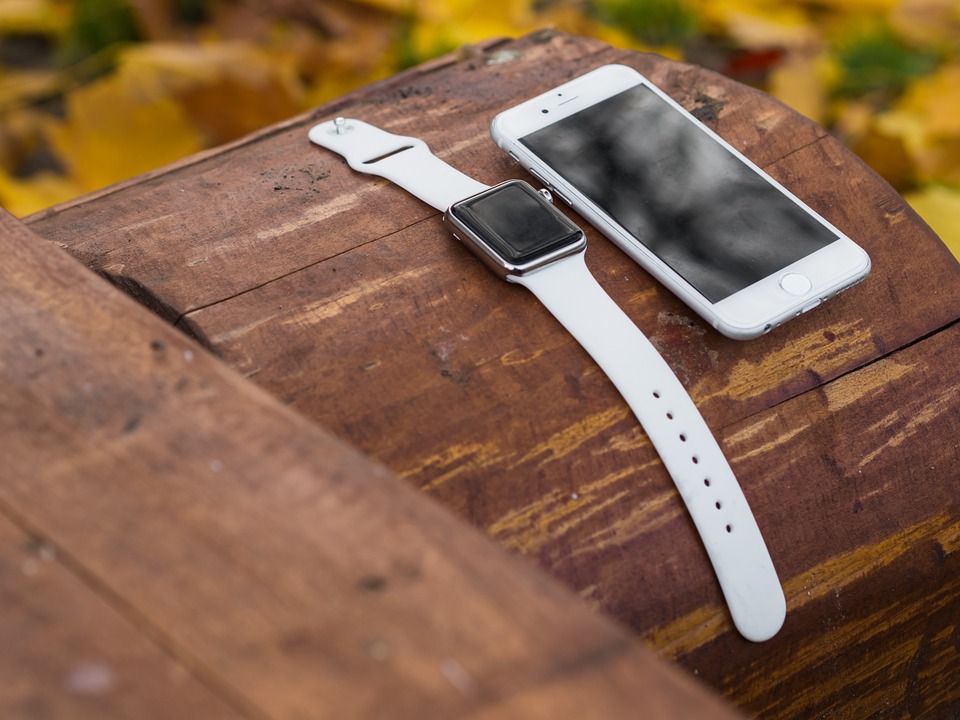
There you have it, folks! My top five apps that I use for health and fitness. This is the part where I point out that I am in no way being compensated for speaking about these apps, nor do I endorse them specifically above any others that you may have tried/like. In fact, I’ve tried a score of others. Some have been as simple as a library of different exercises. Some have been so over-the-top complicated that I removed them from my device within the first week. The important thing is to find some helpful apps that work for you and your lifestyle.
I don’t endorse technology all that often, so mark this day on your calendars! Actually, besides the technology used for my pump and Diabetic supplies, I usually don’t endorse technology at all, haha. But since society as a whole is normally tethered to their smart devices, it only makes sense to use them to benefit our health & fitness. I find that all of these apps are somewhat subjective to the user. I think the five I’ve listed are fantastic and even if I’ve removed some of them on occasion, I always seem to come back to them. There’s plenty of good, free apps out there so don’t be afraid to install a few and try them. Worse that happens is you don’t like them and remove them. ☯
 The Blogging Buddhist