Walkin’ In A Winter Wasteland…

I had the distinct pleasure of waking up to several inches of white bullshit a few days ago. It’s one of those things where there’s just no getting away from it. Winter and snow comes along every year and when it does, there are several things one needs to bear in mind to keep oneself warm and safe. Especially f one is travelling with Type-1 Diabetes. Being prepared means the difference between being safe and finding oneself in a compromised position.

Travelling with Type-1 Diabetes requires special attention to detail and ensuring that I bring everything with me in the event of a worse-case scenario. First and foremost, your personal vehicle should always have the basic necessities that one needs during the winter, whether you have Diabetes or not. This includes booster cables or one of those very handy booster packs, a first aid kit, blankets and candles. Those are all basic things that everyone should have. We live in the age of cell phones and easy communication, so it’s important to keep your cell phone charged during your travels.

Once you’ve covered all those bases, you need to focus on the Diabetic aspect. I make a point of always having a backpack or a shoulder sling available. Inside, I keep my glucometre, some fast-acting carbohydrates and nasal spray. I also have a small, travel size first aid kit and whatever extra crap I need for the day, including books and my Bluetooth keyboard for blogging. Depending on how long I’m on the road and where I’m headed, I’ll also be carrying insulin and pump supplies.

The point is, in the event of a collision or becoming stranded in a storm, being prepared will ensure you can stay safe until help arrives. In the event of low blood sugar, you fast-acting carbs to bring it up and in the event of your infusion set or sensor expire, you’ll have replacements. blankets and candles will ensure you can stay warm since, depending on how you land during a collision, your vehicle may not run and if it does, it may be dangerous to do so.

Most of this should seem like common sense but it always amazes me how many people take to the road without any supplies or precautions. Although most people can survive for a reasonable period within the shelter of a vehicle, being Diabetic makes it all the more hazardous. Last but not least, Saskatchewan winters are especially cold as fuck, which can also affect blood sugars. During the cold, winter months, take precautions, be safe and be prepared. And stay off the roads unless absolutely necessary. ☯️

Thumbs Up…

If there’s one thing that I’ve been able to start noticing with age, is the fact that my reflexes aren’t quite as sharp as they used to be. That’s a normal thing, and we all get there eventually but it lent a particularly stinging reminder last Sunday. I’m totally on that bandwagon of trying recipes I see on Facebook. You know the ones; the short little video that shows all the ingredients belong dropped into a slow cooker or a pan, to create a wonderful and trendy meal within minutes? Love those videos…

Anyway, I saw this one video where you take three packages of ramen noodles, of all things, drop them into a slow cooker with a pound of cooked ground beef, chicken broth and veggies of your choice and slow-cook it for about two hours. It looked easy enough and I enjoy the occasional package of ramen, so I thought I’d attempt it as a way of having ready-made meals for my work week. I chose red peppers and fresh mushrooms as my veggies.

Since I’m not writing this post to brag about my culinary skills or lack thereof, you should reasonably assume that something went wrong. I was using a small cutting board and slicing up my mushrooms, when some random kids came running up my driveway. Since both my kids were inside, the movement drew my attention, both because of my hyper vigilance that I believe will never go away and my ADHD. The problem is I was in mid-slice when I turned my head. The result was a very new and very sharp chef’s knife slid across the tip of my thumb.

The sharp pain and bleeding was immediate and I dropped the knife and moved to the sink, right as the kids were ringing the doorbell. I called for my wife as blood was fountaining into the kitchen sink. She dealt with the kids, who were collecting bottles, while I applied pressure and tried to stem the bleeding. At the risk of trying to sound macho, this isn’t my first rodeo in terms of my flesh getting sliced, but despite several minutes of applied pressure, the bleeding showed no signs of stopping.

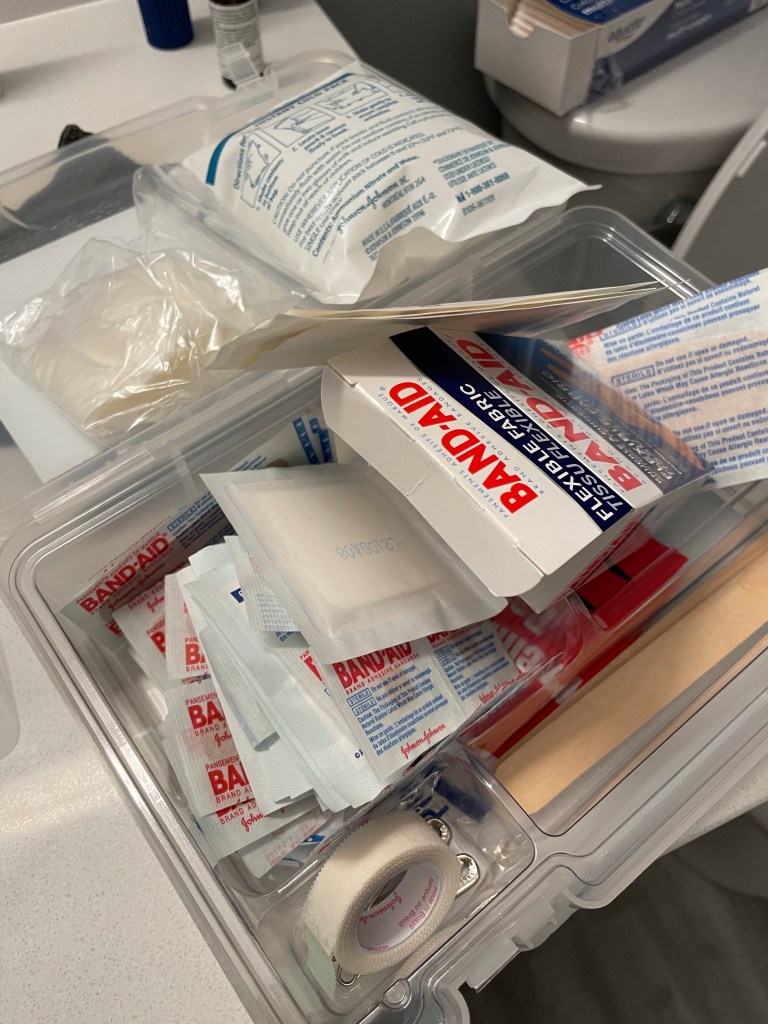
I staggered to the bathroom and opened up our home first aid kit (pictured above). Despite the cost for this thing, I was disappointed at the lack of bandages and gauze contained within. Maybe I should have looked at the included materials a bit more closely before buying it. There were only two, small gauze bandages, which I bled through and turned scarlet within seconds. After 15 minutes of consistent bleeding with no end in sight, I made my peace with the fact I would need to visit the ER…

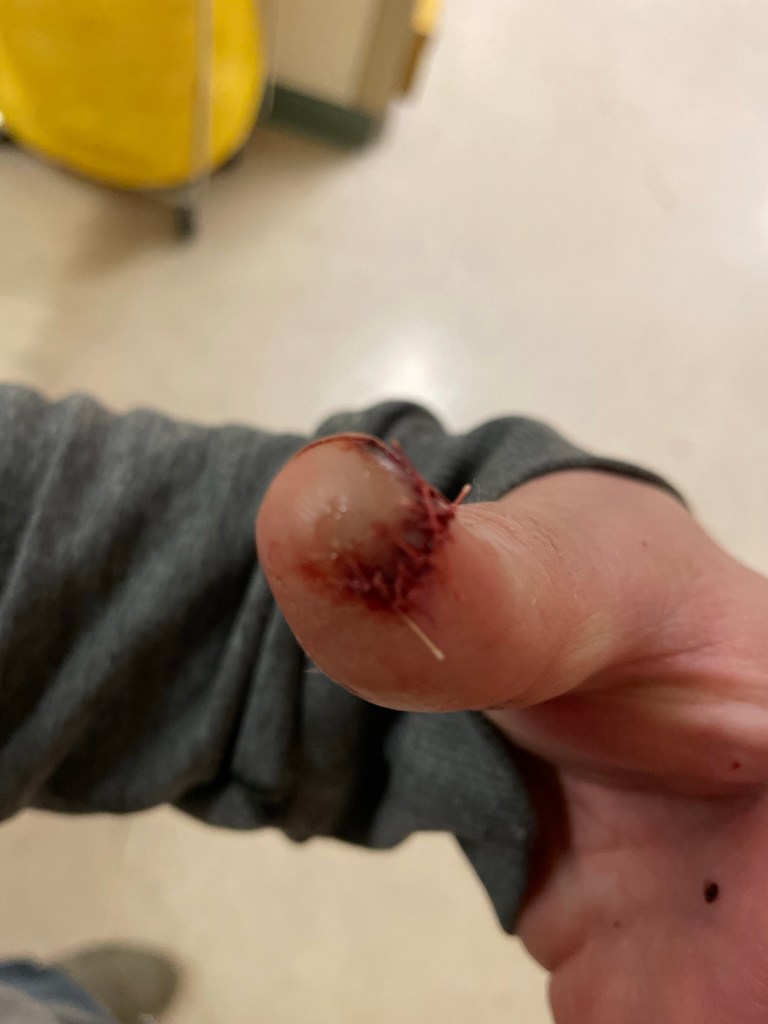
Because I’m stubborn (and cheap), I chose not to call an ambulance and just wrapped a tight bandaid to close the wound and drove myself to the hospital. There are enough people complaining about wait times for hospital waiting rooms, so I won’t touch on that beyond saying my total time at the hospital was about four hours, which isn’t extreme in the grand scheme of things. The real comedy came during my treatment, which included the freezing of my left thumb and the application of four stitches. Hopefully no one is squeamish as I will be sharing photos…

I had the attention and care of a surgical intern as well as an attending surgeon. The surgeon asked me if I was squeamish and asked if I would be okay at the sight of my own blood. Instead of just saying yes like a normal person, I made a point of bragging that I was a retired cop and had seen it all and experienced it all and would be fine. When the surgeon explained that the two-inch needle would be inserted directly into my nerves to numb my thumb (say THAT three times fast) and that I should look away. I proceed to explain that I have been Type-1 Diabetic for over four decades and have had needles of varying sizes inserted into almost every part of my body, including my eyeballs, so just do it, already.

Entertained by my bravado, she inserted the needle and injected the numbing agent. When the needle reached the nerves in my hand, my body reacted immediately. My body flushed, my head started spinning and I was overcome with nausea. I have never dealt with something of this nature, where the reaction is completely involuntary and out of my control. I had just enough time to warn the ladies that I was going down, so the surgeon was able to retract the needle and guide my head down to the pillow. They attached a blood pressure cuff and a pulse reader to monitor my vitals, which will become integral to my story, shortly.

After a bit of time, my thumb was fully numb and the intern was able to apply four stitches to my thumb and I was no longer spilling my life’s blood all over the place. I was waiting for the surgeon to come back and inspect the intern’s work before applying a bandage and sending me on my way, when the intercom announce a “Code Blue,” which is the usual code in a hospital settings for someone needing to be resuscitated or required immediate, emergent care. Since I was in one of the main trauma rooms, half a dozen staff poured in and explained that I needed to vacate so they could bring in their emergent patient.

I immediately complied and jumped to my feet before I realized I was still hooked up to the heart monitor and blood pressure equipment, which resulted in my yanking several machines and pieces of equipment across the cot and floor. The staff were greatly amused by my clumsiness and helped untangle me, so that I could vacate the room. I now found myself standing in a random hallway with my stitched thumb held up, waiting for someone to come apply my bandage and give me a tetanus shot, which I was told I would now require.

All in all, it was the last fuckin’ thing I needed over my weekend. Granted, there’s never a good time for one to injure oneself and given the difficulties in healing wounds that Type-1 Diabetics tend to have just puts me further on edge, given that I can’t see how the healing is coming along. Granted, it’s been a few days and it’s the first morning where I don’t wake up from sharp pain. It has made me realize just how much use one gets out of one’s thumb. You never know what you have until it’s gone and my thumb is no exception. Daily tasks are far more difficult when one can’t apply pressure to one’s thumb.

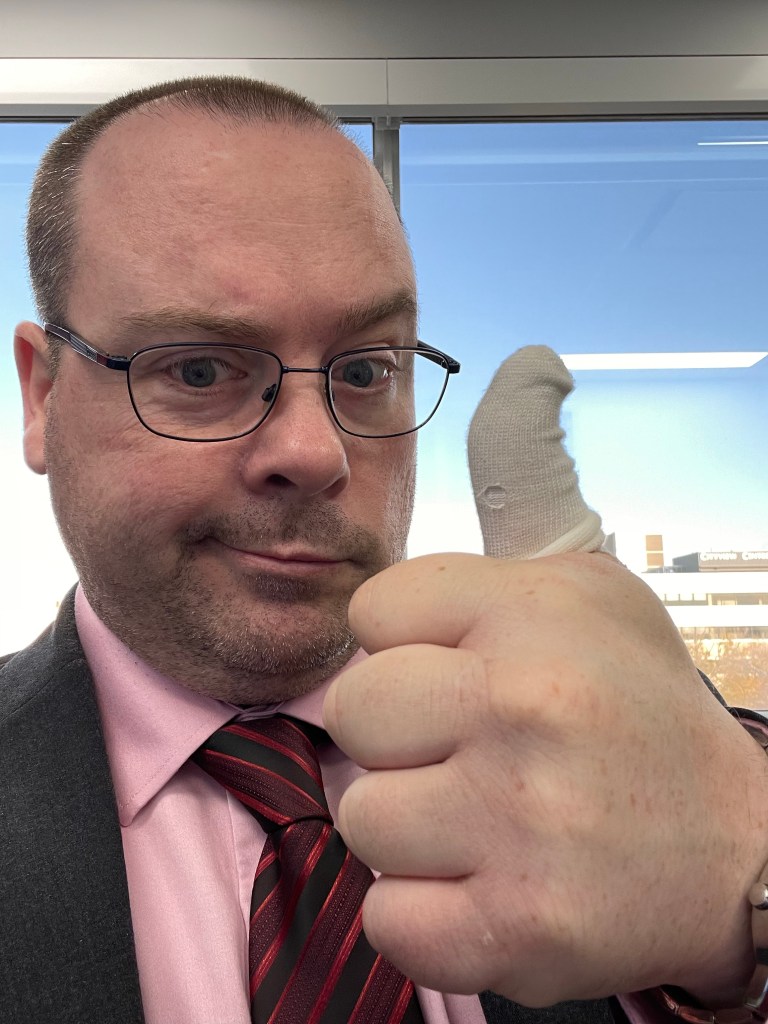
The irony is that it seems pretty stupid and menial. It’s a thumb. A cut on a thumb. It wasn’t a traumatic injury, I’m not laid up for weeks and I don’t require any follow-up therapy. So it amazes me how such a small injury can be so debilitating to one’s daily routine. It also reminds me to pay fuckin’ attention to the task at hand, pun fully intended. Another few days and the bandage can be removed as the stitches will dissolve on their own. Here’s hoping there’s no further complications and I can get back to quasi-normal. ☯️

Supplementation, Part Cinq…

I absolutely love this post! I consider it to be one of the best-written and important posts I’ve ever drafted and when I mention this to some of my readers and/or followers, it usually catches them by surprise. Perhaps they believe that my endearment should be reserved for posts about martial arts or even Diabetes. But the truth is, the contents of this post cover a lot of the bases: nutrition, health and requirements of the body, which all play an integral role in maintaining proper health for Diabetes and ensuring one can train and develop their fitness acumen. So read on, if you haven’t. Scroll on by if you read it last year…

I consider the consumption of vitamins and minerals to be an important part of maintaining one’s health. It’s no surprise that modern nutrition is sorely lacking in most people and with every reposting of this material, I’m reminded of the importance of taking a steady multivitamin on a daily basis; a fact my doctors keep reminding me, as well. With the colder weather hitting our area and everyone’s immune system taking a hit, vitamins and supplementation are very important. So, bearing in mind that I’m not a doctor or nutritionist, here’s what I posted all the way back in June of 2019. Enjoy!

One of the key reasons behind the consumption of food is to obtain carbohydrates for energy. The human body requires energy to carry on normal functions and, well… stay alive! But what else do we get from the food we eat? A proper diet will also include a number of vitamins and minerals that we require to maintain proper health, growth and energy levels within the body. We’ve all heard about getting enough vitamins from a young age. I remember getting my Flintstones vitamin everyday as a kid.

But if you’re like most people, you’re likely wondering what these vitamins are for and what they do. My goal is to cover off the main ones here:

Vitamin A: This is an all-around vitamin that provides a number of functions including but not limited to the proper health of various bodily functions, tissues and helps to fight chronic disease and is known to be good for the eyes.

Vitamin B: This one is a bit complicated, as there is a large grouping of enzymes, vitamins and minerals that fall under the “B” category. In general, B-vitamins are used for energy production, immune function and absorbing iron. Some them include B2 (riboflavin), B3 (niacin), B9 (folate) and B12. There are a few more that I can’t recall, but B12 is considered amongst one of the most important of vitamins overall because it helps you turn food into energy.

Vitamin C: At some points, this one has been referred to as the sunshine vitamin. I’m thinking that’s mostly because people’s main source of Vitamin C is from citrus fruits. But this vitamin also helps with iron absorption, immune function and is a natural antioxidant that helps with the elimination of free radicals. Eating citrus fruits are also what sailors used to eat on long voyages to prevent scurvy.

Vitamin D: This vitamin helps with the strengthening of bones and teeth. Our bodies are designed to self-generate this vitamin naturally through exposure to sunlight, but obviously that needs to be done in small doses. Modern life has created an environment where more people spend their time indoors, away from the sun. So supplementation becomes important.

Vitamin E: A pretty straight forward vitamin, this one helps with proper blood circulation and clear skin.

Vitamin K: This vitamin is essential for blood-clotting. In order words, if you’re deficient in this vitamin, small cuts or injuries can cause excessive bleeding that can become dangerous.

Folic Acid: We hear people speak about this one as being necessary during pregnancy. And they would be correct! Folic Acid helps to prevent certain complications during childbirth but is important to everyone for proper cell renewal. This one is also known as Folate, or Vitamin B9 (as listed above).

Calcium: Most people should be familiar with this one. Teeth and bones, people! Teeth and bones! Good calcium levels are required to keep those body parts healthy.

Iron: This helps to build muscle tissue naturally and helps with proper health of the blood. As an interesting sidebar, it’s also what makes your blood red through the reflection of light!

Zinc: Immunity and Fertility. I’m a little unfamiliar with this one and haven’t had the opportunity to research it a great deal.

Chromium: This one is near and dear to my heart. Because it helps to control blood sugar levels. Chromium is what helps all the systems of your body to get the energy they need when they need it. Some traditional medicine practitioners will suggest Chromium supplements for Type 1 Diabetics who may have difficulty in maintaining proper levels.

Magnesium: This one helps your body to absorb all the other vitamins and minerals. It also acts as something of a relaxant to muscle tissue and play a role in proper muscle contraction.

Potassium: This mineral helps with the proper hydration of your body and helps to control blood pressure.

There are many others of course, but I’ve tried to cover off the main vitamins and minerals required for a proper diet. We get most of what we need by eating regularly and including a variety of healthy foods. A lot of people take a daily multi-vitamin, which is fine. But unless you are experiencing symptoms or unexplained illnesses, there shouldn’t be a need to actively try and take added amounts of anything. Your medical practitioner should be able to advise you if further supplementation is required. For example, patients who are recommended to take Folic Acid and Iron during pregnancy.

Obviously, all of this is extremely important; not only for proper health and fitness, which is important to me, but to help with Type 1 Diabetes as well. Taking a daily multivitamin can help to ensure that your body gets everything it needs, in combination with carbohydrates, lean proteins and fibre. My wife Laura originally gave me the idea for the post I wrote in 2019 when she asked about B-vitamins. Every time I re-post this material, I think of her. The credit for this post is all her! ☯️

There Are No Free Rides…

I don’t know if any of you have heard of the most recent trend where people are using a certain Type-2 Diabetes medication for weight-loss. I had a colleague of mine bring it to my attention this morning and I couldn’t believe it, when I watched the news clip released by Global news on October 6 about the phenomenon. It’s one of those things that quote frankly rank right up there with eating Tide pods or snorting condoms. Although, I guess this one isn’t so much a dare as it is a quasi-medical attempt at cutting corners.

So, what am I talking about here? Well, specifically, I’m talking about a medication call “Ozempic,” or semaglutide, which is the generic name. like most Type-2 treatments, Ozempic is intended to be used in tandem with proper diet and exercise in order to help control and maintain blood sugar levels. Problematically, this drug apparently also promotes a certain level of weight loss, which people are jumping on, because no one seems to understand that healthy weight loss does need to involve proper diet and exercise. If anyone wants to see the news clip, it can be accessed here.

Like pretty much any medication or treatment ever created, any specific medication will usually carry more than one use. That’s why it isn’t overly surprising that even if this medication is intended to help control Type-2 Diabetes, someone was bound to jump on the weight-loss train. The caveat is that like every medication or treatment, there are also side effects; some of which can be pretty serious if the medication in question is not being taken for its intended purpose. Ozempic is no different.

According to an article posted by WebMD, mild side effects of this medication can include tiredness, nausea, vomiting, diarrhea and constipation. On the more severe side, there can be a possibility of kidney issues as well as pancreas or gallbladder disease. Doesn’t exactly sound like a fuckin’ spa treatment, right? Seems like a bit of a risk to try and lose weight quickly. Seems easier to simply start working out and eating better but what do I know? Oh, wait! I’m a patient with Type-1 Diabetes who has managed to go over four decades without any serious complications. THAT’S what I know!

That last point and likely the biggest issue, is the availability of the drug. Because people are all jumping on the bandwagon to get their hands on it to build their bikini bod, people who actually need it to help treat Diabetes are left wanting. If you watch the news clip I linked above, supply chain issues are becoming a problem. Not so great. There are no free rides, folks! If you want to lose weight, get up and get moving. Control what you consume and in what amount. Seek the guidance of trained professionals in both nutrition and fitness. The concept of any magic drug that will help you lose wight is laughable. Even the ones that may have this effect, the risks far outweigh the reward. Food for thought…☯️

Type-1 Diabetes And Kids…

No, I don’t mean kids WITH type-1 Diabetes… I mean having Type-1 Diabetes while there are small children in the mix. If you take care of yourself and manage your condition properly, you’ll eventually reach a point where life will progress to a point where children are part of the equation and get in the mix. We often hear that being a parent means sacrifice. So, what happens when there’s an aspect of your life that you can’t sacrifice or even compromise on? That can makes things difficult, especially since children don’t have the tools or the maturity to necessarily understand some of the ins and outs of their parents’ condition. If you’re just entering into this particular chapter of your life, let me share some of the realities I’ve faced in that regard over the past decade…

Managing Type-1 Diabetes in the hopes of reaching old age and seeing your family grow up, requires a number of moving parts and aspects that don’t always work well when there are small children in the mix. At times, it can mean being borderline rude and mean to the members of your family, even if in reality, you’re doing it in the interest of being around long enough for their benefit. Even IF you’re lucky enough that this may be understood, it eventually falls on deaf ears when the years melt away; especially since most people don’t understand the need to maintain one’s standard as opposed ot just trying to fix it later on. The irony is, as technology has advanced and my personal treatment has become more effective, it’s opened up the door to different issues. Here are just a few of the bigger ones:

Treats Aren’t Necessarily To Share
While some people can get away with a quick glass of orange juice or some of those glucose tablets, those options have been very effective for me. In short, fast-acting carbs have included candies such as jelly beans, gummy bears and other fat-free gummy options. Skittles also work well in a pinch. Picture yourself having a low and trying to wolf down a handful of that goodness, only to have your toddler want to have some. On the one side, handing over a couple of them wouldn’t necessarily break the bank. On the other, depending on the available stock one has, the few you hand over may be the ones you need to push yourself up the added point or two to get back to normal. Trying to make a child understand that is usually difficult at best. After all, why does daddy get to snack on some goodies and I don’t?

Sleep Is Not An Option Or A Negotiation
As I’ve often written about before, sleep is an integral part to a person’s overall health. Blood pressure, mood, weight loss and blood sugars are all affected by the amount and quality of sleep that someone with Type-1 Diabetes. This can often mean that grabbing the occasional nap as well as ensuring that one gets the 7 to 9 hours of nightly sleep required is difficult. Ever had a kid lift your eyelids and ask for food? Or have both children awake and basically beating the shit out of each other while you’re trying to nap? I have. Just this morning, despite it being the weekend, I had one of my kids wake me up at 5 o’clock because his iPad was dead and he needed something to watch his cartons. How well do you think he understood that daddy needs his sleep and he shouldn’t be waking anybody? Not in this lifetime?

Equipment Is Always At Risk
This is a big one, especially if you include items like an insulin pump or continuous glucose monitor sensors in your treatment. Over the years, tubing and equipment have been torn out, grabbed, yanked and destroyed by the little hands of the innocent. This can lead to significant issues, especially if you happen to have NO coverage for your supplies. Imagine trying to figure out how you’ll get proper insulin delivery when your infusion set still had two days’ worth and you were on your last one? During both of my sons’ infant years, trying to spent some cuddle time while trying to keep them from ripping out my equipment has proven problematic. Babies don’t usually understand “don’t touch” at the best of times. When they see something that’s shiny and plastic, grabbing is grabbing.

Exercise Can Be Difficult If Not Dangerous
I’ve spent the majority of my life pushing myself physically. From my martial arts training, to police training, weight lifting, cycling and the score of hours I spend on the punching bag, exercise is not only a big part of who I am as a person, it’s the thing to which I owe the majority of my good health and Diabetes control to. It’s no secret that physical fitness contributes to one’s overall health for anybody, Diabetes notwithstanding. But one’s commitment to fitness can be compromised by the presence of children in the mix. Picture bench-pressing a solid amount of weight, only to have your kid walk up next to you and decide that it’s a good time to tickle or poke your eye. Or even if they don’t, getting smacked by the bar will cause a meltdown that will end your workout pretty fuckin’ quick.

The caveat to this one is that at some point, your kids will be able to join you in those workouts. There’s a lot of fun in having my toddler on the punching bag while I’m on the strike pad and we take turns switching. Or having my oldest play a rigorous game of basketball of tag with me. On occasion, I even get lucky enough to entice my oldest to use the punch pads while I hold them or move along with me as we do some calisthenics. That’s where at least one aspect can be fully shared or enjoyed with one’s kids. But finding the free time for oneself to commit to a solid workout is not only not often understood by one’s kids, especially when it means added time away from home. Kids don’t get that.

The last point I’ll touch on, is the scariest part of all. There’s always that possibility that the son may inherent the condition of the father. It’s one of the things that keep me awake at night the most. So far, my oldest has been found free and clear. I’m hoping it stays that way. but the reality is that dealing with Type-1 Diabetes can be difficult at the best of times. Explaining it to one’s children and navigating some of the difficulties listed above (and there are others) can be just as difficult. The important thing to bear in mind is to stay consistent, recognize that may not always understand but that you’re doing it for them. They may not be happy about it but in the end, everyone will be better off for it. Food for thought… ☯️

Lean, Mean, And A Few Things In Between…

One’s health and fitness has many moving pieces and sometimes it can be difficult to navigate the vast plethora of bullshit that you can find online nowadays. I say this with the firm understating that I’m reaching you now through an online medium, but I stand by my statement. Even if you set aside all the misinformation or pseudo-science that can be found online, it’s important to remember that what works for one person may not work for another. What’s more is, doing things wrong may cause more harm than good.

This seems like a good time to remind everyone that I’m not a medical practitioner, dietitian or have many formal training. This post is intended solely as my opinion, based on my own experiences. talk to your own doctor before contemplating anything mentioned here. Now that the disclaimer is out of the way, let’s talk diets and fitness. For most people, dieting generally means either cutting the amount of food you eat or eliminating certain food groups that one may have read contributes to overall weight gain.

The problem with the former, is many people believe that cutting the amount of food they eat will automatically make them lose weight. Although this can occur in some situations, it can also have the opposite effect. Because the human body is programmed to keep you alive no matter what, eliminating your food intake or starving yourself, will usually result in your body hoarding away what you DO eat as fat, which it will then use to sustain you should there be another long period without food. Depending on your metabolism, one should rather examine HOW one eats as opposed to trying to eliminate HOW MUCH they eat.

Another big problem is depending on the almighty scale. People tend to measure progress on the number staring back at them from a scale, but that can be deceiving, as well. The problem includes the fact that if you’re building mass as a result of exercising more frequently, that scale may not be your friend. The whole “muscle weighs more than fat” concept is total bullshit! A pound of fat or a pound of muscle is still one fucking pound. I will die on THAT hill.

But even if you’re waistline is slowly getting smaller, your muscle mass may be getting bigger, which could be why you aren’t seeing the results you want. It’s important to remember that you need to incorporate ALL factors into your fitness journey, including what comes in, what comes out, your weight, your diet and your exercise routine. Each person is unique and even though your neighbour has lost tons of weight from fasting doesn’t mean that will work (or is safe) for you.

I happen to be dealing with my own weight-loss journey at the moment, where I’m dealing with that very scenario. A certain change that one of my martial arts counterparts has tried showed great success and seems to be working for me, as well. More on that in the near future but the important thing to rememher is if you’re dieting, be sure to control aspects such as portion size, frequency of meals and HOW you consume your food. People don’t seem to recognize the amount of damage one can cause by simply trying NOT to eat in order to lose weight.

For example, there’s a reason you need to consume food. Carbohydrates provide a primary source of energy for the body. You know, energy? That thing you need to stay alive and do ANYTHING??? Completely cutting carbs prevents that. Other aspects, like include proper levels of finer and protein, to help with the proper growth and repair of muscle tissue and the normalization of your elimination systems. This means that if you do something du,b like eat nothing but protein, you’ll stop yourself up like a loaded subway car during peak hours in Tokyo. Not pretty…

The key to it all, is balance. Just like you should be taking regular breaks from fitness to allow the body to heal, you also need to find the means to control your portion sizes and still get all the food groups and nutrients you need in order to stay healthy. Fad diets are usually just that; a fad. The complete elimination of entire food groups should be avoided, unless done on the advice and guidance of a medical professional. And for light’s sake… Don’t STOP eating in order to lose weight. To somewhat quote The Mandalorian, this is NOT the way…

Take A Break Before You Break…

Maintaining one’s fitness is an ongoing battle, usually with absolutely no end on sight. Usually and for the most part, people develop and maintain a routine for themselves that isn’t always conducive to proper fitness. one of the big realities, and the one people tend to overlook the most, is that rest is just as important and integral to one’s fitness journey as staying consistent and committed. And foregoing appropriate rest can have some nasty effects on your overall health as well as your fitness goals.

When you have Type-1 Diabetes, proper exercise and maintaining one’s fitness becomes an entirely different kind of fight. Without proper, consistent exercise, blood sugars can run amok, your health will decline and your condition will be all the harder to manage. Granted, some of that can happen even if you DON’T have Diabetes, but I do, so I tend to focus on that. The problem is that you can go past consistency and slowly stray into working out TOO much.

Our bodies are designed to respond to physical exertion in a number of different ways. When it comes to building muscle, growth is achieved by exerting the muscle tissue to the point where micro tears occur. Through the healing process and the proper consumption of protein, fibre and water, the muscle tissue grows back at an increased size to compensate for the level of exertion the body noted during the previous workout. This only part of the aches and pains that one might feel after a significant workout.

The issue comes into play when those aches and pains grow severe enough that you lose mobility or use of those particular muscle groups. For example, if you had a wicked leg day and the following morning, you can barely walk, this means that you’ve over-exerted yourself and you should consider taking a period of rest and treating the affected area with heat and/or cold to aid in the healing process. To continue to work out and exercise in those circumstances can lead to injury, which would require longer recovery time and some circumstances, medical intervention.

So, what can or should be done in these types of circumstances? Well, some people rotate the muscle groups that they exercise. This means that if they do leg exercises today, they may do arms and chest tomorrow. That kind of thing. That’s a good practice to have, regardless of the level of exertion that you put yourself through, especially since you should work towards developing the body as a whole and not necessarily focus on only one aspect. But it’s important to bear in mind that resting one particular part of your body isn’t always enough. N o matter you’re level of commitment or your goals, you sometimes need to allow the body as a whole to get some rest.

A strong, consistent fitness habit will help to ensure better health, better weight management and better overall blood sugar control. proper exercise contributes to better blood pressure, better sleep habits and has been shown to improve one’s overall mood. Although having a fixed routine doesn’t always work for every person as each of us is different, there’s always a way to work towards something that works for you. Just remember to drink plenty of fluids, get adequate rest and don’t push your body beyond the warning signs it’s giving you. You’ll recover faster and although you may think that working out none-stop will get you to your goals faster, it’s good to remember that sometimes, slow and easy wins the race. Food for thought… ☯️

A Little Perspective…

Throughout the course of my life, I’ve had to put up with a lot of misinformation and “helpful” suggestions from friends and family regarding how to better manage my Diabetes. Over the decades, I’ve had people try and tell me how to adjust my diet, my exercise regiment and even my insulin and medication dosages; all in the interest of trying to help. Surprisingly enough, 99% of the time, this unsolicited advice has come from folks who are neither Type-1 Diabetes themselves, nor do they have someone close to them who is (besides me, of course).

One of the big problems with how I’ve managed my Diabetes throughout the decades is that I almost have an invisible illness. People don’t assume I have Diabetes to look at me. I have sight in both my eyes, although the injections don’t make that easy, all my organs are clear and function normally and I have all my limbs and appendages without ever requiring amputation. Admittedly, this is pretty rare for someone who was diagnosed over 40 years ago and has suffered through some of the complications I have, as a child. This can make it pretty easy to assume that your granola-crunching ways may hold the key to healing me. But it doesn’t.

For example, quite some years ago I had someone I was associated with, who tried to convince me that if I switched to eating only vegetables (not becoming a vegetarian, mind you. Simply eating nothing BUT vegetables) I would no longer be Diabetic and would no longer require insulin injections. I can just read my tombstone now: “Here Lies The Blogging Buddhist. Died With A Turnip In His Hands…” Cue the sad music… This approach obviously wouldn’t work, for a wide variety of reasons. But it’s a good example of how I’ve often received “advice” from people who know nothing about the condition I live with. Here are a few more…

I Have This Diet That Will Heal You! First and most importantly, there is no diet that heals or reverses Type-1 Diabetes. This is often a common beliefs because in some rare cases, diet and lifestyle changes can help reverse the effects of Type-2 Diabetes. The problem is that Type-1 and Type-2 Diabetes are significantly different conditions, basically only similar in name. My body’s own immune system is attacking my insulin-producing cells, resulting in my condition. There is no diet that can repair or reverse that. Keep your tofu, natural diet alternative shit off my plate! I’ve already taken insulin for the carbs.

Can’t You Just Exercise More And Eat Less? You Wouldn’t Need Insulin Then, Right? Ah, the age old question… If insulin reduces your blood sugar levels, can’t you just consume less sugar to keep it from rising and exercise more to balance it out? No. No, I can’t. There are many reasons why this can’t be a thing and why people who became Type-1 Diabetic usually never survived beyond two weeks, prior to the 1920’s. Insulin is hormone and it performs several functions within the body.

The main functions and the important ones, include controlling your body’s blood sugar levels by helping sugar enter your cells to be used for energy. Energy… You know, that shit you need in order to stay alive? Yeah, that. Insulin also helps the body to store the excess energy for later use and helps to balance out your body’s weight and metabolism. Without insulin, a whole mess of nasty shit starts happening inside your body, resulting in a slow, painful way to die. So, no, Karen! I can’t just exercise more and eat less.

It can be easy to misinterpret or misunderstand someone else’s condition, especially if you’ve never experienced it or had a family member who has. What’s important to realize is that most people with Type-1 Diabetes have received professional medical care for their condition and know what they need to do. Some random diet you’ve found in a magazine or fitness ideas without the benefit of how the condition actually affects the person’s body won’t be helpful. And believe me when I say, we’ve heard them all before. Food for thought… ☯️

On The Run Doesn’t Have To Mean Without Fun…

Growing up, my household had a bit of a wash, rinse and repeat approach to meals. For the most part and being raised by a French Acadian mother meant that feeding a group of people involved tossing meat, potatoes and veggies into a giant pot and boiling it until it became mush. usually served with dinner rolls and pickled beets, this was also the ONLY meal my grandmother ever served; a testament to a leaner time when wartime families had to feed a dozen people or more at every meal.

As grateful as I am for having had the opportunity for a warm plate on my table growing up, there’s no arguing that it seriously influenced how I choose to consume my meals now, as an adult. Throughout school, I was always burdened with the same ol’ peanut butter sandwich without the benefit of adding jelly, due to the sugar content. It became tedious and boring and i usually dreaded lunch time as something to get through as opposed to a period to sit, enjoy a meal and contemplate the events of the day. Things have changed…

As an adult, I find myself dealing with the same challenge of bringing lunch for myself that doesn’t involve something generic and won’t throw a significant curve ball against my blood sugars. I usually have breakfast AND lunch at work, which allows me to get to work a bit early so that I can get a jumpstart on my day. This morning for example, I had a leftover boiled egg from yesterday’s potato salad. carb-free and filling enough to get me through my morning, it was a good option.

So what about lunch? The big problem I had during my youth is that the classic sandwich poses logistic issues that, from a flavour standpoint, can’t be ignored. If one makes their sandwich first thing in the morning and includes all the constituent parts, t you run the risk of having things sit and meld together in a way that may cause your bread to get soggy or the flavours of certain ingredients to change, once they absorb some of the others. Refrigerating a sandwich over several hours will also tend to alter the flavour and let’s be honest, who really thinks a cold sandwich is tasty?

The alternative is simple; be willing to do some assembly DURING your lunch hour. I’ll use yesterday as an example. I packed a large, flour tortilla into a sandwich bag. provided they’re fresh, they’ll be plenty flexible and will fold nicely. Then, pack some shredded cheese and your preferred sauce in small, reusable containers. Then, I chose my meat, which on this occasion was some very lovely slow cooker chicken that my wife had prepared the day before. Keeping all these ingredients separated prevents the flavours from mixing with one another, come lunchtime. Another thing you prevent is needing to heat the meat portion of your meal with condiments that likely shouldn’t be nuked. Ever try reheating fries that already had ketchup on them? It usually doesn’t go well…

The benefit with allowing yourself some time to assemble your meal at lunch time is you’ll get a better, fresher tasting meal and you have the opportunity to heat up your protein without heating up your wrap or condiments and sauces. This can apply to a number of different meals. Today, for example, I’ve brought a small bowl of homemade chili with a container of cheese. Sprinkle a bit of buffalo sauce in that bad boy after heating it up, mix in the cheese and allow the heat of the chili to melt it just a bit and you’re off to the races.

So, this all rather feels like a first world problem and it begs the question, why am I bringing it up? Well, for a number of reasons. The first being that just because you’re having a meal at work doesn’t meal it should be an enjoyable experience. Fast meals intended to be jammed down your gullet so you don’t starve during your shift shouldn’t be the norm. I say this while fully acknowledging that some folks only have a brief window for meal breaks. I, myself, never had a scheduled meal break while I was a police officer.

That being said, and something I learned a long time ago, is that a rushed, stressed meal period will also affect one’s blood sugars. Although every meal can’t be a pageant, being able to take the time to actually consume your meal without rushing and having a hot alternative in front of you can have a significant impact on one’s blood sugars. Given everything else that’s affected by Type-1 Diabetes, it should be no surprise that event he way you consume your food can have an impact. Just something to consider. Food for thought, pun fully intended…☯️

Mellow Out With Some Melatonin…

This is one of those posts where I need to be very clear in that I am in no way a medical professional and everything outlined below is strictly my opinion and what I’ve noted from my own experiences. It’s important to consult and discuss any new supplementation with your doctor or medical practitioner before starting to take it. This is especially true of anyone with Type-1 Diabetes since, as you know, just about everything affects us in some given way, shape or form. Moving on…

I’ve had some recent experiences with Melatonin supplements and I thought I would share my personal findings, since it seems to be all the rage these days. I say these days, but Melatonin has been researched for decades and first started to be used as a nutritional supplement in the 1990’s, with it becoming licensed for use in Canada in the early 2000’s. You can find some at just about any pharmacy and many retail outlets and it will usually come in gummies or pill form.

So, let’s start with the basic question… What the fuck is Melatonin? Simply put, it’s a hormone that’s naturally produced by your oft. When it gets dark out, the body is triggered to produce Melatonin, which signals your body to sleep. This is why you read so many sources that tell you to stop staring at screens at least half an hour before bed; because light reduces your body’s Melatonin production. For the purposes of this post, I’ll be discussing my use of Melatonin supplements, which are artificially created and packaged.

I recently had the opportunity to try Melatonin after my wife purchased some from a local distributor. She had been having troubles falling asleep and thought to try them herself. One night, when I found myself wide awake and on a night off, I decided to give one a try. Hers were in gummy form and contained 2.5 milligrams of Melatonin. I took one about half an hour before I planned on going to bed and spent the majority of the night up. It had done nothing. The following night, I took two gummies, which gave me 5 milligrams of Melatonin. The difference was amazing. I fell asleep nicely and not only did I get a full, uninterrupted night’s sleep, I woke up refreshed and without any grogginess or sluggishness.

Being cognizant of my responsibilities during the day, I chose not to repeat the attempt the following night. That came later, during the next weekend. However, 5 milligrams now appeared to have no effect. I made my peace with the possibility that I had built up a resistance to it, which would be problematic of a hormone one’s body produces naturally. It wasn’t until some time later when I was shopping at a local retailer, that I found over-the-counter pills for 10 milligrams of Melatonin. I grabbed a bottle and brought it to a pharmacist to discuss. We went over the medications I was on and finding no complications or interactions, I bought the bottle and brought it home.

I took a single, 10 milligram pill about half an hour before bed and found myself once again drifting off to a solid night of uninterrupted sleep. It was glorious. As it was the weekend, I had the benefit of repeating the experiment the following night, with the same results. Apparently 10 milligrams is my sweet spot. I’ve made a point to stay away from taking some every night but it’s been very effective for me in helping to reset my proper sleep cycle and get a good night’s sleep. A couple of nights of taking it consistently at the same time and I now get tired and feel the need to go to sleep on my own, even without it.

The important thing to remember is the same as with all supplements. Be mindful of your uses, side effects and any possible interactions with other medications you may be on. WebMD, one of my favourite medical websites, has a great article that covers many of these aspects. You can read it here. Personally, none of the medications I take appear to interact with the Melatonin and my blood sugars have remained consistent. I haven’t experienced ANY of the possible side effects listed for short term or prolonged use. I will note that the instructions on the bottle recommend short-term use.

All in all, I’m reasonably satisfied that the supplement is doing its job; resetting my sleep cycle and allowing me to get a good night’s sleep. It’s also the first supplement I’ve ever taken that doesn’t appear to require continued use to enjoy the effects. I usually only take them on the weekends but my sleep during weeknights appear to be more consistent now. I don’t know. The rest of you will have to try and judge for yourself, considering every person is different. But I have to say that although I hadn’t even heard of this stuff before my wife brought it in the house, I’ll admit that I could have used it to help with sleep cycle years ago. Just remember to be cautious and check with your doctor before getting too far into it. ☯️