Deadly Roller-Coasters (yet Another Diabetes Story…)

It’s been a hellish week for me and given that it’s only Wednesday, that’s saying quite a bit. Last Thursday, I had the benefit of going out for drinks and games with some associates of mine. For anyone who knows me, that’s a rare and unusual occurrence for me. As much as I immerse myself in time at home and running errands, it’s nice to occasionally grab a pint and let one’s hair down. Conceptually speaking, of course. I’m bald. But it was a god evening of a couple of pint of white IPA (my colleague’s idea) and a platter of appetizers, couple by unlimited access to games and challenges. We spent only a few hours before I made my way home to crash. All seemed right with the world.

Over the past decade, I’ve come to learn that having Type-1 Diabetes shouldn’t prevent you from enjoying the things in life that everyone else does. That’s a pretty broad statement and one that, while certainly applicable, doesn’t always work out the way we want. Even if my endocrinologist tells me I can enjoy that large wedge of chocolate cake thanks to my insulin pump doesn’t mean that it won’t completely fuck with my blood sugars while the insulin is trying to catch up. Some of it is timing, some of it is calculating carbs and some of it is just plain ol’ luck. But on occasion, there’s just no accounting for the uncertainties. A plate of random appetizers is extremely difficult to carb-count.

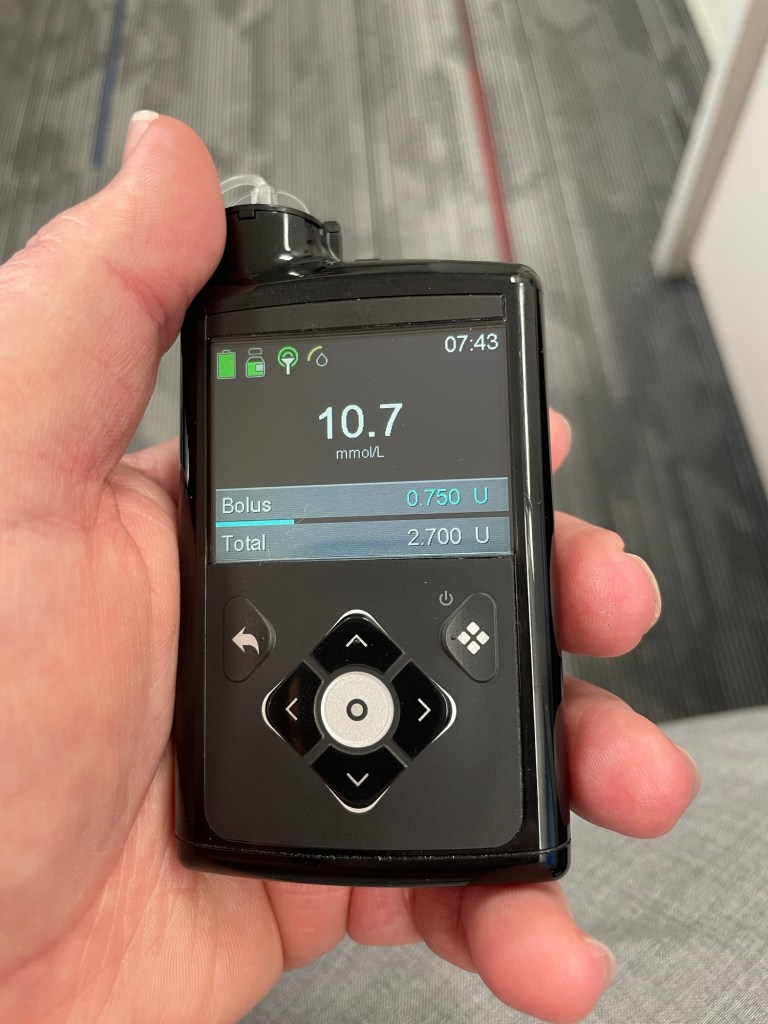
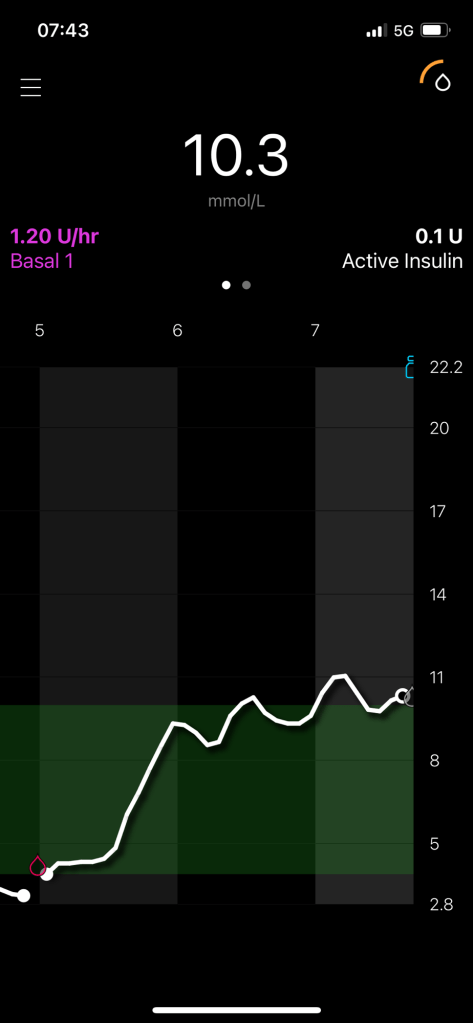
I woke up at about 2 in the morning with blood sugars reading at about 30 mmol/L. Yes, you read that right. Fuckin’ 30! For you non-Diabetics out there, normal range is between 5.0 to 7.0 mmol/L so sitting at 30 involves a whole slew of bad bullshit that happens inside the body. And outside, if you include the vomiting. But we’ll get to that. I got home at about 8:30 pm on Thursday evening and my CGM sensor expired. Just my luck. Since it takes about two hours for a fresh sensor to warm-up and calibrate, I was in for a bit of a late evening. Nonetheless, I charged the transmitter, grabbed a shower (bare abdomens mean Diabetic happy showers) and installed the new sensor. I calibrated around 11:00 pm and hit the sack, exhausted at having actually gone out into public and done things. I anticipated going into work the following morning.

On the Friday morning, I did my usual thing, which includes hitting the ground running. Since I had showered the previous evening, I had a bit of a head start. I prepped some lunch, packed my work bag and got dressed in casual attire, since it was “jeans Friday.” By the time I got to my office, the veneer of starting my day had worn off and I started to feel it… An intense feeling of nausea and body pain, specifically in the joints and muscles. I got through the start of my daily routine at the office but I was distracted and unable to focus. My boss came in and took one look at me and told me I looked like shit. I couldn’t fault him because he was right. I was an unpleasant shade of grey, sweating through my shirt and felt as though I might pass out.

You may have heard the expression that the shoemakers kids go barefoot… I’ve always been far better at encouraging other to get rest and be healthy than I am at taking care of myself. Oh, I can rock this whole T1D thing like nobody’s business but I tend to fend off and stubbornly press through anything that seems like common symptoms. On this occasion, I chose to take my boss’ advice and packed up to return home. It turned out to be a good idea since, I barely had time to dump my bag and remove my jacket before running to the bathroom and purging the limited contents of my stomach. The pain was unreal. Ai this point, I realized I should lie down. I should point out that I had been spending most of the night bolusing and slowly bringing my blood sugar down. I woke up ayt 14 mmol/L, which is not great but it’s a far cry better than 30.

Over the next 48 hours, I consistently retested my blood sugars, bolused additional amounts to keep bringing my blood sugars down and try to feel better. I sipped ginger ale and sugar-free Gatorade to keep myself hydrated. Given the pain I felt, I knew I was dehydrated but if I had to venture a guess, I’d say I was in some level of ketoacidosis. It wasn’t until about 8 pm on Friday night that my blood sugar had dropped low enough to allow me to have something to eat. I ate sparingly, concerned I would just spew it all up. But it stuck. I changed my infusion set once, believing I was possibly not getting the doses I needed. Absorbtion rates can differ depending on where your infusion set sits or how much scar tissue you have. I also took a couple of manual injections when I realized that despite an empty stomach and plenty of bolusing, my levels didn’t seem to be coming down.

It was a hellish weekend and by Sunday morning, my throat felt raw and on fire. The pain was at a level that was radiating into my ears and head. Acetaminophen had zero effect. No surprise there; it never does for anything I get. I finally went to the pharmacy and got some over-the-counter throat spray. The problem with those sprays is actually having shoot to the back of your throat properly. Yes, I heard it as I typed it. Let’s move on… I eventually moved on to a homeopathic throat syrup that worked far better. A mild, minty-hint of Ibuprofen later, the pain passed just enough that I was able to get some semblance of a night’s sleep on Sunday. Going back into work on Monday was far easier. But the pain was ever-present. Here’s where I start bashing the current state of our health care system. Buckle up…

On Monday afternoon, I attended a walk-in clinic at about 4:15 pm. Pay close attention to the fact I stated it was a WALK IN CLINIC. I was told that walk-ins would only be accepted as of 5 pm. Hmm, interesting and mildly stupid but okay. I offered to give my information and be called in at 5 pm. The receptionist refused, citing my check-in couldn’t be accepted UNTIL 5 pm. Fuck me. So they expected me to cross one of the busiest boulevards in the city during a key traffic point of the day. Say it with me: HAPPEN. NOT. GONNA. I stopped at the next clinic on my route home. This is also a walk-in clinic AND there was a huge decal on the window boasting that the walk-in clinic is open from Monday to Thursday until 7 pm. Another rather important detail to bear in mind.

I walked into this second location and the first thing I noticed is that the lobby was completely empty. It was 4:25 pm. I walked up to the reception counter and presented my health card. When I was asked if I had an appointment, I said no. She explained that they were “no longer accepting walk-ins.” I asked how a walk-in clinic could not accept walk-ins, to which she replied that they were closing shortly. I checked my watch in the event I had suddenly shifted forward in time. She said they were closing at 5 pm and I pointed out that they’re door sign said they were open until 7 pm. She didn’t believe me, despite it being on THEIR FUCKIN’ DOOR!!! I also pointed out that their lobby appeared empty and I just needed five minutes for the doctor to look at my throat and potentially subscribe something. It was unreasonable for them to turn patients away with 35 minutes left to the day. She suggested I go to the other location I had attended as they accept walk-ins as of 5 o’clock.

I managed to get home despite the heated anger building behind my eyes. My recipe of Ibuprofen and throat syrup saw me through another “reasonable” night’s sleep but on Tuesday morning, I attended a couple of meetings where I had to speak through most of it and my throat caught fire. I had had enough. One of my colleagues mentioned a walk-in clinic in the downtown core, which was close. I cleared it with my boss and went down. To my surprise, I got in within 15 minutes. Unfortunately, besides a bit of throat irritation, the doctor didn’t find anything. When I asked why the pain would be so bad and radiating into my ears and head, I was told people manage pain differently. Fuck my life. Because I DON’T routinely get needles in my eyes, have had bleeding ulcers and broken bones. A sore throat is putting me down this hard? I somehow don’t think so.

As of today, the pain has almost disappeared but the throat still stings a bit. The whole blood sugar issue was extreme and is something I never want to go through again. It was also dangerous and rather stupid, on my part. As I get older, recovering from these sort of things is becoming harder and harder. Given the high blood sugars and how long it was taking for it to come down, I likely should have sought emergency medical attention. Woulda, coulda, shoulda… But there were definitely some lessons there, for me. Next time, I might just skip the appetizers. Eating any amount of something I can’t positively crab-count is never ideal. With the weekend coming up, hopefully I fare just a little bit better. Diabetes certainly makes every day interesting. ☯️

Read Your Labels… (A Diabetes Story)

I’ve spent more years treating Type-1 Diabetes than not. It’s sometimes hard for me to imagine a time when I WASN’T Diabetic. By virtue of this, I often find myself in a position where I become… shawl we say, complacent? Laziness has never been an issue for me but I would be lying if I said that I don’t occasionally get a bit too comfortable with certain routines and overlook some important details. And as anyone living with Type-! Diabetes will agree, even a small detail can be an important one and can adversely affect you.

One of those details is the proper and thorough reading of the nutritional label on absolutely everything I eat and drink. The reason behind this is quite simple: I need to know the amount of carbohydrates I’m ingesting. Although I’m quick to say how marvellous a piece of technology my insulin pump may be, it still requires significant attention and care on the user’s part to ensure everything is working as it should. Letting my pump know how many grams of carbs I’m about to eat allows it to inject the proper amount of insulin for my meal according to the different ratios I have programmed for the different times of the day.

This is where my tale begins… Over recent years, we’ve started buying large, club pack boxes of ramen noodles. Setting aside for a moment that one pack of ramen noodles contain more than half one’s daily intake of sodium, they often make a quick meal when there’s little else available. It’s also a great “sometimes” meal for my boys on the weekend, who tend to be fussy as fuck and will barely touch prepared meals that my wife and I make. We’ve taken to buying the chicken-flavoured no name brand, since it costs a bit less and no one in the house will eat any of the other flavours, other than myself. This is where my complacency comes into play…

For years, I’ve been accustomed to the fact that each pack of ramen noodles contains about 50 grams of carbs, give or take. And I usually bolus for this amount. I rarely question this and I don’t bother checking the label as it’s the same stuff, every time I have one. Yesterday, my wife and I took our boys to the grocery store to grab a few items as we had also completely ran out of ramen noodles. As usual, I grabbed a club pack box of the chicken flavoured for everyone to have but I also decided to grab a few name brand ramen noodles in the other flavours. I grabbed a beef, a shrimp and an oriental flavour. I figured I could bring one to work sometime in the next week.

So today, I decided to crack open the oriental flavour for lunch. As I was mixing the noodles and seasoning with the water, I decided to glance at the nutritional label, since its’ theoretically something new, given that it’s name brand, and maybe the carb count is different. See? I’m not completely negligent. I do TRY to stay on track. Anyway, I was surprised to see that not only was the carb count about half of what the no name brand usually has, the package size is also much smaller. This struck me as odd but I didn’t question it and bolused accordingly. I proceeded to enjoy my noodles while I worked.

About an hour later, I started to feel flush and nauseous and couldn’t seem to sit still. I pulled out my pump and noted that my blood sugar levels were rising pretty damn quickly. The CGM reading had three arrows pointing straight up which, for you non-Diabetics, means my levels were skyrocketing. I was mildly confused but bolused a correction dose of insulin to counteract the high. I remembered I had a spare package of no name noodles in my desk and pulled it out. Same as usual, the total carb count was shy over 50 grams. What I realized is that the package didn’t really feel bigger than the name brand one.

I pulled the wrapper out of the trash and took another look at the nutritional label. There it was… the smaller size was because the label measured on SERVING, not one PACKAGE. And one serving was approximately half of the package, which is why the carb count was so much lower. In reality, the total package was abut the same as the no name brand. Now, I don’t know who the hell would prepare and only eat half a pack of ramen noodles or what kind of communist bullshit that serving size is, but shame on me for not picking up on that. The result was an adverse effect on my blood sugars.

So, the important takeaway for today’s post is to pay attention to details and read your nutritional labels carefully. Bolusing properly can be difficult at the best of times, even when there is a label. But overlooking small details such as serving size can have a meaningful impact on proper control. And there’s nothing worse than being on the blood sugar roller coaster; where you’re high so you can correct, then you drop low and have to treat. Wash, rinse and repeat. I’ll be watching my nutritional labels far closer now, believe me. ☯️

Preparing For The Road…

Travelling is often considered one of the best ways of taking a vacation. That’s why most people use the saying “getting away from it all” when they go somewhere. But for someone with Type-1 Diabetes, travelling can present its own set of headaches and problems that often just doesn’t make it worth one’s while to take a trip. I’ve posted often before about what people should bring with them or carry in their vehicles while travelling, especially in the winter. But while rounding the corner on 1,600 posts, who the hell remembers what I provided three or four years ago. By virtue of this, today’s post will focus mostly on my own experience and what you should bring with you, if you have Type-1 Diabetes.

I think there’s a distinct irony in the fact that until about ten years ago, travel was no big deal. A couple of boxes of insulin, a box of syringes and my glucometer with a full jar of strips and I was off to the races. My biggest issue was worrying about getting through security at an airport with all the sharps in my bag but besides the occasional longer time to get processed through, I’ve honestly never had a problem. But these days while being on pump therapy, I fnd myself needing to pack and carry about a dozen separate components, most of which act off of one another so forgetting one is just as bad as having brought nothing at all. I still aheva bit of an extended wait time at airport security and often need to be patted down since I have medical devices attached to my body, but I still don’t have significant issue in that area.

Whether I’m driving or flying, the main nissue comes with proper preparation and packing before the trip even happens. For example, we’ll start with the most important piece of equipment, which is my insulin pump. What’s nice about the pump is I use a model that has continuous glucose monitoring and tracks my blood every five minutes, making micro-adjustments as I go through my day. This can be exceptionally important while travelling since, as you all know, absolutely EVERYTHING affects blood sugars. But the pump itself uses four separate components (including the pump itself) that need to be changed out every three days. Time and insulin calculations can make the difference between having a smooth trip or scrambling to the nearest pharmacy to try and figure out if they carry what you need. For the pump, this includes the insulin reservoir, the infusion set and the bottle of insulin. It’s kind of hard to travel WITHOUT the pump, since its attached to me. In ten years of being on pump therapy, I’ve yet to leave the house without it.

My CGM, or continuous glucose monitor, is even worse. It uses five separate components, including the inserter, adhesive bandage, the sensor, transmitter and charging cradle. Every time I cahnge this bad boy, I need to put the transmitter into the charging cradle for about an hour. Then all the other components come into play. A small price to pay for well-controlled blood sugars but if you’re keeping score, we’re slowly creeping towards a dozen separate pieces of equipment I need to drag with me when I travel. This is why the calculation is important. For example, I’m currently sitting in a hotel room in Saskatoon where I travelled for my scheduled eye injections. Although I’m only away from home for a little over 24 hours, I checked how many units of insulin I had left in my pump and “assumed” I would have enough to last until I get home. But it’s surprising how many carbs were in that burger and fries I had the previous night. By the time I rolled out of bed about an hour ago, I only had five units left. Thank the light I brought a spare set of everything…

And that’s the take away lesson for today. Bringing extras of everything, even when you don’t believe you’ll need them, will avoid problems and make your trip smoother and less stressful. Calculate how many infusion sets and CGM sensors you’ll need and double it. After all, it may not just be your schedule or your usage you have to contend with. What if you have a set failure? What if you sit in a hot tub at the hotel and fry your sensor? What if your infusion set gets ripped out by something? These are all things that I’ve had happen to me. Always bring more than you need and that includes your insulin. Bearing in mind that I’m aware that not folks are in a position and have the additional resources and equipment to always carry extra, of course.

Over the years, a key component I’ve always carried with me is a full bag of skittles or gummy bears. yes, you read that right… While some folks use orange juice ro something similar, that shit takes FOREVER to work on me, if I’m having a low. If boarding a flight or travelling a long distance on the road, you may find yourself in a compromised position if you have a low and suddenly can’t get immediate access to something sugary. If you’re travelling the vast expanses of Canadian highway with hours between stops when you suffer a low, that bag of skittles could mean the difference between carrying on safely or finding yourself in a seriously compromised position.

All of this should be pretty common sense, especially if one has had Diabetes for any significant amount of time. On a final note, keeping a small, basic first aid kit with you is always a good idea. Basic kits will usually come with small bandages, adhesive tape and bandaids. People with Type-1 Diabetes are prone to infections when an injury happens. That cut you got while hiking or the knee you scraped falling off your bike, can become a problem quickly, if left untreated for a significant period of time. Quickly cleaning it and slapping a band aid on until you get home can make all the difference. Unexpected injuries can occur while travelling, as well. These are just basic steps to try and take some of the stress off of travelling. Given the added steps and effort it takes, sometimes it doesn’t seem worth travelling. But it also isn’t worth staying hidden at home to avoid that effort. Not my style. Diabetes shouldn’t prevent you from doing anything you want to have a happier life. Food for thought… ☯️

Food For Thought…

It’s ironic because I end so many of my posts with the phrase in today’s title but I just couldn’t help myself. As I‘ve often written before, living with Type-1 Diabetes comes with a broad set of difficulties that can make navigating daily life more complicated than it needs to be. From having to measure and calculate everything you, when you sleep and how much you work out, to dealing with equipment failures and battery replacements all while never being quite sure if you’re doing it all right can be exhausting. And one’s personal nutrition through all that mess is no exception.

As with many of my posts, I’ll start using off by clearly stating that I am not a nutritionist, dietitian or medical professional and that you should always consult your family doctor or medical practitioner before starting (or stopping) any particular dietary regimen. Unlike my experience in karate, I post these things based solely on my own experience and what I’ve found to be true. But what works for me may not work for you, which is why it’s important to consult a professional. That being said, I’ll touch on that last point. Bit later in this post.

It wasn’t until 2014 that I figured out that crab-counting was a thing. That may shock some people but throughout my childhood, Type-1 Diabetes or “Juvenile Diabetes“ as it was called at the time, involved taking your one shot of NPH insulin in the morning and staying away from sugar. That was essentially it. My parents were never provided any education on how carbohydrates basically equate to sugar and affect blood sugars in much the same way. Hungry? Here, have a slice of bread with peanut butter. There’s no sugar in that. Thirsty? Here, have a glass of milk, there’s no sugar in that… I cringe, even just writing that, as I imagine the dozens of carbs being pumped into my young body without the realization that it will adversely affect my blood sugars.

This would be the reason why I suffered the most of my complications throughout my childhood and before I entered adult life. The early damage to my eyes, the comas I suffered through and my insufferable mood swings in my teens that were aggravated by being a teenager likely could have been avoided, or at least improved, had we known about carb counting. I say “we” because as a child, I consider it to have been my parents’ responsibility to look into and acknowledge these things. But as I grew into adulthood, my knowledge of Diabetes was somewhat skewed by the practices observed by nut family during my childhood. Although inherently no one’s fault, I often wonder what might have been different, had I been armed with the knowledge I have now.

Starting on insulin pump therapy and being trained in carb counting back in 2014 changed the game significantly. I began to see markedly improved blood sugar control, better A1C results and things were looking up. But as time marches on, so does the wear and tear on one’s body, which leads to different complications. For me, the ever-present “dad bod” and the apparent inability to lose weight despite a reasonable diet and proper exercise, has begun to cause some issues with my kidneys and has led to some pretty radical lifestyle changes, not least of which is my starting on Ozempic. I’ve posted about this a couple of times already but I will update that since starting on it, I’ve lost nearly 30 pounds, which is no doubt helpful.

Although weight loss and proper exercise are important, what you stuff in your mouth is JUST as important. And starts with you. I’ve always been a bit of a heavy eater but I always justified it with the fact that I work out consistently and keep active. But my gut has always persisted. Some people have often tried to get me on fad diets, keto-this or paleo-that… The bottom line and what needs to be acknowledged by anyone, is that weight loss requires a healthy diet coupled with regular, rigorous activity. Full stop. Although some fad diets will work for some, they likely won’t work for others. It’s important to remember that every person is different, so if cutting out certain foods helps you shed some pounds, good for you! The next person who tries that same thing may lose no weight at all. This can lead to discouragement and giving up on losing weight.

That’s why, much like the martial arts, one’s weight-loss journey will be unique to them and they need to find the method that works for THEM, not the one that your favourite celebrity is toting on the infomercial. Portion size has been a big thing for me. Instead of a full plate of food, cut it back to half. Less calories means better weight management. Although the base concepts are pretty simple and make plenty of sense, regardless of what diet you’re trying to follow, it amazing how that detail seems to slip past everyone’s mind. And that, my friends, is food for thought… ☯️

What Fills Your Cup…?

Once in a while, I come across a meme or a saying or something that I believe is worthwhile sharing or referencing on this blog. Writing about specific aspects of karate or Diabetes can become a bit saturating at times and I like to focus on the more philosophical aspects of life. This leads us to today’s post. I’m going to kick this off by pointing out that I can’t recall where I got this from, only that I read it online from one of the many sources I explore. I really should start writing this shit down but with all the reading and research I do on my own time, there would be no end to it, if I did. plus, I can never tell what I might use in a post and what I don’t. But I digress…

We’ve all heard the saying that it’s hard to fill a cup which is already full. Depending on where you’ve read or heard this saying and like many others, there are several sources credited with it. Some say it’s a Chinese saying, others attribute it to being a Zen proverb, which is the context under which I started hearing it. Either way, it refers to the concept that when one is learning, it’s exceptionally difficult to teach someone who already assumes they know everything. Life is an ever-constant journey of knowledge and one’s cup should never be full. But there are those who seem to operate as if it is…

But my point today is that there’s more to that than simply the teaching context. And here’s where my sourced material comes in. Here’s the scenario: You’re walking with a full cup of coffee when someone comes along and bumps into you or shakes your arm, making you spill coffee everywhere. Why did you spill the coffee? One would be inclined to say that it was because someone bumped into them. But this would be a wrong answer. The correct answer would be that you spilled the coffee because there was COFFEE in your cup. If you had tea in the cup, you would have spilled tea. Whatever is in the cup is what we spill out.

This means that when life comes along and shakes you, which will inevitably happen, whatever is inside of you will come out. It’s often easy to fake it or keep it concealed; until you get rattled. So, it becomes important to ask oneself, “what’s in my cup?” When life gets tough or you face adversities, what spills over? Will it be joy, gratefulness, peace and humility? Or will it be anger, bitterness and negativity? Life provides the cup. You choose what you fill it with and what you will inevitably spill onto the world.

I’ll admit that I agree with this line of thinking but I’m going to take it a step further and add my personal perspective to it because, well… my fuckin’ blog and all that. My view is that YOU are the cup. And life fills it. When life pours negativity into your cup, you need to find a way to empty it out to make room for the positivity. There are two ways to do this. The first is to allow it to spill out. Although this may not sound ideal, letting it spill out doesn’t necessarily mean you’re unleashing your rage on the world. It can mean finding healthy and proper ways of dealing with your negative thoughts and feelings. Exercise, working out, asking to someone about it… It can be a pretty hefty list.

The other way to empty your cup is to drink from it. But I if you’re looking to empty out negativity, drinking it will only cause you to internalize it, which is not only horrible for you but only delays the inevitable. That which is the eventual spilling over o the negativity. The difference is you may not have as a much of a say in how it spills out. That’s why every person sometimes needs to get help pin emptying their cup. If it’s positivity we’re talking about, have at it! Let that shit spill out on the world and drink it all in as much as you can. It’s all good. Just be sure to take care of yourself and keep yourself healthy. The cup isn’t going anywhere. And neither should you. Food for thought… ☯️

A Review – Star Trek: Picard (Definite Spoilers Ahead)

Whether you’re a Trekkie fan or not, there’s no denying the deep influence that the Star Trek universe has had on film and television since the late 1960’s. Spawning a number of subsequent television series and movies, it encompasses what I enjoy most about the sci-fi genre; exploration, future technologies and the possibility of what’s out there… All while enjoying it all from the comfort of one’s couch. Some of my best childhood memories included sitting on the couch on a lazy day with my father while watching Captain James T. Kirk make a flimsy effort at hand to hand combat, followed by quasi-inappropriate canoodling with a female of some previously unknown alien race.

My children apparently haven’t inherited my love of Star Trek, which is a shame. Despite that fact, I used to have the benefit of knowing I had watched every series and movie under the Star Trek banner. With the release of series such as Discovery, Strange New Worlds and Lower Decks, I fallen out of touch with some of the more modernized iterations of the Star Trek universe. This is a problem I sought out remedy by subscribing to Paramount+ a few months ago and starting with what turned out to be an excellent series. I’m talking about Star Trek: Picard. I advise you to stop reading now, if you haven’t seen it and don’t want spoilers…

Let’s start with how it began. Star Trek: the Next generation is a follow-series that ran from 1987 to 1994 and featured the exploits of the USS Enterprise “D” and its crew, some 80 years after Kirk’s Enterprise. It was a fantastic series and ran for seven seasons, covering new races, new planets and had better visual and effects than the original series, making it a more enjoyable experience for the 9-year old Blogging Buddhist who would sit and soak up every episode. Jean-Luc Picard was the Captain of this particular Enterprise and led the ship and crew through many adventures and hardships. The series ended with Picard ultimately contributing to saving nothing less than the entire galaxy and humanity itself, with some passive-aggressive help from the omnipotent entity known as Q.

What was fun about TNG is that it addressed some reasonably serious issue on the ship while not taking itself too seriously as a whole. Despite some negative criticism about some of the storylines, I enjoyed every episode. Star Trek: Picard takes place a couple of decades after the end of the TNG storyline and features a retired Admiral Picard who is suddenly thrown back in the fray when a young synthetic woman, believed to be the daughter of the later Lt. Commander Data, seeks his assistance. He spends the majority of the season sorting through the chaos and attempting to have a prohibition on synthetic life abolished. The season ends with Picard making an ultimate sacrifice but still pulling through.

Season 2 sees Picard and his colleagues trapped in a dark, alternate reality, somewhat reminiscent of the mirror universe, if you’ve read of those Star Trek books. This is done by none other than the infamous Q, who also appears to be slowly losing his omnipotent abilities. In an effort to right things, the team ended accidentally travelling to 2024 and putting one of Picard’s ancestors on the right path before Q sends them all back to their own time, seemingly using the last of his omnipotence and sacrificing his won life in the process. Once they return to the 23rd century, they are faced with a galaxy-destroying force that is being prevented by none other than the Borg. I had a hard time believing that myself, until I realized that the Borg queen was one of Picard’s characters that remained in in 2024 and waiting 400 years to save the day.

Season 3 is where things got interesting and the one I enjoyed the most. It reunites the majority of TNG’s original bridge crew and senior staff, including Geordi LaForge, Will River, Deana Troy, Beverly Crusher and eventually, a regenerated and reborn Data. Word shows up in all his Klingon glory and we eventually learn of a young man named Jack Crusher, said to be the product of Picard and Beverly Crusher’s sleepover activities, some twenty years prior. The premise of the season is that there seems to be something inside of Picard’s son, which is drawing him to the Borg. He eventually concedes and goes to a dilapidated and nearly-dead Borg queen, played by the same actress who was Borg queen in Star Trek: First Contact.

The Borg end up assimilating the vast majority of humanity within a short period, due to an infection that rewrites their genetic code when using the transporter. All individuals too old or who predate this genetic rewrite are being systematically eliminated by the newly-assimilated human race and it’s up to Picard and his crew to use their unique style of space-faring swashbuckling to eliminate the Borg queen once and for all and to save humanity. Which they do. With gusto.

Of course, there are a number of subplots and side stories that I’m not covering here, including with the Romulans and an abandoned Borg cube. But I need to leave some mystery for if you sit through it. Star Trek: Picard definitely manage to strike a perfect balance. For me, the nostalgia of seeing the old crew back together and operating as a unit occasionally brought a tear to my eye, reminding me of a simpler time and happy memories. Although it only ran for three seasons, it did something that most series fail to do; it provided a fantastic storyline while leaving the audience wanting for more. But it recognized when it was time to stop.

If you’re looking for something to binge over a weekend, I would highly recommend Star Trek: Picard. My wife watched it with me and I believe she enjoyed it as well. At only 10 episodes per season, the entire series is only 30 episodes long, which is barely a season and a half of most shows. Granted, it has an almost 1-hour runtime, so you’re looking at 30 hours of watching. Either way, see for yourself. If you’re a fan of the Star Trek universe, it’ll tie off some storylines from TNG nicely and stoke the fires of your memories from the 1990’s quite nicely. ☯️

Come Play With Me, Daddy…

I’ve often said that life rarely cares about one’s plans. While it’s great to have goals and objectives in life that you’d like to accomplish, it’s important to remember that things change, and you can’t be in control of every factor that may get in the way of what you’re trying to do. Planning out your life to the letter is nigh impossible. That’s why if you take a path where you expect things to happen within a certain timeline, you’ll undoubtedly be disappointed at the result.

Through my late teens and into adulthood, I faced the very real possibility that I would likely never have children. I don’t recall the exact statistic but doctors have told me that the majority of male Type-1 Diabetics usually end up not bearing children. In some ways, this came as a mild relief when I was younger since Diabetes can inherently be passed on to one’s children. But as I got older, I began recognizing that passing on one’s life to the next generation is important in all aspects.

Luckily, those concerns came to an end in 2014 when my wonderful wife and I had our first son, Nathan. It’s a pretty typical scenario that we’ve all seen, either in our personal lives or on television… The parents are burned out, exhausted and somehow still fighting and pushing forward, dealing with diaper changes, middle-of-the-night feedings, crying and a complete and utter disruption of the serene life they may have had before. Just imagine that many if not most of these couples have their children in their 20’s. Since life never goes according to plan, I met my wife and we had our first child when I was in my late 30’s.

Considering I was an operational police officer at the time, I was used to working through extended periods of fatigue, so my policing experience was actually quite invaluable in parenting. But I would be lying if I said it was a breeze. Add in the fact that as someone with Type-1 Diabetes, sleep, proper nutrition, exercise and a structured routine are all very important to maintaining one’s overall health. Raising an infant is the opposite of most of that. Most obviously, a parent wants to be able to play and interact and roll around on the floor with their kids. Sharing in the innocence and fun is a big part of the magic that is parenting.

When our second son, Alexandre, was born four years ago, it was even worse as I was now in my 40’s. trying to finding the energy to jump around and play with your kid when you’re burnt from a day’s work, still have laundry and household chores other do and all he wants to do is wrestle you to the ground and demonstrate his recently-developed right hook. First world problems, am I right? But energy levels for a Type-1 Diabetic are iffy at the best of times. Trying to share some of that energy with a toddler while in your 40’s is something else.

It can frustrating sometimes, as much for Alex as it is for me. Especially since he won’t understand that daddy’s tired and needs to rest. He just understands that he wants to play with his daddy. And so he should! That’s why it becomes so important to maintain those blood sugars, maintain your physical fitness and keep a healthier lifestyle. Doing so can help you to at least TRY and keep up with your next generation. For me, my children are a handful and they rarely stand still. My oldest is a roiling ball of energy and my youngest is a fucking tank. Both require their own amount of energy and attention; something that isn’t always the easiest.

I just need to keep my energy levels up enough to ensure that when they get older, they can look back and acknowledge that they had some fun with their father. Especially before I get much older and can no longer keep up. On the flip side, I’d be lying if I said there isn’t an inherent joy in being able to shed some of the adult facade and just play with toys or watch a cartoon movie with my kids. They give me as much as I give them. Maybe just not in the same way. ☯️

The Comeback Kid…

I have to say that 2024 hasn’t exactly started on a pleasant foot for me, at least health-wise. Back in November, my oldest son was diagnosed with bronchitis, which saw him on antibiotics and hacking like a chain smoker for a couple of weeks. All things consider3d and given his youth, he recovered reasonably quick. I, however, were not so lucky. Around the end of the month, I started coughing as well. And then I did something stupid…

If there’s one thing I’ve learned from being Type-1 Diabetic for 41 years, is that I’m inclined to catch each and every. Little bug that comes floating past me. Hazard of the condition, I guess but the result has been that I’ve developed a stubborn streak. Especially when it comes other obtaining basic medical care. I’ve always been of the opinion, and the current state of Canada’s healthcare system has proven it, that there’s little point in trying to see a doctor for something basic like a cough. It’s pretty rare but sometimes I’m wrong…

It stands to reason that in the first week or two, one will usually tend to ignore something as basic as a cough. Normally attributed to the cold weather or the common cold, going to a doctor for a generalized symptom like a cough is basically the same as wasting several hours of your life, especially since they’ll likely just tell you to grab some cough syrup, get rest and fluids and call it a day. I will fully admit that I do occasionally tend to consult with Dr. Google, and everything I found about bronchitis seemed to indicate that my son wasn’t contagious after three days. Since I didn’t start coughing until well after a week of his, I thought I was likely in the clear.

By the second week, my cough had worsened to the point hat I was chugging Buckley’s like it was Alpine beer (look that up, if you’re not from the Maritimes) and it was enough that it was beginning to affect my sleep and my work. Luckily, my blood sugars seemed to be rolling at a normal level, so… small favours. But after a couple of instances of missing work to catch up on sleep, it was mildly suggested that perhaps it would be time for me to get checked. However, my stubborn streak told me that this had to pass soon, considering I had already been hacking for a while.

The beginning of week 3 of this phenomenon was a short week for me, as it was the week before Christmas. With a mounting task list to accomplish before the holiday break and a multitude of meetings and events, I never got to a clinic. The following week was actually the week of Christmas. Although I was off all week, it was fuckin’ Christmas. I muddled through the holidays and we even travelled towards the end of the week to be with family for the New Year holiday. That was the conclusion of week four. I hadn’t gotten better and in fact, I start “throwing up” from my lungs and expelling liquid, as well as having some difficulty breathing.

That last sentence obviously kicks things up a notch and likely makes some of you wonder if I’m completely out of my mind for having waited so long. Time and circumstance can be a bitch. But upon my return to work on January 2, I made a point of trying to get in to see someone. On Wednesday, which was January 3, I finally managed to get in to see a doctor after waiting for over three hours and frightening some people with my hacking. I was diagnosed with a bacterial infection in my lungs and prescribed an antibiotic, steroid and an inhaler to help open up my lungs and breathe a little better.

That was on January 3 and I’ve worked my way through all the prescribed meds. The steroid had a ridiculous effect on my blood sugars, leading to some harsh nights without the carbs to account for it. It’s only been the past few days that the cough has all but disappeared and I’m starting to feel better. Lesson learned for me, that I should wait and ignore my illnesses. You’d think that would be common sense but if everyone had common sense, they wouldn’t need to call it “common sense.” But I digress…

The colder season can be harsh for anyone with some sort of chronic condition as we tend to get sick a bit more than the average bear. But when you factor in recovery time, blood sugar control due to the illness AND due to medication, as well as how blitzed you’ll feel from exhaustion, that cough I ignored way back in November may have been better served by visiting the clinic sooner. Lesson learned and food for thought. Don’t ignore your body. Although the symptom may seem simple (say THAT three times fast), the cause may be a shark in the water. Stay healthy, my friends. ☯️

The Second Family…

Most karate practitioners have been there and I spent decades experiencing the same routine… Your dojo doors open up and you show up for class about thirty minutes before start of class. There’s some friendly “how are you’s” and hellos exchanged while stretching. Maybe you engage in a form or two and do a bit of light shadow sparring. Sensei is always the first one there and always makes a point of asking you how your weekend was or, if you’re on the last class of the week, will ask you what plans you may have for the weekend to come.

Sound familiar? It should. This is the sort of social nicety that one can expect when entering a dojo and before starting class. Setting aside for the moment that not all dojos have the whole “get here half an hour before” mindset, you can usually expect that people who train together will bond together. Relationships and connections will develop, which will lead into a more social connection beyond the immediate purpose for being in the dojo, which is training in karate. This aspect is important, not only for you as a person but for you as a student, as well.

These connection make it easier and more comfortable to train in the dojo environment and allow for material to be absorbed and learned easily. If one is able to think back to the initial year one started in a dojo, there was awkwardness, silence and it felt as though one’s skills weren’t progressing. Some of that could likely be attributed to the fact that those interpersonal connections and relationships hadn’t been solidified yet, which led to less questions being asked, less people being approached for coaching and less overall learning.

Some may comment that this isn’t entirely accurate and that it doesn’t really play a role but I’ve seen it firsthand. It’s very hard to learn if you train like an antisocial douche who sits in the corner and doesn’t connect with anybody. It doesn’t necessarily mean that you’ll learn NOTHING. But you certainly won’t learn at the level you should with the quality of teaching that a dedicated student deserves. The worst is when the teachers and instructors do their best to reach out but the student STILL wants nothing to do with connecting to other fellow karateka.

All that being said, my point is that training in karate has so much more to offer than just being in the dojo. It’s the semi-permanent connections made with the practitioners. For example, you can tell a lot about the dynamic of a dojo by what happens AFTER the class. For the most part and from what I’ve seen of many dojos I’ve trained in, the class closes, people change and get the hell out of dodge. I even trained at one dojo that boasted shower facilities on site but I’ve never seen anyone use them. Considering the key holders are usually standing there waiting like vultures for everyone to get into street clothes and leave, that’s not surprising.

In my home dojo, it usually took at least half an hour for everyone to leave. This is because once class closed, you’d have students helping each other with technique, or people would start chatting and conversing, almost to the point of hanging out. Hell, my home dojo had a standing tradition that on the last Wednesday of every month, senior students would get together to grab a beer after class. Stories and laughs would be shared and even if we were all karate practitioners, most of the conversations would be unrelated to karate. Imagine that? Even now, when I travel home for any reason, I make a point to have social visits with Sensei and others I’ve trained with. These are relationships and bonds that last a lifetime and can never be undone.

Am I saying this phenomenon is necessary to train in karate? Absolutely not. Considering I’ve been effectively training for over ten years by myself, by virtue of there being no schools of Uechi-Ryu in Saskatchewan, I think I’m living proof of that. What I’m saying is that it makes it BETTER. It makes it more fun and more motivating. Like it or not, human beings are pack creatures and we are drawn to others of our kind. To develop those bonds is to provide an undeniable benefit to one’s training and ultimately, to one’s overall personal development. Food for thought… ☯️

The Ozempic Follow-up…

So back in November, my visit to the endocrinologist’s office resulted in my having Ozempic prescribed as a weekly injection. I wasn’t particularly jazzed about getting on this medication as, in the history of my life, the introduction of any new medication has ALWAYS caused chaos in my blood sugar control. However, Ozempic works by mimicking the effects of the naturally-occurring hormone the body produces to tell your body that you’re full. The result is that you eat less. If you combine this with regular exercise, not only does your blood sugar control become much tighter, one tends to lose weight as a side effect.

While Ozempic isn’t primarily intended as a weight loss tool, I will point out that within a month of me using on the injections, I dropped from approximately 94.5 kilograms to 91.1 kilograms, which is a significant improvement. The loss of weight has made my cardio workouts a bit easier, clothing fits better and if I can finally kick this pulmonary infection, I’m looking forward to increased energy levels and ability to return to some of my physical activities, such as Kempo Karate, which I recently found out has re-opened its doors.

Even at almost two months in, I haven’t really felt any of the general side effects for this drug that most sites, such as WebMD tend to list. I’m actually enjoying the lessened portion sizes and I’ve started incorporating more vegetables and lean proteins into my diet. I’ve eliminated most (key word) processed meats and foods and enjoying the benefits of my exercise bike in the basement. The result has been a healthy drop in weight, as you can see from the photo above, which was taken yesterday morning. Fasting weight is subjective, based on a few factors, including whether you’ve had your morning bathroom trip, if you weigh yourself with clothing or not and removing anything that provide added weight, such as your insulin pump or cell phone. In recent days, I’ve gotten weight results as low as a flat 90 kilograms (approximately 198 pounds), which is the lightest I’ve been in over ten years.

Although the drug is primarily intended to help control blood sugar levels and tend to be used more with folks that have Type-2 Diabetes, it has very much proven to be an invaluable tool in getting me healthier. My blood sugars are smoother but the weight loss is the icing on the cake. So much so, that it has evoked the envy of work colleagues who would like to try the drug themselves. Considering they don’t have Diabetes, it speaks to the trend seen in recent media about the recreational use of this drug for weight loss. This causes supply chain issues for the Diabetics who genuinely need and benefit from this medication, which is why it’s important never to use something of this nature unless you need it and it’s been prescribed by your doctor or medical practitioner. ☯️