The Ontario Odyssey: The Aftermath…

My wife and I recently travelled to Toronto for a work-related business trip. Since my lovely wife celebrated a birthday close to that date, we felt it would be a nice trip for her to join on, since we would have our evenings to enjoy each other’s company and a much-needed break from our little ones. We were lucky enough that their grandmother was able to come spend a few days with them so that our trip could be accommodated. This would be the first time my wife would actually stay and wander within the City of Toronto.

I should preempitvely start this post by mentioning that I have no inherent dislike or hatred for large cities in general. After all, having travelled the likes of New York ( 8million people) and Tokyo (about 13 million people), Toronto is a far cry sitting at only about 3 million people. Still, that’s a marked departure from our home city of only about 250,000 people and the difference in population exposed us to some very harsh realities of modern society at its worst. Here are some of the highlights…

Our trip started decently enough, albeit with a 30-minute flight delay on our departure. While this didn’t affect our 1-leg direct flight, some of the passengers connecting in Toronto were visibly nervous and upset with the delay. Understandably so. While not seated together (we booked separately as my job covered my flight cost), our flight was uneventful and we landed in Toronto in late afternoon. The differences in our home environment and the big city were immediately evident upon trying to get through the terminal.

Majoratively and for the most part, I’ve noticed that people in the big city will go absolutely out of their way to avoid eye contact with others. While this is a personal choice and fine in concept, the practice is a bit more problematic. Especially when you’re in a large crowd. As we were walking at a rushed pace to find a cab, I had to repeatedly ask people to bring their eyes up as most people either had their eyes down on their phone or would simply walk right into others by virtue of not making eye contact. Just to be clear, I’m not of the impression that it’s everyone else’s job to get out of my way. But at least have the decency to keep your eyes up and contribute to the flow of foot traffic instead of being a hindrance. This would be common sense but I guess if sense were common, there wouldn’t be a term for it.

We stepped out of the terminal into. 36-degree summer heat. The sweat immediately bloomed on my forehead and the dizziness from the heat kicked in immediately. Exhausted and harassed by the crowds, we were quite happy to get to the hotel and check in. Not wanting to exhaust ourselves further, we opted to dine at the bistro located within the hotel, where I enjoyed a very lovely gourmet burger and some crispy fries. It was a nice ending to a day’s travel. We retired to the room and unceremoniously passed out shortly thereafter.

The next morning saw me deal with day 1 of my meetings, followed by an evening of dining with the group at an organized dinner. The menu was too extensive to get into, quite honestly, and the food and wine flowed freely, which made for an excellent evening of conversation, food and relaxation. The following day saw my meetings end around the noon hour. With the second day of conferences completed, we now had the remainder of the day to ourselves and decided to venture into the downtown core to shop and explore. This is where the issues began…

Besides being misdirected to a shopping centre we didn’t want by a “helpful” taxi driver, the heat basically floored us and sapped all life from us. By the time we reached the downtown core, we experienced the full gamut of human ignorance and indifference for one’s fellow man. Walking like a flood of angry badgers and completely oblivious to other people in their path or attempting to walk through, the population continued on the almost religious adherence to avoiding eye contact and willingly walking into others. Despite some verbal attempts, I even had a couple of occasions where I had to hold a had up to prevent someone from walking face-to-face into me. I’m surprised I didn’t get into a fight, to be honest.

Our overall downtown trip was not only disappointing but was enough of make us realize that populated city centres are not our thing. We begrudgingly made our way back to our hotel and once again dined in the main floor bistro, as it was convenient and easy. While we were still ultimately happy at having had some private time to spend together, the overall experience that was Toronto was not ideal. For us. Just to be clear, it wasn’t ideal for us. But we still had the opportunity for good conversation, some fine meals and the opportunity to travel together. That still tips the scales to the positive side.

The lesson for anyone out there reading my little rant right now, is that we live in a world of continuously evolving technology and as it carries on, we get more and more immersed in this technology. We ignore the real world in favour of burying our face in screen where we suddenly become brazen, outspoken and even quasi-offensive (or sometimes flu-blown offensive). But yet in the real world, we ignore the people around us and pretend they’re not there, even in a large crowd. In many ways, this is quite sad.

Let’s just say that I’m quite happy living in an environment that has a little population as it does. Both my wife and I are from towns with a population of a few thousand. Neither one of us can stand large crowds or millions of people. Despite this, we try to accommodate living in the real world because that’s where we all exist. But I won’t lie when I say we were quite happy getting back to our little city and making it to our quiet home in our little suburb. ☯️

Don’t Stress Over It…

I’ll be the first to admit that my tactics at approaching life have changed significantly over the past five years or so. And undoubtedly with positive results. It’s no secret that stress can have a number of adverse effects on one’s physical and mental state, especially in the long term. If you live a life of constant stress and anxiety, you’ll do more damage to yourself than the stress is worth. And chances are, the people behind that stress won’t give two shits about how far you put yourself out there.

Prolonged exposure to stress can lead to nasty effects like muscle tension, headaches, stomach problems and even heart and blood pressure issues. In addition to those few and according to an article posted by WebMD, symptoms of prolonged stress can include chest pains, rapid breathing, insomnia and loss of sex drive. I can’t but help but feel that the last one is a bit of a chicken or the egg scenario… lack of sex drive stresses you out, so you suffer more lack of sex drive, which stresses you out further… Brutal. But i digress…

Stress can also lead to the old saying about things “weighing on your soul,” as it can affect the emotional part of one’s health, as well. Loneliness, difficulty relaxing and becoming easily agitated can all be caused by prolonged exposure to stress. The problem comes from the body “fight or flight response,” which is triggered by harmful situations in one’s environment. It’s important to note that what may be considered stressful for one person may not be stressful to another. For example, some people may give zero fucks about how clean their bathroom is, while another person may get stressed out if a towel sits out for more than a couple of days.

So how does this tie in to Type-1 Diabetes? Well, the short answer is, surprise, surprise, EVERYTHING affects Type-1 Diabetes and stress is no exception. Stress will often adversely affect blood sugars, mostly due to the release of adrenaline and glucagon during those periods of increased stress. The result can be blood sugars that will slip easily out of whack, especially if you’re on a clever little insulin pump that will try to adjust for rising blood sugars but won’t understand WHY it’s happening. But all things being equal, everything described in the last few paragraphs are reason enough to try and avoid stress as much as possible.

We live in a crazy world that seems to promote stress rather than try to mitigate it, so it can be hard to avoid. For the most part, I spent over twenty years waking up to an alarm, hitting the ground running and rushing to get from point A to B, every day. There are reasons why my A1C’s have been total shit for almost two decades. In recent years, I’ve flipped the script a little bit on what it means to be healthy and have made some changes. I no longer wake up to an alarm. No, I’m not rich and I do hold a day job. I’ve accomplished this by having a reasonable bedtime at night and sticking to it in general terms as a daily routine. Even on the weekends, when I know I can sleep in a bit, I won’t wake to an alarm but will allow my body to wake on it’s own, which is far less stressful and shocking to the system than any alarm one could imagine.

A bit part of managing one’s stress has to do with how you choose to begin your day. My morning routine usually includes those first few sips of caffeine, followed by showering, dressing and prepping my lunch. Sound pretty standard? That’s because it is. The difference is I make a point of taking my time and not rushing. If I should be a few minutes behind or late, so be it. Granted, not everyone has that benefit but if you do, be sure to take advantage of it. On your way to work, try listening to some music as opposed to the news. Find a tune that you’ll sing to or groove to. Or both. Puts you in a much better mindset than hearing what political or world issues may be threatening your world.

Obviously, I’m not suggesting burying your head in the sand; I’m just saying there’s no need to constantly make yourself on edge and there’s plenty you can do to calm yourself and reduce your stress level. Finally, find some time for yourself. Whether it’s meditation, sitting with a book or just sipping a pint while watching a game, take the time to decompress and unwind. While built with the inherent ability to react to stress, we’re not built to be constantly exposed to it. That’s why so many people experience burnout and develop mental health issues.

Keep tabs on your stress. Doing so will help with one’s overall blood sugar control and help promote better overall health; diabetes-related or not. And let’s not forget the most important reason, health and stress issues aside, for doing well of this for yourself, which is to be happy. It’s important to be happy. If that isn’t motivation enough to help get you out of bed without an alarm, something may need to be changed. Food for thought… ☯️

A Belt Is Just A Belt…

I still vividly remember the first night I stepped into Sensei’ dojo. I was young, impressionable yet still chock full of sarcasm and quasi-narcissism. However, I was extremely aware of my own reality and recognized that I needed something life-altering in order to keep myself alive. Karate turned out to be the path towards that goal. After that first night, it would only get better. That’s not to say there wasn’t a significant amount of literal blood, sweat and tears. But I was willing to work at it and do what had to be done to reach my goals.

As I began to grow and progress within the dojo, I started to take notice and recognize the different belt ranks and how they seemed to play a role in the overall flow of the dojo. Generally speaking and for most people, black belt is usually the ultimate goal for the students. Ironically, achieving black belt was never ACTUALLY one of my goals, although I would eventually achieve it in early 2002. It would be a turning point for me and a significantly important day in my life and my martial arts journey.

One phenomenon that I’ve come to realize over the years is that the majority of students who stick with it long enough to reach black belt soon quit afterwards. For me, I never actually permanently stepped away from karate, although I can admit there have been times in my life where I’ve taken a hiatus. Such a break is never inherently a bad thing; one sometimes needs to evaluate one’s life in order to rot determine next steps. But the one thing I never did is hang up my belt permanently. And such a thing should not be done. Although addressed in different ways in different styles, Sensei always said that passing black belt was a student’s way of formally asking his Sensei to teach him karate. Can’t do that, if you quit.

I recently read a post online by Steve Rowe. For those who may not be familiar, Steve Rowe is a martial artists and author and has posted a number for very insightful things about the martial arts. One of the best takes on black belt that I’ve read in while was from him. Here’s a taste…

“Taking responsibility for themselves.
Their own training.
Their own standards.
Their own progress.
Never blaming others for a setback.
Being stroking enough to help others.
THAT’s a black belt.”

I wish I could find the post again but I’m sure if you Google Steve Rowe, you’ll no doubt find it. But the post goes on to talk about how becoming a black belt is an investment in oneself and how passing black belt is like finding the ladder that you now need to climb. Not only do I truly love this perspective but I agree with it, as well. Over the past 22 years, I’ve continued to push myself, to learn new things, to teach others and to continue my training.

If I were back home, I have every confidence that I would have climbed the dan ranks without question by now. But deep down, I understand that it doesn’t matter. It’s just a belt. And the certificate is just a piece of paper. It’s what you do with those that knowledge once you have it that will make you an effective martial artist. Food for thought…☯️

A Hearty Middle Finger To Type-1 Diabetes…

It’s been a little over two weeks since I started on my brand new Medtronic Minimed 780G insulin pump. To be completely honest, I upgraded primarily because my previous pump’s warranty ran out and I didn’t want to risk being stuck high and dry if something happened to it that required repairs. While I looked up some of the new pump’s enhanced features, including but not limited to upgraded SmartGuard technology and Bluetooth connectivity for better communication with the CGM sensor, I kinda wondered just how worth it getting a new pump would be.

Over the past couple of weeks, my curiosity was satisfied many times over. With at least two sensor changes and multiple reservoir changes, the difference in my overall blood sugar control has been phenomenal. While I couldn’t guess at what my A1C is currently sitting at, I would assume it’s dropped significantly from my last bloodwork results, all thanks to the increased control and time in range that the new pump has provided. One handy feature is to be able to monitor my blood sugars and perform certain functions through an app on my phone. One of the fun features is that it provides a percentage of time in range for the previous 24 hours. I used to average somewhere between 70 to 80% time in range. Lately, I’ve been hitting the 90’s. And then a few days ago, this happened…

It’s a pretty satisfying feeling, knowing that for the past 24 hours, your blood sugars have been so well controlled that you haven’t gone out of range at any point. Obviously, I could hit a low or a high in the following hour and that percentage would drop but still… In that moment, I had been in range for the 24 hours preceding that moment. While it could have happened before, I don’t know that it ever has. And even if it had, I would have had no way to comprehensively know it before getting this pump. I’m almost looking forward to my next round of bloodwork…

To say I’m impressed and happy with this new pump would be an understatement. The monitoring and micro-bolus adjustments have made things great. Between that and how much my blood pressure and organ health are improving, it kind of feels like everything is coming up me. Here’s hoping that nothing breaks the spell… ☯️

Welcome to Medtronic: The Next Generation

Time flies… It’s a constant of life that people rarely choose to acknowledge. Almost to the point where most folks seem to be of the opinion that they have all the time in the world. But I digress… In this instance, I say that time flies because somehow, five years have gone by in the blink of an eye. In late 2013, my endocrinologist and the RCMP were both pushing me pretty hard to start insulin pump therapy. I resisted this with all of my will, because I didn’t like change and I was fearful of wearing a pump while working as a police officer. Oh, how wrong I would turn out to be.

I started on the Medtronic Minimed Paradigm in early 2014 and it would turn out to be nothing spectacular. Sure, I no longer had to carry an insulin pen and all I had to do was input my carbs and the pump would do the work. It was neat; a technological gadget that was more fun to talk about than actually deal with. That first year was an absolute mess of botched infusion sets, inadequate ratios and failed boluses due to injecting into scar tissue. There were growing pains but after a while, the pump became as much a part of me as Type-1 Diabetes had been for all the years prior.

In 2020, I was told that I qualified to obtain a newer pump and was issued the Medtronic 670G insulin pump. I’m usually very in line with “if it ain’t broke, don’t fix it,” so I wasn’t jazzed about getting yet another new piece of equipment. Plus, this new pump featured continuous glucose monitoring, which I would be on for the first time. I never could have anticipated how much of a difference this would make in my life and my A1C even dropped below 7.0 for the first time in almost 20 years. Despite the many pieces of hardware taped to my abdomen and some of the headaches that come with using new equipment, there’s no arguing that pump therapy has been a game-changer in ensuring my advancing years are healthy.

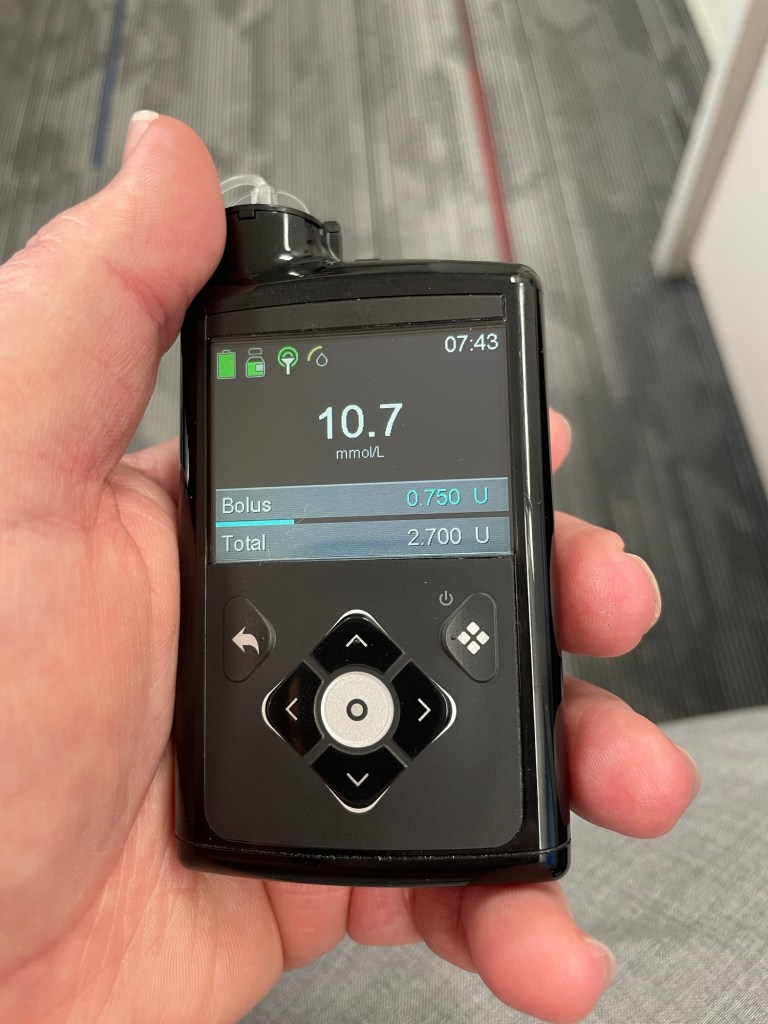
My new Medtronic 780G. Don’t judge the blood sugar; Auto Mode isn’t on, yet.

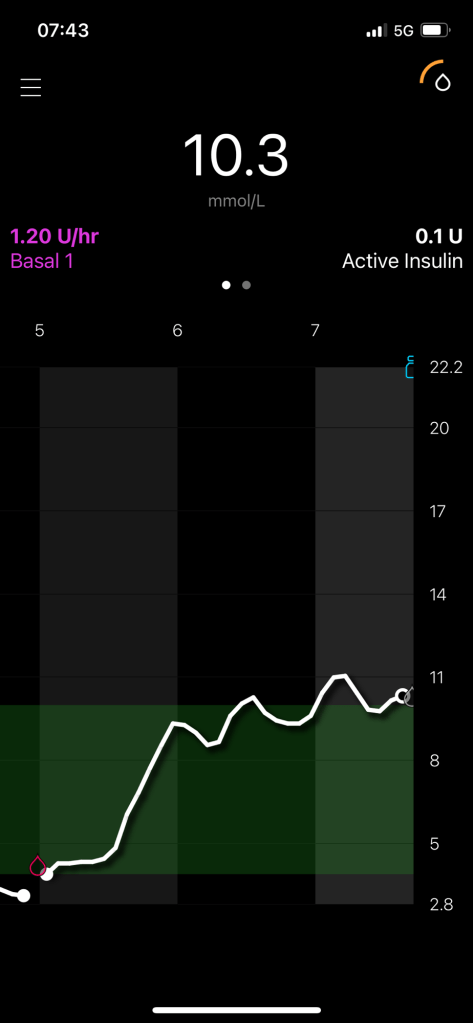
Yesterday was like Christmas. After 5 years, I ordered and received my new, upgraded Medtronic 780G insulin pump. I spent the better part of a few hours in the evening getting everything charged and ready, examining the new functionality and a new glucometre (boo). By the time I finally crashed for the night, I was using the new pump, had a brand new Bluetooth CGM installed and I am now waiting for SmartGuard to finish warming up so I can jump on auto mode. Some of the fun benefit with this upgraded version is the Bluetooth pairing, which improve CGM connectivity and prevents all those nasty communication losses. It also allows for a fun mobile device app, which allows me to monitor my blood sugars without constantly in clipping my pump or pulling out of my pocket.

The app screen

I should probably make it clear that there are several companies that distribute insulin pumps in Canada and that, much like martial arts, which brand/company you use is subjective to one’s preferences and experiences. For me, this will be my third Medtronic pump because I like the functionality and excellent customer service. And I don’t like change. Although I always look at all available options, I’ve never been able to bring myself to switch to anything else. Plus, Medtronic spoils their customers. They sent me a shit-ton of supplies along with my new pump.

The stockpile

As I get older, life makes it more difficult to properly maintain blood sugar levels and stay healthy. Eventually, Diabetes will kill me. That may sound a bit morbid but it’s a stark reality. While acknowledging that reality, it’s nice to know that technology is doing its part to ensure that my longevity is as long as it can be. Maybe eventually, technology will outrun Diabetes and it will be a thing of the past. Until then, I’ll continue to be the nerd who gets excited over the prospect of a new insulin pump. ☯️

The 6-Month Aftermath…

Throughout my life, there have been a few times where my life was in genuine jeopardy and I stared death in the face. Sounds a bit melodramatic, perhaps, but accurate nonetheless. The first although not the most memorable, is when I was initially diagnosed with type-1 Diabetes. This happened at the tender age of four, which means that while I fell ill and passed out in my bowl of Froot Loops, I didn’t necessarily have a clear grasp of what was happening or even what Diabetes even was. That being said, it started a lifelong journey of obstacles, medical complications and even goals for myself.

It wouldn’t be until years later and poor treatment of my Diabetes that complications and insulin resistance would threaten to end my life before I had the chance otherwise live it. It would be at this stage that I would begin to lose faith in the health care system and take my care into my own hands. This is also what prompted the beginning of my martial arts journey. While I have always been successful in, to quote Star Trek, take death and turn it into a fighting chance at life, there is some damage that I’ve never recovered from. One good example are my eyes. As a result of my preteens being spent with extremely high blood sugars and living through a half dozen comas, my eyes have damage to them that would decades to treat and those treatments are still ongoing to this day.

However, nothing has been quite as scary as test results I received from my endocrinologist back in November. Although I usually have the benefit of a “boring” visit by virtue of how tightly I control my Diabetes, this visit would be anything but. While going through my blood test results, my kidney function was raised as a concern. For those who haven’t read previous posts and may not be aware, my brother had kidney disease and had a transplant, and it eventually contributed to his death. I knew how serious this was and the potential negative outcomes. To put things into perspective, the normal range for proper kidney function is between 0 to 20 mg/L. My test results in November showed me at 175!

My doctor did the usual, where they try to sugar coat and soften the news as much as possible, mentioning that losing some weight and altering my diet would help to reverse some of the damage. But the basic reality slapped me in the face; I was beginning the downward spiral towards the earliest stages of kidney failure. I left the doctor’s office a deflated man, that day. My doctor had also prescribed Ozempic to help with some of the concerns surrounding my Diabetes. As I’ve written on a couple of occasions, smaller portions and an altered diet have actually given me some success and I’ve shed a fair amount for weight. Having started at about 217 pounds back in November, I weighed in at 191 pounds last week when I visited the doctor’s office.

My doctor was extremely pleased, not only with my weight loss but with the results of said weight loss, which included my kidney function having dropped to 16 mg/L! Coupled with all the nasty issues like cholesterol and blood pressure being absolutely normal, my kidneys had not only completed recovered and all damage was reversed but I essentially had the kidneys of a non-Diabetic. The sense of relief I felt was indescribable. The only thing better than getting a clean bill of health is getting one after you spent months believing you had reached the point in your Diabetic journey where everything was going to start shutting down.

Now, it’s important to recognize that although I work really hard to maintain my health and fitness, none of that whole “turning death into a fighting chance at life” could have happened without help from others. Without Sensei to teach me and train me the way he did, my health and overall fitness wouldn’t have progressed as well as it did. And who knows where I’d be today. By the same token and despite my best efforts, weight loss has been a difficult journey for me over the past fifteen years. Without my endocrinologist prescribing the right medication and seeing me through to losing roughly 25 pounds, my kidneys would likely still look like Rocky Balboa at the end of the movie.

In closing, I think it’s important to recognize the significant difference a bit of weight loss also makes in one’s overall health. People are often resistant when their doctor tells them they need to lose some weight and people today are usually more for the whole “love yourself the way you are” than they are for getting up off the couch and doing something. But that proposed weight loss can make a significant difference in all the systems in your body. And it’s important to recognize that sometimes, one needs a little help in getting there. And there’s nothing wrong with that. Some food, albeit a lot less of it, for thought…☯️

Deadly Roller-Coasters (yet Another Diabetes Story…)

It’s been a hellish week for me and given that it’s only Wednesday, that’s saying quite a bit. Last Thursday, I had the benefit of going out for drinks and games with some associates of mine. For anyone who knows me, that’s a rare and unusual occurrence for me. As much as I immerse myself in time at home and running errands, it’s nice to occasionally grab a pint and let one’s hair down. Conceptually speaking, of course. I’m bald. But it was a god evening of a couple of pint of white IPA (my colleague’s idea) and a platter of appetizers, couple by unlimited access to games and challenges. We spent only a few hours before I made my way home to crash. All seemed right with the world.

Over the past decade, I’ve come to learn that having Type-1 Diabetes shouldn’t prevent you from enjoying the things in life that everyone else does. That’s a pretty broad statement and one that, while certainly applicable, doesn’t always work out the way we want. Even if my endocrinologist tells me I can enjoy that large wedge of chocolate cake thanks to my insulin pump doesn’t mean that it won’t completely fuck with my blood sugars while the insulin is trying to catch up. Some of it is timing, some of it is calculating carbs and some of it is just plain ol’ luck. But on occasion, there’s just no accounting for the uncertainties. A plate of random appetizers is extremely difficult to carb-count.

I woke up at about 2 in the morning with blood sugars reading at about 30 mmol/L. Yes, you read that right. Fuckin’ 30! For you non-Diabetics out there, normal range is between 5.0 to 7.0 mmol/L so sitting at 30 involves a whole slew of bad bullshit that happens inside the body. And outside, if you include the vomiting. But we’ll get to that. I got home at about 8:30 pm on Thursday evening and my CGM sensor expired. Just my luck. Since it takes about two hours for a fresh sensor to warm-up and calibrate, I was in for a bit of a late evening. Nonetheless, I charged the transmitter, grabbed a shower (bare abdomens mean Diabetic happy showers) and installed the new sensor. I calibrated around 11:00 pm and hit the sack, exhausted at having actually gone out into public and done things. I anticipated going into work the following morning.

On the Friday morning, I did my usual thing, which includes hitting the ground running. Since I had showered the previous evening, I had a bit of a head start. I prepped some lunch, packed my work bag and got dressed in casual attire, since it was “jeans Friday.” By the time I got to my office, the veneer of starting my day had worn off and I started to feel it… An intense feeling of nausea and body pain, specifically in the joints and muscles. I got through the start of my daily routine at the office but I was distracted and unable to focus. My boss came in and took one look at me and told me I looked like shit. I couldn’t fault him because he was right. I was an unpleasant shade of grey, sweating through my shirt and felt as though I might pass out.

You may have heard the expression that the shoemakers kids go barefoot… I’ve always been far better at encouraging other to get rest and be healthy than I am at taking care of myself. Oh, I can rock this whole T1D thing like nobody’s business but I tend to fend off and stubbornly press through anything that seems like common symptoms. On this occasion, I chose to take my boss’ advice and packed up to return home. It turned out to be a good idea since, I barely had time to dump my bag and remove my jacket before running to the bathroom and purging the limited contents of my stomach. The pain was unreal. Ai this point, I realized I should lie down. I should point out that I had been spending most of the night bolusing and slowly bringing my blood sugar down. I woke up ayt 14 mmol/L, which is not great but it’s a far cry better than 30.

Over the next 48 hours, I consistently retested my blood sugars, bolused additional amounts to keep bringing my blood sugars down and try to feel better. I sipped ginger ale and sugar-free Gatorade to keep myself hydrated. Given the pain I felt, I knew I was dehydrated but if I had to venture a guess, I’d say I was in some level of ketoacidosis. It wasn’t until about 8 pm on Friday night that my blood sugar had dropped low enough to allow me to have something to eat. I ate sparingly, concerned I would just spew it all up. But it stuck. I changed my infusion set once, believing I was possibly not getting the doses I needed. Absorbtion rates can differ depending on where your infusion set sits or how much scar tissue you have. I also took a couple of manual injections when I realized that despite an empty stomach and plenty of bolusing, my levels didn’t seem to be coming down.

It was a hellish weekend and by Sunday morning, my throat felt raw and on fire. The pain was at a level that was radiating into my ears and head. Acetaminophen had zero effect. No surprise there; it never does for anything I get. I finally went to the pharmacy and got some over-the-counter throat spray. The problem with those sprays is actually having shoot to the back of your throat properly. Yes, I heard it as I typed it. Let’s move on… I eventually moved on to a homeopathic throat syrup that worked far better. A mild, minty-hint of Ibuprofen later, the pain passed just enough that I was able to get some semblance of a night’s sleep on Sunday. Going back into work on Monday was far easier. But the pain was ever-present. Here’s where I start bashing the current state of our health care system. Buckle up…

On Monday afternoon, I attended a walk-in clinic at about 4:15 pm. Pay close attention to the fact I stated it was a WALK IN CLINIC. I was told that walk-ins would only be accepted as of 5 pm. Hmm, interesting and mildly stupid but okay. I offered to give my information and be called in at 5 pm. The receptionist refused, citing my check-in couldn’t be accepted UNTIL 5 pm. Fuck me. So they expected me to cross one of the busiest boulevards in the city during a key traffic point of the day. Say it with me: HAPPEN. NOT. GONNA. I stopped at the next clinic on my route home. This is also a walk-in clinic AND there was a huge decal on the window boasting that the walk-in clinic is open from Monday to Thursday until 7 pm. Another rather important detail to bear in mind.

I walked into this second location and the first thing I noticed is that the lobby was completely empty. It was 4:25 pm. I walked up to the reception counter and presented my health card. When I was asked if I had an appointment, I said no. She explained that they were “no longer accepting walk-ins.” I asked how a walk-in clinic could not accept walk-ins, to which she replied that they were closing shortly. I checked my watch in the event I had suddenly shifted forward in time. She said they were closing at 5 pm and I pointed out that they’re door sign said they were open until 7 pm. She didn’t believe me, despite it being on THEIR FUCKIN’ DOOR!!! I also pointed out that their lobby appeared empty and I just needed five minutes for the doctor to look at my throat and potentially subscribe something. It was unreasonable for them to turn patients away with 35 minutes left to the day. She suggested I go to the other location I had attended as they accept walk-ins as of 5 o’clock.

I managed to get home despite the heated anger building behind my eyes. My recipe of Ibuprofen and throat syrup saw me through another “reasonable” night’s sleep but on Tuesday morning, I attended a couple of meetings where I had to speak through most of it and my throat caught fire. I had had enough. One of my colleagues mentioned a walk-in clinic in the downtown core, which was close. I cleared it with my boss and went down. To my surprise, I got in within 15 minutes. Unfortunately, besides a bit of throat irritation, the doctor didn’t find anything. When I asked why the pain would be so bad and radiating into my ears and head, I was told people manage pain differently. Fuck my life. Because I DON’T routinely get needles in my eyes, have had bleeding ulcers and broken bones. A sore throat is putting me down this hard? I somehow don’t think so.

As of today, the pain has almost disappeared but the throat still stings a bit. The whole blood sugar issue was extreme and is something I never want to go through again. It was also dangerous and rather stupid, on my part. As I get older, recovering from these sort of things is becoming harder and harder. Given the high blood sugars and how long it was taking for it to come down, I likely should have sought emergency medical attention. Woulda, coulda, shoulda… But there were definitely some lessons there, for me. Next time, I might just skip the appetizers. Eating any amount of something I can’t positively crab-count is never ideal. With the weekend coming up, hopefully I fare just a little bit better. Diabetes certainly makes every day interesting. ☯️

Read Your Labels… (A Diabetes Story)

I’ve spent more years treating Type-1 Diabetes than not. It’s sometimes hard for me to imagine a time when I WASN’T Diabetic. By virtue of this, I often find myself in a position where I become… shawl we say, complacent? Laziness has never been an issue for me but I would be lying if I said that I don’t occasionally get a bit too comfortable with certain routines and overlook some important details. And as anyone living with Type-! Diabetes will agree, even a small detail can be an important one and can adversely affect you.

One of those details is the proper and thorough reading of the nutritional label on absolutely everything I eat and drink. The reason behind this is quite simple: I need to know the amount of carbohydrates I’m ingesting. Although I’m quick to say how marvellous a piece of technology my insulin pump may be, it still requires significant attention and care on the user’s part to ensure everything is working as it should. Letting my pump know how many grams of carbs I’m about to eat allows it to inject the proper amount of insulin for my meal according to the different ratios I have programmed for the different times of the day.

This is where my tale begins… Over recent years, we’ve started buying large, club pack boxes of ramen noodles. Setting aside for a moment that one pack of ramen noodles contain more than half one’s daily intake of sodium, they often make a quick meal when there’s little else available. It’s also a great “sometimes” meal for my boys on the weekend, who tend to be fussy as fuck and will barely touch prepared meals that my wife and I make. We’ve taken to buying the chicken-flavoured no name brand, since it costs a bit less and no one in the house will eat any of the other flavours, other than myself. This is where my complacency comes into play…

For years, I’ve been accustomed to the fact that each pack of ramen noodles contains about 50 grams of carbs, give or take. And I usually bolus for this amount. I rarely question this and I don’t bother checking the label as it’s the same stuff, every time I have one. Yesterday, my wife and I took our boys to the grocery store to grab a few items as we had also completely ran out of ramen noodles. As usual, I grabbed a club pack box of the chicken flavoured for everyone to have but I also decided to grab a few name brand ramen noodles in the other flavours. I grabbed a beef, a shrimp and an oriental flavour. I figured I could bring one to work sometime in the next week.

So today, I decided to crack open the oriental flavour for lunch. As I was mixing the noodles and seasoning with the water, I decided to glance at the nutritional label, since its’ theoretically something new, given that it’s name brand, and maybe the carb count is different. See? I’m not completely negligent. I do TRY to stay on track. Anyway, I was surprised to see that not only was the carb count about half of what the no name brand usually has, the package size is also much smaller. This struck me as odd but I didn’t question it and bolused accordingly. I proceeded to enjoy my noodles while I worked.

About an hour later, I started to feel flush and nauseous and couldn’t seem to sit still. I pulled out my pump and noted that my blood sugar levels were rising pretty damn quickly. The CGM reading had three arrows pointing straight up which, for you non-Diabetics, means my levels were skyrocketing. I was mildly confused but bolused a correction dose of insulin to counteract the high. I remembered I had a spare package of no name noodles in my desk and pulled it out. Same as usual, the total carb count was shy over 50 grams. What I realized is that the package didn’t really feel bigger than the name brand one.

I pulled the wrapper out of the trash and took another look at the nutritional label. There it was… the smaller size was because the label measured on SERVING, not one PACKAGE. And one serving was approximately half of the package, which is why the carb count was so much lower. In reality, the total package was abut the same as the no name brand. Now, I don’t know who the hell would prepare and only eat half a pack of ramen noodles or what kind of communist bullshit that serving size is, but shame on me for not picking up on that. The result was an adverse effect on my blood sugars.

So, the important takeaway for today’s post is to pay attention to details and read your nutritional labels carefully. Bolusing properly can be difficult at the best of times, even when there is a label. But overlooking small details such as serving size can have a meaningful impact on proper control. And there’s nothing worse than being on the blood sugar roller coaster; where you’re high so you can correct, then you drop low and have to treat. Wash, rinse and repeat. I’ll be watching my nutritional labels far closer now, believe me. ☯️

Preparing For The Road…

Travelling is often considered one of the best ways of taking a vacation. That’s why most people use the saying “getting away from it all” when they go somewhere. But for someone with Type-1 Diabetes, travelling can present its own set of headaches and problems that often just doesn’t make it worth one’s while to take a trip. I’ve posted often before about what people should bring with them or carry in their vehicles while travelling, especially in the winter. But while rounding the corner on 1,600 posts, who the hell remembers what I provided three or four years ago. By virtue of this, today’s post will focus mostly on my own experience and what you should bring with you, if you have Type-1 Diabetes.

I think there’s a distinct irony in the fact that until about ten years ago, travel was no big deal. A couple of boxes of insulin, a box of syringes and my glucometer with a full jar of strips and I was off to the races. My biggest issue was worrying about getting through security at an airport with all the sharps in my bag but besides the occasional longer time to get processed through, I’ve honestly never had a problem. But these days while being on pump therapy, I fnd myself needing to pack and carry about a dozen separate components, most of which act off of one another so forgetting one is just as bad as having brought nothing at all. I still aheva bit of an extended wait time at airport security and often need to be patted down since I have medical devices attached to my body, but I still don’t have significant issue in that area.

Whether I’m driving or flying, the main nissue comes with proper preparation and packing before the trip even happens. For example, we’ll start with the most important piece of equipment, which is my insulin pump. What’s nice about the pump is I use a model that has continuous glucose monitoring and tracks my blood every five minutes, making micro-adjustments as I go through my day. This can be exceptionally important while travelling since, as you all know, absolutely EVERYTHING affects blood sugars. But the pump itself uses four separate components (including the pump itself) that need to be changed out every three days. Time and insulin calculations can make the difference between having a smooth trip or scrambling to the nearest pharmacy to try and figure out if they carry what you need. For the pump, this includes the insulin reservoir, the infusion set and the bottle of insulin. It’s kind of hard to travel WITHOUT the pump, since its attached to me. In ten years of being on pump therapy, I’ve yet to leave the house without it.

My CGM, or continuous glucose monitor, is even worse. It uses five separate components, including the inserter, adhesive bandage, the sensor, transmitter and charging cradle. Every time I cahnge this bad boy, I need to put the transmitter into the charging cradle for about an hour. Then all the other components come into play. A small price to pay for well-controlled blood sugars but if you’re keeping score, we’re slowly creeping towards a dozen separate pieces of equipment I need to drag with me when I travel. This is why the calculation is important. For example, I’m currently sitting in a hotel room in Saskatoon where I travelled for my scheduled eye injections. Although I’m only away from home for a little over 24 hours, I checked how many units of insulin I had left in my pump and “assumed” I would have enough to last until I get home. But it’s surprising how many carbs were in that burger and fries I had the previous night. By the time I rolled out of bed about an hour ago, I only had five units left. Thank the light I brought a spare set of everything…

And that’s the take away lesson for today. Bringing extras of everything, even when you don’t believe you’ll need them, will avoid problems and make your trip smoother and less stressful. Calculate how many infusion sets and CGM sensors you’ll need and double it. After all, it may not just be your schedule or your usage you have to contend with. What if you have a set failure? What if you sit in a hot tub at the hotel and fry your sensor? What if your infusion set gets ripped out by something? These are all things that I’ve had happen to me. Always bring more than you need and that includes your insulin. Bearing in mind that I’m aware that not folks are in a position and have the additional resources and equipment to always carry extra, of course.

Over the years, a key component I’ve always carried with me is a full bag of skittles or gummy bears. yes, you read that right… While some folks use orange juice ro something similar, that shit takes FOREVER to work on me, if I’m having a low. If boarding a flight or travelling a long distance on the road, you may find yourself in a compromised position if you have a low and suddenly can’t get immediate access to something sugary. If you’re travelling the vast expanses of Canadian highway with hours between stops when you suffer a low, that bag of skittles could mean the difference between carrying on safely or finding yourself in a seriously compromised position.

All of this should be pretty common sense, especially if one has had Diabetes for any significant amount of time. On a final note, keeping a small, basic first aid kit with you is always a good idea. Basic kits will usually come with small bandages, adhesive tape and bandaids. People with Type-1 Diabetes are prone to infections when an injury happens. That cut you got while hiking or the knee you scraped falling off your bike, can become a problem quickly, if left untreated for a significant period of time. Quickly cleaning it and slapping a band aid on until you get home can make all the difference. Unexpected injuries can occur while travelling, as well. These are just basic steps to try and take some of the stress off of travelling. Given the added steps and effort it takes, sometimes it doesn’t seem worth travelling. But it also isn’t worth staying hidden at home to avoid that effort. Not my style. Diabetes shouldn’t prevent you from doing anything you want to have a happier life. Food for thought… ☯️

Food For Thought…

It’s ironic because I end so many of my posts with the phrase in today’s title but I just couldn’t help myself. As I‘ve often written before, living with Type-1 Diabetes comes with a broad set of difficulties that can make navigating daily life more complicated than it needs to be. From having to measure and calculate everything you, when you sleep and how much you work out, to dealing with equipment failures and battery replacements all while never being quite sure if you’re doing it all right can be exhausting. And one’s personal nutrition through all that mess is no exception.

As with many of my posts, I’ll start using off by clearly stating that I am not a nutritionist, dietitian or medical professional and that you should always consult your family doctor or medical practitioner before starting (or stopping) any particular dietary regimen. Unlike my experience in karate, I post these things based solely on my own experience and what I’ve found to be true. But what works for me may not work for you, which is why it’s important to consult a professional. That being said, I’ll touch on that last point. Bit later in this post.

It wasn’t until 2014 that I figured out that crab-counting was a thing. That may shock some people but throughout my childhood, Type-1 Diabetes or “Juvenile Diabetes“ as it was called at the time, involved taking your one shot of NPH insulin in the morning and staying away from sugar. That was essentially it. My parents were never provided any education on how carbohydrates basically equate to sugar and affect blood sugars in much the same way. Hungry? Here, have a slice of bread with peanut butter. There’s no sugar in that. Thirsty? Here, have a glass of milk, there’s no sugar in that… I cringe, even just writing that, as I imagine the dozens of carbs being pumped into my young body without the realization that it will adversely affect my blood sugars.

This would be the reason why I suffered the most of my complications throughout my childhood and before I entered adult life. The early damage to my eyes, the comas I suffered through and my insufferable mood swings in my teens that were aggravated by being a teenager likely could have been avoided, or at least improved, had we known about carb counting. I say “we” because as a child, I consider it to have been my parents’ responsibility to look into and acknowledge these things. But as I grew into adulthood, my knowledge of Diabetes was somewhat skewed by the practices observed by nut family during my childhood. Although inherently no one’s fault, I often wonder what might have been different, had I been armed with the knowledge I have now.

Starting on insulin pump therapy and being trained in carb counting back in 2014 changed the game significantly. I began to see markedly improved blood sugar control, better A1C results and things were looking up. But as time marches on, so does the wear and tear on one’s body, which leads to different complications. For me, the ever-present “dad bod” and the apparent inability to lose weight despite a reasonable diet and proper exercise, has begun to cause some issues with my kidneys and has led to some pretty radical lifestyle changes, not least of which is my starting on Ozempic. I’ve posted about this a couple of times already but I will update that since starting on it, I’ve lost nearly 30 pounds, which is no doubt helpful.

Although weight loss and proper exercise are important, what you stuff in your mouth is JUST as important. And starts with you. I’ve always been a bit of a heavy eater but I always justified it with the fact that I work out consistently and keep active. But my gut has always persisted. Some people have often tried to get me on fad diets, keto-this or paleo-that… The bottom line and what needs to be acknowledged by anyone, is that weight loss requires a healthy diet coupled with regular, rigorous activity. Full stop. Although some fad diets will work for some, they likely won’t work for others. It’s important to remember that every person is different, so if cutting out certain foods helps you shed some pounds, good for you! The next person who tries that same thing may lose no weight at all. This can lead to discouragement and giving up on losing weight.

That’s why, much like the martial arts, one’s weight-loss journey will be unique to them and they need to find the method that works for THEM, not the one that your favourite celebrity is toting on the infomercial. Portion size has been a big thing for me. Instead of a full plate of food, cut it back to half. Less calories means better weight management. Although the base concepts are pretty simple and make plenty of sense, regardless of what diet you’re trying to follow, it amazing how that detail seems to slip past everyone’s mind. And that, my friends, is food for thought… ☯️