I had to go downtown and stand in line last Wednesday for something work-related that I needed. Due to social distancing requirements and the location’s own internal policies for dealing with the public, a facemask was obviously required and I was asked to wait outside the building until one of the people seeking the same service as I was, exited the building. Luckily, I was the first one at the door but I had no idea how many people may have been inside or how long it would take them to come out.
I had dressed reasonably well, wearing a cotton shirt covered by a thick, cotton hooded sweatshirt. Although I won’t be a little whiner and complain that I was freezing to death, I’ll admit that it was only 7 degrees outside with cold winds. This made the wait all the more painful. People accumulated in line behind me, and the general public’s penchant for complaining shone through like a bright beacon in the storm. People were arguing and complaining to the two poor security guards who were monitoring the building’s entrance. One lady, who was there for the same purpose as I was, had brought someone else with her and got visibly angry when she was informed that she wouldn’t be allowed to bring her friend inside with her. They had arrived together in a cab. She was pissed.
Apparently, not everyone took the same precaution as I did by checking the location’s website in order to confirm their requirements prior to coming down. But as the weeks go by, I’m noticing this kind of trend more and more, with people fast becoming frustrated with the restrictive requirements brought on by COVID-19 and the limits imposed by businesses and government locations. The wearing of masks, limits on the number of people within buildings and the need to socially distance is starting to grate on everyone’s patience as the world waits on baited breath for everything to go back to “normal.”
Here’s the problem: This IS the new normal. Leading experts, as well as health authorities and the World Health Organization all agree; there will be a resurgence of COVID-19 in the near future, and likely with a vengeance. I could try and cite some sources, but there’s enough out there that a quick Google search will show you what I’m talking about. At the time of writing this post, the Government of Canada’s website reports an estimated 158,758 active cases of COVID-19, with Ontario and Quebec carrying the brunt of that number (Canada.ca). If you click the provided link, I’m sure that number will have changed, likely increased.
One of the bigger problems is the fact that there seems to be a growing number of the population who simply don’t take the pandemic seriously. I’ve seen this first-hand and even have members of my family who think this is the case. Just a few weeks ago, I saw someone standing by Wascana Lake, here in Regina, holding a sign that stated that Corona Virus was a lie told by the government. Right. Because there isn’t enough on the government’s plate without creating a pandemic that’s currently damaging our Nation’s economy.
But plenty of people are ignoring the easy, common sense precautions that have been put into place. Things like social distancing, wearing a face mask when out in public, and avoiding outings unless for work or mandatory requirements like groceries or medical appointments. A good portion of the population seems to have gone back to the “old” normal, including having large gatherings and carrying on as though there ISN’T a pandemic happening. Idiots.
If there’s one thing history has taught us, it’s that viruses can evolve. We’re not done with COVID-19 and if people continue to ignore the easy steps, the results that follow will be much, MUCH worse. So, why take chances? Wash your hands frequently (which you should have been doing all along, anyway), before and after any outings. use hand sanitizer and wear a face mask. Stay socially distanced and don’t wander needlessly for anything you don’t absolutely need. That seems like a pretty reasonable way to avoid a serious respiratory virus that could kill you. ☯
I’ve had Type-1 Diabetes for almost four decades now, and during those decades I’ve seen it all, heard it all and almost tried it all. With the exception of some of the more complex procedures, such as pancreas and/or islet cell transplants, I’ve been on every kind of therapy and have tried several different diets. Some have even been rather “new age” and eclectic. I’ve also dealt with a number of conditions, such as Diabetic Macular Degeneration, Diabetic Retinopathy and Diabetic Ketoacidosis.
One of the bigger issues that many if not most people fail to recognize is that not every therapy works for every person. In fact, many therapies simply won’t work for different people. For example, there have been types of insulin that simply have little or no effect on me the way my current insulin does. And for the most part, these issues have been discovered by accident, or through a change in my prescriptions or therapies.
This is one of the reasons why, as a child and a teenager, I hated going to doctor’s appointments or even changing practitioners. Every doctor or medical practitioner I’ve had, has changed my prescriptions, altered my therapies or has tried to put their own personal spin on my condition. It can make life difficult; especially when any change can upset the balance of one’s daily routines.
On the face of it, we usually have very little choice but to accept it when a doctor says, “we’re going to try this and see how it works for you.” As a child, I would usually just sit there and nod. I’d let my parents take the prescription or document the change in requirements and then I’d ride the change. More often than not, I’d find myself getting ill or suffering major complications and I’ve been in several comas, between the ages of 6 and 10.
This has led to a certain level of paranoia when trying new things, in relation to my health. But the reality is that there is no REAL way of making progress in the available therapies without some trial and error. If I hadn’t tried certain diets and prescriptions, I wouldn’t have found what’s worked for me and what hasn’t and I may well have not survived beyond my teen years, which is what my doctors at the time offered me as a life expectancy.
It’s pretty similar to trying out a specific type of diet. Let’s take something reasonably well-known, like the Paleo or Keto diet. Some people try these fad diets and lose a reasonable amount of weight and it works well for them. Others will try those same diets with no measurable results. Or worse, they’ll gain weight. The same can be said for certain Diabetic therapies. What works for one person with Diabetes may not necessarily work for someone else.
It reminds me of when I started on pump therapy. I avoided insulin pumps like the plague. Given my chosen profession and the nature of how insulin pumps operated, I honestly didn’t think it was for me. Until I tried it. After a significant amount of trial and error, pump therapy wound up being the best decision I could have made. Even recently, adding Continuous Glucose Monitoring to the mix has proven to be an exceptionally good decision.
My point is that you may have to throw caution to the wind and try a few things in order to smooth out your therapy. Diabetes is a well-known condition, albeit not always understood. But every human being is different and every person’s system is different, so one particular therapy may produce different results for different people. Makes sense, right? Don’t be afraid to branch out and try different things in order to keep yourself healthy. As long as you take ownership of those attempts and take care, you can almost be guaranteed to find something that will work for you. ☯
People love to eat. And that stands to reason! There are so many cultural foods, restaurants and options available, as compared to even 20 years ago when the best you could hope for was a local fast-food joint and perhaps one fine-dining restaurant in your home town. And for the most part, you wouldn’t set foot in that fine-dining establishment unless it was a special occasion. But these days, you can order just about any type of food online, in person or through delivery. Eating what you want (so long as you can afford it) has never been easier. And that’s a problem…
Over the past century, there has been a measurable increase in how much the average person eats during a meal. This has led to a heavy increase in obesity, heart and circulatory issues as well as contributing to Type-2 Diabetes. In fact, according to a 2012 article posted by The Globe And Mail, “most Canadians underestimate what constitutes one serving of meat, grains and fruit and vegetables under Canada’s Food Guide.” And that’s a pretty accurate statement, when you consider that the t-bone you just seared on your barbecue this summer was without a doubt higher than your recommended daily intake of meat.
For those who don’t live in the Great White North, Canada’s Food Guide was created in 1942 in order to help ensure Canadians were eating in the proper proportions and maintaining their proper health. It also took wartime rationing into consideration, but the Guide is still accurate and actively used. It essentially describes that the average plate of food should be comprised of 50% vegetables, 25% grains and fruits and 25% protein. Although that’s just the gist, it’s also the basis for how we should be measuring out our plates on a daily basis.
There are a lot of reasons why we tend to underestimate portions and eat more. Some of it is perception. Plates and implements are larger than they were in, say, the 1950’s. Some of it is a monetary issue; we expect more for less, as in we expect our plates to be loaded when we go to a restaurant or eatery even though portion sizes would dictate that we should eat far less. Just think about the last time you went a restaurant and ordered a plate of pasta. In Canada, if you pay $25 for a plate of pasta, you would damn well expect that the plate will be piled high with pasta, sauce and plenty of meatballs. And where the hell is my garlic bread???
Meanwhile, the actual recommended portion of pasta for a single meal is no bigger than a tennis ball. And that’s just one general example, but because of rising meal costs in most restaurants, we expect more bang for our buck. For food products in general, most Canadians tend to measure portions on the fly, meaning if you eat cereal you’re likely to fill your bowl and grab some milk as opposed to reading the label to see what the actual portion size is. In many cases, the nutritional information label will list a portion size that’s much smaller than what you’ve been consuming in one sitting.
There’s a lot you can do to fix this problem. I found an article on Australia’s Huffington Post that provides “8 doable tips” to help with portion control. Rather than list them all in detail, I’ll let you click the link and give the article a read. It’s quite good, but the tips include simple things like drinking water prior to eating a meal, properly measuring out carbs and proteins, using the same plates and bowls consistently for frame of reference and eating slowly. There are more tips in the article.
For those who have Diabetes, portion control is critical because we need to count all the carbs we ingest and calculate the amount on insulin we need to take to counter them. Most Diabetics would be prone to saying, “But Shawn, it doesn’t matter how many carbs we eat, so long as we take the required insulin for it…” First of all, you may be right. But secondly, it’s not just about the carb versus insulin consideration. It’s the fact that overinflated portions can lead to unnecessary eating, weight gain and health issues.
You don’t need to keep eating until you’re stuffed. I know I’m guilty of this one myself. If we make a pizza and I earmark half of it for myself, I’m usually inclined to eat the entire half in one sitting. The nutritional label usually reads 1/3 of the pizza as a single portion, meaning I’ll often wolf down three portions in one meal. And I wonder why I can’t slim down my middle!
Children are lucky in that they still have the instinct to stop eating once they’ve had enough. In fact, that’s why most parents find themselves barking at their kids to finish off their plates. They’ve just gotten full and no longer WANT to eat. But by the time they reach adolescence, that instinct disappears and overeating rears its ugly head, leading to a score of health issues.
As I always say, it’s important to consume any and all things in moderation. But what’s even more important is portion control. You don’t want to skip meals or starve yourself as you’ll be more likely to gorge yourself on unhealthy snack along the way. But as you eat, you should try cutting down your portion sizes. Combined with consulting your health and/or medical practitioner and regular exercise, it’s a sure recipe for success. ☯
Okay, this is one of those “silly” holidays that hold no real history or bearing and that most wonder if they should actually be “celebrated.” But I enjoy including some of these from time to time, especially when they relate to something near and dear to me. And I love coffee. It’s no secret that I’m a big fan of caffeine, and since coffee is consumed pretty much everywhere in the world in some form or another, I though I would throw a few facts out for International Coffee Day…
The first thing would be the development of this holiday. The International Coffee Organization in Milan came up with this little gem back in 2014. Depending on your source, the holiday is celebrated either on October 1st or September 29th. According to a Wikipedia post, International Coffee Day is celebrated on different dates ranging from early January to early October, depending on what country you hail from. I’ll stick to Canada’s September 29th.
I couldn’t find exactly how one “celebrates,” other than to consume and enjoy a nice, hot cup of coffee. And most people do this on a daily basis, anyway. But now is as good a time as any to remind you of some of the potential health benefits of coffee, so long as with all things, you consume in moderation. Avoiding the fact that many experts believe we’ll run out of coffee beans by 2080 due to climate change, let’s examine my top five benefits of coffee:
Coffee will make you less tired: This one should be pretty obvious, but I always like to start WITH the obvious one. Caffeine is a stimulant, and once it hits your blood stream and reaches your brain, it can help wash away fatigue;
It’s good for you: As long as you don’t douse your coffee with a bunch of sugar and loads of creamer, black coffee has zero calories, zero carbohydrates and contains a batch of B-vitamins as well as Potassium;
Coffee makes us happier: This is another d-uh moment. If you’re a coffee drinker, there’s a noticeable “pick-me-up” effect, due in part to caffeine’s stimulant effect but also because we enjoy the coffee. Any good part of your day is a good part of your day, and will make you happier;
It can help stem Type-2 Diabetes: Despite having Diabetes myself, albeit Type-1, I’m a touch skeptical on this one. But there are a batch of studies that have apparently shown that coffee drinkers have a reduced risk of Type-2 Diabetes;
Coffee is high in antioxidants: Next to the occasional glass of red wine, coffee contains a huge amount of antioxidants and can help clean you out from the bad stuff.
Healthline.com has a fantastic article entitled 13 Health benefits of Coffee, Based on Science, which outlines not only the five I mentioned above but eight more benefits as well. And I mentioned moderation earlier because as with all things in life, moderation is key. Overconsumption of caffeinated beverages can pretty much worsen or CAUSE the opposite of all the benefits I have listed above.
I also forgot to mention my favourite benefit of black coffee: the enjoyment. If you had told me I’d love coffee this much, twenty years ago, I’d have called you crazy. But with all the different blends, types and flavours, there’s a lot to be experienced and enjoyed simply from that small cup of steaming liquid you start your day with. So, hopefully you did. After all, it’s International Coffee Day! ☯
I hate cardio. This probably comes as a surprise, coming from someone who believes that if you aren’t dripping in sweat when you’re done, it wasn’t a workout. And the truth of it is, I do enjoy cycling. But that’s mostly because it allows me to get outside, reconnect with nature (to a degree) and keeps the cardio aspect buried in the background. The best of both worlds. But to say that I’m heading out for a run or doing cardio for the sake of doing cardio would be a stretch.
Cardiovascular endurance training is important for one’s health. According to an article posted by the Mayo Clinic, cardio exercises help to strengthen your heart and muscles, burn calories, help control your appetite, increases sleep, promotes joint movement and helps to manage Diabetes. Cardio can be a long-term or long-distance thing, like long-distance cycling or swimming 30 laps in a pool, or something incorporated into a weight or resistance workout, such as jumping rope.
Jumping rope is an easy, convenient way of including some light cardio into your workout routine. I’ve kept a jump rope in my gym bag for the past ten years, and I make use of it whenever I get the chance. Jumping rope can burn a wicked amount of calories; several hundred calories in a 15-minute period, in fact. It can help improve overall balance and coordination, not to mention that the heart benefits are the same as with traditional cardio. And although it can be taxing on the knees and leg joints, doing it properly is considered a lower-impact than something like running.
I like to incorporate it by using it with circuit or interval training with karate techniques. For example, I’ll do a minute of front kicks, followed by a minute of high-speed jump rope. Then a minute of the next kick and a minute of high-speed jump rope. So on and so forth. Sometimes I’ll simply use it as a warm-up or a cool down. A good quality jump rope is portable, convenient and low-cost. You can stuff it into any gym back or backpack and all you need is about a 25-foot square of space.
As much as I dislike cardio, it is a necessary aspect to proper health and fitness. And there’s no denying that it also helps with the blood sugar control and sleep quality required for someone with Type-1 Diabetes. If the last time you used a jump rope was during a spirited game of double dutch during your school years, you’ll want to start slow and ensure you do it on a stable surface. Avoid grass or carpet as it can snag the rope or catch against your footwear. ☯
I have clear memories of all the stuff I had to go through when I was first diagnosed with Type-1 Diabetes. Since my older brother had a wide variety of illnesses, junk food and sugary snacks were never really a staple in my household anyway, but I remember that certain things took a dramatic change nonetheless. I was no longer allowed to drink juice whenever I wanted. I was subjected to frequent daily shots for insulin and finger pokes for blood glucose testing. It was a traumatic time for a 4-year old who hadn’t even had the opportunity to grab life by the horns.
The irony is that all the traumatic stuff is the only reason I’m still alive, even if some of it was misguided, wrong and in some ways caused more harm than good. Back in good ol’ 1982, carbohydrate counting wasn’t a thing at my hospital. Maybe if I had lived in a larger centre, there would have been better Diabetes education available. But in my hometown, there was a singular mantra when it came to the control of Diabetes: Don’t eat sugar! That was it. In tandem with a morning injection of short-term insulin and an evening injection of basal insulin, my blood was tested once a day before bed and I was good to go.
Yes, you read that right! My blood was only tested once a day. Quite a far cry from the dozen times I finger poke myself these days, or the Sensor Glucose readings I get from my pump every five minutes. Not to mention that my first glucometer was roughly the size and shape of a brick. (There’s an illustration of that glucometer in my previous post: When Diabetics Get High… (but not the way you think) But Diabetes therapy has come a long way from it’s beginning, when a person diagnosed with Type-1 Diabetes usually considered it a death sentence.
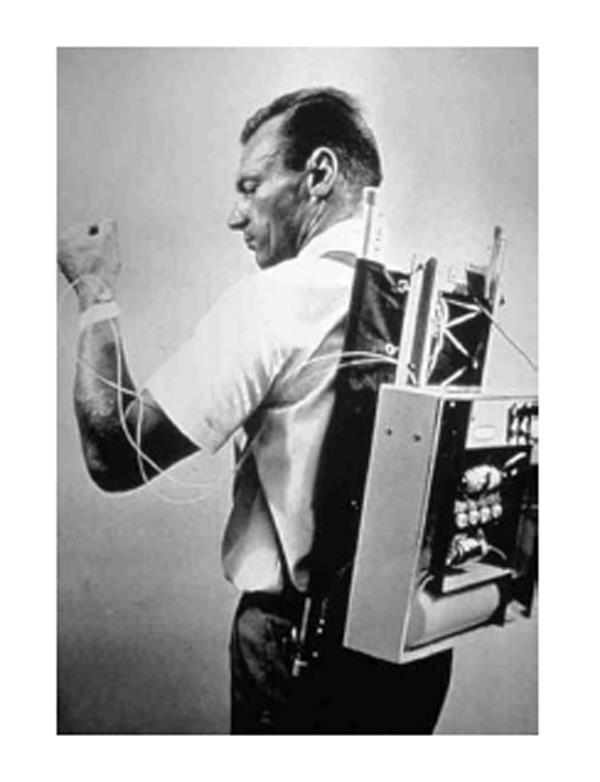
A photo of the first insulin pump
Pump therapy, along with carb-counting and exercise, have made the life of a Type-1 Diabetic easier by scores from what it previously was! As illustrated above, the first insulin pump was basically the size of a large backpack and included metal parts and was cumbersome and impractical. It looks like something Tony Stark developed in a cave. Would I use something like this today? Obviously not, but back in 1963 when Dr. Arnold Kadish designed it, it would prove to be the launching pad for an insulin therapy device that would be widely accepted.
Smaller insulin pump. Source: Wikipedia
Smaller versions were developed by others roughly a decade later and they started being developed with wearability and accessibility in mind. But it wouldn’t be until the early 2000’s that insulin pump therapy would catch on as a common thing. One of the main obstacles is the overall cost. Although I don’t remember the exact retail price of my most recent insulin pump, I do know that it ran to the tune of about $8,500. If I didn’t have benefits through my work, I wouldn’t be on pump therapy.
That’s without taking into consideration that a box of infusion sets runs at about $200/month, reservoirs are about $50/month and the CGM sensors are about $400/month, making for a lovely total of almost $1,000/month when you factor in the insulin and test strips and anything else I may not have mentioned. Is it any wonder why people without solid medical insurance can’t take proper care of themselves? But I digress…
My point is that Diabetes therapy follows the very same trends as modern electronics and technology. When computers started becoming a thing, the average computer took up an entire room that had to be temperature controlled. Imagine trying to play Candy Crush on one of those bastards? The concept of a “personal computer” didn’t take hold until the 1970’s and even then they were boxy, clunky, difficult to move around and were pretty limited in what they could do. Today, the average smart phone has more computing power than what astronauts originally used to land on the moon.
The same can be said for insulin pumps. What started out as a huge, boxy, metallic backpack has now become a small, inconspicuous 3-ounce plastic box. Smaller than most cell phones. And technology is just getting better and better. There are different aspects being developed, including an artificial pancreas going through clinical trials, which could be promising for the future of improved Diabetes control. Who knows, maybe we’ll reach a technology that will allow for the wearing of a simple “insulin patch,” like a nicotine patch, and forego injections and needles altogether! We’ll get there, eventually. But getting there is the obvious problem and as the old saying goes, the waiting is the hardest part. ☯
Never, in the history of mankind has anyone ever calmed down after being told to calm down. Has this ever happened to you? There’s nothing I dislike more than being genuinely upset about something and having someone try and tell me to calm down. The same concept applies to bad moods. I’ve never understood why people feel compelled to assume that one’s bad mood is attached to an underlying condition. For example, have you ever tried assuming that a lady’s bad mood is because of a particular “time of the month?” How did THAT exchange go for you? You probably can’t answer on account of your wife/girlfriend/sister breaking your jaw for making the assumption…
This same concept can be applied to Diabetes. I know I harp on the pitfalls of Diabetes in a lot of my posts, but that’s because the list of symptoms and complications is almost endless. And mood swings are one of the worst. Although every person is different, there’s no denying that uncontrolled blood sugars will cause a change in one’s mood and emotional well-being. For myself, high blood sugars will turn me into the loveable care bear you all recognize into an angry grizzly hell-bent on destroying anything in his path. I’m usually the same before my morning coffee. But I digress…
There have been so many times in my youth when this phenomenon affected my position in life or my relationship with others. Since my blood sugar control was limited to testing about once or twice a day and treating when I “felt” a low, there were times when I was a mean grump and treated those in my immediate surroundings harshly. Most times I wouldn’t even be aware that I was being a total ass but that wouldn’t stop the damage from being done.
Eventually, some relationships ended and some were forever altered into something less special. I mean, who wants to be around a cranky bastard all the time, right? But I’ve had times when my increasing bad mood has caused friends to avoid me and relationships to be damaged or lost. And this is not even including the fact that badly controlled blood sugars will usually make you sluggish and lethargic, making people believe you’re lazy or unmotivated. There have been days when I would just sit there with no energy, while friends and associates would try and convince me to go do something, anything other than sitting like a lump.
Knowing what I know now (say THAT three times fast), I understand that the frequent testing of one’s blood sugars and proper control of one’s Diabetes could have prevented those symptoms and I likely would have had a much happier adolescence. Hindsight is a hell of a bitch. At least I understand and have a much better control now. Life in general is the only thing that makes me cranky now, hahaha… haha… ha (cries a little while laughing). ☯
My eye injections came and went yesterday, as they do every 8 weeks. I’ve written about this before… I receive injections of a prescription medication called Lucentis. In case you’re just now joining the show, Lucentis is used to treat a condition known as Diabetic Macular Edema, which involves the accumulation of fluid in the tissues of the eye. Lucentis dries up the fluid, reducing the swelling it causes and overall improving my vision. The condition is basically permanent, and requires scheduled in-hospital injections every two months or so. All caught up? Good! Moving on…
As I recently posted, I sold my car. There were a number of reasons behind this move, but it was for the best. As such, our home is now down to only one vehicle. This shouldn’t be a problem in theory, since I grew up in a household with only one vehicle and I turned out fine (as my jaw twitches imperceptibly). But the timing of this eye injection appointment came at the worst possible time. My son Nathan started his first full week of 1st Grade yesterday.
My wife and I had concerns that if something happened, such as a bathroom-related accident or heaven forbid, he coughs at school, she would have to go get him. Something not so easily accomplished if I have the vehicle up in Saskatoon while she’s stuck down here, juggling a cranky infant and trying to find a way to pick up our five-year old. Boring and routine as my eye injection appointments had become, I decided to branch out and go on a little adventure. I took the bus…
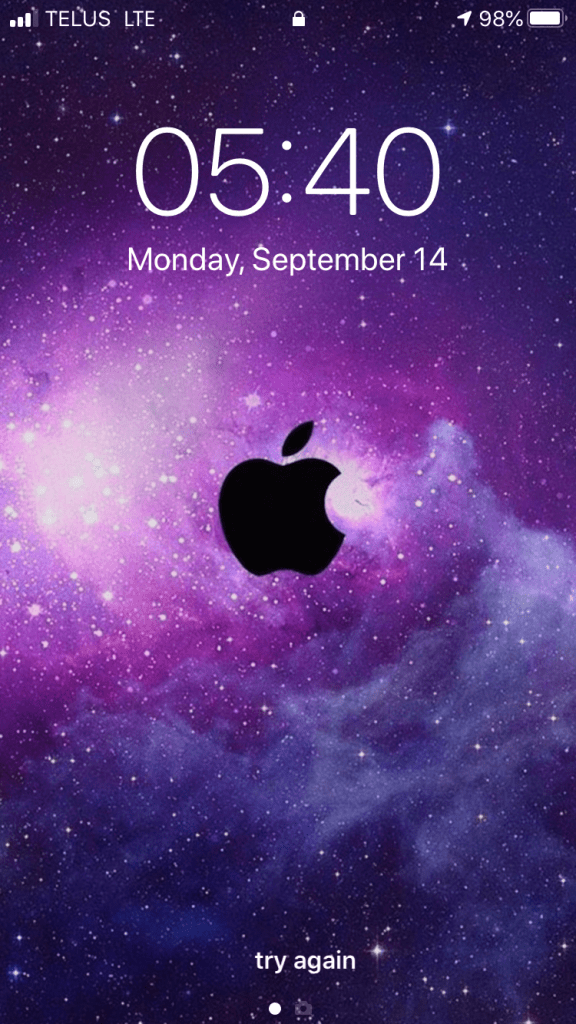
The time, at the city bus stop
It turns out that Regina does have a bus line that runs from here to Saskatoon and back. Since my appointment was at 3 pm, I could catch a bus from Regina to Saskatoon at 7:30 am, arrive around 10:30 am, walk to the hospital, get my injections and catch a return bus at 6 pm. Sounds reasonable in theory, right? Since the bus terminal is a little over 5 kilometres away, it would take a little over an hour to walk there. And waking the entire family just to drop me off and come back home is a definite no! Especially since once you wake an infant, you’re pretty much screwed.
I checked the city bus schedule, and the bus that ran downtown passes in front of my house at 5:40 every morning. When I woke up at 5 am, the temperature was only 4 degrees Celsius and there was a chill in the air. So I dressed with a thermal shirt and my wool fleece shell, wool hat and gloves. I packed a t-shirt and a light Under Armour jacket for the later afternoon. I was quite glad I did, since I made plans to hop on the city bus during this frigid time.
An empty bus in the early hours of the morning
The bus was running a few minutes late, which in retrospect I wish I could say was reasonable and I understood. But my chattering teeth demanded justice, and since there was no one ON the bus, I couldn’t quite understand why the delay. But there’s no telling what the route may have been like, up the road. So I left it alone, paid my fare and sat down.
I was immediately greeted by the conductor’s voice over an intercom asking me to put on a face mask. Of course… Good ol’ COVID-19… I didn’t see the point, since the driver is wrapped in what is effectively a plastic bubble and I was alone on the bus. But fatigue and lack of caffeine rendered me silent and I slipped on a mask. I overestimated the time I would require, since this was my first time getting to Saskatoon this way. I arrived in the downtown area at 6 am, an hour and a half before the departure of the Saskatoon bus.
I’m Batman!
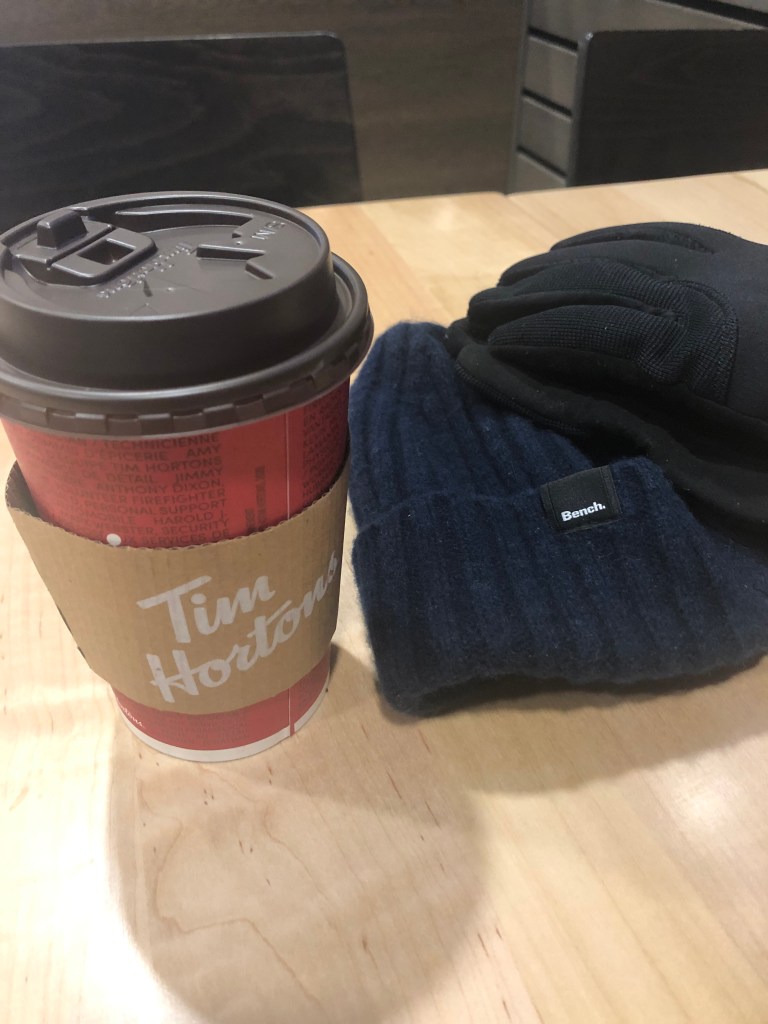
I walked along 11th Avenue in Downtown Regina feeling like that one lonely hospital patient who wakes up during the apocalypse. The streets were empty and quiet, except a couple of city buses, and there was even a token grocery bag floating by on a light morning breeze. Since I was far too early and uncertain what to do with myself, I decided to fix one problem and stopped in at a Tim Hortons, which conveniently opened at 6 am. It was a downtown location without a drive-thru and isn’t open 24 hours like most locations.
I sat down with my coffee and a Wheel of Time book and let the hot cup of caffeine breathe some life into me. About half an hour later, I was asked to vacate my seat as the location had a “no more than 30 minutes” policy in relation to their lobby. I was a little miffed, but it didn’t surprise me. It’s become the way of the world for most businesses. I half-heartedly objected, but I packed up and shuffled on. I made it to my intercity bus stop at 6:40 am. Now, we wait…
Mmm, coffee…
There was one other gentleman (besides the bus driver) waiting at the stop, and upon seeing my coffee cup, asked if I would watch his bags while he walked to Tim’s to grab one of his own. I was a little taken aback by how trusting he was to allow a stranger to watch his bags, until I realized he probably assumed I had nowhere to go since I would be taking the same bus as him.
The bus ride itself was uneventful and I took advantage of the fact that I could still see clearly to do some reading. We arrived on 2nd Avenue in Saskatoon at about 10:30. My appointment was about a 15-minute walk away and was scheduled for 2:55 pm, so I had some time to kill. This is where I discovered something important about Saskatoon: their downtown core has nothing! Oh sure, there are office buildings and businesses, a couple of convenience stores… But I was looking for a place to hunker down for a while and get out of the chill. The nearest place I found was a restaurant that only opened in half an hour.
My chariot awaits
I made my way down to Midtown Plaza, which is a two-story shopping centre I knew would have a food court and hot coffee. I got there fine, despite some douche-canoe’s attempt to grab my backpack (a story for another day) and enjoyed my second cup of coffee of the day and did a bit of reading. I got bored pretty quick and after a couple of laps of the stores in the centre, I walked over to the hospital. I figured I could sit on the bench outside the main entrance and relax until my appointment.
By 12:30, I was starting to get cold and decided to try and get inside. The hospitals are pretty controlled at the moment and for the most part, you can’t even get inside unless you have an appointment. My name was on a list but they obviously didn’t have an appointment time as they told me to go right in. I got to the Eye Care Centre and checked in, since I didn’t assume they’d let some random person lounge in their waiting room.
The first thing the employee at the admitting desk said was that I was booked in for 2:55 pm and that I was too early. I played it off as though it was a mistake and said, “2:55? Not 12:55? That’s my bad, I must have read the appointment slip wrong. Should I just sit and wait then, or do I need to leave and come back?” Since I had arrived on a bus and had nowhere to go, she agreed to let me sit in the waiting room and she would “put a note on my file,” which resulted in my getting in early and being seen by the doctor almost right away.
I should have felt guilty at being passed so far ahead of schedule, but considering the times when I WAS on time and still had to wait an hour beyond my appointment, I took the win and left the hospital just shortly after 1 pm. Now I had a different problem. I needed somewhere to go for the next FIVE HOURS!!! My bus was only scheduled to leave at 6 pm.
I spent the afternoon randomly walking around the city and looking at different shops and things. I walked by the river and I even did a few more laps of the mall. Considering my vision was impaired and I couldn’t read, I was pretty limited so I ended up sitting on a bench at 2nd and 23rd Street and settled in for a long wait for the bus that would take me home. At one point, some city worker (or at least I assumed he was, since he had an orange vest on) tried to tell me to move along since that particular corner had signage stating that loitering was not permitted. I explained why I was there and was basically left alone afterwards.
At 5:30 pm, I walked to the actual bus stop and was checked in for the trip. At 6 pm, which was supposed to be our departure time, we were advised the bus was running at least 15 minutes late. Of course, it is! When the bus finally arrived, loading and check-in for everyone had us leave a half hour later than our scheduled departure. At this point, my head and my eyes were killing me and I was too tired to care. As long as somebody drove the damn bus and got me home.
When I got back to Regina, I stepped off the bus and started walking to wards the only city bus route that ran up to my street. As I walked, I checked the online bus schedule and realized that the next bus would leave the stop I was heading towards at 9:15 pm. It was 9:13… I was over a block away, but I ran. I had to reach that bus, otherwise I would be stuck waiting an hour for the next one. The downtown mall was closed and so was the Tim Hortons I had used that morning. If I missed the bus, the best I could hope for would be a local pub, which wouldn’t be the worst thing but I ultimately just wanted to get home.
My saving grace is that there were four buses lined up to use the stop, and the one I needed was last in line. I had never been so happy about a delay in my life. In actually, a delay had CAUSED the panicked rush. If the intercity bus hadn’t left Saskatoon 30 minutes late, I would have made it to the stop in plenty of time. But the bottom line is I made it, got on the bus and sat quietly, all the way home. I walked into the house and took all of ten minutes to unpack a couple of essentials before unceremoniously crashing on my bed.
Over the course of the day, I walked about 15 kilometres in total. I got cold, then I got too warm. I was found with too much time on my hands and I was at the mercy of someone else’s driving. And as those of you who know me are aware, if it goes faster than I can walk, I just as soon be the one driving. I had a person attempt to steal my backpack, watched some “colourful” people shouting and acting erratically in the street, and experienced the pulse of the neighbouring city.
Do I regret taking the bus instead of the family vehicle? Let’s consider the pros and cons… On the pro side, the cost of my transit was less than half of what I would have paid for my usual hotel room. Once you factor in meals and fuel for the vehicle, I saved a few hundred dollars. Although not an earth-shattering amount, that makes a savings of just shy of $2,000 after a full year. Not too shabby. I also didn’t have to drive and could focus on scenery and reading for a change.
The cons? I had a lot of downtime on my hands with nowhere to go and nothing to do. That’s partially my fault as I overestimated my timings since it was my first time travelling this way. But COVID-19 also take the majority of the blame, since I really had nowhere I could go to simply grab a coffee and chill. In pre-Corona days, I would have sat with a coffee and read for a couple of hours.
I’ll definitely need to fine-tune my timings and work something out, as I don’t plan on spending HOURS outdoors during the winter months. Will this be my new normal? Probably. But the savings involved can’t be ignored, neither can the biggest pro of them all; the fact I was able to sleep in my own bed that night. ☯
If you’re anything like me, having Type-1 Diabetes has the lovely effect of having me catch just about every little sniffle, bug and/or flu that may come floating my way. With an immune system that doesn’t seem to know enough NOT to attack the insulin-producing cells of my body, it stands to reason that whoever is manning the immunity train in my body is drunk at the wheel. This is one of the reasons why the upcoming season is one of two of the most difficult seasons for me to get through…
The autumn season has always been the most difficult for me, despite the fact it’s one of my favourites. The temperature turns colder and inclement weather becomes the norm. These weather phenomenons have the effect of making you sick more often. Unlike the common misconception, it’s not the cold itself that causes you to become sick but rather the fact that cold viruses travel better and spread faster when temperatures are cooler. Not COLD, but cooler. There’s a bunch of extra fun stuff, like colder temperatures making your sinuses less likely to block a virus and your immune system being less effective in the cold. But I’m not a doctor and I digress… Moving on!
Normally, none of this is a problem and I suffer through the colder seasons the same way as the rest of the world does… By cranking the heat and bitching about it. Some colds and illnesses have required me to take the occasional sick day, although this has been pretty rare. But the advent of COVID-19 has changed a great many things, and having a cold is no longer a simple thing.
Don’t think it makes a difference? Step onto public transit, like a bus or a train, and cough. Take a quick look around and take stock of how many people are giving you a look akin to thinking you carry the bubonic plague. The past year has fostered the belief that a cough means COVID-19, and I’ve seen people avoid, walk away and even become aggressive against others who may have had nothing but a dry throat or the common cold. This is a concern for me, as I’m the one in my family who faces the front lines to do groceries and run errands so that my family is the LEAST exposed.
There are a number of things that you can do to mitigate these issues, including washing your hands frequently, coughing and/or sneezing into your elbow and avoiding places where people gather in large numbers. You’re probably thinking, “But Shawn, aren’t those things we’re supposed to be doing anyway?” Ah, very good, Grasshopper! These are things that you should have been doing, even in pre-Corona times. Considering my immune system and the fact I have year-round sinus issues, my throat often gets dry and sends me into the occasional hacking fit, which has always been fine.
Now, it’s a guaranteed way to clear the crowd in front of me, since most people associate coughing to COVID-19 and not the fact that I’m simply an idiot who can’t seem to breathe and swallow his own saliva at the same time. So, let’s discuss the newer steps that should be taken. In addition to all of the above, staying home when you’re sick is also expected/required, depending on your area’s laws and policies. The next is the wearing of a face mask. And we’re gonna talk about THAT one…
Depending on what source you lean on, the effectiveness of face masks have been disputed since the beginning. Some people fall on the side of wearing them and others feel they’re useless and make no difference. Considering that hospitals and first responders have been using them for decades, you’d think the message would already be clear. But people aren’t always so great at getting the message. Some areas are starting to require the wearing of a mask as soon as you step out of your home, which in some respects may be a little over the top. I certainly don’t want to start wearing a face mask when I’m cycling, for example.
But even here in Regina, many businesses, including large-scale retail chains, have made the wearing of a face mask mandatory in order to enter their locations. Since people LOVE to be unique, many people have opted for wrapping their face with bandanas or wearing custom, homemade masks as opposed to purchasing masks at their retail locations or medical outlets. Although this is fine, not all masks are created equal, and there are significant problems with wearing a mask that falls short of what’s required.
According to an online article posted by ScienceDaily, any facial coverings that you wear “need a minimum of two layers, and preferably three, to prevent the dispersal of viral droplets from the nose and mouth that are associated with the spread of COVID-19 […]” This means that if you wrap a repurposed layer of an old t-shirt around your face, you’re not preventing much. Some studies have shown that although two layers of thick cotton or other recommended materials obviously prevented the spread of droplets from a cough or sneeze much more effectively than a single layer, three is the optimal choice.
Wearing a single layer can actually makes things worse, as the single cotton layer will cause what’s called “aerosolization” of droplets and make them easier to spread. So if you’re being a jack ass and simply wrapping a single-layer bandana over your face so that you can get into your local Walmart, you’re definitely defeating the purpose. It doesn’t help that most people are aware that the wearing of a mask doesn’t necessarily protect them from the spread of COVID-19 but is intended to prevent THEM from spreading their own germs.
This gives them a sense of entitlement where they feel they don’t need the mask, since it doesn’t help them anyway. This concept is right up there with people who don’t believe in vaccination. It’s about society as a whole and not necessarily just for you. It’s become a sad state of affairs when you see people yelling and arguing with retail employees because they refuse to wear a mask. Medical workers and first responders have to wear that stuff for eight to twelve hours, sometimes more. Wearing a face mask for twenty minutes while you get your favourite brand of cheese puffs and your tube of Preparation-H should be the least of your problems, snowflake!
We’re a long way from the end of this pandemic. So it’s important that everyone does their part in order to help get us past it. Even I’ve jumped on the face mask bandwagon, with my custom Batman mask! The best recommendation I can personally make, is to wash your reusable masks frequently. Most people don’t realize that you’re exhaling into that thing for long periods of time and your breath is expelling bacteria into the material. Failing to wash your masks frequently can result in causing other health problems.
There are worse things in the world than the proper wearing of a facemark when you go shopping or run errands. And it’s important to know the symptoms and recognize them, in yourself and in others. For example, sneezing and sniffles are NOT symptoms of COVID-19, despite the reaction people have when someone sneezes in public. Although some would argue it’s for good reason, we’ve developed a paranoia against any and all symptoms, which doesn’t bode well for my weakened immune system throughout the colder months. It’s gonna be a long winter…☯
I remember training for my black belt in karate, and doing my very best to prepare for it in a Rocky-style format. I used to get up at five in the morning and run five miles, followed by an hour of intensive shadow boxing and forms. Without getting into the specifics of the test, I knew that I would be facing the challenge of my life, and I wanted to do everything I could to ensure I would be successful.
The last class before the weekend of the test, I attended class and tried to blend into the background, which wasn’t easy considering I stood at the front as one of the senior students. I didn’t speak to anyone about the upcoming test I would be subjected to, over the weekend, as was the custom in our dojo. Test dates were kept private until the student walked into the next class with a new belt colour around their waist.
After that last class, Sensei and I took an hour together and discussed the test and what would be involved. We went over some of the material that I knew I had some mild difficulty with, and I made a point of explaining that I planned on having a light meal and getting to bed early, in order to get some extra rest. Sensei smacked me in the back of the head and spoke three very important words: Don’t. Change. Anything.
Essentially, Sensei explained that despite being faced with a very important and very physical test the following day, I should have the supper I’d usually have. I should follow it up by having the evening I would usually have and go to bed no earlier than I usually would. The idea was that altering my usual routine would cause a disruption in my rest as opposed to helping it, and potentially increase my test anxiety.
Change and variety are good. Of this, I have no doubt and there is no question. But when it comes to facing something out of the ordinary, it’s important to remember that we shouldn’t alter our routines. We need to trust our gut and follow our usual routine. trying to do anything out of the ordinary will only stress and tax your body further and increase one’s anxiety. Stick to what you know. It’ll serve you better in the long run. ☯










 The Blogging Buddhist