And Touched The Sound, Of Silence…

Ah, Simon & Garfunkel… Part of the endless soundtrack of my youth, the Sound of Silence is a haunting classic with rich lyrics that stir the imagination and move the spirit. And most recently in 2015, a band called Disturbed covered the song and did a fantastic job. Both versions stir a little something in my soul and the song is fantastic. If you haven’t heard either version, I highly recommend you fall down the youTube rabbit hole and watch both. Then, you can judge for yourself. But enough about my musical preferences; let’s get on with the point of today’s post.

Today, I’d like to talk about silence. A beautiful thing, silence. Not many of us get to enjoy it. In fact, modern life almost makes it impossible. Depending on where you live, even if you happen to be childless and live alone, you’ll still hear the residual background noise of the world around you. And sometimes, the static can get to be a bit much. This is one of the purposes behind meditation. Quieting your mind can often be achieved through intense and mindful meditation. But what about being quiet yourself? There are plenty of stereotypes about Buddhism; in fact, I’ve written posts on that very thing. But one of the stereotypes that happen to be true is that some of us choose to take a vow of silence.

Vows of silence are used in many different religions and even by some non-religious affiliates of those religions. The reasons behind it vary, ranging from simply a disciplinary requirement of the particular religious sect, forms of protest and all the way up to helping self-enlightenment and the belief that it potentially brings one closer to God. But for the purposes of today’s post, I’ll focus on what’s familiar, which is the Buddhist aspect.

In Buddhism, taking a vow of silence can certainly represent will-power and self-discipline. But it also serves as a means of being at one with your thoughts, developing a better ability to listen to others (something most people should develop) and making certain that one observes Right Speech, which is part of the Noble Eightfold Path of Buddhism. A vow of silence helps to ensure that you have the ability to think about what you’ll say before it comes barreling out of your mouth. This prevents you from bringing harm o yourself or others by saying something foul or negative.

Definitely, one of the main reasons one should take a vow of silence is not only to stop talking, but to quiet one’s mind. I’ve spoken about how Zen involves achieving peace and enlightenment through meditation, and this is pretty difficult with a disquieted mind. During a vow of silence, one does not simply stop talking; one needs to be aware and be mindful of one’s thoughts, eliminating the negative and focusing on the positive.

That last aspect can be a challenge, and certainly one of my own, personal obstacles during meditation. Being mindful and in control of one’s thoughts is a difficult thing, requiring years of practice and self-discipline. After all, even though focusing on nothing is still focusing on something, trying to keep the mind clear becomes difficult because the human brain simply isn’t designed NOT to have thoughts coursing through it. A vow of silence can help with that.

Contrary to some sources and popular opinion, a vow of silence doesn’t have to be a life-long thing. Some monks will take a vow of silence for a specified period of time or for specific reasons and then resume speaking. Some will simply stop using verbal communication, although most are of the belief that even written communication is a form of speaking and will avoid writing as well.

Last but not least, silence can lend some physiological benefits to the body. According to an article I found on PsychCentral.com, even just short periods of silence can help lower blood pressure, boost the immune system, decrease stress, promote good hormone regulation and even prevent plaque formation in the arteries. The article goes on to suggest a variety of ways to achieve that silence, including a walk in the woods, meditating, deep breathing (which you’ll do while meditating anyway) and my favourite, which is staying in bed an extra five minutes before getting up for the day. That last one is pointless with two young boys in the house. But I digress…

Some people aren’t big fans of being in silence. Some can even say they have a phobia of silence. Be that as it may, there’s no denying that any period of glorious noiselessness can have a variety of physical and emotional benefits and isn’t simply restricted to the religious side of things. Interested in trying it out? It doesn’t have to be a vow or last for a significant period of time. Choosing one hour every day to simply enjoy some silence can allow for all those benefits as well. Of course, I know a number of people who could definitely benefit from taking a vow and keeping their mouths shut for years. But that would mostly be for the benefit of the rest of the world. ☯

Life Isn’t All Black And White, There Are Shades Of Grey…

One of the benefits of this soul-crushing pandemic is that people have been taking advantage to make changes within their household and in some cases, within themselves. Home improvements, distance education and fitness regiments that were previously untapped have become the norm. In fact, my neighbour has spent the past month bracing his basement, drywalling, replacing the electrical systems in his home and making upgrades. It’s been impressive to watch.

Some people have gained weight and damaged their health through the increased consumption of alcohol and junk food as well as a “nesting” instinct that includes lounging and working from home; all of which can have a detrimental effect on a person’s health. In my case, I’ve taken advantage of the current pandemic to do something that’s completely out of the ordinary, for me. It’ll likely sound silly and frivolous and I’ve done this twice. But to me, it’s something of significance. I’ve grown out my hair.

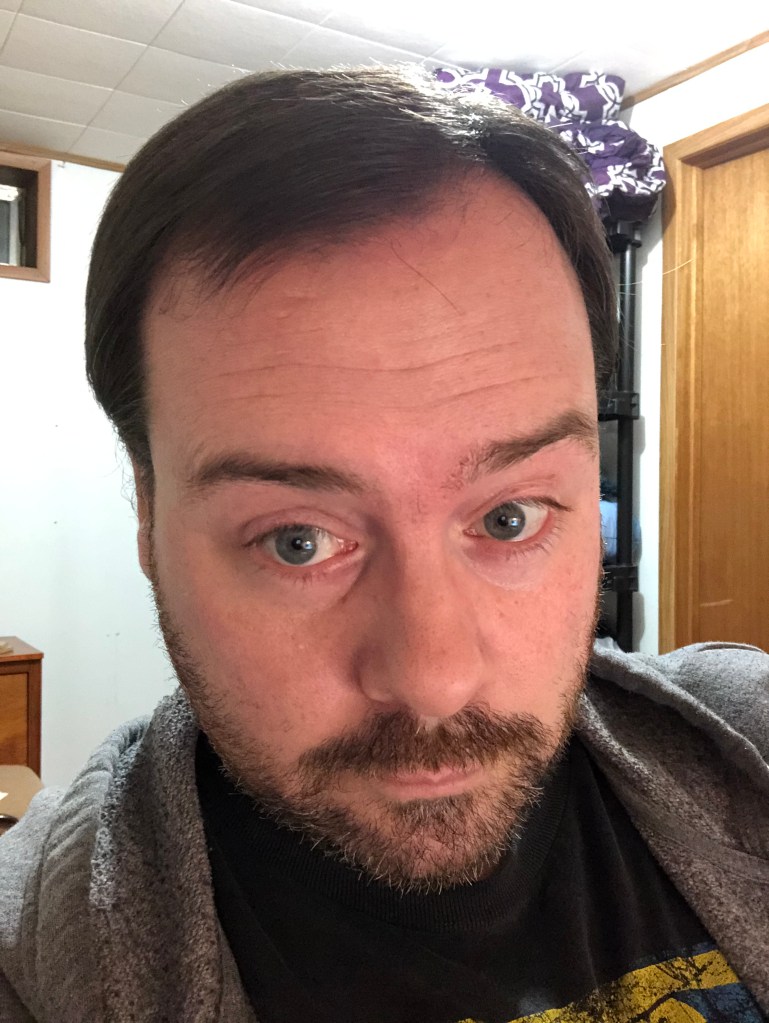
My first attempt at hair growth, February 2020

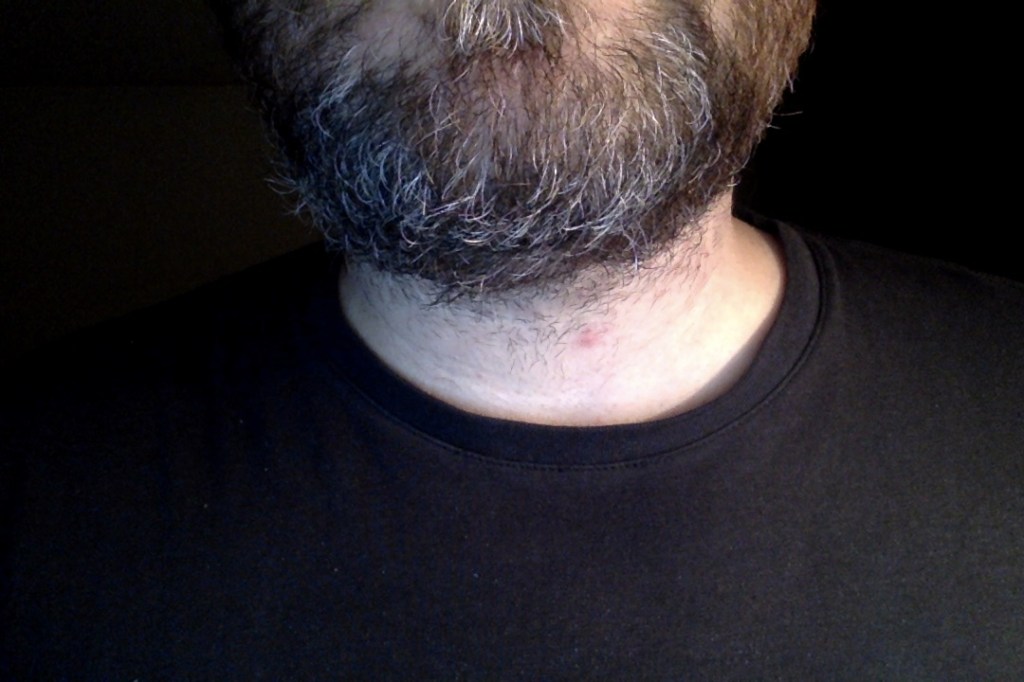
As you can see from the photo above, I have a significant growth of hair on my head. Considering the fact that this was a bit over a month’s growth and I’m usually bald and clean-shaven as a newborn, this is a fair bit of hair. You can almost see a light tinge of grey in the facial whiskers, a result of stress and troubles that plague my life in recent years. Considering I’m only in my early 40’s and my mother reached her 70’s before a touch of grey started to appear (notice I say a “touch” of grey), it’s a testament to the hardships I’ve had to deal with in recent years.

For those who may not be in the know (or who simply haven’t reached that stage in life), grey hair is caused when the pigment cells in your hair follicles that make melanin start to die. For the most part, this occurs later in life as advanced age begins to set in. Without these pigment cells, a person’s hair begins to lose it’s original colour and begins to appear grey and/or white. I started out my life with red hair, not unlike my infant son Alexandre’s hair. By the time I had reached the age of about six or seven years old, my hair darkened to it’s current dark brown, which is a combination of the red hair of my father and the black hair of my mother.

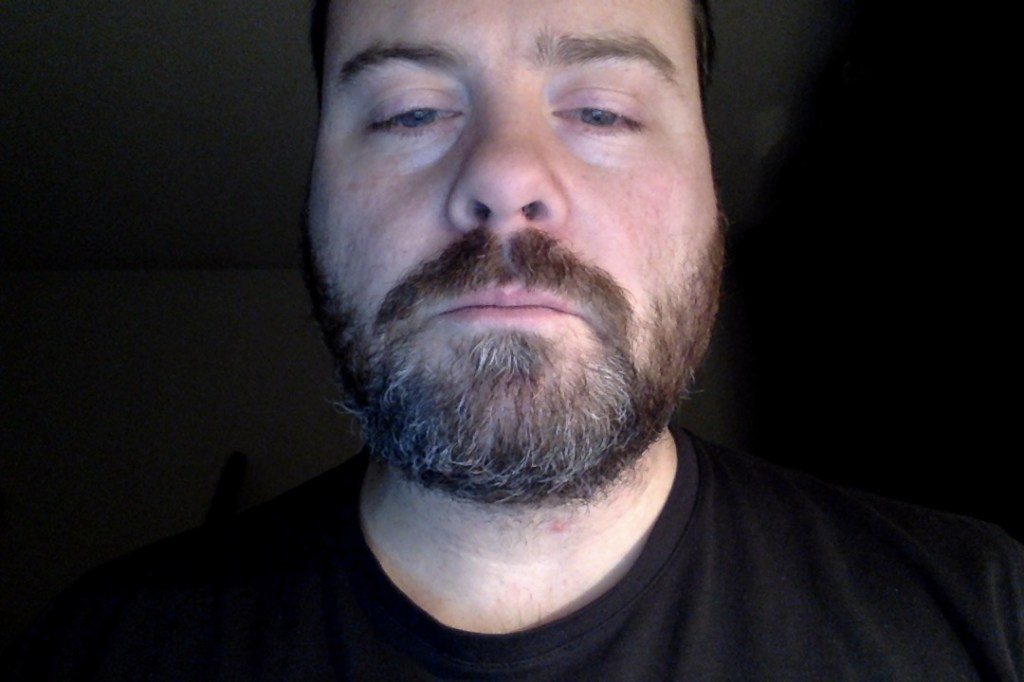
Although my first attempt at letting my inner hippy out to play only lasted a couple of weeks (I would shave EVERYTHING days after the photo was taken), my second attempt has gone on for almost two months. The difference this time, is that I trimmed my scalp while my facial hair continued to grow. The result is that even though more time has elapsed than the growth in February, my head doesn’t have as much hair but my beard is much fuller.

Current beard growth, with a LOT of grey (let’s ignore how tired I look)

You may be asking, “Why are you writing a blog post about your hair turning grey? What does this have to do with Diabetes, Fitness or Buddhism?” Well, first of all, stop being sarcastic with me… My grey hair entitles me to respect! No, but seriously, I’m using this post as a visible indication of how much of a physical effect that stress can have on a person’s body. Some of us like to think that we’re invincible and can handle anything. But even the strongest stone will eventually succumb to the trickle of water.

According to an article posted by HealthLine.com, increased stress can lead to an increase in the stress hormone “cortisol,” which can lead to a bunch of negative and nasty side-effects over the long term. This can affect the nervous system and, big surprise! Your hair follicles are connected to your nervous system! This can cause those pigment cells to die off prematurely, turning your hair to a more, shall we say “distinguished” colour, way earlier than expected…

A slight close-up, so y’all know it’s grey and not a trick of the light

So there you have it! Increased stress can certainly cause one’s hair to turn grey, prematurely. And I’d be lying if I said that I haven’t been suffering from an increased level of stress over the past two and half years. I think we all have, for different reasons. But this is a visible reminder of why it’s all the more important to take steps to try and keep your life as stress-reduced as possible. You’ll notice that I say “reduced” and not “free,” because there really is no such thing as a stress-free life. Bruce Lee said so. ☯

yin-yang-9

Help Me To Keep This Going!

My content may be free and I absolutely love providing it, but my time is not! I’m trying to make a go of it as a full time writer but obviously, everyone needs to get paid for the time they put in. Your donation to this blog can mean the difference between seeing daily content or wondering “whatever happened to The Blogging Buddhist.” Help me keep this permanent. Any small donation helps and will not go unappreciated.

CA$5.00

Sleep Vs. Meditation

Meditation is a large part of Zen Buddhism and I’ve been practicing meditation in some form or another for about twenty years or more. During this time, I’ve seen meditation do some amazing things; overcome pain, focus one’s concentration, fight insomnia and even control one’s cardiac rhythm. Some of it has a lot to do with the style and type of meditation one practices as, yes, there are a number of different ways to meditate. This has often led me to ask the question: Can meditation replace sleep?

The easy answer would be no, it can’t. But that’s a subjective opinion. I’ve found some sources that would indicate otherwise. And I’ll embarrassingly admit that there have been times when I’ve found myself falling asleep DURING meditation, and there are a number of logical, explainable reasons behind that. According to an article posted by HealthLine.com, proper meditation is a relaxation technique that helps to increase melatonin and serotonin, decrease blood pressure and reduce one’s heart rate. These are all early steps that one’s body goes through prior to falling asleep. So one could easily suggest that meditation can logically lead to sleep.

It stands to reason that when meditation is used as a relaxation technique, it will calm a person and help promote sleep. But that still doesn’t answer the question of whether it can REPLACE sleep. From a personal standpoint, I’ve found that often meditating for even fifteen minutes has had something of a rejuvenating effect and has created an increased state of alertness. But this could easily be attributed to the calming effects of the meditation as opposed to a lack of need for sleep.

I found an interesting article on Muse that suggests that although meditation can never completely replace sleep, there are a number of deep similarities between the two. However, the differences include the mind’s state of alertness where, while meditating, we’re always focused on SOMETHING, even when that something is nothing. Meanwhile, during sleep the conscious mind is taking a break, despite the fact that the body is performing a bunch of important tasks, including synaptic repair and memory organization. It’s also been said that there are tens of thousands of thoughts coursing through our minds while we sleep. Sleep is one of those things that continues to be researched, regardless of how many studies are put out.

There are some studies that show that ten minutes of deep meditation can replace about 44 minutes of sleep (ecoinstitute.org). These studies are usually inconclusive but if accurate, one could feasibly meditate for just short under two hours in order to reap the benefits of a full night’s sleep. Sign me the hell up! You know all of those times when you’ve uttered “there aren’t enough hours in the day?” Just think of what you could do if you suddenly gained six hours a day that you no longer needed to sleep through!

That EcoInstitute link I shared goes on to explain that “[…] as far as the body is concerned, meditation and sleep are two different things. While sleep is meant to replenish your energy and help you heal, meditation is designed to cancel out the stress that made you tired in the first place.” So the concept of meditating to replace sleep is a bit of wishful thinking.

There are plenty of articles and studies out there for anyone who is looking for more information. In all my years of using meditation, I can honestly say that I’ve had to succumb to sleep at some point. So I totally agree that they’re separate aspects of rest and one can’t replace the other. But I also know that meditation, used in the right context, can provide an increased level of alertness that can be useful for getting through that slump in your workday or even just helping yourself feel better. Even ten or fifteen minutes of meditation over one’s lunch hour can be beneficial. Now if only I could get Nathan to meditate… ☯

yin-yang-6

help Me To Keep This Going!

My content may be free and I absolutely love providing it, but my time is not! I’m trying to make a go of it as a full time writer but obviously, everyone needs to get paid for the time they put in. Your donation to this blog can mean the difference between seeing daily content or wondering “whatever happened to The Blogging Buddhist.” Help me keep this permanent. Any small donation helps and will not go unappreciated.

CA$5.00

Kids Do The Darndest Things, And Adults Usually Clean It Up…

If there’s one thing that most parents of my age group can easily complain about, it’s how children now days seem to be engrossed in technology with less time for physical activity. It’s become a genuine issue, with childhood obesity hitting an all-time high in North America and kids showing no signs of slowing down, figuratively-speaking. This is where it becomes important for parents to not only encourage proper fitness but to show the right example by indulging in physical fitness themselves.

Nathan prior to his second birthday, executing a solid horse-stance

When my son Nathan was barely beyond his toddler years, my wife and I signed him up for a kids’ activity group, which included soccer balls, hoops and games in order to stimulate physical activity and learn team skills. Nathan’s inability to keep his attention on a single thing for longer than thirty seconds resulted in him running around and doing his own thing while other kids were seated in a circle, learning new things. It was embarrassing at the moment, but the reality is he still played his heart out and got some exercise.

We chose not to keep him in this group, since he had to be signed up and we would have to start paying for fees. I couldn’t justify spending money on an activities group he wouldn’t comply with, so I took his fitness into my own hands. Nathan has always been a child with excessive energy levels, but he rarely sees fit to use them appropriately for fitness. This is why it sometimes makes it difficult to get involved in something structured.

Walking his brother after school (the energy drink is mine)

Don’t get me wrong, there are days when he’s raring to go and I’m the one settled on the couch. But there are a number of important reasons WHY it is so important to get our children off the floor and doing something physical. I’ve been pretty fortunate that Nathan is often game to join me on the mats and do some exercise, even when his idea of exercising is hitting me repeatedly with a punch mitt until I stop my reps and wrestle on the floor with him.

Exercise is an important part of a child’s development. Exercise is required in order to strengthen bones, increase muscle mass and improve a child’s overall proper growth. From a non-physical standpoint, exercise is also important for a child as it promotes socialization, self-esteem and helps with concentration and schoolwork. That last sentence is an aspect that most parents tend to forget. And most reputable sources, and I’ll let y’all look into those yourself, recommend at least an hour of rigorous physical activity every day.

Although it can be hard to get kids interested in physical activity, there’s a lot you can do to encourage it:

  1. Be The Example: It stands to reason that if your kids see you sprawled on the couch with a bag of chips, binge-watching a show for four to six hours without moving, this is the standard that they’ll grow up with. They’ll assume that laziness and apathy is acceptable. After all, if it’s good enough for mom and dad, it should be good enough for them, right? Wrong. Even if it’s just to get your kids moving, you need to set the example. After all, the family that stays fit together, stays healthy together;
  2. Limit Screen Time: This is a tough one, especially for my son. And to be honest, it can often be tough on my wife and I, as well. It’s SO easy to tell Nathan “Go watch a show on your iPad,”when we’re trying to get things done or want some peace and quiet. But realistically, keeping him off a screen is important to helping him grow and develop properly;
  3. Plan Activities: Although I would like being able to tell Nathan “Go outside and play,” this doesn’t work for most kids. Some of them may be able to go outside and entertain themselves, but it doesn’t allow for much structure. Plus, let’s be honest: sitting in a sandbox rolling a small car doesn’t do much for fitness and proper health. Play some ball, run some races or go talk a walk. Aerobic and anaerobic exercise is important, even for kids;
  4. Keep Up The Encouragement: Hey, my son can’t throw a proper front kick to save his life. And his idea of blocking consists of squatting down into a ball and covering his head with his hands. The martial artist in me cries on the inside. The daddy in me is just happy that he’s training with me. But no matter what, the high-fives and pats on the back need to keep coming. It’s pretty hard to stay motivated if one isn’t encouraged. This is true of adults as well.

At the end of the day, this is one of those things where anything is better than nothing. But there are also certain restrictions you need to observe. Children really shouldn’t be doing any heavy weightlifting until they’ve finished growing. They can lift weights, but they should avoid lifting HEAVY weights for the purpose of lifting as much as they can as it can interfere with the body’s proper development.

Keeping kids physically active and engaged is about more than just getting exercise. It helps to mold the foundation they’ll need to maintain proper health, growth and development throughout their formative years and into adulthood. And maybe, just maybe, the parents will join in for the ride. ☯

yin-yang-5

Help Me To Keep This Going!

My content may be free and I absolutely love providing it, but my time is not! I’m trying to make a go of it as a full time writer but obviously, everyone needs to get paid for the time they put in. Your donation to this blog can mean the difference between seeing daily content or wondering “whatever happened to The Blogging Buddhist.” Help me keep this permanent. Any small donation helps and will not go unappreciated.

CA$5.00

Add A Little Sunshine To Your Body…

The past couple of months have had most of us seeing two issues that have a direct impact on what I’ll be discussing today: the colder weather and quarantine regulations. The reality is that when winter hits, we all tend to stay indoors a lot more than we do during the spring and summer months. This makes sense, since most people don’t enjoy being out in the cold unless it’s to ski or something. But given that everyone has to socially distance and/or self-isolate, this winter has seen this effect worsened.

Because of all this, there are certain things that some people are starting to lack, such as fresh air and Vitamin D. There are others, but these are the ones that come to mind. I wrote a pretty lengthy post, all the way back in June of 2019 in what I can only describe as my infancy in blogging. The post was called What Did Think You Were Eating For? and it explains the purpose and benefits of the most common vitamins and minerals that the human body requires on a daily basis. Check out the old post, it’ll save you the pain of having me write this post until the New Year, describing them all.

There are some who would argue that a person gets everything they need from diet, so long as it’s balanced and adhered to. Although this CAN be true, there’s no denying that most people will lack in one area or another, whether because their specific diet lacks a little something or they live as hermits in their mom’s basement. Just about every doctor I’ve had since childhood has recommended the use of a daily multivitamin in order to supplement whatever you may be lacking.

Vitamins and minerals are important because they perform all kinds of roles within the body, including healing wounds, strengthening tissues and boosting your immune system. Vitamins are also integral to converting your food into energy stores. I could go on and on about the benefits of proper vitamin and mineral balance, but we’d be here all day. So suffice it to say, you need that shit in order to have a healthy life.

In case you feel intimidated by the vitamin aisle at your local retailer, you’re not alone. Although similar, not all multivitamins are created equal and you should talk to your doctor or health practitioner before you start taking any of them. Some multivitamins “feature” an added touch of something, such as iron or magnesium, and you could actually be getting more of something than you should while trying to prevent the opposite.

I’ve read in a few places that some vitamins and minerals will also affect blood sugar, so there’s THAT. Like Diabetes doesn’t cause enough problems… But I can’t find a source for that to save my life, so take it for grain of salt. One last point I’ll touch on is that in order for a daily vitamin to be effective, you have to be consistent and disciplined in its use, meaning you have to take it for the long-term in order for it to become effective. But before running out to spend a fortune on capsules, be sure to read the label so you know what you’re consuming and consult your doctor. In case saying it twice wasn’t enough, CONSULT. YOUR. DOCTOR.

I mentioned fresh air in the opening paragraphs because fresh air can help to clear the mind, properly oxygenate the blood and gets you away from your television, devices and smart phones for a short period of time. You also need to be outside for the production of Vitamin D. Contrary to what’s often believed, sunlight doesn’t PRODUCE Vitamin D, but it’s necessary in order for it’s production. The body produces Vitamin D when exposed to the sun’s rays.

Of course, nothing quite compares to getting outside and breathing in the fresh air and enjoying a bit of sunlight. But it’s nice to know that when the -50 degree Saskatchewan winters and quarantine requirements see you bundled up on your couch with your favourite blankie, there are alternatives. One simply needs to be well-educated in what’s being introduced into the body. ☯

yin-yang-3

Help Me To Keep This Permanent!

My content may be free and I absolutely love providing it, but my time is not! I’m trying to make a go of it as a full time writer but obviously, everyone needs to get paid for the time they put in. Your donation to this blog can mean the difference between seeing daily content or wondering “whatever happened to The Blogging Buddhist.” Help me keep this permanent. Any small donation helps and will not go unappreciated.

CA$5.00

Heavy Or Fast, Exercise Has An Effect…

I’m a huge believer in the fact that a person should be training and/or working out several times a week, if not daily. I’ve had many of my counterparts (both Diabetic and martial artist) point out that it’s possible to have too much of a good thing and that daily training isn’t ideal. But when you factor in sessions of meditation, low-impact yoga and walks, it can be pretty easy to log something different seven days a week.

And before all the yoga practitioners jump on here and tear me a new one, I’m not saying that yoga isn’t a fantastic workout, because it can bring the sweat like anything else. But the point I’m trying to make today, especially for my fellow Type-1 Diabetic readers, is that different TYPES of workouts will have a different effect on your body and blood sugar. And it can be confusing and difficult to make heads or tails of it. After all, one would be inclined to think, “burn glucose to lower, eat carbs to increase,” right?

Last week, I had the privilege of enjoying two workouts. The first one was a circuit-style workout, with some speed and intervals thrown in. I performed this workout with my 6-year old son and we ended the workout with about fifteen minutes of punching the mitts. All in all, it lasted about forty minutes. During this period, my CGM was taking care of monitoring my blood sugar levels and I sat in the range of 5.3 to 5.7 throughout the entire workout and for a while afterwards. Okay, not bad.

The second workout was a period of doing karate forms, or kata. I practiced these alone for about a half hour, doing two or three of each of my forms required for my next belt certification. Doing them alone didn’t stop my son from sitting on the steps and watching quietly while occasionally mimicking some of the techniques he saw. But during that brief half hour, my blood sugar dropped from the mid 6’s to about 3.8 mmol/L.

The fact is, different workouts will have different effects on your body whether you have Diabetes or not. But it’s because of that Diabetes that you need to be wary of said effects. There’s no magic formula to figuring this out. Most of it will be trial and error and will require you to try different things to see what works for you. But I’m going to throw out some basic concepts as they relate to Diabetes. If you want some in-depth information, the Juvenile Diabetes Research Foundation has a great article that covers what I’ll be saying in greater detail.

Let’s start with cardio. I’m not a huge fan of running but as some of you know, I LOVE cycling. Cardio (or aerobic) exercises tend to last longer than say, weightlifting or other types of exercise. Although exhausting, biking for 70 kilometres will typically be less intense than say, doing repetitive sets of heavy weights for 30 minutes. Under normal circumstances, you’ll burn glucose consistently throughout the majority of your workout, meaning you’ll experience a low at some point during your workout. Pretty straightforward, right?

Next is anaerobic exercise, or your weightlifting, karate, boxing… Most of the workouts that are higher in intensity and will build muscle as opposed to cardio. Because of the higher intensity, the release of adrenaline will trigger the breakdown of glycogen in your system which is then turned into glucose, resulting in a spike in blood sugars. This is usually a real pain in the ass for me, especially since I usually suspend my insulin pump and leave it in my gym bag to avoid damage during karate classes.

Still with me? Good. The JDRF link I provided above will also offer some insight into combination aerobic/anaerobic workouts like team sports, but that shit gives me a headache to think about. So check out the link. The bottom line is you may have to suffer through some trial and error in order to figure out what works best for you. Removing my pump is normally a good idea during karate to keep from damaging it. But if I do as my doctor suggests and bolus a unit or two to compensate for the pump’s absence, I usually suffer a low quite quickly. I’m usually better off letting the spike happen and correcting it after class is done. Although not the best choice, that works for me. It may not work for someone else.

Having Diabetes shouldn’t stop someone from enjoying the full range of health and fitness that their bodies can allow. Although it may take a bit more planning and tweaking than the average person, there isn’t anything I can’t do. The important thing is to plan ahead. Always keep some fast-acting glucose with you, in case you suffer a low. Keep a blood glucose meter close by s that you can confirm your blood sugar levels, whether you wear a CGM or not. And of course, be sure to stay hydrated. ☯

yin-yang-2

Help Me To Keep This Permanent!

My content may be free and I absolutely love providing it, but my time is not! I’m trying to make a go of it as a full time writer but obviously, everyone needs to get paid for the time they put in. Your donation to this blog can mean the difference between seeing daily content or wondering “whatever happened to The Blogging Buddhist.” Help me keep this permanent. Any small donation helps and will not go unappreciated.

CA$5.00

Snitches Get Stitches…

If you saw someone driving erratically on the highway and thought to yourself that this person may be intoxicated, you’d call the authorities. Right? Because that person is a hazard to themselves and others and it’s in the interest of public safety to do so. If you saw someone get assaulted on the street, you’d likely do the same thing. Granted in today’s society, you’d get more people filming it on their phone than helping out, but that’s a different issue.

The irony is that all of these things, assault, driving while impaired and even “little” things like speeding or rolling through a stop sign, are against the law. Statutes and regulations have been put in place to prevent these actions. Not because they’re intended to restrict a person’s freedom but in a way, to ensure it by guaranteeing everyone’s safety; including your own. The same can be said about many of the health measures being implemented by governments in order to try and flatten the COVID-19 curve.

Hell, I’ve even seen people phone the authorities on neighbours because they’re having a loud party and the worst damage is that the person is losing some sleep because of the noise. It doesn’t stop them from calling, nonetheless. The problem is that people only report these incidents when they directly affect them or benefit them. You wouldn’t give two shits about the party happening on the other side of town or the drunk driver travelling on the other side of the Province, despite the results being the same.

In recent times, governments have begun to implement a number of laws, statutes and regulations that limit the number of people in households and certain businesses and make the wearing of non-surgical masks mandatory in public places. Since I know that the majority of my readers aren’t from Saskatchewan, I haven’t bothered to link these laws as they’re different in each country. Hell, in Canada they’re different in each Province, although my Sask readers are welcome to Google “Saskatchewan Public Health Act” if they want confirmed information.

I’ve been extremely disheartened with the reactions and comments that I’ve seen spreading across social media, since the regulations restricting the number of people in a household has been implemented. It seems that with every post that someone writes about a gathering in a household, a commenter will jump on there and indicate that they should be left alone and that people shouldn’t be “snitching” on their neighbours. Yeah. Great. That sounds ideal, but there’s a lot more to it than simply letting the neighbour have their party…

Picture this scenario: a local resident decides to invite a dozen or more of their closest friends to have a small social gathering. Seems like a good idea, right? Moral is low, a lot of people are working remotely from home and don’t have a lot of contact with the outside world and realistically, we’re all supposed to be in this together, right? The resident knowns he or she doesn’t have COVID-19 and has done the “responsible” thing and asked all the invitees not to attend if they have a fever, cough, yada, yada, yada…

One of the big problems, which has been explained ad nauseam in the past year, is that you can be carrying the virus without demonstrating any symptoms. You may have it and not even know it. So you’re temperature is fine, you’re not coughing or having difficulty breathing. Great. You head on over to your party and have an awesome time, drinking awesome shooters and maybe even meet a special someone. Fantastic. Then , those invitees all go to their homes and their work and potentially spread the virus on to the people in their surroundings because someone at that gathering wasn’t aware they were carrying the virus.

Maybe you’ve spread it to your family, who has then spread it to their work and in their schools. That results in greater case numbers, more people getting sick, schools closing and potential lives in jeopardy. All because you wanted to have your little party and people think they shouldn’t be phoning in on their neighbours. Does that seem like a bit of a bleak picture? Absolutely, but it’s also the reality. And much like the offences I mentioned in the opening paragraphs, these types of gatherings are not a scenario where “they’re not hurting anybody else,” but a case where they may likely be causing this pandemic to continue on for longer than it needs to. Oh, and it’s illegal. In case no one caught that little detail. IT’S ILLEGAL.

This time of year is particularly hard for people, especially since restrictions mean that we don’t get to see our families over the holidays. I feel that sting better than most, since my parents are in New Brunswick and there’s no realistic chance in hell that I’ll be with them for Christmas. I’m lucky; I have my wife and sons to spend Christmas with. But I’m an only child and my parents are separated due to my father being a care-home resident that’s currently locked down. But besides obeying the law, which all of us should be doing, isn’t sacrificing one Christmas worth it to ensure you may be able to live to see the subsequent ones?

I know that all of this seems restrictive, and as I’ve written on a number of occasions, people don’t like to be told what to do. But the reason this seems to be dragging on is because we loosen our grip too soon, only to have a resurgence of the virus requiring tighter measures. Wouldn’t it make more sense to simply follow regulations and restrictions, let this thing die out so that we can start looking towards the future? Seems to this Buddhist that this would be the path of least suffering. But what do I know? I’m just a short man on a tall soapbox… ☯

yin-yang-1

Help Me Keep This Permanent!

My content may be free and I absolutely love providing it, but my time is not! I’m trying to make a go of it as a full time writer but obviously, everyone needs to get paid for the time they put in. Your donation to this blog can mean the difference between seeing daily content or wondering “whatever happened to The Blogging Buddhist.” Help me keep this permanent. Any small donation helps and will not go unappreciated.

CA$5.00

Don’t Get Salty, I’m Just The Messenger…

Ahh, salt… It’s the most common seasoning in most household kitchens and unless you have some medical restriction that prohibits its use, I don’t know too many people who haven’t thrown a dash on their food from one time to another. Salt is pretty old school and has dipped its toes in to a number of different aspects of humanity. It’s not only been used as a seasoning, but has also been used as a preservative for food, a disinfectant and even as a form of currency. So, what’s the real deal with salt?

Many people actually crave salt. There are a number of different possible reasons for this and I’m sure at some point, you or someone close to you has demonstrated the inability to stop eating once you’ve started in on a salty snack. You know, “betcha can’t eat just one?” As with all things in life, there’s some good and some bad. And I’m going to spit out some of both…

Depending on which generation you grew up in, you’ll have noticed that most salt containers will have the words “with Iodine” or “iodized” added to it. This is because Iodine is a necessary mineral component that’s part of a hormone called thyroxin, which helps to regulate one’s thyroid. Humans need to obtain Iodine from outside sources in their diet, since the human body doesn’t produce it. So most of North America began adding it to salt, sometime in the 1920’s.

Sodium, which is only one of the components of salt, is a necessary mineral that the human body needs in order to properly balance one’s hydration and blood volume. This is usually done with the consumption of potassium and magnesium as well. Sodium directly influences blood pressure, and folks who suffer from chronically low blood pressure will sometimes be advised to increase their sodium intake.

The hydration aspect is an important one, from a fitness AND a Diabetes perspective. As I can easily attest from a lengthy bike ride in extreme summer heat, lack of mineral salts, such as sodium, will cause a condition called hypionatremia, which is a problem when the water levels in your body rise too high and your tissues and blood cells begin to swell. Sodium can act as an electrolyte to help balance out hydration and the absorption of water in your system. Your body also needs sodium for proper muscle and nerve tissue health. The contracting of your muscle tissue depends on proper sodium levels, as well.

Since life is a matter of balance, there’s a bad side to salt/sodium, as well. Too much sodium increases your risk of stroke, kidney disease, bone and joint issues as well as heart failure. Sound familiar? It should; these are all possible Diabetes complications, as well. So for someone who has Diabeties, an increased level of sodium will aggravate all those existing complications.

Whether you have Diabetes or not, sodium falls under the same category as carbohydrates. Your body needs it, but you have to find the proper balance. Not enough sodium will cause issues and too much sodium will cause complications. Just like the over-consumption of carbohydrates. From a fitness standpoint, you sodium (as well as other mineral salts) in order to stay properly hydrated when exercising. In fact, most “sports drinks” are just water infused with variations of sodium and potassium, with some colouring and flavouring thrown in to justify the crazy price retailers charge you for it.

The average person will get all the salt/sodium they need through the consumption of their regular food, as most food has pretty solid levels of sodium. This means that unless you’re training at an athletic level or in the extreme heat, consistently sipping water and eating a healthy diet will be enough. For the former, sipping the occasional electrolyte sports drink can be helpful to avoid nausea, muscle cramps and fatigue during heavy workout. ☯

yin-yang

Let’s Keep The Engine Going!

My content may be free and I absolutely love providing it, but my time is not! I’m trying to make a go of it as a full time writer but obviously, everyone needs to get paid for the time they put in. Your donation to this blog can mean the difference between seeing daily content or wondering “whatever happened to The Blogging Buddhist.” Help me keep this permanent. Any small donation helps and will not go unappreciated.

CA$5.00

The Needle Jammed Into Your Haystack

Today, I’m going to tackle a side effect of Diabetes that I never have before. Although I’ve touched on it briefly in previous posts, I’ve never really taken the time to examine it and put a name to it. Well, today is the day. No time like the present. I’m talking about a well-known condition that usually remains unnamed for most Diabetics called Lipohypertrophy.

So what is Lipohypertrophy? According to an article posted by HealthLine.com, it’s defined as “an abnormal accumulation of fat underneath the surface of the skin. It’s most commonly seen in people who receive multiple daily injections, such as people with Type-1 Diabetes. In fact, up to 50 percent of people with Type-1 Diabetes experience it at some point.”

In layman’s terms, Lypohypertrophy is the scar tissue that one accumulates from repeated injections in the same area. This is especially true if you wear an insulin pump and/or test your blood sugar frequently throughout the day. The difference between Lypohypertrophy and actual scar tissue is that the former isn’t permanent. Providing you take the proper steps. I’ve read a number of different sources in relation to this, and most of them recommend everything from mildly massaging the area, all the way to liposuction to remove the fat deposits. I don’t know about you, but I have no interest in such extreme measures (I mean the liposuction).

For the most part, Lypohypertrophy will pass if you allow some time between injection sites. Sometimes when I remove an infusion site, I’ll see a hard, red spot where the cannula pierced my flesh. That spot will disappear. Typically. This process, however, can happen as quickly as days or take as long as months. So it’s important to rotate your injection sites regularly and try to avoid always jabbing a needle into the same spot, constantly.

Other important steps to prevent Lypohypertrophy is to ensure to always use fresh needles. Although on a microscopic level, needles will start to bend at the tip after only one use. Many Diabetics will try and save a few bucks by re-using the same needle over and over. But doing so can result in thicker scar tissue and possible infection. Rotating your site and even considering smaller needles can be good ways to prevent and avoid Lypohypertrophy. I’m not sure how acupuncture would help, but I’m certain your local acupuncturist could explain it. In extreme cases, liposuction can provide an immediate solution to elimination the unsightly lumps, but you face the same risks as you would with any surgery.

The reality is that although we don’t think of it in that way, there’s plenty of real estate to inject your insulin, so you should avoid repeated use of the same injection sites. Some people even keep a log to ensure they avoid repeated sites for as long as possible. You’ll know it’s time to visit your doctor if your injection sites become red and swollen, are hot to the touch or painful without touching, all of which are signs of infection.

The same can be said of your fingertips, although this is straight up scar tissue and there’s little you can do to heal it once it forms. The difference is that Lypohypertrophy will affect how your body absorbs insulin. But as long as blood is drawn, the desired result is achieved. Maybe take it easy on the guitar practice while your fingers heal, but otherwise you’re good to go. Just one more aspect of the Diabetes rollercoaster one needs to think about. ☯

Early Bird Gets To Socially Distance

A lot of people, most people really, are pretty stoked that there are only a couple of weeks left to 2020. To be honest, I see no evidence that 2021 will be any better than this year was but it’s good to stay positive. It’s like I’ve always told my wife: enjoy and appreciate the positive aspects of where we are, because the next spot may be much, much worse… The same words can easily apply to the world’s transition from ’20 to ’21.

Before I get too morose and negative, this time of year also brings the holiday season along with it. The world has changed in the way that it does business. And before everyone jumps on the internet bandwagon to tell me that I can not only do all of my Christmas shopping online but have it delivered to my home, I’m well aware. But sometimes you can’t beat the feeling of being out and handling the items yourself before paying for them. In some instances, this is also the only way to guarantee that you’re getting what you planned on, and not some wrong-sized or incorrect item because of an error on the other end when ordering online.

I was out running errands about two weeks ago. As I had brought Nathan to his bus stop with the SUV (he’s pretty spoiled), I took off to go do some shopping and run errands right away at 8 a.m. I discovered something that really shouldn’t have surprised me. The stores I went to were basically empty. Since most people were gone to school or off to their workday, I pretty much had the aisles to myself. It was nice, because I was able to shop around and actually look at stuff, take my time and wander without worrying that I was holding up someone behind me. You know, since they’re supposed to keep six feet away.

I think we forget that frequenting retail locations (when necessary) during these “quiet” periods is an excellent way to run your errands and get the stuff you need while managing to social distance the way everyone should. Plus, the peace and quiet that accompanies said shopping is a great way to let your mind float and start your day. No long-winded post with heavy explanations today. I just thought it was neat and that I should share. Stay safe! ☯