On The Brighter Side…

Sometimes life can be difficult to navigate and things always seem darkest before the dawn. I’ve had my fair share of difficulties in the past few years, and not all of them related to COVID-19. But if you take the time to slow down and pay attention, there can be some nuggets of golden wisdom among the dust. I recently reconnected with a friend from my childhood and he posted something that resonated with me. As a result, I’ve decided to share it here.

I wasn’t able to track the source of where he got it, and I’ll be translating it from French, but the message should be pretty clear. We often take things for granted and especially when things are rough, we ignore the good things in life altogether. With that thought in mind, I present for your consideration, 10 signs that things in life are actually going well:

  1. You Have A Roof Over Your Head: It’s appropriate that this one is first on the list. A safe home to live in is something that not everyone has the benefit of having. I can admit that even I have often taken going home at the end of the day for granted;
  2. You Have Food In Your Stomach: Next to having shelter, an empty stomach is a problem faced by more and more people. One wouldn’t think this would be a problem in modern society, but it is;
  3. You Have A Heartbeat: This one resonates most with me, because my brother and I have fought against health issues for our entire lives. The bottom line is that if you’re still alive, you can still fight the good fight;
  4. You Have Water: Hydration is the key to life. I’m sure you’ve all heard that you’ll live longer without food than you will without water. And that’s pretty accurate. Not everyone has access to clean drinking water;
  5. You Have Access To Personal Hygiene: Right up there with the previous four points, self-cleanliness is often taken for granted but provides so many benefits in one’s life BESIDES smelling nice…;
  6. You Have Friends And Loved Ones: There’s nothing worse than going through this life alone. Even people who claim to be loners will usually yearn for companionship now and again, so just imagine how lonely it is when you have no one in your life;
  7. People Love You: Okay, so this one kind of goes hand in hand with the previous point. But the lesson here is that the people in your life love you, and that’s not to be taken for granted;
  8. You’re Doing Your Best: This one is pretty subjective, but as long as you’re doing your best at whatever you do in your life, you’re doing okay. Trying and failing doesn’t make life tragic. Trying, failing and refusing to try again is the problem;
  9. You Have Clean Clothing: It’s one thing to be clean yourself, but being dressed in clean, properly-fitting clothes is not just a matter of image but a matter of health and wellbeing;
  10. You’re Still Breathing: I once read somewhere that if you want a simple test to know if you’ve completed all the challenges in life, it’s this: if you’re still alive, you haven’t. No matter what comes at you, always remember that you’re still breathing. You’re still alive. And as long as you’re still alive, there’s always hope.

I look at this nifty little list and I recognize that I’m blessed with all ten of those points. I have a home, a family, food in my belly and clothes on my back. I know my family loves me and have a great support system. And despite everything I’ve been through in recent years, I’m still breathing. I’m still here. It’s important not to take any of it for granted. Not everyone has the benefit of everything listed here. ☯

“Pump” Up The Insomnia…

It’s been an interesting change in routine, having started a new job last week and being half way through my second week. My wife was just commenting this morning that we seem to have developed a trend where our routine starts by waking up at 5 a.m. early in the week and on that evening, we’re so blasted from our “start of week” that we usually crash shortly after we put the kids to bed. This is followed by getting into the groove later on in the week, allowing us to stay up a bit later and completely throwing caution to the wind on the weekend, which likely leads to our exhaustion on that first morning. But I digress…

As much fun as I’ve been having, meeting new people and learning new skills, adapting my habits at home and getting proper sleep has been the biggest challenge. I’ve often said that technology is really only as good as the person wielding it and how involved they choose to be. But sometimes technology takes it upon itself to be a total pain in the ass, despite the intended programming. I faced just such a situation last night. Now, I know I tend to write these stories on occasion and it seems as though I’m just complaining about my condition. In truth, I write about these things in the hopes that other people with Diabetes will read them and relate to them, maybe acknowledge that they’re not alone in their situation. But anyway, here we go.

Finally coming down to normal

My wife was also exhausted last night, and we ended up crashing just shortly before 8 p.m. I know, I know… We’re like an old couple. Things were fine, we even allowed ourselves a brief snack in bed as we watched our respective streaming services and within the hour, I had fallen asleep. I performed a calibration of my CGM before bed, my blood sugars were normal and I anticipated a full night’s sleep. I anticipated wrong. At about 9:30 p.m., my pump began vibrating wildly. It woke me instantly and I checked what the problem was. “Insulin Flow Blocked. Auto Mode Turned Off. Consider Changing Infusion Set.”

In retrospect, if I’d been smart I would have gotten out of bed and dealt with the issue. But since I had already fallen asleep, I was groggy and pissed at being woken so I did the only logical thing. I jiggled the infusion set at the site on my stomach, acknowledged that it was likely due to my sleeping on it and reset the pump. Resetting Auto Mode involves going through a multi-level menu and turning it on, saving, then going back and providing a BG reading to get Auto Mode to kick back in. Although only a one-minute process, it’s a tedious one to perform when you’re barely awake. I also delivered a bolus to correct the fact that during this “block,” my blood sugars had creeped into the low teens, making me even groggier.

Once I fell asleep, I was once again awoken for the same reason sometime during the midnight hour. Are you kidding me??? Same issue, same error messages. Once again, the smart thing to do would have been to get out of bed and go deal with it, but I managed to acknowledge that I still had about 120 units in the reservoir, which I didn’t want to waste on a set change. I also managed to realize that if the insulin delivery had worked for the past few hours, it had to do mostly with my sleep position and less with the pump itself. I reset everything and provided a further bolus due to being in the mid-teens, and tried to will myself to stay on my back, away from the infusion site.

You can see the slight rise from my snack, followed by a bolus at around 9 p.m. when I was first awoken and how the night went to hell from there.

Just shortly after 2 a.m., the same issue happened for a third time, so this time I opted to leave Auto Mode turned off, make sure I was on my back and go back to sleep. At this point, I knew I only had a few hours left to productively sleep in some given way, shape or form, so I opted for rest over proper blood sugar control. Maybe not the smartest choice, in retrospect. But I stand by it. You can see in the photo above, how the pink drops disappear from the screen, shortly after 2 a.m. This is when Auto Mode was shut off. I also provided a bolus to help treat the fact that I was still sitting at roughly 14 mmol/L.

My alarm went of at 5 a.m. as scheduled and I turned and sat up, with my body protesting in the way it generally does at my age, when I’ve been woken every few hours. I tried turning on Auto Mode once I was standing up, but it provided the same error messages again so I called it quits and sacrificed the remaining insulin units in favour of changing out the infusion set. From the first photo, you can see that I’m slowly dropping back to normal. All I can say is that the Keurig machine in my office will be working overtime, today.

It just goes to show that Diabetes management can be trying and challenging, even during the nighttime hours when you should be able to get some sleep. And don’t get me wrong; I love my insulin pump. LOVE IT! I’ve had the best blood sugar levels and the lowest A1C results ever, this past year. But even with a device that’s as advanced as my current pump, there can still be some user error, issues and corrections that need to be made. And since life rarely cares about one’s plans, those issues can sometimes take place at night.

Moving forward, I’ll need to see about maintaining some infusion sites that don’t involve sites that are pressed against the mattress when I turn over at night. That should be pretty easy; I have plenty of real estate on my abdomen to choose from. But the Diabetes challenge never ends. The high blood sugars, repeated wake ups and required adjustments have left me feeling drained. Just one more day of battling the T1D beast! Now if you’ll excuse me, I have a much-needed morning coffee calling my name. ☯

Taking A Little Respite…

I’m an incredibly long way from what I would consider to be lazy. Between my continued efforts towards fitness, Diabetes control and giving my maximum in everything I do, I very rarely sit still. The fact I have difficulty sitting still in general tends to help, as well… But once in a while, even the most dedicated person needs to take a step back and throttle back on life and take a rest. And mental exhaustion being a very real thing, it can lend a heavy impact on one’s motivation.

A couple of weeks ago, I found myself skipping karate classes and performed personal workouts a lot less than usual. I’ve had the pleasure of throwing a couple of quick, 10-kilometre bike rides into the mix, which was nice. But with the warmer weather coming along, the opportunity for different and increased number of workouts is becoming a thing. The recent heavy snows we’ve had in Regina notwithstanding, of course. But a severe lack of motivation has unfortunately thrown a monkey wrench in my otherwise rusty gears.

I’m a big advocate of pushing oneself, and of making an effort to workout, even when you don’t feel like it. Given the nature of Diabetes and the effects it has on a person’s body, it’s no surprise that there are days where either the body or the mind simply don’t want to put in the effort. I had both my body AND my mind gang up on me in recent weeks when I’ve skipped the majority of my workouts. Even while acknowledging that I should have been doing something, I just didn’t want to. To use the vernacular of today’s younger generation, I can’t even…

And you know what? That’s okay. Even if it may feel like you’re being lazy, stepping back and taking a break from your fitness habits can have a lot of benefits. Yes, yes, I know… The benefits of doing SOMETHING definitely outweigh doing NOTHING. But here are some quick benefits that I’ve noticed, whenever I’ve taken a break:

  • You Can Relax: I think we can all agree that being “switched on” all the time can take a toll. There is such a thing as over-training, and it’s important to recognize that point. Taking a break week can let your body fully recuperate and allow you to relax a bit and maybe focus on other interests, such as reading or playing with your kids;
  • You Can Regroup: Honestly, there’s something to be said for having the time to just sit back and contemplate things. Whether you want to take the time to meditate, focus on work or even come up with some new workouts, taking a break can allow you the time to figure it out. Personally, I get bored of doing the same workout over and over and I like to design new circuits and try new things. Otherwise, I feel my fitness is becoming stagnant;
  • You Can Heal: Constantly working out can be taxing on the human body, and even more so when you’ve reached my age. Even though you can continue to work out with mild injuries (with limitations), it can be nice to allow some extra time for the systems on your body to reset themselves and for any outstanding injury to heal completely.

Given the particular life changes and adjustments tat have taken place within my household in the past week, it’s no surprise that I continue to be exhausted. Like many people, I’ve spent the last little while hibernating at home while COVID-19 has marinated on the outside. The result of this has been that waking at 5 in the morning every day is no longer something I’m used to. I’m slowly getting adjusted o it, now. But I’d be lying if I said that I haven’t been sneaking off to bed as soon as my wife and I get the kids down. Surprisingly, my blood sugars have fared quite well during all of this. I think that can be attributed to routine, since I eat my meals at pre-planned times and don’t snack or eat outside of those times.

As one always does, I’ll adjust. I usually find that taking a “lazy week” once in a while will allow me to reap all those benefits mentioned above. The important thing to remember is not to go on some sort of junk food bender while you’re sitting around doing nothing. And I’m definitely not saying that you should do this indefinitely. Or often. Especially since a sudden change in your level of fitness and activity will play hell with even the best balanced blood sugars. But if you allow yourself the occasional break, it can even help improve your mood and energy levels for when you DO get back to it. And one always needs a little time to adjust to any new routing. Food for thought… ☯

Death: Science vs. Religion

Christopher Bullock, a British actor once said, “Tis impossible to be certain of any thing but death and taxes.” And this much is inevitably true. If there’s one thing that every person in this world has in common, it’s the fact that we’re all going to die someday. I was exposed to death at an early age, given the passing of my brother before I had reached my teen years. From that point on, my perspective and interest in the topic of death has followed me throughout my entire life.

Most people in general avoid the topic of death as they prefer not to think about the prospect of their lives coming to an end. For the most part, this is because of the fear that accompanies the unknown circumstances surrounding death. After all, no one truly knows what happens once the body dies. The thought of simply ceasing to exist is frightening, to say the least. It’s frightening, even to me. And I’ve had a LOT of experience witnessing and dealing with death.

So what’s the real deal? What happens after death? The physiological results are well-documented and well-known, so I’m just going to go ahead and ignore those since we’re focusing on what happens to the PERSON after death. Not the body. I read a great blog post over a year ago, where the author went into detail about how at this point we should be acknowledging the existence of an afterlife, based on how many accounts there have been from people who have reached the brink and peeked through. The post explained how it should be a foregone conclusion of SOMETHING that occurs after death, as opposed to wondering IF.

Some have even come back with information and details that they wouldn’t have known otherwise, unless they had spoken to passed relatives and such. Could some of it be coincidence? Maybe. It wouldn’t be the first times that a person was made privy to information that they heard on a subliminal level and only remembered when hitting a comatose stage. It’s possible that the person is remembering a detail that they didn’t know they had heard. But coincidence will only take you so far, with people admitting to hearing and knowing details discussed outside the room while they were clinically dead, etc.

So, let’s examine the difference between the scientific approach and the religious approach. Catholicism is pretty straightforward and you can learn everything you need to know about death by reading the Holy Bible. Easy-peasy. Heaven, hell and the related steps are pretty clearly outlined for someone willing to read through it. Most Buddhist sects have a pretty firm belief that the end of one life simply transitions you into the next, with the person’s spirit leaving one body and finding a new life to live.

Some sects also believe that one’s reincarnation will depend on what kind of existence you led in the previous life. Bad people will become dung beetles. Good people become something better and so on and so forth. There are deeper details than that involved, but I won’t get too far beyond the fact that we believe in past lives and reincarnation. Of course, different schools of faith will have different beliefs but Buddhism and Catholicism is what I know. So there. The bottom line is that if you’re a believer in faith, life after death is a possible belief you carry. The only way to know whether it’s true or not is to take that last Nestea plunge. And then you’d be in no position to actually share the information anyway.

From a science standpoint, I think it’s important to acknowledge that we are all energy. And that’s not just a Buddhist perspective; we literally are made of energy. We’re composed of atoms, which are made of energy. Pure and simple. Electrical and chemical reactions within the body have been said to be enough to produce approximately 100 Watts of power in the average human body. Before I go down a rabbit hole of biology, let’s take a look at physics, instead. Depending on what level of physics you may be/have studied, the First Law of Thermodynamics tells us that energy is always conserved and can be changed from one form to another; never created or destroyed.

What does this mean for the human body at death? From a scientific standpoint, one would be inclined to believe that one’s energy will need to go somewhere and become SOMETHING. We simply don’t know what. If your belief is from a more theological standpoint, then the belief in an afterlife is a given and your spirit will depart the body and go up or down, depending on your specific beliefs. So one way or another, it would be reasonable to say that you’re covered. You’ll move on to a “next stage” after death. I should probably point out that this is all speculation on my part. I’m no theologian. And I’m sure as hell not a scientist. But I think that examining a subject that most people try to avoid such as death, is a good way of dispelling some of the fear and anxiety that comes along with it.

Last but certainly not least is who a person is as an individual. Our consciousness and self-awareness is something that is very hard to believe will simply blink out of existence at the point of death. I think, therefore I am, right? Consciousness needs to count for more than just a bunch of chemical and neural components of the flesh. I would think. Ultimately, the only way to know for sure will be to take that final road trip to whatever awaits. I’m sure as hell in no hurry to take that trip. All things in time. But to quote David Bowie, “I don’t know where I’m going from here, but I promise it won’t be boring.” ☯

A Gentle Change Of Perspective

Sometimes it feels as though I’ve worn a uniform my entire life… From a very young age, I started wearing a karate gi. Throughout my teens and twenties I found myself falling the old school route where I wore a fast food and a pharmacy uniform as I worked jobs to get me through high school and college. I started wearing security uniforms in my 20’s during the chaotic period when I still wasn’t quite sure what I wanted to do with my life. The, I stepped into my chosen career and the wearing of a uniform became second nature, despite the fact I had been wearing one in some way, shape or form for almost twenty years prior to that.

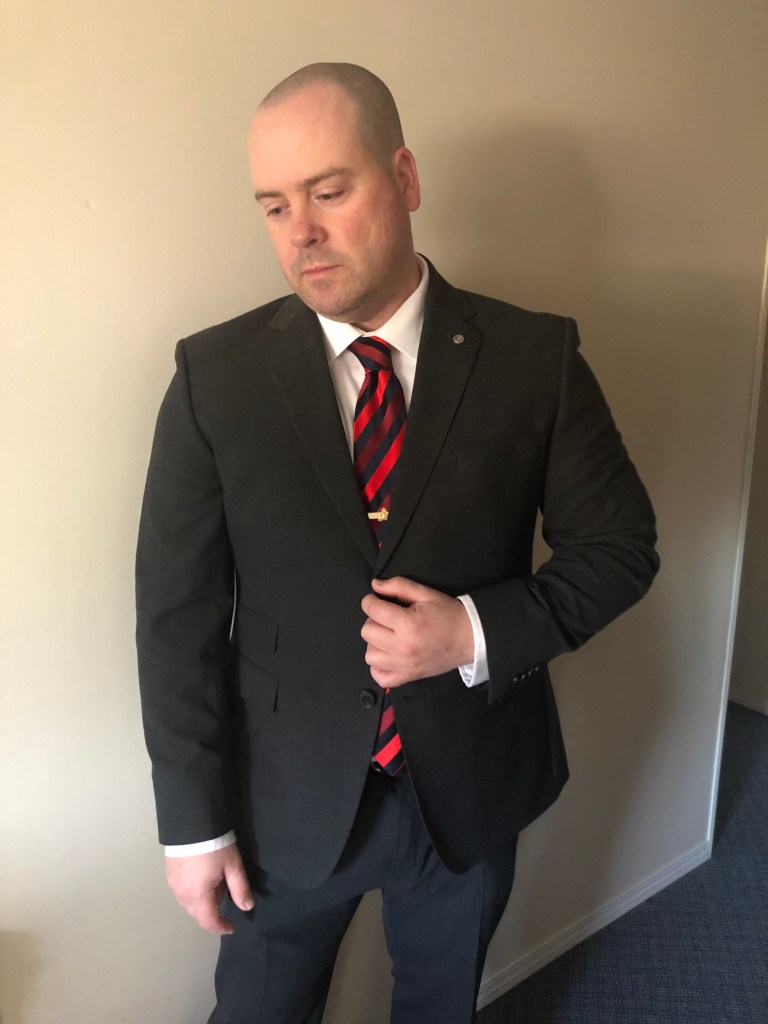
Yesterday, I started a new job in which I get to enjoy the pleasure of being dressed in a very different kind of uniform. Some may look at this photo and say, “That’s not a uniform…” And you’d be right, in the traditional sense. But how one dresses for a job is a representation of the quality of work one intends to DO on the job, and I feel it’s important to dress well for one’s position. Plus, I love suits. I F&*KIN’ LOVE SUITS!!!

There’s nothing complex or complicated about this morning’s post. No deep-rooted philosophical lesson or long-winded explanation about some function of the body, a martial arts technique or what Diabetic issue is currently throwing a monkey wrench into my life. Just a quick, simple post to share a happy moment with all of you. Yesterday was amazing, albeit a very different kind of exhausting than I’m used to. I have some excellent and professional people I work with, which made the first day all the more smooth. But it didn’t help that I missed my scheduled bus to get home, meaning I had to stand in a snowstorm for about twenty five minutes until the next one came along. Live and learn.

It’s a new routine for the entire family, with everyone making adjustments as working from home is solely my wife’s arena, now. But by the time I finally DID get home last night, it’s a fair assumption to say that we were both exhausted and we crashed very shortly after the kids did. That’s usually a sure sign of a day’s work well done. Now, as I step into my second day I have a clear idea of how my day will go and what to expect. Adjustments will be made, systems will adjust and a routine will develop. All will be well. Except for the snow. The snow needs to take a snow day. Pun fully intended. ☯

Oh, There’s An App For That…

I know that I’m usually the first to rag on people’s addiction to technology and their smart devices. That being said, I also acknowledge that my health wouldn’t be what it is today, if not for advancements in the technology that make things like my insulin pump and continuous glucose monitor possible. So, I’m also the first one to swallow my words when technology works in my favour. Maybe that sounds like a double standard, but what are you gonna do? It’s my blog! Moving on… Anyone who reads my blog on a regular basis is also aware that I’m a big fan of fitness, exercise and maintaining one’s health. And these are all things that can work great in tandem with said technology.

It seems not a week goes by without hearing someone say “Oh, there’s an app for that…” And that’s usually pretty accurate. From finance to planing and organizing, dieting to social media, smart devices have pretty much opened the spigot on the market for programmers to put out an app for just about everything under the sun. This includes health & fitness. Now, I’m usually one to endorse working out and maintaining one’s health ‘au natural,” if you will. This means that I have no issues working up a solid sweat by using a small square of floor space and using nothing but my own body weight in order to work up a solid sweat.

All this being said, I’ve also gotten into the routine of enjoying a number of different apps on my phone, which I use to track fitness and health habits in my daily life. Most of you know this already, as I use one particular app to prominently track my walking, running and cycling workouts. And since I’ve always used an iPhone, these apps will be ones that are available through iTunes and the App Store. I can’t speak to what equivalents may be available for Android users. But without further ado, here are my top five apps that I use to help improve my health & fitness habits:

  • LibreLink: Of course, I have to include something directly related to Diabetes, here. This is a free app that works in conjunction with the FreeStyle Libre, which as my Endocrinologist puts it is the “poor man’s CGM.” The FreeStyle Libre works by being injected into the tricep and held in place by an adhesive and can be read by specialized software. If you’re old school and don’t have access to a smart phone, you can purchase the Librelink Reader for roughly $50 (depending on the pharmacy you shop at) but you can definitely save the cost by using the app. Simply hold the phone up to the Freestyle Libre and it will read your sensor glucose, same as a CGM would. The app is fantastic as it allows you to input your age, weight and a bunch of other stats and will show you trends, graphs and even has an A1C calculator based on the readings held in its memory;
  • Noisli: If you have a whole bunch of brain-burning acronyms attached to your name like I do, sleep can be a fleeting thing. And even more fleeting when Diabetes issues keep you up as well. It can be difficult to find something to help you sleep that doesn’t involve medication or gets drunk. That’s where Noisli comes in. This is a free “white noise” app that allows you to use and customize a wide variety of sounds to help you drift off to la-la land. Sounds include rain, thunder, wind, rustling trees, leaves, trickling and dripping water (those ones would make me need a diaper overnight), crackling fire and even some more eclectic sounds like the background of a coffee shop and a train clacking on railroad tracks. The aspect I enjoy most is having access to white, pink and brown noise, which are all varieties of a static-like sound that are designed to help calm your mind and help you drift off. I actually did a full post on white noise, which you can read here. My favourite aspect of this app is that you can combine any combination of those sounds and even save them as specific profiles so that they’re available the next time you open the app, without having to combine them all together every time;
  • My Water Balance: If you guys aren’t tired of hearing me say how important it is to stay hydrated, you haven’t been paying attention! This app is a fun little program that allows you to set goals and track your daily intake of fluids. You can input your weight and hydration goals and the tracker will keep a tally of how much you’ve drank throughout the day. You can download the free version, which tracks the basics like water, coffee, tea and a few others. I’ve paid the small amount to download the full version, which has a batch of additional options and lets you track just about every type of beverage including, ahem… wine and beer! The app suggests how much you should be drinking based on your age and weight, but you can also set your own goal. The only downside is you have to manually enter the amount of fluids you drink, which can be problematic if you’re using a glass at home and don’t know how much it holds;
  • Seconds Pro: This app is actually called “Seconds,” but I forked over the added money to get the Pro version. This app features an interval timer that you can program yourself. in other words, you can develop your own circuit timers using your own, chosen exercises. Not only does it let you customize your workout, it also connects to your device’s music library, meaning you can link your favourite workout playlist and have it play in conjunction to the circuit you’re doing. Now, paying for the Pro version does have it’s share of increased features and functions, including different TYPES of circuits and certain tracking features. I purchased a Lightning to HDMI cable and I used to run this app directly to the large, flat screen available at one of my postings. It was incredibly handy to help keep my workouts on point. But the last benefit I’ll mention, is that the app’s voice over means you don’t require a screen. The app will tell you when a timer count is ending, what exercise you’re on and when the workout is done. Think Siri, but for fitness; and
  • Runkeeper App: This one was saved for last because it’s my overlord of fitness… I use it to track everything else. This app has features that allow you to enter your age, weight, height, fitness goals and what units of measurement you want to use for everything (metric or imperial, etc…) Then, you can use the GPS function to track your distance, speed, mileage and calories burned for trackable activities such as walking, running and cycling. It also allows you to manually log other activities, such as swimming, elliptical and even yoga and meditation (yes, meditating burns calories. Read about it here). The basic app is free and you can join fitness competitions, add “friends” through your contacts or Facebook (provided they’re also using the app). I use it to log ALL my activities including weight workouts and karate sessions. There’s a paid or “Pro” version you can sign up for, but it comes in pretty costly at $13.99/month, which may be cheaper than a public gym membership but more than a person is willing to pay on an app. I’ve been using the basic version since 2017, and it’s suited my purposes quite well. In fact, if you’ve read any of my posts on my cycling goals, the images that I feature are usually screenshots from this app.

There you have it, folks! My top five apps that I use for health and fitness. This is the part where I point out that I am in no way being compensated for speaking about these apps, nor do I endorse them specifically above any others that you may have tried/like. In fact, I’ve tried a score of others. Some have been as simple as a library of different exercises. Some have been so over-the-top complicated that I removed them from my device within the first week. The important thing is to find some helpful apps that work for you and your lifestyle.

I don’t endorse technology all that often, so mark this day on your calendars! Actually, besides the technology used for my pump and Diabetic supplies, I usually don’t endorse technology at all, haha. But since society as a whole is normally tethered to their smart devices, it only makes sense to use them to benefit our health & fitness. I find that all of these apps are somewhat subjective to the user. I think the five I’ve listed are fantastic and even if I’ve removed some of them on occasion, I always seem to come back to them. There’s plenty of good, free apps out there so don’t be afraid to install a few and try them. Worse that happens is you don’t like them and remove them. ☯

Time To KID Around, Part 2 (The Diabetes Aspect)

Have you ever tried to explain to a young child what Diabetes is? Not an easy task, especially when you take all the good, the bad and the ugly into consideration. My biggest fear when Nathan was born was the possibility that in a few short years, he would be diagnosed with Type-1 Diabetes himself and would have to deal with many of the same difficulties that I had. Since Type-1 Diabetes does involve an inherently genetic component, it’s a very real fear and one that I wasn’t looking forward to having him deal with.

Those fears were somewhat put to rest a year or two ago when we had him tested and found no issues with his immune system and insulin production. We were warned that there was still a few years of risk involved, but as it stood he was free and clear. Now, if we can be so lucky with his younger brother, Alex, I’ll be a happy camper. Dealing with the disease affected and altered my childhood in ways that I can’t help but make me wonder how life might have been different for me if I HADN’T been diagnosed. But I digress…

I don’t think I need to point out how many moving parts and components there are to the effective daily control of Type-1 Diabetes. It can be overwhelmingly irresistible for a young child to see all the equipment and electronics involved and they’ll no doubt want to touch, see and play with everything there. The important part is to be honest and not try to sugar-coat any of the details (see what I did there?).

In Nathan’s case, I’ve always been very honest and explained everything in plain language. One of the unexpected benefits to that level of honesty, is that he’s been exposed to seeing blood drawn since the day he was born. I consider this a benefit because he doesn’t have the same fear of blood that most other children do, be it mine or his own. He’ll acknowledge pain, of course. But if he’s bleeding, the blood in and of itself isn’t an issue for him.

I remember dating a girl who already had a son that was about Nathan’s age now. And if he’d scrape his knee and a bit of blood would show, he’d basically blow up and have a panic attack. Although one can understand that children view things differently than adults, even I have to admit that it was a bit much. That’s why I’m happy that Nathan has grown to be desensitized to certain things as a result of having a Diabetic father.

The biggest challenge I’ve face with Nathan, and now his brother Alex, is my insulin pump. When you have a baby sitting in your lap and he’s looking around and grabbing at everything in sight, an infusion set can be a temptation for those little hands. It took a bit of time as well as trial and error, for Nathan to understand bot to touch “Daddy’s Ouchy,” and to leave the pump alone.; something that I am now working at making Alex understand, as well.

The important thing, as I mentioned earlier, is to use plain language and explain things as they actually are. Nathan has seen photos of a pancreas, he knows it helps with the regulation of glucose in the blood through the release of insulin and he’s aware that my pancreas no longer produces insulin, which is why I need to have it artificially injected through the pump. He’s also made his peace with the fact that certain fast-acting sugared goods are for Daddy only, when my blood sugar drops. He’s not a fan of that last one, but he gets it.

Nathan has held all of my Diabetic equipment and supplies in some way, shape or form and has even had the opportunity to press buttons on my pump (with my guidance) in order to see what everything does. By doing this and ensuring his understanding, there’s less risk of him sneaking into my desk and messing around with my Diabetes equipment. But the nice thing is that although he doesn’t like them, Nathan has less fear of needles than the average kid, since he’s been around them and has watched me injecting myself since he was born. Educating is always better than forbidding. ☯

Because It Can’t All Be About The Meat…

In the past year, I’ve tried a wide assortment of meat alternatives and veggie based alternatives that I never would have considered, even just a few years ago. I still favour my Mushroom Swiss Burger from FatBurger and I can’t see myself ever swaying from it. But I would be lying if I said that vegetables aren’t loaded with a wide variety of health and nutritional benefits that make adding them to your meal a good idea. I usually favour a cruciferous option, like broccoli or brussel sprouts. But I seem to be the only one in the household who likes them. I know brussel sprouts are pretty universally hated, but sprinkle a bit of cheese on some broccoli? Fuggedaboutit…

As I have a firm belief in the balance of things, I like to point out how there’s inherently a good and a bad side to all things. We already know that vegetables can provide vitamins, minerals and nutrients that some other foods may not. And there’s certainly the benefit of feeling full for longer that comes with having plenty of green on your plate, steering one away from over eating and helping with the reduction of your total daily caloric intake. But what about veggie-based meat alternatives?

A balance can be important if you’re trying to control say, oh I don’t know… your carbohydrate intake so that you can maintain better blood sugars… From a fitness standpoint, vegetables are important for a variety of reasons besides what they provide your body for building and healing muscles tissue and there are also some vegetables that will help you to sleep and digest better. If you’re looking to replace some of the meat in your diet with an alternative, it would be helpful if you gained all these benefits in the process, right?

If we get to the meat and potatoes of it (see what i did there?), some of the meat alternatives mentioned in the opening paragraph may not be all they’re cracked up to be. And this is where the BAD side of things comes in. I’ve written about this before but as I’ve tried different things, I think it’s pretty important to recognize the potential pitfalls of trying to replace everything in your diet with a vegetarian alternative. Here’s a short list of things to bear in mind when purchase veggie-based meat alternatives at the supermarket:

  1. They’re Loaded With Preservatives: This is the first and probably the top one. Anything you eat that’s been mass-produced and sold at the supermarket will go through some sort of processing that will involve preservatives in some given way, shape or form. Without getting into the specifics surrounding potential pesticides used for crops, you can be certain that real vegetables and real cuts of meat won’t have all these preservatives, making them the better option. There are a number of negative effects to the over-consumption of preservatives, including some forms of cancer. No, I’m not trying to say that eating these meat-alternatives will give you cancer! Simply that excess preservatives have been long found to be bad for the body. Moving on…;
  2. They’re Also Packed With Salt: I’ve often written about the importance of checking the nutritional label when eating something packaged. People rarely consider the amount of sodium they may be eating when consuming something “healthy,” and portion sizes are often not proportionate with how much a person would actually eat. I learned this lesson the hard when, in an effort to reduce the amount of carbs I consume in a day, I was starting my morning with a mug of chicken broth. Sounds like a warm, reasonable way to start the day. But the portion size is usually about half a cup of vegetable broth, which accounts for roughly 25% of your daily sodium intake. Once I’ve guzzled down a full mug, I’ve already packed on well more than half of my daily intake of sodium and it’s first thing in the morning. And speaking of carbs…;
  3. They’re Full Of Carbs: I was pretty excited about six months ago when I found a package of buffalo “chicken” bites that were made with cauliflower. They tasted even better, which made me believe I had found a healthy alternative to eating platefuls of buffalo bites made of chicken, which happens to be my next food addiction after burgers. Then I realized that despite being made from vegetables, the bites had almost double the amount of carbohydrates than traditional chicken bites. It probably didn’t help that they were battered. Not so great for a Type-1 Diabetic who’s trying to control blood sugars and the amount of carbs he’s taking in!
  4. They Can Cost A LOT: Processing and packaging food that’s been prepared in any particular given way gets costly, and that cost is usually reflected in the item’s price point. It’s made all the worse when you have to make something look like something else. Have you seen the chicken nuggets made from vegetables? I swear, I wouldn’t be able to tell the difference, based on appearance. The point is, a small box of cauliflower buffalo bites will usually cost about as much as a traditional box of buffalo chicken bites, making them ridiculously costly.

So the big question is, are these veggie-based alternatives better for you? From an overall and Diabetic standpoint, the answer is a resounding NO. You’ll end up taking in as many carbohydrates, if not more than your traditional versions and you’ll pay more for it, to boot. Watching your sodium intake is quite important when you have Diabetes, as proper kidney health is always a concern at the best of times. The only way to balance the scales (except for the cost aspect) would be to eat significantly less of the alternatives, which could potentially leave you feeling hungry and unsatisfied.

On the flip side, if you’re okay with eating small amounts at a time and you’re looking for a veggie-based alternative snack, they can be okay. So long as you bolus correctly for them and take the sodium into account. The long and short of it (let’s be honest, I always go for the long…) is that you’re better off having yourself a plate of carrot or celery sticks with a touch of ranch dip, a hot bowl of broccoli with cheese sprinkled on top or even a bowl of boiled Brussel sprouts with a touch of melted butter and pepper. Any of those will be far healthier, satisfy you and make you feel full for longer, whether you have it as a snack or part of your meal, and you’ll get all the included benefits without any of the preservatives. ☯

Spatial Awareness

The world is a dangerous place, and it’s made all the more dangerous by people who ignore their surroundings and have no sense of spatial awareness. This can apply to a martial arts context as well as in everyday life. In the video below, I share my thoughts on that very thing. ☯

Letting Me Off My Leash, Free-Range Diabetic

I don’t think I need to explain that people take most common, everyday things for granted. I experience this a lot because despite the advancements I’ve lived through in the past 38 years, it’s difficult to move around without a SIGNIFICANT amount of supplies. The fact that I’m fed up of it likely makes it sound way worse than it is. But eventually, a guy gets tired of carrying around a man purse just so that he can run some errands throughout the morning without concern. The “for granted” aspect comes in because most people fail to recognize how lucky they are to be able to just step out of the house with abandon.

A week ago, I decided that I would sit through a specific bus route that I would be using for work. This was so that I could time out my entry into the city in the mornings without the concern of being late. Alexander was napping, Nathan was gone to school and my wife was hard at work in front of her own computer, so I felt it was a good opportunity to go out for an hour or two. I started to pack my usual shoulder sling of supplies, when a wave of impatience struck me and I decided to go in a different direction.

I tested my blood. Perfectly normal with no insulin “on board.” Good. I took some sinus medication so that I wouldn’t suffocate through the wearing of a mask in public for a couple of hours. Excellent. That shit’s supposed to last a few hours, anyway. I had my wallet and identification, and I grabbed a face mask and stepped out the door. I waited a matter of minutes at the bus stop and after a 22-minute bus ride, I was in the downtown core and stepping into the local shopping centre.

Not my mall, by the way. I didn’t want to be the creepy dude snapping photos in the mall.

I spent about an hour and a half downtown, walking around and browsing through some of the shops before grabbing the bus for the return journey. My blood sugars didn’t bottom out, I didn’t die and I didn’t find myself needing anything that I would usually pack and drag along. It felt really nice, being able to just step out of the house and go somewhere. It felt “non-diabetic.” I’d like to say it felt normal, but I’ve had Type-1 Diabetes for so damn long that being Diabetic feels normal to me.

I’ve managed to compress what I carry throughout the course of a day into one small, single-shouldered sling and it usually contains the following:

  • Fast-Acting Carbohydrates: I favour jellybeans as they seem to work fastest for me;
  • Nasal Spray: I’ve had some mild sinus issues since childhood and occasionally need a spritz. Wearing a face mask also makes it harder to breathe;
  • Blood Glucose Meter: Besides the fact that my insulin pump seems to be a temperamental bitch who screams at me every couple of hours despite smooth blood sugars, frequent blood sugar testing is still required to ensure the proper calibration of my CGM. Plus, should there be an issue with the CGM, I need to have the ability to properly ascertain my blood sugar levels; and
  • Extra Supplies: This is a broad one, but it can involve anything, including spare pump supplies, extra insulin or added lancets and strips. There can be a lot more, depending on the situation.

Most of the time, it’s just for when I go out. But realistically, when I travel to Saskatoon overnight, I often opt for something small and portable to carry. Considering I travel up, get the injections, sleep it off then drive right back down the following day, I make a point not to pack a huge suitcase. There are no nights out on the town, requiring extra clothing or special stuff. But when I make a point to stop and take notice, I really never leave the house without bringing a whole shwack of crap! This comes from years of situations where I’ve developed a “better to have it and not need it” mentality, as it relates to Diabetes.

It felt nice to be out for a few hours without dragging a bunch of stuff. I almost felt normal, walking among people. Note that I said “almost.” Besides, as I said earlier, I’ve had Diabetes for so long that it seems normal to ME. I can hear some friends thinking, “Shawn? Normal…?” Come on, guys! Give me a break! I’m about as normal as I’m ever going to get. But seriously, if you’ve ever had a friend text you to randomly go for coffee or you’ve decided to go sit through a movie on a whim, appreciate that freedom for what it is. There are so many things that a Type-1 Diabetic needs to consider before leaving the house that it almost makes it tedious to do so. Don’t take the little freedoms for granted. Sometimes, they’re the best ones. ☯