The Shoemaker’s Kids Go Barefoot…

The title is actually a very old phrase, apparently originating centuries ago. It demonstrates the unique irony that people will often neglect their own needs and desires while trying to help or take care of others. This line of thinking was not lost on me last night, as I sat quietly sipping a cup of tea while watching some short comedy clips on my phone in a local coffee shop. I was there for barely an hour. But the time there paid dividends in improving my mood, increasing my calm and allowing me to reset after what had been another shitty day in an otherwise overall shitty week. And this has been a shorter week, by virtue of Monday having been a statutory holiday. So just imagine, if I had the fifth work day to contend with? But I digress…

Modern adult life holds so many requirements, that most don’t necessarily realize the toll it takes on them. Often masking their pain and stress with vices such as alcohol, gambling, or any other combination of bad habits, people usually just try to get through their days as best they can. But if one were to stop and truly take stock of everything they need to do within a calendar month in order to hold their households together, the list would look pretty daunting and overwhelming. Taking care of one’s home, shopping for groceries and other household necessities, chores around the house, taking care of one’s children, prepping meals… The list can go on and on. I’ve become more fervently aware of all of these as I have been using a very useful little app in recent months called “Errands.” It’s a straightforward app that I installed on my iPad. It allows me to list and schedule all the errands and tasks I need to undertake, including by specific breakdown (home versus work, an outside errand, appointment, etc). Need to fuel up the car on my way home? Put it on the list. Traveling to Saskatoon for my eye injections? Put it on the list, as well as items to book my hotel room, pack my overnight bag and refill prescriptions.

While the app has been extremely handy in helping me to recognize what’s needed to be done around the house, its also helped me to recognize the daunting weight I carry when it comes to taking care of everything. Some of this has come full circle for me, with the recent decision to commit two nights a week to karate training within my home. Placing a repeating reminder in my Errands app, every Tuesday and Thursday sees me earmarked for karate training. Obviously, it would be easier if I were training outside the house. After all, it’s harder for the daily grind of life to catch you when you’re in an outside dojo. But training at home can be difficult. Last Thursday, I got home with full intentions of jumping into a gi and having an hour or two of solid karate training. Then, my oldest came downstairs to get my help with something. Okay, fair enough. While I was setting up, he came downstairs a second time. This time, his younger brother was hovering around the top of the steps; a habit he usually has, since he enjoys following his brother around. I dismissed him and explained I would be doing karate shortly and needed some alone time. Ten minutes later and before I had even started, he came downstairs to use the shower. His brother followed and was now underfoot. Karate didn’t happen.

This tends to be the recurring trend, with this past Tuesday seeing me working until late hours, resulting in fatigue that saw me crash once I was finally able to log off from work. The resulting effect is eventual burnout, and I’m headed there. So when I say that sitting quietly at a table in a coffee shop sipping on a cup of tea, Earl grey, hot (Picard reference), is a necessity, I don’t mean it lightly. I mean it literally. The hour I spend alone decompressing allows me to refocus my energies and provide for my family with less of a danger of burning out or losing my shit on them while I try to do so. Most people don’t recognize this need. And while I have trained for years to meditate and use it as a tool to promote my own inner-self and wellbeing, trying to meditate in a household with two young children carries the same risks as when I try to practice karate. While typical workouts like weight training or working out on the punching bag aren’t really affected if a little one comes pestering, being interrupted in the middle of a kata is damaging to one’s overall martial arts training.

That’s why it is most critically important to take time for oneself. And there are plenty of options. For me, and during the warmer summer months, I enjoy sitting in my open garage with a cigar and listening to music or watching comedy videos. Laughing is good for the soul. Maybe your downtime includes sitting quietly in a coffee shop reading an old school book, or taking a walk around the lake. It inherently doesn’t matter what you do, provided you do it outside the house so you aren’t interrupted and it’s something solely for you. When explaining this to your family, there’s nothing wrong with making it clear that for the next hour, you’re unavailable for anything that isn’t an emergency. That you love them but unless the house is on fire or someone is injured, you should be called or texted until you give the all-clear. So many relationships that end badly could have been salvaged or better held, had the people in those relationships acknowledged and respected this need. It isn’t selfish. It’s needed. Your feet also need shoes. Everybody’s does. Food for thought… ☯️

Why Carbs?

You know, having discovered carb counting back in 2014 when I was first introduced to insulin pump therapy, I realized that I had spent my entire youth misunderstanding the body’s relationship with sugar, carbohydrates and what they really mean for someone living with Diabetes. When I was a child and known to have “Juvenile Diabetes,” the basic rule was simple; take your shot and don’t eat any sugar. This led to significant errors on my parents’ part. Hungry? Have a slice of bread. There’s no sugar in bread. Thirsty, have a glass of milk. There’s no sugar in milk. It resulted in a number of years where my health was in decline, my blood sugars were rampantly out of control and had me live through a number of Diabetic comas. Not fun. But it was the early 1980’s and my parents, light bless them, did the best they could with the limited information we were given. Even when the health care system was “better,” there were still significant gaps that could have cost me my life early on. If not for the several times my brother woke and ran to my parents to wake them, I likely would have died before reaching my teens. Which is what they expected of me back then. But I digress…

Pump therapy introduced me to the concept of carb counting. So, let’s start with the basics, for those who may not be aware. Carbs, or carbohydrates, are macronutrients found in most food that your body breaks down to use as a primary source of fuel. For the most part, you NEED carbs, even though your favorite celebrity may tell you that you should go carb-free. Complex carbohydrates can include simple carbs, which are usually the ones that act fastest if you need to increase your blood sugars, or complex carbs, which need to be broken down by the body first, which is why they don’t make an ideal blood sugars treatment. This can includes breads and crackers and such. And this also includes fiber, which is included in the carb total on your food label but should be substrates from the carbs you calculate for, as they don’t affect blood sugars. The other main sources of fuel are protein and fat. If your body has no carbs available for fuel, it will begin burning stored fat for energy, which is why some folks believe in fasting and going carb free. All caught up? Good. Moving on.

Since learning to carb count, I’ve altered my mindset when it comes to food. For the most part, the trend in the western world is to add carbs to carbs, when eating a meal. Think about it. When was the last time you went out to your local restaurant for a meal? If it was a burger joint, you likely would have had a burger and fries. The carbohydrates in the burger are paired up with the carbohydrates in the fries, leading to a massive amount of unnecessary carbs within one meal. The second aspect is that since these are all complex carbs, bolusing for the correct amount of carbs will likely cause your blood sugars to drop significantly before your body has a chance to break those complex carbs down into usable energy. Then you end up piling fast-acting carbs on top to, you know, keep from dying… The result usually ends up being that your blood sugars will skyrocket. Even trendier and “full meal” restaurants seem to pile on the carbs. Have a side with your meal? Sure, why not? Potatoes, fries, rice… They’re all an unnecessary and unneeded carb added to the total count of your meal.

Most of this stemmed from the need for restaurants to portray the concept of getting bang for one’s buck, by ensuring full plates or meals. Since most sides are made from something lenticular and cheap, it’s a no-brained, from the business’ perspective. From the perspective of a Type-1 Diabetic who needs to calculate everything, it can be complicated and complicating. And no, that’s not a typo; I mean both. The inherent problem is that a portion of crabs that you yourself didn’t measure out can be extremely difficult to bolus for. A pile of mashed potatoes can quickly turn into bolusing too much or too little for what you’re getting, on top of being a complex carbs within that will take forever to break down. And unfortunately, while salads and veggies are options that would eliminate that problem, most vegetable, especially the high-fiber ones, are fillers that will make you feel fuller, faster. While this is not an inherently bad thing, it sucks when you pay a small fortune for a delicious meal where you might get to full from vegetables to enjoy the main. Plus, I’m one of those “I’m not paying for food that my food eats” people.

When eating out at any dining establishment, have a closer look at your meal and consider the pros and cons. Maybe a particular location has those seasoned, crispy fries that you really like and makes it definitely worth the added insulin. Or maybe, just maybe, you can just enjoy the burger, skip the fires and NOT deal with the added blood sugar issues or bolusing that ensues. Not least of which is the added fullness and bloating from overeating. You don’t have to be an Ozempic user to recognize how to keep your meals reasonable and portions smaller and more manageable. You just need to give a fuck about your health. Food for thought… ☯️

Give Yourself A Break…

Type-1 Diabetes is a beast of a condition to manage. I don’t think that should really be a secret to anyone who has it but to the undiagnosed general public, many seem to think that all it involves is taking the occasional insulin shot, testing your blood sugar and NOT eating sugar. In truth, managing Type-1 Diabetes is a life-long journey (although some would call it a battle) that requires constant monitoring and being on one’s guard. For myself, I was diagnosed at the tender age of 4 years old. Some would throw out a few token “aww’s” at that but realistically, I was too young to really know any different. It was likely easier for me than it would have been, had I gotten diagnosed into my teens the way some friends of mine have. I grew up learning how to manage Diabetes and never had the opportunity to develop “bad habits” that might have made control more difficult in my later years.

But for the folks who are not Diabetic and may not have a family member who is, there is a lot that goes on in the day-to-day steps to control my Diabetes and ensure I don’t lose my eyesight, have an organ fail or have limbs amputated due to poor control. And those are just some of the more knowable potential outcomes. The lesser known and visible side effects are things like ketoacidosis. I had a friend who hosted a guest in her home who was Type-1 Diabetic. He spent the weekend there and the following morning, she and her husband were curious at the fact that he was sleeping in so late. They knocked at the door and inquired when he would be getting up. She remembered him responding “Do I have to,” to which she indicated no and let him go back to sleep. An hour or two later, they were concerned enough that they decided they had to wake him. He had unfortunately locked the door and they had to break their way into the room. He had gone into a Diabetic coma and died. This is the darker side of the condition that people don’t recognize when they’re busy making jokes about “Diabeetus” and thinking it’s because just eat too much sugar or candy. But I digress…

Here are some of the things that I need to stay on constant guard about, when managing my Type-1 Diabetes on a day-to-day basis. This is the stuff that most people don’t realize and that aren’t visible to anyone who isn’t immediately in my household. This list is not exhaustive but is definitely part of my daily routine, which is likely why I’m always exhausted and need several cups of coffee. But here we go:

  • Extra and non-Diabetic Medications: This one is a particular sore point for me. Besides insulin injections, I have daily medications I need to take. In early 2010, a regularly scheduled doctor’s visit resulted in being prescribed statins, which are apparently a required staple of grown adults with Type-1 Diabetes to help control cholesterol levels, and Ramipril, which is used to control overall blood pressure and heart health. On top of that, although I came off of this one a few months ago, is a medication called Ezetemibe, which also used for cholesterol control. Although, since starting to use Ozempic in late 2023, I no longer need the Ezetemibe since my cholesterol is essentially a non-concern. Oh yeah, I take weekly Ozempic injections to help blood pressure and kidney health.
  • Frequent Blood Sugar Testing: I’m pretty lucky to be on a modern insulin pump. Prior to 2014, I was testing my blood sugars up to ten times a day on average. The problem with that is the inconvenience of having to blood let one of your fingertips when you’re feeling off, no matter where you are or what you’re doing. Flying blind and assuming your blood sugar levels can be dangerous and detrimental to your health. It’s even more inconvenient if you’re on a flight, in a restaurant or in a work meeting where you need to excuse yourself. Even worse was during the dating phase where you’d need to test your blood or worse, if things were heating up and getting physical and you had to ensure your blood sugars were okay to “proceed.” Thankfully, that part of my life is over.
  • Constantly Carrying a Man-Purse: What I’ve learned over time and especially in the past year or so, is that I can never take anything for granted. Stepping out of the house to run an errand while thinking “I’ll only be fifteen minutes,” can turn into a medical emergency pretty fuckin’ quick.! Just at the start of this summer, my blood sugars were normal and I had to run to a local mall to pick up one item. The mall is a literal five-minute drive away from the house. It should have been quick, easy and without concern. Once at the mall, my pump started loudly blaring at me. My blood had dropped to 3.4 mmol/L. What should have been a quick, ten or fifteen minute trip turned into forty minutes of sitting on a bench, sipping on a Coke and waiting for my blood sugars to rise enough for me to safely (and legally) drive home. These days, I always carry a small shoulder sling that contains a glucometre, a small first aid kit, wipes and hand sanitizer and at least one (although usually several) bags of non-perishable fast-acting carbs. Which brings me to my next point…
  • Keeping family Members from Being Concerned: They say it takes a village and in most circumstances, they would be right. One of my mother’s greatest concerns over the years would be that I would find myself alone as an adult and have to deal with the pitfalls of Diabetes alone. This can be inherently dangerous, since slipping into a serious Diabetic episode when I have no one to help can be deadly. But when I look at that scenario with the trip to the mall, one of the first things I did was text my wife. Not only to let her know I would be a while longer than expected but in the event I found myself in greater medical distress, I had to be prepared to have her assist me in some way, or at least know to go to the hospital to find me if something happened. It can be somewhat exhausting for family, especially considering it isn’t a condition they have themselves. That’s why it’s incredibly important NOT to get testy when they ask if you’ve tested your blood, or eaten enough, or remembered to take your pill. If you have family members that are invested enough to give a shit about your health, you need to soak that shit up and be grateful. Like I said, it takes a village.
  • Near Constant Adapting To Changing Conditions: Probably the toughest and most annoying aspect outside of taking insulin or testing your blood sugars, is having to adapt to plans depending on what your body is doing. Sure, everyone does this. Ever had to cancel plans with friends because you had the runs and couldn’t leave your house? Picture that, but on a daily basis. I’ve lost count of how many times I’ve had to cancel coffee or hangouts with friends because I was ill due to blood sugars or my compromised immune system had me dealing with yet another common illnesses that most people would shrug off. Don’t even get me started on wanting to get a workout in but my low blood sugar fucks my night. Or, speaking of fucking up one’s night, imagine wanting to get physical with your significant other, but your blood sugars are too high or too low to allow you to perform as required. Not fun.
  • Traveling Becomes a Burden: Honestly, this has become WORSE since starting on an insulin pump. Travel becomes tedious, especially if I should be leaving the province or country. I have to calculate and plan out my insulin intake, use of supplies and alternatives in the event I run out of something at my destination. Will I be able to find what I need? Will I be covered for it, outside of my home Province or while I suddenly find myself paying a significant amount of money out-of-pocket? If a given pharmacy in the area doesn’t carry what I need, can I do without or will I be sacrificing a portion of my trip traveling elsewhere to find what I need? Just two years ago, my continuous glucose monitor expired and the one I had packed for the week failed on installation. My local pharmacies not only had no idea what I was talking about when I tried to purchase more, but I had no means of ordering any. I had to run the pump without CGM for the remainder of my trip.

While some of these can be chalked up to basic inconvenience, some of them can lead to significant issues or even become life-threatening. You know how you always read about these folks who get harassed for parking in a handicap space but don’t “look” disabled? Picture that, with everything but not limited to, everything I listed above. Managing and living with Type-1 Diabetes requires a daily grind where you can never let your foot off the gas. And people often wonder why I’m always exhausted and binging caffeine like it’s going out of style. Don’t eat sugar? Sure. Take daily insulin shots? Absolutely. But trust me when I say that while it could always be worse, Type-1 Diabetes, at least when it’s properly controlled, is a far cry from an easy walk in the park. Food for thought… ☯️

Autumn Falls

Most people have a preferred or favorite season throughout the year. For most people, it tends to be the spring, when everything starts melting and the weather gets milder. Birds are chirping and greenery starts to poke its head through whatever remnants of winter snow may remain. For others, it’s usually the summer, since this generally means vacations, hot weather and outdoor activities and/or time at the pool or beach. You EVEN get the occasional person who favors winter, citing the beauty and clam that a slow, snowy night can bring. Personally, winter is the season I dislike the most, given that it means shoveling and snow removal, traveling to work in the cold and increased utility costs for keeping the house warm. No, for me, the best season and the one I enjoy the most is autumn, colloquially known as the fall season.

During fall, one can not only start to enjoy some of the milder weather, similar to what spring brings, but one begins to cool off after the hotter temperatures thrown about from the summer months. I get to spend time outdoors and perform yard work and chores without turning my shirt transparent from the sweat. It’s still nice enough out to enjoy workouts on my punching bag or sitting in my garage with a nice cigar. Wildlife still wanders my residential property but changes within their behavior and color start to emerge. The same can be said for the wonderful splendor of nature as a whole.

The Appalachian view of the bay from my home town in New Brunswick

For decades, I lived in Northern New Brunswick, surrounded by sea water, an open bay and the rounded moutain tops of the Appalachian range. During my youth, I was blinded by time; surrounded by beauty but never truly seeing it, because I grew up around it. It wasn’t until I moved away and started my career in Saskatchewan that my mindset changed. Now, returning home is much like taking a breath of fresh air. For those who have read previous posts, specifically recent ones about the pitfalls of my recent trip out East, I’m referring to the environment and its beauty; not the difficulties of going how again. But it isn’t until recent years while visiting my home area that I’ve come to realize just how much beauty was sitting in front of me all along, with my very clear eyes blind to seeing it. I guess that can often be the way of things when one is younger. You never quite appreciate what you’ve got until it’s gone, right?

Sugarloaf Mountain, an extinct volcano in my hometown

If you look at the photo included with this post, you’ll see one of the best parts of the fall season; the changing colors of the leaves. Stretch across a mountainy splendor, one can experience every variety of red, orange, yellow and brown, occasionally sprinkle with a touch of remaining green. This is either from the pine tress or from the few stubborn holdouts that don’t seem to lose their remaining chlorophyll, the pigment that gives most leaves their color. The overall tableau allows one to drink in the full splendor of nature’s awesome beauty and the impressive cycle and process it goes through every year. I can easily imagine, sitting on a rocker on a front porch, looking out at the open ocean and changing colors of the leaves, all while sipping on a hot cup of herbal tea. Not all time needs to be occupied. Sometimes the perfect day is allowing time to slow to a standstill so that nature can be heard. Although I will confess, this is often easier said than done.

So as the autumn settles in for its very short visit before the frigid temperatures of winter settles in, be sure to take some quiet time. Watch the transformation. Watch the evolution of the season and enjoy the cool, crisp mornings offset by the warmer, balmy afternoons. This is truly the best season that offers just a little something for everybody, regardless of their preference. And if you’re unfortunate enough to miss it, take comfort in the knowledge that it’ll all come around again in a year. But for now, take advantage if you can. A peaceful moment can heal many wounds. Jus’ sayin’… ☯️

Not All That Glitters…

Ah, Shakespeare… I never read much of his stuff through school the way many others might have. Apparently, French schools in Northern New Brunswick took issue with using English literature as a base for learning. No idea if it’s still the same today, but back when I was a student, they died on the hill that they would only refer to French-origin authors. But I digress… Despite the title, today’s topic isn’t about Shakespeare. It’s about Diabetes. Specifically, the benefits and pitfalls of an insulin pump and some of the unseen difficulties that people may not be aware of, when they see someone rockin’ an insulin pump on my hip. I recently had a couple of teenagers walk past me in a retail store and they actually asked me if I was wearing a pager? First, I was surprised they knew what a pager was. Now, I’m just disappointed that they asked, considering the tubing that juts out from the top. But anyway, moving on…

I’ve been on pump therapy for a little over ten years now, and am enjoying my third insulin pump from the same supplier. Each more advanced than the previous, my first pump was a glorified syringe; providing a basal rate throughout the day and not delivering insulin unless I manually inputted carbs for as bolus. I still had to finger prick several times a day and maintain direct, hands-on control of all aspects of my Diabetes (which one likely should anyway). When the concept of continuous glucose monitoring was brought up, I was recommended the Freestyle Libre. Referred to as “the poor man’s CGM,” it wouldn’t tether or communicate with any pump, but a simple phone app would allow you to get your interstitial fluid reading at any time. The down fall to this is that it didn’t maintain levels for you or adjust your pump, so total manual intervention was still required. But it was still a step forward from constant finger pricks.

My second pump came with a tethered CGM, which now allowed me to have communication between the pump and the CGM for direct adjustments and insulin blouses, based on what my blood sugars were at, at the time of my meal. It was a significant step forward and prevented constant finger pricks every time I ate something. Which was nice. The third pump, which is the one I’m on now, not only has a tethered CGM but uses a platform called SmartGuard, which communicates and makes micro adjustments to my blood sugars every five minutes, depending on my blood sugar levels, insulin sensitivity at certain times of day, and different carb ratios for different meals and times of the day. These adjustments, performed by the pump itself without my intervention, have significantly improved my time in range, providing better overall blood sugar control, less extremes high’s and low’s and a happier, less grumpy me (although only marginally less grumpy).

So, here comes the dark side of pumps… I’ve always written that life rarely cares about one’s plans. The only stronger advocate for this effect is Type-1 Diabetes. At the end of the day, you can do everything inherently right and still have issues. Such examples happen frequently for me, despite how closely I watch my levels and take care of myself. After all, just about ANYTHING can affect blood sugars, including things like mood, temperature and climate and just about anything else you can possibly think of. And no matter how nice a trinket the insulin pump may be, or how diligently you work towards controlling your condition, something will always come along to throw a monkey wrench into the mix.

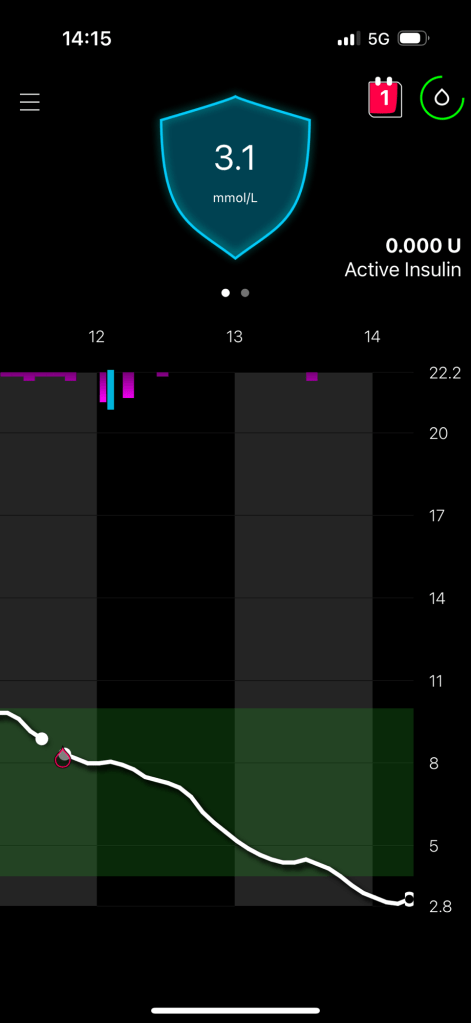
If you look at the image above, it shows a steady decline in blood sugars levels. This is from the app on my phone that monitors my pump functions, so that I don’t have to constantly remove the pump from my belt to look at it. This decline in blood sugars carried on for a couple of hours. If you look closely, you’ll note that the pump initially trie dot adjust by cutting off my basal flow shortly after the noon hour to compensate for the downward trend. Although sitting around 8.0 mmol/L isn’t a terrible level, the downward trend is what can be a concern. Once I dipped below 4.0 mmol/L, I slipped below proper range. I’ll point out that during this time period, I was at a science Centre with my family. I wasn’t engaged in stressful activity, I wasn’t exerting myself and I spent most of the visit sitting. It starts to take an upward trend shortly after the 2 o’clock hour. This is after spending over forty minutes eating an entire bag of Skittles (the large, 170g bag; not the individual 61g sachet).

It took another half hour or so for me to start to feel normal and to be able to function within what I needed to walk around, interact with my kids and get us home. It’s a not-so-frequent occurrence but it does happen; even with something as technologically amazing as the insulin pump. But low’s aren’t the only issue. Lingering high’s can also cause significant issues. High blood sugars can lead to nasty secondary issues like ketoacidosis, where your blood slowly turns acidic. Not fun. But the overall shitty feeling you have while dealing with either extreme high’s or low’s more than just suck; they can potentially endanger your life. The previous day to the scenario above, I had a blood sugar level in the mid-teens, which lingered for a significant portion of the day.

If you look at the image above, the tiny red slice accounts for the period below range I suffered while out with my family. The huge yellow portion is the approximate fourteen-and-a-half hours that my blood sugars were high. This led to a night with barely any sleep, frequent urination, constant adjustment bonuses to compensate, both manual and pump-programmed, and wondering at what point I should start to consider phoning an ambulance. Nice, eh? The icing on the cake is I ate nothing heavily sugared, drank plenty of water and fluids and didn’t do anything that should have elicited this spike. But for some reason, it happened, it lasted and it lingered. I had to deal with it during the period of the day that a reasonable person should be sleeping and getting the required rest for the day that would follow. It sucks, but such is the life of a Type-1 Diabetic. It sometimes has no rhyme or reason and just fucks with your day without warning.

This is all the more reason to be properly prepared at all times. In that extreme low scenario when I was out with my family, if I hadn’t packed my shoulder sling with some fast-acting carbs and other Diabetic necessities, I might have found myself in a difficult situation. And this is the where the “not all that glitters is gold,” comment comes in. The insulin pump is an amazing tool for Diabetes therapy. But that’s all it is; a tool. A technologically-advanced tool that makes my life ten times easier than it was two decades ago, mind you. But a tool nonetheless. And as handy and pretty as it is, it still falls to the person behind the pump to ensure proper blood sugars levels are controlled and health is maintained. Diabetes has come a long way, since I was diagnosed all the way back in 1982. I can say with sincere honesty that I can’t wait to see what the next decade will bring. After all, there’s nowhere to go but up. Stay healthy. ☯️

When Customer Service Still Exists… (Above & Beyond)

We live in a world of entitlement and immediate gratification. Most people these days are of the opinion that they owed everything, are entitled to everything and assume they’re always right. I see a lot of that. Cue a British retail mogul named Selfridge, who coined the phrase “the customer is always right…” In the early 20th Century, Selfridge coined this slogan, but the part that modern people seem to forget, is that the slogan actually reads, “the customer is always right in matters of taste.” This slogan was meant to emphasize that customers should always have their preferences catered to, rather than lose the sale. Somehow, over the decades that followed, it got shortened to “the customer is always right,” and customers the world over have used this as a weapon to assume businesses should bend over backwards to provide things the customer either hasn’t paid for, or isn’t entitled to. The flip side to that coin, is the degradation of customer service in modern retail. More and more, it seems that getting decent service and correct orders in almost any industry is a dead art; businesses preferring to assume customers should just take their chances and suck it up if it’s wrong, rather than actually try to do it right.

It’s a bit of a cynical view, I admit. But it comes from a place of experience and knowledge. I’ve worked in retail industries often over the past three decades, despite my policing career, and I’ve seen the damage from both sides. This is why, when good service is provided, especially good service that goes above and beyond, I believe that is should not only be recognized but thoroughly congratulated. So, here’s the background. I was diagnosed as Type-1 Diabetic when I was four years old. As of two days go, that means that I’ve been Type-1 for 43 years. I’ve been around the block, as far as dealing with every possible situation Diabetes can throw at me, including ketoacidosis, comas, frequent dehydration, eye issues (hence my eye injections) and kidney issues. I’m among the lucky ones, as I’ve worked and fought hard to maintain myself and my health, preventing some of the more serious complications of Type-1, such as organ failure and, well… death. So believe me when I say that I try and do everything right and control my condition with an almost surgeon-like precision.

Whenever I travel, whenever I leave the house, really, I always make a point of bringing along certain necessities with me. This usually includes nasal spray, hand sanitizer, a portable first aid kit, a glucometer, and last but not least, fast-acting carbohydrates, like Skittles or Swedish Berries. This is done almost without exception since, even on a short car ride, my blood can suddenly drop for little to no reason and I can find myself stuck in traffic with no means of treating a low. It’s almost reflexive at this point, having done so for most of my adult life. Which is why the situation that happened last Thursday night came as a bit of a shock… I travelled to Saskatoon for my scheduled eye injections. I do these at 13-week intervals now, which is a marked improvement from the 4-week intervals I started at. Once again, a testament to how the body can heal itself from many conditions if you take care of yourself and give it the tools it needs. I travelled to the city Thursday morning and checked into my hotel room without issue. I walked over to the hospital about mid-afternoon and got checked into for my procedure. Getting through the process can take a couple of hours but the procedure itself is only about ten minutes. Modern medicine, go figure.

That evening, I enjoyed a solitary meal at the Irish pub located on the ground floor of my hotel. Everything went fine and I made my way back up to my room to binge-watch some Netflix and go to sleep. I awoke a couple of hours later to my insulin pump blaring an alarm at me. It appeared that I was suffering a low. Not just a low, but I got the dreaded “Below 2.8mmol/L” message, which meant that my low blood sugar was basically at a life-threatening level. The only thing I can figure is that I had over-bolused for my meal and the additional insulin hadn’t caught up to me until then. Yet another reason why it’s never a good idea to eat so close to bedtime. Accustomed to treating late-night lows, I staggered over to my backpack and rummaged through, trying to wrap my fingers around the live-saving gummies or Skittles I expected to find. Only, I found nothing… The candies I usually so meticulously packed in every bag whenever I left the house were nowhere to be found. Panic began to set in. I considered downing the little sugar packet included with my coffee station but quickly dismissed the idea, since it would have very little effect and I would still be in trouble. With little other choice and quickly losing sense of my faculties, I did the only thing I COULD do; I grabbed my room key and debit card and stumbled out of my room to seek help.

I made my way to the ground floor and remembered the bank of vending machines to my left. I walked over and struggled to see clearly, both from the blood sugar and from my recent eye injections, to figure out if one of the machines took debit. I felt the minutes melting away, so I walked up to the counter and asked the front clerk for help. I managed to mumble out that I was Type-1 Diabetic and was having a low episode and needed his help. Although I have been staying at this hotel for over ten years, I didn’t recognize this man, which likely makes sense as I’m usually sleeping during the over night. This man guided me over to the lobby couch, sat me down and hustled into the restaurant’s kitchen and got me a cup of straight Coke. He handed it to me and watched me as I drank it readily. He got me a refill once I had finished the first cup and carried on from the reception desk, while keeping a clear eye on me. After about ten minutes, my blood sugars started to climb back to a level where I could at least start to see properly and feel a sense of coherence again. He asked me how I was feeling, to which I replied that I was coming around. The clarity of my voice must have encouraged him, compared to what I had initially mumbled.

I slowly walked over to the vending machines and I was able to find one machine that took debit, so I got myself a bottle of Coke to bring back to the room, in the event I dropped again or if I needed a little bit extra. I was sure to thank this gentleman before getting on the elevator. My blood rose to over 4.0 mmol/L before I finally fell back asleep, which isn’t phenomenal but was a clear sign it was climbing and my pump would wake me if it dropped again. I woke up the next morning feeling as though I had been hit by a freight train. I felt like an absolute inexperienced idiot. Not only did I have one of the worst lows in recent memory, I ad to do it while I was away from home and on the one occasion where I somehow forgot to pack some carbs for the trip. I know how the latter happened but I won’t bore you with the reasoning. The bottom line is that when it comes to my health, there is no valid excuse. If anything, I should have checked my back when I arrived and unpacked. At least then, I would have had the opportunity to buy something for the room ahead of time and I could have avoided the whole thing.

As I started sipping my morning caffeine, the reality of the situation started to sink in. The severity of the low and the situation I was in, alone in a hotel room, no sugary products to consume and slowly losing cognitive capacity, this could have gone from bad to extremely worse in very short order, had I not made my way downstairs and if my mystery clerk hadn’t assisted me. Although he may not have been fully aware of just how serious a state I was in, and he may not recognize that he may have potentially saved my life (or at the very least, saved me from an ambulance ride), he rose to the occasion and helped me without hesitation. He could have done what many would have done, and what I’ve been subjected to in the past, where security could have been called, accused me of being intoxicated, etc. After all, incoherent, stumbling man on shorts and bare-footed, mumbling something about an episode; many would have acted differently. But not this man. This man stepped up and gave me the help I needed to allow me to help myself. For me, that’s customer service that goes above and beyond what one would usually hope to find.

When I checked out of my room that morning, I asked the front desk clerk who the gentleman working overnight was called. As I asked, I reached over to the bank of business cards on the desk and grabbed one for the General Manager. I think the clerk took this as a bad sign and asked me if something had happened. I said that yeah, something had happened. This man possibly saved my damn life and I wanted his name so her could be recognized. She told me her name was Greg, and was happy to hear that he was able to help. I’ll be sending a note to their General Manager recognizing this man and what he did for me last Thursday. He showed the kind of attention and assistance that everyone in the service industry should be able to provide for their guests/customers. And I should dare say that customer service like that doesn’t belong on the night shift. Hat’s off to you, Greg! You’re an example to others. Keep up the good work!

For myself, this was a sobering reminder that my condition follows me wherever I go. It doesn’t take days off, doesn’t stay behind when I travel and won’t give me an inch for the mile. By virtue of that, it’s all the more reason for me to be vigilant in preparing for any outing, trip or travel. After all, I can’t always assume that in the event of an emergency, Greg will be there to save the day. Sugary food for thought… ☯️

I Have Superpowers…

No, I’m not faster than a speeding bullet. I can’t leap tall buildings in a single bound and I’m not mightier than a locomotive. I’m not referring to the imaginary superpower, although that would be really fuckin’ cool. I always thought the power of flight would be the best power, since I could eat to work every morning without paying for gas or sitting on public transit. But I digress… No, the super power I’m referring to, is one that we all have and we can all take advantage of. The big problem is that in general, without limiting ourselves by certain exceptions, no one tends to recognize or take advantage of those super powers. I’m talking about your body’s own inherent abilities.

The human body is a genuinely amazing thing. For the most part, the human body is able to heal and/or regenerate almost all the tissues within itself, with the obvious exception of teeth. Bear in mind, there’s a huge difference between “healing” and “regenerating.” For example, the liver is one of the only organs that can positively regrow, even if a significant portion of it has been removed. Bones will also knit themselves back together, often stronger than their previous state, when broken. The majority of the tissues in one’s body will heal themselves back together their original state, or what’s known as “cell replacement.” Depending on how they heal, this can be pretty extreme. For example, I’ve read that the lining of our stomachs and intestines are almost constantly replaced by fresh cells; a necessary system of the body to counteract the corrosive nature of our digestive acids, or the uterine lining in a woman’s body, which regenerates completely from one month to another.

This plays a major role in how we live. For the most part, the healthier we live, the better the chances we have of proper healing and recovery. For example, despite being one of the organs that can regenerate, the liver will fail and die off if one consumes and abuses of alcohol. Certain nutrient or mineral deficiencies will prevent bones from knitting and can even make them brittle. It’s important to note that nutritional, lifestyle habits and even how we sleep can affect our body’s overall ability to heal and regenerate itself. Age also plays an important factor, of course, with one’s body’s ability to heal properly decreases with time and age. But in terms of lifestyle and fitness, I can provide a first-hand example…

In November of 2023, I received a Type-1 Diabetic’s worst news from my endocrinologist. My blood work showed that my kidneys were struggling and I was in the early stages of kidney failure. That would be scary for anybody but having lived for 43 years with a condition that I knew would eventually knock one of my organs out of play (besides the pancreas, of course). It’s a reality I was always aware of but never really paid any mind, since I tend to work out pretty well and monitor my blood sugars pretty closely. I remember walking out of my doctor’s office that day with a fairly strong sense that I had been handed a death sentence. Recognizing that I had a family and very much left to do with my life, I did what I always do when death foolishly knocks at my door; I fought back. I started by asking what could be done to heal the issue. This is an important aspect to proper health. People these days are obsessed with “treating” symptoms but never really look at the overlying cause that’s brought them to their current state.

My doctor suggested that losing a bit of weight would help. My initial thought was “fuck you, too.” Although always on the husky side, I’ve never been obese or even what one would call fat. Although I snack and eat like the best of the ‘em, I’ve never been a horrific eater and always monitor my carb intake carefully. This is where he introduced me to Ozempic and suggested I start taking it. I was pretty leery of it, due to the negative spin the media had put out. But I reluctantly started on it. In tandem with the drug, I also drastically altered my diet. No, I didn’t jump on to some stupid fad or gimmicky diet and I didn’t download an app. I simply took common sense steps that doctors and nutritionists have been barking for decades. I started avoiding battered foods in favor of fresh, lean proteins. I got in the habit of pan-searing fresh fish instead of getting battered, frozen fish. Steak and chicken were prepared fresh, as well. Healthy grains in small doses, fruits and even soup, which I’ve always considered a nemesis of mine. I had soup forced on me a lot during my childhood and as an adult, I always stood that a liquid couldn’t be a meal. I’ve allowed myself to provide me wrong.

Sleep habits were altered. I go to bed effectively the same time every night, with the only exceptions being if I’m traveling and it can’t be helped. I started taking steps to ensure proper, uninterrupted sleep, which has been challenging in and of itself, due to PTSD. But once I got to a certain point, I can now get at least six to seven hours of sleep WITHOUT any of the initial aids I was taking to get that sleep. Most mornings, I wake up prior to my alarm. Working out has been a consistent challenge in recent years. Fatigue and lack of motivation can be some of the biggest obstacles to proper health. I changed up my routine where, instead of trying to work out for a couple of hours, several times a week, I work out for thirty minutes, every day. There are days where I miss, of course. But losing one 30-minute workout is much easier to recover from, than going a full week without working out at all.

In conjunction with the Ozempic, this led to about 30 pounds of weight loss, which is almost double what most semaglutide users can expect. Instead of sitting back and letting the medication treat something, I jumped on and helped it do its job. Given this weight loss, a few magical things started to happen. My blood sugars became increasingly easy to control. My blood pressure dropped and stayed down, meaning I had less headaches. My sleep quality increased significantly but last and not least was the biggest aspect of all; my kidneys had recovered and I was no longer in early stages of failure. The sense of relief and satisfaction at having taken my health in had the way I did was phenomenal. Now, I’m not suggesting that someone who IS in kidney failure can recover their organs. I’m not friggin’ Wolverine, after all. I was lucky enough to have caught this at a stage where the damage could be reversed.

The lesson here is that most people have vices that are unhealthy and do damage that isn’t seen in the here and now. It isn’t until a red light pops up that we decide to stop and take a good, hard look at our habits. Some people never get the opportunity. But making some of these small changes to one’s habits can be life-prolonging, if not life-saving. So, we all have a super power. We have the ability within ourselves to heal our bodies and maintain our health. We simply need to embrace that power and work towards making life healthier and easier for ourselves. Food for thought. ☯️

When Should One Start Teaching?

This is actually a topic I found recently on a social media page for karate, where the subject of teaching others and at what level of black belt can one begin to teach. Recognizing that every style has its own methods and differences, I don’t necessarily want to generalize too badly but I will share the high level version of what my school has always done and what Sensei always encouraged. For the most part, my Sensei’s Sensei used to say that martial arts is like climbing a ladder; over time, you make your way up several rungs to get higher. Once you do, you’ll take notice of someone who is a number of rungs below you. The idea is that you should reach down and help that student climb the next rungs to reach the same level as you’re on, if not exceed it. Then, as that student progresses to the higher rungs, they would be doing the same for you. It’s a bit of a romanticized notion and it certainly requires each practitioner to be a bit selfless and willing to help others as opposed to focusing solely on themselves.

But the specific question posed in the social media post I saw, was how many degrees to one’s black belt were required to teach. This is a bit of a loaded question, since originally, belt systems weren’t used in traditional Okinawa karate. The ones with knowledge basically just, well… taught. So the concept of requiring a black belt in order to teach others is a somewhat westernized detail that doesn’t necessarily track. One aspect I WOULD agree with, is the requirement to get one’s Sensei’s approval or consent before starting to teach someone else what you’ve learned. Your Sensei is the one best suited to determine what level you’re at, and whether you’ve become proficient enough in certain areas to effectively pass on the material. After all, if you perform a technique poorly and you teach it to someone else, they’ll learn it poorly and practice it poorly. This does your style a disservice and will lead to the dilution and watering down of your style, whatever that may be. But at what point can one genuinely begin to teach others?

This question takes me all the way back to good ol’ 1989. Yes, you read that right; 1989. 36 fucking years ago. Man, I’m getting old… Anyhoo, I remember struggling through much of my first week in karate. Such is always the way with new students. You don’t know shit, haven’t learned anything yet and are basically just following along, trying to mirror what you see everyone else doing. Usually while doing it poorly or improperly. After the first week, Sensei grabbed me before class and told me I needed to learn some of the basics one-on-one. I had foolishly assumed at the time that I would be receiving this instruction from Sensei. But given that there are several students and only one Sensei, I quickly learned that he would often lean on other students to provide initial coaching and guidance. I still remember the young girl who taught me the opening of my first kata… She was a few years younger than I was. One of three sisters, all of whom were in karate, her name was Teri-Lynn.

Patient, helpful and willing to put me through my paces, it’s interesting to wonder where I would be or what direction my martial arts training may have taken, if not for those initial interactions where I was properly guided by someone who knew the material and could easily and readily pass it on. It played an integral part in how I viewed the dojo, its students and the teaching of Uechi Ryu. Unlike some other schools I visited and tried, where I was basically left endlessly to my own devices to learn and glom on to what I could. This makes it extremely difficult to learn properly and can lead to frustration, discouragement and ultimately, quitting the school. But my point is that Terri-Lynn was a yellow belt when she taught me all the basic knowledge I required to start my karate journey.

So, the takeaway lesson here, is that rank is irrelevant when it comes to teaching the art. Whether your belt is white, black or any of the colors in between, teaching what you know is man important part to learning within karate. And not just for the one you’re imparting the knowledge on; it’s important for you, as the teacher, as well. One cannot effectively learn without teaching. And one cannot effectively teach without learning. This is the important balance that one must acknowledge when seeking to learn and/or teach within traditional martial arts. Karate is meant to be taught. And while one cannot effectively teach train by oneself, karate is not a solitary art. I’m reminded of a line from Star Wars, of all things. In Episode I, where they’re at a Jedi funeral and discussing the return of the Sith, Yoda says, “Always two, there are. No more, no less…” There’s a whole bunch of reference behind this but the same can be said of karate. One who knows, and one who learns. Those roles will shift and go back and forth through the years. Learning and teaching go hand in hand. That’s why, if trying out a new dojo and you feel abandoned and left to your own devices, it may not be the style for you. Food for thought… ☯️

The Minimalist’s Travels…

A couple of weeks ago, I travelled to the East Coast to go deal with some family matters for my folks. It was a tumultuous week of emotional ups and downs, for a variety of reasons but you can read all about that in a series of posts entitled “Here We Go Again.” Since I was traveling by myself for the week, I made my way back to my home Province with nothing but a military-style rucksack on my back and survived for seven days. After the series of posts, I had some folks reach out and ask me exactly how I managed to survive a full week with nothing but minimal clothing and a small backpack. Well, I can confirm that it’s equal parts efficient packing and planning once I was on the ground. And with this, hopefully short, post, I’m going to walk you through it. Let’s see what I can manage…

First and foremost, I travelled with 5.11’s Rush 24, a 37L military-style rucksack. Black in color and boasting several compartments and pockets, I typically use it for my day-to-day transit to and from work, to carry my laptop, iPad and personal effects during the week. In this instance, I chose to use it to travel. For anyone interested, you can find it on Cabella’s website here. While a bit costly, it’s made of durable material that can not only hold everything I need but also withstands travel and being tossed around. Hence the military-style aspect. Sitting about 20 inches high and roughly 8 to 10 inches deep. It allowed me to pack the following… (Bear in mind that this was for seven days and six nights’ of travel)

  • Three pairs of underwear and socks;
  • Three dri-fit shirts;
  • A hoodie
  • Three sets of pump supplies (reservoirs, infusion sets and sensors);
  • Minimal toiletries (toothbrush, nasal spray and fast-acting carbs);
  • My personal cell phone and work phone;
  • My iPad;
  • My noise-cancelling headphones; and
  • All required cords for devices.

That’s it! That’s all I travelled with, for an entire week. I forgot to include a bottle of insulin in that list but that goes without saying. I also wore a thin, Under Armour jacket over my shirt, since it was only 15 degrees when I left Saskatchewan. At first glance, most people would assume that this is crazy or that I’m making it up. After all, I’m sure there are several items that you’ve noticed are missing from this list, that the average person would definitely require in order to be away from home for several days. But bear with me, young padawan… I’m going to teach you the ways of minimalist travel…

On the morning of my departure, I took a hot shower, shaved and brushed my teeth. Nothing out of the ordinary that the average person should be doing on a daily basis, anyway. But since I was freshly clothed, deodorant applied and fully packed, I had very little in terms of hygiene to worry about. At least until I arrived at my destination. I grabbed my rucksack and got dropped off at the airport by my family, about to depart and be without them for the week. With only the rucksack to bring along, I didn’t need to check any baggage and I didn’t have to contend with the current trend where too many carry on’s are brought on planes, prompting flight crews to force me to check my bags. I could stuff the rucksack under my seat and still access my tablet and headphones as I saw fit. It also meant that I didn’t have to wait for baggage at the carousel, saving me lots of time at the arrival end of things.

Once at my hotel, I could slip quietly into bed and sleep off my travel, ready to deal with the issues of the coming week. Now, you may be thinking, “He brought a tooth brush but no toothpaste.” You’re right. What one needs to realize is that traveling to New Brunswick can be a significantly costly endeavor, especially with a family to support. Saving money wherever possible is key. Since this wasn’t a vacation, per se, and far from a pleasure trip, I had to ensure I was thrifty in what I spent on. First and foremost, one should always take advantage of the free amenities that most hotels will offer. If you attend the front counter and advise them of something you’ve forgotten or need, they’ll often have sample or travel size options that you can get as a courtesy. This includes toothpaste. On my first morning in New Brunswick, I got a travel tube of toothpaste from the front counter. Pair that with a hot shower using the soap and shampoo available in the room, and I was off to the races.

My first stop to ensure a smooth, and worry-free week, was the travel section of my local, big box retail store. Travel options will usually run you very little money and can actually last far longer than one would be inclined to think. Once in the travel section, I grabbed an antiperspirant, hair gel, supplementary toothpaste, a disposable razor and shaving foam, as well as a travel shampoo and a single bar of old school Dove soap (since hotel soap is almost non-existent). Then, I was off to a pharmacy location, where I was able to find a single-use box of Tide laundry detergent, to use with in the hotel’s guest laundromat. Based solely on those purchases, which barely ran me over $20, I was set from the toiletries and hygiene standpoint. Check!

Next, comes food… There’s no denying that meal consumption can be one of the most costly expenses when traveling. Ever try to get a basic eggs, bacon, toast breakfast at an airport? I did… The cheapest I found was about $35. Fuck you, airport! For that amount, I can buy a dozen eggs, a pound of bacon and a loaf of bread for several meals and still not reach $35! But even eating out at restaurants and fast food for the week can start to drain the ol’ bank account pretty damned quick. Especially since even fast food value menus are now almost as costly as full, sit-down meals at a full restaurant, finding way sot trim costs can be difficult. Since I’m by myself and have no one else to please or squalling kids with fussy tastes to contend with, I could live on the bare minimum for the week without concern.

First, we start with breakfast. I’m a bit old school with respect to the fact that when I think vacation breakfast, I want hot options that include meat. Maybe that’s just me as a dude, but I was some eggs. I want some bacon or some sausage. And since those items are carb-free, it has the potential to make breakfast my most filling meal of the day. My hotel, however, does not have these meat options. In the past, I would have turned my nose up and grabbed a sausage McMuffin instead. This time around, saving money was key and I swallowed (pun intended) my pride. My breakfasts for the week consisted of muffins, yogurt and the occasional hard-boiled eggs, since they did have those on occasion. For lunches, I found a six-pack of high-protein, high-calories meal replacement shakes at the pharmacy. Tossed those in the mini fridge and downed one at midday as my lunch. Then, schedule pending, I would allow myself some sort of proper, sit-down meals somewhere for supper. So, six breakfasts and six lunches ran me about $13, since breakfasts were free and the money was only for the meal replacement shakes. Not too shabby, since one meal at a restaurant would have no doubt cost more than that.

After a few days, I did a load of laundry at the hotel and refreshed the limited clothing I brought with me. I did so again on the Thursday before traveling back to Moncton for my early flight the next morning. All of these little steps allowed me to travel light, travel efficiently and save hundreds in what would have otherwise been a much more expensive trip. I didn’t suffer or want for anything while I did all of this, but I was able to keep my wallet from cracking down the middle. Bear in mind, nine of this minimalist approach would have been possible if I had been traveling with my family. A spouse and kids means more baggage, more meals and there’s no conceivable way in hell MY sons would have consented to drinking a meal replacement shakes every day. The costs would have been far more significant. But it allowed me to travel out to New Brunswick, see to my parents’ affairs and visit some old friends on a reasonably tight budget. I used to think I could never do what I’ve seen others do, traveling with next to nothing, staying in hostels, etc… But some of it is very doable and possible. It also makes coming home to a warm bed, hot meals and a grateful family all the more worthwhile. Food for thought… ☯️

Oh, All The Supplements…

I tend to monitor a number of health trends and websites in my daily grind. When you’ve been diagnosed with a life-altering condition at a very young age, you tend to keep an eye on things that could potentially provide some benefit or ease symptoms of said condition. For example, there’s a lot of hype online about a woman in China who was apparently taken completely off insulin therapy for her Type-1 Diabetes, using stem cell therapy. While I haven’t read all the articles and am not completely versed on the ins and outs of this apparent “success,” I do know that based on other research I’ve done, anything that comes from transplanting one thing into another, is the vast plethora of anti-rejection meds that one tends to be dependent on, usually for the remainder of their lives. That may be better than the alternative of being on insulin therapy for the rest of one’s life. But I’m just saying, the jury’s still out…

But what I want to touch on today, is a chemical called L-Carnitine. I’ve seen tons of type on social media, fitness sites and medical websites about this stuff, boasting how it helps you to turn body fat into immediate fuel, causing weight loss in those who take it. Given that I’m always skeptical about trends and gimmicks meant to help someone lose weight without putting the work in, I had to investigate. I know, I know, this is coming from someone who injects Ozempic into his body on a weekly basis. However, semaglutides are already naturally produced by the body. The injections simply add to that, making kidney health, blood pressure and lower blood sugars and weight a possibility. You still need to control your diet, exercise regularly and take good care of yourself to prevent other issues. Imagine my surprise when I found that L-Carnitine is just a little bit, if not a lot, the same…

So, what is L-Carnitine? According to an article I found on WebMD, “L-carnitine is a chemical that is made in the human brain, liver, and kidneys. It helps the body turn fat into energy.” So, sounds just a little bit like what they indicate in all the hype promos I’ve seen. And “made in” the human brain, etc? Sounds naturally-produced, a bit like the semaglutides in Ozempic. But L-Carnitine is actual very important for brain and heart function, as well as muscle movement. It’s actually necessary for the proper physical function of the body. Okay, so far, so good. L-Carnitine is used to support people who lack in this chemical naturally, and to help treat certain conditions of the heart and kidneys. But the article doesn’t go a great deal into that. While it boasts a number of different uses for treatment of serious medical conditions, it’s the weight loss that I’ll focus on, here.

The idea here, is that if L-Carnitine turns body fat into fuel, one should naturally lose weight while taking it, since it will melt your fat stores in order to produce fuel, which will result in the slimming of one’s gut and overall fat stores. One thing the article doesn’t touch on, is how one needs to alter and/or maintain diet or exercise. Intuitively, I’m inclined to assume that if you don’t exercise and limit the crap you eat, you’ll have limited success. It’s also important to note that like any other supplement or medication, you should take anything without first consulting your physician or medical practitioner. Especially since you never know what interactions you may have with the existing medications you’re on. And I have to admit that the “infomercials” tend to focus on all the obvious deflection tactics, such as showing someone whose already trim and buff, downing L-Carnitine, suggesting he got that way by doing so.

As I’ve come to learn over the decades, there are no free lunches. Pun fully intended, since you take this stuff orally. Apparently. Some of the medical-grade stuff is apparently taken by IV. But another article I found on HealthLine reflected much of the same as the WebMD article, with one notable exception. The article reads, “L-carnitine helps move more fatty acids into your cells to be burned for energy, so it’s sometimes used as a weight loss supplement. A 2020 review of 37 studies found that L-carnitine supplementation significantly reduced body weight, body mass index (BMI), and fat mass. However, it had no effect on belly fat or body fat percentage.” So for me, it’s a pretty weak prospect since belly fat is what I’m most concerned about. L-Carnitine can apparently also HELP with exercise, even if exercise is needed to help burn fat.

For example, I used to get my supplements through a supplier (I can’t remember which one) that sent me a small sample bottle of L-Carnitine. It was branded as a supplement that would help boost my workouts. I saw absolutely no measurable difference, although it was just a small sample bottle with about two doses. So, the jury’s still out. I don’t know if this stuff is on the level and legit, or not. You’d have to judge for yourself. And make sure you consult a doctor before you do. All I know, is that nothing in this life is without effort. No matter the supplement you take, the miracle results it boasts or whether you believe it’ll work or not, nothing will substitute good ol’ fashioned blood, sweat and tears. Even WITH a supplement that shows ANY result, proper diet and exercise are a must and necessary to assist with weight loss and getting rid of that pain in gut belly pouch that everyone hates. Food for thought… ☯️