If you’re anything like me, the day or two after an extreme workout will have you feeling like hell. For the most part, this sensation is temporary (see my post from four days ago entitled, Grin Through The Pain) but it can often feel as though you need an extra little something to help your tired and sore muscles along; especially if you work out frequently.
Under normal circumstances, one could easily include certain medical professionals in their training routine such as massage therapists, acupuncturists and chiropractors, bearing in mind that the three provide different functions. But with the current state of the world, it’s difficult to find a productive way of getting the same relief for your muscle tissues. Heating pads and over-the-counter pain killers can only take you so far.
This is where foam rollers come into play. Foam rollers are reasonably popular with athletes nowadays, and they first came into play in the late 1980’s when physical therapist Sean Gallagher began using it as a self massage tool. But like everything else, there’s some good, bad and ugly associated to using one.
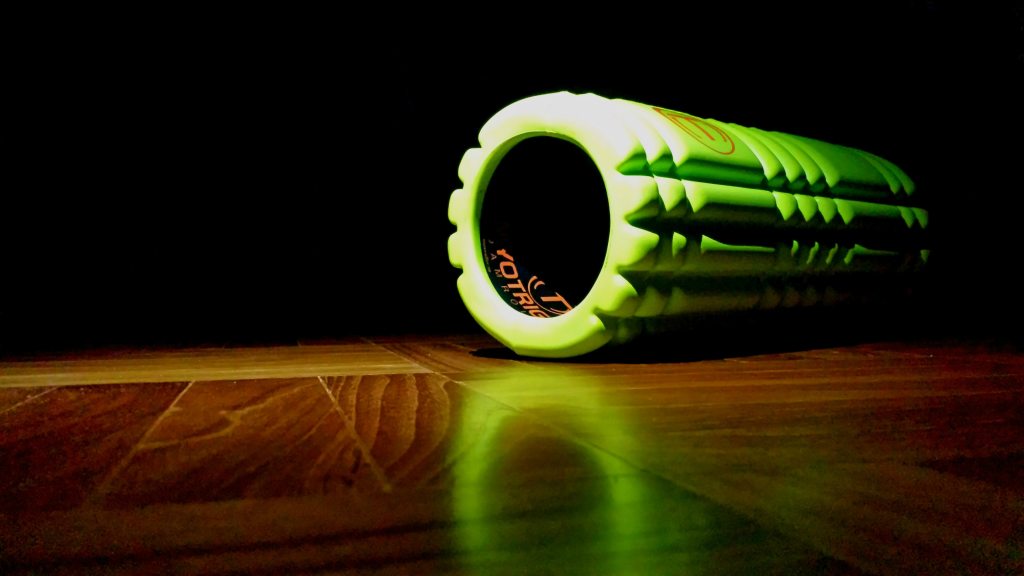
Example of a textured foam roller
The proper use of a foam roller will help to ease knots and tightness, increase blood flow through the muscle tissue and help loosen scar tissue. All of these things will significantly help with recovery time after an intense or gruelling workout. You can use a roller before and after a workout, to help with stretching and the prevention of injury.
Another good use for a foam roller is if you spend your day working in a sitting position or if you got a kink somewhere from improper sleeping positions. According to an article posted on Healthline.com, foam rolling has a number of benefits including but not limited to easing muscle pain, increasing your range of motion, temporary reduction of the appearance of cellulite, relieves back pain, helps to manage fibromyalgia and is a handy tool for relaxation.
It is advised that one needs to be careful when rolling and that one should avoid rolling over joints and to avoid foam rolling if you have a muscle tear or a break. There different types of foam rollers, including smooth rollers that are suggested if it’s your first time rolling and textured rollers that work deeper into the muscle tissue. Here’s the Healthline article: https://www.healthline.com/health/foam-roller-benefits
Like anything else, consult your doctor or medical professional before starting any new fitness routine. But foam rolling can be a reasonable addition to your at-home workout routine. It won’t completely replace a registered massage therapist, but it can provide some relief during trying times. ☯
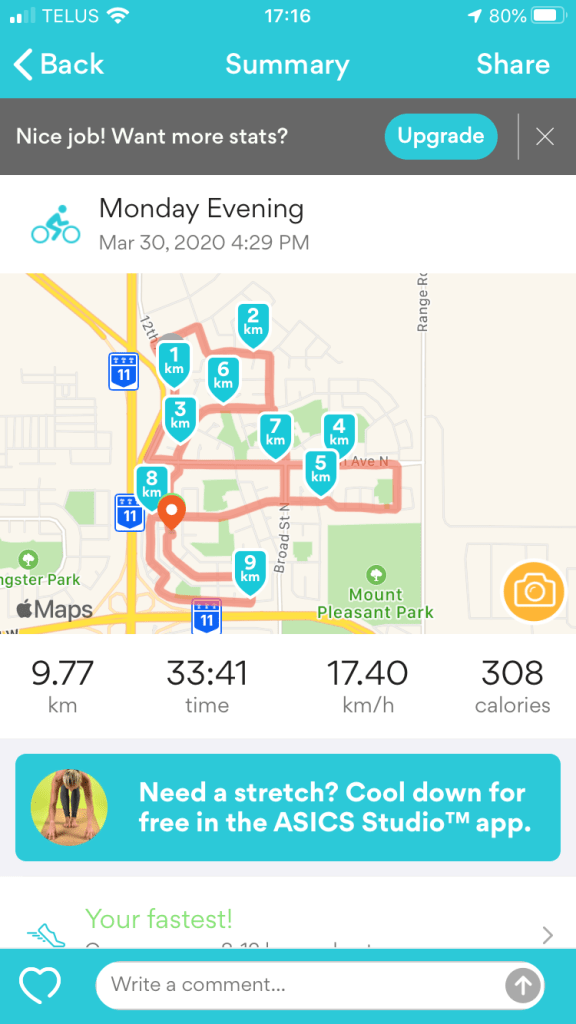
Yes, you read the title correctly; I stole my wife’s bike! Although a borrowing a marital property can hardly be referred to as theft, and she knew I was boring it. It was 14 degrees Celsius in Regina, Saskatchewan yesterday afternoon (although it may have reached higher but that was what I saw when I checked). As such, I decided that it would be a good idea to spend some time outside for the day’s workout.
Last year I logged a reasonable number of kilometres over the warmer months on a bicycle, and I discovered a love for it. I even cycled to work, on a number of occasions, which happens to be about ten kilometres away. The best aspect of cycling is that it’s a low impact exercise, so the past three and a half decades of wear and tear on my knees from full-contact martial arts doesn’t impede my ability to peddle.
There are a number of measurable benefits to cycling, including but not limited to;
increased heart health;
increased flexibility and blood flow;
muscle gain and joint mobility; and
weight loss stress reduction.
As long as you push and bike hard for at least 30 to 60 minutes, several days a week, you’ll get a good burn and see some noticeable results.
I stepped out of the house shortly after 3:30 p.m. and pulled my bicycle out of the garage. It had been sitting there all winter, so I knew I’d have to lubricate the chain and gears, as well as inflate the tires. The first two items went off without a hitch. I hit a hiccup on the third…
Using a small hand pump, I inflated the rear tire. When I moved to the front tire, I worked up a sweat trying to inflate it, to no avail. It was soft to the touch and had no firmness whatsoever (I just heard it, get your mind out of the gutter!) I started my car and plugged in a small emergency compressor that my father-in-law gave us for Christmas. I used it to inflate the front tire. Success!
That success was short-lived, as I could hear an audible hiss that resulted from the front tire deflating. I had a leak. This is not surprising, considering the bike was in the garage through the cold of winter, and rubber tends to crack under such conditions. I was pissed. Given the temperate weather, dry roads and the need for a workout, I was hell-bent on getting behind a handlebar.
I brought out my wife’s bicycle and repeated my prep cycle: lubricate the chain and gears and inflate the tires. No issues, and within minutes I was on the road. I pushed and peddled, all while singing along to Kenny Loggins’ “Nobody’s Fool” (It’s an awesome song, theme to Caddyshack II. Seriously, YouTube it!)
Once I started peddling, I felt it was hard to stop! I ended my run at just under 10 kilometres, feeling great! I think my wife may have lost her bike for the summer (at least until I can repair my front tire). Despite the current state of the world, there’s still plenty of opportunity to get some exercise and fresh air, so long as we stick to social distancing protocol. ☯
Nothing quite beats the feeling you get after an intensive workout. The burn, the aching muscles and the fatigue… They all have benefits, including a better night’s sleep and maintaining your overall health. However, one of my biggest pet peeves is the fact that the following day feels as though my entire muscular system feels as though it’s been dipped in battery acid and moving becomes a painful effort.
It’s not necessarily a bad thing. Aching muscles after a workout indicate that you’re getting stronger. As you exercise and workout, your muscle tissues become damaged and break down. As they repair themselves, they become bigger and stronger than they were before. Although this is how bodybuilding is done, it also applies to most forms of intensive exercise. In my case, doing an hour and a half of forms at full strength, coupled with shadow sparring, left me feeling floored yesterday.
If you’re new to the fitness scene and are just starting out, the pain after a serious burn can be a bit scary. Most people may be of the opinion that they’ve injured themselves and may not understand that this pain is normal. One important thing is to keep moving. Continued movement will help in recovery and keep the muscles warm. If you decide, “Uh oh, better stop until I feel better…” you may be doing more harm than good.
Don’t get me wrong; there’s a big difference between moderate aches and actual injury. Knowing the difference can mean preventing further and possibly permanent injury. If you have difficulties performing normal every day tasks, such as brushing your teeth or showering, then you’ve done too much.
According to an article posted on WebMD, there are a number of different things you can do to help with the aches and pains associated with working out.
Keep Moving: When we feel pain, our instinct is to rest what hurts. This isn’t always ideal for continued physical conditioning. The article suggests that doing something light the following day after an intense workout, like swimming or cycling, can be beneficial;
Get Some Rest: I’m not trying to be contrary here (considering the first point), but rest days ARE necessary for proper recovery. It’s suggested that the second day after a serious burn is the worst, so having a recovery day can be ideal;
Apply Heat: People often debate which is better; heat or cold. The reality is that heat helps with pain and cold helps with swelling or inflammation. If you have aches and pains after a workout, applying light heat from a warm towel or heating pad can be beneficial. The important detail is to avoid direct contact with heating devices and to use heat in short increments, such as fifteen minutes at a time;
Get A Massage: Massages have a number of great health benefits on their own, but getting one after a serious workout can help increase blood flow, relax your tissues and increase your range of motion. Be mindful of the type of massage you get and be sure to let your masseuse know that you’re getting one because of an intensive workout. He or she should be able to suggest something appropriate. As an alternative, foam rolling can also be beneficial, although this should be done carefully and moderately; and
Take An Anti-Inflammatory: I’m not a big fan of this one. Although it will help with swelling and pain reduction, it’s one of those things where you shouldn’t take medication unless it becomes a last resort. My reasoning for this is because prolonged use of anti-inflammatories can cause a number of annoying side-effects on the body. So this should be used in moderation.
Some important steps the weren’t mentioned in the article, is staying hydrated and fuelling your body through proper nutrition. Your muscle tissue will need plenty of water, fibre and protein in order to properly build and recover damaged tissues. And if you happen to have Diabetes, be sure to monitor your blood sugar levels frequently before, during and after your workouts. ☯
Throughout the years, I’ve had many friends and associates ask me how I manage to control my Diabetes and still do martial arts to the extent that I do. I’ve been studying for so long at this point that it basically feels like second nature to me, but I’ve had friends who have come to watch karate classes to see what all the hype is, only to be blown away by the physical exertion, sweat and effort that goes into traditional karate. Given my age, I would be lying if I said that my flexibility and ability to push as hard and as long as say, twenty years ago still existed.
Although I’ve had an interest in the martial arts since a very young age, it wasn’t until my Diabetes complications started to overtake my ability to fight them that I tied on a karate gi and stepped into a dojo for the first time. The rest would be a lifetime story that continues to play out to this day. The martial arts has given me so much, and I think that the average person fails to understand just how many benefits there are to proper, traditional training.
When I say “proper, traditional training,” I don’t mean a commercialized martial arts club where there are hundreds of students, you basically fend for yourself and hardly ever have any one-on-one coaching. I mean the little bare floor dojo down a side street or back alley; the one that has a dozen students at most and push themselves to the point where the floor is literally soaking up blood, sweat and tears… The kind of place where you learn, not only to defend yourself but a definite lifestyle that you keep with you until your end of days. THAT’s the kind of training I was blessed to have throughout my childhood and into adulthood.
Now, I could go into one of my “fun” little bullet lists about all the benefits that martial arts can provide for someone who really dives into it and gives it their all. But instead, I’d like to bring up a very special martial artist that I read about years ago. I found a photo of this little guy while researching something else, and it reminded me of the importance of believing you can achieve your goals, no matter what. I’m talking about an inspirational young lad named Shoham Das.
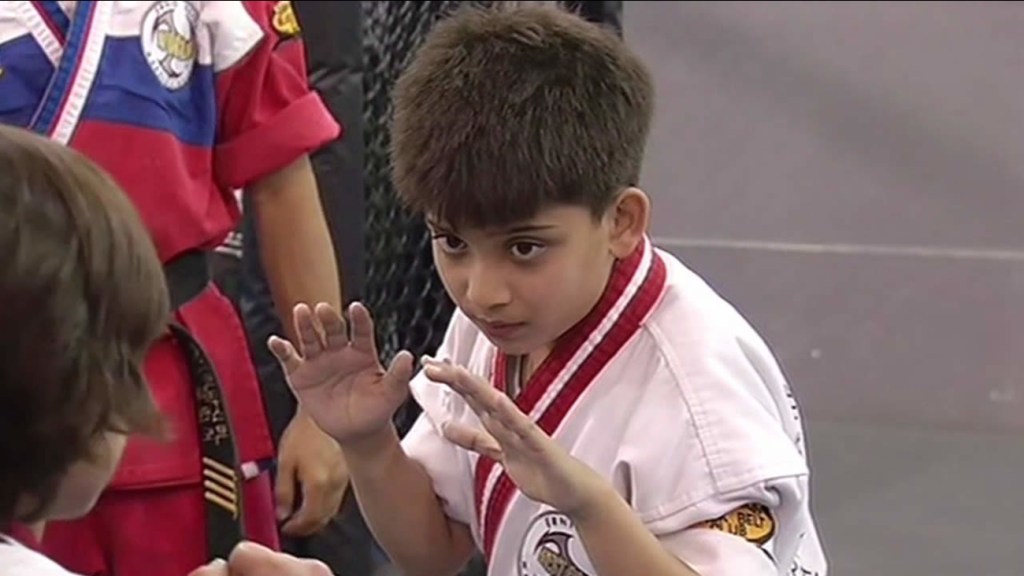
Shoham Das, aged 11
Shoham Das was a young boy from San Jose, who was born with a rare heart condition in which he is missing his right ventricle and in effect only has half a heart. The condition is so rare that it’s thought to afflict only 1 in 10,000 kids. Das has had three open heart surgeries at three days old, six months old and four years old, respectively. This means his endurance tends to be low and he often requires more rest than a counterpart of the same age without this condition.
Despite this condition, Das has been studying Tae Kwon Do and mixed martial arts since the age of 7, and during a weekend in early May of 2014, Das tested and successfully graduated his first-degree black belt at the age of 11. The testing, which required two hours of combined skill in various areas of the art he studies, required Das to have his oxygen levels monitored by his mother throughout, but he was successful and continues to train.
Now if you do the math in your head (and hopefully you don’t actually have to), this means that he graduated his first black belt in only four years, and prior to maturity. Although I’m not a fan of this practice, which seems to be the norm in many modern-day dojos, you can’t argue with the focus and will required to reach this level given the specific ailments Das has been diagnosed with.
In fact, some of Das’ doctors have indicated their belief that all the physical activity and structured study involved in the martial arts has made Das’ muscles and heart tissues stronger, allowing him a better quality of life and to be able to do more without getting tired so easily.
Although Das has a lower endurance than a counterpart without his condition, he’s been blessed to study at a dojo that focuses on the skill rather than the endurance. An aspect in which Das has in abundance. Although many dojos turned him away due to his condition, Das eventually found an instructor who took him in. He kept at it and by last year Das is said to have achieved a third-degree black belt in Tae Kwon Do and continues to train.
In the above link, Das has shown to be humble, attributing his health and continued life to his doctors and specialists. It stands to reason that he wouldn’t have gotten this far without them, but there is absolutely no doubt in my mind that the increased strength, discipline and skill he got from training in the martial arts all those years have definitely played a key role.
If you look at this impressive young man’s life and see how much he’s accomplished DESPITE his condition, it may lead you to ask what the hell some people’s problem is. Anything is always more than nothing, and amidst anything else happening in your life, it’ll always be up to you to take yourself in hand and ensure your continued health, whether you have a medical condition or not.
I look back at my life and I have a clear understanding that in order to survive given my personal complications, I couldn’t just sit back and depend on others. I had to stand up and make things happen for myself. Just like Shoham Das. Although he may only physically have half a heart, he’s got more heart than most. ☯
One of the biggest struggles for folks with Type-1 Diabetes is weight loss. People who don’t have Diabetes have qa rough go of it as it is, but when you throw Diabetes in the mix, it becomes all the more difficult.
One of the reasons behind this is insulin therapy. Believe it or not, constant insulin injections may lead to weight gain. According to an article posted by MedicalNewsToday.com, “Eating more calories than the body needs will lead to excess glucose levels. If the cells do not remove glucose from the blood, the body will store it in the tissues as fat. When a person takes insulin as a therapy for Diabetes, their body may absorb too much glucose from food, resulting in weight gain.” (https://www.medicalnewstoday.com/articles/325328#link-between-insulin-and-weight)
Realistically speaking, there are a number of things that can be done to help trim you down for the coming summer months. First and foremost, we need to agree that weight loss requires a combination of exercise AND diet. If all you do is binge on every fad diet that floats by, you may see some immediate results but it likely won’t stick. If you work out consistently but eat like a living trash can, you’ll still start chugging out.
Before you blow the dust off of your cut-off jean shorts, try doing some of the following:
Exercise 3 to 5 Times A Week: This one should be pretty obvious, since I mentioned it earlier. But physical activity is important, whether you have Diabetes or not. A workout doesn’t have to be an all-encompassing activity that takes hours. Even 20 or 30 minutes of activity that leads to an increased heart rate will be beneficial;
Quit Snacking: Most people have a compulsion to snack. When you’re sitting at home, watching a show or a movie, we generally tend to want something to munch on. Although one can find some healthier alternatives to snack on (granted, you won’t catch me eating celery sticks while watching Avengers: Endgame), limiting or eliminating snacks is even more ideal. Salty or high-sodium snacks may cause you to retain water and/or gain weight;
Drink Plenty of Fluids: Many times, we eat out of habit and not necessarily out of hunger. Dehydration can be another problem, as it can cause a person to feel the same sensation as hunger. Stay away from sodas and sugared juices and stick to water and herbal tea; and
Embrace Your Technology: I use a water drinking app (My Water), a fitness app (Runkeeper) and a workout designer app (Seconds Pro). These things can be helpful in helping to keep you on track. Runkeeper has GPS tracking that allows you to measure your time, distance and average speed, all while tapping into your music playlist. Seconds Pro allows you to design your own circuit, HIIT, Tabada and interval workouts. You can program it to use the music on your phone and set whatever times and periods are required. All three of these are free of charge, with the option of upgrading to pro versions that have additional features (I’ve upgraded My Water and Seconds Pro).
Keep in mind that eating well and also meal planning are much easier than it probably sounds. Frozen vegetables have proven to be just as healthy and beneficial as fresh ones, and can be way easier as they won’t spoil. Black coffee is also a big plus, since it contains zero calories and can give you the caffeine boost required for that workout.
No matter what route you take or what methods you use, the biggest thing is to give it time. If you expect to see results within a week or two, you’ll be greatly disappointed. In fact, IF you see results in as shirt a time as a week, you should probably consult a medical practitioner. Every individual person is different and what works for one person may not work for you. ☯
Karate has a rich and fantastic history, and has branched out into many different styles and genres. Karate is a specific type of martial art and not a style in and of itself. The word karate (or two words, if I’m being specific) is Japanese for “empty hand”, meaning that a practitioner is said to be studying karate do, and the practitioner is known as a karateka.
One important detail to discern is that there are two main branches of karate: Japanese and Okinawan. And although they are similar, there are some important discrepancies between the two. Here are some of the more important differences:
We’re More Traditional: Okinawan karate uses karate as a way of life as opposed to a being interpreted as a sport. All the original systems of karate came out of Okinawa, and when they hit mainland Japan, the Japanese took these styles and began altering altering a number of things including the forms and techniques. Although highly effective, one of the things that Japanese karate changed was striking for points. And yes, Okinawans also compete in modern times, but it isn’t always so;
We Use Weapons: Okinawa was a pretty brutal place way back in the day, and the use of weapons by the criminal element was pretty prominent. This meant that martial artists had to incorporate weapons into their training as well. After all, it’s hard to defend against a weapon unless you have one as well. For this reason, most practitioners of Okinawan karate also studied Okinawan Kobudo, which a style of weapons training. Although the use of weapons has diminished significantly over the decades, Japanese karate doesn’t use weapons at all;
We Have More Natural Movements: Okinawans practice karate in ways that accentuate the natural movements of the body. Our stances are high and natural, our blocks use our opponent’s energy and we prefer to execute techniques at close range rather than from a distance. Japanese karate does very much the opposite, by focusing on low stances and approaching combat from farther distances from their opponents;
We Don’t Yell Constantly: Although I will admit that there are kiai in Okinawan karate (a kiai is a single-syllable yell to focus energy during an attack), we practically never use them. Most Japanese karate styles use a form of kiai known as “osu”, which drives absolutely bat-shit crazy. Styles like Kyokushinkai use the term “osu” constantly and for everything. Osu did NOT originate in Okinawa and is widely misused in modern karate, especially in the western hemisphere; and
We Focus On Our Students: Okinawan karate is particular, because the Sensei will spend one-on-one time with his or her students. Japanese karate, by contrast, teaches to large masses of students at once. This is why some Okinawan techniques are significantly more involved than their Japanese counterparts; because they are individually taught to the student, as opposed to a large group of students at once.
One last detail I’ll provide is that karate refers specifically to Japanese or Okinawan empty-hand styles of martial arts. If someone is teaching a Chinese or Korean style of martial arts, it rightfully shouldn’t be referred to as karate.
I’m not saying that Japanese karate isn’t as effective or as good as Okinawan karate, they’re just different. It’s like how a revolver and a pistol are both handguns, but their features, pros and cons are quite different from one another. Know the background and history of the art you’re looking to study, and make sure you choose the style that’s right for you. ☯
If there’s something I’ve seen a lot of in the martial arts, it’s prejudice. Does that surprise you? It shouldn’t. Even in the most classic kung fu movies, you can see one style pitted against another, one clan fighting another or comparisons of one style against another. Prejudice has run rampant throughout the martial arts, as every style tends to believe it has the perfect way, all the while dismissing or belittling other styles in favour of its own.
I gotta be honest, that shit drives me nuts! Yes, the martial arts are thousands of years old. And some styles have a pure lineage that can be traced quite a ways back, as opposed to some others. But every style is descendent of another, almost without exception.
The biggest issue I see is when someone comes out with their own “style” and touts it as something they’ve created from scratch. This is always a bit suspicious and can possibly be a “McDojo”, depending on who and how the style was developed. But let’s examine the concept of developing one’s own style, shall we?
My own style, Uechi Ryu, was founded by Kanbun Uechi and renamed in his honour after this death. The exact history can be easily looked up, but the jist is that he fled to mainland China and studied a style of kung fu for a long period of time before returning to Okinawa and having it develop and evolve into a style of karate do.
My point is, every style comes from SOMEWHERE. So why would you be opposed to it, when someone says that they’ve created their own? There are some pretty famous people that are socially well-known, who have created their own styles of martial arts. I’ve gathered my favourites here:
Jeet Kune Do: It stands to reason that this one would be on the list, and not least of all first… This is a style of Kung Fu that was founded in 1967 by none other than Bruce Lee. Lee had spent his childhood studying Wing Chung and eventually came to feel that there were too many restrictions and classical mess, and founded Jeet Kune Do as a “formless” style, which was considered more of a philosophy for practicing the martial arts. The point is, he used the influence of kung fu to develop his own style and it’s still practiced by many to this day;
Dux Ryu: This is a style of ninjutsu founded by Frank Dux, an American marine who studied several different styles of martial arts. Some people may know him from the movie representation of his victory in a secret full-contact martial arts tournament called the “Kumite”. This movie was a little hit called “Bloodsport”, starring Jean-Claude Van Damme. The movie was released in 1988, and Dux had several martial arts schools in the U.S. Although some of his claims have been disputed, argumented and disproven since the release of this movie, he’s still known as a professional martial artist who founded his own style of martial arts. And the movie is totally awesome! Jus’ sayin’…; and
Chun KuK Do: The last style on this list is a style created by Chuck Norris. Now, I have to be honest, I’ve never been a huge fan of his work (ducks under the desk to avoid being punched, as Chuck Norris is EVERYWHERE). But there’s no denying that the man has studied martial arts… A LOT! In fact, he’s studied Tang Soo Do, Tae Kwon Do, Karate, Jujitsu and Judo. Chun Kuk Do has many aspects of a traditional martial art, including forms and techniques adopted mostly by Korean styles as this is what Norris primarily studied. Chun Kuk Do was founded by Norris in 1990, making it one of the newest styles of martial arts.
There are students currently studying all three of these celebrity-developed martial arts styles, even to this day. And here’s a newsflash: karate is only 150 to 200 years old! In fact, Kyokushinkai is a style of Japanese karate founded in 1964, making it only 56 years old! My point is that it’s an effective style of karate and has made its mark on the world, nonetheless.
I’m not saying that every schmo who studies a martial arts for a few years can suddenly open their own doors and introduce their own “style”. But the ones who have, deserve to have that style explored and examined before being dismissed out of spite. The martial arts is a constantly evolving creature that will always continue, so long as there are serious practitioners who will indulge the way. 200 years from now, Chun Kuk Do may be as widely regarded as karate. ☯
I have many fond memories of my time in karate; one of the most important being the very first day I stepped into class. I was wearing sweatpants and a dingy t-shirt. I had researched enough on what I was about to do to know that I was to take off my shoes and socks and bow at the door before entering. I had visited the dojo and observed a class the previous week, and was given some rudimentary guidance by a brown belt who was instructing during the teacher’s absence.
I walked up the stairs to the second level of the gymnasium where class was held (it was actually the ground floor, but since my home town is built on the side of a mountain in Northern New Brunswick, the entrance is in the basement) with a grim determination to give it my all and to improve my health. I walked to the entrance of the dojo and noticed about two dozen students milling about, stretching and chatting about their weekend. I bowed respectfully at the door and when I raised my head, the crowd had parted and there stood Sensei…
Now, what you need to understand is that I was something of a smart-ass kid… Some of you are likely thinking that sentence could lose the “kid” and still be accurate. And you would be right. But my point is that I had a sarcastic streak that not many parents and adults shared or enjoyed. My mouth got me into trouble often enough that sometimes I paid a price for my words. Enter: Sensei.
That’s why when I saw that the head instructor of the school was a man with whom I had some “verbal” interactions, I slowly back-stepped and tried to retreat from the building. No such luck. Sensei looked up and saw me at the entrance and asked if I was trying out. I replied that I was. He motioned me to enter and assigned me a yellow belt to help me stretch out properly and learn some of the basics I would need to make my way through the class. Thus began a lifelong journey that I’m still working on, more than three decades later.
Every person has a story. Every story has a beginning. Sure, all those stories start the same way: with one’s birth. But speaking strictly about martial arts, the beginning of one’s story, regardless of the reason for joining, should be some guidance. Someone should be taking the time to show you some of the rudimentary basics, stances and strikes that you’ll be using during class so that you don’t become overwhelmed or confused.
Depending on the size and composition of the school you train with, this is no longer always the case. I recently saw a young girl in her teens walk into the dojo I train with, and she was accompanied by her mother. They introduced themselves and the mother sat on the bench and the girl just stood there. Class was scheduled to start in a matter of minutes.
I approached and instructed that she should remove her socks. Her mother objected to her being barefooted. I explained that some of the techniques we would be doing could cause her to slip and injure herself, should she wear socks. Especially since her balance and coordination for martial arts had not yet been developed. I asked if she did any other physical activities, to which she replied that she had done dance. I took a few moments to explain where she would be lined up and to simply follow along with the people in front of her. Bow when they bow, kick when they kick, so on and so forth…
Had I not spoken with her, this girl would have been left to her own devices and ignored, as no one else in the class seemed keen on approaching her. I couldn’t help but think that this was a horrible way to begin one’s first class, and thought back to how different my experience would have been had I been in those same shoes. She lined up based on instruction given to her by one of the senior belts and class began.
I know I have often picked on Millenials. Hell, I think a lot of society bashes on them a great deal. They come by some of it honestly. And Generation “Z” is proving to be no better. Not everyone fits in these categories, but what I observed that night was teeth-grinding and painful to watch. This young girl had six students and instructors in front of her, with plenty of opportunity to mimic and follow along.
She spent a good majority of the first hour simply standing in place, watching. Sometimes she would try something, only to throw her hands up and turn to look at her mother. She seemed unable or unwilling to perform even the simplest of movements, including squats and stretches that anyone could be able to do. Considering I had my beginnings in karate with an instructor who would not have permitted ANY student to sit still during training, it was painful to watch.
I wonder how different HER experience might have been, had one of the senior students approached her and took her in hand when she first arrived. Had she been shown some of these basics one-on-one before the start of class, some of it might have seemed less foreign and strange. Or perhaps it’s the change in behaviour and expectations that accompany the younger generations of today. It’s hard to tell.
I’m hoping this young lady will stick it out long enough to develop the solid effort required for her to reap the full benefits of martial arts. But the lesson here is that if anyone new walks into your preferred sport or workout environment, take the time to chat with them, guide them and show them the basics. You’ll make the experience much more immersive for them. And if you’re the one coming into something new, make it worth your while. Push yourself and give it your best effort. Not only are you worth that effort, it’s the least you deserve. ☯
Music is awesome. It has the means to allow a person to express themselves in a very unique way. Music also has the means to reach every person. There are so many types of music that there is always at least one genre that appeals to any given person. Music can also communicate. There are few genuinely universal ways of communicating, but shaking your booty to great music is well understood anywhere in the world.
Music can also play an important role in how your workout plays out. It’s no secret that having an awesome playlist and some sick beats (I promise never to use that term again) can improve your workout and make you push harder towards a wicked sweat. So, why is this? IS it just our imagination? NO. There are actually some measurable reasons why music can help improve your fitness.
According to an article by the Huffington Post, “Listening to music while exercising can release feel-good chemicals – such as dopamine and opioids – that may boost your mood, dull pain and make you less tired […]” (https://www.huffingtonpost.ca/entry/how-music-affects-workout_n_55d746a3e4b0a40aa3aaa9da?ri18n=true) If this is true, than having some music blaring while you workout is definitely beneficial.
Some other theories include the fact that music is a distraction. If you are distracted from the agonizing shin-splints keeping you from completing your 3K-run in record time, you’re more likely to push hard and keep going. Speaking from experience here, folks! Another theory is that good music, or rather what may be good to you, will help increase your confidence. This causes us to push harder.
No matter what the reasons, and no definite evidence has been found despite many studies, you can’t argue that having your earbuds in while you push yourself adds a definite plus to your workout. Think about it. When was the last time you went to a gym that DIDN’T have at least some of the people wearing headphones or earbuds? And it’s almost a sure guarantee that fitness locations will usually have music playing on the intercom system. Unless it’s one of those heathen locations that have a sporting event blaring, but that’s an entirely separate problem.
My current karate school even uses music during the warm-up portion of the class. This is a bit of a controversial thing, considering that most martial arts schools include an aspect of discipline that doesn’t include having Metallica blaring while shadow boxing! But I’d be lying if I said that the addition of music didn’t get even the laziest of students moving a bit better.
So whatever your reasons for doing so, crank up the tunes. Whether it’s to make you feel better, distract you from the now or simply helps you follow along with a beat, it can be nothing but beneficial. Unless you work out to country music. Then you’re just asking for trouble. You know who who are! ☯
I brought my son to a public swimming pool, yesterday afternoon. He enjoyed that pool party for his classmate so much a couple of weeks ago, that I thought it would be a great way for us both to get some exercise and burn him out for the night. It would have been nice to snap a photo or two of the fun, but you DON’T want to be that adult taking photos at a public pool!
Swimming is often an overlooked activity by most people, because it seems rather inconvenient. You have to pack swimwear and towels, go to a specific location to swim (especially if it’s winter) and you need to worry about getting properly dry and dragging a bunch of wet things with you when you leave. But is that really any different than working out at a conventional gym? If you said yes, there’s something wrong with your workouts. Unless you have a full gym in the basement of your home (a slight tinge of jealousy over my brother-in-law’s basement comes to mind) then you still need to pack or wear workout gear, go to the gym’s specific location and if you aren’t soaking wet when you finish your workout, then you aren’t pushing hard enough!
Spending time in a pool can have a number of benefits, from a health and fitness standpoint. If you happen to be swimming with my son Nathan, I guarantee that you’ll lose track of the number of calories you burn. And that’s the nice thing: you’re burning through calories while having so much fun that you don’t notice it.
You work just about every muscle group. Even if all you’re doing is splashing around with your kids, working your way around under water requires the use of just about all your muscle groups, making for a great workout. It’s also a very low-impact way to workout, since the water takes a portion of the weight off of your back and joints.
The increased heart rate will improve your heart and lungs, and will help to reduce stress while improving your flexibility and mobility. That last one is particularly important if you need to maintain your fitness level through an injury like, oh let’s say… shin splints! The low impact will allow your injury to heal while still allowing you to burn calories.
It goes without saying, even if I’m saying it, that anyone with Diabetes needs to closely monitor their blood glucose levels while swimming. Often, your blood sugars can start to drop suddenly, especially if you’re caught up in the fun. When going to a public pool, I always arrange to keep my gym bag close by. It contains fast-acting glucose, my glucometer and my cell phone, which allows mw to test my blood sugar through my Freestyle Libre.
Last but not least, it’ll fire up your hunger and make you tired. This is a good sign that you’ve had a god burn and can retire to your home for a rest. One of the first things Nathan told me as we were towelling off to leave was, “Daddy, I’m tired…” Yes! He’ll be sleeping early tonight… No such luck. He got his second wind and was his typical destructive self.
Swimming can be beneficial in all sorts of ways and do nothing but good for the body. I spent most of my life living in the East Coast of Canada where i could spend the entirety of my summer, swimming on beaches, rivers and lakes. It was glorious! If you do swim outdoors, be sure you know how to swim and are aware of how to swim in bodies of water that may have currents and other dangers. Otherwise, you can’t go wrong. So get out there and dive in; the water’s fine! ☯



 The Blogging Buddhist