Because It’s There…🌋

Every once in a while, I’m reminded of something that I used to do in my youth. Specifically, things I used to do in my home Province of New Brunswick. I’m originally from a small town called Dalhousie (not to be associated with Dalhousie University, which is in Nova Scotia) but I would frequently travel to a neighbouring town called Campbellton, which is about 25 kilometres away.

Given that Dalhousie was lacking most amenities throughout the late 80’s and early 90’s with the drop in the paper industry as the digital age started to kick in, my friends and I would often lean on Campbellton as it was designated as a city (despite only having about 5,000 people) and had plenty of commerce, restaurants and stores. It also had the only Tim Horton’s in the area at the time, if you can believe it.

So we used to travel up there a lot, and when I hit my teens I started using my bike to cycle from Dalhousie to Campbellton. It’s ironic to think that just at the beginning of this year, I considered 20 kilometres to be a milestone, when I used to bike 25 kilometres to reach Campbellton, THEN bike around town and make my way back to Dalhousie. Oh, how youth provides a certain little something…
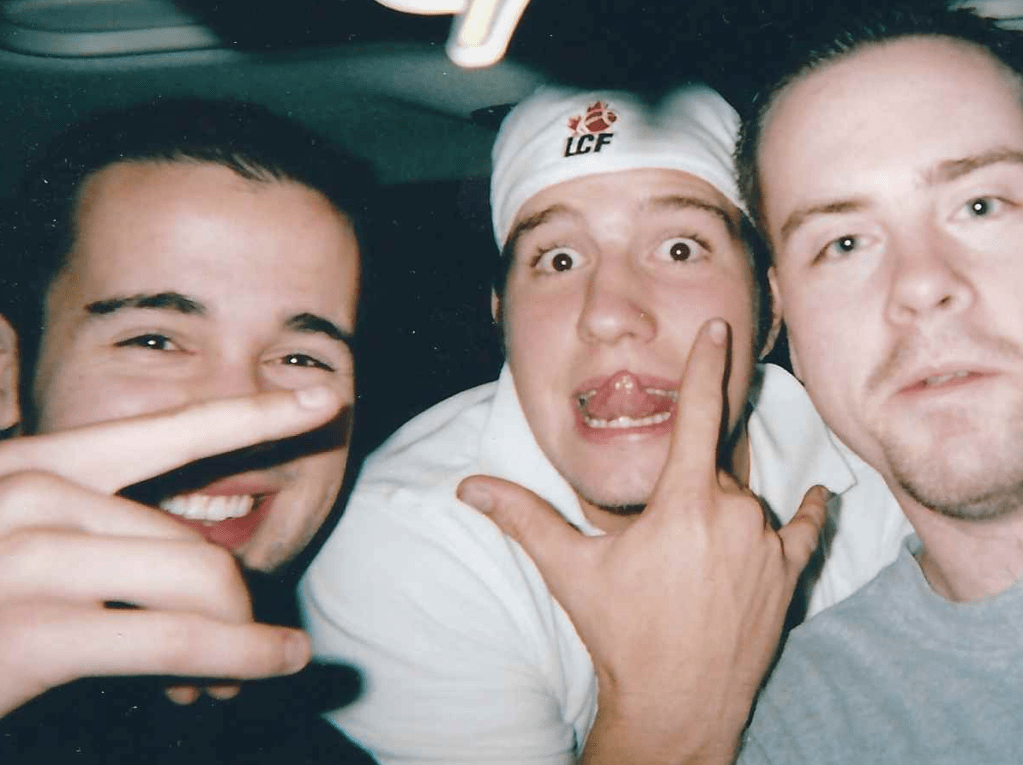
My friends Christopher (left), Kevin (centre) and I about to go climb Sugarloaf Mountain

In the late 90’s, I got into the habit of cycling to Campbellton quite frequently. Although once I got my driver’s licence and purchased a vehicle, my dynamic switched up and I started travelling up by car. I needed to find something to replace the exercise I was getting from cycling, so I chose to climb our local mountain, named Sugarloaf. Now, if you Google Sugarloaf you’ll find a number of different locations from around the world. But MY Sugarloaf is located on the southern side of Campbellton.

Sugarloaf Mountain, as seen from Highway 11, heading West towards Campbellton

Just to keep things interesting, I’ll give you some basic stats on this tree-filled lump. Sugarloaf Mountain is an extinct volcano. It was formed some 420 million years ago when thinning of the Earth’s crust allowed it to peak its nosy face out of the ground. It’s about 922 feet from base to tip, and has a walking trail around its base as well as a ski resort and multiple downhill skiing trails on the west side of the mountain.

I started climbing the mountain by its designated hiking trail for the first couple of years. But as I got bolder, I started wearing protective gloves and solid shoes and scaling the vertical sides, as well. I got a few friends to join me on some of those climbs, but they usually ended up quitting within the first 30 minutes claiming that I was out of my mind. And probably with good reason.

The boys and I, soaking wet after climbing back down in the mountain in the pouring rain

I miss climbing. I obviously don’t get to do much of it (none) considering I live in the Prairies now. There aren’t a great number of mountains out here. But I definitely plan on trying to make an effort to reconquer the mountain on the next occasion that I visit my folks. It’ll be interesting to see how different in may be, considering the mountain likely hasn’t changed, but I definitely have!

I haven’t seen or spoken to Christopher or Kevin in over fifteen years. We didn’t have a falling out or anything; we simply got on with our respective lives. And sometimes, that’s the way of it. Friendships sometimes come and go. But the good and happy memories you make along the way are yours forever. ☯
The Right Frame Of Mind

Developing yourself and reaching a goal can be difficult. Especially when you don’t allow yourself to have a strong frame of mind or proper perspective. Having a partner when you work out can be extremely helpful, as I wrote about in a previous post It Takes Two, Baby…🎶. But although having someone there to spot you and motivate you can be quite the benefit, you need to allow yourself to have a correct frame of mind behind your workout.

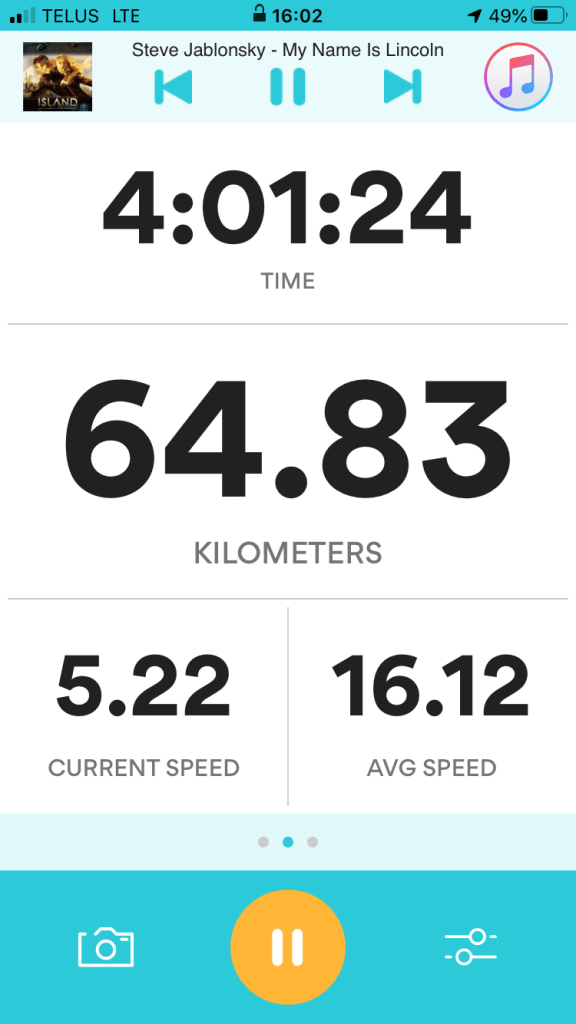
The distance I achieved yesterday

A friend of mine recently pointed out something important as it relates to fitness. Let’s say that you’re trying to lose some weight. You intend on climbing the nearby mountain with a partner, which is not only smart for safety reasons but can motivate you to push further in order to keep up. As you start climbing, you begin to feel tired. Your body is having difficulty continuing due to the excess weight that you’re trying to shed, and you feel compelled to stop.

Perhaps you tell your partner you need a rest. Or perhaps you tell them you can’t go on. Maybe you surrender to your body’s urge to have you sit down and give up. A terrible thing to allow, especially if you’ve set yourself some fitness goals that can be important for your health. For someone with Type-1 Diabetes, this can be a common occurrence, since fluctuating blood glucose levels can have the unfortunate side effect of making a person groggy and sluggish.

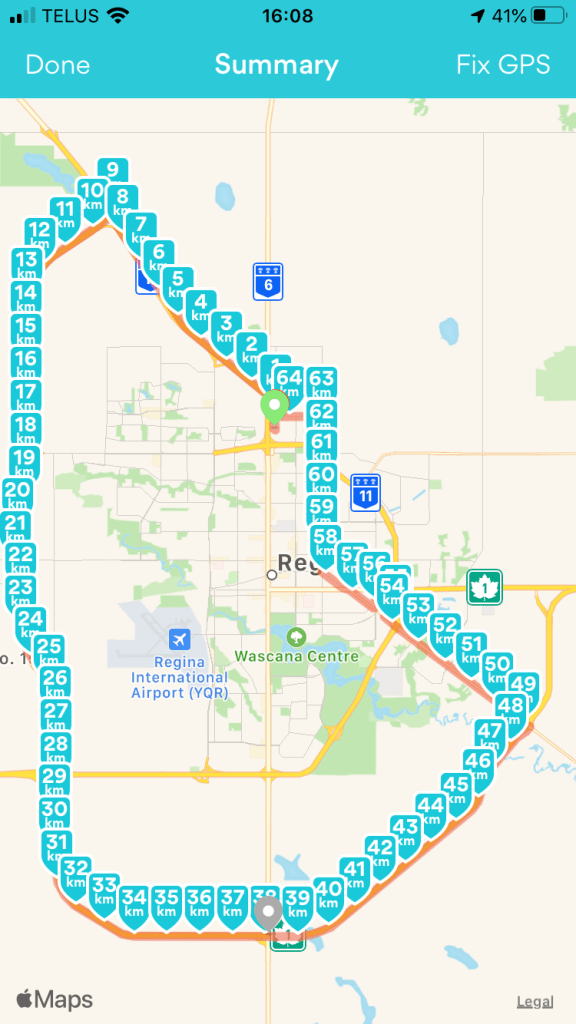
Yesterday’s route around the Regina Bypass

As I’ve often mentioned before, it’s important to ask yourself why? What is the reason behind your motivation? Your body should and will give out, long before you do. Why do you think people listen to music when they work out? It’s not simply for their love of it, although for some I would believe that’s included. It’s because music motivates us (and in some ways, distracts us from the physical exertion we’re going through).

This is why it’s so important to motivate yourself and stay positive. When I started cycling for fitness this year, I would get home after about a dozen kilometres and my legs would kill, I’d be exhausted and I would feel like total crap. But as you can see from the images above, the day before last saw me hit 65 kilometres. And yes, when I got home my legs killed, I was exhausted and dehydrated and needed food. But I can promise that a dozen kilometres now seem like a trivial amount, and I can do it quite easily in only about half an hour. This is something I wouldn’t have imagined when I started.

Sometimes it’s better to take things in small increments. If I’d hopped on my bike and tried to reach 60k on one of my first times out, I likely would have floored myself and became discouraged. But by staying consistent and building myself slowly, I’ve been able to keep building and developing how far I can go. The same can be said of martial arts or any fitness regimen that you may be attempting.

Let’s get back to our friend who’s attempting to climb the mountain. When exhaustion sets in and you feel like you can’t go any further, there’s no shame in taking a breather. But then, look ahead and spot a point further up the trail and tell yourself, “I can push at LEAST until that tree…” Then go for it. Once you reach that tree, maybe you’ll need another breather, maybe you won’t. But fix yourself another short goal and strive for it.

I think it was a Navy Seal that I had seen years ago, who described taking his training in steps, from day to day. At the beginning of the day, he would tell himself to simply get past breakfast. That’s it. Once this period had passed, he would focus simply on getting through the afternoon. Nothing more. With each piece of the day’s puzzle reached, he would be able to shift his focus and move on to the next, thereby guaranteeing he would make it through the day before hitting the rack. If he were to focus on completing the entire day, he would likely become discouraged and lack motivation. This is a concept that anyone can apply to their daily routines.

The idea is to allow yourself the time to grow. Have a positive and motivated perspective and you’ll go much further. If your thoughts are negative as soon as you begin, you’re sure to fail. how can you be motivated if you’re already defeating yourself? But if you focus on the positive, music, goals, health benefits, perhaps the scenery that surrounds you as you climb, you’re more likely to push farther and accomplish more.

Your own health and fitness is important; critical to your survival, really. And the proper mindset is what will help get you there. For someone with weight issues or Diabetes, staying fit and healthy can mean the difference between life and death. This is one of the reasons I push so hard. Life has too much to offer to lay down and die sooner than necessary.

And Diabetes or not, death will take me. Of this, there is no doubt. But I can promise two things: Death will lose ten pounds in sweat trying to make it happen and he’ll lose a mouth of teeth in the attempt. I intend to go down fighting. (Gee, that would make a great t-shirt) ☯

Life Isn’t A StopWatch

I hate being interrupted. Honestly, it happens in all aspects of life; there’s simply no getting around that. With children, work and daily obligations, interruptions to ANY task I may be doing is a common occurrence. And I’ve honestly come to expect interruptions and even become concerned when I’m not interrupted. This usually means that my son is up to something… (he’s literally pestering me for food as I type this sentence)

A good example is the fact that between the first paragraph and this one, I’ve been away from my keyboard for about twenty minutes making waffles for my son and trying to figure out why my Roku stick won’t play his damnable shows…(Burn in hell, Peppa Pig!) But the good news is with something like a blog, I can stop typing to deal with whatever the interruption may be and return to it once I’ve gotten clear. But what about something like working out? Can you stop your workout and come back to it, later on?

Life isn’t a stopwatch. There’s no way to pause time and restart it once we’ve gotten past whatever may be in the way. There are a finite number of hours in the week, and focusing on one’s fitness amidst needy children, work, chores around the house and anything else that may come along can prove to be difficult. How effectively can your fitness plans be instituted into your daily life in these conditions?

According to a blog post on Strong Mommas, there are four valuable tips to dealing with interruptions to your fitness routine. You can click the link to get the full details from the post, but I’ll synopsize these tips here, based on how I deal with things. There are only three tips listed in my post because #2 and #3 in the linked post are basically the same:

  1. Workout when you’ll be least interrupted. This can be a bit difficult, depending on your lifestyle and what job you have. The article describes the writer finally “sucking it up” and waking up at 5:30 in the morning to wake up. Screw that noise! I’m not a morning person to start with, so that’s the LAST option I would entertain. But it happens to be a period where the writer can guarantee she won’t be interrupted, so it works for her. Cycling workouts are best for me, as they happen to be outside the home. But even this gets interrupted, depending on what I have going on at home. If you have a period of the day where you may have some peace and quiet, this should be when you go for it. I agree on the writer’s last thought on this point, that working out during late evening when the kids go to bed can be rough, especially since you’ll likely be tired as well;
  2. Pick up where you left off. If your workout gets interrupted and you find yourself freed up, there’s nothing wrong with coming right back to it. This sucks, since you’ve likely cooled down while taking care of whatever caused the interruption. If you can get back to it within 15 minutes, you should be good to go. Depending on how much your body has cooled down, you may have to warm up again before resuming your workout. This will depend greatly on how tight your muscles feel and is subjective to the person working out. If you’ve barely reached halfway through your set, just start the set from the beginning;
  3. You may have to surrender and quit the workout. There’s a chance that depending on the workout and what the interruption is, you won’t get the chance to return to your workout. That pisses me off to no end and stubbornly, I often don’t include these instances in my logs. But as most fitness experts would tell you, doing anything is better than doing nothing.

If you’re anything like me, you should PLAN on being interrupted. Whether it’s a phone call, a child’s needs or anything else in the household, you can almost be guaranteed that your workout may be interrupted. I’ve found that what usually works for me is doing a shorter workout. Working out for only 30 minutes significantly increases the odds that you’ll get through your sweat before being stopped or interrupted. That being said, it also depends on what type of workout you’re indulging in.

The important thing to remember is to roll with the punches and not let it discourage you or stress you into NOT working out. You can exercise literally anywhere at anytime, so this is a pretty good flexibility when all things are considered. Look for opportunities and take advantage of whatever may be in front of you. For example, whenever I go for my eye injections in the city, I always walk from my hotel to the hospital, then back. It’s not an intense workout, by any means but it gives me the better part of over a kilometre of walking, which is better than nothing.

To be honest, I’m a creature of habit and routine, and I absolutely despise having said routines disrupted by anything. So I usually have to work pretty hard at not letting the anxiety levels rise to ridiculous levels. For example, while writing this post I was interrupted at least a half dozen times by the varying members of my family and their need of my assistance. Like I said, it’s GOING to happen, there’s no getting out of it. So plan accordingly, stick with it and keep pushing forward, no matter what the grind of daily life throws in your way! ☯

“Rowdy” Ronda Rousey

As usual, I’ve been reserving my Sunday posts for people that have inspired me or motivated me in some way. While going through my Kobo with my wife, we came upon the autobiography of Ronda Rousey, entitled “My Fight/Your Fight.” I started talking about the autobiography and about everything Rousey has been through in her life (up to that point) to get to where she is today. My wife suggested that I seemed pretty inspired by Rousey and that perhaps I should write about her. And here we are…

Many people in martial arts circles and non-fitness circles alike have expressed a love/hate relationship with Rousey. Some believing her to be more of a passing fad than a genuine athlete, some idolizing her as a true martial artist and pioneer in the women’s division of one of the most male-dominated forms of sport entertainment currently in existence. But the truth of it is she’s accomplished many great things. Most of which were accomplished through sheer force of will and has beaten odds that would have crushed a lesser person.

Rousey was born in California in the late 80’s and was born with a condition known as apraxia, which is a particular childhood speech disorder that made it difficult for Rousey to speak in a coherent manner for the first years of her life. This would be one of the first obstacles she’d overcome as she would eventually go on to speak normally, as anyone who has heard her speak in recent years could attest.

Rousey suffered tragedy early in her life as her father broke his back while sledding with Rousey and her sisters. Rousey’s father became a paraplegic as a result and took his own life in 1995. Years later, Rousey would begin training in the martial art of Judo, as her mother had been an accomplished athlete in Judo, having been the first American to win the World Judo Championship in 1984.

Rousey progressed, promoted and moved up the ranks in Judo and won more medals and trophies than I could possibly list here (you should read her biography for deeper details) and never gave up along the way. She faced personal difficulties at home, which saw her leave her family to train elsewhere and injuries that made continued training and development difficult. But along the way, she never stopped fighting, in the physical and metaphorical sense. Rousey became an Olympian by winning a bronze medal at the 2008 Olympic games, becoming the first American to win an Olympic medal in women’s Judo since its creation.

After winning an Olympic medal, Rousey retired from Judo professionally, and sought some direction in her life. Without getting into the nitty-gritty of it, my impression was that she slipped off the rails a bit when she failed to find that direction in her own life. I can definitely relate to that, on a number of levels.

Rousey fell into the world of Mixed Martial Arts in 2010 as an amateur, a term that wouldn’t apply to her for very long. She trained with the same passion and fervour in MMA and she had in Judo, and quickly came to make her mark on the sport and ultimately, the world. Her signature move was submission by armbar, and it seemed that no opponent could best her.

Rousey stepped into professional MMA in the following year and became Strikeforce’s Women’s Bantamweight Champion in 2012. Rousey would go on to be the first female signed with the Ultimate Fighting Championship, after a great deal of debate whether women would ever be in the UFC. Once part of UFC, Rousey was named the UFC’s first Women’s Bantamweight Champion, a title she defended over and over until her loss to another fighter in 2015.

Rousey was away from MMA for about a year before she returned to reclaim her title. She ultimately suffered another loss and unofficially retired from the UFC in late 2016. She was, however, inducted into the UFC Hall of Fame in 2018. Rousey has since moved on to professional wrestling, and has continued to make an impact there, as well.

The thing about Ronda Rousey is that despite the obstacles, difficulties and losses she’s faced in life and career, she never stopped fighting. Even at her lowest, when she felt she had nothing more she could lose, she found ways to rise up and pick herself up like a proverbial phoenix. Rousey has gone on to author books, star in action films accomplish inspirational things despite said obstacles.

If you want to learn about Ronda Rousey the person, I would definitely recommend picking up her autobiography, My Fight/Your Fight. You can get it from your local bookstore or you can get it as an e-book for your Kobo, which is what I did. It’s definitely worth the read and will give you insight on her character and her development as a person, as opposed to an entertainer and athlete. But, what an athlete! If you need some proof, just Google her fight record… From Judo to MMA to professional wrestling, the scales definitely tip in her favour.

As most of you know, I’ve never been a great fan of MMA. To a traditional martial artist, the term “mixed martial arts” doesn’t ring true under any circumstance. So, for me to be inspired and motivated by an MMA athlete is a bit of a step out of my comfort zone. That being said, holding a 6th degree black belt in Judo definitely helps. She’s a good combination of traditional and modern, with a warrior spirit to back it up. ☯

Think About Why…🤔

In speaking with some associates lately, I was asked why I push so hard physically. At first, I didn’t understand the question. I’ve been Type-1 Diabetic since the age of 4. As a result of that, I’ve been physically active to the best of my ability since then. I’ve never really felt that I had a choice. I’ve taken my own health in hand for longer than I can remember. Being physically active is really all I’ve ever known. Much like being Type-1 Diabetic is all I’ve ever known…

In your own life, if you take the time to ask yourself why, you might be surprised at the answer you get. There really isn’t a “bad” answer; whether you choose to do it to get in shape, get healthier, lose weight or even to associate with others. Your reasons are your own and no one can tell you any different. But if you have Diabetes, the reasons can hit a little closer to home than working on your summer body, which thanks to 2020, my beach body has called in sick for the remainder of the year. But I digress…

I think it’s important, at least at SOME point on one’s journey, to ask yourself… why? Why do you push yourself, physically, emotionally, perhaps even spiritually, towards fitness goals that you may otherwise not be pursuing? Well, in my case the answer is pretty damn simple: I push so hard because I enjoy staying alive.

It’s a documented fact that people with Type-1 Diabetes have a shortened life expectancy of about 20 years. I’m not a great fan of those numbers. Being part of a family where the men live into their late 90’s, I can’t say that I’m pleased with the thought of that being shaved down to my 70’s, considering I’m more than halfway there! For that reason, if none other, I try to stay as physically active and fit as possible.

I think the prospect of staying alive is a pretty good reason to stay in good shape. I’ve enjoyed the benefit of having loads of fun, learning martial arts and meeting tons of people along the way. But staving off the effects of Diabetes is certainly the top priority. It’s always a bit morbid to think about one’s mortality, but for anyone who has dealt with Diabetes their entire life, I guarantee it’s always itching at the back of our minds. ☯

Terry Fox

Last week, I decided to touch on certain role models that I’ve had over the years. I showcased Michele “The Mouse” Krasnoo last week, as she has a been a source of inspiration and martial arts brilliance for me for as long a I can remember. But this week, I decided to touch on someone who may not be a martial artists, but has been a source of inspiration for me since I was a young child. Terry Fox.

Terry Fox (and I’m quoting directly from Wikipedia here, since I lack some of the specific details) was a Canadian who was diagnosed with osteosarcoma in 1977 and ultimately had his right leg amputated in 1977. Despite his amputation, Fox continued to run using a prosthetic leg and even played basketball and various other activities.

Terry Fox was a self-driven warrior. No act of God or man could keep him from his goals, and he hated losing so much that he continued to push until he succeeded, no matter what it involved.

“I Believe In Miracles. I Have To.”

– Terry Fox

Fox started on the Marathon of Hope in 1980, dipping his foot into the Atlantic ocean and carrying samples of ocean water with him with the intention of pouring it into the Pacific ocean once he completed his cross-country trek. He made it as far as Thunder Bay, Ontario before, despite his will and recuperative capacity, he had to stop after suffering coughing fits and chest pain. The cancer that had taken his leg had spread to his lungs and ultimately ended his journey.

On June 19, 1981 Terry Fox passed away after succumbing to complications from pneumonia. His death rocked the entire country, even going as far as having the country lower flags to half mast, which was a practice normally reserved for statesmen.

The Terry Fox Run and the Marathon of Hope continue to be inspirations for Canadians. Fox set out to raise awareness and funds for cancer research and damn if he didn’t make his mark on the world. We should all be so lucky. But the important lesson is that no matter what the debilitation, you can reach your goals and make an impression no matter what the condition you face. ☯

Bolt Out Of The Blue ⚡️

So, yesterday I wrote about a project I’m working on, where I will be trying to cycle longer and longer distances over the summer months. At the beginning of the warmer season, I started by hitting 10-kilometre and 20-kilometre milestones, and I’ve been increasing ever since. The details of how I intend to use this training are explained in yesterday’s post (I’ve Got A Plan…), so I won’t get into THAT again.

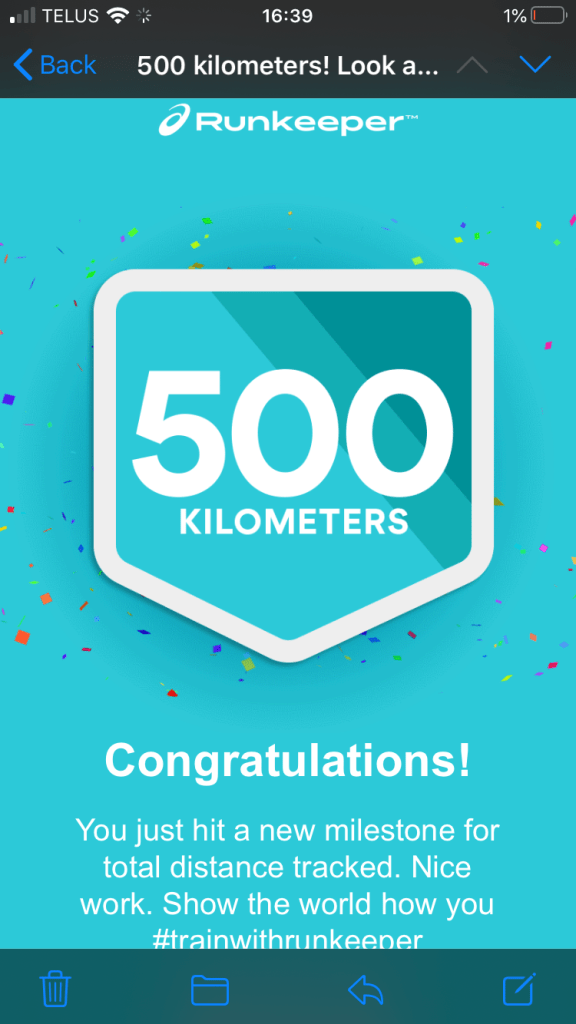
The truth is, that 40-kilometre trek was accomplished LAST Saturday, with the majority of my treks coming in at the 20 and 30-kilometre totals. The good news is that I’ve already broken a pretty decent milestone for this season, that which is to have cycled for over 500 kilometres!

I’m trying not to be TOO overexcited about this, since it really only takes a little over a dozen outings at 30k to reach this number, but I’ve never really tracked total mileage before and have certainly never pushed myself cardio-wise, as I’ve been doing lately.

But as fate would have it, life rarely cares about one’s plans. Last Tuesday, I left the house fully motivated and fully caffeinated, with the intentions of pushing to reach 50 kilometres. This only made sense as it would be the next milestone for me in my insane summer plans. I left the house early in the afternoon, and set out to get as lost as I could, considering I’m being tracked through GPS.

When I reached about 20 kilometres, I started feeling a consistent thumping, coming from the rear tire. I chanced running whatever may have been ahead of me long enough to watch the rear tire for a moment and noticed it was significantly below pressure. The thump I felt was the valve stem being pushed against the inner surface of the wheel due to low pressure.

I texted my wife to let her know what happened and walked the bicycle for about half a kilometre to local gas station in the hopes of re-inflating my tire. When I got there, I was dismayed to learn the the air compressor required money to activate. Did y’all know you had to pay for air? Because I sure as hell didn’t, and I had no cash on me.

I was lucky enough that one of the employees was kind enough to loan me a dollar so I wouldn’t be stranded. I re-inflated the rear tire and it seemed to be holding, so I continued on. I lost air pressure once again about two kilometres further from home. I had reached 22.24 kilometres. I threw in the towel and asked my wife to come pick me up, which required handling and loading two small children. My wife puts up with a lot of my shit…

I was pretty pissed off as this was the second time I had flattened a tire in recent months. But since it was the rear tire and has all the gears and parts included, I didn’t trust myself to remove it to replace the tube (especially since I royally f$&ked the brakes on my last bike doing it on the front tire). So it was decided that considering the various terrain I cycle on, I should go purchase a new mountain bike.

You wouldn’t think that buying a bike would be difficult, but finding one that wasn’t ridiculously high-priced and suited my size and needs proved to be more difficult than anticipated. I spent all day, last Wednesday, wandering among five different retail locations, with no luck. Yes, you read that right: FIVE! Some locations were out of stock, which it almost seems as though Regina is suddenly ga-ga for bikes, or some didn’t have a frame size to accommodate my height, or the cost was simply too high. A certain popular retail chain that uses a blue and yellow colour scheme only carried bikes that were $798, of all things! And their prices are usually better than most! Yes, I’m cheap!

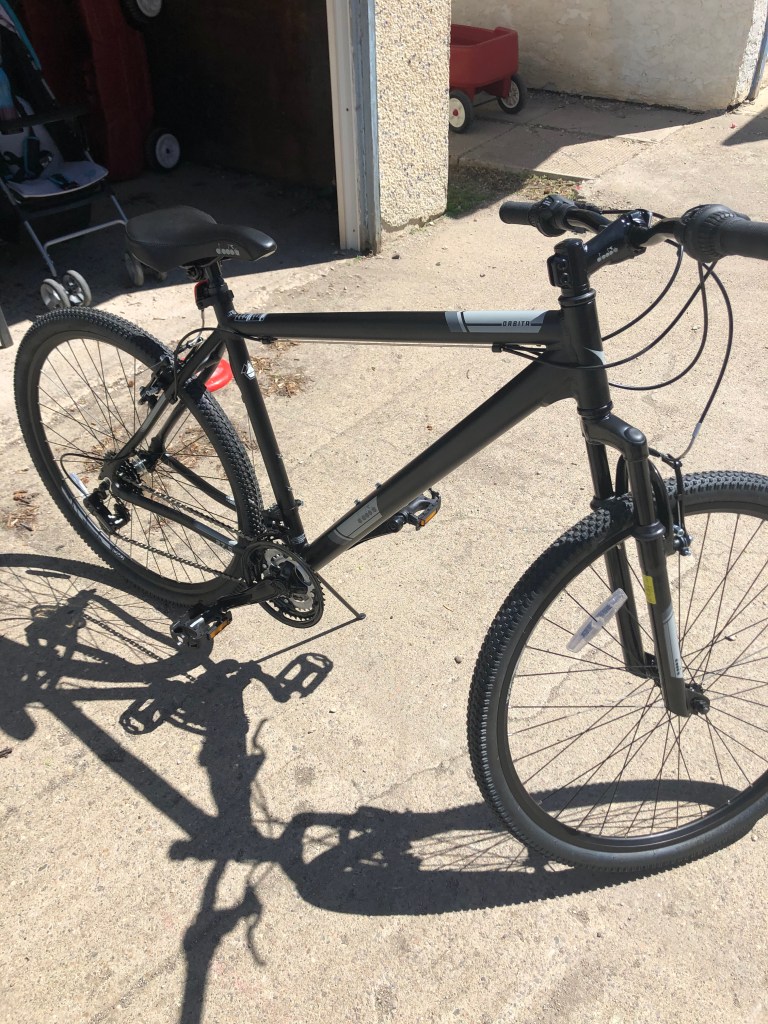
I had a few more locations that I was able to check last Thursday, and thank the Light I was able to find one at a SportChek location, here in Regina. It had everything I was looking for: mountain bike, proper frame and wheel size, mountings for a water bottle and tire pump and the price was reasonable. Done deal! The staff helped by performing a pre-purchase checklist to ensure the gears, brake and tire inflation were all up to standard before I left the store.

The new ride, still naked without all the accessories.

So, having picked up this bike last Thursday, I strapped on my water bottle holder and travel bags and took a spin. The north-bound wind was strong enough that I almost turned back after 3 kilometres, but I stuck it out. Plus, the staff may have SAID they properly inflated the tires but they were slightly under pressure, which caused some drag and made the trek difficult. I had to stop at 30k, but I at least I broke her in!

So there you have it: the new beast I’ll use to kill myself slowly through long-distance cycling! I’ll admit that all the cycling I’ve been doing has made my legs feel better (an important aspect when you have Diabetes), have improved my blood sugars and make me tired enough to actually get SOME sleep at night, despite my current work situation. I’m looking forward to tweeting my ride further, and increasing the distance I travel in the weeks to come. Hopefully with less strong winds pushing against me. ☯

I’ve Got A Plan…🚲

So, if you’ve been following my blog for a while, you’re aware that I enjoy cycling. For the most part I’ve been doing it as a means of throwing a little cardio into my week, or getting fresh air as opposed to working out in my basement as I usually do. But as the warmer season has hit Saskatchewan and the world has basically ground to a halt, I’ve started to use my bike more and more.

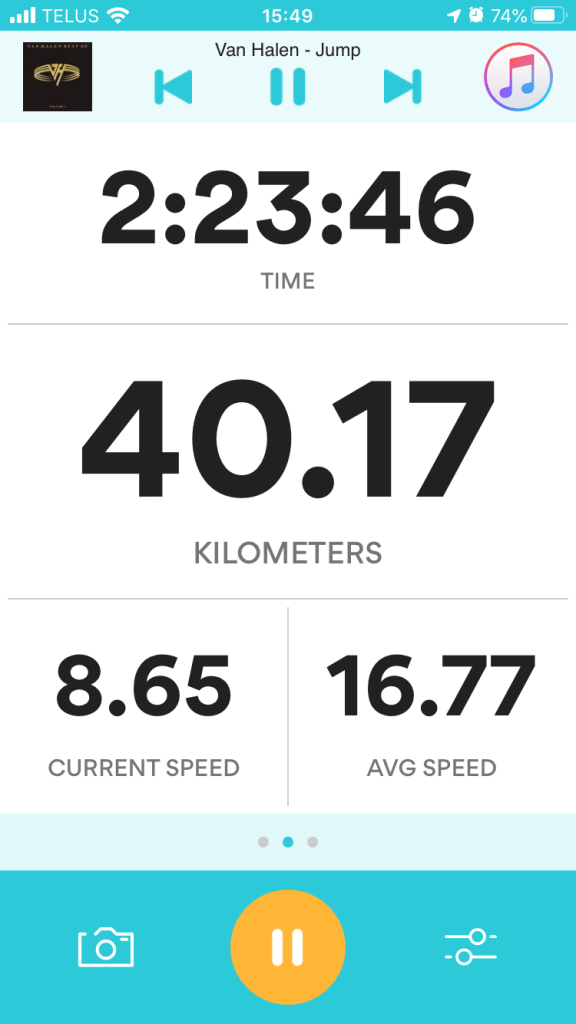
My season started off pretty simply; a quick 10k here, a smooth 20k there… But as I’ve been going on further outings and pushing myself harder and further, I’ve been increasing the mileage I accumulate with every trip. About a week ago, I racked up 31 kilometres. I felt a tad on the hurty side the following day, but I pushed through and recovered nicely. Last Saturday, I achieved 40 kilometres in just about 2 hours.

And yes, that’s Van Halen I’m listening to!

When I got home, I’ll admit I was pretty exhausted. My legs hurt, I was sweaty as shit and all I wanted was a nap. But I overall, I felt damn good. It got me to thinking… I can keep pushing myself and going further and further as I train. It’s what I’ve been doing for years. Cycling is simply the newest fitness niche I’ve fallen into. But I’ve started to wonder how I can use this to potentially help others.

Since I’ve already reached 40 kilometres, why not 50? 60? 80? At 80 kilometres, I can reach Moose Jaw from Regina. I can also reach Strasbourg, where a couple of friends reside so that I have a familiar location to make a stop before returning home. Yay me! So how can I use this to benefit others, you ask? Well, I’m glad you asked that question…

Since we’re just past mid-May, I can easily contribute the next two months to interval training in order to increase the amount of distance I can reach with every outing. My intention is to cycle several hundred kilometres, let’s say 200, at end of summer. That would put me safely within reach of Saskatoon from Regina. I want to reach out to Diabetes Canada, formerly known as the Canadian Diabetes Association, and obtain some assistance in turning my trek into a fundraising initiative in favour of my cycling.

If necessary, I intend to increase the distance. Hell, why not Portage La Prairie, Manitoba or Winnipeg? Go for the big 500 kilometres? As long as I’m willing to take breaks when necessary and keep my meals carb-rich as I travel, I’m confident I can make any distance I set my mind to. So why not leave a mark to better the world while I still can? Makes sense, right? What the hell else have I got to do at the moment?

Let me know, in the comments, what your thoughts are or if you believe I’m totally off my rocker. Doesn’t mean I won’t do it, but I’d appreciate everyone’s input… ☯

It Takes Two, Baby…🎶

Depending on what your motivation may be, working out by yourself can suck. Royally. On the other hand, certain activities that I train in, like meditation, learning a new karate form or burning off steam on a punching bag, can work quite well when I’m alone. But it stands to reason that having a partner when you break a sweat can have some measurable, noticeable and unexpected benefits.

When I first started the martial arts, I felt exposed. I’m sure some of you have been there; you walk into an environment where EVERYBODY knows more than you do. Potentially. So even though you happen to be standing at the back of the class, you feel like everyone’s eyes are on you, judging you, watching you excessively sweat and gasp for air as they go through the motions barely showing any effort… Nah? Just me? Whatever… let’s carry on…

According to an online article I found on NBC News of all places, working out in a group has the benefit of others’ healthy habits rubbing off on us. The article states that a 2016 study found that “overweight people tend to lose more weight if they spend time with their fit friends […]” Which can certainly make sense if all the time you spend with said “fit friends” happens to be at spin class, yoga, zumba, cycling and etc.

Certainly, there is a great deal to be said for the accountability factor, where it’s more difficult to skip the workout when it’s part of a pre-organized program with others. And you inevitably end up kicking your workouts into high gear in order to accommodate and keep up with others who are doing the same. The above-linked article touches on these aspects as well.

All of this can certainly be true of karate. After those first few classes, I found myself pushing hard to keep up with the other students. Karate is one of those “keep up or be left in the dust” environments where you’re totally free to move at your own pace, but eventually it just won’t be enough. But the camaraderie that develops once you start holding your own is particular. It’s one of the aspects I most enjoy within the dojo.

Ultimately, working out with a friend or loved one doesn’t just keep you accountable through fewer skipped workouts. It can also encourage you to try out new exercises or activities you may not have thought of and may encourage you to push harder in order to keep going. Surprisingly, you may even catch yourself working out for longer periods as you’ll discover something other than fitness. You’ll discover that working out with a partner is fun.

My wife and I occasionally enjoy some fitness circuits together. She’s a champ and is always a good sport, no matter what I throw at her. I enjoy it a great deal, because it not only helps her to stay fit and get the blood pumping, it also allows me to include her in an important aspect of my life. So working out with your spouse is very important. It doesn’t have to be an all-out sweat storm that flattens you for the next couple of days; I rather save those for my friends whose suffering I enjoy (looking at you, Jayden!).

In closing, working out with a partner can also ensure your safety. If you happen to be doing something like lifting heavy weights or hiking in a remote area, having someone with you can ensure that you’ll have immediate help should something go wrong, which can be an important aspect if you happen to have Diabetes and suffer a low at an inopportune time. Not to mention that a little healthy competition amongst friends or loved ones is never a bad thing. So get out there and challenge yourselves. The only limits are the ones we set ourselves. ☯

When The Way Is Right…☸️

I don’t deny that one could say I became a Buddhist almost by accident. I hadn’t even HEARD of Buddhism when I started martial arts in the late 80’s, yet here I am. Decades later, constant study and trying to follow the right path. A good portion of my story is a prime example of cause and effect. As I progressed in the martial arts, I was introduced to concepts such as Budo, Bushido’s code and my first introductions to Buddhism.

Despite the accidental introductions (or not so accidental, if one believes that all things happen for a reason) there have been a number of measurable benefits to my years of Buddhist study and martial arts. I originally got into martial arts for the purposes of improving my health, and it has turned out to provide more benefit than that scrawny kid ever could have imagined when he set out on the journey…

There’s no denying that the martial arts has provided me with a number of significant advantages.  The physical requirements and exercise has helped to improve my insulin sensitivity and fight off insulin resistance.  The intense training has provided me with better blood circulation, which as most of you likely know, is VERY important to someone with Diabetes.  Measurable improvements in body mass and appetite followed, allowing me to survive well past the window of expectation that most of my doctors had for me in the late 80’s, early 90’s.

  When I started studying Buddhism, some of the most important aspects that I began to work on were mindfulness, meditation and control of my inner thoughts and emotions.  This is not to say that I don’t display emotions (my wife can attest to that), but my practice has allowed me to control how I externalize my reactions and emotions.  Over the years, this has allowed me to deal with problems and face issues in my personal and professional life in an almost detached manner that allows for logic to step in and for the emotion to come out at a later time.

Something I need to point out is that most people automatically associate Buddhism with meditation, but the truth is that you can reap the benefits of meditation on its own.  Not only from a Diabetes standpoint but for people in general, meditation can do a world of good.  This is becoming a well-known fact, and plenty of people are getting on board.  Meditation is offered/taught in some places of work, schools and a variety of classes where different varieties of meditation are taught.

And yes, there are different types of meditation.  Some of the most popular ones are transcendental meditation, focused meditation, mantra meditation and relaxation meditation are but a few, and it all depends on what you’re trying to accomplish with the meditation that you do.  Just like there are a variety of types of yoga and types of martial arts. 

But some of the benefits of meditation can include lowering one’s blood pressure, controlling pain within the body, improving one’s sleep, helps one to focus and increase self-awareness and helps with stress and anxiety.  All of these things can be helpful with the control of blood sugars and overall Diabetic health.  You can find introductory classes on guided meditation in most major cities, and there are plenty of books on the subject as well.  Be sure to keep an open mind, and if it doesn’t feel right to you, don’t be afraid to  seek out different classes as every instructor or teacher may have a different method of imparting the knowledge.

I may have fallen into some of what I do by accident or coincidence, but I’ll never look back.  One of the beautiful aspects of meditation is that you can basically do it anywhere.  All you need is a comfortable place to sit/lie down, whatever your preference may be.  ☯