I always like to keep an ear open to new things, especially where my health and fitness are concerned. And something I’ve been reading about recently is a slow-digesting protein called Casein. Somewhat comparable to whey protein, Casein is absorbed and used by the muscles at a different. According to an article I found on Men’s Health, casein is a slow-acting form of protein that “drip feeds your muscles” and “your blood amino acid ‘peaks’ with your protein synthesis […] and continues to do so for up to four hours after ingesting.”
So, what’s the skinny? Is this shit better than whey protein? From what I’ve read, they’re both quite similar with the exception that whey is absorbed much faster. The slower rate at which the body processes Casein makes it a bit easier on the body as it provides a steady stream of amino acids and protein to the body instead of having get all soaked up in one shot. That same Men’s Health article goes on to explain that Casein is usually best taken before bed, since its slow delivery allows for better muscle recovery while you sleep.
Another article I found posted on Muscle & Fitness also agrees that whey is the best option as a post-workout protein, but lists a number of benefits to including Casein in your fitness regiment. Besides lasting longer than whey and helping to provide greater strength, the article boasts greater muscle gains and some fat loss benefits. Of course, like everything else, this is combination to a good diet and consistent exercise.
One last benefit that Muscle & Fitness included is that the consumption of Casein can potentially reduce and prevent the effects of enamel erosion. That’s based on some studies from the UK, of course. So one needs to take it with grain of salt. But it would be cool if it did since you don’t usually hear about fitness supplements providing such a benefit.
Last but not least of course, is the fact that there are some studies showing that Casein can help with insulin and glucose levels. But I wasn’t able to find anything definitive. At least, nothing worth mentioning here. But I intend to keep researching and looking into it and I’ll be sure to add to this if there’s a positive Diabetic component that’s found.
In the meantime, I’ll say the same thing I say with everything else. Although this is an over-the-counter supplement, you should consult your medical practitioner before adding any specialized supplements to your daily diet. Like everything else, Casein may not be for everybody and since everyone is different, all the benefits listed in these articles may not necessarily work for you. ☯
Objectively-speaking, I’m a bit of a weirdo… I can already hear my friends arching an eyebrow while saying, “Objectively???” But seriously, I tend to dip into the strange and unusual on occasion, but today’s post will be simply something to gross most people out. If you have an aversion to feet, you may want to back out of this post now without proceeding any further.
A couple of weeks ago, I was enjoying a nice half hour of shadow boxing in my home dojo. As I’ve written in previous posts, I purchased a whole batch of black foam mats that interconnect, making for a nice, open-concept area with a padded floor. Perfect for karate, wrestling, circuit workouts and more. During a particularly spirited portion of shadow boxing, I decided to execute a tuck ‘n roll where I come to a stop, delivering an elbow strike to my “opponent” on the floor. During the roll, I discovered an important detail about those foam mats. Toenails don’t slide on them…
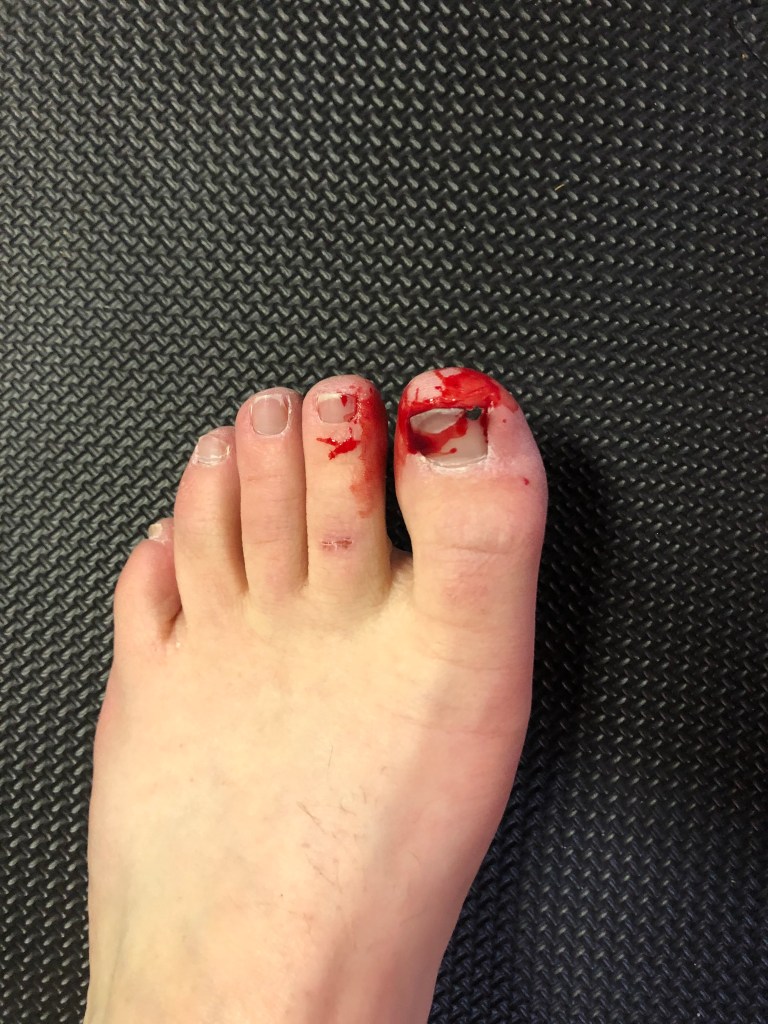
My left foot, in all its bloody glory!
When I executed my roll, I pushed off with my left foot. My big toe was the last thing to leave the mat, which caused the nail on my big toe to press down against the mat. When my toe continued moving, the nail decided to stay with the mat. The bloody line that’s clearly visible along the middle of the nail is where the toenail lifted. I completed the technique and continued on my merry way. It wasn’t until a minute or two later when I threw a front kick with the left foot that I noticed a bright, red drop fly out towards the wall. I looked down and discovered the mess you see above.
It’s not a secret that proper foot health is important to anyone with Diabetes. Over time, most people with Diabetes will develop SOME level of Diabetic Neuropathy, which can lead to all sorts of complications with the body’s extremities, namely the feet. The main concern with Neuropathy is that it can cause a loss of feeling in said extremities, meaning you may not feel the injury when it happens and delayed care can lead to infections or worse.
Another particular concern, is that Diabetes can also lead to lessened blood circulation. With less blood circulation (or slower blood circulation) the required platelets, nutrients and cells required for healing will be delivered much slower to someone with Diabetes, hence the reason you always hear that foot injuries take longer to heal. And that’s if they heal at all. For someone with extremely poor blood sugar control, medical intervention can be required in order to help the wound heal as it may not be likely to do so on its own.
A close-up, just because I’m a sick bastard…
For those of you who may be wondering: Yes, I felt the injury. Albeit not immediately. There was a delay due to the music and adrenaline. I was kind of in the zone. But I noticed the blood BEFORE I felt the sting. No, I didn’t halt my workout. I probably should have, in the interest of cleaning the wound and bandaging it appropriately. But I was about 20 minutes into a 30-minute shadow boxing routine and I didn’t feel the 10-minute delay would result in the loss of my toe.
But it’s important to recognize that if you have Diabetes, wounds should be cleaned and bandaged in a timely manner, even if they don’t hurt. Poor circulation issues and Neuropathy are sneaky bastards and can cause damage if you ignore injuries. Like the freshly forged blade of the samurai, my training mats have now been anointed in blood. Even if it’s mine. Damn it. Nathan plays on those mats. Looks like I’ll have some cleaning to do, once I’ve mended my toe… ☯
Stretching is an important requirement to proper health and fitness, and it continues to amaze me how many people don’t take it seriously. For example, I see a lot of karate students who show up to the dojo five minutes before start of class and jump into it cold. There are significant risks to such a practice, which many students seem to forget. Yes, I know what you’re thinking… In the street, you won’t have time to stretch if you get into an altercation and had to defend yourself. While this is certainly true, we stretch and train our body so that in the event of a cold start such as a street fight, your body is conditioned and muscle memory kicks in.
There’s a significant balance between too much and too little, when it comes to stretching. Have you ever gone a full week without doing any exercise? Notice how everything feels tight and it seems a bit harder to move? This is because over time, your muscles will shorten and tighten up if you don’t stretch regularly. This is why stretching is required in order to stay flexible and mobile and to allow full and proper motion of our joints. In fact, some would argue that stretching is more about mobility than fitness. But I believe it holds some importance in both.
The key thing is to not overdo it. You should aim to stretch for anywhere from about five to ten minutes in order to ensure your muscles are warm and pliable. Not to be mistaken with an actual warmup, of course. But after about a ten to fifteen minute warmup, get to the actual workout. It is actually possible to stretch TOO much, and this can lead to injury, damage to ligaments and tendons, pulled muscles and even hypermobility.
Although most people have some form of hypermobility somewhere in their body, it’s not a good thing. Hypermobility refers to the ability of certain joints to move beyond their supposed range of motion, which is a problem that can cause it’s own batch of complications and issues. So it’s important to find a correct balance in stretching and warming up the body.
Stretching should be done right before a workout, although some argument has been made for stretching afterwards, as well. Depending on the type of workout you do, stretching after the workout can help keep the muscles flexible and help prevent stiffness and injury. But you should start by finding a comfortable corner and stretching slowly, breathing and moving comfortably. Although it can be useful to try reaching a bit, it’s important not to extend beyond what’s comfortable. Stretching can provide a feeling of tension, but it shouldn’t be consistently painful or stinging.
Once you’ve stretched and warmed up all the required muscle groups, you’ll want to slip into a warmup. Warmups can contribute to stretching and mobility, but depending on the workout you’re doing are meant to get your heart rate up and the blood pumping. So it’s important to keep the two separate, in terms of completion. Start small, going no further than what your body can comfortably reach. As you fall into a routine, you’ll likely notice that your flexibility is increasing and you can stretch farther. But don’t push it! It isn’t one of those things where if you reach it once, you can reach it again. Muscle tissues will tighten and loosen depending on how frequently you stretch and exercise and how often you don’t.
If you’ve managed to overstretch or stretch too much, you’ll notice a number of symptoms including swelling, redness and weakness of the muscle in question. In fact, it may even hurt while you’re at rest and you may not be able to use that particular overtaxed muscle for a period of time. At home treatment can include some over-the-counter anti-inflammatory pain meds, resting the muscle in question and using the PRICE method (Protection, Rest, Ice, Compression and Elevation) until the injury subsides. The important thing is not to return to stretching the damaged muscle before its had a chance to heal.
If you hear a sharp popping sound while stretching, feel pain at a level that can’t be tolerated or ignore or are completely unable to move the limb associated to the muscle group, you should seek immediate medical care. You may have torn something that can only be repaired at the hospital. It’s important to use your judgement but don’t try to “tough it out,” and injuries can be become aggravated easily. You can stretch after a workout as I mentioned earlier. But if you do, keep it to a minimum as your body will already be tired and it can be easy to overdue it. ☯
Lifting weights is an important part of health & fitness, even if you’re not necessarily trying to bodybuild. And to be clear, weightlifting and bodybuilding are not one and the same; weightlifting is only one of the activities that a bodybuilder performs in order to build upon themselves, with a score of other important factors at play. I’m certainly no bodybuilder, nor do I aspire to be. I use dumbbells and kettlebells freely, as gaining and maintaining true muscle strength is important in the martial arts and in maintaining the bodily strength required to keep healthy.
And before I go too far into my opinionated rant, let me just say that I have a reasonable amount of admiration for those who are able to sculpt and develop their bodies the way you’d see on a sports network. The old-school Schwarzenegger look may even suit some people, although I find it altogether exaggerated and a bit much. And there’s a significant difference between true strength and bodybuilding. In actual strength training, a person will use the lifting of weight to increase muscle size in order to increase strength, and can use that strength functionally. Bodybuilders are lifting weights solely for the purpose of increasing their size. Although there will be increased strength during the process, it may not be as effective as proper strength training.
The purpose of today’s post isn’t to bash on bodybuilding. As I mentioned earlier, kudos to the folks who are able to sacrifice and work hard towards making their bodies the way they want them to look. Today’s focus is on increasing the mass/size of your body and how it relates to the martial arts and proper health. As it just so happens, being a little too “buff” can have some negative and even detrimental side effects on the human body.
Let’s cover off the martial arts aspect, well… just because! I’ve seen a number of heavily-muscled people walk into the dojo throughout my youth, only to walk out after a few classes. And why do you suppose that is? Well for one thing, increased size will DECREASE your flexibility, mobility and range. You’re stiffer and tend to move much less easier. Just to be clear, I’m referring to people who are REALLY muscled. But in a combat art such as karate, flexibility and mobility are extremely important, for obvious reasons. Are there exceptions to that rule? Absolutely. But the really buff people who still have all the flexibility and mobility are VERY far between.
Speed is another. Your punch may have all the strength of those massive arms behind it, but it means nothing if I can casually avoid your fist because you’re moving like melting butter. The bigger you are, the slower you’ll move. Physics says so. You can only move so fast, as speed equals distance over time. The bigger you are, the more time it takes you to cover the distance, hence slower speed. Picture the difference between a 2-door coupe and an 18-wheeler. It’s easier to achieve a specific speed with the coupe because it takes less time to cover a specific distance due to less weight. There’s your high school physics lesson for tonight. But in the event of a real fight scenario where a person’s wellbeing hangs in the balance, expect that I’ll kick in your knee caps while you’re trying to take a swing. You won’t see it, as your field of vision won’t reach over your massive chest, but you get the idea…
And that’s the other problem is the excess size. You’ll be restricted by your own clothing, for Light’s sake! You’ll have less ability to maneuver in tight spaces, leaving the advantage to the smaller, trained fighter. This is why it’s always been a bit of an issue for me, when people automatically say things like, “Look at how buff that person is. I wouldn’t want to mess with them!” Having big muscles is only one small part of the equation that allows you to use them effectively to protect yourself and others.
And now, because I write about Diabetes, let’s discuss how increased muscle mass relates to health. Don’t forget that the bigger the engine, the more fuel is required to operate it. The human body is very much the same way. The bigger you are, the more calories you’ll need to consume to maintain your body on a daily basis. For someone with Type-1 Diabetes, who needs to calculate carbohydrate intake and take insulin dosages accordingly, this can be a significant problem. I’m not saying it can’t be done; I’m saying that finding that proper balance will be all the harder. And you may cause damage in the process, from a Diabetes-standpoint.
The next issue is the toll it takes on the body. Being too muscular is just as bad as being obese. Don’t believe me? Weight is weight, and your skeletal structure doesn’t grow stronger to accommodate your increase in mass. Your bones, organs and vital bodily systems may not be able to accommodate become too buff. Just think of your heart and how much hard it has to work to maintain all the added mass. That’s why bodybuilders will frequently suffer heart and organ issues. Schwarzenegger himself has had heart surgery. That should tell you something.
There’s nothing wrong with increasing one’s muscle mass. In fact, it’s one of those “happy medium” things where lifting weights a few times a week can decrease the chances of cardiac issues while doing it too much will tax your heart. take it with grain of salt. If we’d pay attention to absolutely EVERYTHING that can be harmful, we’d die of worry instead. Ultimately, the point is that muscle mass for strength good/ Muscle mass for size, bad. Especially from the martial arts standpoint. Just for shits and giggles, here’s a commercial from 2011 for Planet Fitness that makes me laugh every time I see it… ☯
In recent months, I’ve been trying to reduce my daily caloric intake in the hopes of slimming down a touch. You’ll notice I said “reduce,” and I mean just that. I don’t allow myself to get hungry and I’ll still permit the occasional snack-based indulgence when I feel it’s warranted. In fact, most research I’ve read has confirmed that this is the best course of action, since denying yourself cravings will usually lead to a slippery slope of binging on junk food. But I digress…
If you work out often and consistently, I’m sure you’ve been there… You’ve got a good sweat going, decent music is blaring on your iPhone, your son is destroying everything in his path… or maybe that’s just me! But suddenly, you feel a hollow gurgling coming from your gut, followed by the telltale growl of hunger. What to do? Do you stop your workout simply to go grab a snack? Out better yet, is it okay to start your workout on an empty stomach? That, dear readers, is the important question!
Speaking strictly from a personal perspective, going into any kind of intense workout on an empty stomach can be somewhat problematic, bordering on the dangerous. After all, depending on the type of workout I perform and for how long, my blood sugars will either drop to the floor or skyrocket. As a simple matter of planning, I usually need to decide what type of workout I’ll be performing before I do it so that I can decide what food (if any) I should be consuming prior to feeling the burn. But the question I posed is whether or not it’s “okay” to work out on an empty stomach.
There’s a prevailing theory out there that if you work out on an empty stomach, your body will be forced to burn fat as fuel and you’re more likely to lose weight through the burning of fat. This is a concept known as fasted cardio and like everything else in the world, its effectiveness has been debated back and forth by various studies over recent years. In fact, according to an article posted by HealthLine.com, a 2016 study showed an increased fat burn and a lower daily caloric intake. But the same article also points to a 2014 study where there was no measurable benefit to doing so.
One of the big problems with working out on an empty stomach is that your body may not necessarily use fat as the next fuel source. An article posted by WebMD explains how the body may lean towards burning the sugars in your muscle tissue, which will actually lead to sacrificing some muscle mass in order to try and lose fat. And both articles agree that even IF your body burns through some fat as energy, it’ll likely just adapt to doing this by storing MORE fat when you finally do eat.
As with most things in life, it’s all about balance. You want to try and consume whole foods that are healthy and prepared at home as opposed to foods that are processed and high in sodium and unhealthy fats. Knowing your body and how your blood sugars respond to specific workouts will go a long way towards helping to ensure you get maximum bang for your buck during your workout. A fasting workout also means that your energy levels and stamina will be much lower, causing you to be far less effective DURING your workout. The flip side is to keep your portions small, which will ensure that you don’t get nauseous during an intense workout from a full stomach.
Personally, I’m not a fan of jumping out of bed first thing in the morning and hammering at it. I’ve done it. But I hate it. But if you keep your portions small and healthy, you’ll have the fuel you need to power your engine and you’ll still hit the fat-burning threshold once you’ve depleted that fuel. I’ve always said that there are no shortcuts or easy steps to losing weight. One needs to be patient and work towards it. And whether you choose to work out on an empty stomach or not, remember that you’ll need to eat in order to replenish yourself within the couple of hours following the workout. Check your blood sugars before and after your workout (and during, if you simply don’t feel “right”), stay hydrated and don’t forget to consult your medical practitioner if you’re starting a new workout routine and you aren’t sure if it’s right for you. ☯
There’s a significant difference between training in the dojo and getting into an actual conflict on the street. For one thing, the dojo should (hopefully) be a controlled environment and includes a gi or other garment that’s inherently designed to promote proper movement. And dojos usually involve training barefooted. So what happens when you get into an altercation where your movements may be restricted by street cloths and shoes or boots? In this video, I briefly explain some of the issues you may face when trying to use karate while dressed for street instead of the dojo. ☯
The decision to join martial arts can involve navigating some pretty choppy waters. And knowing what to look for in order to ensure you’ll get what you want/need out of martial arts can be important. The video below explains what I believe you should be watching out for, when you walk into a dojo for the first time with the intentions of joining. This is not an exhaustive list, by any means. And if any of the martial artists reading this post and watching the video have anything to add, please feel free to include them in the comments. Enjoy!
The human body has a pretty bad ass nervous system, and that system is responsible for more than most people think. Your nervous system is not only responsible for the sending and receiving of information between your body and your brain, it’s also responsible for generating how your body reacts to the information it receives; either from the brain or from outside stimuli. Your nerves are also what your children seem to think is appropriate to climb onto during a Sunday morning when they believe it’s appropriate to both wake up at 7 o’clock in the morning as opposed to letting their parents sleep in! But I digress…
One of the common side effects of Diabetes is Diabetic Neuropathy. This is the damage that can happen to your nervous system due to frequently high blood sugars and bad blood sugar control. This happens because as the tiny blood vessels supplying blood to your nerves are damaged, you begin to get that numb feeling in your extremities. This often starts with the feet and legs, although it can be present elsewhere. About half of people with Type-1 Diabetes will experience some level of neuropathy if they’ve had Diabetes for 10 years or more and lack proper control.
There are ways to deal with this, of course. Maintaining proper blood sugar levels to prevent the aforementioned blood vessel damage is key. Maintaining good blood circulation is also incredibly important. That’s why I often harp on and on about the importance of good fitness. It’s not all about being buff, which is a problem I don’t have, anyway. Being physically active not only helps in controlling blood sugars and processing your body’s fuel, it also goes a long way towards promoting proper blood circulation.
I often like to say that one’s body is an engine. Most modern engines have a computer controlling everything, which would be your brain. And since there needs to be some sort of interface between the engine and the computer, this is where your nervous system comes in. So what happens when you introduce something foreign into that interface? As a someone with Diabetes, I’ve been a living pincushion for 38 years. Wow, 38 years… Times sure flies when you’re dealing with Diabetic bullshit.
But seriously, I’ve had to deal with thousands upon thousands of injections during my life, including finger pricks, insulin injections, IV injections and in recent years, intravitreal injections for my eyes. So what happens if you stick one of those needles into a nerve? I can almost promise that if you’ve had Diabetes for any length of time, you’ve had this issue. Maybe you didn’t realize it at the time. Or maybe you’re dead inside and didn’t feel it. That’s not a joke; I mean that if you have neurological damage and the associated nerve is injured due to damaged blood vessels… Come on… I’m not ALWAYS sarcastic.
But being on insulin pump therapy in recent years has introduced a different problem I haven’t had to face during all those years. I now have plastic cannulas inserted into my body for days at a time. For the insulin pump aspect, it isn’t a big deal; the infusion set is changed every three days. But for the CGM, or Continuous Glucose Monitor, it can be more problematic as this sits in place for a full seven days (approximately) unless there’s an issue or a failure. So, what happens if one of those is injected into a nerve?
The first thing you’ll notice is pain. I mean, needles hurt by their very nature. But inserting one into a nerve will hurt more than usual. This can be difficult for someone with Diabetes to discern, since numbness in the extremities may make the increased pain difficult to notice. But you MAY notice continued or constant stinging at and around the injection site for as long as the cannula is in place. You may also notice a mild twitching of the muscle grouping around the nerve, which is an after effect of the nerve’s reaction.
The pain and damage is normally temporary and will go away either once the nerve heals itself or you’ve removed the object causing the issue. But since this is Diabetes and nothing is ever easy, it’s important to be aware that permanent damage CAN be caused. Of course, I’m referring to tiny, sensory nerves that are generally close to the surface of the skin. So they tend to heal up quickly, but if they’ve been cut or puncture in any serious way, it can take several weeks to heal. Increased exercise will release endorphins, which are the body’s natural painkillers and provide increased blood flow. That will also help the nerve to heal faster.
As with anything in life that gets on your nerves, you have to deal with it and make it stop. If you experience burning pain or twitching muscles that doesn’t seem to be subsiding, it may be worth it to remove the cannula or sensor and start over. If you pay for your supplies “out-of-pocket,” this may not seem like the optimal choice if a sensor is supposed to last 7 days. But it may be preferable over causing permanent damage or dealing with the pain for a week. ☯
A couple of weeks ago I was chatting with a fellow blogger who asked me an interesting question in relation to how I meditate. We had been discussing the ability and opportunity to meditate in the midst of being at home with family, pretty much around the clock. This discussion led to a question about what posture I use and how I deal with comfort issues and positioning during meditation. Since I effectively never do anything the easy way, the answer is not as simple as one specific pose or position.
The kneeling position, known in martial arts circles as “Seiza”
For the most part, I sit in a kneeling position during meditation. That doesn’t mean that this is always the OPTIMAL position, and I do tend to use a few different ones. But the position you see illustrated above is one that’s also associated with karate and some formal Japanese settings, so I’ve had most of my life to get used to it. Named “Seiza,” this position requires the person to kneel on the floor, placing their calves beneath their thighs and pointing the toes out behind them. The big toe on the right foot overlaps the left one, and the butt rests on the heels of the feet.
There’s a bunch of pomp and ceremony that goes into how to sit down and get up when using this posture, as well as when it’s appropriate and/or required to use it. But this post ain’t about all that. This is a posture that Sensei would often have us close out in, as it allows for a few moments of deep breathing and contemplation at the end of a workout. It also makes it significantly easier to bow respectfully when karate class closes. This posture is also used at the current karate school I train with, both at the beginning and the end of class.
From a meditation standpoint, I like this posture because it effectively forces me to sit up straight. I can breathe fully and unlike the lotus position, which I’ll cover off next, this posture doesn’t allow much room for me to slouch or slump. The downside is that sitting on one’s legs for more than about 20 or 30 minutes can lead to a condition called “paresthesia,” which is where some of the nerves and the blood flow in the legs become compromised resulting in the “pins and needles” sensation when a limb falls asleep. It’s never a good thing to block circulation, and since a Type-1 Diabetic’s circulation isn’t all that great to begin with, this can be a concern if you plan on meditating for a long period of time.
The next important posture is the lotus position. This is the classic and most recognizable posture in meditation. In fact, any time you see a statue of Buddha, he’s likely seated in the lotus position. This involves sitting with your butt on the floor with the left foot resting on top of the right thigh and the right foot resting on top of the left thigh in a cross-legged position. The hands are generally resting on top of the thighs, usually with the index and thumb of each hand joined together. This pose is not only used in meditation but is also used in forms of yoga, and is thought to promote the proper channeling of the body’s energy.
This can be a more comfortable posture to assume if you plan on meditating for a half hour or longer, as it won’t necessarily constrict blood circulation the way Seiza does. The problem I find with this posture is that unless I’m propped against a wall, I tend to let my shoulders slump or I start slouching at the upper back, which can become uncomfortable and damaging to the spine over long periods of time. Lotus has many variations to it and I usually favour the “half lotus,” which involves only setting one of the feet on top of the opposing knee with the other one simply being on the floor. This prevents the usual possible circulatory issues.
If you have Diabetes (or any other circulatory issues) there are a few things you can do to help facilitate meditation, regardless of what pose you use. You can get a meditation pillow. These are great as they keep your butt about four to six inches up off the ground, putting less stress on the knees, hips and various joints associated with meditative postures. The Japanese have special little folding stools that allow for the appearance of the kneeling position while taking the stress off of joints and allowing proper circulation.
Last but not least, you can try traditional postures, such as sitting in a chair. This is fine and I’d be lying if I said that I’ve NEVER done it. It just feels weird to me. Probably because I’ve spent my entire life using formal postures. Sitting in a chair just feels like it takes something away from the experience. You can also try lying flat, either on the floor, a yoga mat or on your bed. The only problem with this is if you lie on your bed and start breathing deeply with your eyes closed, you face the risk of falling asleep. Although I’m a big fan of naps and falling asleep isn’t necessarily a bad thing, it also usually isn’t my goal when I meditate. So I try to avoid this posture unless I’m having difficulty sleeping and I’m intentionally trying to meditate my way to dreamland.
Obviously, there are different types of meditation and postures that go along with them. Depending on what your goal is with meditation, you can’t really go wrong. The important thing is to find a posture that’s comfortable and suits YOU. It should accommodate your body and allow you to relax so that breathing, energy and blood flow are facilitated and you can focus on the mindfulness required for proper meditation. As I’ve often written, every person is different so it should be no surprise that each person’s needs and preference may be different from a meditative standpoint. ☯
We love our families and want nothing but the best for them. Sometimes, the best is not what we think it is and can only be sought out by the family members themselves. But health and fitness doesn’t discriminate, and it’s important that everyone in the family get off the couch and do something physical at least a few times a week. This isn’t always an easy thing to encourage, and some family members will often be less than enthusiastic about being put through the ringer; especially if you happen to be the instructor…
If you happen to be an instructor of a sports club or a martial arts dojo, getting your family involved can be a good or a bad thing. I’ve seen it all… Family members who have basically been forced or coerced to join and family members who feel it necessary to “tag along” even if their efforts are far below what would usually be required of the environment. It can be a difficult and awkward situation, especially since you need to go home and live in relative peace with these people once class is done.
Trying to teach Nathan the basics back in 2019. Kid can’t take a hit…
One of the best examples I can think of are Sensei and his son. As his only male child, Sensei expected his son to train diligently and consistently. And to excel. A bit of an archaic way of thinking by today’s standards but remember that I’m referring to 40 years ago. The son was made to attend every class, train every day and even to start teaching at a young age, despite the fact that by the time he reached his pre-teens, he expressed no interest in karate. As a practitioner myself, I can certainly relate to how heartbreaking that would be. But it’s important to remember that even if karate is your thing, it may not be your child’s.
The result of that forced learning is that decades later, Sensei’s son is no longer an active practitioner. Oh sure, he has skills that will always be with him. And appropriately, he was Sensei’s first student to pass black belt. Those are all important milestones for both of them. But when you compare it to someone like me, who has been eating, breathing and sleeping karate for over 30 years but who joined and trained of his own volition, the difference is I still make it a part of my daily life and have ambitions to teach.
Training with a spouse or loved one has its own set of complications. Imagine having your spouse in your karate class, yelling at her, making her do knuckle push-ups and basically flooring her physically. Then getting home that evening and expecting to share a shower or snuggling up as though you DIDN’T just make her life a living hell. Much to the same tune as working a job with a spouse, training with them can be rough waters to navigate. And if it’s to be attempted, clearly defined parameters and guidelines for what’s expected and what will be done need to be established. By the same token, making sure that nothing is done that could be considered favouritism needs to be kept in mind as well.
It’s important to remember that the familial title should be the priority. If you’re a husband, then that’s your role and it would be very difficult to be a slave-driving instructor to your spouse. They can hate an instructor all they want, so long as they get the results they seek. But it’s a little hard to release and use that hatred against your husband. The same can be said of your children, as forcing them into something they don’t want to do could potentially sour them from being interested in any similar activities in the future. And it’s just as important that ALL family members be active, albeit occasionally for different reasons.
This doesn’t mean that you can’t be active with your family. You can participate in a variety of sports and activities that can get the heart pumping without necessarily taking on an instructional role. Taking walks, snowball fights or sledding are great family activities. Even a good old fashion pillow fight, so long as you have the space and a safe environment to do so. Nathan and I often just roll on the floor mats downstairs, wrestling and grappling. He has a blast playing around while I’m slowly teaching him some grappling techniques. And he’s started showing interest in picking up the 3-pound dumbbells and imitating what I do during at-home workouts.
My wife does not train in karate, but we still work out together whenever we have the chance. Couples who get fit together, stay together. But it would be a different story if I had to act in a capacity where I had to constantly push her and force her to do more. Such student/teacher relationships can lead to resentment and hard feelings. That’s why it’s very difficult, bordering on the impossible for anyone to fill that role while still maintaining the relationship.
There’s no problem with encouraging family members to exercise together and get fit together. In fact, in can even be an inexpensive way of keeping the family involved together during trying times while getting some much needed exercise. But the day your spouse or child decides to walk into your dojo may require some wariness and caution on your part. The difference between “Yes, Sensei!” and “Yes, Dear!” or “Yes, Daddy!” can mean the difference between a happy household or a few slammed doors. ☯









 The Blogging Buddhist