
I found this online a few days ago and I thought I’d share it. Its probably surprising to read a post of mine that doesn’t involve lists or long convoluted explanations about something, but sometimes you just gotta keep things simple. Enjoy! ☯

I found this online a few days ago and I thought I’d share it. Its probably surprising to read a post of mine that doesn’t involve lists or long convoluted explanations about something, but sometimes you just gotta keep things simple. Enjoy! ☯
When faced with a medical condition you know nothing about, people will often make their own assumptions. One can hardly blame them, especially if their education and/or upbringing has provided some “seeded” information that they believe to be true. This is one of the reasons why I find it extremely interesting when someone decides to get past the fear voicing those questions, especially to someone living with the condition.
Enter the big question of the week: “What will happen to you if you don’t have insulin?”
The short answer is that I’ll die. There you go. Thanks for reading. It’s actually a bit more complicated than that, but that’s the short of it. The answer not so much involves the “if” I’ll die so much as it involves what I’ll die from. The bottom line is that before the arrival of insulin, people with Diabetes just didn’t survive. Simple as that. Once diagnosed, they slipped into a coma and died.
Just to be clear, I’m referring strictly to Type-1 Diabetes. For people with Type-2, whether using insulin therapy or not, their life expectancy can extend as long as years, depending on the specifics of their condition, diet, age, exercise and all that fun stuff. But for the average Type-1 Diabetic that can recognize early symptoms and takes precautions, the average life expectancy without insulin is believed to be about 7 to 10 days at most. Nice, eh?
“But why don’t you just diet and restrict yourself from carbohydrates, and exercise more when your blood sugar rises?” Very good question, anonymous person! Here’s the answer…
According to an article posted on Healthline.com, without insulin, your body can’t use glucose as fuel and begins to break down fatty tissue as a replacement, which causes those fats to turn into acids called ketones. These ketones build up in the bloodstream and eventually get expelled through one’s urine. However, when these ketones accumulate in the bloodstream, the blood starts to become acidic. This causes a condition called Diabetic Ketoacidosis.
Ketoacidosis is usually the condition that winds up killing the patient, but some of the symptoms may get to the patient first. These symptoms can include dehydration, shock and slipping into a comatose state. Here’s the HealthLine article, if you want more details: https://www.healthline.com/diabetesmine/ask-dmine-lifespan-sans-insulin#How-did-people-with-type-1-diabetes-survive-historically?
So no, the easy answer is that I can’t simply stop eating carbs and exercise more if my blood sugars rises to dangerous levels. The unfortunate reality is that this would be like sticking a piece of duct tape to stop a crack on the Hoover dam! Eventually, DKA would take over and my blood would turn acidic, effectively killing me despite my best efforts. This is why good blood sugar control and proper insulin therapy is so necessary.
The best way to maintain your health and stay alive, other than proper insulin therapy, is to stay hydrated and recognize the symptoms of DKA before they hit. Your body will cramp and ache everywhere, you’ll fall into the “endless diabetes cycle” of drink, pee, repeat and you’ll likely have confusion and bad breath. This is why it’s important to check for elevated ketone levels if you’ve suffered extreme high blood sugar, as the ketone process may have begun even if you’ve corrected your high with insulin.
Just one more aspect of Type-1 Diabetes that we have to worry about! But this is an easy one to prevent and manage, so long as you adhere to your insulin therapy, stay hydrated and watch your blood sugar levels carefully. Diabetes is already believed to shorten a person’s life expectancy; no need to give it any further opportunities. ☯
Having Type-1 Diabetes is expensive! I’ve spent the majority of my life saying, “I can’t afford to have Diabetes…” And with good reason, considering the cost and expense that goes into everything required to help keep us not only alive, but in good health.
In Canada, the average cost for a bottle of long-acting insulin such as Lantus (this is the type of insulin that would provide basal coverage over a full day) is about $80. A bottle of short-acting insulin, like Humalog, will run you anywhere between $35 to $40 a bottle. And if you’re anything like me, you may require two to three bottles of that sweet stuff in a month.
Now if you’re lucky, a bottle of long-acting stuff will get you through the month. So according to new math, you’d be looking at well over $200 a month for JUST the insulin. Don’t even get me started on the cost of syringes, needles, blood glucose sticks and various other supplies required to maintain oneself in the wonderful odyssey that is Type-1 Diabetes. If you don’t have some sort of medical coverage or benefits, it can be a life-threatening issue.
This is why it’s always so heart-warming to hear about something that helps to alleviate or lessen the burden, financial or otherwise. I just recently read about a bill passed by the Illinois state legislature in November of 2019, which puts a price cap on out-of-pocket cost for insulin at $100. Illinois’ Governor signed the bill into state law in January, with the law taking effect in Illinois in january of 2021.
Illinois will be the second state to pass such a law after Colorado, with several other states beginning to follow suit with bill of their own. An article posted by Newsweek provides further details, including outlining the increasing issue of some people dying from rationing their insulin supplies or skipping doses, to being unable to afford their insulin. Here’s the article: https://www.newsweek.com/illinois-becomes-second-state-cap-monthly-insulin-prices-more-states-are-considering-it-1483987
This is a fantastic step, but obviously it’s only a beginning. To be clear, this price cap applies to a patient’s co-pay, and not to the cost of insulin when purchase over-the-counter. This does not prevent drug manufacturers from charging increased prices for the sale of their products. It is said that in the United States, the price of insulin has tripled over the past decade.
Although this article is based on pricing and laws from the United States, the situation is very much the same in Canada. I remember the difficulties and financial strain I had to deal with, all through my 20’s and into my 30’s, due to the fact that I had no medical benefits to help take the burden of cost off my shoulders. It will be a wonderful time, when governments come to realize that life-saving therapies such as insulin should be made available, free of cost. ☯
Ah, Diabetes… Eternal thorn in my side and the “behind the scenes” silent partner that guarantees all the things I MUST do in my daily routine in order to survive. Type-1 Diabetes has been around for a very long time, from its “humble” discovery in the late 1800’s by doctors who recognized the condition developing after removing the pancreas, to the ancient Egyptians mentioning something pretty close to sounding like Diabetes almost 3,000 years ago.
For those who may not be in the know (and who have never read my blog before), Diabetes occurs when one’s own immune system attacks the body’s insulin-producing beta cells created by the pancreas. Depending on when you were diagnosed, T1D may have been referred to as “child’s” Diabetes or Juvenile Diabetes. The latter was the term I spent my childhood hearing, since the majority of Type-1’s are often diagnosed as children. So, this raises the question as to whether one can contract this specific type of Diabetes later on in life, such as during adulthood…
The short answer is yes. Although we know that Type-1 is linked to the body’s immune system attacking the beta cells, doctors aren’t entirely certain WHY it happens. Some research suggests that it can have genetic components, and researchers are also of the opinion that it could be triggered by outside components like diet or a pre-existing medical condition. That last one is certainly the case for my father who, in his 60’s, developed Type-1 Diabetes. And before everyone chimes in, no, he didn’t have Type-2 prior to this. But he has been diagnosed with a number of medical conditions, including Degenerative Spine.
The challenge with a diagnosis of Type-1 in adults is that most people (and most doctors as well) tend to assume that an adult actually has Type-2. This can be difficult and confusing, since both types will often have matching symptoms. Although the weight component is the x-factor between the two types, you can easily find Type-1’s who will have weight issues and Type-2’s who don’t. The tricky part is figuring out if your Diabetes is caused by your immune system or your inability to absorb insulin properly.
A sub-type of Diabetes, sometimes referred to as Type-1.5, is referred to as LADA (Latent Autoimmune Diabetes in Adults). As defined on a web page posted by the Mayo Clinic, “Latent autoimmune Diabetes in adults (LADA) is a slow-progressing form of autoimmune Diabetes. Like the autoimmune disease type 1 Diabetes, LADA occurs because your pancreas stops producing adequate insulin, most likely from some “insult” that slowly damages the insulin-producing cells in the pancreas.”
LADA pretty much embodies the issue I described earlier, where a diagnosis of Type-2 may happen because someone with LADA will still continue to produce insulin for months, maybe even years before insulin therapy will be required. Here’s the Mayo Clinic article, which provides further information; https://www.mayoclinic.org/diseases-conditions/type-1-diabetes/expert-answers/lada-diabetes/faq-20057880
The bottom line is simply this: if you find yourself experiencing excessive thirst, frequent urination, constant fatigue and moodiness as well as fluctuating weight, you should get yourself tested for Diabetes. And if you suspect that a diagnosis of Type-2 may not quite fit, don’t be afraid to consider that you may actually have contracted Type-1 and get a second opinion, if necessary. After all, Type-1 isn’t just diagnosed in children, anymore. ☯
Yes, you read the title correctly; I stole my wife’s bike! Although a borrowing a marital property can hardly be referred to as theft, and she knew I was boring it. It was 14 degrees Celsius in Regina, Saskatchewan yesterday afternoon (although it may have reached higher but that was what I saw when I checked). As such, I decided that it would be a good idea to spend some time outside for the day’s workout.
Last year I logged a reasonable number of kilometres over the warmer months on a bicycle, and I discovered a love for it. I even cycled to work, on a number of occasions, which happens to be about ten kilometres away. The best aspect of cycling is that it’s a low impact exercise, so the past three and a half decades of wear and tear on my knees from full-contact martial arts doesn’t impede my ability to peddle.
There are a number of measurable benefits to cycling, including but not limited to;
As long as you push and bike hard for at least 30 to 60 minutes, several days a week, you’ll get a good burn and see some noticeable results.
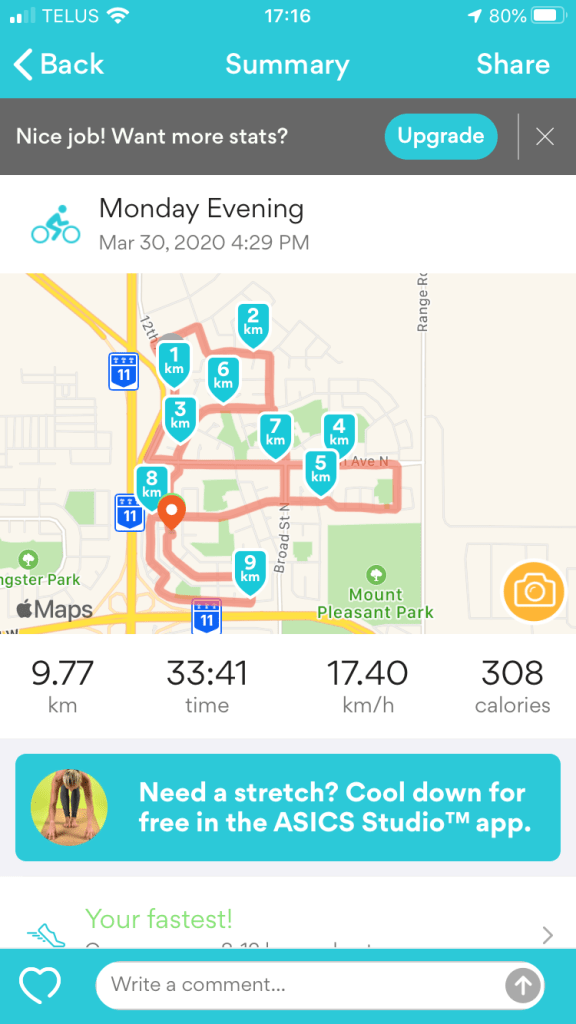
I stepped out of the house shortly after 3:30 p.m. and pulled my bicycle out of the garage. It had been sitting there all winter, so I knew I’d have to lubricate the chain and gears, as well as inflate the tires. The first two items went off without a hitch. I hit a hiccup on the third…
Using a small hand pump, I inflated the rear tire. When I moved to the front tire, I worked up a sweat trying to inflate it, to no avail. It was soft to the touch and had no firmness whatsoever (I just heard it, get your mind out of the gutter!) I started my car and plugged in a small emergency compressor that my father-in-law gave us for Christmas. I used it to inflate the front tire. Success!
That success was short-lived, as I could hear an audible hiss that resulted from the front tire deflating. I had a leak. This is not surprising, considering the bike was in the garage through the cold of winter, and rubber tends to crack under such conditions. I was pissed. Given the temperate weather, dry roads and the need for a workout, I was hell-bent on getting behind a handlebar.
I brought out my wife’s bicycle and repeated my prep cycle: lubricate the chain and gears and inflate the tires. No issues, and within minutes I was on the road. I pushed and peddled, all while singing along to Kenny Loggins’ “Nobody’s Fool” (It’s an awesome song, theme to Caddyshack II. Seriously, YouTube it!)
Once I started peddling, I felt it was hard to stop! I ended my run at just under 10 kilometres, feeling great! I think my wife may have lost her bike for the summer (at least until I can repair my front tire). Despite the current state of the world, there’s still plenty of opportunity to get some exercise and fresh air, so long as we stick to social distancing protocol. ☯
If you happen to be a clumsy ox like me, you’re prone to injury at the best of times. My son seems to have inherited this trait (although he comes by it honestly from both his parents) and we often have “ouchies” that require the occasional bandaid, cold compress or disinfecting agent. I don’t remember the last time I went an entire week without walking into a wall, stubbing a toe or tripping over something that was sitting in plain sight. I suppose it’s weird that when the sparring gloves come on, I’m poetry in motion. But everyday activities make me look like a drunk rodeo clown.
One of the worst problems with injuries is you can often be faced with one that’s bad enough to require some attention but NOT bad enough to require a hospital visit. Or even if it requires a hospital visit, your injury and your mental state may be worsened by the impending wait you’ll face at the hospital. Because I can promise you that unless your skull is wide open and bleeding or you’re having a heart attack, your expected wait time at the ER in Canada can be hours.
For example, Nathan fell down the stairs about two years ago. He had a bruised eyes, a swollen lump at the front of his skull and a bleeding cut. Since he was only three years old and we were dealing with a fall down some stairs, we bundled him up into the car and rushed to the emergency room. We waited for almost four hours before we finally threw in the towel and came home and treated the injuries ourselves. And THAT involved a toddler falling down the stairs. Don’t panic, his energy levels were off the charts and we got him examined at a later time.

This is just one example of why it’s important to keep a properly stocked first aid kit in your home. Although you don’t want to absolutely spend a fortune on your kit (it’s all made of the same stuff at the end of the day), you may not want to skimp on the supplies either. You can usually find decent supplies at most retail outlets, especially if you live in a larger town. If you’re lucky and you have one of the bigger dollar stores, you can even find some decent first aid supplies there.
You can take the lazy route and buy a pre-packed kit. These are usually pretty basic and contain the general items needed to deal with an immediate injury until a medical professional or first responder reaches you. You can, however, put together your own kit. This allows you the option of customizing your kit with preferred items and/or items that may not be included in pre-packed kits. You just need to remember to replace and replenish items that may have been used or expired.
In my line of work, I usually recommended three basic items that HAD to be in a first aid kit: protective gloves, bandages/gauze and a one-way CPR mask. With those three items, you should be able to lend basic first aid to someone with minor to moderate injuries until first responders can reach you. Anything else in your kit is simply icing on the cake. A good pair of angled scissors are a good idea, in case you have to cut away clothing to access a wound or injury.
If you do buy a pre-packed kit, make sure you know what’s inside it before you purchase. For example, you can buy a small 3″ x 3″ plastic first aid case that will contain bandages, band-aids and tape for a little over $5. That’s about as basic as it gets. Or you can splurge on kits that have several hundred items and cost well over $100. It all depends on what you want to have available.
Personally, I have a solid kit that I purchased at my local retail outlet for about $20 and it contains a little over 100 items. I keep it in our cold room with our non-perishable food and supplies. I also took the liberty of purchasing added gauze and bandages, since the kit was in short supply. A small bottle of disinfecting agent is also a good idea, since most kits won’t contain any. I keep a smaller first aid kit, both in my personal car and the family SUV.
You can check out a composite list on the Canadian Red Cross website at https://www.redcross.ca/training-and-certification/first-aid-tips-and-resources/first-aid-tips/kit-contents?gclid=EAIaIQobChMIxo_AxpG56AIV5f7jBx05kQwLEAAYASAAEgLfLPD_BwE
This webpage also provides a composite list for an emergency supplies list, which may not necessarily be first aid related, as well as an emergency car kit in case you become stranded or involved in a collision. It stands to reason that if you have the ability to be trained in basic first aid, you should also do so.
A good first aid kit can be extremely helpful in most environments. Since people with Diabetes have difficulties healing open wounds and are prone to infection, being able to treat injuries quickly and efficiently can mean the difference between a well-healed wound or getting your foot amputated. I’m being mildly dramatic (yes, mildly) but you get my point. ☯
Throughout the years, I’ve had many friends and associates ask me how I manage to control my Diabetes and still do martial arts to the extent that I do. I’ve been studying for so long at this point that it basically feels like second nature to me, but I’ve had friends who have come to watch karate classes to see what all the hype is, only to be blown away by the physical exertion, sweat and effort that goes into traditional karate. Given my age, I would be lying if I said that my flexibility and ability to push as hard and as long as say, twenty years ago still existed.
Although I’ve had an interest in the martial arts since a very young age, it wasn’t until my Diabetes complications started to overtake my ability to fight them that I tied on a karate gi and stepped into a dojo for the first time. The rest would be a lifetime story that continues to play out to this day. The martial arts has given me so much, and I think that the average person fails to understand just how many benefits there are to proper, traditional training.
When I say “proper, traditional training,” I don’t mean a commercialized martial arts club where there are hundreds of students, you basically fend for yourself and hardly ever have any one-on-one coaching. I mean the little bare floor dojo down a side street or back alley; the one that has a dozen students at most and push themselves to the point where the floor is literally soaking up blood, sweat and tears… The kind of place where you learn, not only to defend yourself but a definite lifestyle that you keep with you until your end of days. THAT’s the kind of training I was blessed to have throughout my childhood and into adulthood.
Now, I could go into one of my “fun” little bullet lists about all the benefits that martial arts can provide for someone who really dives into it and gives it their all. But instead, I’d like to bring up a very special martial artist that I read about years ago. I found a photo of this little guy while researching something else, and it reminded me of the importance of believing you can achieve your goals, no matter what. I’m talking about an inspirational young lad named Shoham Das.

Shoham Das was a young boy from San Jose, who was born with a rare heart condition in which he is missing his right ventricle and in effect only has half a heart. The condition is so rare that it’s thought to afflict only 1 in 10,000 kids. Das has had three open heart surgeries at three days old, six months old and four years old, respectively. This means his endurance tends to be low and he often requires more rest than a counterpart of the same age without this condition.
Despite this condition, Das has been studying Tae Kwon Do and mixed martial arts since the age of 7, and during a weekend in early May of 2014, Das tested and successfully graduated his first-degree black belt at the age of 11. The testing, which required two hours of combined skill in various areas of the art he studies, required Das to have his oxygen levels monitored by his mother throughout, but he was successful and continues to train.
Now if you do the math in your head (and hopefully you don’t actually have to), this means that he graduated his first black belt in only four years, and prior to maturity. Although I’m not a fan of this practice, which seems to be the norm in many modern-day dojos, you can’t argue with the focus and will required to reach this level given the specific ailments Das has been diagnosed with.

In fact, some of Das’ doctors have indicated their belief that all the physical activity and structured study involved in the martial arts has made Das’ muscles and heart tissues stronger, allowing him a better quality of life and to be able to do more without getting tired so easily.
Although Das has a lower endurance than a counterpart without his condition, he’s been blessed to study at a dojo that focuses on the skill rather than the endurance. An aspect in which Das has in abundance. Although many dojos turned him away due to his condition, Das eventually found an instructor who took him in. He kept at it and by last year Das is said to have achieved a third-degree black belt in Tae Kwon Do and continues to train.
Last month, at the age of 16, Das is looking towards the future and is considering a potential career in medicine. You can read about what he’s been up to here: https://healthier.stanfordchildrens.org/en/half-a-heart-and-a-whole-lot-of-spirit/
In the above link, Das has shown to be humble, attributing his health and continued life to his doctors and specialists. It stands to reason that he wouldn’t have gotten this far without them, but there is absolutely no doubt in my mind that the increased strength, discipline and skill he got from training in the martial arts all those years have definitely played a key role.
If you look at this impressive young man’s life and see how much he’s accomplished DESPITE his condition, it may lead you to ask what the hell some people’s problem is. Anything is always more than nothing, and amidst anything else happening in your life, it’ll always be up to you to take yourself in hand and ensure your continued health, whether you have a medical condition or not.
I look back at my life and I have a clear understanding that in order to survive given my personal complications, I couldn’t just sit back and depend on others. I had to stand up and make things happen for myself. Just like Shoham Das. Although he may only physically have half a heart, he’s got more heart than most. ☯

Who doesn’t enjoy a nice piece of chocolate? It’s tasty, and can easily replace a sudden sugar craving. If you know your chocolate, you likely know that dark chocolate is a great alternative to satisfy your sweet tooth. Reasonably low on sugar, dark chocolate traces its roots to several thousand years ago in Central America. They usually consumed it by fermenting it and drinking it with wine.
I won’t get into the whole process of how the modern form of it is made, but it’s safe to say that it can be used in many forms and is generally enjoyed by all. To be clear, dark chocolate is any chocolate that contains higher than 50% cocoa and unlike “milk” chocolate, has no milk added to it. Obviously. And if you’re part of the rare percentage of the population who doesn’t enjoy chocolate, move along! This post is not for you…
Dark chocolate is rich in a lot of things, including but not limited to flavanols, which have been proven to help with heart health, lower blood pressure and increase insulin sensitivity. That last one can help reduce the risk of Type-2 Diabetes. Dark chocolate also happens to have high percentages of iron, magnesium, manganese, copper, potassium, phosphorus, zinc and selenium. Healthline.com has a great post that lists the recommended daily intake for all these, and can be found here: https://www.healthline.com/nutrition/7-health-benefits-dark-chocolate#section2
The article goes on to explain how dark chocolate is loaded with antioxidants and is considered brain food. The benefits of increased blood flow to the brain make it so that it increases cognitive function. Not to mention that dark chocolate also contains traces of caffeine, which I’m a big fan of. Two ounces of 70% dark chocolate contains about 60mg of caffeine, which is a bit less than a small coffee at most popular chains. The higher the percentage of cocoa, the higher the caffeine content. Wrap that shit around coffee beans or Swedish berries? Fugedaboutit!
Obviously, in order to reap the most benefits you should try not to cheap out on your chocolate. Get chocolate that’s at least 70% or more. Generic chocolate will often use processing that, although improves flavour, will cause the loss of flavanols, which are one of the key benefits. Another recommendation is NOT to refrigerate your chocolate. I’m guilty of this one. I like the snap and crunch of refrigerated chocolate. But if you keep it in the fridge, it can cause something called “blooming”, which is the white substance that appears on chocolate that’s been sitting around for a long time.
If your chocolate HAS bloomed, you can basically melt it down, stir it up and let it harden and you’re good to go. Granted, I wouldn’t try that with the chocolate you find stuffed at the back of your grandma’s pantry that’s likely been there for thirty years, but I digress…
Don’t go stuffing your face, yet! It’s not all good news. Chocolate, especially dark chocolate, is extremely high in calories. So if you eat it by the fistful, you’re susceptible to weight gain. Dark chocolate may have the benefit of lower sugar content, and the higher the cocoa, the lower the amount of sugar. But you’re basically eating a slab of fat, considering dark chocolate is made of cocoa, butter and sugar. So if you’re eating chocolate to try and raise blood sugar after a low, you may be waiting a long time for it to kick in since your body processes the fat first.
Dark chocolate is best enjoyed by eating a small piece after a meal, melting a square into your coffee or melting it to drizzle on fresh fruit. Despite the health benefits, it can be easy to indulge and overeat. And this is one of my rare exceptions where I encourage people to go organic. Finding dark chocolate that advertises as “organic” is a good thing as it prevent exposure to pesticides and chemicals that may have been sprayed on the cocoa beans.
So grab a slab, melt some down or have a bite. Even a small piece every now and then will allow you to satisfy sugar craving, enjoy the many health benefits and last but not least: you get to eat chocolate! Pairing it with red wine is also an excellent alternative. So, go get you that chocolate, yo! 🍫
I know that just about everyone is tired and fed up of hearing about the current pandemic spreading across the globe, but the reality of the matter is that it’s happening and there’s no getting away from it. Another reality is that this crisis brings up a number of interesting thoughts and ideas, which has been an interesting side effect of the whole thing.
One of the ideas I’ve been rolling around in my head, is the way people seem to be dealing with this whole issue. We already know that folks have gone ape shit and started hoarding and gathering toilet paper, which has led to arguments and fights in public with total strangers and people who genuinely need a twelve pack as per usual that can’t seem to get any. Non-perishable food items have also been something of a popular staple.
But oddly enough, retail locations don’t seem to have any issue carrying full shelves of daily essentials, such as shampoo, soap, cleaners and toothpaste. Although many people have pointed out the fact that eating is a tad more important than worrying about wiping your backside (and I’ll point out that there are a number of countries that don’t even use toilet paper and depend on water-based or other methods of clean-up), everyday hygiene should also be a concern.
So let’s examine this aspect in slightly greater detail, shall we? Daily personal hygiene is an extremely important part of staying healthy. There’s a reason why the big push at the moment is to have everyone wash their hands frequently: because cleanliness = health. This should make sense to the average person, but in a real-world quarantine scenario, worrying about food is normally the top concern.
There are some basic, common sense levels of hygiene that most people know about. For example, we all know we need to brush our teeth. Failing to do so will cause tooth decay, plaque and gum disease and can lead to coronary problem through bacterial infections. Not to mention bad breath that can lead to a serious decrease in kissing. Brutal. Washing our hands frequently helps to mitigate the spread of germs, bacteria and other nasty things that some people may not even be aware that they’re carrying.

But it needs to be taken a step further than that, which includes showering, bathing and personal grooming. Most medical professionals will agree that bathing or showering should be done at least every other day. Basic cleaning of your own body will prevent the lesser issues, such as oily skin and body odour.
But failing to properly follow good personal hygiene can lead to serious complications and illnesses. According to lists I found as posted by Healthline.com and the CDC website, these conditions include but are not limited to: scabies, lice (of varying types), diarrhea, athlete’s foot, ringworm, swimmer’s ear and hot tub rash (whatever the hell THAT is). And don’t aren’t the worst ones.
Here are the respective websites to read specific detail on all of the above as well as others:
Last but not least, we need to remember that failure to follow good hygiene can lead to the propagation of germs and bacteria, which is kind of what the world is trying to avoid right now. “Social distancing” won’t keep that other person in Walmart’s cereal aisle from smelling your personal brand of funk, either.
For us Diabetic types, keeping clean can also help with other issues. I don’t need to tell you that T1D’s tend to be prone and susceptible to infections, which can be caused by poor hygiene. This is why any medical professional recommends keeping your feet clean and dry, since foot issues are prevalent with Diabetics. But that concept applies to your whole body.
So while you’re busy stocking up and squeezing the Charmin, don’t hesitate to grab some freakin’ Irish Spring and shampoo! Keep yourself clean and smelling pretty. It’ll keep you healthier and will guarantee that once all this has blown over, you won’t step out of your house looking like a reject cast member of Lost and smelling like today’s catch! ☯
I would be lying if I said that this isn’t the definitive time to be alive with Type-1 Diabetes. Treatment options, medications and education that definitely weren’t there even 50 years ago are a Godsend and reinforce the possibility that the lifespan of someone with condition is much more assured than it used to be.
Prior to the creation of insulin, the average person with type-1 Diabetes would typically die after 7 to 10 days, usually due to complications such as ketoacidosis. But despite all the benefits and available resources (which are not necessarily available to everyone, FYI), there are still significant difficulties that come with living with T1D. If I had a dollar for every person who told me how lucky I am to have an insulin pump, I could likely retire.
And while they’re quite right about how lucky I am, most non-Diabetics don’t realize the amount of work and effort required in order to maintain our health, despite all these benefits. Because I’ll tell you right now, even the best technology is NOT all it’s cracked up to be!
Let’s take the overnight odyssey I suffered last Monday as an example. Last Monday was a pretty typical day for me; work and errands in the morning, time with my son in the afternoon and some television and R&R during the evening before bed. I used Monday as a rest day, since I foolishly did a marine workout on Sunday evening that pretty much slaughtered my legs.
We had dinner, and as is often the case I miscalculated and boluses too much for the amount of food I ate. The end result was a low, which I treated but overcompensated. What followed was to be a night of sweats, nausea and lack of sleep…

Here’s the logbook entries for the end of Monday night, as taken from my Freestyle Libre. My family and I had dinner around 5 p.m., which would explain why my slightly elevated blood sugars started to go down within the next hour. At 6:38, I realized my blood was starting to drop. I retreated to me basement office, where I indulged in a handful of fast-acting carbs.
Usually, it works like a charm so I gave it time and thought nothing further of it. About forty minutes later, I checked my levels again, only to realize that I was sitting at 3.8! It had tapered off, sure, but it was still too low to safely sit at. So I suspended my pump and wolfed down more fast-acting carbs, uncertain of how much insulin beyond what was required I may have coursing through my system.
At 9 p.m. we were getting ready to crash for the night, so I checked my levels again and realized that I overcompensated and was now at 14.2, with the indicator arrow telling me that I was still climbing. I bolused accordingly and hit the sack, confident that my pump would bring my levels under control. I mean, why wouldn’t it? That’s what it’s for, right? Unfortunately, as convenient and effective as my pump may be, it’s still a mindless machine and requires direct human intervention to function. Adding to the fact that it’s prone to malfunction like any other piece of technology, it can make proper balance of blood sugars rather challenging.
Less than an hour later, I hadn’t fallen asleep yet so I checked again. I had continued to climb to 15.2, but the indicator arrow showed that I was levelling off and I still had a lot of insulin on board, so I went to sleep confident that it would be fine. It would NOT be fine… I woke up just before midnight, feeling flush and nauseous and checked my blood sugars again. I was sitting at 14.2, which was odd considering how much I’d bolused. Concerned I may overdo it and slip in the other direction, I nevertheless instructed my pump to bolus in order to correct. The pump indicated I still had too much insulin in my system and did not provide any further. Fair enough, machine! Take the wheel, I’m going back to sleep!

I tossed and turned for a few hours and may have slipped in and out, but I didn’t really get much sleep. I was awoken by the violent spasming of my pump and checked the alert, which indicated the worst message a pump user can see: “NO DELIVERY”. What the hell? I resumed my pump’s normal function and checked my blood, to see that I was still sitting in the high 14’s. I requested a bolus to correct. The pump began to comply.
Then, 2 units into the bolus, the pump vibrated once more and still provided the message “NO DELIVERY”. I wasn’t due to change out my set until the day after, and I still had a LOT of insulin in the pump. I made several attempts to get the pump to comply. After three attempts at trying to get insulin into my system, I finally surrendered and took a manual injection, the old fashioned way.
I performed a “FILL CANNULA” to see if insulin would drip freely from the infusion set, which it did. I reset the pump to continue with its normal basal rate and tried to get back to sleep. I tossed and turned, washed some Netflix on my iPad and got up for the dreaded Diabetic cycle of drink, pee and repeat. I may have snoozed off and on from sheer exhaustion, but I awoke at 8 a.m. and found my blood sugar to be sitting at 19.8! In the interest of preventing further complications and despite the waste of insulin and pump resources, I completely changed out my pump assembly and started a new infusion set.
I spent the next 8 hours (yes, you read that right) working on getting my blood sugars back down to a normal level. I was exhausted, parched and felt like absolute shit. I did a workout on Monday evening despite my fatigue, in order to help get myself balanced. The big problem is that I have no idea what caused the pump to stop delivering insulin, whether is may have been a bad site or bent cannula… who knows?
This simply goes to show that no matter the advancements, no technology is perfect and no two days for a T1D are ever the same. The challenges, issues and complications continue to pile up, even when one does everything as properly as they can. I’m hoping that my new pump system will help lessen and alleviate some of the issues, but until a cure is found, Diabetes is still a full time job. ☯
 The Blogging Buddhist