I wrote a post a little over two weeks ago about a pan flute I had purchased from China. I was extremely excited at the prospect of learning this instrument, as it has a classic place in classic Asian music.
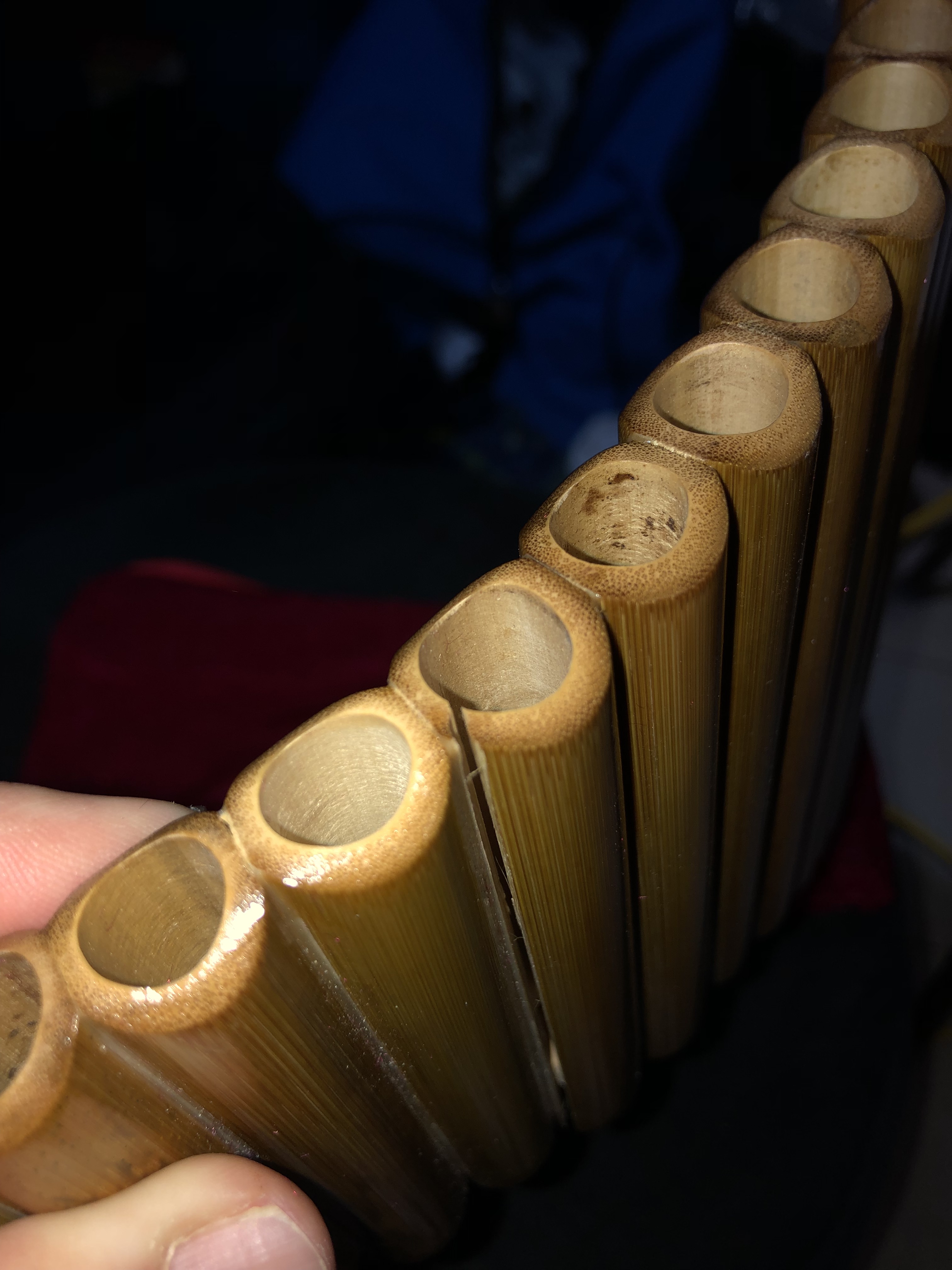
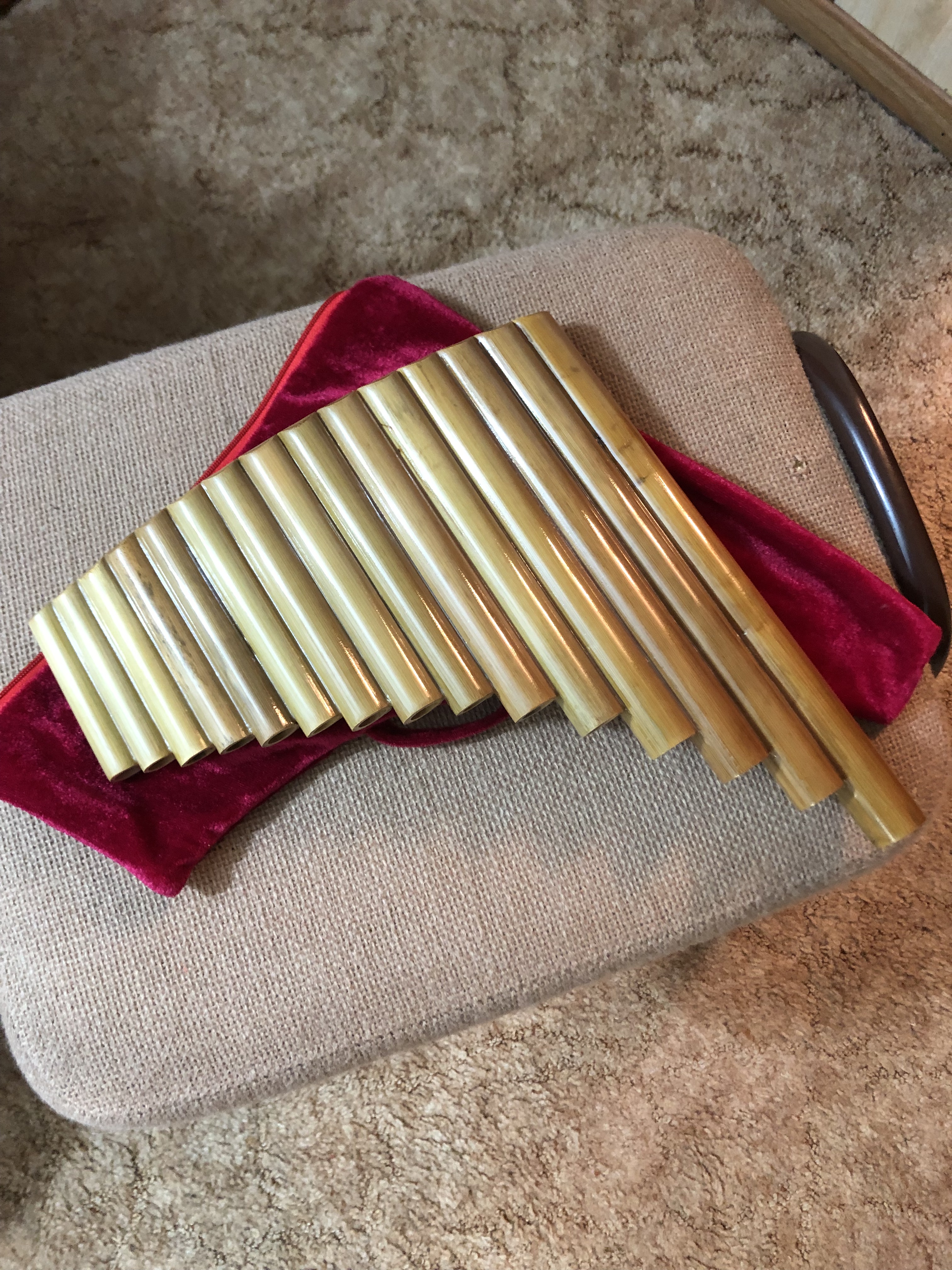
However, about a week after it had arrived, I took it out of the velour sack that accompanied it and examined the instrument. I blew the first notes on the flute and discovered that some of the notes were flat and wouldn’t play. Upon closer inspection, I discovered that the flute had a long crack down one of the tubes.
The crack runs all along the tube to the bottom
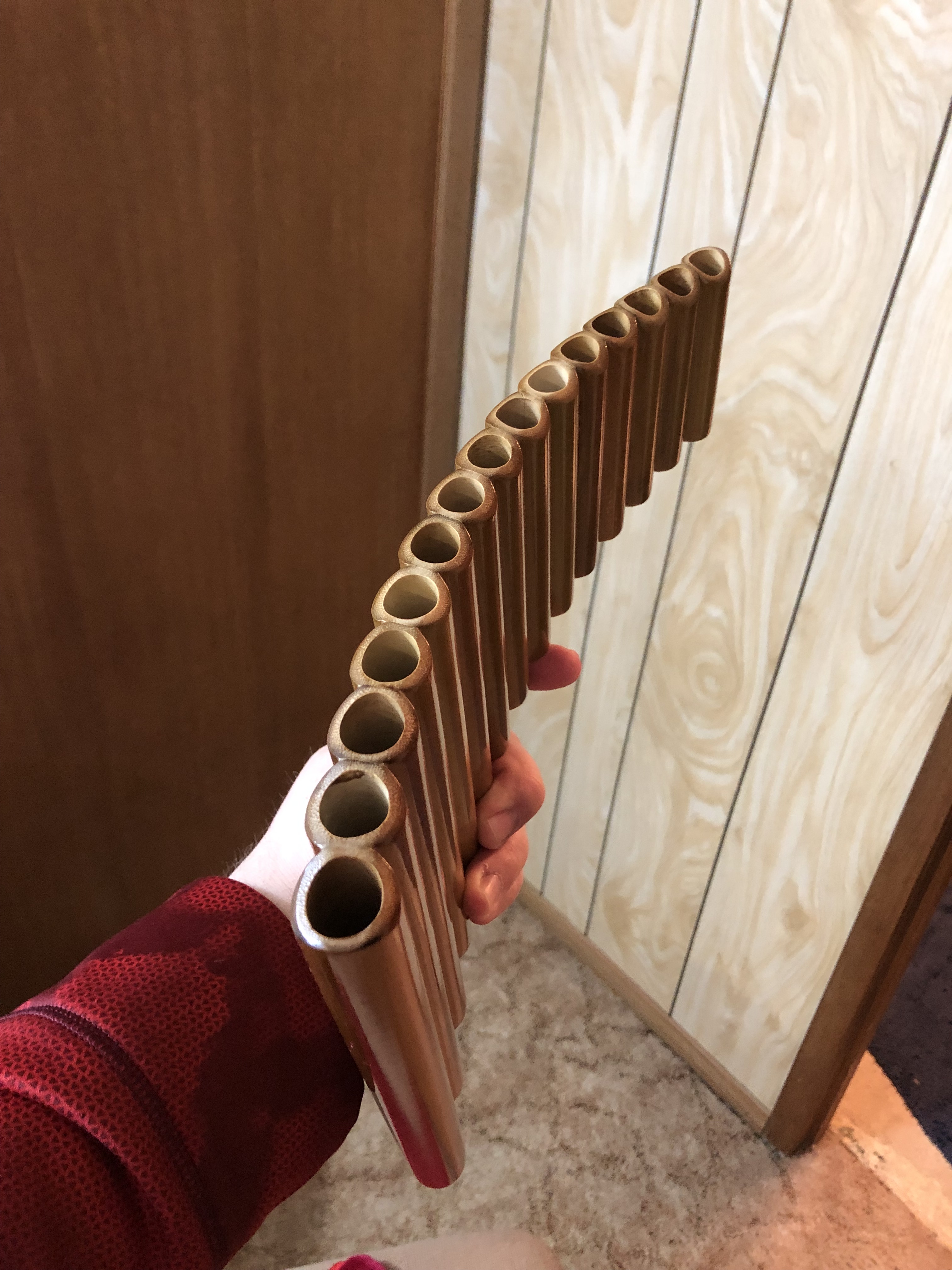
It was heart-breaking, since it basically renders the flute unplayable. Oh sure, I could probably find some tunes to play that don’t require the specific damaged notes, but limiting an instrument in this fashion does it very little justice!
Another view of the fractured tube
I’ve noticed that some of the other tubes are starting to develop some stress cracks as well. I’m not sure what I expected from a $14 purchase from China…
I’ve given the pan flute to my son Nathan, and he’s presently having a blast with it. It can give him some of his first exposure to music and instruments. Who knows? Maybe he’ll learn to play it!
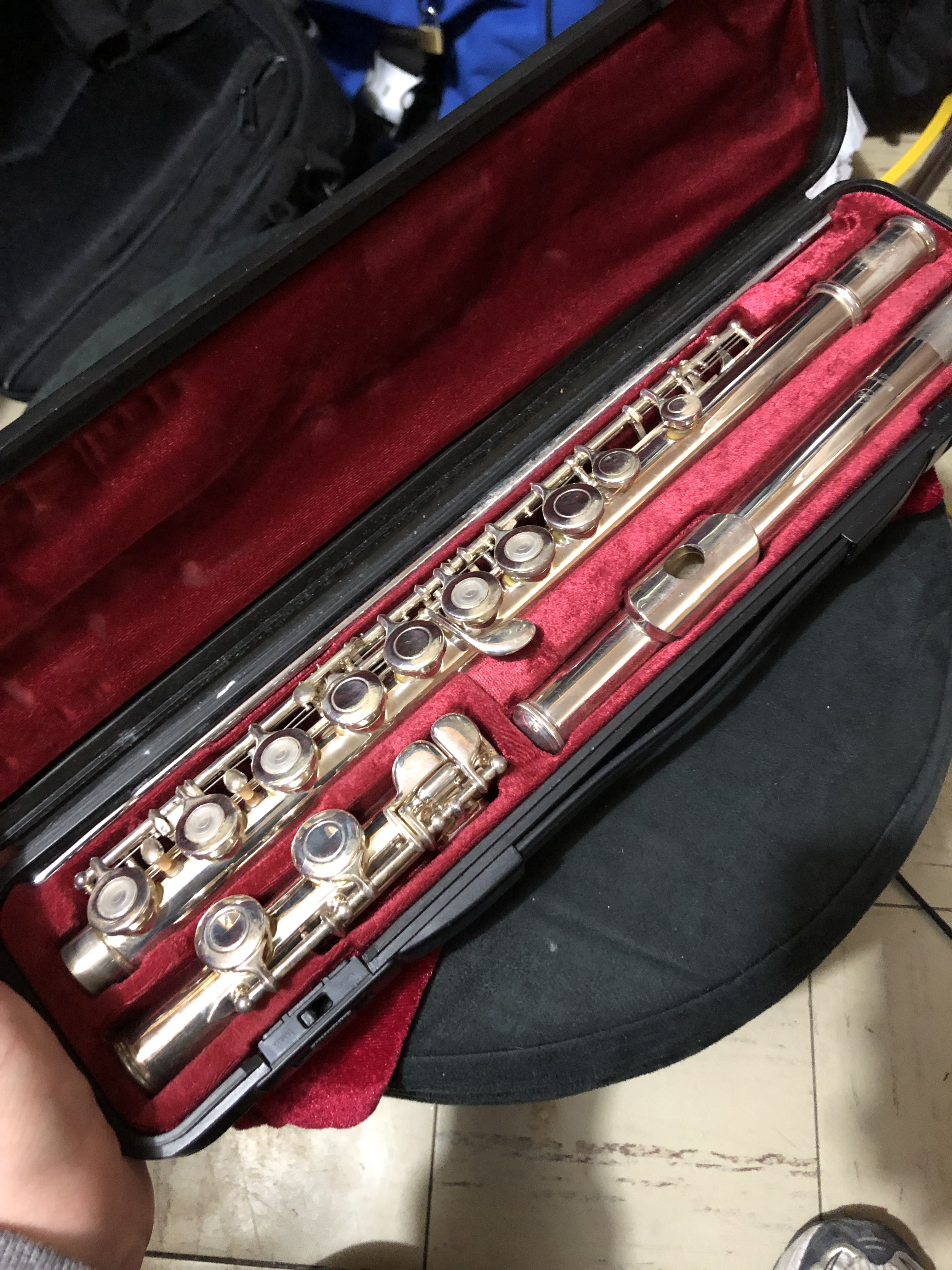
All dark clouds have a silver lining. My wife has provided me with an actual flute she had in her possession.
The new “Kaze”, which is Japanese for “wind”
I’ve purchased a beginner’s primer on learning the flute. In the months to come, I intend to start learning this instrument as a substitute for the pan flute.
Music is a wonderful form of expression and can be relaxing and beneficial for one’s health. I’ll keep you all posted on my progress! ☯
Sometimes we don’t allow ourselves to be aware of the influence our parents have on us. As soon as we’re old enough to reach our goals, we often attribute our successes on our own merit and efforts. This doesn’t mean that the groundwork for that success didn’t come from those who have had the most impact on our childhood.
My mother lives a life of limited means. She has a small, one bedroom apartment where she can be near my father who resides in a care home. They both reside in New Brunswick. My mother has been trying to reduce the amount of belongings in her apartment due to the lack of space. One of the items she has had for the past few years is a small wooden dining table coupled with a set of wooden chairs.
My grandmother had purchased this table set for several hundred dollars a few years ago. But since she herself has been relegated to a care home, she had turned it over to my mother. Mom has been keeping this table set in her bedroom, which has been a source of issue for her. She recently decided to try and sell the table set.
The apartment complex she lives in caters to retirees, and she was certain someone in the building could make use of the small table set. She drew a quick poster on a piece of plain paper and tacked it on the building’s bulletin board.
Not an hour had gone by, and my mother was visited at her apartment by a young man who was painting the unoccupied units for the building’s manager. He explained that he and his wife were recently married, starting out and looking for inexpensive furnishings for their home. He wanted to see the table set.
My mother showed him in and brought him to the table. He examined it carefully and felt that it could suit his household’s needs, but would need to confirm with his new bride and asked if he could take a photo, to which my mother obliged.
The young man asked how much my mother wanted for the table. After quick consideration, she indicated that she would like $100 for the table, since her own mother had purchased it at about four times that amount only a couple of years ago. The young man asked if my mother would be willing to accept $80. My mother mulled it over and stated that the young man should discuss with his wife and come back the following day should they decide to purchase and the price could be discussed then.
The following day, my mother brought her small car to the local dealership for some needed repairs. The car had been making a knocking sound for a couple of weeks, and one of my uncles advised her of the cause and the need for the repair. Having nowhere to go, my mother waited patiently for a couple of hours until the repairs were done.
When she approached the service desk to retrieve her keys, she was dismayed to hear that the bill amounted to nearly $200! once again, my mother is living on limited means and did not have the funds available for such a bill.
She was considering her options when one of the kinder employees looked into it and found an extended warranty that my mother had purchased along with the vehicle; one that was still in effect. With this added warranty, my mother owed nothing for the repair of the vehicle. The employee was satisfied to tear the invoice to pieces in front of my mother.
My mother was overwhelmed and SO thankful for the discovery. For those who know my mother, her eyes well up at the drop of a hat. And this occasion was no exception. She retrieved her vehicle and headed home.
Wondering about the young man and the dining table? Well, my mother was feeling deeply grateful at being spared the hardship of a bill she couldn’t afford. She couldn’t help but feel that she needed to repay this good fortune in some way.
She walked into the apartment building and went straight to the unit where the young man was painting along with others. She asked if he had discussed the table with his wife, to which the young man stated he had. The young man explained that they had very little money and only had about a spare $50 so they wouldn’t be able to buy the table.
My mother then asked the young man if he would be willing to buy it for $20, if he took it today after his work day ended. The young man was overwhelmed and accepted immediately. He was so excited, he asked the other painters if he could leave the work site for ten minutes to load the table into his truck right away.
As my mother was telling me the story of how all of this came about, I could hear the joy and pride in her voice. not only did she get some reprieve from financial hardship, she was able to do something great for a young couple starting out. And she felt that she had positively “paid it forward”.
That’s when my mother spoke the words that have been one of the main mantras of my life for decades: “Everything happens for a reason!”
Are you kidding me? I’ve been using that very saying for almost as long as I’ve been studying Buddhism, and here my mother was probably the one who planted the thought in me, years ago.
It’s important to remember that kindness begets kindness. Positivity brings about the optimistic and positive energy of the world and creates the environment we all want to be in. Be good to others, even if for no other reason than the act of being good. I can promise you that in the long run you’ll be happier. And who knows? With all that positive karma, perhaps someone will pay it forward to you! ☯
For those who study it, meditation is an integral part of everyday life. It can have a number of measurable benefits and help people with daily living as well as facing issues that arise in their day to day life.
Meditation, like most things, comes in a variety of types, methods, etc… But one of the most overlooked methods of meditation is music. Yes, you read that right: music!
Music has the ability to provoke a meditative state in most people, even those who have never studied meditation. Whether you listen to it, play it or sing, the end result is the same. Think about it; you listen to a peppy, upbeat song and it makes you happy or cheers you up, right? You listen to a soft ballad and it evokes memories or emotional attachment.
Music on its own can help to reduce blood pressure and has been shown to increase the release of dopamine and aid with muscle function. Listening to music during physical activity can help to motivate you and push your body farther during a workout.
I often use classical or asian meditation music in the background when practicing actual meditation. Any time I have a workout, whether cycling or weights at home, I put on some high energy music to help motivate me along.
So, crank up the tunes. The benefits are many and the drawbacks are few. ☯
It’s story time! In October of 2001, I had the privilege of travelling to Japan and stayed there for about a month. This coincided with my training for Shodan (black belt) and my Buddhist studies, and I had the opportunity to visit and stay with two Buddhist monasteries as well as dine and spend time with a number of Japanese and Okinawan dignitaries.
I was 23-years old when I travelled to Japan. It was the most exciting time of my life, since I had spent the majority of my life in Northern New Brunswick, sheltered from the majority of the outside world. I was about to get a crash course in world etiquette, and looking back on it I don’t believe I was as prepared as I could have been.
Obviously, the first and most important thing I learned right from the moment of my arrival, was that bowing was preferred over handshakes. Although many Japanese people have adopted handshakes due to the Westernization of their populace, the custom of bowing is still very much a staple of Japanese culture.
Chopsticks are still the most commonly used utensil, and tipping is frowned upon as the Japanese don’t believe in being given money they haven’t worked to earn (a custom I wish the Western world would adopt).
Despite all these customs (and there are many more), the biggest one is insulting your host by refusing refreshment. Believe it or not, I had never enjoyed a beer or any alcoholic beverage prior to 2001.
We visited a Japanese dignitary in Narita, Japan, when we first arrived from Canada. Sensei had told me that I might be offered a beer or some sake (Japanese rice wine), and that I shouldn’t refuse as it would be viewed as an insult.
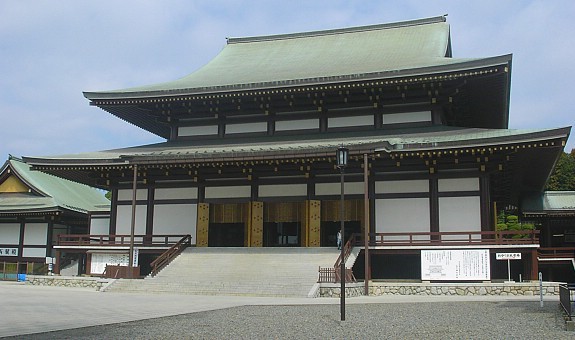
Buddhist temple in Narita, Japan
When we all sat around a table within the dignitary’s household, his wife brought me a bottle of beer. Having never consumed it before, I gave the drink a couple of experimental sniffs before taking a sip. I was pleasantly surprised to see that it was carbonated just like a soda would have been.
I drank the beer the same way as I would have consumed a soda. Before my empty bottle had touched the table, the wife brought me a second. I glanced at Sensei, whose eyebrows told me that refusing the second would be as grave an insult as refusing the first.
Sensei could have told me before our arrival that I could have sipped that first beer for hours and it would have been fine, but having emptied my bottle meant that my host needed to provide me with more. It ended up being a lesson in etiquette that would be learned through experience.
I was pretty intoxicated by the time we left the dignitary’s home. It would go on to be one of the most memorable experiences of my life. Not because I got drunk. Because I learned that it is most important to learn the customs of the people you’re visiting before going.
To this day, I can’t raise a glass to my lips without thinking of Okinawa. I have find memories and dream of a time that I can go back. I would encourage anyone who travel to foreign lands to take the time to study their culture and etiquette. Not only will it make for a more pleasant experience, but it could provide some insight into why certain things are done the way they are. ☯
The world is a volatile place. It always has been. Violence is a predominant trait of humanity and has always had a presence within society. We simply hear more about it during modern times, thanks to mainstream and social media and the availability of the world’s information at our fingertips, courtesy of the internet.
But is it necessary? Civil rights leader Mahatma Gandhi once said: “I object to violence because when it appears to do good, the good is only temporary; the evil it does is permanent.”
People have often asked me how I manage to consolidate the violence within my own life. Some often assume violence is dominant within me. Given my line of work (which I’ve always made a point not to specify on this blog, perhaps someday you’ll know why) and a lifetime martial artist, it can often be presumed that I have a penchant for violence.
And let’s be clear: every person is capable of violence. You don’t need a black belt or a weapon to cause harm. And I’m not exactly the smallest guy on the block. Although I only stand at 171 centimetres tall (5’7″ for you Imperial folks), I carry a hefty 95 kgs (210 pounds, again Imperial…) of which a reasonable amount is mass and not necessarily fat (although the never-ending gut battle rages on!) I have been taught how to fight from a very young age, both in class and on the street and some of what I’ve been taught will certainly do more than hurt a person.
Due to a number of the difficulties I’ve endured during the course of my life, I have an unseen cauldron of burning rage burning deep below, where I do not allow it to affect the surface. A radical mixture to be sure, when mixed with all the training I’ve received.
“But Shawn, doesn’t being Buddhist mean you don’t get angry? Aren’t you supposed to be all peaceful and stuff?”
No and yes. No, being Buddhist doesn’t mean I don’t get angry. I’m human like everyone else and I have the same full spectrum of emotions as anyone who isn’t. Yes, I am SUPPOSED to be peaceful. I actively seek out peace, in whatever form I can receive it. I am not always successful.
As humans, we shouldn’t be denying those feelings when they bubble close to the surface. Emotion is an energy; often created by endorphins and hormones, sure. But an energy nonetheless. And like any energy within our universe, it can’t be destroyed, simply transformed. So it becomes important for anyone to transform this rage into something else; something constructive.
For example, up until about two months ago I had access to a facility full of heavy punching bags and striking equipment. Speaking from experience, nothing quite helps quell feelings of rage, anger, frustration and violence quite like putting the boots to a punching bag for about half an hour. And performing an intense punching bag workout, in combination with drills and push-ups, can burn up to 500 calories per hour for an average person and help get a wicked sweat on.
Listen, no one is ever able to completely eliminate negative feelings or violence from their lives. Life, in and of itself, does not allow for such a thing. But we all have it within ourselves to take that negative energy and do something positive with it. Go for a walk. Have a workout. Renovate part of your house (ripping down walls REALLY helps burn off excess anger!)
And don’t forget to talk about it! If you’re angry, don’t be scared to SAY you’re angry. You have a right to how you feel, despite the circumstance. Whatever you do, make it a constructive choice and the outcome will never be anything more than positive. ☯
The martial arts can sometimes get a bit convoluted and complicated. Depending on the style you study, there can be so many different techniques and forms that keeping them all straight in your head can become difficult.
Martial arts are a bit like everything else in life; you can only learn one thing at a time and it takes a while to master it. This is an issue that many martial arts students frequently have while training. People in general, especially these days, tend to want immediate gratification. They prefer the high-flying kicks and fancy techniques that they see in movies, but most of what we see on screen is unrealistic.
Bruce Lee once said “Before I studied the art, a punch to me was just a punch, a kick was just a kick. After I’d studied the art, a punch was no longer a punch, a kick no longer a kick. Now that I understand the art, a punch is just a punch, a kick is just a kick.”
Unlike a lot of what you’ve possibly read on the Internet, this isn’t a made-up quote! He wrote that in his book, Tao of Jeet Kune Do.
I believe the quote essentially describes the growth a student a student must go through during training. When one begins the martial arts, they focus on learning the technique and practicing. Once they start gaining some experience, they focus primarily on the little details: position of the feet, angle of the joints, effectiveness and impact… But once they’ve been practicing for a length of time, those techniques become a passing thought in the grand puzzle that is the martial arts. It becomes about bringing it all together, and a punch once again becomes only a punch.
It’s important to find a balance between learning and doing. And in that learning, you start to recognize that you’re reaching a stage of understanding when you’re able to perform complex forms or techniques properly without giving them thought. This is what the Okinawans used to refer to as “No Mindedness”. It describes a state where one is almost in a meditative state while training.
But because of the time and effort it takes to master techniques and forms, many students become bored, complacent or lazy in class. Ultimately, many of these students will drop out and/or quit. Only those who stick with it and put in the maximum effort will be able to reap the benefits.
This concept applies to any sport or activity. Work hard, stay patient and focus on learning as much as you can. It will help carry you much further. ☯
I’ve had people ask about how I came about studying Buddhism. The question makes sense; a French-speaking white male living on the Northern shore of New Brunswick wouldn’t necessarily have a great deal of exposure to eastern religions.
I guess it all kind of started in the mid to late 1980’s. Although I hadn’t become entrenched in the martial arts by this point, my religious beliefs would feed off of my martial arts and vice versa, in the years to come. I had already become an avid reader and would pick up any book or manuscript I could get my hands on and read it. My father, in an attempt to steer me away from my grandmother’s medical text books (he felt they were inappropriate for a kid) started trying to find “cool things” for me to read.
Sometime in 1987, my father found a copy of the Tibetan Book of the Dead, and provided the manuscript to me in plain text format on a 3.5 inch floppy disk (I realize how old that makes me sound, and you new age kids can Google “floppy disk” if you don’t understand). It was slow reading, especially since there was only one computer in the house and I had to wait for my father to be gone to work to get a turn.
Without getting into details, the Tibetan Book of the Dead is the western title given to one of the three main manuscripts in Buddhism. It basically describes the transitional period in which a person exists between the death of one life and the beginning of another. There’s more to it than that, but that’s the gist. It was intense and fascinating reading, and I don’t think that my father knew exactly what it was that he had given me. It started me on a path of self-study that I am still entranced with to this day.
To explain how Buddhism gained some roots within my own life, it’s important that I explain a little bit about my family’s religious beliefs. This is not to shine a negative light on anyone’s chosen faith, but my entire family on my mother’s side was intensely religious. In fact, most of my grandmother’s siblings had studied the seminary and most had become nuns. Since my mother had also gone to seminary school, the Catholic faith had deep roots on my mother’s side and I was made to attend church twice, sometimes more, a week. Although teaching your family’s beliefs to the next generation is important, I would come to believe that a traditional church service holds no interest for a young child and can in fact get quite boring. In recent years, some churches offer child programs that allow for the teaching of their faith in a forum where young children are distracted and enjoy the experience. This was not so, for me.
By the time I had reached my pre-teens, my mother gave me the choice as to whether I would attend church or not. And like most children who are given the choice, since I had been forced through it for most of my life, I chose to walk away from it.
By the time the very late 1980’s came along, my health had waned to the point where I was facing death (I’ve written about this in previous posts, if you want to check out that story). Once I began my martial arts training, I began to learn more about Buddhism, Taoism and Zen. One began to feed of the other and I began to actively seek out Buddhist texts and study in greater detail. The more I read, the more I came to feel that the Buddhist faith reflected much more of my personality than my family’s religious faiths (I pluralize that, because my father is actually not Catholic).
My Sensei was a big help, since certain Zen precepts are very dominant in karate. What I study is called Zen Buddhism, a sect of Buddhism that originated in China but built roots as a Japanese form of Buddhism focusing on meditation and intuition. Based on Mahayana Buddhism, it combines aspects of Zen and Taoism. Although there are obviously far too many details about it to draft in a blog post, the Buddhist faith has helped me through the decades by encouraging self-motivation, increased health, focus and concentration and acceptance of all other religious beliefs.
Although my studies were akin to a starving person in front of a buffet, most studies were done on my own. In October of 2001 I travelled to Japan with my Sensei, and had the opportunity to visit a number of Buddhist temples, including temples in Narita and Tokyo. I made friends with a number of the monks in Narita and was invited to stay and become a monk myself.
I was caught in a dilemma. Although their peaceful way of life and quiet study appealed to me, I didn’t know how survival would be possible, being a Type 1 Diabetic. The monks explained that they normally used monetary donations as a means to obtain medical supplies for monks who required them. The monastery would provide my insulin in exchange for joining them.
I could have stayed. A part of me wishes I had stayed. But I came to two realizations that night as I was trying to make my decision. The first thing I realized is that the world keeps on turning. Even if I hide within the walls of a monastery, how am I genuinely promoting peace if I’m hidden from the world? Would I be contributing in a way that would satisfy me and make me feel as though I’ve done my part? The answer was certainly no!
The second thing I realized is how embarrassing it would be to have my mother hop an international flight to drag me back to Canada by my ear! Being an only child, there was no way in hell she would have allowed me to join a monastery on the other side of the world!
But there you have it. I often wonder if my path would have been the same if my father hadn’t provided me with that first manuscript. Maybe so. But as much as I would like to say it all happened by accident, it likely wasn’t. As Jean de la Fontaine said, we most often find our destiny on the road we least thought to travel. ☯
A wise old master recalled a story from a century ago, where a young martial arts student came to a large city in Japan. The student began asking about martial arts schools in the area, as he wished to train during his stay. The local residents provided him with a number of local schools that were considered good.
The student travelled throughout the city and found a small, unknown dojo that was nestled in a quiet back alley, away from the beaten path. He trained for several classes until his skill was recognized and spoken about throughout the city.
Some of the masters heard of the student’s skill and asked him why he was training at this unknown school. The masters indicated that this school was reasonably unskilled, their techniques were inadequate and their students weren’t very strong. The student bowed his head humbly and responded to the masters:
“No matter the status of the school, no matter their reputation… Training with them is a win-win situation for everyone. If they have something worth teaching, I will learn it. If they have nothing to teach me, perhaps I can help them learn something. Either way, there will be an exchange of knowledge. And that can only benefit everyone involved…”
The point is, we often don’t understand the influence we have on others. I’ve had instructors and teachers who have taught me so much, but they have carried on, never knowing the impact or the amount of knowledge they’ve passed on to me (you likely know who you are!)
Be certain to take every opportunity to pass on your knowledge to the best of your ability. Sometimes, the rewards of passing on our knowledge can outweigh the rewards of gaining something from the places we travel through.
That student was travelling and sought out to learn something. The important lesson here, is that we can always earn something important when we teach. And we often learn just as much when we pass on what we already know. ☯
Many years ago, I unfortunately joined one of those multi-level marketing companies. It boasted many benefits that other companies didn’t have and promised a certain amount of generous residual income, based on how hard I was willing to work. As is usually the norm with these types of organizations, I had to give up work shifts in order to make certain info sessions, surrender money of my own to “invest” in the company and it’s products and I was “encouraged” to push my family and friends into signing up!
Obviously, I didn’t stick with the company for very long. I have this thing about putting in a lot of hard work and not getting paid for it! Plus, if you’re really committed to these “companies”, you tend to lose your friends and alienate your family rather quickly. But the point is, during one of the first info sessions I attended, the speaker used a tactic that’s quite popular in those types of forums. He asked the guests what they planned to do once they accumulated some wealth. This gets the guest daydreaming a little bit and helps them focus on working harder on the company.
Most people provided answers that one would expect; buying a larger home or taking destination vacations… When the speaker landed on me and asked what I would do with accumulated wealth, I provided an answer that threw them for a loop.
ME:I would buy a coffee.
SPEAKER:You would buy a coffee…? (look of awkward confusion on his face)
(Bear in mind that I was holding a cup of hot coffee, which had been provided for me at the info session.)
SPEAKER:That’s interesting, but perhaps you’d like to explain what you mean by that?
ME:Certainly. I don’t want to be rich. I don’t need to be rich. I simply need to be happy. If one is happy, then everything else in life can come in its own time. When I can make the amount of income necessary to allow me to stop and buy a simple cup of coffee every morning without worrying about my finances, then I will have achieved that happiness. Because if that cup of coffee gets me going and puts a smile on my face, then the rest of the day can be tackled with a better frame of mind. Therefore, I would use any accumulated wealth to buy myself a cup of coffee. Every morning.
SPEAKER:Uhh,… that’s interesting. Let’s move on…
I got the typical confused look I often get from people when I start getting philosophical in a public setting, and it took almost a full minute before people’s attention refocused on the speaker, once he stopped giving me a look that said he thought I was a random weirdo who walked in off the street (a look I’ve gotten more often than I care to admit!)
Ralph Waldo Emerson said “Life is a Journey. Not a Destination.” We often get so caught up in making goals and struggling to get to the finish line that we overlook the scenery along the way.
It’s important to remember that there is absolutely nothing wrong with shooting for the stars. Ambition and goals are an important part of life and the gratification that can accompany reaching those goals can be immeasurable.
But there is also nothing wrong with taking your time, making plans and taking time to stop and smell the roses. Life is a fleeting thing. On the cosmic scale, we aren’t here for all that long. So make sure you’ve made it possible to stop and buy your cup of coffee. Every morning. That little slice of happiness may be just what you need to get through the obstacles ahead! ☯
I’ve decided to undertake a new hobby. I mean, between martial arts, my Buddhist studies and fitness, writing my blog, reading dozens of books a year and taking care of my son, I have so few hobbies, right?
I’ve decided to learn the pan flute. I found a unique opportunity to get my hands on one for only $14. Considering traditional bamboo pan flutes usually go for $80 to $100, minimum, it was something I couldn’t pass up (I can hear my wife cursing the day I got a credit card as I type this!)
The pan flute is a traditional wood-tube wind instrument that was originally created by the ancient Greeks. It was believed used originally by shepherds and is thought to have been used as early as the third millennium BC. It usually contains a minimum of four to eight hollowed bamboo or wooden tubes and is known for it’s rich sound by blowing across the opening.
My new toy! I feel inclined to name her…
It’s often associated with specific soundtracks. For example, Gheorghe Zamfir played a full track of Japanese Pan Flute for the original Karate Kid movie in 1984 ( the video can be heard on YouTube at https://www.youtube.com/watch?v=kSlAk0GatQ0 and haunts my soul!). The sound was haunting and beautiful, and it has always stuck with me throughout my martial arts training. I’ve always dreamt of learning this instrument and now I have one. It’s important to to have goals.
I’m thinking the name “Kaze” would be appropriate…
Music can play an integral role in your mental and physical well-being. Music wears several different hats for someone who indulges, such as lessening stress and anxiety, improving your mood and facilitating exercise, provides ease and comfort as well as easing pain in certain specific circumstances.
Music can move people to tears, make them smile or alter their mood. I’ve been playing the guitar and singing (in small doses), for the past twenty years. I’m not professional or anything, but the playing of music has always provided a satisfaction akin to meditation, which as you may or may not know, I’m a bit of a fan!
“Kaze” is Japanese for “wind”
Music is often used in physical activity as well as meditation. I hope to learn this instrument in short order and include it in my meditational routine. I’ll keep you guys posted and maybe even post a couple of sound bytes of me playing (if I can learn anything that sounds normal).
My point is, if you have the opportunity to learn and embrace a musical instrument, I highly recommend it. It can provide a certain amount of relaxation and all the benefits I named above, if you stick with it. It can also provide a certain level of discipline, which would be required to master any instrument. But if you stick with it and enjoy it (which is important) the benefits will far outweigh the efforts. ☯






 The Blogging Buddhist