Free Will May Be Free, But It Costs A Lot!

Free will is a hell of a thing. It allows us as human beings to make choices and decisions based on OUR choices. It’s an advantage we have over the majority of the animal kingdom, as most animals tend to act on instinct.

But how is your free will used? Is it for the better of yourself? The betterment of humanity? Or is it more often used in an improper manner?

I recently posted about the three underlying factors behind problems we face in life. Without repeating the entire blog post, the list is that there are always three factors that contribute to every problem we face as humans.

The first factor is someone else. Others tend to contribute greatly to the problems we have. Think about it: when was the last time you faced a problem that didn’t involve at least one other person?

The second factor are elements out of our control. Think along the lines of getting to work almost ten minutes late because of construction. If you didn’t know that a certain road was blocked off and a delay would happen, you could have taken all the precautions possible by leaving on time and taking your usual route but you STILL would have shown up late.

This has a lot to do with causality, or the relationship between cause and effect. Granted, if you were aware of the construction or were given notice of its forthcoming, then that’s all on you.

The third factor is, in fact, yourself. No matter the problem we face, there will always be a certain amount that you contribute to your problem. Most people have a deep difficulty accepting that premise and will often think “this is not my fault!” Well maybe not, but there should still be an acknowledgement that actions or words on your part likely contributed to the tribulation you’re facing!

Accepting responsibility is difficult because we are hard-wired to survive, and defending oneself is an important aspect of survival. If one were capable of accepting responsibility for the part they played in any given situation, problems could be solved so much easier.

I’ve been guilty of this myself. Even recently. I look at particular problems and issues I’ve been facing within my life in the past couple of years and I recognize that I’ve had more than a small role to play in the creation of those problems. I’m hoping this clarity will help to bring said problems to an agreeable conclusion, but who knows?

I’ve often said that all things happen for a reason. Based on that belief, how effective does free will become? If it all happens for a reason, does my free will matter? Life has provided you with the right to choose during the story of your life. We all know how our story began. And we all know how our story will ultimately end. What fills the chapters in between is where our free will and right to choose come in.

So be certain to choose carefully, and accept responsibility for the part you play in life. You’ll be the better for it. It reminds me of a meme I saw about The Matrix. I don’t want to assume everyone has seen this movie, so I’ll explain.

During the beginning of the movie, one of the protagonists offers the main character a red pill or a blue pill. Each of the pills will provide an outcome, but the lead character must choose. The meme reads “Red pill or Blue pill…Nobody ever told you that you didn’t have to take a pill…”

An important lesson. The right to choose is important. Free will is important. But if the situation dictates it, don’t be afraid to refuse both options and walk away. ☯
Why Can’t We Be Friends…🎶

Life is difficult to deal with by oneself. Humans are inherently pack animals, and we tend to accumulate friends along the way. Friendships are important as they tend to teach us social and development skills that help us later on in life.

Most adults maintain an average of three to five friendships, although most times we only have one or two friendships that can be considered “close friendships”. This doesn’t include one’s “acquaintances”, which differ in that an acquaintance is someone you know and spend time with only on occasion. Friendships are a little more involved in that you know each other’s intimate details and spend an INCREASED amount of time together.

All of this is to say that friends come and go. Some experts believe that the average friendship will only last about seven years. If you manage to find a friendship that lasts longer, you’ve certainly found something special.

Almost 25 years ago, I found a young lad who had quite the chip on his shoulder. I met him at a neighbouring karate club. Given that I was a few years his senior and higher ranked than he, I decided to take him under my wing and befriend him. Although my initial intentions were to help him in his martial arts development, our association grew into a friendship that’s endured for more than the past two decades.

As we grew together, we learned together and it became a friendship more valuable than I could have imagined. Time and different paths in life has caused that friendship to fade over the past few years but I learned many important lessons along the way.

Friendships are important. They help to maintain proper brain health. Friends help us to deal with the situations of life, deal with stress and often provide an impartial sounding board to bounce our life’s choices off of.

Although the benefits of friendships are many, they normally don’t last forever. But as time and friendships fade, it’s important to remember the lessons you learned and the impression those friendships made. Whether good or bad, each one has left an impression that’s helped to mold the person you are today. ☯

Smile! It Makes Others Wonder What You’re Up To…

I was on my way home a couple of days ago when I drove past an elderly lady who was walking on an adjacent sidewalk. It’s in my nature to examine my surroundings as I go along, but something about this lady caught my eye in a particular way; she was smiling!

One would be inclined to think that a smile is not a big deal, right? Normally, I would agree. But here’s the thing: this lady had grey hair and was hunched over. She walked with a cane and had a very slow gait. She appeared to have lived through some of the more difficult aspects of life.

Despite the difficulty she appeared to be having, she was looking up at the trees and the sky and had a huge smile from ear to ear. She waved at another person as she walked by. Did she know this person, or was she simply spreading joy and friendliness? And it got me to thinking about the human condition.

We spend most of our lives trying to get things done. We grow up going to school, we study then get jobs, build families and worry about finances. We spend so much time doing all of this that we often forget to take a look around us at the world that’s provided so much beauty.

If this lady is able to enjoy the beauty of life and keep on smiling, then we should really have no excuse.

Life throws quite a bit of stress at us, so it’s important to stop and smell the roses every now and again. As Mother Teresa once said, “Peace Begins With A Smile.”

Expectations Are Never What You Expect

Do you ever wonder what life expects out of you? Have you ever wondered if you’re on the right track, based on those expectations? Well, I have some illuminating news for you: life expects nothing. You’re not “expected” to be on any track. Your life depends on you.

For centuries, there have been expectations out of people through the natural course of their lives. In medieval times, a boy became a man and was expected to take a wife and raise a family. This could happen anytime after the age of 12. Can you imagine? People today would cringe at the very thought of allowing such a young child to marry.

Throughout Contemporary History, you were expected to serve a tour of duty in your country’s military, return home and marry, have kids and get a house and solid job. Not even a career, mind you. Simply a job that would bring in the income required to support your family. That’s all that mattered.

What do you think the expectations are now? There are certain things that people impose on themselves. There are several people who believe that they need to go to post-secondary studies, obtain a university degree, meet someone and get married prior to their 30’s and have children, secure a career and a stable home.

One good example is how most teenagers start meeting guidance counsellors at 16 to start deciding what career they want and what path they’ll choose in life. I don’t know about you, but I had a hard time deciding what I would be doing on any particular weekend; I certainly wasn’t ready to plan out my life at that point!

Things need to happen in their own time. There is no template to how life should be lived. It’s okay if you chose never to go to college or university. It’s okay if you don’t meet the love of your life until later in life. The choice to have children is also yours and can’t be dictated by others.

Pooja Rajkumar once said: “Everybody have their own pace in achieving things in life… just because it happens to others, doesn’t mean it should happen to you as well… You will have your time and when it is to happen it will, without you being worried about it… just have one thing in your mind to clear off the frustration, “all things happen for a reason” and you will be fine!!!”

Don’t be so hard on yourself. Even if things don’t go “according to plan”, it doesn’t mean you’re off track. Don’t push so hard. Don’t stress so much. The things that bring you happiness will always outweigh the things that bring you money. Or possessions. Or suit the expectations of society. Do what brings you peace. ☯

Be Your Own Hero…

Things can get pretty rough sometimes. Life tends to throw a lot at you, and if you aren’t willing to push through and give yourself the effort you may not overcome it all. They say time heals all wounds, but the scars can sometimes be as bad as the wound itself.

How strong is your will? How much strength of will do you have? If push came to shove, and you or a loved one needed it, how far would you be willing to go in order to overcome the obstacle that you’re facing?

Everyone wants a hero; someone to come along and just fix things and make them all better. How often in your life can you look back and say that this has genuinely happened? I’m not saying it CAN’T happen… Some of us have been blessed to have influential people in our lives that have made a difference. But think back to those situations and take an objective look. Can you honestly say those problems were solved by those outside people? Or were you simply guided and encouraged by these people into accomplishing those goals on your own?

Humanity’s will to survive is amazing. Even when a person is in their last moments of life, the human body will have a number of systems in place biologically designed to try and keep that person alive for as long as naturally possible. YOU try and help yourself without even knowing it. That’s why it’s important to be your OWN hero.

In the late 1980’s, doctors told me I would die from insulin resistance and wouldn’t make my teens. I had to take it upon myself to work on my health and well being in order to restore myself and ensure my continued survival. I had the help of some very important people, but my will to survive is what got me there. I celebrated my fortieth birthday last September.

When I joined the martial arts, my doctors and my family told me that it wasn’t an appropriate “hobby” for someone with Type 1 Diabetes. I was told I would get hurt, my blood sugars would be adversely affected and that I would never make black belt. In March of 2002, I proved all those people wrong by achieving my 1st degree black belt in Okinawa karate.

When I set out to get the career of my dreams, they told me that their health policies at the time didn’t allow for type 1 Diabetics. Even when that policy got rescinded, the candidate application process that would usually take between 6 to 12 months took me 2 years! The increased battery of medical tests and examinations would have caused many to simply drop out of the process. But I stuck with it.

Due to a number of Diabetes-related health complications, it was believed I would never have children. That didn’t matter a great deal when I was younger, but it was life-altering when I became an adult. As many would agree, it can be the sort of thing that can define relationships and futures. But despite all that, my son Nathan will be five years old this year!

I guess my point behind all of this (besides making it look like I’m bragging) is that the strength of will to achieve your goals comes from within you. That isn’t always easy, but it’s what will ultimately get you to where you’re going. You’ll be surprised at what you can accomplish once you stand up and trust that you can do it. ☯

If Stress Built Muscles, I’d be Mr. Universe…

I’ve written about stress before, but it remains a predominant aspect of daily life for most people. In general, one could easily write about stress indefinitely, given the number of effects it has on the human body and life.

Stress isn’t inherently bad! Although we tend to view it in a negative way, stress is simply your body’s way of dealing with changes within one’s environment. How we adjust to these changes is what defines the response.

Picture this scenario, if you will…

You arrive at the office at 8 am on a Monday morning. You’ve had a reasonably restful weekend and you walk up to your desk in a relaxed manner. Nothing bothers you, no one is disturbing you and although you have some tasks on your desk awaiting completion, you’re not particularly rushed. Then it happens: your supervisor walks in. Within minutes, your supervisor discusses these tasks with you, imposes timelines and completion dates, and advises you of the additional tasks that will be assigned to you once you complete the current ones…

Sound familiar? If we follow the definition of stress in the literal sense, the supervisor is a the change in the environment that requires you to adjust and adapt, creating stress. But what would have happened if you’d been left to your own devices? I’m not trying to call anyone lazy, but one needs to admit that a person’s productivity tends to increase significantly when stressors are introduced.

When produced in small doses, stress can help you cope with daily life, meet goals and achieve deadlines. Believe it or not, if not for stress you likely wouldn’t be here. Since stress is part of your body’s early-warning system, it can often help produce the “fight or flight” reaction required for proper survival. This is something that, from an evolutionary standpoint, is pretty interesting.

But before I start going off on a tangent, let’s refocus on the stress aspect. Some studies have shown that small amounts of stress in the proper environments can actually help boost your immune system and help your body’s defences against infections and the like.

From a Diabetes standpoint, I can safely say that stress plays a major role in the proper control of one’s blood glucose levels. Since every person is different, the after effect will also differ. Stress tends to make my blood sugar spike; for someone else, it may drop.

I’m making a pretty good case in support of stress, but it can obviously be detrimental as well. Sustained stress over long periods of time can lead to many health complications, such as high blood pressure, anxiety and mental health issues.

There are certain signs that will allow you to recognize if your particular level of stress is too much for you. If you can’t seem to sleep properly, if your appetite, mood or weight begins to fluctuate and your immune system seems pooched to the point where you catch every little bug that floats by, it may be time to address the issue.

The mood aspect will have several different colourful sides as well. If you start being angry or irritated (more so than usual) in such a way that interferes with your daily life, there may be a problem.

Although stress is a part of life and there is no eliminating it, it’s important to recognize your limits and deal with stress in a healthy manner. Here’s where I get to suggest my usual dose of exercise, sleep and meditation. Those are a big help, but don’t be afraid to speak to a medical practitioner if you suddenly feel as though it may be getting out of your control. ☯

Mistakes Are Proof That You Are Trying

“The good deeds a man has done before defend him…”

Recognize that quote? It was spoken by J. Robert Oppenheimer, although he took it from the Bhagavad Gita. You may remember Oppenheimer; he was the theoretical physicists nicknamed the “father of the atomic bomb” and is credited with helping to create the atom bombs that were dropped on Hiroshima and Nagasaki.

How well do you think Dr. Oppenheimer sleeps? I guess I should clarify; Dr. Oppenheimer passed away in 1962, but I can’t help but imagine he had a number of sleepless nights.

We all make mistakes. That’s a big part of what makes us human. Is there anything in your life that you can look back upon and wonder if you would have done it differently? You probably shouldn’t.

Life is a vast mosaic of experiences and decisions. No matter what the choice, good or bad, it has become a penultimate part of what has made you who you are. This is second only to your current, conscious choices.

Sometimes outside forces and influences will create a situation in which we question the choices we’ve made. It’s natural and normal to question the decisions we’ve made, as long as it doesn’t make us falter in our confidence.

I’ve written before about how every consequences is based on three sources: your involvement, an outside influence and elements beyond your control. When you come to terms with that, you can start to own your involvement, and work towards dealing with the rest.

We’ve certainly all made our share of mistakes. Humanity wouldn’t be able to grow and progress otherwise. The important part is in knowing that it’ll all be alright. Don’t be so hard on yourself. Don’t struggle so much. Life shouldn’t be a constant butting of heads. And don’t forget that you can never take it more than one day at a time. ☯

Do Unto Others, Because They’ll Likely Do Unto You…

Given my personal and spiritual beliefs, coupled with the state of the world, I often have difficulties consolidating my understanding of the world’s apparent increased oversensitivity. Although I believe we should all treat each other well, the world has become a place where everyone is offended at the smallest thing.

As a people, when someone does something to wrong us we feel compelled to act or react. Sometimes this reaction can have adverse or negative effects; not only on the person we seek to react against. This brings us to contemplate the difference between seeking justice against those who have wronged us and getting revenge. Where is the line? What is the difference?

Justice is defined as bringing a “just behaviour or treatment” against another. Although normally used in the scope of upholding laws, it basically means a fairness, focusing on impartiality and objectivity. The whole point of justice is to make things right, all the while maintaining the right.

Justice is meant to be blind.

Revenge is defined as “the action of inflicting hurt or harm on someone for an injury or wrong suffered at their hands.” This one provides more of an opportunity to obtain retaliation; since they hurt me, I’ll hurt them!

Both of these options allow for a repayment of a wrong done to us, but one creates more of an extreme than the other. Is one really better than the other?

The reason justice is blind is because is allows for the wrong to be righted with objectivity and impartiality. Meanwhile, revenge is mostly about making one feel better by causing harm on another. Revenge may make us feel better (although it plays hell with one’s karma) but justice allows for an actual repayment of said wrong. And even though revenge may feel as though the scales are being balanced, the cost is often far too high for the payback.

This is a difficult concept to explain to someone who, for example has been personally attacked or has had a loved one attacked. When extreme violence is inflicted upon us, as animals, our instincts dictate that we fight back. At least in most cases (fight or flight syndrome).

So, what about someone’s direct or indirect actions cause a general hardship in one’s life? For example, a person who speaks untruthful words that upset the balance and harmony of another person’s life or perhaps destroys their current WAY of life. How does one seek justice when everyone else’s eyes are on you as opposed to the person who caused the damage? Does it become acceptable to seek out some form of revenge on this person?

A lot of this is speculation, some of it is based on recent events within my own life. However, it’s important to remember that both these things, justice and revenge, have their place in the world. Although the first is generally more widely accepted and appropriate, the latter can often be the only way to truly obtain justice.

The important lesson for all of us is that no matter which avenue is pursued, all of it is for naught is it isn’t combined with forgiveness. Even before justice is served or revenge is obtained, being able to forgive the person who has wronged us is an important first step in ensuring our well-being. ☯

Equality Loses Its Meaning If You Try To Punish Each Other…

There has been a fair amount of press recently surrounding a certain celebrity who has been speaking out against abortion laws being proposed in the United States. This is a hot topic that has been debated for decades, but because of the proposed means of protest, it has sparked a lot of response, both good and bad.

Just to be clear from the get-go, my personal and spiritual beliefs are as such that I’m a firm advocate of always hearing both sides of the conflict before rendering my own opinion. That being said, I believe every person has the inherent right to choose what is or isn’t done to their own bodies, regardless of what any government body may be suggesting.

But today’s blog post isn’t about the story in the news or the celebrity who is using her status as a means of garnering attention to “her” cause. Today’s topic is about equality in relationships.

Decades ago, western culture had an expectation that the man would go off to work every morning and earn the money. The woman would stay home, tend house and take care of the children. When the man got home, the expectation was that the house would be tidy, a hot meal would be waiting on the table and he would be greeted at the door by a loving wife. Is anybody else picturing an I Love Lucy or The Honeymooners episode?

Western society as a whole has moved at what can only be described as a slow crawl on matters of marital equality. It’s not the 1950’s anymore, and things have changed significantly, even though many believe it hasn’t. Both parties in the relationship have an equal right and equal capability to accomplish anything required within the household.

The thing that got my hackles up about the article I had read was how the writer referred to being a stay-at-home partner as “unpaid work”. Honestly, nothing could be further from the truth.

These days, cost of living expenses generally tend to force both partners to work full time at bringing in enough income to live. But some households still have one partner working outside the home and one partner working within.

Here’s the reality: let’s say that one of the two people in the relationship has a decent job making 100k/year working 40 hours a week outside the household. The other person stays at home, cleans, does dishes and keeps things in order. Both partners are putting in their respective day’s work with the total 100K salary being brought into the home. The tasks being done at home are essential and are part of the overall requirements of modern living. If the at-home partner stops performing these tasks, then the household stability will falter, rendering it more difficult if not impossible for the outside work to be accomplished as well. This means that the work done at home contributes to that 100k salary.

The point is, that income is only possible thanks to efforts from both relationship partners. And it becomes important to acknowledge that the one working outside the home needs to contribute once he or she returns to the residence as well. If you get home and throw your feet up while your partner is still slaving away prepping food and trying to keep the kids in line, shame on you!

My work has often involved longer scheduled days, overtime and shift work. Some days I’ve felt run off my feet, but I’ve still helped to prepare meals. I’ve always used my down time to clean, run errands and perform household chores. How could I not? I live here, too! When my son was born, I took months of parental leave in order to be home and help. I got up multiple times a night, sanitized bottles, changed diapers… the whole nine yards. My wife was not employed outside the house at the time, so I could have kept on working. But it was better for both of us for me to be home to help. None of that makes me a “better” partner than others, this is simply what the standard SHOULD be.

Good balance and communication is important!

At the end of the day, no one should be claiming that staying at home is “unpaid work”. It absolutely contributes to the household income and is a necessary function for a family household. I’m not referring to people who are convinced to leave a career that is important to them, of course. That’s an entirely different story.

That’s where proper communication and compromise comes in. Both partners needs to verbalize their wants, needs and expectations in order to achieve proper balance. Otherwise, a change may be in order. But if you do chose to stay home, remember that the work you do at home matters. And speaking from experience, everything done within a day at home is a LOT of work! ☯

Anger Is One Letter Short For Danger

Ambrose Bierce once said: “Speak when you are angry and you will make the best speech you will ever regret.”

Anger is like a virus. The stronger it becomes, the more it affects those around you. Think about it. Have you ever told someone to calm down? How often did those people ACTUALLY calm down? Telling someone they’re cranky or angry usually just makes them crankier or angrier.

Being angry can be detrimental on a person. Anger has shown to increase blood pressure and anxiety as well as cause headaches. It can increase your chance of a heart attacks and strokes.

Intense or long term anger will also cause a number of nasty symptoms, such as indigestion, insomnia and bodily aches. Pretty nasty for an emotion that is deemed normal, right? I can almost guarantee that you likely didn’t consider any of that, the last time you got mad.

Anger can be a useful emotion, if used in a positive manner. But more often than not, anger will lead to poor choices or violence and can damage long-standing relationships. In the long term, that is. If my relationships ended every time I got angry, I’d never be able to drive in heavy traffic!

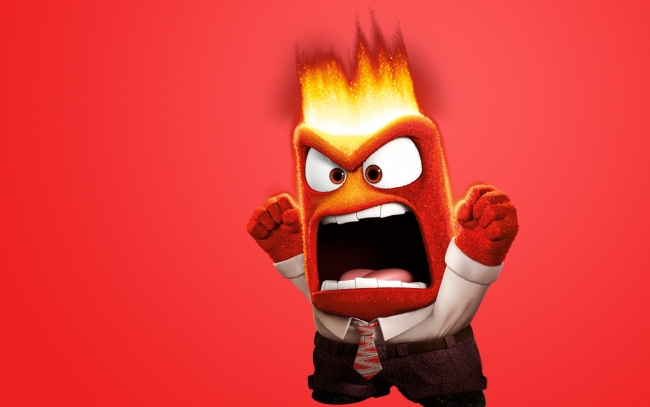
My face, before my morning coffee (kidding!)

There are a number of ways to deal with anger. Obviously, learning meditation is an effective tool for learning to control oneself. Regular physical activity is also a great help. Whatever means you decide to use, remember that as I’ve said before, emotion is an energy. And you can’t destroy that energy, you can simply transform it. This is where it becomes important to transform it into something useful. ☯