The home of Buddhism, Martial Arts, Diabetes and health…
Author: Shawn
I am a practitioner of the martial arts and student of the Buddhist faith. I have been a Type 1 Diabetic since I was 4 years old and have been fighting the uphill battle it includes ever since. I enjoy fitness and health and looking for new ways to improve both, as well as examining the many questions of life. Although I have no formal medical training, I have amassed a wealth of knowledge regarding health, Diabetes, martial arts as well as Buddhism and philosophy. My goal is to share this information with the world, and perhaps provide some sarcastic humour along the way. Welcome!
It should come as no surprise that just about everything has moved to some sort of online forum in the past year. In my household, we’ve even started doing some shopping and Costco orders online and had them delivered; something we had never done prior to the pandemic. Considering that most things have been slowly moving towards online options in the past decade or so, the pandemic has been that last little push that was needed to force us to do everything else without face-to-face-contact. This week, the karate club I train with started having classes on Zoom.
Our Zoom Meeting Dojo (That’s me in the blue!)
It was a strange and different experience, that much I can say. As you can see from the image above, we all met via Zoom and took instruction from Master Harding as he guided us through an hour’s workout. It was interesting to see everyone who had made do with whatever space they had available in living rooms, basements and home dens. I was among the lucky ones that had a large, open space to work with that included my black, foam workout mats. But as I’ve written in previous posts, karate doesn’t require much more than a four by six-foot space to train in. And the group proved that, over the sixty minutes that followed. ☯
The human hand is a wonderful thing and is comprised of almost three dozen bones. Some of those are pretty damn small, making your hands some of the most delicate appendages on your body. Our hands are used for a number of things that we often don’t realize and take for granted. For example, your arms and hands are responsible for helping you with balance when you walk, run and even while standing. None of which mentions that you need your hands to pick your nose and eat burgers. But I digress…
Given that they’re comprised of so many small bones and have those brittle, breakable fingers on them, why do we depend on hands so much in the fighting arts? This is pretty bold talk, coming from the guy who studies a martial arts style directly translated as the “way of the empty hand.” But it’s not so much the use of one’s hands that’s the issue. It’s the WAY and manner in which we use those hands that’s important. And that reminds me of a story. Buckle up!
Decades ago, I was a green belt in class with Sensei and one of the brown belts. It was a quiet night of just the three of us, and the brown belt was slated to test for black belt within the next month or so. As such, Sensei’s attentions were focused on him for the evening while I was relegated to a corner to practice forms on my own. I was fine with this since, as you all know, I love forms. But I was also keeping an unseen eye on the two of them as they were caught in a rather heated sparring match.
As their speed and movements increased, the brown belt tried to perform a grab of some sort. I can’t be sure if he was trying to grab Sensei’s sleeve of gi jacket, but it didn’t work. Sensei isn’t one for sitting still and he kept moving as the brown belts hands was still trying to get a grip (pun fully intended). Two things happened simultaneously: Sensei executed a strike against the brown belt AND the brown belt’s pinkie finger snagged in the open mouth of Sensei’s sleeve and snapped.
An example of Master Uechi’s hand positioning for Uechi Ryu
The brown belt made every effort to conceal how much pain he was in, but it was very clear that the finger had broken. He and Sensei stepped out so that Sensei could drive him to the hospital to get splinted. It was one of the first times I was left completely alone in the dojo, which was interesting to say the least. And it gave me a wake-up call very early (or what felt early) in my martial arts career about the importance of hand placement and guarding one’s fingers.
Depending on the style you study, an open hand may be necessary. It rather hard to perform proper technique in a grappling style with closed fists. On the flip side, it can be a bit difficult to practice a striking art with your hands wide open. For a style like Uechi Ryu, that combine strikes, grappling and pressure points, it can become a little bit convoluted as you’ll need to combine all of those things. But even while using ANY open-hand technique, the important part is to properly protect your fingers. A broken finger isn’t lethal, by any means. But the pain can be enough of a distraction to cost you dearly in a real fight.
I’m not often a big fan of kicks and I usually favour hand techniques in lieu, especially since raising one’s foot off the ground places all your weight and your centre of gravity on one leg. This leaves you vulnerable and isn’t a comfortable position to be in. That being said, I usually prefer a solid punch or an elbow to using open-hand techniques because I like my fingers and don’t want them breaking. At the end of the day, there’s no easy solution to this dilemma, if you study the martial arts.
You can see Master Uechi’s hand positioning in the photo above. Notice the open left hand while he delivers an empi (elbow strike) with the right arm. Far be it from me to question the way a master places his hands, but those spread fingers make me nervous. Sensei has taught us that above all else, keep the thumb tight against the palm and the fingers pressed together. It’s comparable to bamboo; a single finger can be weak but all four fingers combined will be much stronger.
So, that’s the take home lesson in this instance. I always like to relate things back to the street and in an actual street-based altercation, technique and style usually go out the window in favour of just staying alive. This is why muscle memory and training drills are so important. And if it means life or death, a distraction can mean the difference between walking away or being put down. Protect those fingers, people!
Being diagnosed as Type-1 Diabetic at the tender age of 4, I’ve had the benefit and burden of surviving my childhood with a plethora of different doctors, specialists and all-around know-it-alls who love the sound of their own voices and providing unsolicited opinions. But i would be lying if I said that I didn’t owe my survival through said childhood as a result of those medical professionals. During my childhood, my parents lacked the education, resources and information to provide the level of care that was required to help a small child survive Type-1 Diabetes. I mean, they did the best they could with what they had. But there’s no doubt I’d be dead by now if not for the care and advice from the many doctors I’ve had over the years.
But one thing that’s grated on my nerves in recent decades, is the use and aversion to Dr. Google. Y’all know Dr. Google, right? It’s a pretty common practice that people have where they look up their symptoms online and make clinical decisions for their health based on what they’ve found. I don’t need to tell you that this can be an extremely dangerous practice and I certainly don’t recommend it. That being said, there’s a growing number of reputable, peer-reviewed sites that can lend some invaluable information when the situation doesn’t allow for an 8-hour hospital visit or a doctor’s office visit that would likely only be scheduled months down the road.
Such sites can include some of my favourites like WebMD, Healthline.com and the Mayo Clinic’s website. One good example of this is when my wife successfully identified our son’s tendency to soil himself as Encopresis, a condition in children where bowel movements are painful so they hold it in to avoid said pain, resulting in clogged fecal matter that needs to be softened and passed through increased fiber and water intake. (Notice that I used the Mayo Clinic’s page to define Encopresis)
We didn’t just blindly accept the condition as what was happening but the information we gained gave us the ability to ask Nathan the right questions and, as a result, lead to an at-home treatment the ultimately cured the condition. Otherwise, we might have been looking at doctors’ appointments, tests, invasive probes and attempted prescriptions over days and perhaps weeks, for a simple condition my wife was able to identify in one afternoon of reasonable and proper research.
But most doctors despise this practice and not only frown on it but will directly berate patients when they hear that they’ve “checked online” in relation to something medical. One good example comes to mind from the early 2000’s when I was totally and completely exhausted, regardless of sleep. I was always dizzy, had bad headaches and my body and joints ached constantly. Although the internet wasn’t quite what it is now, I was able to research some information and found a condition referred to as Chronic Fatigue Syndrome. Based on my symptoms and the possible causes of this condition, it was recommended I see a doctor. Which I did. Then I explained. And spent the next twenty minutes being lectured on the fact that HE was the doctor and HE’d decide what my diagnosis is.
In a way, I get it. Doctors and medical professionals spend years, huge amounts of money as well as personal commitment and sacrifice to become the professionals that they are. I can understand that it would come as a slap in the face to have Joe Everyday walk into your office and tell YOU what the diagnosis is, before you’ve even had a chance to examine them. It would be like a white belt starting at my dojo and trying to tell ME how to punch or kick because they saw Van Damme do it differently.
The problem is that Chronic Fatigue Syndrome usually passes within a few months and can occur without warning or reason. There are risk factors and possible reasons, but nothing proven. I was basically ignored and sent home with the recommendation to “get some sleep,” despite my explanation that sleep wasn’t rejuvenating me. And there lies the issue: hospital and clinic wait times have just as much effect on the medical staff as they do on the patients. Doctors often double book and have to hustle patients through as quickly as they can, without having proper time to evaluate and diagnose what may be wrong.
On the flip side of things, we have those peer-reviewed sites I mentioned. You know, the ones written by doctors then reviewed and confirmed by other doctors? It’s not a good thing when a patient assumes to KNOW what’s wrong based on a few web searches. But by the same token, it’s also wrong for a doctor to dismiss a patients questions and concerns BECAUSE their information originated from the internet. After all, it’s fuckin’ 2021, people! I’ve heard multiple responses from doctors including, but not limited to:
“Would you like to be the doctor or would you like to let me do my job…?”
“Oh, you checked online?! I guess you have all the answers, then…”
“People need to stop risking their health by depending on the internet!”
“I’ll decide on that, thank you very much!” (usually before they’ve even heard my concerns)
There are many more, but online everything is the way of the world. Although skilled and likely cranky due to debt, doctors need to understand that provided information mixed with the patients genuine concerns shouldn’t be dismissed or taken lightly. After all, if you could diagnose and heal a patient in days using shared information rather than weeks, wouldn’t that be a good thing? Work smarter not harder, right?
I’ve been pretty lucky that such encounters have usually been the result of clinic or on-call doctors and not my usual family practitioners or specialists. But if you choose to use the world’s information to help in your medical care, be prepared to stand your ground and deal with some of the more judgmental and touchy doctors that are out there. This shouldn’t discourage you from doing research and looking at what may be causing a particular ailment, so long as you use common sense and call 911 if you’re bleeding or are suffering an immediate emergency. The internet can only do so much… ☯
One of the things I’ve come to realize in recent years is that “dad bod” is a VERY real thing. Having a condition like Diabetes that increases your gut size doesn’t help, either. But I recently made a short video where I filmed myself doing karate katas and when I reviewed the video to do some editing, I was taken aback at how “thick” I looked. And since this isn’t a rap video, being “thick” is NOT a good thing. I work pretty hard at trying to maintain my weight, but the old adage about gaining muscle mass increasing your overall weight holds some truth as well. I guess that classifies me as a muscled fatman (says the word “fatman” with a raspy Batman voice).
This is why I’m usually game to try anything to help trim the fat, as it were, so long as it isn’t dangerous or harmful and doesn’t affect my Diabetes. Granted, let’s agree that EVERYTHING affects Diabetes, so that’s a tough one. But I try to maintain four to six workouts a week, I’ve incorporated reduced-carbohydrates, reduced daily caloric intake, green tea consumption and trying out any supplements that might help in slimming me down. The bottom line is that falling into a caloric deficit that forces one’s body to burn fat as a fuel source is the only genuine source of weight-loss, although there are different ways to achieve this.
That’s why I was deeply fascinated when I read somewhere that proper sleep can help with weight loss. To be honest, no one loves sleep more than I do. Except maybe my wife. But given Type-1 Diabetes, PTSD and small children in the house, getting a proper night’s sleep or even enjoying a decent nap can be a somewhat fleeting thing. Not to mention that as much as I LOVE my insulin pump, it’s frequent alarms for all reasons throughout the night tend to keep both my wife and I from getting a full, uninterrupted 8 hours of rest.
For those reasons, I decided to look into the matter and see what could be potentially inflating my middle, other than my love for a good burger, as it relates to sleep. An article posted by The Sleep Foundation states that there seems to be a correlation between modern families getting less sleep and the fact that obesity is on the rise. One of the concepts the article proposes is the fact that lack of sleep affects the neurotransmitters that control one’s appetite, leading to greater consumption of food throughout the waking day.
This actually makes a lot of sense to me. I used to work with a lady who swore by grabbing a snack when she felt sleepy on the job. I’ll admit that on days where I felt blasted and needed a nap, grabbing a quick bite to eat would usually refresh me for a short period of time, so I personally feel that there’s some truth to this. Not least of which is the fact that lack of sleep will cause a lack of energy for sports and activities.
The article goes on to point out that less sleep means you have more time to snack and eat, a pleasure that I am FREQUENTLY guilty of. Especially during late-night blogging sessions, I’ll often indulge in some of the very snack foods that I should be trying to avoid. It ends by pointing out the usual sleep recommendations: regular schedule, pitch-dark room, no eating before bed and reducing one’s stress. To be honest, I don’t know of any person who can do ALL of those things. So are we just basically screwed and have to surrender to the oncoming “dad bod?”
Another article I found by WebMD brings up most of what the Sleep Foundation article does but it also points out that we tend to make bad decisions when we’re tired, which leads to depending on sugar-filled caffeine drinks to jumpstart our mornings and eating crap all day since our bodies have difficulties fighting food cravings when tired. Add to that fact that if you’re exhausted you’ll be in absolutely NO mood to exercise and BAM! Weight gain! One direct point that the WebMD article makes states, “Too little sleep triggers a cortisol spike. This stress hormone signals your body to conserve energy to fuel your waking hours. Translation: you’re more apt to hang on to fat.”
I found a few more articles from different sources but they basically parrot what I’ve provided already, so I won’t bother. But the take home to today’s post is that sleeping won’t make you LOSE weight, but lack of sleep will certainly hinder your efforts to do so. In fact, lack of sleep can cause you to gain weight. So, let’s clarify this… Getting more sleep can help me to curb my appetite and encourage my efforts to lose weight? Sounds fantastic. Now, to find a way to get a full, uninterrupted night’s sleep… ☯
I always like to keep an ear open to new things, especially where my health and fitness are concerned. And something I’ve been reading about recently is a slow-digesting protein called Casein. Somewhat comparable to whey protein, Casein is absorbed and used by the muscles at a different. According to an article I found on Men’s Health, casein is a slow-acting form of protein that “drip feeds your muscles” and “your blood amino acid ‘peaks’ with your protein synthesis […] and continues to do so for up to four hours after ingesting.”
So, what’s the skinny? Is this shit better than whey protein? From what I’ve read, they’re both quite similar with the exception that whey is absorbed much faster. The slower rate at which the body processes Casein makes it a bit easier on the body as it provides a steady stream of amino acids and protein to the body instead of having get all soaked up in one shot. That same Men’s Health article goes on to explain that Casein is usually best taken before bed, since its slow delivery allows for better muscle recovery while you sleep.
Another article I found posted on Muscle & Fitness also agrees that whey is the best option as a post-workout protein, but lists a number of benefits to including Casein in your fitness regiment. Besides lasting longer than whey and helping to provide greater strength, the article boasts greater muscle gains and some fat loss benefits. Of course, like everything else, this is combination to a good diet and consistent exercise.
One last benefit that Muscle & Fitness included is that the consumption of Casein can potentially reduce and prevent the effects of enamel erosion. That’s based on some studies from the UK, of course. So one needs to take it with grain of salt. But it would be cool if it did since you don’t usually hear about fitness supplements providing such a benefit.
Last but not least of course, is the fact that there are some studies showing that Casein can help with insulin and glucose levels. But I wasn’t able to find anything definitive. At least, nothing worth mentioning here. But I intend to keep researching and looking into it and I’ll be sure to add to this if there’s a positive Diabetic component that’s found.
In the meantime, I’ll say the same thing I say with everything else. Although this is an over-the-counter supplement, you should consult your medical practitioner before adding any specialized supplements to your daily diet. Like everything else, Casein may not be for everybody and since everyone is different, all the benefits listed in these articles may not necessarily work for you. ☯
You all know that I have a tendency to rag on most of these modern, Westernized holidays. Especially when you get these ridiculous ones, like National Donut Day, Coffee Day, Beer Day and Poutine Day… Granted, I LOVE all of those things, so I’m more than willing to observe such days, despite the frivolousness of them. So it dawns on me that it’s SUPER easy to observe a day dedicated to the aspect of my life I love the most: my wife. Today is International Women’s Day.
International Women’s Day actually came into existence in 1911 in Canada, and is observe in order to celebrate all things woman! And there’s a lot! I’ve been lucky enough to grow up, work and befriend so many strong, capable women in my life. And even luckier still to have found and married the best one. In the daily grind of our lives, it can be easy to forget or miss just how much the women in our lives do for us. I, for one, am grateful that I found a woman who shows me every day that despite the lonely nature of life, I never have to face anything alone. ☯
Life doesn’t care about one’s plans. That’s one of my most frequently used sayings across all the forums I post on, and many people feel that it has a negative connotation to it. Honestly, nothing could be further from the truth. I repeat this short phrase, almost like a mantra on a daily basis because it reminds me that I need to keep pushing and working at everything in life. And so do you. It isn’t intended as a negative thing, it simply represents the fact that if you lie on the floor curled up in a little ball instead of getting up and working at making things happen for yourself, nothing ever will.
And this leads to suffering in one’s own life. As I’ve written about before, Buddhism has this lovely concept of Four Noble Truths; the first two being the acknowledgement of suffering and the second being that this suffering is caused by us. I always like to push it one step further and point out that most of one’s suffering is self-inflicted. It’s for this reason that it’s important that one takes the necessary steps to get up and go.
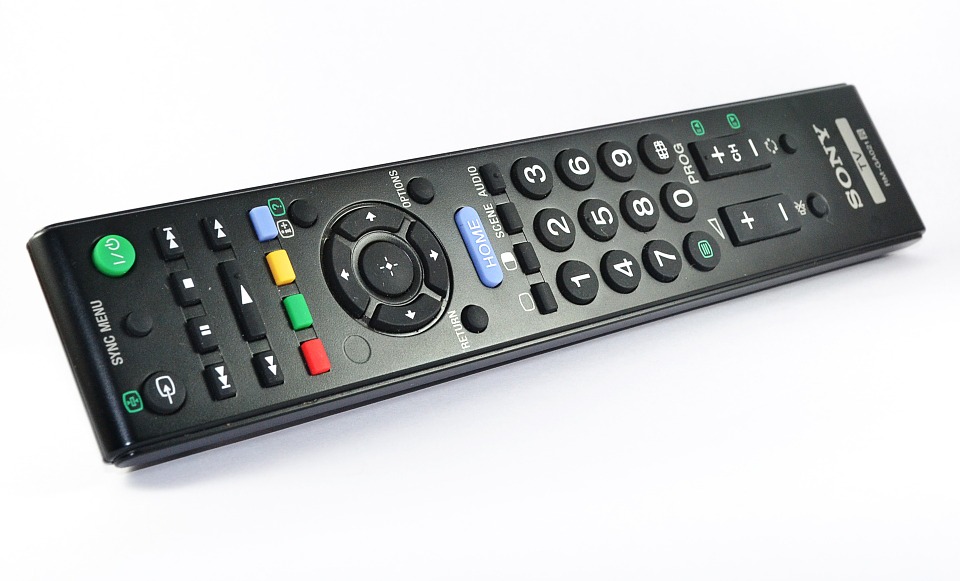
A good analogy that I’ve used on others before, is to think about the remote control to your television. When I was a kid, you had to get up off your ass and turn the dial in order to change a channel… All three channels that you HAD, depending on how well your rabbit ears were aligned. Yes, I’m THAT old… My point is, modern televisions involve remote controls and many models don’t even feature physical buttons on the actual device anymore. Times have somewhat changed.
Now imagine that the batteries in your remote are dead. If you sit back and wait for the incidental chance that someone will come along and change them out for you, you’ll likely go without the binge-watching session you had planned. Especially since no one likely knows your batteries are even dead. So, maintain your own batteries. Keep yourself charged and moving. Batteries are a good analogy, too! Like a friend of mine has told me, “Be like a battery… Some negative, some positive but all power.” Man, I gotta get that printed on a t-shirt! Daryl, if you’re reading this, beers are calling, damn it!
I guess what I’m trying to get at with this poor attempt at a Monday motivation, is that there’s no turning back. Most people live regretting the past and wishing for the future and in doing so, miss out on the present. Life is hard. It’s not MEANT to be easy. If it were, where would the challenge be? That’s why the expression is “going THROUGH hell,” not “getting to hell, suffering a bit but turning back eventually.” Shit happens, bad things fall in our laps. But we owe it to ourselves to keep fighting the good fight, no matter how hopeless or tiring it may seem. No only up is through, so you need to keep pushing.
Instead of saying I regret that, say I look forward to this… Instead of saying I wish I had, say I WILL! Instead of Too bad that happened to me, say I will protect myself and learn from my mistakes! Instead of I failed, say I made a mistake but I’ll recover and win!
Y’all get what I’m throwing down, here? Does it makes as much sense in print as it does in my head? Sometimes the thoughts in my head sound great but they tend to move faster than my fingers can type, so it doesn’t always have the desired impact. Last but not least, don’t be afraid to cut yourself a break. Mistakes and hardships are how we learn and grow. There would be no progress without it. As long as you’ve learned from it and you refuse to stop fighting, you may lose the occasional battle but you’ll ultimately win the war. ☯
I’ve been a huge fan of Cobra Kai since it was released to YouTube and I was absolutely over the moon when it came to Netflix and even more so with the release of Season 3. About a year ago, I scribe to Mary Mouser’s channel and discovered that she was Type-1 Diabetic as well, and she had made a rather heartfelt and emotional video about how she was diagnosed and how’s it’s affected her life. In that spirit, I decided to do the same and the video below explains the when and how that I was diagnosed with Type-1 Diabetes in 1982, and the impact it’s had on me. Enjoy! ☯
Objectively-speaking, I’m a bit of a weirdo… I can already hear my friends arching an eyebrow while saying, “Objectively???” But seriously, I tend to dip into the strange and unusual on occasion, but today’s post will be simply something to gross most people out. If you have an aversion to feet, you may want to back out of this post now without proceeding any further.
A couple of weeks ago, I was enjoying a nice half hour of shadow boxing in my home dojo. As I’ve written in previous posts, I purchased a whole batch of black foam mats that interconnect, making for a nice, open-concept area with a padded floor. Perfect for karate, wrestling, circuit workouts and more. During a particularly spirited portion of shadow boxing, I decided to execute a tuck ‘n roll where I come to a stop, delivering an elbow strike to my “opponent” on the floor. During the roll, I discovered an important detail about those foam mats. Toenails don’t slide on them…
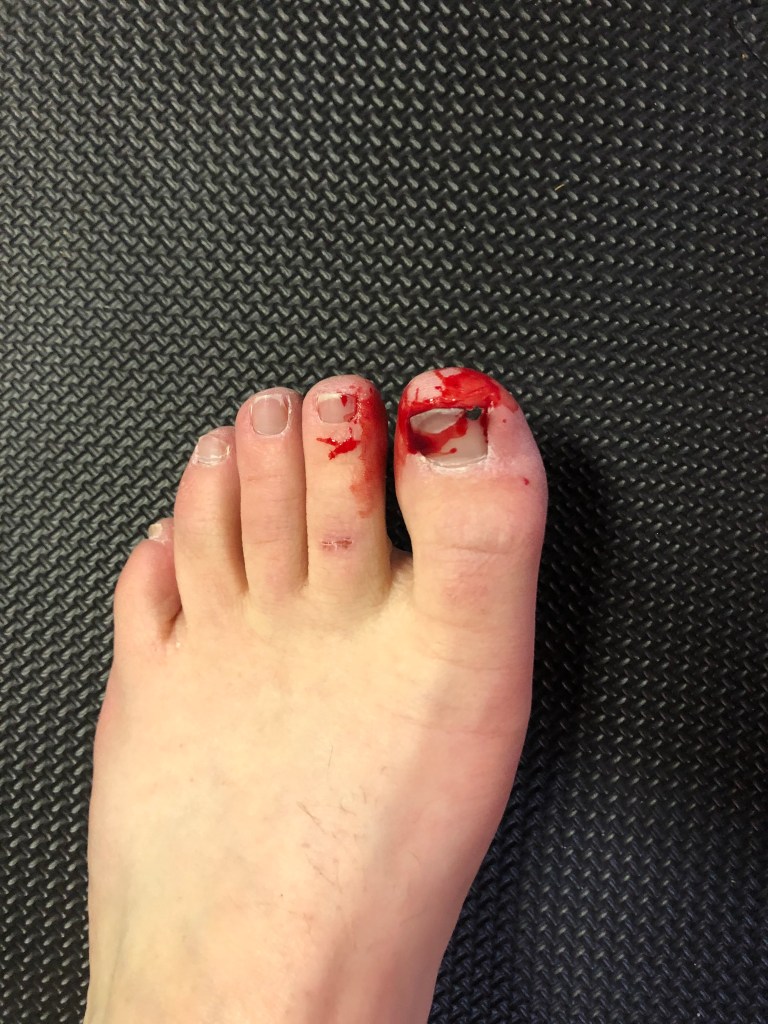
My left foot, in all its bloody glory!
When I executed my roll, I pushed off with my left foot. My big toe was the last thing to leave the mat, which caused the nail on my big toe to press down against the mat. When my toe continued moving, the nail decided to stay with the mat. The bloody line that’s clearly visible along the middle of the nail is where the toenail lifted. I completed the technique and continued on my merry way. It wasn’t until a minute or two later when I threw a front kick with the left foot that I noticed a bright, red drop fly out towards the wall. I looked down and discovered the mess you see above.
It’s not a secret that proper foot health is important to anyone with Diabetes. Over time, most people with Diabetes will develop SOME level of Diabetic Neuropathy, which can lead to all sorts of complications with the body’s extremities, namely the feet. The main concern with Neuropathy is that it can cause a loss of feeling in said extremities, meaning you may not feel the injury when it happens and delayed care can lead to infections or worse.
Another particular concern, is that Diabetes can also lead to lessened blood circulation. With less blood circulation (or slower blood circulation) the required platelets, nutrients and cells required for healing will be delivered much slower to someone with Diabetes, hence the reason you always hear that foot injuries take longer to heal. And that’s if they heal at all. For someone with extremely poor blood sugar control, medical intervention can be required in order to help the wound heal as it may not be likely to do so on its own.
A close-up, just because I’m a sick bastard…
For those of you who may be wondering: Yes, I felt the injury. Albeit not immediately. There was a delay due to the music and adrenaline. I was kind of in the zone. But I noticed the blood BEFORE I felt the sting. No, I didn’t halt my workout. I probably should have, in the interest of cleaning the wound and bandaging it appropriately. But I was about 20 minutes into a 30-minute shadow boxing routine and I didn’t feel the 10-minute delay would result in the loss of my toe.
But it’s important to recognize that if you have Diabetes, wounds should be cleaned and bandaged in a timely manner, even if they don’t hurt. Poor circulation issues and Neuropathy are sneaky bastards and can cause damage if you ignore injuries. Like the freshly forged blade of the samurai, my training mats have now been anointed in blood. Even if it’s mine. Damn it. Nathan plays on those mats. Looks like I’ll have some cleaning to do, once I’ve mended my toe… ☯
Something that’s always had me curious is the separation and designation of certain foods within supermarkets that are labeled as “organic.” For years, I’ve walked past these displays while doing groceries and had a laugh at the pop suckers who paid almost twice the price in some instances, for the very same food I was buying from the regular section. My laugh would be accompanied but a mumbled comment to the effect of, “Idiots! ALL food is organic…”
I wasn’t wrong in my assessment… About all food being organic, not the people being idiots! But I digress… The truth is, yes all food is organic. But what’s being referred to is the method in which the food is grown and harvested. To be specific, “organic” foods are foods that are grown without the use of chemical pesticides, fertilizers, growth regulators and additives. In the case of livestock, they’re bred without the use of hormones and antibiotics.
Depending on who you talk to and what source you research, choosing between organic and traditional food can be a tough nut to crack. Although consuming foods that don’t involve everything listed above may SOUND like a good idea, there are pros and cons to “organic” food, just like everything else in life. I apologize ahead of time for the quotation marks I keep using; I can’t get past the fact that all food is organic, so I consider it a label as opposed to a proper description.
First of all, it needs to be understood that organic foods, for the most part, contain the same nutritional value as conventional foods. There are some mild exceptions, and this is where your sources may differ. For example, an article posted by HealthLine.com indicates that some studies have shown that organic foods may be higher in antioxidants and vitamins. One advantage to the lack of pesticides is that the crops need to defend themselves using natural means, namely increased antioxidants.
The evidence is an overall mixed bag of whether the organic version is better for you or not. Either way, you can’t lose. But the cons come into play when you consider how much more expensive the organic option is. The reason behind this is because the lack of pesticides and chemicals means that farmers need to perform most of their weed removal and crop care by hand, which takes more time, labour and extra hands. Hence, why it costs so much more.
The big takeaway is that most studies agree that although consuming organic foods may help reduce the amount of chemicals and pesticides you ingest, the amount contained in conventional foods is negligible at best, and no worse than you’d be exposed to during contact with your day-to-day life. Another important fact is that although organic foods are grown and harvested in a specific way, it doesn’t make them any healthier to your overall health goals. “Organic” baked goods, butter and fatty foods will still be JUST as bad for you as their conventional counterparts.
Last but not least, you want to be careful when spotting the difference between “organic” and “natural,” as they don’t mean the same thing AT ALL. And besides the increased cost, “organic” produce has a tendency of spoiling quicker than their conventional counterparts. At the end of the day, an apple is an apple and both will be just as nutritional and good for you. The choice to buy “organic” is a personal and subjective one, and should be based on preference. ☯








 The Blogging Buddhist