It’s Toe-tally Painful…

I know that it seems as though I’m often posting about negative shit but trust me when I say, it’s about the journey and the pitfalls we face, not the negative aspect. That being said, it can be easy to fill an entire book with the negative aspects of Diabetes, considering the side effects and secondary issues it causes within the human body. One of them happens to be that wounds are much more difficult to heal for someone with type-1 Diabetes. This if for a variety of reasons including but not limited to, poor blood circulation and nerve damage.

One of the nastiest and most annoying wounds that one can get, is when a toe splits open. Believe it or not, this can happen a great deal when doing karate by virtue of some of the stepping, stomping and movement performed repetitively on a hard floor over hours of class time. I recently discovered this when I noticed last Thursday night after class that my right foot stung every time I took a step. When I got my phone out to snap a pic of what was happening underneath (I’m sure as hell not flexible enough anymore to bring my foot up to my face) I found a fine cut, right the seam where the toe meets the foot.

Calloused but clean…

These types of wounds are worse than paper cuts, because they continue to constantly move and flex with every step one takes. This means that it’s all the more difficult for these kinds of cuts to heal in a timely manner because the wound can’t sit long enough for it to close up quickly (or as quickly as a Diabetic foot will permit). And of course, all the usual Diabetes-related issues will apply; poor circulation in the extremities and neurological damage will contribute to the overall length of time it takes to heal.

That being said, there are things you can do to ensure this type of wound DOES heal up, whether it takes a bit longer or not. Keeping your feet warm and dry are the first lines of defence. Moist feet will breed bacteria (yes, I used the word “moist,” get over it), which is the last thing you want when you have an open wound in an enclosed area like the bottom of a toe. Although most and covered wounds may be more likely to let regeneration happen faster in most wounds, you need to consider the totality of where the injury is, coupled with the fact that the cut I’m showing you in the photo above won’t scab. No one likes scabs, but they do serve an important role in the healing process.

Since a cut like this won’t easily accommodate a band-aid or bandages, keeping the wound site clean can be problematic, especially if you’re stubborn and will keep going to class and training with bare feet. As much as it pains me to recommend it, taking the next class or two off, to allow the cut to heal is preferable to walking and training on a floor where several parties are all bare-footed as well. Luckily, I discovered this cut on Thursday night and no longer have class until Monday night, so I should be able to let it heal.

When you’ve showered/bathed, be sure to dry the area properly and don’t be afraid to let your feet air out well before slipping on socks. If you wear slippers, remember that those bastards contain everything your feet come into contact with. So if you’ve got a pair of old faithfuls that you’ve been wearing for years and you slip them on your freshly-showered feet, you’re mashing light-knows-what into your wound that’s been collected inside them bastards when your feet maybe weren’t as clean as you’d like to think. Moving on…

Antibiotic creams or gels CAN be helpful, although the jury is out on whether they genuinely provide faster healing or not. The consensus I’ve found is that they can help to reduce the risk of infection in simple cuts and wounds but may not do a great deal for the length of time it takes to heal. The other thing to consider is if you smear antibiotic cream into the crook of your toe, as with the cut in the picture above, you’re likely going to rub it all off as soon as you start walking, barefooted or not.

This is the part where I explain that proper diet and exercise and strict management of your blood sugars level will all help with the proper healing of cuts and wounds on your feet. As with any injury, you should seek medical attention if you start to notice that it’s becoming red and angry, turning strange colours, spreading or oozing pus or fluid. Or if it’s been an extended period of time without healing. That’s kind of important, as well.

Limb amputation is the last point I’ll touch on in this post, as morbid as it may be. It’s a harsh reality that’s people will Diabetes often need to face, especially in cases where their condition is poorly controlled and monitored. When a wound in the extremities becomes aggravated or infected, there’s a greater chance that it can lead to amputation, which is why it’s so important to take good care of your feet. You only get one set, so you need to pay attention. Check your feet for wounds and sores you may not feel or be aware you have. Keep that circulation going and keep your blood sugars controlled. ☯️
You’re Not A Rattle-Snake…

“Empty Your Mind, Be Formless, Shapeless, Like Water. Put Water Into A Cup, It Becomes The Cup. Put Water Into A Bottle, It Becomes The Bottle. Put Water Into A Teapot, it Becomes The Teapot. Water Can Flow, Or It Can Crash. Be Water, My Friend.”

– Bruce Lee

I usually take “famous” quotes with grain of salt. In these modern days of the internet and misinformation, you never know when someone may be misquoting. But the above quote from Bruce Lee is Pretty safe, considering I recently acquired his daughter’s book that basically focuses on Bruce Lee’s concepts behind being like water. It’s a pretty decent read, although i haven’t quite finished it yet. But it got me to thinking… One of the bigger obstacles one faces when practicing the martial arts, is the tension people hold in their bodies while training.

In some ways, many ways, one can’t be blamed for tensing up when training in a fighting art. Regardless of one’s experience level, knowing that someone is coming at you with a fist or a foot usually has that effect. But in order to learn properly and develop one’s technique, it’s important to remain flexible and relaxed as you learn. The dojo and/or class environment is a safe space where you can take advantage of developing that POSITIVE muscle memory in a controlled environment. This is hard to achieve when one is all tensed up and inhibiting one’s movements.

Lee’s quote is basically telling you that you need to maintain the flexibility to ensure adaptability in any situation. Issues you can face from this lack of flexibility can include a number of nasty results that you really don’t want to experience in a real-fight scenario. For example, tension may cause one to hesitate. You hesitate in a true fight, you get hit. Period. Tension will aggravate and worsen your “tells,” or your telegraphing. Lack of fluidity and flexibility will cause a hindrance to the free-flow of one’s movement. this isn’t just bad in the dojo; it can be dangerous on the street.

I guess there may be some styles that differ in this view but I haven’t encountered one yet that encourages being tight and tense when training or even fighting. Unlike the rattlesnake that tenses before striking, a karateka must remain fluid and relaxed, allowing muscle memory and skill to take control as opposed to getting into one’s own head. Food for thought… ☯️

Take A Knee…

Nobody likes feeling pain and if you do, you likely run in circles that won’t have you reading a Buddhist blog. But I’m not here to judge. GENERALLY, people don’t like to feel pain and it’s no secret that there are many sources of pain outside of accidental or intentional. I’ve recently written posts about injuries and how they can be aggravated by Diabetes as well as how one shouldn’t ignore injuries or pain if they persist for long periods of time.

One of the body parts that can relate to ALL of those aspects are one’s joints. I don’t know about you but as the years have dragged on, I’ve started to notice an increased amount of joint paint. Not consistent and certainly not debilitating but just enough that it draws my notice.

Now, just to be clear because sometimes I’m not, a joint as it relates to the body is where two bones meet. Joints allow the free movement of the body, which we would be unable to do otherwise. These meetings of bones are held together by ligaments, which are strong elastic bands of tissue and movement is achieved by tendons, which are also a connective tissue that connect to the muscles that create movement.

All caught up? Good. People tend to take their joints and the respective movement they provide for granted and assume that muscles are solely responsible for proper movement. But there are many moving pieces to the process (pun fully intended). The last piece of the puzzle is cartilage. This is another type of connective tissue that serves a number of different functions throughout the body. One of the most important among these functions is coating the bones in a joint to cushion them against friction and impact.

Over time and extensive use, such as one might see from decades of martial arts training, the cartilage in one’s joints can become worn. This wear and tear can eventually cause loss of motion in the joint and pain as the bare surfaces of the bones start to rub together. This grinding of bones is called osteoarthritis, or the “wear-and-tear” disease.

It’s not always as bad as bare bones rubbing against each other. Even mild conditions can have you feeling aches and pains in the joints, especially when moving. It’s important to pay attention to these aches and pains as they can be treated in various ways but it’s obviously easier to do so before it becomes worse. Any joint pain you feel that’s sharp or acute can mean something more serious, like a torn ligament or tendon, muscle damage of bone fractures. None of those should be left untreated and you should have them checked by your medical practitioner.

Why am I writing about this? Well, the reality is that when one studies a contact art like karate, one’s joints take a terrific beating, figuratively and literally. I know that after the many decades of training hard, my joints certainly aren’t what they used to be and I would be lying if I said my knees don’t swell up like balloons on rainy days. The important thing is to keep stretching, warming up the body and ensuring that you don’t ignore consistent, chronic pain when it becomes known. Your body will thank you. ☯️

Just When I Was Starting To Remember…

Yesterday marked the lifting of all COVID-19 pandemic-related restrictions, here in Saskatchewan. It’s been an interesting run of things, considering that even after two years of wearing a mask, I still occasionally forget to slip one on. Last weekend, Nathan and I went shopping at Walmart and I agreed to get him a happy meal since the location had a McDonald’s. Ironically, he had just received his second dose of the COVID-19 vaccine, so I agreed to reward him with a purchased lunch since I was going to make him sit through doing groceries.

We walked in and I had ordered his food and waited for it, for almost ten minutes. We got his happy meal and I loaded him into the cart so he could eat comfortably. It wasn’t until we walked into the store proper that I realized my face was bare! I was wondering why some people were giving me sideways glances. I had my mask on me, of course. I’m usually in the habit of getting as much fresh air in my lungs as I can before slipping on a mask. In this case, I must have simply forgotten.

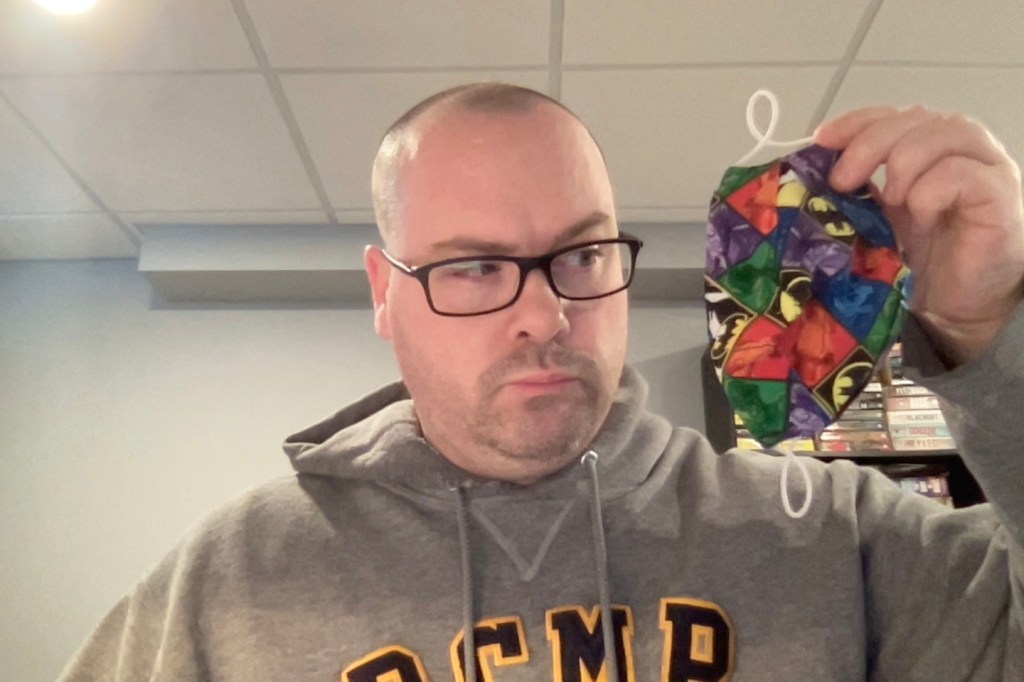
The wearing of a mask has long been a debated restriction over the past two years. I write about it now because it was my most disliked. I hate wearing a face mask. I honestly don’t know how medical professionals do it. My hat’s off to them. Considering I’ve found myself having to train and do karate with a face mask, I’m well aware that once the skin gets a bit sweaty, that’s all she wrote! The mask basically sticks against my face like someone trying to choke me with a plastic bag. Not least of which is the fact that wearing a mask makes it difficult for me to wear my glasses. Anyone who wears glasses will totally understand the struggle. I know, I know… First world problems.

The thing is, a face mask will block some particles from spreading. This makes logical sense, since surgical staff wear them to prevent the spread of germs during medical procedures and surgeries. The logical part of my brain understands this. The “semi-logical” part of my brain suggests that it isn’t as overall effective as the professionals may think it is. When was the last time you walked past someone while wearing a face mask and were able to smell their cologne or perfume? Or caught a smell of a local restaurant wafting in your direction through the mask?

This would seem to suggest to me that particles are making their way into my nose, regardless of the mask. This wold SEEM to suggest that if COVID-19 particles are being blown in my direction, I could potentially be breathing them despite having a plate of cotton armour across my face. Doesn’t that make sense? On the flip side, smelling particles known as “odorants” and having active virus particles make their way into your body may be two different things. I don’t know, I’m not a doctor. This post is purely speculative and simply an example of me thinking out loud.

Some believe the lifting of COVID-19n restrictions is too early. Maybe it is. Some believe that we all need to collectively reopen the world and let nature take its course in order to move on with life. Perhaps we will. In the meantime, it will be nice when the impulse to slap on a mask has passed, although I must confess that it’s my intention to continue to carry one with me in my pocket for some time to come. The world isn’t done with this bullshit, yet. Food for thought…☯️

A Lot Of Effort For A Little Prick…

Alright, this post will be a bit of a rant so I’m warning all of y’all to buckle up. Next week, I’m schedule for my bi-yearly visit to my endocrinologist where we examine my state of existence as it relates to Diabetes and how I’m managing. For the most part, I tend to make things pretty boring for my doctor, with level blood test results and a blood glucose log that you could easily cross-country ski on. My last visit, which was back in September, wasn’t as good as previous ones by virtue of having come off of CGM. This was mainly the fault of my insurance company, which put a cap on how much they would cover and I couldn’t see clear to pay the hundreds of dollars each month for them, myself. But I digress…

My point is that for the first time, my A1C’s were off, my blood sugar results weren’t as pretty as usual and I had some ‘splainin’ to do. I always find it hilarious when a doctor picks out one random bad reading off my blood log and asks, “What happened here?” Dude, I have difficulty remembering what I had for breakfast YESTERDAY… You really think I remember why I may have suffered a high or a low at that particular time? And that’s the caveat, that these appointments usually require a bunch of steps on my part prior to showing up. These steps including getting extensive blood work where I’ve been fasting for 10 hours or more as well as uploading my insulin pump to a database, which always seems to be an issue (apparently because I use an MacBook).

One of the biggest issues with visiting my endocrinologist is the need fr scheduled blood work. This blood work needs to be collected no later than 10 days before the appointment but I’ve had instances where I’ve gotten it two full weeks prior and been told that the results were too old. So not only do I have to time it as closely to 10 days as possible, I can’t really get a leg up and do it earlier. Fun times. If you haven’t guess, this post is a rant against getting my blood work done. Like I said, buckle up.

In order to understand my frustrations, we need to go all the way back to the early 80’s, when Diabetes treatment was a joke (at least in my home town) and they still operated on babies without anesthesia because they thought infants felt no pain. Yeah… THAT decade! Anyway, any time I needed blood work, it would always require showing up at the hospital first thing in the morning. There were no other times to get it done. No appointments and no “save my spot.” You needed to show up, get registered and sit and wait. Here’s the clincher: you’d rarely ever wait more than 15 minutes.

Fast forward to February 25, 2022. I was slated to go to a local blood collecting lab, which seems to be the only way to have your blood work done in Regina unless you’re actually admitted in the hospital. And it’s not that this is a new thing. Even just ten years ago, I would STILL go to the hospital to get blood work done in New Brunswick. So, I don’t know what the problem is out here, but I digress… I woke up in the low 3’s, so there was no way in hell I could keep fasting and make it through the inevitable long wait at the blood collection lab.

I bolused with some fast-acting carbs but the damage was done; I had broken my fast and my test results would be tainted. I also felt like a freight truck hit me, so I ended up calling in sick for work. It wasn’t a great day and when i had my levels up, I fell back asleep and surprised myself by waking up past 11 am. I can’t remember the last time that happened and it only happened because my blood sugars bottomed out. Brutal. Anyway, my chances of getting my blood work done was out the window and I faced a unique problem. If I waited until Monday to get the blood work, I would be below the 10-day requirement.

That wouldn’t be a lot but I know it would be enough to elicit comment, especially if the lab didn’t have enough time to analyze the results. Luckily, we live in the modern era and I was able to check online and discover that my closest blood lab was open on Saturdays. Score! It also opened at 7:30 and was open until 3 pm. Bonus! I wouldn’t have to get there at the butt crack of dawn and wait in line in the cold with everyone else in the city who were rushing to get their blood work done. Or so I thought… getting it done on Saturday also meant that it would be over ten days to my appointment but not so long before as to elicit comment. Alright, let’s do this…

Given that it was Saturday morning, I apparently thought it was a good idea not to set an alarm, the night before.I awoke just after 8 am and my first instinct was to grab a can of energy drink and go sit on the couch to enjoy some weekend silence before everyone woke up. But as I made my way to the fridge, some post-sleep clarity kicked in and I remembered my blood work. I grabbed the requisition form, jumped into some clothes and bolted out the door. Everyone was still asleep.

I got to the blood lab and noted that there were two people in line outside the door. This wasn’t as bad as compared to other days but as I stepped out of my car, I noted that a few people were walking towards the line as well. I didn’t want to make a scene by running ahead of anyone, so I continued at a normal pace, which resulted in having four people ahead of me outside instead of two. It was only -16 degrees before the wind factor, which was a lucky thing. Had it been in the -30’s before the windchill, there’d be no human way in hell I’d be standing in line outside.

The time was 8:46 am, which is important to note. Some chairs in the waiting room were empty, which made me wonder why some of us were waiting outside. There were no restriction notices on the door, nor any explanation around why we were made to wait outside like pack animals instead of inside the warm lobby. By the time I got inside the lobby, it was about 9:20 am. Some of the people who got in ahead of me overheard one of the technicians saying it would be at least an hour’s wait. At least four people stood up and indicated they were leaving as they didn’t have an hour to wait. I felt this thinned out the herd and made it so that I cold potentially get through faster. I was wrong.

My name was finally called at about 9:40, almost an hour after I first stood in line. The only consistent part of their process was the truth behind the hour-long wait. Despite being caffeine-free and on an empty stomach, I was surprisingly patient. maybe it was the perspective of seeing everyone else getting angry, frustrated and making a scene, that helped me to recognize how I sometimes tend to fly off the handle. I was ushered into a stall and asked to remove my coat.

Once I was seated, I was still made to wait for fifteen more minutes before a technician came over and mechanically asked for my name and date of birth, followed by drawing the blood and dropping a container in my hands to collect a urine sample. I went and peed in the little cup and walked out of the blood lab at about 10:05 am, ironically right at the moment when my wife asked me what my ETA was. I could sense the tension in the room as I walked out and couldn’t help but feel that there’s got to be a way for this process to be moved along faster.

That first gulp of caffeine went down smooth, like the very nectar of life was infusing my body with the ability to face the day, despite the first couple of hours having elapsed already. I don’t work as a lab technician and I don’t collect blood samples for a living so I can’t put myself in their shoes. But from the outside perspective looking in, it seems to the common person that this process can see that there should be something done to make the process smoother and quicker. The only saving grace is that my next appointment will likely be in September and waiting outside won’t be such a big deal. Small favours… ☯️

It’s Not All In The Dojo…

Yesterday, I wrote a post about dojo code of conduct and the etiquette that should be observed, regardless of what school you’re in or visiting. It’s a post I’ve written a few times over the past few years, because the concept never changes for me and merits being revisited. Plus, it’s always a good idea to provide information to potential new readers who may not have the time or motivation to read through almost 1,100 of my posts. yes, I may be bragging just a wee bit. I may be full of myself but honestly, who else would I be full of? But I digress…

When I covered a point related to not wasting your instructor’s time, I explained the concept that one shouldn’t JUST be training in the dojo. Although I kept it short (short by MY standards, of course), I think the concept merits further examination. When it comes to something like karate, it’s important to remember that it takes a greater commitment than attending a few classes a week. Although you MAY progress by doing this, the speed and level of your progress would be greatly improved by taking the time to train by yourself, outside the dojo.

When I joined karate, we had three, two-hour classes scheduled every week on Monday, Wednesday and Friday. It was a good spread and I almost always consistently attended all three classes. Over the years, I began to notice a trend where most students would only attend two out of three classes each week, with Friday being the most popular class to miss by virtue of the weekend arriving. For me, Friday was an easier night to train since I didn’t have the burden of homework to concern me before bed. But these absences eventually led to Sensei cancelling out the Friday classes, much to my dismay. I was lucky enough that one of Sensei’s black belts had opened a school of her own nearby and one of her classes happened to be on a Friday.

One of my many quirks (others call them quirks, I call it commitment) that made me somewhat unpopular among my friends, especially when I started dating, was the fact that I would attend class NO MATTER WHAT. This would often be a pain to others, especially during the warmer seasons when we’d be out swimming or sitting around a fire. “Oh, you can miss one class… We’re chillin’ here…” Chill away, lazy folks! Imma go build on my foundation. It sounds like I’m bragging and maybe on some level I am. The point is that I understood, even at a young age that I wouldn’t get to where I wanted to be or have the level of health I wanted to achieve by skipping out on class every time something fun presented itself.

The other problem is that I’d constantly be referencing karate or practicing outside the dojo. Again, others called it a problem; I called it commitment. If we hung out at the beach, I’d soon find myself doing forms on the sand. If we were on a road trip, I’d be using a hand grip strengthener to work my fingers and my grip. That used to drive my friends crazy, especially since I was usually the one driving. If homework was light and it WASN’T a karate night, I was still putting in a couple of hours in my bedroom or I’d go jogging or speed cycling. Anything and everything I could do to improve and increase my overall health and karate development.

It wasn’t always easy. In some ways, a lot of ways, I missed out on a lot of experiences that are considered a right of passage to some. I didn’t go to my prom. I never partied or drank alcohol as a teenager. I never travelled or participated in extra-curricular activities. I just never had the time. I always doing karate. It took me a little over ten years to achieve my black belt, even with that level of intensity and commitment. Of course, there were a number of differences between Sensei’s dojo and many of the ones you see now. Asking to be tested was not permitted; it was up to Sensei to deem when you’d be ready and to test accordingly. And a decade is pretty average in terms of obtaining a black belt in a traditional form of martial arts.

The lesson here is that there really isn’t a bad reason for joining karate, unless your reason is to beat the shit out of someone. So ultimately, if you attend your few classes every week, get a solid sweat in and learn anything, you’ll have still accomplished something. And anything is always something more than nothing. But if you truly want to learn the art, progress and grow into a proficient martial artist, it’ll take more than that. Time is one of the world’s most precious commodities. It the only one we can’t artificially produce or created more of. Giving of your own time is the greatest commitment you can make towards your martial arts journey. And it will eventually yield the best rewards. ☯️

Dojo Code Of Conduct


All the way back in December of 2019, I wrote a post outlining the proper guidelines a prospective student should follow when attending ANY martial arts school. Some of these are simply a matter of tradition, some of them are necessary to ensure that a dojo runs smoothly. Some, mostly all of them, are also a show of respect for the school you’ve chosen to attend. I think we can all agree that even if you’ve studied in a different style or have a different set of core beliefs, you should still show respect when inside someone else’s dojo. ESPECIALLY if your goal is to have it become your dojo, as well. Of course, if your core beliefs don’t align with the school you’re visiting, you likely shouldn’t be joining. But that’s a concept for a different post.

In recent months, I’ve returned to the dojo environment after a significant hiatus. My absence from any martial arts school was equal parts circumstance and COVID-19. But I’ve had the opportunity to observe some students, visitors and outsiders in the dojo I currently train with. Taking into consideration some of the things I’ve observed, I thought it would be ideal to once again share some of the basic principles of conduct within the dojo. This is never an exhaustive list and is often subjective to what’s been seen in the dojo but it’s all good stuff. Here we go:

  1. Bow when entering or exiting the dojo: This seems like a bit of a tiny detail, but it is an important one. It provides a show of respect; respect towards the instructors, respect towards the ones who trained before you, and respect towards the school. It also evokes a sense of discipline. Even though you may not realize it now, that tiny detail begins to lay the foundational discipline that should become the cornerstone of your training;
  2. Ensure your Gi, or karate uniform, is clean and pressed: This one is important not only for protocol and etiquette, but for hygiene reasons as well. And you would be surprised how many people overlook it. There’s nothing worse than someone who assumes that their last workout wasn’t intense enough to warrant laundering their uniform. Make sure it’s clean. Not only does that ensure a more “pleasant” environment for yourself and the other students, it shows proper respect for the uniform you wear on your journey. Keep an eye on the condition of your uniform. If it’s become yellowed and stained, regardless of washing, it’s time to replace it. If there are tears and/or holes, have them repaired (unless they’re unsightly even once fixed). You shouldn’t have to iron your gi but if you do, for the love of ALL that’s good and holy, don’t iron a crease down the center of your pants. Your going to karate class, not a business meeting;
  3. Stand straight and pay attention: When not executing a movement in the immediate moment, it is imperative that you stand straight and tall, heels together and thumbs tucked into the front of your belt. Keep your gaze towards the front and pay close attention to what the head instructor is saying. Try to avoid looking around and fidgeting. A big part of discipline is being able to focus long enough to build an attention span beyond that of a goldfish and if you fidget and spend your time, you may miss an integral piece of information you needed for what you’re working on;
  4. Acknowledge every instruction given: Different styles will have different ways of doing this. Some will choose a shallow bow when the head instructor provides instruction, some will answer in the affirmative by saying Hai (Japanese for “yes”) or something of the like… The method of acknowledgment will depend on the style and school you’re in. But once it’s clear that the instructor has completed providing instruction, this small acknowledgment is not only a sign of respect but provide the instructor with some cursory way of knowing that you’ve understood what’s been said;
  5. No food or drink within the dojo: You would think this one would be common sense, but a martial arts school is no place for you to sip your mocha-choca latte while your kid trains. Since the average martial arts class only lasts about an hour and a half to two hours, you can manage this easily without having food and drink within the confines of a training environment. In recent years, I’ve noticed that it’s become a bit more of a common thing for the practitioners to carry water bottles into the dojo and take water breaks throughout training. I’m pretty divided on this, considering Sensei always use to tell us to use the washroom and grab our drink BEFORE class started, because once you bowed in, you were in until you bowed out. But from a health perspective, I understand better than most that proper hydration is important. That being said, my current classes are only an hour in length and the average person should be able to make it through that short period without necessarily sucking back on a bottle;
  6. Get out of the way: If you become injured or over-tired, bow, step back and sit in seiza (on your knees) at the rear of the class. Stay out of the way and remove yourself from the flow of the class until your fatigue passes or your injury allows you to continue. Of course, if your injury is severe or serious enough to think you need to remove yourself, you likely shouldn’t continue as you could aggravate the injury further. The point is, there’s nothing to be served by standing in the way while others continue and you shouldn’t expect that everyone will stop and wait. After all, this is their time, too;
  7. Don’t show up late: This one is and always has been, a personal pet peeve of mine. Some instructors will say that if you show up late, it’s better to get “some of the workout” in rather than none at all. Although that is a great concept, showing up late can be disruptive to a class and shows great disrespect to your class and instructors. We all have busy lives. It falls to you to plan ahead and schedule things so that you may attend class. Whether or not showing up late is appropriate will be up to your head instructor, but true respect dictates that if you aren’t fifteen minutes early for class, you’re already late. A good example is a recent evening where I had to fight off a bout of low blood sugar and didn’t make it to class. I’m sure that if I really pushed it fought my way down there, I would have been able to make it only a short period after start of class. But such disrespect for the flow of a dojo’s operations shouldn’t be encouraged;
  8. Don’t waste your instructor’s time: Although you’ve likely paid a fee for your presence, the instructor(s) within the school are there to impart their knowledge and skills to you and others. If you aren’t going to put in your full effort, then you’re wasting your instructors time. Effectively, you’re also wasting your time AND the fee you paid. You’re also affecting the other student’s ability to learn properly. Karate isn’t something you can walk into a few 1-hour classes and expect to progress. You need to put in some supplementary time training outside the dojo, on your own. This is the only way you’ll truly progress and make any headway. Otherwise, you may as well join a knitting circle;
  9. Respect and train based on your partner: You will sometimes be paired with someone of lower or higher rank than yourself. If you’re paired with someone of lower rank, you become the example of what is to be taught. If you inflict injury upon your partner, you may discourage them from further learning and you will have gained nothing yourself. If training with someone of higher rank, respect should be given and you should take every advantage to learn from this person as they are in the same position you would be if training with a lower ranked belt. Granted, time has proven that there is just as much you can learn from a lower rank. It depends on how positive your perspective may be…

I’ve seen everything from kids running around, coffee, students fidgeting and looking around… In a school I no longer train with, there was even one guy who showed up forty minutes late for class with a bag of cheeseburgers and ate while the rest of us did calisthenics! Besides the fact that the smell of burgers was killing me, a karate dojo is definitely NOT the place to eating, much less junk food. Even though some of these points could be viewed simply as one’s person’s opinion, it stands to reason that tradition and respect are things that should never be ignored in the dojo.

Folks, no matter what sport or art you study, there will always be guidelines to follow. The martial arts simply have more, and that’s part of the charm. Although the above guidelines are only basic, they apply to any martial arts school you attend. Your specific dojo may have more, and this is one of those moments where it’s important to take the initiative and ask. After all, respect is a primary aspect of karate and all martial arts. Food for thought… ☯

It’s Never Too Late, Until It Is…

“It’s never too late…” How often have you heard that saying throughout the course of your life? It’s a well-known utterance, usually accompanying someone who is doing something said to be beyond the social or physiological limits of their current state. I’ve often read inspirational stories of people in their 70’s getting their PhD’s or parent and child graduating from the same college at the same time, together. Imagine how awkward THOSE frat parties would be? But to some, age is just a number and time seems infinite. I recently read a story about how Willie Nelson earned his fifth degree black belt at the age of 81. You can read that article here.

The big problem with this concept, and trust me when I say that I’m not TRYING to be negative, is that eventually it DOES become too late. Exceptional accomplishments much later in life are the exception, not the rule. This doesn’t make them impossible, simply improbable. And doing so is extremely subjective. Perhaps one person’s specific factors won’t allow for the same level of accomplishment as another. This is true of any point in life, not just the latter part. But eventually, the rigours and responsibilities of life start to accumulate one can find themselves at the mercy of responsibility instead of enjoying the freedom of their own potential. What’s possible becomes a fevered dream, to be dwelt upon during fleeting moments drowned in a cloud of reminiscent drunkenness.

I know that some of this likely sounds negative as hell and once again, it’s totally not meant to be. But since I’m throwing out sayings and utterances, another important one to keep in mind would be, “life is short.” And it is. None of us have any idea when life will take a turn towards that dark tunnel with the light at the end of it, so we should take full advantage. If you spend your life saying that it’s never too late, eventually, time will run out and it WILL be. Although one can always try their best to shoot for the stars, it’s important not to wait on the things that matter to you. Want to train for your black belt? Today is the day you should get started. Want to get on a diet and start losing weight? Don’t wait, get at it. Tomorrow is one more day that you haven’t done what you need to do. “It’s never too late?” Sure, until it is…

Never forget that life should be a pleasant experience. But that takes effort. Happiness should be the first and last thing on every person’s mind in a day but we cause our own suffering, and feeling a sense of loss over the “what if’s” only contribute to that suffering. Despite the pleasantness, life also wasn’t meant to be easy. And one shouldn’t mistake an easy life with happiness. One is not synonymous with the other. One can easily find happiness while still navigating the difficulties of life. What one should never do, is put off the things they want to accomplish. Because eventually, inevitably, the time will come when it WILL be too late. Food for thought… ☯️

Like A Hamster On A Wheel…

One of the big things I enjoy doing for fitness is cardio. There’s something pleasant about pushing oneself to go farther and faster, all while burning calories and fat. Given that my knees are pretty shot from three decades of fight training, I usually opt for cycling because it allows maximum distance while still getting a good burn without all the impact on my knees. This is why I opt for the elliptical during the winter. But despite having the centre of gravity equivalent to a rock, I can run. I usually choose not to, but I can.

During the late autumn and winter months, I’ve taken advantage of using the gym located in my office building. I’ve posted videos of what that location has to offer and it’s served me well. But in recent weeks, I’ve come to find out that circumstances may take this location away and I’ve once again found myself in a position where cardio will take a back seat. I mean, let’s be honest… I have free weights at home. I have a punching bag at home. And I now have a dojo at my disposal. This means that cardio is very literally the only reason I would use the gym location in question.

I’ve gotten rather lazy in recent weeks, missing some classes and negating the aforementioned cardio. There are a number of reasons behind this, including but not limited to the increased work load that has kept me from taking time to run at work. And I kind of enjoy spending some time at home, you know? With this in mind, I started looking for something I could do at home. A traditional elliptical machine or stationary bike would be too heavy and cumbersome to get downstairs, not to mention it would cost a fortune.

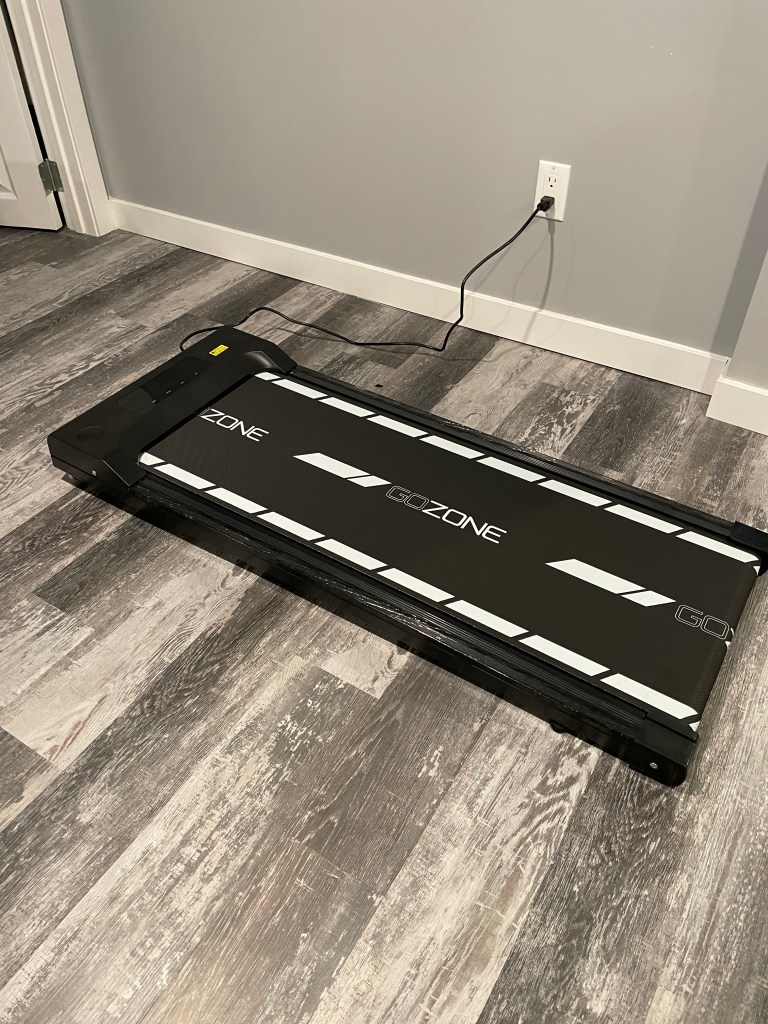
My GoZone “Walking” treadmill…

Enter: the GoZone Walking Treadmill. I purchased it from a local retail outlet and I usually don’t make it a point to endorse any particular distributor, but it doesn’t take a genius to guess what location I’m talking about, given the brand name. Pricing in at about $250, it’s currently on special for about $160. It supports a maximum weight of 265 pounds but only weighs 40 pounds, itself. it doesn’t boast a handlebar with a bunch of fancy buttons and displays but it definitely serves the purpose for an at-home workout area.

Digital display

I started by plugging it in to a nearby wall socket and set upon my laptop for music/streaming. It comes with a small, handheld remote, which controls speed and time. The digital display alternates between elapsed time, speed (in mph), distance (in miles) and energy burned. There’s a memory key on the remote that allows you to set maximum distance or time, and a rounded button for speed adjustment. Maxing out at 6 mph (approximately 10 kph), it allows for a reasonable jog. It wouldn’t be fitting for someone looking to train at hard running but definitely serves its purpose for some at-home cardio.

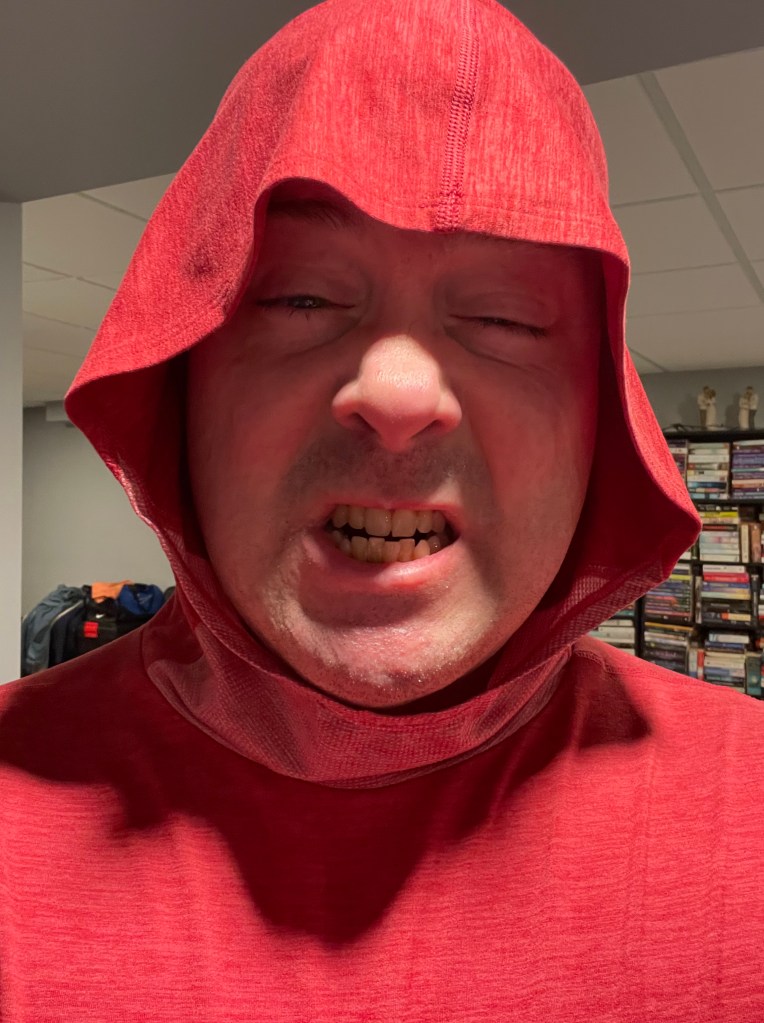
I’m not keen on the fact that it looks as though I have boobs…

I hadn’t run or performed any significant cardio in months, so I decided to test the treadmill out by running a simple mile (1.6 kilometres). I had Disney+ playing on the laptop and I was watching “According to Jim.” The mile crept up quickly and I could feel the shin splints building as I neared the end. It was a good burn, albeit brief, and once I stopped, my core temperature decided to catch up and I was sheathed in sweat. my blood sugars also dropped, making me grateful for training at home. Nathan also hopped on and trotted for almost half a mile.

Being old and out of breath is no joke…

Honestly, I was a bit concerned that the track would start to falter with me running on it. But it held up pretty well. I don’t know how long this thing will continue to work as smoothly as it does but it will make an excellent addition to my fitness routine. Given the low, reasonable cost, light-weight design and portability for storage and reasonable speed, the GoZone “Walking” treadmill is definitely recommended. I keep putting “walking” in quotations because I’ll only ever use it for jogging. ☯️

Self-Care First…

If you’re anything like me, you work pretty hard towards taking care of others. Whether you’ve found your calling by pursuing a career that allows you to help others or you do volunteer work or perhaps simply take that extra amount of time in your daily routine to throw on a load of laundry, do extra dishes or extra cleaning around the house, helping and taking care of others is an important part of one’s life. If there’s anything that life has taught me, it’s that everybody needs somebody and helping to care for them takes many forms and is important.

That is to say, it’s ALMOST as important as taking care of yourself. Great strides have been made in the past couple of decades towards acknowledging one’s mental health as an integral part of a successful, healthy life. Of course, some have been wise enough to acknowledge that, long before it started being well-known. The important thing to remember is that you’re no good to anyone else unless you manage to take care of yourself first. I’ve previously written about the need to take time to do things for oneself, whether that means reading a book or taking a drive on your own.

Your mental health depends on it, which is why it’s so important. Throughout my life, I’ve experienced toxic relationships where I’ve been hindered or prevented from taking proper care of myself. Not only does this make life far harder than it needs to be but the toll it takes on a person is substantial. All that being said, there are three things you should never have to explain or justify. And those three things play an important role in your well-being. In fact, they represent some of the basic needs that all people have. Here they are:

The Need To Sleep

Sleep is an integral part of a person’s health. Without proper sleep, a person can expect difficulty concentrating, blood pressure issues, cardiac issues and a whole score of health-related issues that no one wants to deal with. When you feel tired or sleepy, there’s no reason you should have to explain the need to sleep. There’s nothing worse than being tired and wanting to lie down, only to have someone require an explanation or accuse you of being lazy.

According to Maslow’s Hierarchy of needs, sleep counts as a physiological need, which is the bottom and first layer of needs. At its most basic, everyone sleeps. And the reality is that if one doesn’t sleep, one will eventually succumb and die. Work and familial obligations notwithstanding, you shouldn’t have to explain if you need to lie down and grab a quick snooze.

The Need To Eat

Another bottom level and basic physiological need, eating is subjective to the person. The rules of survival are pretty simple; if you’re hungry, you should eat. Now, bear in mind that hunger can be attributed to more than simply the need for food. Dehydration can cause feelings of hunger, so it’s important to maintain proper hydration levels by sipping water throughout the day. Emotional issues can also cause a person to compulsively eat, which isn’t directly associated to hunger but can cause a person to eat outside the regular boundaries of one’s three meals.

But if you find yourself hungry for the the old fashion reason, that being that you need food in your system, this isn’t something that you should need to explain or justify. In past relationships, I’ve actually had partners who have commented on my eating habits and have accused me of “eating too much” or gaining unnecessary weight through excessive eating. Although I’m not exactly the skinniest dude on the block, I also know that my weight is consistent with my age, size and activity level.

The Need To Recuperate From Illness

This one is near and dear to my heart, especially since I was diagnosed with Type-1 Diabetes when I was 4 years old. Throughout my childhood and into my teens, I would often have friends and later girlfriends, comment on my mood, health and energy levels as Diabetes took its pound of flesh from me. Even into adulthood, I’ve had difficulties when trying to explain or justify needing some down time to myself when overcoming a cold, flu or something Diabetes-related.

I remember one time, I was dating a local woman in on of the towns I was posted in. We went out to an even this one evening when nausea and stomach pain seized me. I told her I would be going home to rest and I could tell she was clearly upset by my early departure. She even made a passive-aggressive comment to others about how we had to leave because I was “not feeling well.” It wasn’t until she came in to check on me the following day and saw the state I was in, did she realize that I was genuinely sick and wasn’t making excuses.

The experience left a sour taste in my mouth and helped me realize that one should never have to explain or justify needing time to medically recuperate. And taking care of one’s health is the second level on Maslow’s Hierarchy as part of one’s Safety Needs, one step above basic physiological needs. I don’t think I need to explain why it’s so important to maintain one’s health and well-being.

This post is effectively an opinion piece. Perhaps there are other needs you feel would be more important and that you dislike having to explain or justify. If so, feel free to share them in the comments section. At the end of the day, the lesson here is that you have to take care of yourself before you can take care of others. Otherwise, the whole house of cards will falter. And as I said earlier, you can’t help others or take care of them before first taking care of yourself. ☯️