Wide World Of Holidays…

December is almost always recognized for the celebration of Christmas. This is due in part to the fact that the Western world was populated and is heavily composed of people who follow a Christian faith, although those numbers are steadily being matched by varying faiths, even here in Canada. What many people don’t realize is exactly how many important holidays are celebrated in December.

For example, even Buddhism has a day in early December in which we observe Bodhi Day, which is historically believed to be the day that the Buddha achieved enlightenment.

One of the most popularly known holidays is Hanukkah, which is a holiday of the Jewish faith. This holiday is also called the Festival of Lights and incorporates 8 days of gift-giving. However, this holiday doesn’t always fall in December and can be observed sometime in late November and as late as January.

There are a number of holidays in December that are also not necessarily attributed to any religious faith, such as Boxing Day, New Year’s Eve, Human Rights Day and the Winter Solstice.

One of the most interesting non-religious holidays is Kwanzaa. This is a week-long celebration held by people of African descent, to honour the African heritage and is usually celebrated by way of a feast and gift giving.

December is a busy month, on top of last-minute shopping and travelling to see family! Take the time to enjoy all celebrations. Even someone who isn’t of a particular religious background will be invited to celebrate in most circles. And the opportunity to learn and better know your fellow man and woman is best taken when the opportunity knocks! ☯

If You Don’t Plan Ahead, You’ll Fall Behind…

As I’ve mentioned in previous posts, the Holiday season is upon us, and with it comes a bunch of fun, celebratory things that we all enjoy. These things can include, but are not limited to baked goods, carbohydrate-heavy meals and the consumption of alcohol or other high-sugar beverages such as hot chocolates and egg nog.

I’ve never been much of a fan of egg nog, myself. But it happens to contain an average of about 8 grams of carbs for every 100 millilitres you consume, with all 8 grams being pure sugar! So if you consume an average cup or glass with about 250 to 500 mL of the stuff, you’re looking at 20 to 40 grams go carbs just on that one glass of nog alone! It can add up quickly.

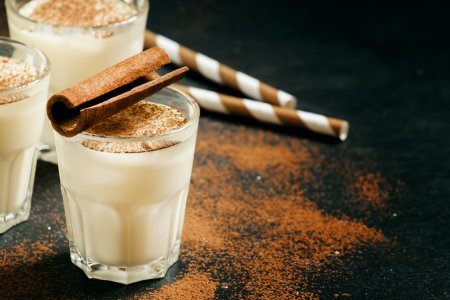
Eggnog with a touch of cinnamon

Baked goods and meals are a special kind of bastard, because they can be extremely difficult to calculate insulin requirements for them. A good rule of thumb is that the average “homemade” cookies or square usually runs at about 20 grams of carbs. This has been my own experience of course, and doesn’t necessarily reflect any specific baked good you may be consuming. For example, when looking at chocolate chip cookies (an old classic) you would be dealing with anywhere between 16 grams to a whopping 30 grams of carbs per cookie depending on the ingredient content and the size of dough you put on your pan.

Last but not least is the consumption of alcohol. I’ve written about this often, because alcohol is such a difficult creature to control and bolus for. Drinking, in some respects will cause your liver to work overtime and your blood glucose to drop. Other types of alcohol may cause your blood glucose to spike, depending on what extra ingredients are included. There’s also the aspect that every person is different and what causes a drop for me, may cause an increase for you or vice versa. It really falls to you to know your body and your resistance to alcohol in order to best prepare for it.

Diabetes Canada posted a fantastic chart on Diabetes.ca that provides a general guideline on the carbohydrate count for most commonly consumed alcoholic beverages. The chart can be found here: https://www.diabetes.ca/DiabetesCanadaWebsite/media/Managing-My-Diabetes/Tools%20and%20Resources/alcohol-and-diabetes.pdf?ext=.pdf

This chart is only a guideline and may not relate to exactly how your body deals with its holiday booze, so monitor yourself carefully. For example, my favourite drink of choice is a rum and diet coke, made with Kraken Rum (the best damned rum in the world). 1 ounce of Kraken Black Spiced Rum is about 1 gram of carbs. My favourite beer is a locally brewed craft IPA that has almost 22 grams of carbs per can. Quite the difference between a drink of one or the other.

The holidays can be a wonderful time of year to spend quality time with family and enjoy some of the little indulgences that you perhaps restrict during the rest of the year. The key to enjoying these indulgences is being prepared. Test your blood sugar often, know the carbohydrate count of what you’re consuming and as is the case with almost everything, moderation is key! ☯

Time Is Of The Essence

It almost feels as though the need to keep an actual times appointment is becoming a thing of the past. Does anyone else notice that? With almost everything from banking to shopping to consulting professionals being made available online, the need to adhere to a business’ specific hours of operation or sticking to a specific time is quickly dying off.

I remember when I opened my very first bank account. I was only ten years old and I walked into our local bank with my Mother (cue the mama’s boy jokes, here!) We had to deal with a live person, sign paper documents and physically be there in person in order to partake of the business’ services (despite being free).

Last year when I started frequenting the local branch of my bank, the tellers were actually ENCOURAGING me to go use the automated machines as opposed to getting in line for a live person. This is only one example of what I’m getting at.

The evening before last, I attended an event at my son’s school. Its was intended as a Christmas event and the invitation was open to all students as well as their families. We knew about the event almost two weeks’ ahead of time, and despite being an evening event we decided to attend. So on Thursday evening, my wife and I loaded our newborn infant and our five-year old son into the SUV and attended his school.

The event was scheduled to open at 6:30 for registration. Based on that, one would be inclined to think that this meant one needed to arrive PRIOR to that. We saw several other families arriving and walking to the building at about 6:15, so we took a cue from that and walked to the building as well.

We walked into the vestibule of the building and found ourselves crammed in with about three dozen people. There was barely enough room to move and unfortunately, people were foolishly still trying to squeeze in. With a small infant near the door, I started getting frustrated and asking people to stop holding the door open. There were unattended registration tables blocking the way into the school.

Okay, fine. I get it. Totally. The flyer said 6:30 and it’s only 6:15. Maybe the school is being punctual to a fault. Maybe something came up. Maybe they’re delayed in getting things set up. Or maybe life enjoys punishing me. Maybe.

The line stretched out along the school and onto the street. We waited, somewhat patiently, for the registration to open so we could get the hell out of the sardine can we had been relegated to. The clock kept turning and we hit 6:40 before people came over to man the registration table. Oy Vey!

I was raised in an environment where if you aren’t fifteen minutes early, you’re fifteen minutes late. The worst part was having people from outside the building coming up to the table and complaining that small children were being made to wait in the cold. The least they could have done is push the registration table further into the school so that more people could make their way inside, rather than wait outside in the cold.

Commitment and adherence to an agreed time is kind of important. Even if something being offered is free, it’s important for society to remember that not only is it the responsibility of the recipient to arrive early, it is the responsibility of the provider to stick to the agreed time. Food for thought… ☯

The Open Road Has No Pharmacies…

If you’re anything like me, you tend to pre-plan most of your daily activities. I, for one, usually have my day mapped out before my head hits the pillow on the previous evening. When I wake up the next morning, I have the benefit of being able to hit the ground running with only a few adjustments or details to iron out. Even on a day off, my hours are usually filled with a number of things that need to get done, and I rarely have a moment where I can stop and say, “Wow, I have nothing to do…”

Not everyone is that organized. In fact, even while being THAT organized (and I’m no KonMari), it’s easy to overlook some details and forget things you may have needed. If you have Type-1 Diabetes, overlooking a small detail can mean the difference between healthy holidays or spending Christmas in an emergency room.

First, let’s cover the basics. Unless you were diagnosed last week, you should have a pretty good idea of how much insulin you use and how many supplies you require over a specific period of time.Every person is different, of course. But if you can’t do simple math and figure out that you use X number of insulin units in Y amount of time, therefore you need Z number of bottles, you may have a problem.

Enter: The Holidays! This is a particular time of year, when different pharmacies and businesses have strange and off hours of business, and can be closed on unexpected days. The obvious being that almost all businesses are closed on Christmas Day, of course. But every business is different.

Given that for the most part, we tend to consume higher amounts of food, baked goods and even alcoholic beverages over the holidays, we also face the fact that we may go through more insulin than we’re accustomed. Even IF you have your dosages and supplies down to a fine art, you may find yourself falling short.

Another important aspect of the holidays is the fact that many of us travel. Whether it’s to visit family or go to a warmer destination throughout the holidays, planning out your trip in relation to your Diabetes supplies can be crucial, especially when faced with the possibilities of being stranded due to mechanical breakdowns, snowstorms or other emergencies.

Back in September, I had travelled back to New Brunswick for work. I had only intended to be there for a week, but a change in plans and schedule saw me gone for almost two. I don’t mind saying, shit hit the proverbial fan! I had packed enough supplies for a full week plus a buffer, but now the extension of my stay would outlast my extra supplies.

The town I was staying at did not have a location belonging to the pharmacy I use, my prescriptions were from out-of-Province and a hospital wait to acquire a local prescription would have taken hours that I didn’t have available. I was unfortunately forced to purchase the required supplies out of pocket. And the kicker is that the pharmacy I went to didn’t even carry the pump supplies I use, so I had to purchase insulin (short and long acting), syringes and blood testing supplies (they had my Freestyle Libra sensors, but they were too expensive to pay for up front).

This was a costly lesson, but an important one. I could/should have planned for that contingency. If I had simply brought an added pump set with me, I likely could have gotten away with buying a single bottle of insulin instead of spending several hundred dollars on supplies. Even if you have a buffer, you should also bring a buffer for your buffer!

Although this applies to the entire year, be sure to consider your health and safety over the holidays by ensuring that your supplies are plenty and that you have enough to get you past the black hole in your pharmacy’s business hours. Nothing says “bah, humbug!” like waiting 8 hours in an emergency room for a short supply of insulin! ☯

The Last Of The Generation…

I received some sad news this morning. My Grandmother passed away at 6 am local New Brunswick time. If you recall reading a blog I posted less than a month ago, this would be the grandmother who fed her whole family by putting potatoes, carrots and beef cubes into a huge pot and boiling it all until it became mush. Such is the Acadian way…

My Grandmother with my brother and I (I’m the infant) in 1978

Dorina Poirier (Robichaud) was born as a U.S. citizen in the state of Maine. She moved to Canada with her family and settled in Northern New Brunswick sometime in the early decades of the 1900’s. She eventually met my Grandfather, who ironically was intended to marry my Grandmother’s sister, Doris.

My Grandparents got married shortly before my Grandfather shipped out to serve with the military in Europe during World War II. Upon his return, like most military families, they grew a rather significantly large family. They had seven children, the second oldest was my mother.

As a child, I had a very turbulent love/hate relationship with my Grandmother. As was the way of the times, she had been a harsh taskmistress on her children during their youth, some of which carried over onto her grandchildren years later.

I was also left in my Grandmother’s care a great deal as a child while my Mother looked after my brother’s medical care in Montreal. Although I’m certain this was greatly appreciated and was very cost-saving to my parents at the time, as a child I couldn’t help but feel some resentment at being left with this woman who was not my mother. Ah, kids…

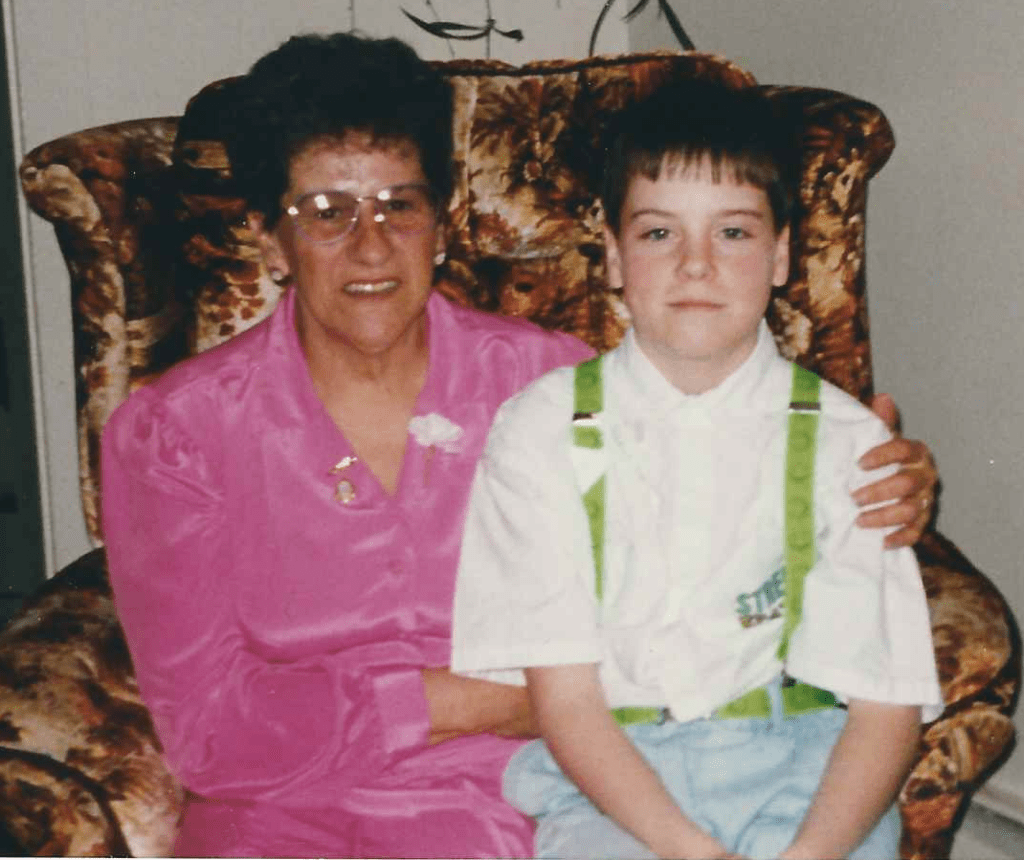
My Grandmother and I in the late 80’s (no comments on my suspenders, please!)

My Grandmother’s family has spread like wildfire, considering that she happens to be a Great-Great-Grandmother with four generations of children below her, and counting.

My Grandfather also sadly passed away in 2013 at the age of 98. My Grandmother has missed him ever since and has been waiting to take that final journey to join him. She was my last remaining grandparent.

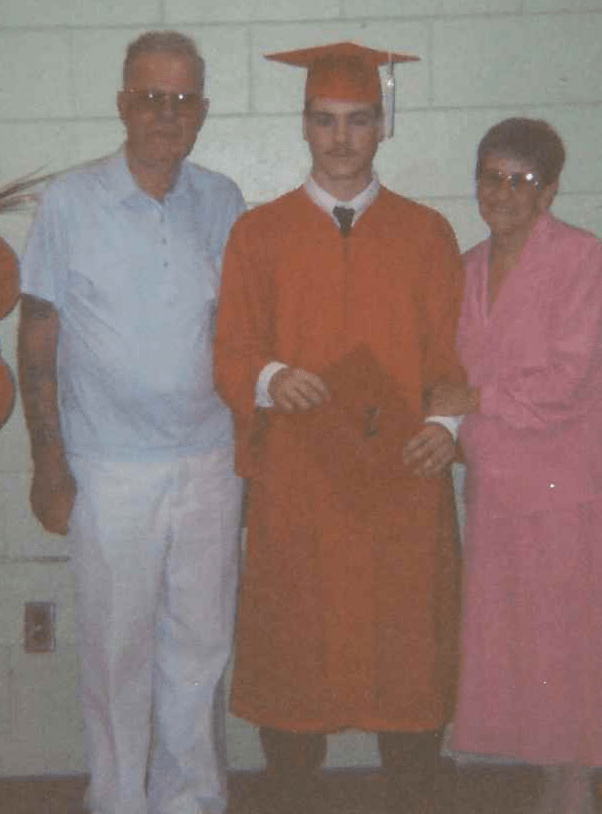
My Grandparents and I at my High School Graduation in 1996

The irony is that besides the rigours of age, my Grandmother had nothing medically wrong with her. She lived a full life, built a huge family and left her mark on the world. She was 95. She goes now to join those who loved her, to await those she loves. She will be missed. ☯

A Reminder Of Respect…

I wrote a post about six months ago outlining the proper guidelines one should follow when attending ANY martial arts school. Some of these are simply a matter of tradition, some of them are necessary to ensure that a dojo runs smoothly. Some, mostly all of them, are also a show of respect for the school you’ve chosen to attend.

In recent months, I’ve had the opportunity to observe some students, visitors and outsiders in a few different martial arts circles. Based on some of the things I’ve observed, I think it would be useful for me to repost some of those guidelines. Here we go:

  1. Bow when entering or exiting the dojo: This seems like a bit of a tiny detail, but it is an important one. It provides a show of respect; respect towards the instructors, respect towards the ones who trained before you, and respect towards the school;
  2. Ensure your Gi, or karate uniform, is clean and pressed: This one is important not only for protocol and etiquette, but for hygiene reasons as well. And you would be surprised how many people overlook it. There’s nothing worse than someone who assumes that their last workout wasn’t intense enough to warrant laundering their uniform. Make sure it’s clean. Not only does that ensure a more “pleasant” environment for yourself and the other students, it shows proper respect for the uniform you wear on your journey;
  3. Stand straight and pay attention: When not executing a movement in the immediate moment, it is imperative that you stand straight and tall, heels together and thumbs tucked into the front of your belt. Keep your gaze towards the front and pay close attention to what the head instructor is saying. Try to avoid looking around and fidgeting. A big part of discipline is being able to focus long enough to build an attention span beyond that of a goldfish;
  4. Acknowledge every instruction given: Different styles will have different ways of doing this. Some will choose a shallow bow when the head instructor provides instruction, some will answer in the affirmative by saying Hai (Japanese for “yes”) or something of the like… The method of acknowledgment will depend on the style and school you’re in;
  5. No food or drink within the dojo: You would think this one would be common sense, but a martial arts school is no place for you to sip your mocha-choca latte while your kid trains. Since the average martial arts class only lasts about an hour and a half to two hours, you can manage this easily without having food and drink within the confines of a training environment;
  6. Get out of the way: If you become injured or over-tired, bow, step back and sit in seiza (on your knees) at the rear of the class. Stay out of the way and remove yourself from the flow of the class until your fatigue passes or your injury allows you to continue. Of course, if your injury is severe or serious enough to think you need to remove yourself, you likely shouldn’t continue as you could aggravate the injury further;
  7. Don’t show up late: This one is and always has been, a personal pet peeve of mine. Some instructors will say that if you show up late, it’s better to get “some of the workout” in rather than none at all. Although that is a great concept, showing up late can be disruptive to a class and shows great disrespect to your class and instructors. We all have busy lives. It falls to you to plan ahead and schedule things so that you may attend class. Whether or not showing up late is appropriate will be up to your head instructor, but true respect dictates that if you aren’t fifteen minutes early, you’re already late;
  8. Don’t waste your instructor’s time: Although you’ve likely paid a fee for your presence, the instructor(s) within the school are there to impart their knowledge and skills to you and others. If you aren’t going to put in your full effort, then you’re wasting your instructors time. Effectively, you’re also wasting your time AND the fee you paid. You’re also affecting the other student’s ability to learn properly. Food for thought…;
  9. Respect and train based on your partner: You will sometimes be paired with someone of lower or higher rank than yourself. If you’re paired with someone of lower rank, you become the example of what is to be taught. If you inflict injury upon your partner, you may discourage them from further learning and you will have gained nothing yourself. If training with someone of higher rank, respect should be given and you should take every advantage to learn from this person as they are in the same position you would be if training with a lower ranked belt.

Recently, I’ve seen everything from kids running around, coffee, students fidgeting and looking around… There was even one guy who showed up forty minutes late for class with a bag of cheeseburgers and ate while the rest of us did calisthenics! Besides the fact that the smell of burgers was killing me, a karate dojo is definitely NOT the place to eating, much less junk food.

Folks, no matter what sport or art you study, there will always be guidelines to follow. The martial arts simply has more, and that’s part of the charm. Although the above guidelines are only basic, they apply to any martial arts school you attend. Your specific dojo may have more, and this is one of those moments where it’s important to take the initiative and ask. After all, respect is a primary aspect of karate and all martial arts. ☯

The Burden Of Knowledge…

To teach is an interesting prospect. It requires a person to take the accumulated knowledge they’ve gained on any given subject and impart it on others in a way that is clearly and easily understood and absorbed. Since people aren’t exact copies of one another, this becomes all the more difficult when one considers that every person absorbs knowledge in a different way; some people listen, some people watch and some people must DO in order to learn. And I have dealt with them all…

Through the years, especially the past decade or so, I’ve had plenty of people ask me why I haven’t opened a school of karate. One of the biggest obstacles that I’ve faced is that my job usually has me moving to a different location every three to five years, which is definitely not conducive to the long-term teaching required for martial arts.

But the main reason, and the one that keeps me from slapping my style’s logo on a door is simply this: I just don’t want to. I should probably explain that statement. When a prospective student walks into the doors of any dojo, they take in the wonder and fascination that comes with watching a karate class. The students, garbed in crisp, white uniforms lined up facing the head instructor. The head instructor, or Sensei, providing the evening’s teaching in whatever form is required, be it calisthenics, forms, techniques or otherwise…

Meanwhile, what does the instructor get out of all of it? Yes, it’s important to acknowledge that learning and teaching go hand-in-hand in karate, no doubt about it. But teaching a class on any sort of permanent basis requires a certain level of loss that not all sensei are willing to pay.

If I take myself as an example, I have a certain amount of material that I need in order to pass my next grade of black belt. Now, I can train for probably about 90% of that required material by myself. But the remaining 10% usually requires a partner, specifically one who has the skill and technique to match what I’m trying to learn.

When I had opened my previous school, I would head to the dojo full of proverbial piss & vinegar, raring to go. Then I would face the dozen or so students who had attended class that night and begin our warm-up. As class progressed, my focus would always lean towards what the students required for their next grading or for the proper learning of the techniques. Sure, I’d enjoy myself and even get a good workout from the class (I could never do otherwise) but ultimately, my training and requirements came to a standstill.

And this is usually a common element of any instructor worth the belt around their waist. They put their own needs and requirements aside in favour of providing the best learning environment for the students. The students usually don’t recognize just how much of a commitment that actually becomes. I can even recall evenings where my own Sensei would only have three or four students and would openly ask what we wanted to work on that night. No matter what the answer, I would often hear a sigh and a far off look in his eyes, which I have no doubt was his recognition of the fact that he would be teaching and doing the same thing for what probably seemed like the umpteenth time, setting his own needs and wants for that matter, aside.

The only thing that ensures the survival of any martial art is to teach it to others. And most people who embark on that journey are genuinely interested in learning. But the commitment and sacrifice that happens is required from both sides: student and teacher. So, if you enjoy your training and consider it an important part of your life, thank your Sensei. He or she is giving more of themselves than you know.

As for me, the day may come when I’ll open the doors of my own dojo again. And when I do, I’ll show up and train my students with the same enthusiasm and commitment they require. No true student of the way would do anything less. ☯

All Shiny And Pretty…

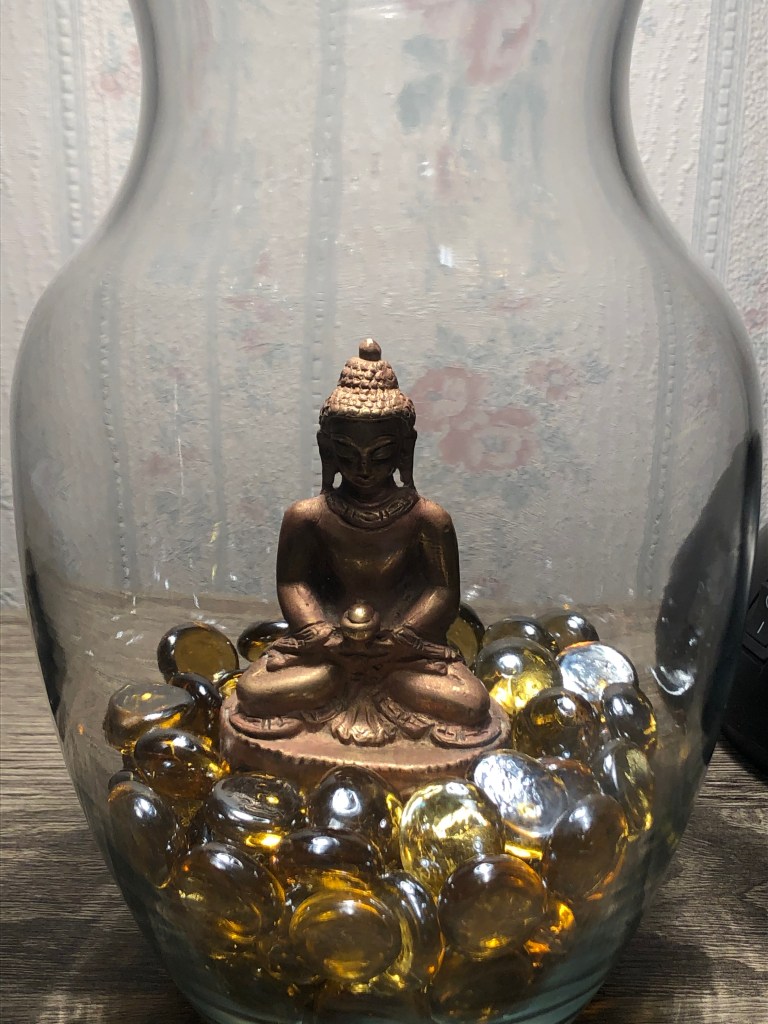
All clean and pretty…

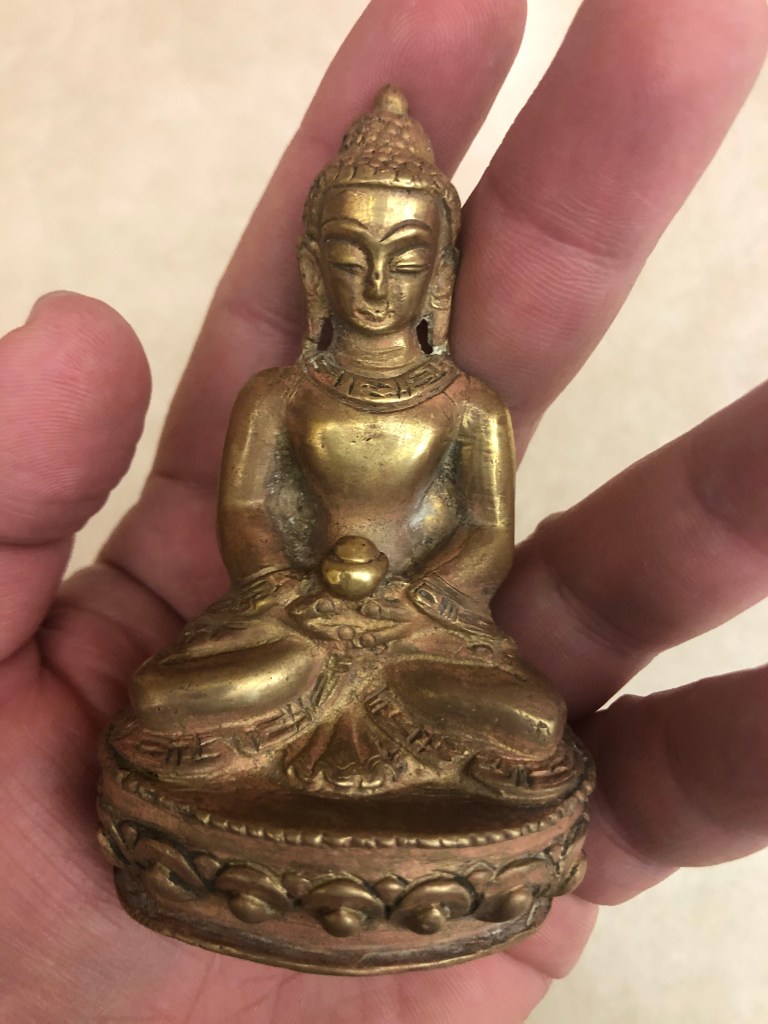
I received this statue of Buddha as a gift, more than twenty years ago. It’s a solid piece of brass, and as such, tends to tarnish and turn black over the course of a long period of time.

The last time I polished this statue was over ten years ago. It had started to turn black and I bought a small bottle of a product called Brasso. I followed the instructions to the letter, pouring a small amount of the product on a clean cloth and buffing the statue until the tarnish got cleaned off. Unfortunately, the statue has enough detail that a cloth couldn’t get into all the nooks and crannies. It left enough tarnish to bother me.

Ten years later, the statue tarnished enough that it was almost black. I wish I had taken a before photo… I contemplated how I would clean it, this time around. I went to a local store and found some Brasso, but it was almost ten dollars for a tiny bottle. I don’t use the stuff often enough to make it worth that price.

I found a homemade solution online that simply involved one part vinegar and one part water. Scrub the statue with a toothbrush or clean cloth then rinse under warm water and buff.

Back in its place

I filled a glass measuring cup with the mixture of vinegar and water and submerged the statue for about an hour. As I was doing other chores around the kitchen, I would occasionally check on the statue and noticed the tarnish progressively disappearing. A quick wipe down and a buff, and the statue is almost cleaner than the day I got it two decades ago. ☯

Keep Your Eyes On The Prize

Most of us go through our daily lives just trying to get through the day so that our heads can hit the pillow. I’ve rather preferred to make it to the rising sun, as it means I’ve lived through the night and can rise to fight another day, but that’s just me. So, what do we rise everyday for? What is it that keeps us from just pulling the covers over our heads and staying in bed? The answer is simple: you need to have a goal.

Goals are important. Even for those who don’t think about it, having a goal can be a driving force behind what keeps you going. You’ll notice I keep saying “goal”, as in a singular goal. One of the biggest mistakes people make is trying to accomplish multiple goals at the same time. Now don’t misinterpret this as not being able to multitask; the two are very, VERY different.

There’s an old proverb that says, “If you chase two rabbits, both will escape.” This is a simple way of saying that dividing your focus on more than one goal at a time likely means you won’t accomplish any of them. It’s important to place your gaze on one goal at a time. And this goal can be simple. There’s nothing saying you need to become a millionaire. If that’s your goal, then by all means, pursue it. Hopefully you will have fixed a singular goal to accomplish it. Nothing is saying that you have to have grand goals, such as finding a cure for a chronic illness. But if such is your goal, it’s definitely one worthy of a life’s work.

Now, if you were to try becoming a millionaire AND find a cure for, oh, let’s say Diabetes… at the same time? Chances are that you’ll fall short somewhere. Focus and effort are required for any definitive goal, and no matter how simple or complicated that goal may be, the requirements are ultimately the same.

So, tackle one thing at a time. Accomplishing one goal can lead into developing the next, and so on… This guarantees that you can wake every morning with a fresh perspective and the ability to focus on your goal. ☯

The Cost Of Advancement…

This afternoon, I went to an eatery of the fast-food variety with my family. For liability reasons, I’ll be a good boy and not name the establishment but suffice it to say that I spent almost a decade working at one, during my late teens and twenties. During our visit, I noted a number of changes to this establishment from when I used to work there. And in the face of those changes, I can only say this: I’m disappointed.

Back in the day, everyone had to order their food from a front counter till, handled by a live, flesh-and-blood human being. At my location, we had a general rule that no person was to stand at the counter for longer than thirty seconds before being approached and helped. This meant that even if you were in the middle of doing something else, you HAD to approach the customer, even if it was to tell them that you would be right with them. There was a face-to-face requirement when you ordered and received your food, and as such, there was a level of service that was only bested by the old days when girls would roller skate up to your window. The customer was the top priority! After all, without the customer there would be no need for me. Oh, how times have changed…

These days, one is usually expected to walk up to a touch screen terminal to place one’s order. Once done, you have the option of paying at the terminal or if you’re told school and have cash you can pay at a till, although there will likely only be one available. Then you either have the food delivered to your table (which I’ll admit is kind of nice) or you wait for your number to be called, something akin to being at a butcher’s counter.

I can’t say that any of this is really of any benefit, as I’ve noted that there always seems to be at least four of five people who return to the counter to complain about something amiss with their order. I can’t help but feel that this lack of human contact at point-of-purchase plays a significant role in this lapse. In fact, on the few occasions where I’ve been missing an item or required something extra, such as a fork or spoon, I’ve often been left standing at the counter while several employees ran back and forth. Even when calling out, I’ve rarely been acknowledged and usually make do without the item I was looking for.

Don’t get me wrong; I’m not trying to bash fast-food establishments. They aren’t unique in this phenomenon and this kind of automation seems to be evolving into the expected norm for most establishments. And if it weren’t for the availability of play structures at some of these locations, I’d probably lose my mind trying to get Nathan to burn off excess energy.

The point I’m trying to make is that face-to-face communication is fast becoming a dying custom in modern society. The advancement of our technology is eliminating our need to directly interact with people and if you pay attention, you can feel its noticeable effect.

The human condition is still as such that we need that interaction with one another. Our humanity depends on it. Although technology can have some fantastic benefits to how we live, we shouldn’t let that technology be our only contact with the world. ☯