Roots In The Foundation

Way back at the end of the greatest decade ever… the 80’s, in case you’re wondering… I met an individual who would change and improve my life. In fact, I would go well beyond saying that he’s saved it, on more than one occasion. I am speaking, of course, of the subject of this week’s inspirational individual: My Sensei, Jean-Guy Levesque.

Sensei began his martial arts journey right around the same time I was born (ironic, isn’t it?). He worked in my home town of Dalhousie, New Brunswick and began studying the art of Judo at a young age. Although he achieved the rank of black belt, he never quite felt as though Judo was the right art for him. This would be where he did his research and discovered an Okinawan style of karate he wanted to pursue. The only problem was that it wasn’t taught in the Maritimes back then.

He found a teacher in Boston, of all places. Sensei packed up his red mustang and left his wife and newborn child behind in order to travel to the U.S. and pursue his martial arts ambitions. He travelled to Boston and found himself under the tutelage of Sensei Robert Blaisdell. At the time, Sensei Blaisdell was taken aback by the Canuck who randomly landed at his doorstep, seeking karate lessons. In fact, Sensei Blaisdell tried to convince my Sensei to seek out a teacher back in Canada as it made no sense for him to travel to Boston several times a year to maintain the skills he would learn.

Sensei wouldn’t be deterred and continued to travel to Boston regularly, eventually reaching the rank of brown belt. At that point, people in my home town of Dalhousie started asking Sensei to teach, which he did, opening his first school of karate in the attic space of an old Catholic School convent. He named the school the New England Academy of Karate & Judo, a name that ne can still see adorning some of my gear to this day.

Sensei and I in 2007

Sensei grew in skills and rank, and starting climbing the black belt ladder. He’s taught hundreds of students in the North Shore of New Brunswick. He fathered two children, a daughter and a son; both of whom have studied karate under his guidance. Sensei became THE leading source of self-defence and discipline back home, and was known as the karate no one stuck with, mostly due to the severe level of discipline and commitment required to keep up with the curriculum.

I walked into his dojo for the first time in early 1989, months before I would celebrate my 11th birthday. I had been diagnosed with Type-1 Diabetes six years prior. I was dangerously underweight, I suffered from severe insulin resistance and had already been through a number of comatose events in the previous years. My parents didn’t want me joining karate and were unaware that I was attending class, having left the house on the premise that I was simply going for a bike ride.

Due to my poor health, Sensei could have easily turned me away, claiming that I wouldn’t be able to keep up or train with the class. But instead, he chose to take me in, guide me, train me and help me develop. Over the next year, my health and blood sugars improved, my appetite and my mass increased and I began to hold my head up as opposed to being the quiet, withdrawn ghost that most only noticed when they needed someone to pick on.

Throughout the decades, Sensei has been a mentor, teacher, guide and father figure. He’s given me advice on almost every aspect of life and has helped in all areas of my growth. he’s taught his students with only the bare minimum of tuition fee, the strict minimum required to keep the doors open and the lights on. He has never charged any of his students for belt tests, additional training or even the physical belts themselves. His tutelage has always been about the art and never about the profit, the way any traditional teacher SHOULD be.

A few years ago, after more than forty years of teaching, he closed the doors to his dojo due to rising rental costs imposed by the local school board for the facilities he used. He now trains in private in a small dojo built into his home. He still trains with a couple of the students he once had, but it’s mostly on a one-on-one basis.

Sensei continues to be an inspiration to me because he sought out to pursue his dreams of learning karate and did so, regardless of the obstacles he faced. He managed to build a career and raise a family while doing it. We should all be so dedicated and committed to something. Even if we now live more than two thirds of the country apart, we communicate often and he continues to train me. I’m still learning from him. I don’t anticipate that will ever change. An email here, a photo or video clip there; he continues to add to my puzzle of a million pieces… One piece at a time. There are many who would say that I improved my life through my own efforts. Although they would right, I likely wouldn’t have made it with a lesser instructor with less dedication. Domo Arigatoo gozaimashita, Sensei!

When The Unusual Becomes Normal

I’m sure we’ve all been there… Or at least, I have! You’re standing in line somewhere, perhaps a retail location, grocery store or the bank. The person behind you is basically at your heels, forcing you forward until you’re almost on top of the person ahead of you. Then it happens; the person behind you coughs or sneezes. Maybe they cover up properly. Maybe they don’t. Even IF they do, you may still be faced with the prospect of a fine mist of someone else’s bodily fluids impacting with the back of your bare neck and onto your clothing. Whatever typhoid they may be carrying makes its way into your pores and then you spread it all over the bloody place by dragging it along on your clothing…

Lovely, eh? As disgusting as that prospect may sound, we haven’t even discussed what the terminals, debit pinpads and counter at the location may be carrying as a result of people like that. And having someone essentially riding the spot on your shoulder where your conscience should be also puts you at risk for having less-than-trustworthy folks watching for your debit pin as you pay for your purchase. It may sound pessimistic (and maybe it is) but this happens far more often than we care to think about. And speaking of thinking, that’s exactly what this concept has had me doing recently…

As the world slowly begins licking its wounds amid the lovely beast that is COVID-19, some of society’s strict quarantine measures are beginning to slacken. But as I’ve recently seen from my excursions into the urban wilds to obtain groceries, plenty of people are still wearing masks and gloves and washing their hands despite these requirements no longer being in place. And despite some industries re-opening their doors and some measures being lessened at essential ones, place markers are still present on the floors and directional arrows can still be seen for circulation in the aisles.

Will these things ever go away? A better question is, should they? All things considered, I’ve always felt that maintaining an appropriate distance in public lines has always been important. Not only for hygiene but for personal safety. I’ve often found myself asking the person behind me to take a step back when using my debit and/or credit card. I’ve gotten mixed responses to this, ranging from “sure, no problem” to “go fuck yourself.”

I don’t think I need to clarify that I’m a firm advocate of frequent hand washing, especially if you’ve read any of my posts related to hand washing. But I don’t think that frequent hand washing should have only become a “thing” because of the current pandemic. It’s something that everyone should have been doing all along, for their own personal health and to prevent the propagation of germs.

Masks and gloves are a different story. The first problem is that people need to understand that wearing gloves doesn’t protect you much beyond the immediate moment. Even medical professionals and first responders switch up their gloves often and between patients, so when you see someone using a pair of rubber gloves ALL FREAKIN’ DAY, it becomes easy to forget that whatever you pick up on those gloves stays there. And unless you switch them up, you’ll just spread that stuff the same as you would with your bare hands.

I get a kick out of the photo I’ve seen online, where there’s a man standing in line to pay for groceries. He’s got a face mask hanging off his chin and he’s eating what appears to be a small bag of chips. The joke is he’s eating the chips while wearing latex gloves intended to prevent the spreading of germs and protect himself. But I digress…

Masks are particular, since they’ve been explaining that it’s mostly to protect OTHERS since the beginning of this whole thing. And in fact, many countries have a large percentage of the population that have been using face masks all along. A neat YouTube video I recently watched, entitled Why Do Japanese People Wear Masks? is a good example, as the interviewees reveal reasons ranging from everything including having a cold and not wanting to spread it, to simply not liking the way they look. And that video was released in 2017, well before the advent of COVID-19.

I’m no boy in the plastic bubble, but some health and safety practices should have been implemented as a general part of daily life a long time ago. Maintaining one’s distance from the people ahead of us is a practice that people should have been doing in the first place. So, as strange and unusual as all of this may have seemed in the beginning, will social distancing become the new normal? Are we all going to develop a reflex for staying far away from the people in line with us and learn to distance? It will be interesting to see how society learns to adapt and adjust once it returns to “normal”… ☯

Workouts Of A Shredded Variety

I’m a big fan of including variety in my fitness routines. Besides martial arts, I like to include cycling, running, swimming and various forms of cross-training. In order to maintain one’s health and fitness, it’s of the utmost importance that one works on various aspects of physicality. I’m usually not one for specifically endorsing one product or another, especially since I consider my blog to be a forum for passing on information that can be interpreted freely by the reader, without direct influence.

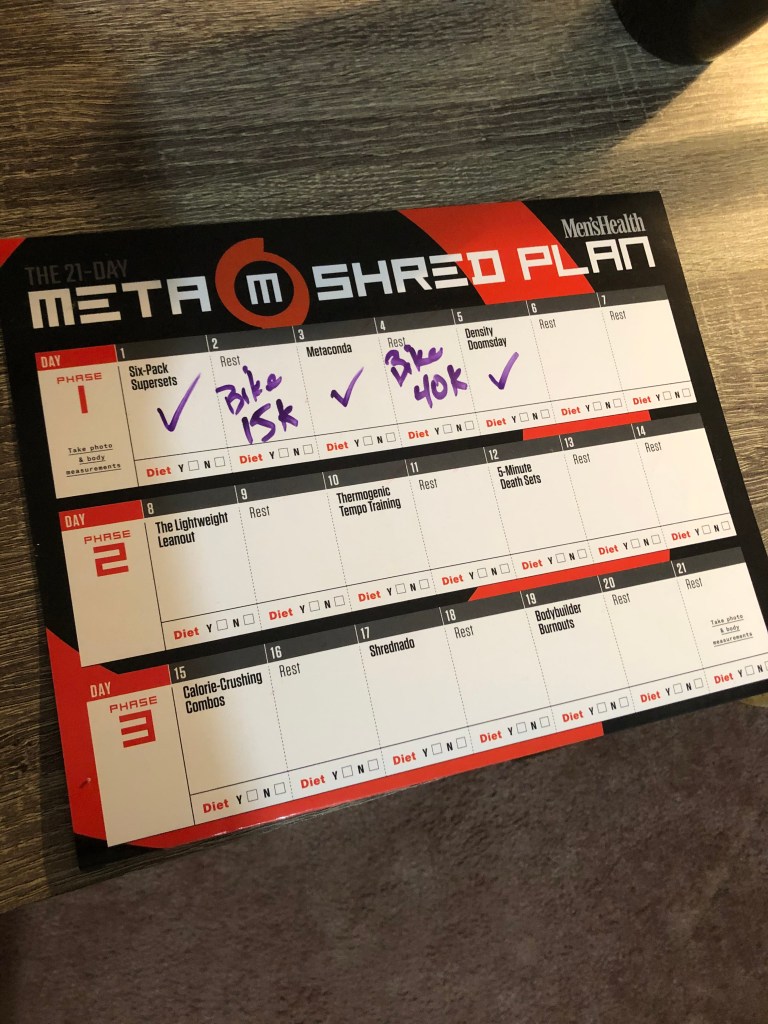
Despite that fact, I’d like to share a 21-day DVD workout plan that I’ve used on several occasions. I’m referring to the 21-day MetaShred. Created by BJ Gaddour, it includes 9 workouts over 21 days and boasts unique workouts that never repeat themselves over the course of those 21 days. I first got it after seeing it featured in Men’s Health magazine and decided to order it. I’m usually not one for “fad” workouts, but I’ve done the full 21 days on a number of occasions and I have to admit that it never disappoints.

It’s been a few years since I ordered it, and I can’t seem to find a link to ordering it here in Canada. But I know that you can find the program on E-Bay, Amazon and various other online shopping forums. It includes a box with 3 DVD’s (3 workouts per DVD), a reusable water bottle that I use for cycling and a dry-erase 21-day calendar to track your progress and what workouts you’ve been doing.

As you can see from above, I recently decided to get back into MetaShred. I’m not one for sitting still, so I’ve been including my cycling between the actual workout days. Each workout is only 30 minutes, making it extremely manageable. My wife has joined me on some of these workouts often. It’s a nice way to work up a sweat when you need a change from your usual routine.

There are a lot of popular DVD workouts available on the market. I’ve tried some different things like Insanity, P90X and Body Beast. MetaShred just happened to be the one that suited me and works best with what I’m trying to accomplish. One of my friends has (or had) P90X and I’ve done a couple of those workouts with him, but I found the movements awkward and uncomfortable. My best suggestion would be to find friends, associates or co-workers who have some of these workouts and see if you can either join them or borrow the kit so you can try it for yourself.

They say variety is the spice of life. I’ve heard that on a number of occasions and I’ve often found it to be true. Don’t be afraid to branch out and try different things. on the road to fitness, there are very few wrong turns. ☯

Fill Up Your “Punch” Bowl With Proper Technique 🥊

I love a good action movie as much as the next person, and I’ve watched WAY more than my fair share over the past decades of my life. But having studied traditional martial arts and the human body during those same decades has often left me disappointed in how fights and/or punches are depicted in these movies. Often, you’ll see one of two extremes: someone who gets knocked out and gets back up moments later, no worse for the wear or two combatants who pummel each other’s faces and neither goes down until the penultimate moment where one is finally knocked out.

When I’m watching the movie, I’m totally in the moment and I could care less if the protagonist suddenly sprouts a third fist in order to win the fight and get the happy ending that the audience is hoping for. In the aftermath, I usually get analytical and start describing why “that couldn’t have happened that way” as my wife rolls her eyes at my running commentary of proper technique.

First of all, if you’re new to my blog I should start by pointing out that I’m not a medical professional. This means that you can take my description and information regarding the human body at face value, although I’ve studied and applied it over three decades of martial arts training. So, although I don’t have a thick piece of paper on my wall from some post-secondary institution, my accumulated knowledge still has some weight and value.

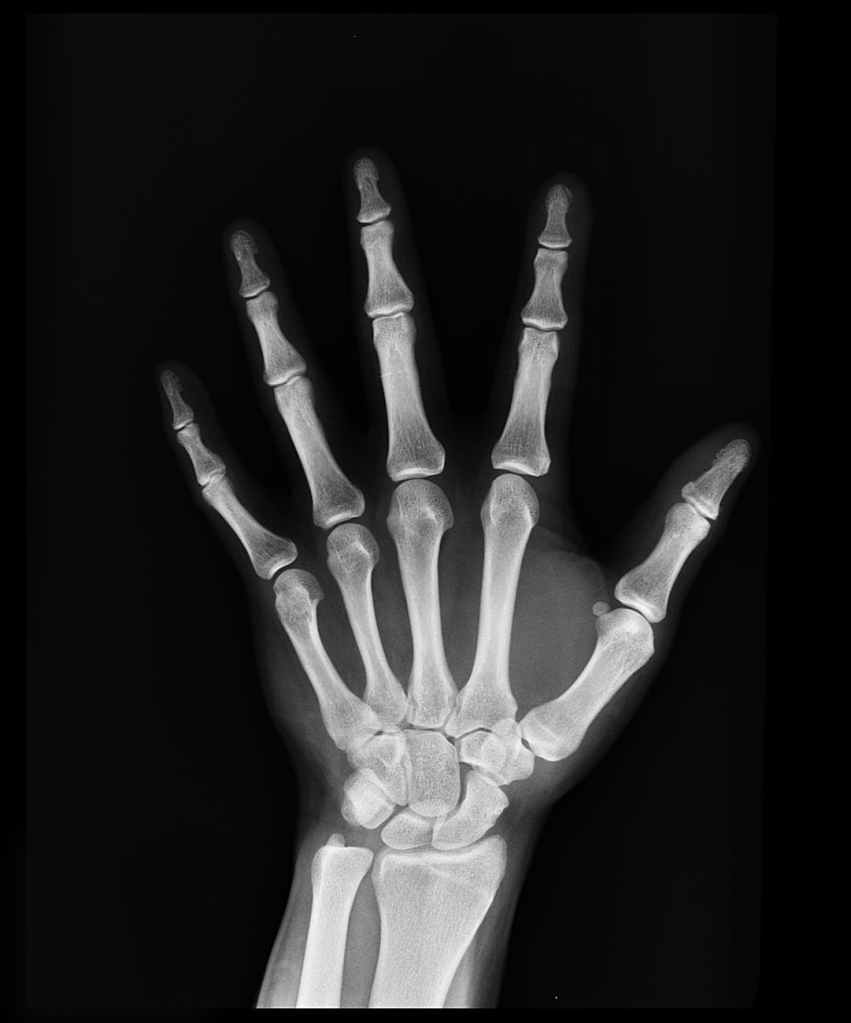
X-ray view of the human hand

Alright, now that the disclaimer is out of the way, let’s get back to the topic at hand. Punching is one of the most basic and rudimentary fight techniques. I’m sure that prehistoric humans closed their fists to hit each other before language was even developed. I don’t know, I wasn’t there. I may be old but I’m not THAT old. Give me a break, here…

But there is significant difficulty behind how a punch is supposed to happen and what the result may be. In considering my opening paragraph, what happens when someone is actually knocked out? The short of it, is that your brain moves around inside the skull and impacts with the sides. Once that impact occurs, the brain experiences trauma and brain cells start to die. Then, a combination of blood flow and neurotransmitter issues cause unconsciousness.

Now that the science of being knocked out is out of the way, quit yawning and take a sip of your coffee and listen to the important part. If you get knocked out as the result of a punch to the head, you SHOULD seek medical attention. Depending on how hard the punch is, there can be all sorts of permanent damage including but not limited to a concussion (which are not necessarily permanent but they are dangerous). But being knocked out will usually take several minutes to regain consciousness and once you do, its followed by confusion, lack of stability and balance. So what you see in the movies where someone gets knocked out then gets back up a few seconds later, full of indignation and ready to carry on is quite inaccurate.

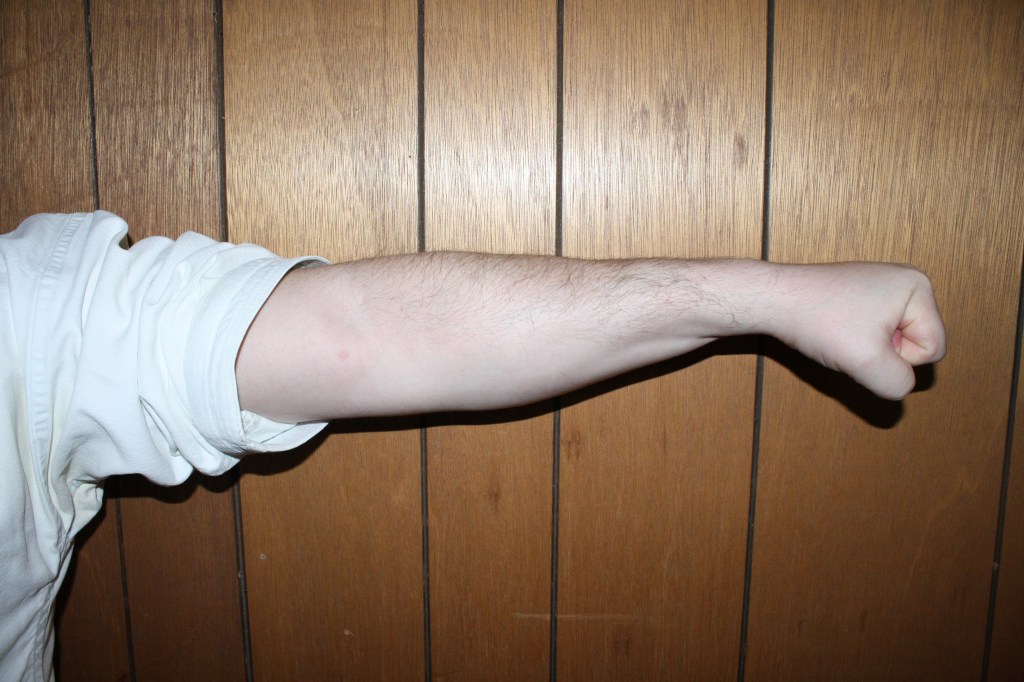
Proper alignment of a punch

Now that the target has been discussed, let’s cover the tool. Punching is a risky proposition. The human hand contains over two dozen bones, 8 of which make up the wrist. There are five metacarpals that constitute the palm with the remaining bones making up your fingers. The wrist and metacarpals are actually pretty delicate bones and require a little something extra in order to prevent fracturing and breaking if you’re to punch someone/something.

This is why proper bone alignment during a strike is so important, because it prevents such injuries. Martial artists will practice punching drills for hours where the proper alignment of the punch is engrained into our muscle memory so that when the moment comes to strike, the punch lines up without thought. This is why boxers and MMA fighters wrap their hands and wrists during training, because they focus on power as opposed to alignment and technique.

To be honest, unless you’re punching to the body or an area of soft tissue, a punch is a terrible technique to use on the head. Considering the fact that the head is wrapped in hard bone and is designed to protect the brain, coupled with the fact that your hand is chock full of tiny bones, throwing a punch to someone’s skull or even the jawline will likely cause injury to your hand. This is the part where you need to hope and pray that your first punch puts your opponent down.

The average punch, even from someone without training is strong enough to knock the average person out. Yes, I repetitively use the word “average” because every punch is different and everyone’s body is different. Something bear in mind. And I totally endorse the fact that the classic “action” scene where the two combatants exchange head strike after head strike without one of them going down can’t really happen. But should your strike not be strong enough, turns out to be a glancing blow or you just happen to be fighting someone with a thicker skull, you need to ensure your offensive tools remain intact long enough to survive the encounter.

All things being equal, if you NEED to strike the head I would recommend using an elbow strike. Yes, yes, an elbow strike means getting in closer to your opponent. But it also means less chance of injuring your hand and staying in the fight. An elbow strike doesn’t require bone alignment and your elbow is hard and stronger than you could possibly make your fist. If you plan on hammering a human skull, that would definitely be the better option. ☯

Gear Up For The Ride 🚲

I was recently asked what I bring with me on my bike rides, especially since I have Diabetes and my distances are starting to get longer and farther. I’m no professional athlete and I’m obviously not crossing the entire country (or the Province) but I certainly have some details to consider. Especially if I want to keep from, you know… dehydrating or passing out from low blood sugar.

So with that in mind, here’s a list of the items I carry with me, either on my person or on the bike itself, when I head out on my peddling adventures;

My two-wheeled cadillac
  1. A Bike: D-uh, right? But obviously you need to get yourself a bike that suits your needs. This bad boy is the Diadora Orbita 18-speed. It retails at about $300 (give or take a few bucks) and is a mountain bike. I point out that last detail because there are a few different types of bicycles including road bikes, comfort bikes and hybrids. The important thing is to ensure that the frame and wheel size are appropriate for your height and that you know what you’ll primarily be using the bike for. If you purchase your bike from a decent retail location, they’ll have specific sales people who deal with bicycles and should be able to help you with that. Depending on what you’re using it for, it doesn’t have to cost you a fortune. I would even recommend looking into getting a decent second-hand bicycle. But if you do, be sure to test it out before purchasing it;

2. A Water Bottle: It stands to reason that you need to stay hydrated during your travels. When getting your bike, you want to make certain that if it doesn’t already have a water bottle holder that it at least has the mountings for you to install your own. This is what I did. As you can see from above, there’s a second space to install a second water bottle holder across from the first one (the silver bolt in the lower right corner).

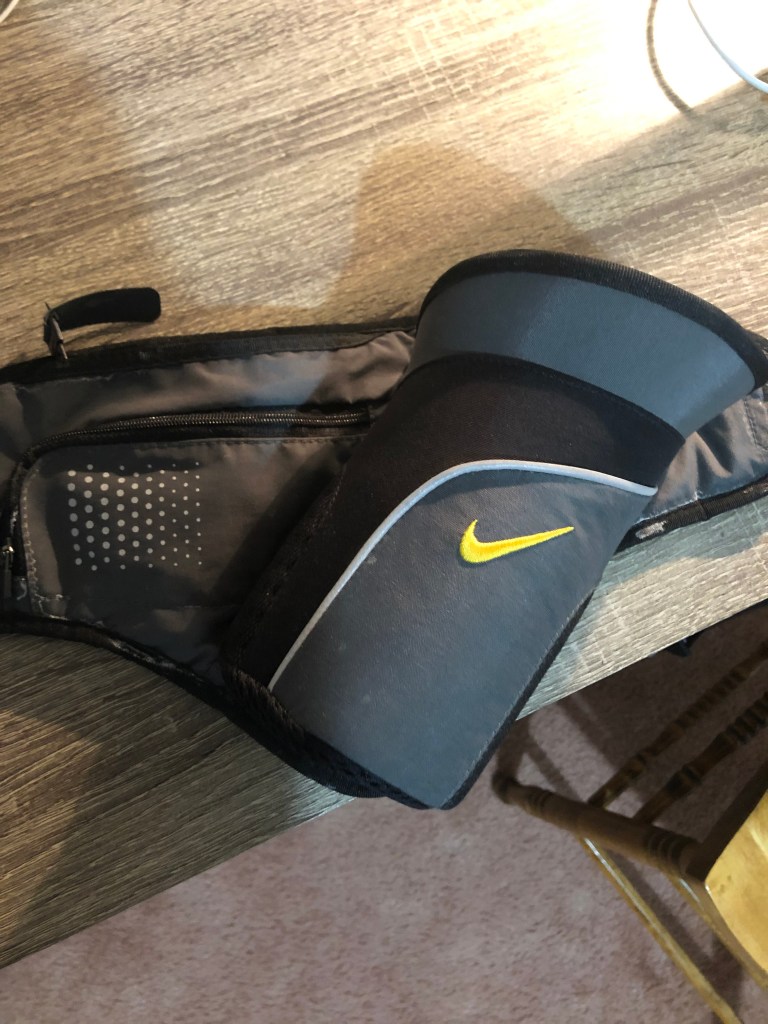
3. Second Water Bottle Holder: Although not a second bottle holder, I use this Nike Bottle Belt that’s actually intended for runners. But it works quite well while cycling as well. Between the two, it allows me to carry about a litre of water. I usually carry one bottle of water and one bottle of sugar-free electrolytes in order to ensure I stay hydrated and don’t succumb to hyponatremia while cycling. Eventually, I plan on getting a second bottle holder on the frame AND use the one pictured above.

4. Rear Accessory Pouch: There are a number of different frame-mounted bags and pouches you can get for your bike. The one pictured above is a small Diadora pouch I purchased at a local retailer that mounts under the seat. I use it to hold house keys, my first aid kit and anything that I would need to stop in order to use, such as nasal spray or painkillers. And speaking of First Aid kits…

5. First Aid Kit: Most people don’t consider this aspect, but if you’re out and about on a bike and are planning on travelling for a significant amount of distance, you need to consider the possibility that you may become injured. I purchased the kit as seen above from the “travel section” at a local retailer. At only $4, it contains a pair of vinyl examination gloves and basic bandages as well as some towelettes. This kit fits nicely in rear pouch of my bike and at such a low cost, it’s easy to replace if you end up using any of it. It’s a pretty basic kit, but honestly if you have an injury that you can’t cover with a bandage or band-aid, you should probably be calling for help;

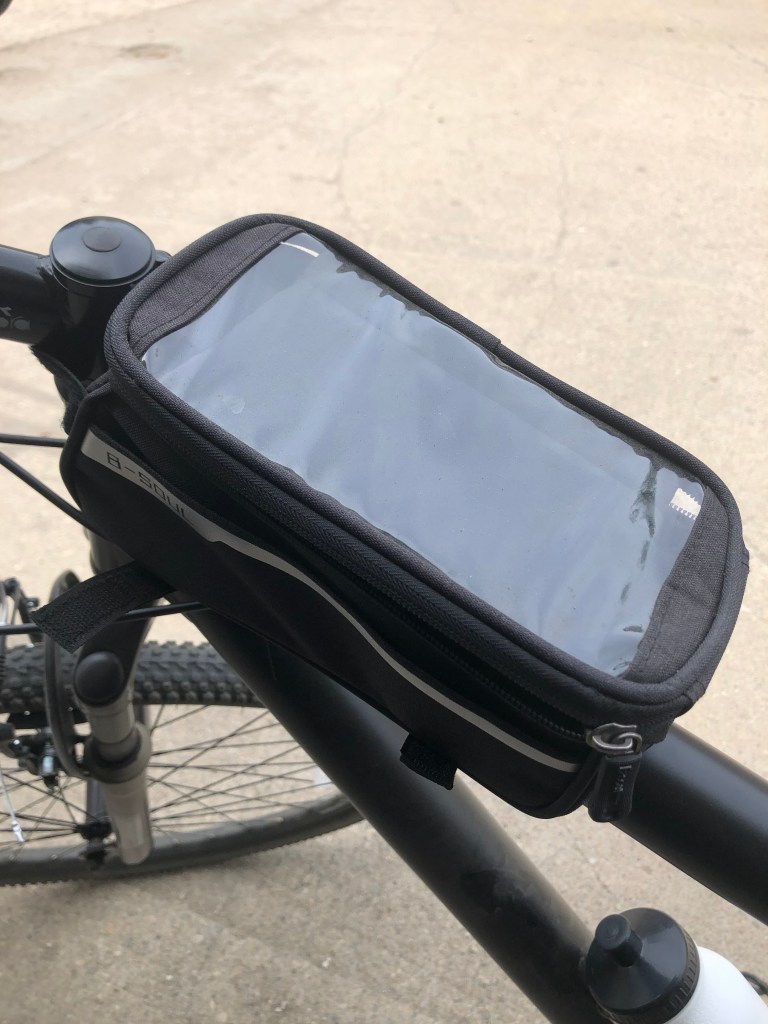
6. Main Storage Pouch: Alright, here we go. This pouch contains the essentials. I usually bring a small travel bottle of sunblock, gum, lip balm, my wallet and a small Tupperware container of jellybeans. The lip balm is important in order to keep winds and elements from drying and cracking your lips. Your wallet is an important aspect in the event you require medical attention or you happen to be approached by law enforcement (depending on where you’re cycling). The jellybeans are the best form of fast-acting glucose that works well for me. After about ten jellybeans, even some of my worst lows correct themselves quickly. This is also the place where I’ll jam a few dried meat sticks, some cereal bars and even some ibuprofen in the event I need it. The front panel is clear vinyl, allowing me to store my cell phone and see its display as I ride. This is handy as it allows me to use my GPS tracking app and monitor my mileage and what music I’m listening to.

Outside of what you may store on your bicycle, you want to make certain that you’re dressed in comfortable fitness gear. I wear a thin Under Armour long-sleeved jacket, which protects me from wind and other elements and also provides me with pockets for a few small items. I use fingerless gloves so that my hands are also protected from the elements but my fingertips are bare, allowing me to access the touch-screen on my phone.

You also want to make certain to wear an approved helmet and properly-fitted footwear. You’d be surprised how much of a difference it makes if you’re wearing sneakers that fit and are well broken in. Sunglasses are also a must, if not for UV protection, to protect your eyes from the wind and debris as you ride. As I continue to increase my distances, I plan on adding a rear bike rack with saddle bags. In the event that I start travelling for hundreds of kilometres, I’ll start including a single-person tent and a bedroll as well as changes of clothing and additional food and supplies.

I don’t want to get ahead of myself, of course. But the important thing to remember is that planning ahead is the important aspect. You want to make sure that you carry the essential items that you’ll require for the length and duration of your trip. Glucose, hydration and means of communication in the event of an emergency are always a must. ☯

Patience Is A Virtue, But Living Virtuously Is A Challenge

They say good things take time and patience. Yeah… I’ve heard that a time or two, but patience is not always an easy virtue to live with. And most people have an EXTREMELY limited supply of it. I’m no exception. As Ferris Bueller once said, “Life moves pretty fast. If you don’t stop and look around once in a while, you could miss it.”

A lack of patience, or impatience, is not always a bad thing. Impatience can lend a number of benefits, depending on the environment and the specific situation one is dealing with. I think that a point I read in a great article by Psychology Today, which states that impatience is often triggered when we have a goal and that it will cost us more than we thought to reach it, is on the money.

Sometimes, when we think we’ll reach a goal sooner than we do, impatience can help light a bit of a fire under us and motivate us to hammer through to reach the aforementioned goals. You can check out the article, it’s pretty good. But the gist is that impatience can help reduce overall cost of reaching your goals because it forces you to get your mental gears turning and consider new and different ideas; something that’s important in everyday life.

The grass in my yard, after several attempts and a SEVERE lack of patience

A good example of this, is my back yard. When my family and I moved into our house a four years ago, we were tickled pink at the size and potential of our backyard. The only downside was that the rather large, open area was overrun by weeds and dill plants and had no grass. That first summer, my wife and I spent hours in the sun ripping out weeds and spraying weed killer until our backs were shot and we both prayed for death.

Nadda. The autumn reached us and we still hadn’t succeeded in getting all the weeds pulled and all the options I looked into in terms of having someone professional come remove the weeds and/or get grass growing, cost an arm and a leg and we weren’t willing nor did we have the funds to be going the professional route. We spent three summers spraying and pulling weeds. Last summer, we managed to essentially salt the earth and destroy everything alive back there. Yay, patience.

This year, I invested some time into tilling the soil repeatedly and planting some grass seed. I even invested in a lawn sprinkler and started watering the soil several times a day (which was killer on the water bill). But after spending the past two weeks watering, pulling weeds and keeping a tight rein on everything, I finally have grass growing in a once-barren back yard.

Now, I have plans for flowers in a circular brick planter we already had in the back yard and at the front of the house, as well as repairing bare patches on our front lawn. Patience can pay off. It’s definitely the lesser evil when it comes to reducing stress and having a simpler life. But impatience can be a useful tool as well, in the right doses and in the right situations. Just be sure that if impatience rears its occasional head, that it remains constructive and not destructive. (I have grass! Woohoo!) ☯

To Learn Or Not To Learn

Let’s say you haven’t studied karate. Could you perform one of my forms? Right now? Without any instruction or teaching, could you protect yourself or others with a martial arts technique? If you answered no, that would be the typical (and wise) answer. The reality is that learning the martial arts is difficult enough on its own; let alone without the guidance of a proper instructor or Sensei.

Not everyone is fortunate enough to have a teacher. I know a number of fighters and martial artists that have committed themselves to learning through books, videos and simply by watching others. Although this CAN be accomplished, it’s an extremely difficult road to walk and most are unable to maintain their momentum. It’s a bit comparable to the guitar. When I was in high school, everyone was obsessed with grunge bands, and playing the acoustic guitar.

Tons of people went out and bought guitars with the intention of learning. Some bought primers to learn basic chords, some watched others playing… A few were even motivated enough to learn how to transition through four basic chords in order to play a simple rendition of “Time Of Your Life” by GreenDay (an awesome song, you should YouTube it, if you’ve never heard it). But within a year, most of those people would set down their guitars and forget about them by graduation and likely never pick them up again.

The same can be said of martial arts. It’s all well and good to read as many books on martial arts, philosophy and Bushido’s Code as possible; I encourage it, in fact. But if you want to learn any fighting art, you need at least some rudimentary instruction. You need someone to correct you, someone to guide you and someone to teach you the things you don’t know. Otherwise, how can you ever have a hope in hell of getting better?

I think it’s safe to say that modern society is a mixed bag of people who prefer their independence and people who expect to have everything handed to them. But as the old saying goes (and I forget who said it), “If you are not willing to learn, no one can help you. If you are determined to learn, no one can stop you.” If you are looking to learn, seek out a teacher. Find someone who has been where you are and has studied what you’re looking to learn. Not everyone is able to be a student; very few are able to go it alone. ☯

Through My Father’s Eyes

How ironic is it, that today happens to be Father’s Day AND the day I write about the people who have most inspired me throughout my life? First, let’s cover off the details of Father’s Day, shall we? Father’s Day was created by Sonora Smart Dodd after sitting in church listening to a sermon about Mother’s Day. She decided she wanted to create a holiday allowing her to honour her father’s memory as he had passed. The first Father’s Day was celebrated on June 9, 1910. It took a long time for the holiday to gain popularity, and it wasn’t until 1972 that President Richard Nixon signed Father’s Day into law as a permanent, yearly holiday.

With all that being said, can you take a quick stab at who I’ll be writing about today? I would be remiss if I passed up the opportunity to write about one of the most influential men in my life: my father. His name is Peter Cook and he was born on May 4, 1952 in Saint John, New Brunswick. My father’s life did not have an easy beginning as he was given up at birth. It wasn’t until almost two years later that my Grandmother Anna and my Aunt Iris went to the orphanage and found him. My aunt took one look at him and said, “He’s smiling at me like Peter Rabbit…” And so my grandmother decided to name him Peter.

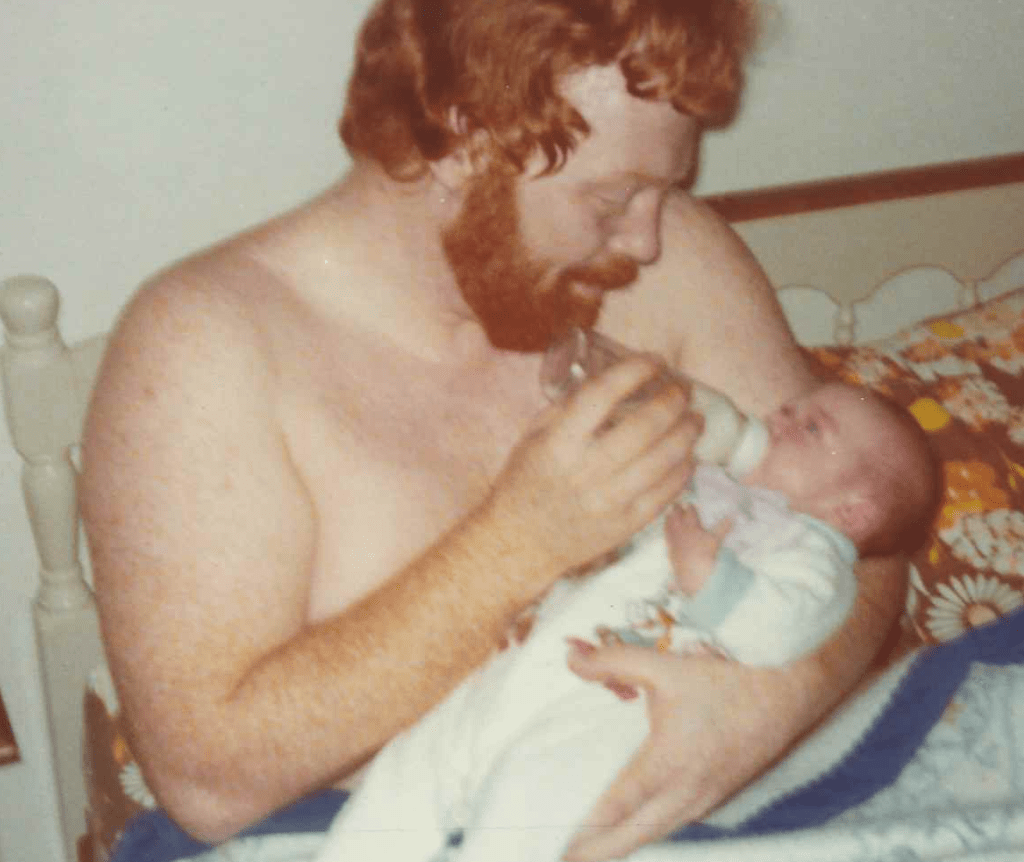
My father, feeding me in the middle of the night upon returning from a night shift.

My father grew up on the island of Grand Manan, which is island in the Bay of Fundy on the south-western corner of New Brunswick. It’s a very small island, but my grandfather was a fisherman and my grandmother was a nurse at the local hospital. My father spent many a day walking along the beaches, exploring the sea and joining my grandfather on fishing excursions.

My father developed a strong love of nature, which he ultimately passed on to me. He moved to the main land and graduated high school in Sussex. From there, the following years are a mystery as he took to travelling around the province with a backpack. He’s never told me the tales of what took place during those wandering years, but he made his way to the North Shore and found himself in Dalhousie, where he got a job with the Province’s power authority: NB Power.

He met my mother through some mutual friends and within a year they were married and had me. My mother already had a son from a previous relationship, my brother Stephane. He immediately adopted my brother once they were married and my brother became his son. As I’ve written in previous posts, my brother was afflicted with several serious medical conditions that required constant care and medical attention.

My father and I watching Star Trek on a lazy Sunday

My father didn’t hesitate for a second, and spent most of his time working overtime to afford sending my mother and brother to Montreal, where my brother received treatment by several specialists. The important thing is that my father always made time for me when he got home from work, no matter how busy or tired he may have been. But he sacrificed just about every part of himself for his children.

In the early 2000’s, my father began developing severe pain in his back. Although many people experience back pain, his would turn out to be far more extensive. Within the years that followed, my father would develop Degenerative Spine Disease, which would result in the loss of the use of his legs and confine him to a wheelchair for the remainder of his life.

My mother and father as they are today

My father is currently living in a care home in Northern New Brunswick. He lives out his life in a wheelchair, but makes the best of it. Like most Cook men, he has a fiery temper and does not suffer fools lightly. He gave up all of himself in order to provide for his family, and never spoke a word of regret. Despite the lot life has thrown him into, he’s never voiced that he would have done anything differently or any regrets he may have. Oh, sure… he bitches about his food and living conditions CONSTANTLY, but who wouldn’t?

My father is a gentle giant… A massive man who speaks softly but isn’t afraid to let his voice boom when the situation warrants it. A strong love for nature and for family, coupled with his ability to keep pushing no matter what life has thrown at him has made him one of the most inspirational men I know. And that’s important isn’t it? Everybody has heroes and it’s nice to look up to them. But I was lucky enough to be raised by mine. ☯

Is There Such A Thing As Healthy Paranoia?

My first instinct is to answer “YES” to the question in today’s title. And my judgement and opinion are likely clouded by my chosen career and past experiences, but what are we if not the result and development of our past experiences? But most people would disagree. Paranoia is usually not viewed as a good thing, but there are times when it can be a useful tool.

By most standard definitions, paranoia is considered to be a mental condition. This condition usually causes the afflicted person to feel persecuted, watched or threatened despite any evidence to the contrary. There are a number of outlying conditions that can be associated with paranoia, including but not limited to schizophrenia, Paranoid Personality Disorder and many others. But certainly, a person can be paranoid without having a mental condition. In fact, most people have experienced paranoia at some point in their lives.

“Fear Is A Logical Response To Actual Danger!”

– Peter Griffin, Family Guy

Paranoia can be a destructive instinct. It can cause damage to your job, home life and your relationships. Especially if you let it control you (I’m referring to non-mental condition based paranoia, of course). After all, developing the ability to trust others is the foundation of living within modern society. But being aware and wary of a real and genuine threat is a form of paranoia that can be instrumental to life and survival.

I’m not saying that you need to be suspicious and wary of every other person and avoid the outside world. Doing so finds us slipping back into the mental health realm… But sometimes a dose of healthy suspicion is a good thing. The more you observe, the more you notice. So long as you don’t find yourself falling into the loop of more suspicion causes more worry and more worry causes more suspicion. ☯

To Master One, Study The Other…

It stands to reason that in order to truly master something, you need to be committed to it. It’s very, very difficult to say, master a karate style if you’re training and/or studying in five different styles. Eventually, the differences in methods and techniques will catch up and confuse you, leaving you unable to properly master any one style.

As Master Robert Trias once said, “One Religion, One Love, One Style…” But your style should never stand alone. There are many things that you can do to help your journey along during your training. Many popular mainstream martial artists that you see on television or on film indulge in a number of other activities that the common person wouldn’t associate with martial arts.

Gymnastics or dance are some of the most popular ones, since they can provide a significant amount of benefit. It’s almost symbiotic, where dance provides benefit to the martial arts and vice versa. I started studying dance back in 2007, while living in Ottawa (that’s right, I can cut a mean rug). I absolutely LOVED it, and the instructor frequently asked me over and over if I was certain that I had never studied dance before.

I finally admitted to studying karate, which she immediately confirmed was likely why I was so good at dance, since it would help with balance, proper stepping and remembering sequences. And there are plenty of options as it relates to the martial arts, including music, poetry, gardening and floristry. But what I’m referring to, is specifically the examination and understanding of other types of martial arts.

Miyamoto Musashi wrote, “To learn the fist, study commerce. To only study the sword will make you narrow-minded and will keep you from growing outward.” It should make sense, right? When was the last time that you didn’t learn at least something from observing the actions of others? The same can be said of martial arts styles. By observing and learning a little something about say, Judo or Tae Kwon Do, I can learn a great deal about the shortcomings of my own style, the techniques I need to develop/perfect and what my style may be lacking as opposed to others.

Don’t be afraid to branch out and explore. As I’ve often said before, if you’re part of a martial arts club that discourages the observation and study of other styles, your respective instructor may not have your best interests at heart. Although you should ensure your dedication to a specific style, learning about others can provide benefits and correction that you may not get otherwise. Another perspective is never a bad thing. ☯