No Use Getting Violent Over Spilled Coffee…

That title was supposed to say “spilled milk,” but I’m much more partial to coffee than milk, so there you have it. Trust is an important commodity. It’s something you definitely need to have in others, both in your professional and your private life. Without it, you’d never be able to work side-by-side with anyone or let anyone into your life. Just think: when was the last time you met someone new and just immediately trusted them?

Some people can definitely engender a sense of trust in you the first time you meet them but for the most part, trust has to be earned over time and through the words and actions of the other person. It’s almost always a difficult process, especially when it involves trusting the other person to do something in your stead. A good example would be watching my five-year old pull a carton of chocolate milk out of the fridge.

Nathan rarely gets chocolate milk. Yeah, I know… I’m a cruel daddy. But we have chocolate syrup that I use for him on occasion so a carton of actual chocolate milk is a rare treat that he gets when he’s been behaving well (so he rarely gets any). Recently he got a small glass from a 500mL carton, which left the remainder in the fridge for later consumption. During the following morning’s breakfast, he asked if he could have some, to which I replied that he could.

Then my genius son, in all his glory, chose to pull the carton out of the fridge by gripping the very top lip of carton, using nothing but his index and thumb. I could see his tiny wrist trembling from the weight and the visible struggle on his face, and my every instinct was to grab the carton from him and bring it to the counter myself before it inevitably fell and splash all over the kitchen floor. I was surprised when I took a breath (and held it) and allowed him to complete the task, thereby preserving his dignity and allowing me to trust him.

But it was forced and difficult, and I usually find that this is a difficult thing regardless of who or what I’m dealing with. For a lot of people, myself included, it’s a control thing. Most people dislike and/or are uncomfortable with the prospect of letting someone else do a particular thing when they know they can do it faster/better/more efficiently… For others, they’ve simply been doing things themselves for so long that it feels distinctly odd to have someone else do it for them.

Allowing yourself to trust can relieve a great deal of pressure in your own life. Nobody should be expected to carry the burden of life on their own, and we can all agree that any load is much easier to bear when it’s weight is shared. This is something that I feel I need to work on, for my own self-development. Had Nathan dropped that chocolate milk, sure it would have made a mess but it would have been a teachable moment (especially since I’d have made the booger clean it up himself). But it allowed me to let go a bit and trust that he could do it. And he did. What would happen if he’d ever spill my coffee is a conversation for another day… ☯

I Dream Of Nihon…

I had an interesting dream last night about Japan. It was reminiscent of my trip there in 2001. Although it’s been almost twenty years, I still remember getting on the road in the early hours of morning before the sun rose to drive from my home town of Dalhousie, New Brunswick to Mont-Joli, Quebec where my team and I would grab the first flight of many that would carry us all the way across the globe to Narita, Japan.

It was a long summer before we travelled out in October of 2001. The world had changed about a month prior and I was curious as to whether we would actually be making the trip. But as it turned out, we decided to live life for the sake of living and risk it out. Although the rest of the team took the summer off, I trained hard as I anticipated getting my black belt in Okinawa. I was at the tail end of my time as a brown belt and this trip would provide the final step I needed to finally begin my journey in the martial arts.

Performing Seisan kata for Sensei and Nakama-Sensei at his dojo in Ginowan

We had a total of four flights, starting from Mont-Joli to Quebec City, Quebec, followed by a flight to Montreal, Quebec, on to New York before finally flying to Narita, Japan. We stayed overnight in New York and did the tourist thing. It was nice, and we even climbed the Empire State building. We dined at some restaurants and embarked on the fourteen-hour flight that would take us to Narita.

During that fourteen hours, our flight arc took us across Alaska. I remember everyone being fast asleep and the plane was dark and quiet. I was gazing over the snow-covered landscape that was 35,000 feet below me. I remember leaning my face against the window and thinking about how the world looks so peaceful and beautiful and serene from that high up… Then my bowels almost evacuated. The plane rocked violently and shifted to the side. It felt as though the plane struck something solid and I saw the port-side wing flex upward at what I felt was an impossible angle before settling back to its original position.

I sat there shaking, thinking about how close I came to dying. I looked around the plane and realized that no one had woken. I realized that if the plane had crashed, I would have been the only poor bastard awake to experience it. When Sensei woke up, I told him what happened. He got a good laugh at my expense as he explained that we probably struck an air pocket and dropped a few feet. Once the plane hit normal air, the wings would flex to accommodate the stress. If only I had known, I could have prevented making a fool of myself. It would be the first of many of those situations on this trip…

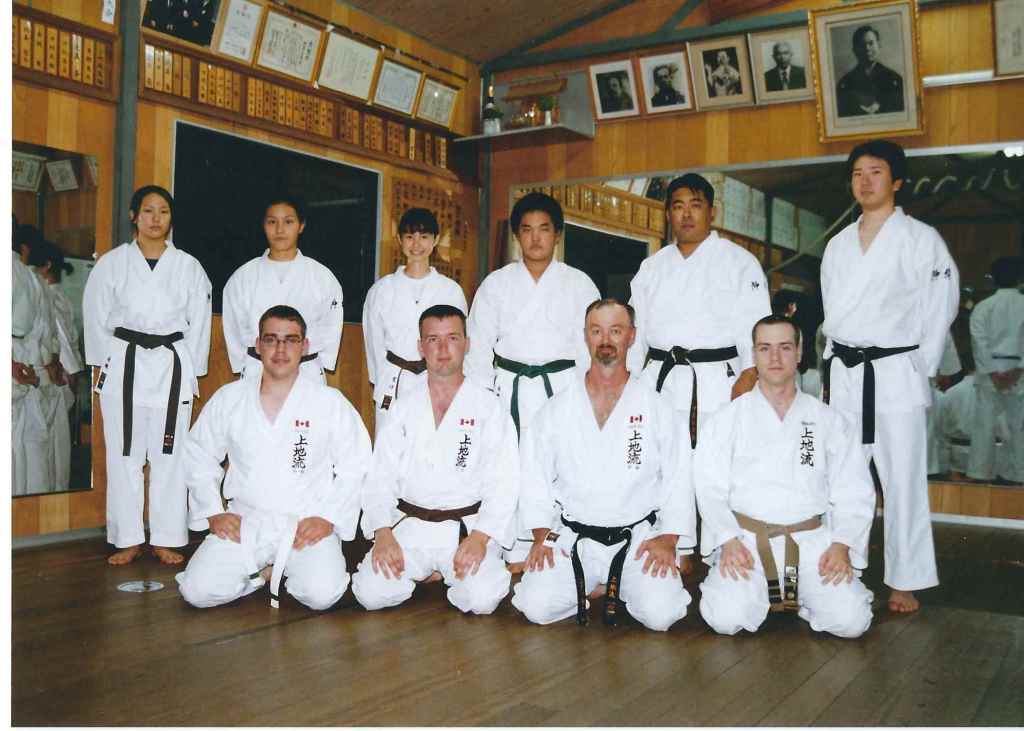
Nakama-Sensei’s senior class posing with us in Ginowan

We landed in Narita, Japan and stayed at a traditional Japanese inn. The rooms had paper walls and tatami mats for beds. Honestly, the most comfortable sleep of my life with the exception of my memory foam mattress. There was a public bath and meals were served by the inn’s owner who was also the front counter person. We stayed there for three days and visited Tokyo Tower as well as the Budokan and Kodokan Judo Institute. Believe it or not, I had my very first beer at a Japanese dignitary’s home during my time in Narita. I was 23 years’ old.

We took a short flight across the Ryukyu islands to land in Naha, Okinawa. this is where we would be spending the following weeks of our stay. We checked in to the Oasis Hotel in Naha, where I would be sharing a room with the two other guys in my team while Sensei and his wife had the second room. As of the following morning, our schedule went a little something like this:

  • Wake up at 6:00 am;
  • Brief breakfast of whatever foods we purchased from a local grocery store and ate in our rooms;
  • Three to four hours of karate classes in the morning before breaking for lunch;
  • Afternoons to ourselves, which included laying on the beach, shopping at the local markets and visiting museums;
  • No supper, because heavy shit was coming;
  • Another three to four hours of karate with the senior class;
  • Beer and food at Nakama-Sensei’s home afterwards;
  • Ceremoniously pass out from exhaustion;
  • Wash, rinse and repeat.
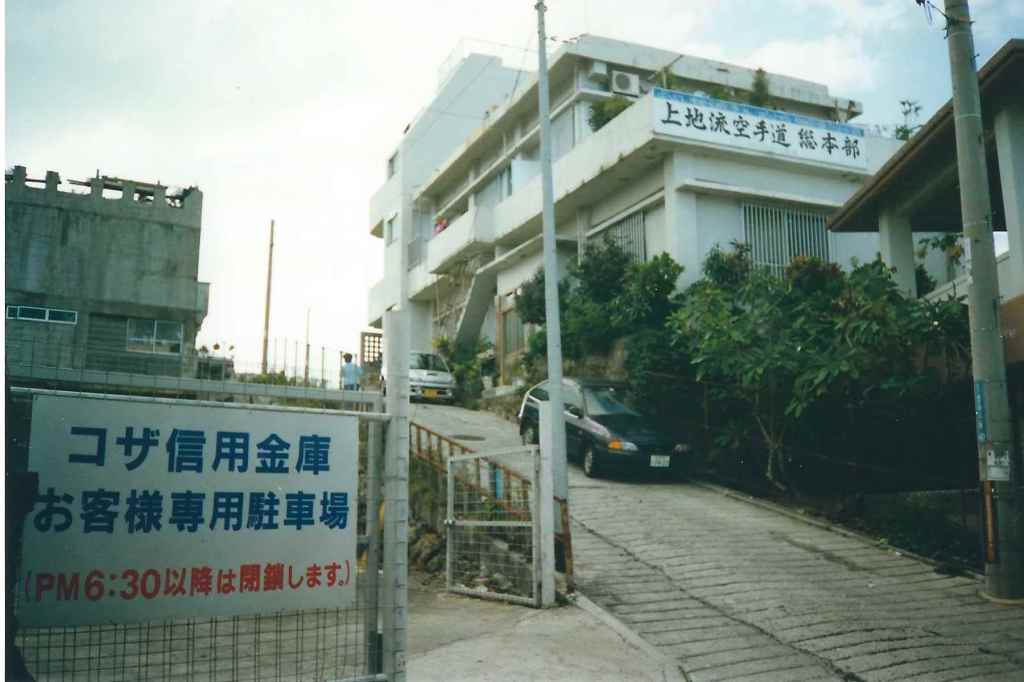
Uechi-Ryu’s original dojo in Futenma City, Okinawa

It was a gruelling few weeks of training and running around. Although it was October and considered to be the onset of the colder season for Okinawans, it was 40 degrees and hotter than hell for us. All the beer and sake we drank never came out. I could include a lot of the incidents that took place during our trip. The fact that Sensei filmed one of the other male students applying sunblock on my shoulders while at the beach, getting drunk in front of that aforementioned dignitary since it was my first time drinking beer and accidentally screaming “I love you” in Japanese to a fifteen-year old girl… Yeah, I wasn’t proud of that one. Y’all can tell me in the comments which of those fuck-ups you’d like to hear more about!

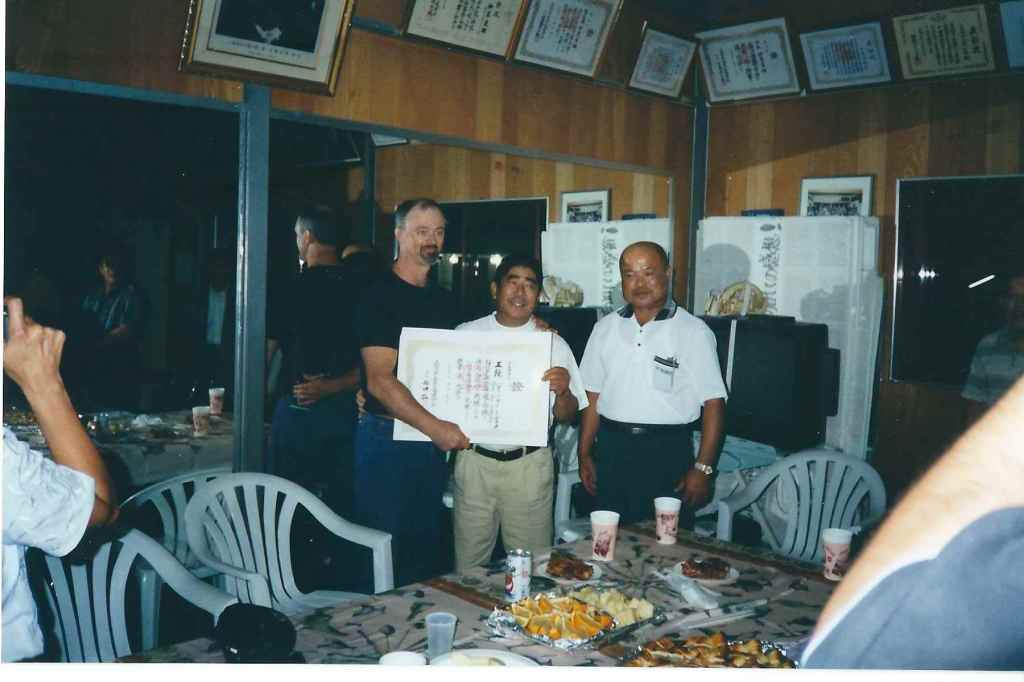
Left to right: My Sensei, Nakama-Sensei and the head of the Okinawan Karate Association

Out of everything I experienced in Okinawa, watching Sensei receive his 6th Dan was by far the most rewarding. Combined with a couple of Okinawan elders trying to set me up to marry their daughters and bring them back to Canada, it was a memorable night. It was also a fantastic way to wrap up our trip. I even got the opportunity to visit some Buddhist temples.

I miss Japan and Okinawa greatly. It was mostly a month of good times and good memories. It only surprises me that it’s taken me this long to dream memories of the place. Sensei has returned to Okinawa every two to three years since then. He keeps going back and all I’ve done is dream about the memories I’ve made. Perhaps someday I’ll go back.

I didn’t get my black belt in Okinawa like I planned. In fact, I only got it the following year in Sensei’s private dojo in my hometown. In some ways, a lot of ways, that suited me better. Would it have been memorable to get it in Okinawa? Sure. But I wouldn’t trade the memories I gained in Okinawa or the experience of my black belt test for anything in the world. ☯

The Benefits And Perils of Water

“Be Like Water, My Friend…”

– Bruce Lee

Water is essential to life. There’s no question. But water has the potential to create or destroy. Of this, there is also no question. Bruce Lee is famously known for including the concept to “be like water” in his teachings. And for good reason. The concept behind this is an important one in the martial arts. Fluidity of movement and adapting any given scenario without necessarily being stuck to any one system or style is what I always felt Lee was getting at when he referred to this.

I think my favourite version of this, was said by Jason Scott Lee when he starred as Bruce Lee (believe it or not, there’s no relation) in Dragon: The Bruce Lee Story in 1993. Lee explains how in order to study the martial arts a practitioner has to “be like the nature of water.” He explains that water will take any form, fill any container. Water is the softest stuff on Earth, but it can penetrate rock… Yeah… About that last one…

Enter: last Thursday night. I was sitting in my small basement office, researching and typing away and searching for jobs. Sometime late in the evening, beyond the 10pm hour, a thunder storm rolled in and thunder was audible in the basement. For whatever reason, Nathan becomes skittish and frightened when there’s thunder so I went upstairs to find him standing on his bed looking out the window. I could tell he was apprehensive, so I offered to build him a blanket fort in the downstairs office so he could go to sleep and have me nearby. He eagerly agreed.

Torrential rain fell for well over an hour and just past the 11pm hour, my wife came down to check on us and confirm that I had closed up our garage (which I had). As we stepped out of the office together and walked towards the stairs, we could see a difference in colour on our basement floor and turned on some lights. We found that the floor at our west wall was soaked with water. Our baseboards had warped and at least a half dozen cardboard boxes we had in storage had soaked up a heavy amount of rain water.

Our foundation was very obviously leaking, and we worked quickly to try and move as many things out of the line of water as we could. Just to be clear, it wasn’t pouring water in like a sieve, but water was seeping in enough to have a visible wetness on the tile floor in the storage room and to soak about two feet of carpet from the wall, all along the western edge of our house. We emptied out our boxes and found that several books had been damaged/ruined in the incident and that many other items were in need of drying off.

It was late at night, and I had consumed a couple of glasses of red wine at this point and was ready for bed. Nothing snaps you out of it quite like a threatening incident against your home. I was at a loss. There was no way to stop the rain and certainly no way to repair the foundation in such a way that it would stop the further propagation of water during the night. We did the best we could in moving everything away from the damaged wall and called it a night.

I’ve often written that foundation is everything. Your foundation is basis for everything that it holds up and that if your foundation is weak, your structure can be the strongest in the world but will still falter, in time. In writing about that concept, I’ve usually been referring to the martial arts. But the joke is that I was now exposed to a real-life example of how this is true. The foundation of my home is now weakened and compromised and it threatens the safety of my home as a whole.

I contacted our insurance company the following day to report the incident. I was provided good, friendly service by the lady I was speaking to and was scheduled to have an adjuster/investigator come assess the damages to see if our insurance would cover costs of repairs. I asked several questions, one of which was whether or not the foundation would be repaired in order to prevent such a thing from happening again. The response was that all of the foundations in our city were subject to cracking and shifting because of the nature of our soil, and that insurance wouldn’t cover anything related to our foundation due to it being a “naturally occurring event that happens over time.”

I was understandably upset and asked her what, exactly, that she expected would be repaired for us if not the actual source of the problem. She explained that they would replace our baseboard and walls, as well as pull up the carpet, clean and replace the flooring as necessary. So basically, they’d be looking at replacing our 1969 orange carpet and wooden clapboard, which we were planning on renovating anyway. But they fully intended on leaving the foundation damaged.

It’s a prime example of how the almighty dollar rules modern society. When we purchased our home, we were forced to obtain home owner’s insurance in order to be approved for a mortgage. I don’t know if this is the same everywhere, but it was certainly the case through my bank. But despite being forced to get it and paying thousands a year in premiums, they don’t seem keen on covering the aspects of one’s home that can actually become an issue. Not to mention the $1,000 deductible that I would have to pay.

The lady also advised me that moving forward with a claim would eliminate my “claims-free” status and that my yearly premium would be increased by 15% for the next three years. I was polite enough not to swear at her over the phone, but I have to admit that I’ve never wanted to get rid of a home so badly in my life. I think we may be shopping around for a closer and better insurance company in the near future. In the meantime, my wife and I need to start the arduous task of taking our basement apart and starting repairs on our own. And we’ll likely have to repair our foundation at our own cost. Ah, home ownership…

Like I said, this is a real life example of how water can be just as destructive to us as it is necessary. Even if one were to assume that a concrete wall should be able to hold water at bay, my home is proof that water will eventually erode any surface and find its way through. This should be a good lesson for the importance of tenacity and commitment. But at the moment, it’s really just something that’s testing the upper limits of my calm. ☯

If Owning Problems Was Cash, I’d Be Bill Gates…

The world is a complicated place. There is no easy solution, when dealing with the day-to-day requirements of adult life and I’ll totally admit that there are days where I’d rather crawl into my blanket fort and colour than deal with those requirements. What’s more is that there will always be “battles” to be fought because, well… You’re an individual and your thoughts, opinions and methods won’t always match up to everyone else’s. You can’t expect to see eye-to-eye with everyone and this can become a problem, especially if that mismatch takes place between you and an employer.

One of the more important aspects of adulthood is being able to own up to your problems. As children (at least in my generation), our parents taught us to be honest about things and admit when we’ve done something wrong. Basically, the foundation for owning up to your problems has already been laid. But once childhood has melted away, a lot of us revert to blaming everything on others. And although other individuals will undoubtedly have some responsibility, it won’t be until you face up to your role in any specific issue that you can start to live with less stress.

One good example is an associate of mine that I’ve known for over twenty-five years. Good guy, good heart, he’d totally be one of those people who would drive an hour to spend the entire day helping you move your house. However… He’s one of those individuals who ALWAYS blames everything on everyone else. Even when the problem is a direct result of his actions, he still feels that he bears none of the responsibility.

Not everyone is that extreme. The person in question unfortunately butts heads with everyone in his environment; co-workers, supervisors and even the members of his household. And over just about everything! Someone took the parking spot he wants? Fight. There’s been a change in policy regarding something in his work? Refuses to do it and fights about it.

The main component of that last paragraph is to learn to pick your battles. Not everyone seems capable of this very simple thing, but some people go out of their way to try and ice-skate uphill! Honestly, when it comes to work, unless you’re the owner of your own company, sometimes it’s best to just clock in, do as you’re asked and clock out. There’s nothing wrong with voicing your opinion, but tempting faith by refusing to do things on the job is just ASKING for trouble. But I digress…

The point of today’s post isn’t necessarily about CAUSING the problems so much as it’s about taking responsibility for them. That seems to be an aspect that most people have issues with. And there are a batch of really good, yet complicated psychological and physiological reasons why most people do this. For the most part, people are programmed simply to never admit that they’re wrong. For others it can be things like having a fear of failure, appearing weak to others or being a total douche. I don’t know, I’m not a psychologist.

A had a conversation with a friend of mine named Marty, a little over a year ago when I was facing something difficult. Truth be told, I’m still neck-deep in that difficulty, but a theory he discussed got me thinking about who bears the responsibility behind the problems we face. There are always three sides to every problem in life: the part that’s your fault, the part that’s someone else’s fault and the part that’s random events outside your control.

The part that’s someone else’s fault. You don’t live on this planet alone. Because of that, things that you deal with will always have an outside component. Even when it seems as though it was something you did. The problem with this aspect, and the reason I listed it first, is because it’s the one most people tend to focus on. “How can I blame this on someone else?” is often the credo of the problem-solving millennial (I’m not limiting this concept to millennials, just to be clear)

Random events outside your control. There are elements of every problem that are simply the result of things you can’t change. A good example of this would be working on an important online project at home when a thunderstorm knocks out the power. This results in your project being lost to the ether due to the loss of internet. You can’t control the coming of a storm any more than you can control the tide or the phases of the moon… Sometimes you simply need to understand that there is LITERALLY nothing you can do to alter that aspect of the difficulty you face.

The part that’s your fault. This is the big one, the one people hate, the one people refuse to admit and deal with. See, no matter what the difficulty there are things you will have said and done that have gotten you to the here and now. This means that whether directly or indirectly, you bear some of the responsibility for where you’re at. This is where it becomes important to control one’s thoughts, words and actions in order to prevent causing and/or aggravating problems within your own life. This is not to say that you can’t offer up your opinion or voice your objections; it simply becomes a matter of picking your battles.

When you recognize the role you play in the events of your life and begin to be proactive in how you deal with, it can go a long way towards the elimination of suffering and the promotion of peace within your own life. There will always be an aspect of life that’s out of your control. And you can’t control others. You can only control yourself. I think it’s Epictetus who said, “It is not what happens to you, but how you react to it that matters.”

Slow And Steady Wins The Occasional Race

You know, they say that good things take time and that patience is a virtue. Yeah,… I’ve heard that on occasion. I’ll be the first to admit that I’m usually more of a proponent of hammering through at top speed. Going cycling for 60 kilometres? Nothing slower than 3 minutes per kilometre is acceptable. Practicing karate forms? Maximum strength and maximum speed! If I ain’t sweating, I ain’t happy!

But on occasion, going slowly can be a good thing. Whether you’re weightlifting, doing martial arts or learning a new fitness routine, there are a number of benefits that can be enjoyed if you just take your time and go slowly. According to an article I just read by Fitness Republic, lifting weights slowly can help you to prevent injury, help to maintain your form and people with minimal muscle mass or medical conditions can do it much easier than if they’d be expected to go at normal speed.

One of the key points is that it can also help you to build larger muscle mass. The thought behind this is “[…] lifting slowly forces your muscles to hold the weight longer. […] If you go faster, momentum will do a lot of the work for you, and your muscles will be active for a shorter amount of time.” In fact, the article goes on to explain that lifting slowly will also target your skeletal muscles, which are essential for everyday movement.

I’ve read a few articles where this is the focal point, and most of them agree that slow movements can be beneficial. I became curious about this after my latest MetaShred workout entitled Thermogenic Tempo Training. The workout had you do a set of six different exercises. During the first cycle, you’d lift slowly, hold and release. Then repeat. On the next cycle, you’d lift, hold and lower slowly over several seconds. The third set had me lifting and lowering slowly.

You wouldn’t think that doing exercise slowly would be challenging, but it was gruelling! I had sweat dripping off my forehead in no time. Now, I’ve begun incorporating this process with some of the more basic exercises I perform: squats, push-ups, etc… You ever try to do more than ten push-ups where it takes you several seconds to reach the floor and come back up? It’s painful as hell, and I’ve grown accustomed to doing dozens of push-ups at regular speed but I sure as hell can’t get past ten going slowly. At least not yet.

Without even realizing it, I’ve been training with slow movements all my life. From my very first day in the dojo, I’ve practiced forms and techniques slowly until I grew accustomed to them and could begin to perform them faster. And even to this day, I’ll perform katas slowly and methodically in order to ensure proper form and technique.

Hey, there’s nothing wrong with doing a fast-paced workout. But not every workout needs to be a spine crushing cross-fit style lightning round. Sometimes, as with many things in life, it’s better to slow it down and take your time. It doesn’t mean you aren’t still putting a maximum effort into it; it simply means you’re doing it a slightly slower pace. ☯

Don’t Answer Yourself!

I was doing dishes a week ago and thinking about a particularly difficult situation that a colleague is going through. While contemplating some of the associated policy and rules behind what he would be facing, my wife noticed my lips moving and realized that I was talking to myself. To be honest, I hadn’t even noticed I was doing it at the time. But I admit its a practice I’ve indulged in a lot. And so should you.

During our infant and childhood years, we indulge in self-talk a great deal. Whether it’s to act out whatever game we’re playing or simply to babble on (in my son’s case, he effectively never shuts up whether there’s a person in the room or not), it’s a part of who we are. Our brains don’t differentiate between actively thinking or speaking those thoughts out loud.

However, as we reach adulthood most of us tend to eliminate the practice from our lives or keep a tight lid on it. Maybe from embarrassment or negative correction from a parent or influential person in our lives, there’s a societal stigma against talking to yourself. For the most part, if we see someone talking to themselves we tend to associate it with mental health issues. But believe it or not, it’s perfectly normal to talk to oneself and can actually have some benefits.

According to an article posted by Big Think entitled, “5 reasons talking to yourself is good for you,” they touch on a few of these reasons and they seem to make a lot of sense. Especially when you consider that some of them were taught to me by teachers in high school and college. These reasons include the fact that self-talk can help augment your cognitive performance, helps you to encourage yourself and can be an effective means of talking yourself down.

The article also goes on to explain how self-talk can be a means of developing self-control, but the one that sticks in my mind the most is that it reinforces memory. Whenever I would have difficulty with something I was studying in college, my professors would encourage me to read the material out loud. This helps the reader to retain the information more effectively as it involves an active participation in the absorption of information.

One of my favourite perspectives comes from Dr. Jessica Nicolosi, a clinical psychologist who was quoted in an article by NBCNews.com as saying, “If we speak out loud, it forces us to slow down our thoughts and process them differently because we engage the language centers of our brain.” I’ve noticed this effect when I’m reading bedtime stories to my son. It always seems as though my mind is taking in the words and processing them WAY faster than my mouth can spit them out, and it often causes me to skip over entire paragraphs.

My son’s too clever to let me off the hook and usually has me back it up a notch, but sometimes we need to slow ourselves down and talking to oneself can be an effective way to do it. Just to be clear, we’re talking about an ACTIVE participation in talking to oneself, not the result of a mental health issues or hallucinations. If you decide it’s a good idea to have a conversation with your microwave at two in the morning after eating magic mushrooms, we’re in a different arena of discussion and you should probably re-evaluate your life’s choices.

Talking to yourself can also be an extremely effective way of preparing for something that causes you anxiety. Anytime I’ve had to do something that would involve speaking for long periods in front of people such as giving presentation, providing guided tours or teaching any kind of a session to someone, I’ll usually “present” to myself in order to be prepared to do it to others. This not only acts as a sort of rehearsal before speaking in front of others, it can also allow you top time yourself in real time, since our minds process faster than we speak.

The bottom line is that talking to yourself is not only normal, it’s healthy. It can lend a number of benefits and even though most people don’t admit to it, almost everybody does it. My grandfather always used to say that it’s perfectly fine to talk to yourself… as long as you don’t start answering yourself! ☯

Ohm, Excuse Me…

Do you have a personal mantra? Do you have ANY mantra? What the hell is a mantra, anyway? The term is used fairly often in modern society. Not a month goes by where I don’t hear someone say, “Oh, yes! It’s my personal mantra…” For the most part, they’re referring to some clever quip or saying that they feel has significant impact on their daily lives and/or their existence. But what is an actual mantra, and what purpose does it serve?

Simply and traditionally speaking, a mantra is defined as “a word or sound repeated to aid concentration in meditation.” Typically originating from the Hindu or Buddhist faiths, the using of a mantra focuses your active mind’s attention in such a way that it allows your thoughts and mind to float freely. It can help with relaxation and does, in fact, focus your meditation. It can be extremely handy if you’re a newcomer to the meditation scene and are having difficulty sitting still or concentrating.

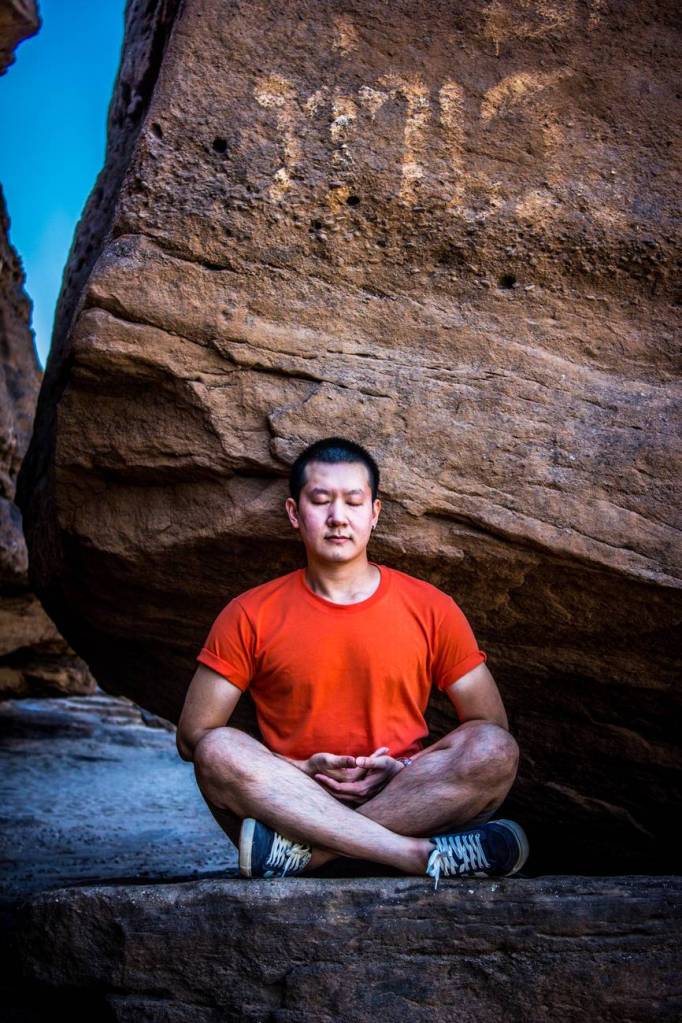
That being said, I should reiterate a point I’ve often made in the past that there are various forms of meditation, from the traditional image most people have as illustrated above, to moving meditations such as Tai Chi or even Yoga. Not every method and/or form will require a mantra, and not every mantra is a simple “ohm.” It can be pretty much anything you choose, so long as it works to help you focus and concentrate.

Personally, I don’t use a mantra when I meditate. I prefer silence or some soft background music with forest or ocean sounds. By focusing on these sounds, I’m focusing my mind. I’ve usually referred to this as an “external mantra.” Silence can also be an effective mantra, since focusing solely on the silence and concentrating on it will have most of the same benefits as an active, repetitive mantra.

Depending on what school of thought you prescribe to, the use of the mantra “ohm” causes a reverberation throughout the body that religious monks believe has spiritual or religious effects on the body. I couldn’t find a stock photo to demonstrate it and I’m too cheap to buy one, but there is a Hindu symbol that represents “ohm,” (also spelled aum or om) and you can hit up Wikipedia under “mantra” if you want to see it. It’s been made popular in such a way that the symbol is represented on yoga gear, jewellery and clothing apparel.

On a last note, a personal mantra is something a bit different. This usually involves a saying or quote that resonates with a person and has a direct impact on how they live their life. Something along the lines of, “Forgiveness is divine, but never pay full price for late pizza…” Anyone who recognizes that quote will understand how badly I just aged myself, but it’s usually something a person repeats or states to themselves or others often but has nothing to do with an actual mantra or meditation.

Although you don’t NEED a mantra in order to meditate, it can be a handy and useful practice to help you focus and concentration when doing so. Sometimes life makes it a bit difficult to find a quiet moment to meditate and a mantra can also help block the outside world. In fact, there are some YouTube videos with hours of mantra chanting, for those who want to have a listen at what it should sound like. ☯

Social Distancing Should Also Be Social Media Distancing

I know that anyone who’s read the majority of my posts will be aware that I’m not a big fan of social media. For those who are new here and may not be aware: I’m not a big fan of social media… In all seriousness, I consider social media to be somewhat harmful. Not because it’s inherently harmful in and of itself, but because some people choose to use it in harmful ways.

I’ve been off the social media scene for almost two years now, having done away with the likes of SnapChat and Facebook, due to issues they caused me in my professional life. I was partly responsible for these issues, since no person is ever ABSOLUTELY responsibility-free in any given issue, but after I learned the damage that having other people on social media caused, I chose to step away.

As the world continues to turn, the population continue to become more and more dependent on social media for even the smallest of social interactions. Everything from applying for jobs to dating, the more time passes, the more people are depending on their computers and their devices to do the talking for them. And as convenient as some of it may be (I’ve applied to a number of jobs online, it sure saves driving around and physically handing out resumes) there are some significant pitfalls, as well.

In some ways, a lot of ways, we’re slowly losing touch with our own humanity. No, I don’t mean that we’re all suddenly becoming robots. But we certainly are beginning to resemble automatons. I challenge any of you to walk through a public area, even one where a person should be paying attention to their surroundings such as the grocery store, and you’ll notice that the majority of the population have their faces buried in the screen of a smartphone.

I don’t know about you, but when I’m at the grocery store I pay attention to the aisle I’m in and the groceries I’m looking for. Weird concept, right? You would think that checking your Twitter or Facebook could wait until AFTER you’ve completed your errands. And no one really needs you to SnapChat the nachos you found at 20% off, regardless of how excited you may be.

In some ways, a lot of ways, I totally understand the compulsion. There’s an almost surreal addictive feeling behind some of the social media platforms that are out there. Up until late 2018, I would compulsively check my phone dozens of times throughout the work day, no matter what I had on the go. Nowadays I tend to limit myself quite a bit more, checking my phone only for phone calls and email purposes and occasionally searching for things that I’m curious or researching on.

A good example of how we’re stepping away from our humanity involves a story I’d like to share with you. I have a friend who used to be absolutely obsessed with online singles’ sites. In fact, over the course of a few very short years, he completely did away with meeting women in person, and depended solely on finding online profiles and attempting to meet people in this fashion. Now don’t get me wrong; I’m not saying there’s necessarily anything wrong with meeting someone new online. But if it causes you to lose the ability to approach someone in person, then it can be more harmful than good.

The digital frontier allows people to present themselves in any way they see fit. Occasionally, this won’t be in keeping with their realistic selves and people get some rather nasty surprises when they meet in person. That’s only one of the pitfalls. Don’t even get me started on meeting someone online who ends up being of an opposing gender than you thought they’d be, or a creeper who’s trying to meet with minors. But I digress…

My friend spent a few years trying to meet “the one” through many of these singles’ sites. He went on some dates and even started some semi-lasting relationships with them. But they never lasted. Not in the way he wanted. I used to encourage him to go out somewhere and do it the old fashion way. Go sit at a coffee shop with a book and a beverage. You spot someone from across the room, your eyes meet, you share a smile and you walk over and introduce yourself. Maybe you chat for a while. Then you work up the courage to ask if they’d like to meet for coffee again. Maybe they say yes and offer up their phone number.

Maybe I’m just old-fashioned, but I believe this kind of thing still happens. Although not quite as I described above, I met my wife the old-fashioned way; live and in person. My friend finally yielded to my persistence and attempted to meet someone in person. His experience was grand. He attended a local book store and introduced himself to a woman and asked her if she could recommend a good book she may have read (pretty smooth, I thought). They hit it off and even went out once or twice. They ultimately moved on from one another, but the experience changed his perspective of the online scene.

Dating is only one aspect, but it’s an easy one to write about. But for the most part, our dependence on the Internet and social media is slowly pulling us away from the actual world around us. Although the world is currently caught in the throes of social distancing, there’s still a big, beautiful world out there. And it would be a shame if people completely disconnected from it in exchange for the cold, pixelated screen of a smart device. ☯

Burn, Baby, Burn…

If you’re anything like me, you enjoy the smell of incense. I particularly enjoy the smell of an incense that’s available locally called “Ocean.” But there are number of more traditional scents, such as sage and sandalwood. And I once read somewhere that the word “incense” is based on the latin term meaning “to burn,” which is kinda cool.

Incense incense burning is usually done in order to produce a particular scent within the surrounding room, but it’s been long associated with the martial arts, religious practices and ceremonies and rituals. In fact, while growing up in the Catholic church I would often attend services with my family where the priest would walk around and “bless” the congregation by shaking a device called a “censer,” which contains burning powdered incense.

Some religions will use burning incense as a way of blessing things, warding off bad spirits or during ritual practices. Most convents and temples of varying faiths will usually have incense burning for one reason or another. Some people burn it within their home just for the pleasant scent (pleasant being a relative term, since my wife tolerates the incense I use but isn’t a huge fan if it).

Is incense a good idea? Like most things in life, there are good and bad aspects to incense burning, especially within one’s home. First of all, let’s agree that burning incense creates smoke. In all cases, breathing in smoke of any kind is never a good idea. This isn’t a new concept; the medical world has been talking about the dangers of smoke inhalation for decades. Ever sit too close to a camp fire? Once the breeze conveniently turns the smoke towards you, breathing easy is the last thing you get to do.

Depending on where you purchase/obtain your incense, they’re mostly made from natural ingredients. This doesn’t mean that it’s any better for you. After all, tobacco and marihuana are natural products but they’re no better for your lungs. But modern incense that you buy at your local retail chain can contain preservatives, chemicals and artificial products that can release carcinogens into the air.

You can Google some research initiatives that were done in the past twenty years. increased levels of incense burning has been linked to certain forms of lung cancer, asthma, tissue inflammation and even rashes. I have no idea how much incense you’d have to burn to be affected by these hazards and ideally, you should be burning incense in a well-ventilated area.

At the end of the day, incense has been around for way longer than we have. Make sure to light and burn it safely, since it is a fire hazard and try not to use it in confined spaces. I have a bad habit of lighting a stick of incense during my workouts in the basement of my home. It’s not so bad when I’m doing forms, but it gets a little hard to breathe when I’m doing something intense like a circuit workout or weights. Actually, that’s kinda what led me to write this post. Burn with care, folks! ☯

I Will Return To My Shadows

One of the great things about having my childhood (if it can be called as much) take place throughout the 80’s is all the great movies that started to come out. We got the Christopher Reeve Superman sequels (even if they weren’t well received), the last two original Star Wars trilogy chapters and a saturation of “Brat Pack” movies, including The Breakfast Club, Sixteen Candles and Pretty In Pink (I’m partial to Molly Ringwald, sue me!)

But there is a particular movie genre that also became popular during the 1980’s and it still holds a certain level of fascination to the public, even today. I’m talking about ninja movies. I’m sure you’ve seen at least SOME of these movies; stealthy assassins cloaked in mystery and garbed in black hoods, they seemed almost unstoppable and were usually trained in a variety of weaponry and were usually depicted in the movies as being exceptionally skilled in hand-to-hand combat.

But how accurate was that portrayal? To be honest, there is a common misconception that ninjas are martial artists. And although I’m no ninja myself, I can say for a fact that this isn’t true. The ninja were covert assassins, believed to have existed during the feudal era of Japan. They were basically mercenaries who could be bought by whomever could afford them.

Their preferred method of operation was to spy and assassinate through the use of disguises, deception and avoidance. They considered escape and living to see the conclusion of their mission to be paramount over active engagements or fighting. Because of this, the ninja were often considered dishonourable and the samurai considered the ninja beneath them.

When referring to martial arts circles, people usually tend to immediately associate a ninja with Ninjutsu (or ninjitsu) and consider it to be a martial art. The reality is that Ninjutsu is anything BUT… Ninjutsu, as it is, is classified as a system of espionage and assassination, normally including infiltrating locations, spying and accomplishing specific tasks that included but were not limited to capturing criminals and other individuals, obtaining private information and whatever other tasks that could not be accomplished through conventional means. This explanation clearly does not include the martial arts, which are defined as a means of self-defence.

A ninja would be trained in Ninjutsu and expected to develop some proficiency in a number of different weapons and offensive tools that would allow infiltration without notice, evasion and exfiltration. All of this would happen without the victim(s) even knowing that they are there. Ninjas would often originate from the samurai class and would already have some familiarity with an actual martial art. Since some of their tasks would often unavoidably include combat, ninjas would often train in some form of martial arts as well as the expected weapons and tools of the trade.

So the portrayal you see in the movies, where a ninja suddenly stands up out of a small shadow in the corner of a room to face off against an opponent is far from accurate, although it still makes for great cinema (if you haven’t seen 2009’s Ninja Assassin, I highly recommend it!) And if a martial arts practitioner tells you that he or she is a ninja, then by definition they are not. Especially since the ninja were not in the habit of revealing themselves to anyone outside of their clan. ☯