“Grin” Through It…

The pandemic has certainly put a number of things on the back burner, with most amenities and some necessities having closed for a number of months and most of us finding ourselves dealing without. One of those basics necessities happens to be the dentist. I had the opportunity to visit a local dentist’s office and treat myself to a good old fashioned cleaning. I brought Nathan with me so that he could get a look at the process and what’s involved with proper oral health, since during his last trip to the dentist, he turned into wolverine and fought off the staff.

Some of this is quoted from my previous post on oral hygiene because, well… concrete information doesn’t change! So if you’re a committed reader of my blog, you may recognize some of the information.

Oral hygiene and dental health are extremely important. Perhaps more so than most people understand. While growing up, I remember that the standard was simply that you needed to brush regularly and floss in order to keep from losing your teeth. Since then, studies and medical advancements have proven just how serious the problems can become if you don’t pay proper attention to your mouth.
Let’s think about our mouths for a moment: it’s the entry point for your food and the air you breath. This means that you have a lot of stuff from the outside world that enters your body through your mouth. Like most surfaces on your body, your mouth is full of bacteria. Some of that bacteria is good, but the bad bacteria is what can lead to tooth decay, bacterial infections and gum disease. Bacterial infections can be pretty serious, especially for Type 1 Diabetics. Our weakened immune systems make us more susceptible to infection and makes them worse. Just to make you grit your teeth harder, (see what I did there?) the gum disease caused by improper oral health can make it harder to control your blood sugar levels.

Even if you don’t have Diabetes, poor oral health can leave you susceptible to cardiovascular complications, pregnancy complication and pneumonia. So, what can you do to hep prevent those oral health issues? Brushing your teeth is an obvious first step. Despite what some of us were taught as children, brushing three times a day (or after every meal, whichever is greater) is not necessary. According to the Mayo Clinic, brushing twice a day is what the current recommendation indicates. This means brushing once in the morning and once before bed. Despite this, most dentists still stick to “old faithful” and tell folks to brush three times a day. It’s not a bad thing.

Although some dentists have indicated that even once can be acceptable, you tend to run into some problems with that, including potential bad breath throughout the day and unsightly food stuck in your teeth if you’re out in public. If you only brush once a day, best to do it first thing in the morning to eliminate morning breath. But brushing after any meal you eat is ideal, since the break down of food by the bacteria in your mouth will potentially cause issues. Be sure to floss. Most people overlook flossing or it bothers them. But flossing is required to eliminate the bits of food that can’t be removed by a toothbrush. Leaving that food between your teeth against the gum line can lead to an increase in bacteria. Use an antibacterial mouthwash. Don’t forget that mouthwash is supposed to complement your dental routine and isn’t meant as a substitution for brushing.

Click on these links to articles posted by Colgate and WebMD that explain some of what I’ve written and can provide further insight. Some other small changes can also help with improved oral health, such as avoiding staining drinks such as red wine or smoking tobacco products. And don’t forget to replace your toothbrush every few months. That s&*t gets gross!

So it may not have been a post about blood sugars or exercise, but proper oral hygiene can help prevent Diabetic complications and other issues that be aggravated by Diabetes. Why take chances when the prevention is so simple? Nathan was pretty impressed with the fact that I nearly fell asleep during my cleaning and it proved to be no issue for me. He’s looking forward to a check-up of his own in order to cash in from the Tooth Fairy. Now that dental offices have re-opened, I highly recommend everyone get in for a check-up. ☯

What’s A Name Worth?

Yesterday, I wrote a post about the potential addictive nature of sugar. I won’t get into that aspect again, since y’all can simply go read yesterday’s post if you haven’t already. But after having that post go live, I had some folks as for examples of the different names that companies use for sugar in their ingredients. As I wrote in my post Fruit Juice Is Bad For You from two weeks ago, foods that are advertised as “No Sugar Added” or “Natural” won’t necessarily be sugar-free.

In that spirit, I thought I would share a list of different names that companies use in their ingredient lists to replace the word “sugar.” This is not a comprehensive list, simply the ones I’ve seen or are aware of. Here we go… (takes a deep breath)

Dextrose, Fructose, Glucose, Lactose, Maltose, Sucrose, pretty much any word with “ose” at the end… Cane juice or Cane sugar, Corn Syrup, Maltol, pretty much anything followed by the word “syrup”, Caramel, Cane juice, Honey, Molasses… (exhales and tries to catch his breath).

Those were just the ones that I know about. I found an article posted by VirtaHealth.com that lists 56 different names for sugar. You can give it a gander and see for yourself. Some of them sound like perfectly normal foodstuffs and you wouldn’t assume that they refer to sugar. And since the ingredient list usually runs from highest to lowest amount, the closer to the beginning of the ingredient list that the word is found, the higher the content. Something to keep in mind when trying to reduce your sugar consumption. ☯

That White Powder Is NOT Cocaine, But It May As Well Be…

Sugar. Ahh, my old nemesis… Since I was diagnosed as a Type-1 Diabetic at the chaotic age of 4-years old, I never really got to experience that sweet side of life throughout my childhood. In fact, on the few, rare occasions where my blood dropped and the only recourse was to enjoy a regular Dr. Pepper or have a good old fashion candy bar, it would usually make my week. I made it past my teen years before having anything sweeter than fruit became possible. Since carb-counting wasn’t a thing in my household, the total and complete elimination of sugar in my diet was one of the key ways that my parents dealt with my condition.

It’s no secret that sugar has a measurable and real effect on the body, whether you have Diabetes or not. This has been proven time and again, and there have been studies that I’ve read that show that sugar has been shown to have an addictive effect as well as many others, on the body.

According to an article posted by WebMD, the average person consumes 17 teaspoons of sugar a day, which is significantly more than the recommended 12 teaspoons. Granted, that’s an American statistic but I’m sure it still applies to the majority of the Western world. And since the population seems to be hell-bent on consuming copious amounts of sugar, let’s examine some of the effects it has on the body.

According to that same article, eating sugar causes a release of dopamine, which is the “feel-good” hormone. Because of this, you’ll be likely to want more and more sugar in order to continue riding the dopamine train. This will cause the “sugar high” that my son seems to love using as a weapon of mass destruction, followed by a sugar crash, which can adversely affect your mood and make you feel down. This, in result, will cause you to seek out more sugar to counter the crash. Wash, rinse and repeat.

In addition, sugar consumption has been linked to dental issues, joint pain, skin issues, liver and heart disease. And it’s no secret that excess sugar consumption has been linked to weight-gain. And if I have to explain the issue with eating excess amounts of sugar if you have any type of Diabetes, then you probably need to go back and read some of my previous posts. Which you should be doing anyway. Go ahead, I’ll wait…

There have been some studies that have shown that sugar can be as addictive as cocaine (hence, today’s title). I tried my damnedest to find the studies I read, but I couldn’t track down the one that referred to it. But there’s no denying that some people enjoy the dopamine release and the short burst of energy that sugar can bring, and have difficulty staying away when it isn’t present. This is why you’re likely to grab a donut on your afternoon break as opposed to carrot sticks.

Can sugar have an addictive component? Yes. Granted, it often depends on who you talk to. The idea is not to try and completely eliminate sugar from your diet (whether you have Diabetes or not), but to consume in moderation in the same way as you would do with everything else. It can also be difficult to truly know how much sugar you’re consuming since it can be labelled as so many different things that you may not even know that you’re eating sugar! Modern Diabetic therapy has made it possible for people to eat in the same way as everyone else, provided they test their blood sugars regularly and adjust their insulin levels. ☯

Vanity Is A Weakness

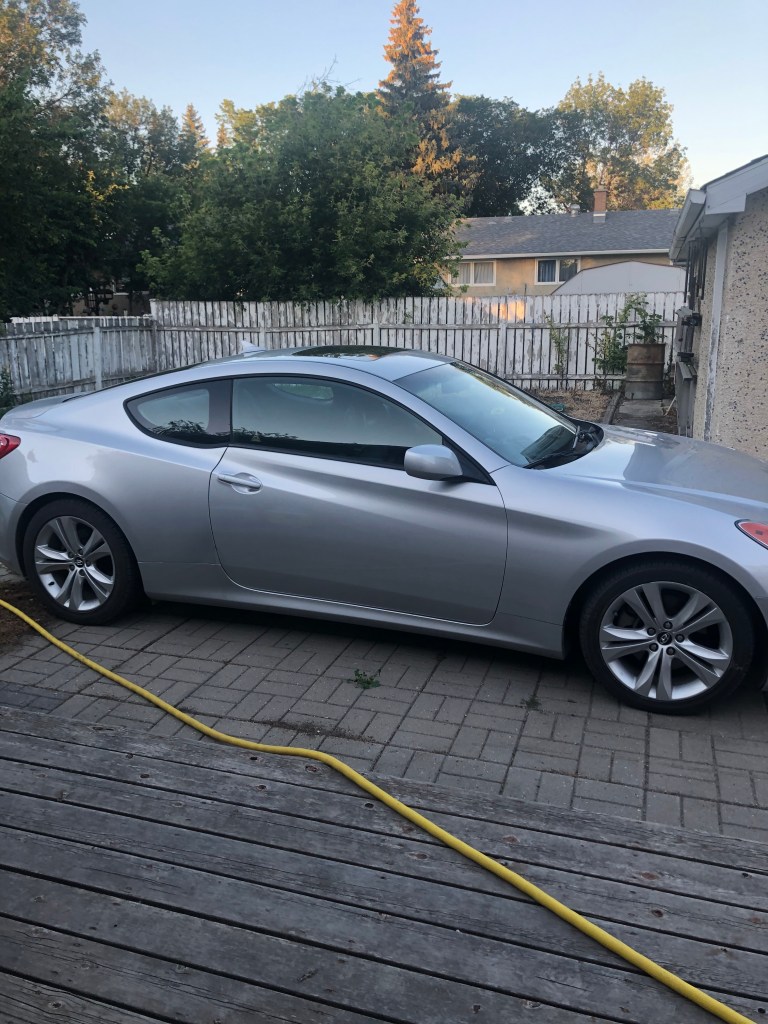
I’m selling my “bachelor-mobile.” Yes, that’s right! I’m selling my little two-door sports coupe with the manual transmission that’s kept me feeling like I’m still in my twenties when I’d rip around the streets of Regina, Saskatchewan. The reason is pretty simple: my wife works from home now and we really only have need of one vehicle. It’s financially unreasonable to keep two vehicles when a household only needs one. Right? Am I right?

What’s blown my mind in recent months is exactly HOW difficult it is to sell a premium vehicle in excellent condition. It seems that people are ridiculously hung up on the little details and as opposed to what I’ve done in the past, people assume that the work and the research will be done for them. I realized after a couple of weeks of dealing with people who were inquiring about the car that I’ve never actually SOLD a second-hand vehicle before. I’ve mostly dealt with dealerships.

The Bachelor-Mobile

Selling a personal vehicle as a private seller is extremely taxing and time-consuming. We’ve had a ton of interest in this car, and for every person who has an interest, I’ve had to subject myself to a lengthy plethora of questions about the vehicle and multiple photos beyond the adequate ones included in the selling post. It’s tiring, because I’m generally of the opinion that these questions could most easily be answered by setting up a viewing to simply come SEE the vehicle. Wouldn’t that be so much better than trying to ask questions about it?

For some, I can kinda understand the impulse to want to see more and ask further questions through a digital frontier. I’ve had some people who live two, all the way to eight hours away from Regina who have shown interest. But for those who reside right here in the city, it’s pretty disappointing to see the reactions and requirements of some of the people who have come to view the vehicle.

Just so everyone doesn’t think that I’m some sort of megalomaniacal douche-canoe (Google that, if you don’t know what it means), let me give you some examples. Some of this may seem perfectly normal and expected, but it struck me as a touch odd and left me with a bad taste in my mouth.

I had a young guy, probably 16 or 17 years old, come see the vehicle with his father. They spent well over half an hour with me, pushing every button, trying every feature and then taking a lengthy test drive, which included city AND highway speeds. The boy was totally enamoured with the vehicle and I could tell that he was definitely interested. His father asked the rough questions, although I was able to answer them without issue.

He said he would get back to me and he left quite happy. So imagine my surprise when I got a text from him a day later saying that he wanted me to bring my vehicle in for a mechanical inspection before he would put a offer in. Now, this struck me as a bit odd, especially since he spent more than half an hour test-driving the car. It would be one thing if he had no idea how the vehicle ran, but we ran it in every condition it could face, except off-road!

He said he had no concerns but wanted the inspection done as a precaution. Although I was a touch resistant, I would have gone through with it if he had simply agreed to pay the necessary expenses! One thing I definitely won’t do is put out money in order to sell something. That’s just flat out ridiculous. Therefore, ambitious hot-rod-seeking teen boy didn’t buy my car.

Another potential buyer reached me through text message after getting my number through my wife’s FaceBook market page. She requested “additional photos”… That always throws me for a loop. I had a half dozen photos of the car, inside and out, which showed every perspective of the vehicle. I wasn’t sure what she was looking for, so I asked. She specified she wanted a side shot of the vehicle. Okay, fair enough. I told her I’d get the photo as soon as possible.

Errands and parenthood got in the way and she texted aggressively, asking why I hadn’t gotten back to her yet. I told her that the time to take some photos would need to happen but that I would still get them as soon as I could. I asked her why she didn’t simply come over to take a look at the car herself, to which she replied that she lived in Saskatoon. This put her at just over two hours away from Regina. I kinda get it. But on the other side of the coin, why wouldn’t you just buy a car in Saskatoon? It’s a bigger city anyway!

I eventually got a free minute to take a full-on shot of all four sides of the car and sent them to her. Her exact words were, “Finally, those are MUCH better pictures… my son’s dad will texting you with questions.” Umm, what? There was nothing wrong with the advert’s photos, but “my son’s dad” sounds strange as compared to “my husband.” I let it go and moved on. The next day, a random dude called me, not texted but called, and identified himself as this buyer’s ex-husband. He asked a couple of cogent questions about the car, but ended up asking for specific photos of specific areas of the vehicle.

I’m definitely not lazy, but I explained to the gentleman that I had an adequate number of photos on the advert and that the extras I sent to his ex-wife were a courtesy. The next obvious step would be for one of them to come down to Regina for an in-person viewing and test drive. This would answer all the questions he had and would save the trouble of trying to work around my schedule to get added photos.

Apparently I had the “audacity” to suggest he come for a test drive and it was decided that he would pass on the vehicle. I understand that this is subjective since it’s my car and my blog, but am I being too sensitive? I find myself wondering what happened to the good ol’ days when you’d purchase a private vehicle by showing up in person and taking the damn thing for a test drive. Don’t even get me started on the folks that are either asking me if I’m willing to trade for another vehicle or are offering HALF MY ASKING PRICE…

It’s amazing how difficult it is to sell of a second vehicle in order to lower/eliminate some debt and try to get ahead. People are hung up on the small details, before they even see the damn vehicle. I have a guy who intends to buy the car without even test-driving, but won’t have the money for another week from this post going live. I’ll be curious to see if he comes through. Maybe I’ll get a chance to reduce more belongings in the long list of property I don’t want/need. ☯

The Need For Speed

Low blood glucose is probably my biggest pet-peeve in terms of Diabetic symptoms. I’ve been fortunate enough that with the exception of a bit of Diabetic Macular Edema, I haven’t had to deal with the more extreme Diabetic side effects. But given that I’m a fitness enthusiast with just a hint of crazy, low blood sugar is definitely one of my most-visited Diabetic symptoms.

So, how does one best treat a low? The standard answer is the rule of 15/15. Provide 15 grams of fast-acting glucose and wait 15 minutes. If your blood sugar is still low, then repeat. This isn’t always feasible, since you may be in the middle of a 60-kilometre bike ride with no place to rest or take shelter, and you need to boost your blood glucose NOW! So what’s the best answer for getting some fast-acting glucose into your system?

For myself, I like to use regular jellybeans. The ones usually put out by Dare or Ganong. They usually sit at about 2 grams of carbs per jellybean, so wolfing down about a dozen usually does the trick. I find they work the fastest and the best for me in particular, especially in the middle of the night. Grabbing two handfuls puts me at just over a dozen jellybeans, which allows me to safely go back to sleep.

Every body is different, and every Diabetic will be just as different. What this means for you is that you may need to experiment and try a few different sources of fast-acting carbohydrate to figure out what works best for you. Maybe jujubes will be preferable over jellybeans, or maybe it’s apple sauce, like one of my fellow bloggers prefers.

What you want to try and avoid, is any source of glucose that is high in fat, like chocolate. Although chocolate will have the desired effect, it’ll simply take a whole lot longer since the body will need to break down the fat before getting to the glucose. And since chocolate is essentially a brick of sugary fat, your blood may continue to drop while your body is trying to process the fat before giving you what you need.

Glucose tablets can be ideal, although they don’t seem to work well for me. I usually have to eat the entire package before I feel or see any noticeable difference. And that’s the thing: what works for you depends on your metabolism, how low your blood sugar may be and how quickly you need it to rise. If you’re lounging at home, binging Netflix, chocolate may be a perfectly acceptable option for you. It’s pretty subjective.

At the end of the day, monitoring your blood sugars through a CGM or by testing via finger-prick multiple times throughout the day is an absolute must to ensure you maintain good blood glucose levels. But if you’re suffering a low and need to get yourself up there a bit faster, be sure to chose a fat-free option that can be easily and quickly consumed. ☯

Full Disclosure Does Not Mean Full Exposure

Most people are not prone to revealing their medical conditions to people. And I can’t say I don’t understand where they’re coming from. Some people are fearful of how others will act and react around them once they know. Others feel that perhaps they’ll be treated differently at work and potentially get passed up for promotions and special duties if certain medical conditions are known.

In Canada, the Labour Code and the Charter of Rights prohibits such discriminatory behaviour on the grounds of a medical condition, but if you were to strap your boss’ appendages to a polygraph and ask if that was the reason, you might be surprised. And in some cases, most cases I would think, this stems from ignorance about conditions such as Diabetes. So in a way, employers may think they’re protecting you as well as their business by ensuring they don’t put you in a position where you could bring harm to yourself.

Truth be told, I’ve always been of the opinion that full disclosure on what’s going on with me is the best policy. This simplifies matters, especially in cases where I need to request time off for something like my eye injections. In addition to that, I’ve been in a position on more than one occasion in my youth, where I’ve suffered Diabetic issues and the people around me didn’t know what was going on. Not a pleasant situation to be in.

So this begs two question: How much should you tell your employer/friends/family? And what should these folks do in a situation where you are having a Diabetic episode? The answer to the first one may be my opinion. The answer to the second is common sense and SHOULD be observed, regardless of what environment you work in.

First, let’s make something clear: you are under no obligation to share your medical information with an employer. The Labour Code and the Charter of Rights and Freedoms are reasonably clear on that. But you can click on the links to research that on your own. But should you choose to disclose your Diabetes to an employer, it can be a life-saving choice, as we all need some help every once in a while. I’ve been in situations where although I’m conscious and able to speak, I was sure grateful to have someone get my glucose to help me out. This can be an important consideration and you should bear it in mind before deciding that you don’t want to bring up your Diabetes.

The next point, and I’ve been asked this more times than I can count, is what to do if you find someone suffering from Diabetic symptoms (extreme high or low blood sugar). This is what would be referred to as hypoglycaemia and hyperglycaemia. Both are pretty terrible and carry their own set of complications, and there are differing opinions on what you should do if you come across someone you believe is suffering from either.

What I usually try to explain to people is that they’ll always be faced with one of two scenarios. Either I’m conscious, in which case I’ll get them to help me get what I need, or I’m unconscious. If a suspected, Diabetic patient is unconscious, I don’t care what literature you’ve read that says otherwise, DON’T TRY TO GIVE THEM ANYTHING!!! If you can’t ascertain if their blood is too high or too low, trying to treat them blindly can cause more damage.

For a while, there was a school of thought that said to give a Diabetic some glucose as you would either treat a low or if they were running high, first responders could treat it when they got on scene. Are you kidding me? If they’re in rough shape from high blood sugars, the amount of damage you can do to them by giving them additional glucose would be catastrophic.

If you’re familiar with Diabetes and the equipment we use, you could potentially test their blood. Most glucometers are reasonably fool-proof these days. Just stick the test strip into the slot and the meter will tell you what to do anyway. In this way, you can ascertain if they’re running too high or too low, and this can be of great help to first responders and you’ll know if providing glucose would be a good idea or not. But if you blindly give glucose, you could cause issues like DKA (Diabetic Ketoacidosis), organ failure, nerve damage and even heart attacks and strokes. Not a chance I’d want anyone taking with MY life if they were there.

If you were on the ball enough to call 911, first responders will be there in due course to deal with matters. The best option is to keep the person safe and clear of any danger and make sure to pass on whatever symptoms you may have documented to first responders so they can best do their job. And if you work/live with someone who has Diabetes, ask some questions. Most of us will gladly answer them as we not only prefer to clear up any confusion, most of us understand that it could be of great help to us in an emergency.

And if you HAVE Diabetes, consider letting your employer know. You may not HAVE to, but doing so could potentially save your life. And let’s be honest; there’s no shame in having Diabetes. Contrary to how it’s sometimes portrayed in the media, having Type-1 Diabetes is not your fault and it’s nothing to be embarrassed about. A little food for thought on your Wednesday morning. ☯

It’s a HIIT…

It’s no secret that I love a little variety in my fitness routines. I’m pretty sure that I’ve tried it all… Cardio, Zumba, Tai Chi, Weightlifting, Cross-fit and many others… I’ve never been afraid of trying anything new and/or different when it comes to my fitness. After all, one could potentially discover a new fitness routine that’s loaded with fun, health and fitness benefits.

Enter: the HIIT workout. For those of you NOT in the know, HIIT stands for High-intensy Interval Training and features (as the name suggests) intense intervals of cardiovascular exercise mixed with short rest periods. These workouts usually let about half an hour, although some of them have been known to last a bit longer, depending on one’s endurance and fitness levels.

HIIT workouts can have a number of benefits, including fat burning, muscle gain and improved blood sugars. But I’m going to focus on 7 benefits of High-intensity interval training as discussed in an article posted by Heathline.com:

  1. You can burn calories quickly in a short period of time: This is one that’s come up in most of the articles I’ve read on the subject. And the general consensus is that you can burn more calories in less time during a HIIT workout than you would with something traditional like cycling or weight lifting;
  2. Your metabolic rate remains high for hours afterwards: an increased metabolism will lend a score of benefits that I won’t bother covering in this post, but a HIIT workout will do it for you. In fact, it will do it more effectively than other traditional workouts;
  3. The fat-burning benefits: Okay, I’ll be the first one to admit that fat-burning is not only one of the most sought-after benefits of any fitness regiment, I’ve often written about how no matter what “gimmick” workout you may doing, there is only one way to effectively burn fat: to burn more calories than you take in. However, a study named in the article I linked above showed a 17% reduction in visceral fat, or the disease-promoting fat surrounding your internal organs, when doing HIIT workouts;
  4. You could gain muscle: Alright, I won’t touch on this too much because the reality is that any consistent and intense workout regiment will help you gain muscle. This shouldn’t come as a surprise. And a “high-intensity” workout would be no different…;
  5. It could improve your oxygen consumption: In this regard, they’re referring to the fact that HIIT workouts will help your muscles to use oxygen more effectively, and will do so in half the time of a traditional workout;
  6. It can reduce heart rate and blood pressure: This has been shown to be prominent mostly in overweight and obese individuals, but it’s an important health benefit nonetheless;
  7. It can help reduce your blood sugar: Seriously?! Woohoo to that! being a Type-1 Diabetic, I’d rather have to consume carbs than burn them. Research has shown that HIIT workouts can not only be extremely beneficial to those with Type-2 Diabetes but can help to improve insulin-resistance.

The good thing about HIIT workouts is that it allows you to reap the benefits of most standard workouts in only half the time. Like any workout, you should consult your medical practitioner before starting ANY fitness regiment, and pay close attention to how a change in fitness routine affects your blood sugars. After all, variety may be the spice of life, but Diabetes will keep you seasoned with complications. ☯

Duty Is Heavier Than A Mountain…

I first heard the quote in today’s title all the way back in the early 1990’s when I started reading Robert Jordan’s Wheel of Time series for the first time. At the time, I thought it was just a cool quote, “Duty is heavier than a mountain, death is light as a feather.” It’s a quote that the main protagonist ends up carrying with him throughout the entire series. Since the release of the books, many people have been quick to point out that the quote actually comes from an old Japanese military text (myself included, since I wrote about it last year).

But by the time I had reached the end of the series, the expression had come to mean a great deal more to me than simply a line in a book. And in truth, there are a lot of values that are important to me; loyalty, honor, duty and obligation. These are things that are surprisingly not thought about in any great depth by most people. But the martial arts (at least traditional schools) are steeped in these values. And I’ve grown with these values ingrained as part of who I am.

“Loyalty Above All Else, Except Honor…”

– Lt. Vincent Hardy, Striking Distance

Doing the right thing should be easy. People think it’s hard to do the right thing, but it really isn’t. Unless you’re values are a bit shady, doing the right thing should come smoothly and easily and should be done without thinking. It shouldn’t be a chore, it should feel like what you’re SUPPOSED to do; because it is. It should be. Key word: should. Sometimes, it can be harmful to yourself to do the right thing because it can cost you.

Doing the right thing can sometimes take something from you that you endeavoured to obtain for yourself. So the important question becomes, if you know that being loyal and doing the right thing will take something important away from you, do you still do it? Yes. The answer you’re looking for is yes…

Duty is ever-present. There will always be things in your life that you have a bound duty to, so you should roll with that. Honor is always important. It helps you to do what’s right, even when it seems hard. Loyalty should be earned. But if someone in your life has become important enough to earn that loyalty, then you should be true to that loyalty to the best of your ability. ☯

The Next Milestone…

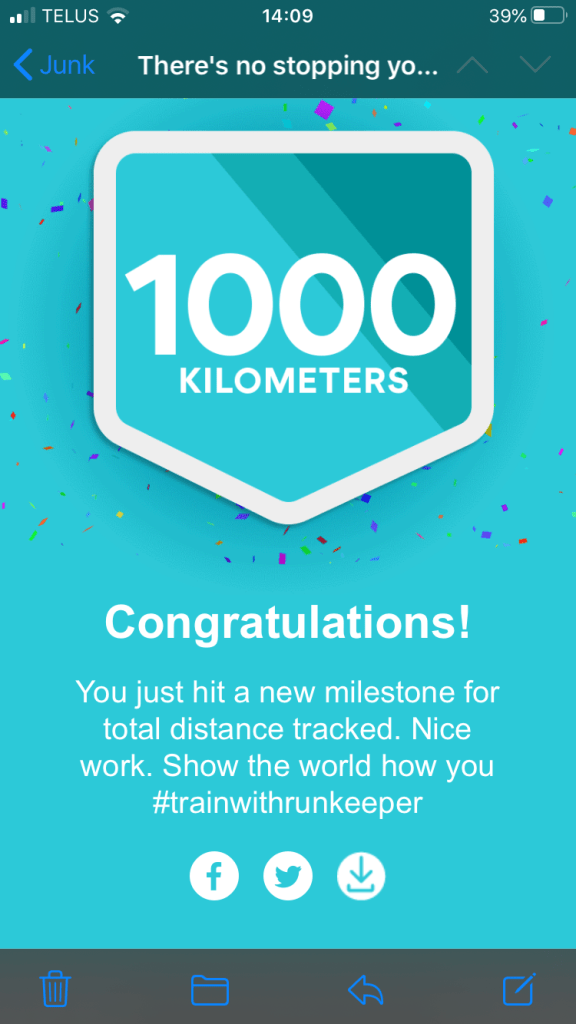
So after using yesterday’s post to bitch, whine and complain about Mother Nature’s unending use of the Prairie Provinces as her personal whipping ground with the non-stop wind, I got an e-mail from my RunKeeper app yesterday indicating that I’ve apparently hit 1000 kilometres this year!

I had some recent issues with my workouts not syncing up to my RunKeeper account, so even if I’ve been counting the number of workouts I’ve been doing per week, none of the statistical stuff has been uploading. I sent in a message to their support link and got a solution the same day. Once I cleared the syncing error and all the workouts synced, I got a batch of emails. One of them was the image you see above.

Considering I reached the 500k mark back in late May, I’m somewhat surprised that I got here this quickly. But either way, it feels nice to be up in the thousands. It will be interesting to see how many more kilometres I can rack up before the colder season kicks in and the snow hits the ground! ☯

No Use In Getting Angry With The Wind

Last Monday was a Civic Holiday (Saskatchewan Day for us), and most of the city was quiet and businesses were closed. My wife had the day off and since the temperature seemed pretty mild, I thought it would be an ideal day to try and achieve 70 kilometres on the bicycle. I had discussed this plan with my wife a few days prior, and given the amount of time that it would take me to reach this distance (I cycle at about an hour for every slice of 20 kilometres, give or take) she suggested that I leave during the early morning hours in order for it to be cooler outside and so that I wouldn’t lose the majority of the day to my trek.

I decided to take her advice and set my alarm for 6:30 am. I probably could have gone a bit earlier, but COVID has made me a bit lazy in my old age, and getting out of bed is a definite “not like” for me. My CGM sensor was scheduled to need replacing in the next four hours and I knew I wouldn’t be home in time, so I opted to remove it and simply run without for the duration of my trip. I loaded up the satchels on my bike with cereal bars, protein sticks, electrolytes and jelly beans. I checked the inflation on my tires and I took to the road at about 7:30 in the morning.

The first leg of my trip went flawlessly. My goal was to take a 35-kilometre route to a local community called Lumsden, stop for a light bite to eat and make my way back. My plan was to use secondary Highway 734, since it had a paved surface but would be quieter than the busy, four-lanes Highway 11. It also takes a roundabout route, allowing for a longer mileage. I had tunes going, my mileage was being tracked by my Runkeeper app and I even achieved 10 kilometres in 20 minutes, which was a speed goal I had been trying to achieve the week prior.

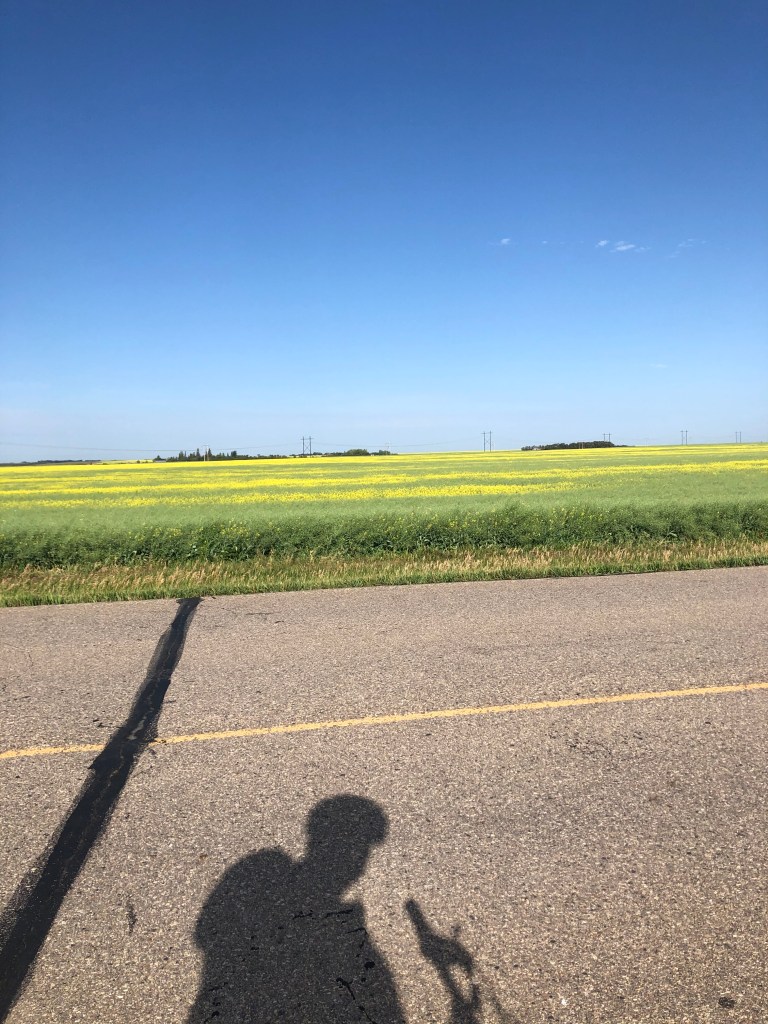
My view of the bright, yellow Canola fields along the highway

I managed to reach Lumsden in just short over an hour, but the route I used only took 29 kilometres! You’d think this would be a good thing, but it meant I’d have to find a different, longer route in order to get home otherwise I’d have to spend time lapping my neighbourhood streets in order to hit my 70. I examined the map and decided on a route that should have allowed me to reach my goal.

I had plenty of company on the road, despite the light traffic. Between prairie dogs, horses and cattle in the fields and the dozens of caterpillars walking about the road surface… Since it was a fairly chilly morning, the caterpillars are drawn to the asphalt’s heat, which it absorbs from the morning sun. But before I go off on a tangent, let’s get back to the ride…

One of the many fuzzy companions I encountered

Not only was I sitting on cloud nine from the speed I had used to reach Lumsden, I was pretty confident that I would be able to get back home in roughly three hours’ total, which would have signalled a whole bunch of achievements in terms of time and distance. But as I often say, life doesn’t care about one’s plans. And in this instance, nature and technology had a much different idea of how my morning would go.

First, I experienced the AWESOME pleasure of climbing the Lumsden hill on a bicycle. In case my sarcasm isn’t quite oozing through my typed words… It was ridiculous. Then I hit the top of the hill into the open area and got hit by wind. Directly. Into. My face. It was the kind of wind that brought me to a complete stop as soon as I stopped pedalling.

I know that a lot of people joke about how flat Saskatchewan is, but does there seriously have to be this much wind ALL THE TIME??? All the time I gained during the trek towards Lumsden was blown out of the water by trying to ride against the wind over the next three hours. It didn’t take long for me to become exhausted and with the lack of CGM, I was curious as to how my blood sugars were doing.

I stopped on a quiet stretch of highway and tested my blood. I was sitting at 4.1 mmol/L, which isn’t a HUGE issue but since I still had about 20 kilometres to go I thought it would be a good time to stopped for a snack. I texted my wife to let her know I was still alive and stuffed my face, followed by some electrolytes. I got back on the road and kept struggling against the wind.

Then, right in mid-song, my phone went quiet. I stopped and checked on it, only to find the the battery had died. This struck me as odd since I’ve often cycled for four hours or more and still got home with a charge. So now, not only had I lost my ability to track my progress, I also lost any means of communicating with my wife (or emergency services, if need be). There’s a certain psychological effect to recognizing that you’re in the middle of nowhere with no means to call for help, if needed.

I made my way home and realized that as I was angry at the fact it was windy. And then I realized? Is there any point to being angry at the wind? After all, the wind is a natural occurring phenomenon. It serves a number of purposes in nature. It wasn’t INTENTIONALLY making my ride tougher, despite the fact that I kept asking ti to “give me a break.”

And this is an important aspect in everyday life. We’re often faced with naturally-occurring obstacles that we have no control over and aren’t set out to make our lives difficult, despite the fact that they often do. Life doesn’t care about our plan and we have to work through or work around those obstacles accordingly. Ultimately, I managed to reach my 70 kilometres. It sucks that the phone stopped tracking at 58.9 kilometres, but at the end of the day, I still reached the mileage. So it wasn’t a wasted day, despite how blasted I was when I finally got home. ☯