The home of Buddhism, Martial Arts, Diabetes and health…
Author: Shawn
I am a practitioner of the martial arts and student of the Buddhist faith. I have been a Type 1 Diabetic since I was 4 years old and have been fighting the uphill battle it includes ever since. I enjoy fitness and health and looking for new ways to improve both, as well as examining the many questions of life. Although I have no formal medical training, I have amassed a wealth of knowledge regarding health, Diabetes, martial arts as well as Buddhism and philosophy. My goal is to share this information with the world, and perhaps provide some sarcastic humour along the way. Welcome!
There’s a certain level of pride in ownership. Think about it: you have a few buddies who come over to watch whatever sporting event you’re into, and one of them comments on your television set. Next thing you know, you fall into a self-indulgent monologue about where you got it, how much you paid for it and the size and features of the screen, before one of your buddies finally stuffs a beer into your hand and reminds you the game is about to start. A person usually can’t help it. Pride in one’s belongings is a normal instinct, albeit self-indulgent and unnecessary.
Last night, someone broke into my family’s vehicle. This is the third time in as many years that this has happened. Speaking from a professional standpoint, there’s not a hell of a lot one can do about something like this. It’s a petty crime with little to no evidence, which means there isn’t anything for the police to go on. I know this from experience. From a personal standpoint, I consider it a violation of my privacy and an invasion of my home. Although the vehicle may be parked outside, it’s my property ON my property, and no one has any right to access it without my consent.
So, why do these people do it? I wish there was an easy answer… From a humanity perspective, I’m certain there are some who are simply seeking out cash money. That certainly seemed to be the case with my vehicle. I opened the driver’s door this morning to find my glove box and dash compartment sitting open and papers strewn all about. Even some of the menial electronics I had in the vehicle, such as a dash cam, were left untouched. This leads me to believe that they hoped to find coins, at the very least. But we keep nothing of value in our vehicle.
There are different schools of thought, in relation to a crime like this. Some people believe the best course of action is to simply leave the vehicle unlocked, allowing persons unknown an unhindered access to the vehicle so that they ca see there’s nothing inside and move along. Others, such as myself, believe that there’s no value in accommodating criminals in order to make their process easier, regardless of their reasons.
There is a enough suffering in the world without intentionally causing more. Besides the inconvenience of having to clean everything up, I spent the morning drop-off explaining to my 5-year old son why someone came into our vehicle and made a mess, even if the vehicle didn’t belong to them. What’s more is the sense of random strangers being inside the vehicle where I transport my children adds an unwanted sense of reality to the violation.
I find myself in a position now, where I am considering taking added security steps in my home including a camera system or a car alarm system. Despite the fact that keeping one’s doors locked should be enough to inform any person that they’re not welcome, the way of the world seems to require more. The worst part is the sense of anger I feel towards these persons, and the potential actions I may take if I were to ever catch them. I don’t want to be that kind of person. But one can only take personal violations for so long. ☯
Some days, I like to let my head cool down from all the reading, research and long-winded writing I do, and simply post something funny, inspirational or cute. So, here it is! I found this online and it made me smile, so hopefully it does that for you as well.
Some of the important lessons of life can come from the most unlikely sources, even if all they do is make you grin like a fool. ☯
It’s been a hell of a long week, with basement demolition and foundation bracing taking place within my home. It started last Wednesday, with a crew from Grasshopper Construction showing up to take down the current walls and finishings from the basement in order to expose the concrete foundation. This was to be followed with the placing of steel braces all along the foundation walls in order to shore up and solidify the concrete and prevent any heaving or caving in, since the soil in Regina is primarily composed of yellow clay and tends to shift and cause said heaving.
The “Before” photo
My wife and I agreed that it would be best for her and our infant son to take a trip to her parents’ place for the week that followed, in order to allow the baby to get his naps and stick to a routine as opposed to dealing with the cold and noise that would take place within the house. My wife also requires a wifi signal for her work-at-home job, and we knew that power and internet may be interrupted at intermittent times.
This left me with my 5-year old son, Nathan, as he had school all week and had to make the bus every morning. The first day of demolition went well, with a significant amount of the finishings removed by the end of the day. The crew were extremely efficient, keeping me updated and asking questions as required. They were also really good with cleaning as they went and at the end of every day, which made the continued use of the washer and dryer a possibility during the whole process, which was greatly appreciated.
The panoramic “After” photo
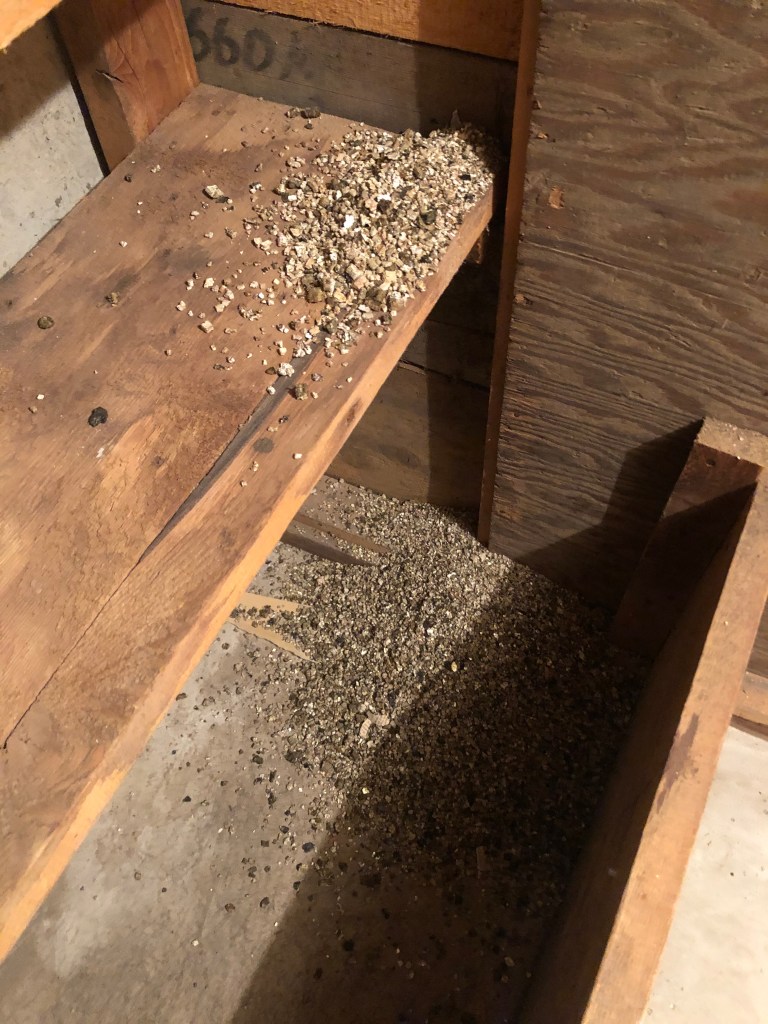
After two full days of demolition, they had about 90% of the basement demolished and on Thursday afternoon, Jeff (the owner of the company) brought me to the basement to show me that they had discovered the inner walls of our cold storage room filled with an asbestos insulation called Vermiculite. The tiles left under that wonderful orange carpet of the basement’s open area were also made of asbestos. This meant that demolition and bracing would need to stop until I could get professionals to come in and remove the asbestos.
We were already aware of the floor tiles prior to the project starting, as Jeff recognized it during his first visit. But it wasn’t a concern as it wouldn’t interfere with the bracing of the foundation walls. But the cold room unfortunately had to be demolished in order to access the section of south wall that needed to be braced. I looked up a local asbestos removal company and asked for someone to come take a look and provide an estimate. At about 4:30 pm on Thursday afternoon, one of the guys came over and assessed the cold room and floor tiles and advised he would email me an estimate of costs.
Asbestos tiles
For those who are unfamiliar with it, asbestos refers to silicate minerals that are arranged in a fine fibrous crystal form and was used for multiple residential and industrial applications in Canada towards the end of the 1870’s. It became a popular commodity, due to it’s fire and temperature resistance as well as its ability to stand up against exposure to chemicals. Given it’s physical flexibility, it was often used as a source material for floor tiles, insulation, sound-proofing and temperature control. Especially since it was so cheap. The big problem is that when asbestos is damaged or broken up, it can release microscopic “fibrils” that can potentially be inhaled.
Asbestos insulation, or “Vermiculite,” discovered once they tried tearing down this wall
The inhalation of asbestos can lead to certain forms of cancer, specifically mesothelioma. I won’t get into THAT one; y’all can use Google on that one. I’m just happy that I managed to spell it properly. I got my estimate on Friday afternoon, and was told that an asbestos crew would be there the following day (Saturday) to do the clean up. I updated Jeff and we agreed that this would work out perfectly as it would prevent any interference or delays with the foundation bracing.
The asbestos removal people were scheduled to be here at 8:00 am on Saturday morning. I got up at 7:00 am, in order to have Nathan dressed and ready in the event we needed to vacate the house for a few hours. By 8:40, I started to wonder if I had misunderstood and contacted the company. Lo and behold, they only showed up at about 10:30 as they apparently booked an earlier job before mine. Such is life.
I was not impressed with the situation. The asbestos removal guys even mentioned that the use of asbestos within the house should have been disclosed before our initial purchase of the property. But considering the original owner did a lot of his own work and on his own, he may have insulated that room himself and it may not have been a known fact. Now that all the hazardous materials had been removed, the demolition team were able to finish removing the remaining finishings and get the bracing done on the foundation walls.
This wasn’t the end of the issues, of course. Minutes into starting their work on Monday morning, the Grasshopper crew found another wall filled with Vermiculite, and had to stop work in that area. A quick call to the asbestos company saw a crew of three show up at my house within 30 minutes in order to clean it all up. I’ll admit that I was a little miffed with them and basically “ordered” them to ensure they tore apart every wall to ensure I wouldn’t have to bring them in a third time.
Thank the light that the Grasshopper crew were flexible and able to take a break to allow the asbestos team to clean up what they had missed on their previous visit. They vacated the basement and showed up to continue working without missing a beat. They somehow showed up right when he asbestos guys left and continued work before I even noticed they even came back!
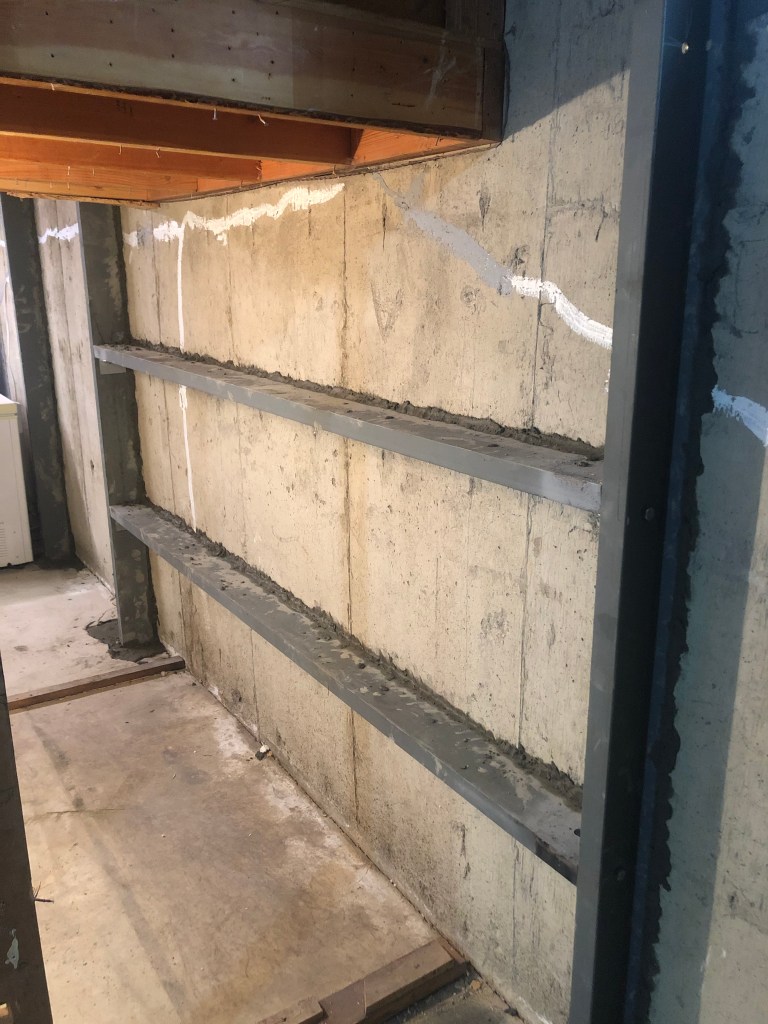
Wall braces, in all their concrete-straightening glory!
The Grasshopper crew worked over the days that followed, and I watched the progression of a heaved, cracked foundation to the neat, sealed and braced walls you see in the photograph above. A plumber and an electrician came in to reconnect certain pipes and power lines that had to be removed for the proper installation of the steel braces. All in all, the basement is looking way better than it did a month ago.
Over the next short period of time, we’ll need to decide if we’re to put our house back on the market or if fate and career will allow us to make it our permanent home. If it’s the latter, I’ve already got some ideas for the open space. Of course I do, this is me! I’m thinking pool table, maybe a mini-bar and cocktail fridge, dart board… After I get some flooring, framing and drywalling done, of course. I can hear my wife groaning already! Either way, a significant amount of stress is off my shoulders, now that I now the foundation of my home has been shored up.
Even the tight, difficult area under the floor landing, still properly and professionally braced
A really huge shout out to Grasshopper Construction, the owners Jeff and Shane, as well as Kess and Luke for their diligent and professional work and for putting up with the occasional distraction and questions from my 5-year old son Nathan. If you live in the Regina area, or know someone who does and requires foundation work or renovations, I can’t recommend these guys enough. Besides their website, which I’ve linked above, they also have a FaceBook page you can check out and see customer testimonials and photos of their work. ☯
I was diagnosed as Type-1 Diabetic at the age of four, so Halloween has never really held an important place in my life. After all, the eating of chocolate and candy wasn’t exactly permitted, unless I was having a low, and my older brother was always too sick to go walking for long distances from door-to-door. So the concept of spending time, money and effort on a costume, just to go out and gather treats from other people never appealed to me as a child. It appeals to me even less as an adult, but it’s no longer about me. It’s about my children.
This year, Halloween has taken a severe kick in the candy-corn since social distancing requirements are as such that trick-or-treating is basically an unessential and frivolous risk when faced with the possibility of walking up to someone’s door to get a freakin’ Kit-Kat bar. Despite this fact, many parents decided to allow their children to go trick-or-treating, last Saturday. There are two schools of thought on this: some believe the risk isn’t worth it (and they’d be right) while others believe that our children shouldn’t be made to suffer because of what’s currently going on in the world (and they’re also right).
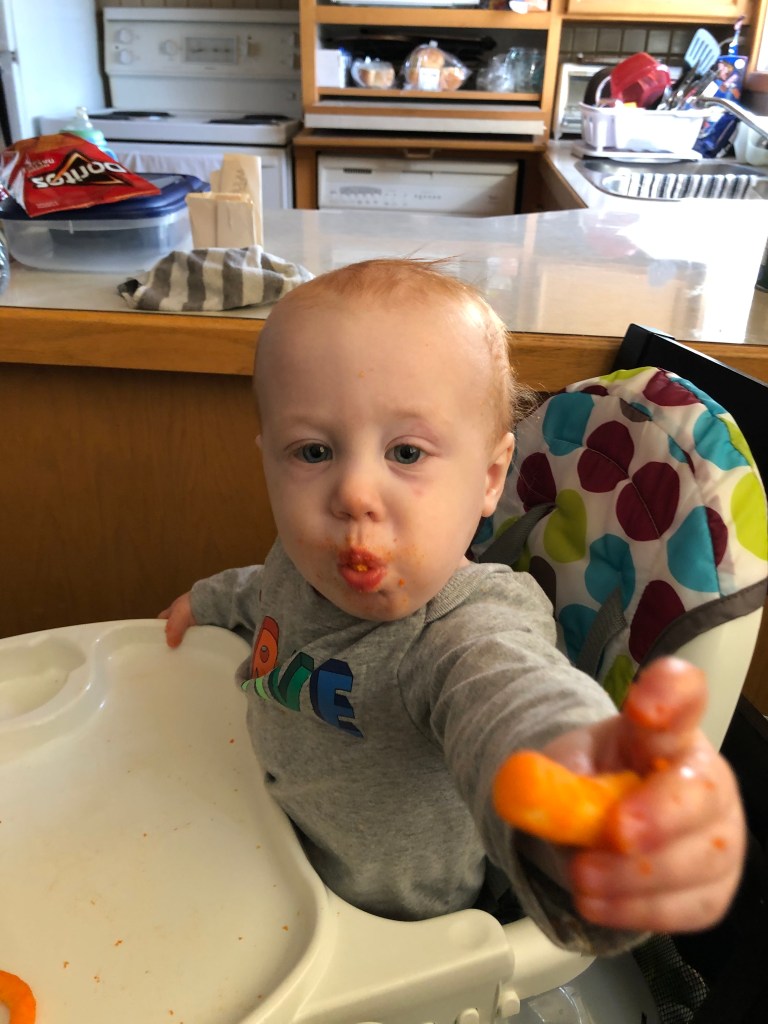
My 1-year old enjoying the spoils of Halloween
The concept of going door-to-door is a relatively recent one, tracing its roots to the early 1900’s when candy companies sought to cash in on the trend of trick-or-treating. According to an article posted by thekitchn.com, candy companies established a sort of “Candy Day,” which was usually observed on the second Saturday of October. This lasted until the 1970’s when the handing out of candy was seen as the most economic means of celebrating and the trick aspect mostly gave way to receiving the treat.
The term “trick or treat” first appeared in print in Canada in the late 1920’s. The idea behind the term was a subtle hint that if the homeowner didn’t provide a treat, a trick would be played through some form of mischief. Halloween, in fact, originally had nothing to do with going door-to-door for candy. This is a shiny aspect that was generously created by the candy companies in order to make money. And make money, they do!
But according to a detailed article posted by History.com, Halloween traces its origins to the Celtic festival of Samhain, when people would light bonfires and wear costumes to ward off ghosts. There’s obviously a bit more involved in it than that, but feel free to click the link to read the article for deeper details. Despite how long-winded my writing becomes, the purpose of this post isn’t actually a history lesson.
This year, my wife and I had a good conversation with our 5-year old and had him understand that due to the COVID-19 virus, that we wouldn’t be going door-to-door to trick-or-treat and rather, we would purchase a couple of boxes of treats and celebrate at home. We gorged ourselves on chips and candy bars (a great challenge for my pump, I might add) and our son was none the less enthused about Halloween as a result. It was a great alternative to exposing ourselves unnecessarily, and our kids still got to enjoy some Halloween candy.
Although this was a pretty simple and common-sense method of adhering to social distancing, we were somewhat surprised to see that some children still came to our door. We could have been grumps and refused to open the door but Nathan, in his generous nature, offered to share from his treat stash so that these kids would be able to partake as well. Many parents would argue that they have a right to allow their children to do as they please, especially on Halloween. I would assume those parents are also anti-vaxxers.
Yes, eventually we need to return to, or establish, some level of normalcy as everyone can’t live behind closed doors for the remainder of human history. But at the same time, there are some things that should be recognized as unnecessary in order to reduce risk of exposure. Getting groceries or picking up prescriptions are a necessity. Sending your kids out into the cold to intentionally interact with multiple households is not. Simply food for thought. Or rather, candy for thought… ☯
Having Type-1 Diabetes involves a lot of preparation and planning ahead. Even simple trips out of the house or a full 8-hour work shift requires good memory on my part, including blood testing equipment, fast-acting carbohydrates and extra equipment in the event my pump’s infusion set fails. It can be arduous, especially if you’re dashing out in a hurry. Light knows, I’ve had many times in my life were I’ve gotten to where I’m going and suddenly remembered, “Damn, I forgot to bring an insulin vial!”
For someone who isn’t QUITE as ancient as I am, and hasn’t had the opportunity to go through the ups and downs of Type-1, the task can seem daunting. What’s worse is that to some, the task can even be overwhelming or frightening, as some Type-1’s may believe that they face serious complications or death if they forget something, leading to self-isolation in the face of that belief. Although this is certainly a possibility, life for a Diabetic becomes much easier once you realize that it’s also the extreme. And a rare one, at that.
Essentially, almost everything you need for proper Diabetes therapy can be purchased over-the-counter. Even insulin. It’s been this way for years, and there’s even been a growing trend of Americans crossing the Canadian border to purchase insulin, as our prices seem to be significantly better than theirs. My point is that depending on one’s financial situation, running out of insulin is pretty much the worst thing that can happen, and even THAT has some solutions.
You can walk into any pharmacy and buy a vial of insulin without a prescription. That’s one of the nice things. Blood testing strips, lancets and devices for injecting insulin are all available over-the-counter, making for a certain level of safe comfort if you should happen to be travelling and forgot some of your supplies. Obviously, you’ll have to deal with retail cost if you don’t have a prescription or coverage. And pump supplies will usually cost you your first born, as well as a pint of your blood.
One good example would be my trip to New Brunswick in September of 2019. I was only there for a few days for a job interview. I was contacted by a different agency in New Brunswick and a second interview was scheduled for the following week. I now found myself in a situation where my pump supplies would run out, right around the time I’d be trying to board a plane home. I couldn’t chance it, so I walked into a local pharmacy and purchased a vial of Lantus, which I hadn’t used since getting on the pump. I had no issues walking into a pharmacy and simply buying the vial, out of pocket.
Because this is me, and life likes to see how much I can handle, there’s an aspect of over-the-counter purchases that tend to be a rather burly thorn in my posterior. In Canada, insulin is in the Schedule 2 drug class. This means that not only is it meant to be kept behind the counter and can’t be accessed without speaking to a pharmacist, they require your full profile in order to ascertain if you’re getting the “correct” insulin in the “correct” doses. As if the person buying the insulin WOULDN’T know that…
If you’re ever-so-slightly paranoid like I am, you’re not a fan of giving out your name, date of birth and home address to every random pharmacy that you may need to buy insulin from. And to be quite honest, one could argue that it should be their right to purchase an over-the-counter item without having to share a bunch of personal information. Right? Maybe? Or is that only me? It’s caused me some difficulty, in the past.
A few years ago, my wife and I had travelled to visit her parents. I ran out of Humalog towards the end of our trip, and I decided that rather than packing us up and heading home a couple of days early that I’d simply go purchase a bottle. I walked into the local Walmart and asked the pharmacist for a vial of Humalog. She then proceeded to start asking for all my personal info, which had never happened to me on previous attempts to purchase insulin.
I explained to her that I had no desire to provide my personal information as I didn’t live in the area and simply wanted to buy a vial of insulin. She made a big production in saying that she had no way to sell it to me without entering my information. I explained that I’ve managed pharmacies in the past, and since the insulin box has a barcode like every other item, all she needed to do was scan it and charge me the price. She refused service. I was taken aback. Rather that “Karen” out on her, I left and took my business elsewhere
Despite the fact that there can be obstacles, what did you notice from those two examples? The end result is that there were always options. And there always will be. In the first example, I had access to plenty of pharmacies and resources. Even in the second example, we could have simply driven home, which would have ultimately solved the crisis, had I not been able to secure insulin elsewhere. I used insulin as my examples because let’s agree that you can likely get by without testing your blood for a couple of days, if need be. You shouldn’t but it won’t cause the damage that being out of insulin will.
Over almost the past four decades of having Type-1 Diabetes, I’ve known doctors, lawyers, teachers, accountants, police officers, olympic athletes and even professional football players who have Type-1 Diabetes. The take-home lesson is that our condition doesn’t prevent us from enjoying any aspect of life that we may be seeking out. And it SHOULDN’T. Yes, there’s a lot to think about. Yes, there’s a lot you have to drag around. But none of that should prevent you from doing the things you want to do. You can’t let Diabetes force you to live in fear. ☯
It’s pretty safe to say that no one really knows what the future will bring. Given the increasing issues the world faces, that’s a pretty fair assumption. But as the world keeps turning, new obstacles and issues seem to pop up; sometimes expected, sometimes not. And this is where the book series I’m currently reading comes into play. I don’t usually make a point of reviewing things like books or movies, unless they directly relate to martial arts, Diabetes or Buddhism because, well… that’s the point of this blog. But this book trilogy relates, even if only after a fashion.
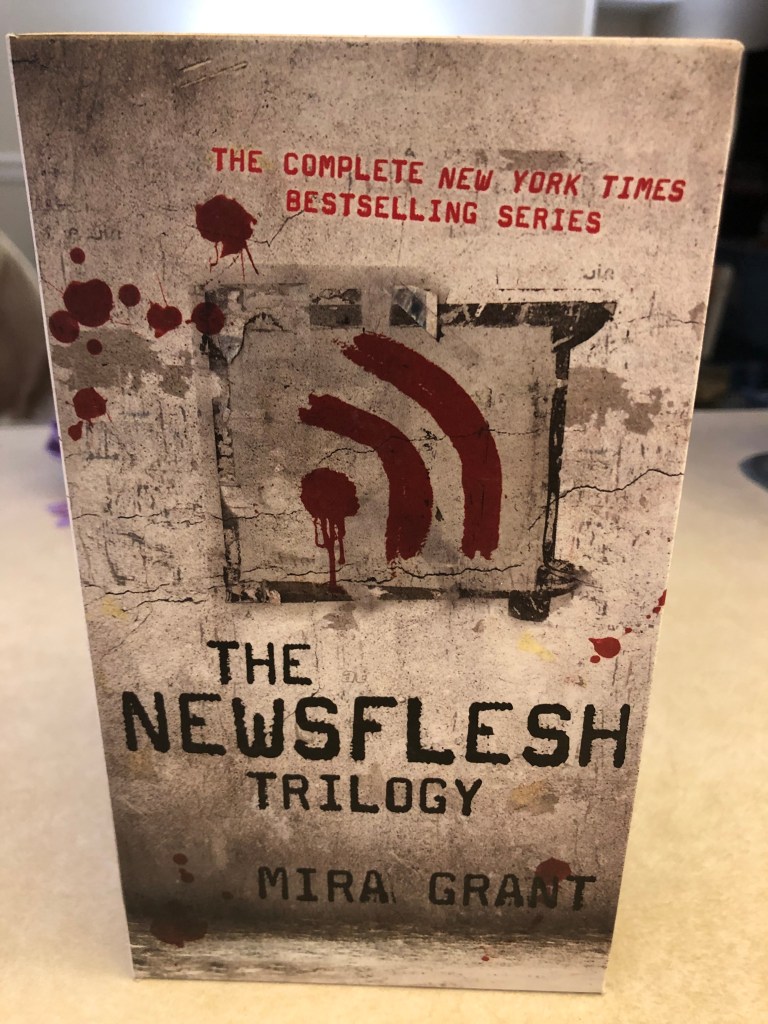
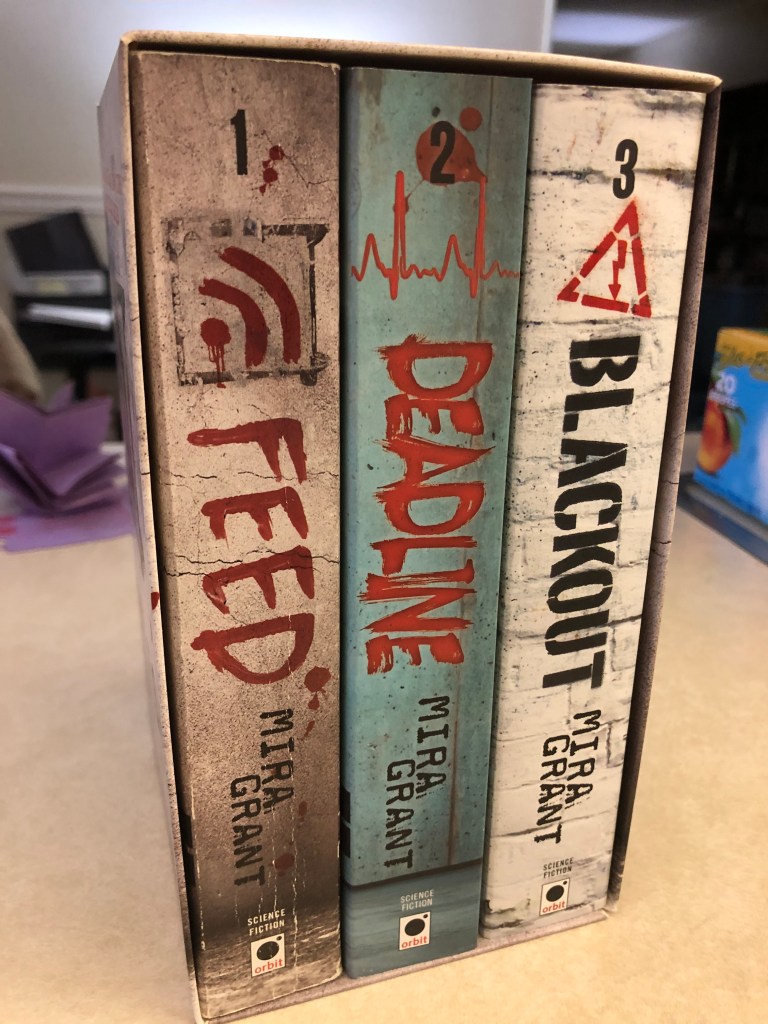
The Newsflesh Trilogy Boxset
I purchased this box set on a whim, while walking around my local Chapters book store (now universally known as Indigo). I was looking for something new to read, and the premise of this storyline looked interesting. Like many of the books I purchase, it’s been sitting on a shelf for the past few years as some of my “alpha choices,” (Star Wars, Star Trek, Wheel of Time and Jack Reacher books) have occupied what bit of time I have to flip through pages.
Although the first volume, entitled “Feed,” was released in 2010, I only bought the box set a few years later. I purchased the fourth and fifth follow-up books about two years ago and this has reminded me that I should get back to them. And in starting to read the first volume, I’ve gotten a bit of an eery look into what our future may potentially become…
Book 1, “Feed” is the one I’m currently reading
Set in the year 2040, Feed follows the story of a girl named Georgia Mason in a world where man-made viruses have combined to create a sort of super-virus that infects mammals and reanimates them in a sort of zombie form. Mason and her brother are bloggers, of all things, and are chosen to follow the presidential election during all the chaos. Online blogs have become the prominent form of media distribution, with the more traditional forms of journalism now defunct.
I don’t want to give anything of the story away, for anyone who may want to read the books. But as a blogger, I feel a certain sense of satisfaction from the idea that online blogging becomes recognized as the mainstream source for news and entertainment. And there’s no denying that having virus develop as a result of trying to cure something else also hits a little close to home, considering the current pandemic we face. In the books, our own cures are what perpetuated the virus and it’s no secret that many are currently trying to develop a cure for COVID-19.
The last bit of frightening irony is that the events in “Feed” take place in 2040, apparently twenty years after the emergence of said virus, which according to new math means that it all started happening in 2020. Just a little bit creepy, when you consider the book was released in 2010, long before COVID-19 was a thing. It gets one wondering if author Mira Grant (Seanan McGuire) had some strange, clairvoyant insight into what the future would bring. Who knows?
The two most recent additions to the series
Although the series has only been running for the past ten years, it’s already put out quite a number of books, but this is the main reading order:
Feed
Deadline
Blackout
Feedback
The fifth book I purchase, “Rise,” is a collection of eight short stories based on the NewsFlesh Series. If you enjoy post-apocalyptic zombie fiction, this series will definitely provide a fresh take on the concept. You can check out the Goodreads entry for a complete list of novels, novellas and compilations associated with the series. If you’re looking for an easy-to-read series to start, the NewsFlesh Series just may be for you. ☯
Most people are of the opinion that their medical history is private; something to be shared only with immediate family and medical practitioners. In most circumstances, this can make sense. After all, who needs to know the intimate details of your health condition and what the symptoms and problems associated with said condition may be? Honestly? Everyone. The correct answer is everyone.
I’m well beyond what can be considered conventional. Not only in matters of health, but with life in general. Unlike the previous paragraph, my personal policy has been full disclosure. Full disclosure with family. Full disclosure with friends. Definitely full disclosure with employers. Not only has this prevented a number of awkward questions throughout the years, it’s truthfully saved my life on a few occasions as well.
There’s always an exception to every rule. Even if it’s always been my personal policy, people who have been aware of my condition have gone out of their way to ignore it. I’m not talking about something straightforward like blaming my bad mood on high blood sugar. I’m referring to something more obvious and definite. this is where I’m reminded of my 11th grade French teacher…
During the 1994-95 school year, I was 17 years old and full of the same raging hormones and issues as any red-blooded teenager. Bad acne, oily skin and a singular focus on the female gender… oh, yeah! And Type-1 Diabetes! I was on two types of insulin, a fast-acting and long-acting, delivered by way of manual injection via insulin pens. I didn’t have the level of control that I have these days, especially since I was pretty much a morose, semi-goth kid who just didn’t give a shit.
I was in 11th grade French, trying to keep my eyes open during class. I likely SHOULD have recognized the symptoms, but my blood began to drop dramatically. Looking back on it now, knowing what I know, I can only assume that my initial dose of fast-acting insulin was too much for the amount of carbohydrates I had ingested at breakfast (if I had eaten any at all). I got dizzy and disoriented and wound up setting my head down on the desk and closing my eyes. I soon fell asleep at my desk.
Now I don’t know about you, but in most classrooms I’ve ever been in, teachers will take serious offence and wake any student they find passing out during their lectures. Despite the fact that teenagers have hormonal and growth imbalances that make them prone to falling asleep in class, teachers usually get pissed about it. It’s just human nature; I’d probably take offence if someone fell asleep during my lectures as well.
The point is, I was unconscious in class and my teacher was ignoring it. She knew I had Type-1 Diabetes and she also knew that I wasn’t the typical type of student who usually DID sleep in class. Common sense would dictate that she’d have assumed there was a problem. She should have halted her lecture and come over to check on me and see if there was a problem. But she didn’t. She let me be and continued on with her lesson. Bitch.
All the while, my blood kept dipping lower and lower, to the light knows how low of a level. When class was done and the lunch bell rang, one of my classmates walked over and shook me awake. He would be the one who would ultimately tell me that most people in class took notice of my passing out, but the teacher didn’t intervene. Given the nature of pack mentality, everyone figured that if the teacher didn’t care, why should they?
I staggered my way to the lunch line and got some food and made my way to a table, pretty much on autopilot. Once I had some carbohydrates floating into my system, I fell asleep in the cafeteria, from genuine exhaustion as opposed to low blood sugar. Dropping or climbing to extremes is incredibly tiring on the body. I missed the first period after lunch, until one of the cafeteria staff found me and roused me. I made the rest of my afternoon classes then walked home.
This gives you an idea of the kind of difficulties I’ve dealt with, even when I’ve TOLD the involved parties about my condition. Imagine the difficulties I’ve had with the people who have had no fuckin’ clue? This is why it’s SO important to get over your insecurities and share the specifics of your condition with the people around you. It could potentially save your life.
What would you prefer? Keeping your Diabetes history to yourself and private or providing others with information that under the right circumstance, could potentially save your life. Ultimately, the choice is up to you. But it’s definitely food for thought. Everyone nowadays is absolutely obsessed with their privacy. And with good reason, I think. But it stands to reason that there are some things that you shouldn’t keep to yourself; especially when it relates to your health and well-being. ☯
There are a lot of little details to remember when you have a condition such as Diabetes. For the most part, being 38 years into the experience has certainly created a level of “habit” or “routine” where I tend to do most things on auto-pilot on a daily basis. But then, there are the days where it feels like a wild, uncontrolled roller coaster that threatens to derail once you reach the top. There have been a number of times, even in recent years, where I’ve checked blood sugar levels and thought “What the fuck…?”
Picture this: I lay my head down to sleep one night. I wake up at about 3:00 am or thereabouts, to hit the washroom and check my glucose level via CGM. I’m reading at about 8.9 mmol/L, which in my world is perfectly satisfactory in order to continue sleeping through the night. I get back to bed and fall asleep quickly, without any issue (I’m just kidding, the no issue thing never happens). I wake up the next morning, rested and refreshed (also kidding, that DEFINITELY never happens) and test my blood sugar via finger prick before my auto mode asks for it.
Upon waking, I find myself at 7.5 mmol/L, which makes me exceptionally happy. A good, decent blood glucose to hit the ground running on a new day. In order to mitigate any potential upset, I toast a single english muffin that according to the packaging, is only 27 grams of carbohydrates. My insulin ratios are thought to be good, since they were recently checked by my endocrinologist, so I bolus accordingly. I get Nathan ready for school, load him up into the car and take him out. When I get back home, about an hour passes and I notice that I feel a little flush.
“It Is Possible To Commit No Mistakes And Still Lose. That Is Not A Weakness. That Is Life.”
– Captain Jean-Luc Picard, Star Trek: The Next Generation
I check my sensor glucose. Bam! 10.8 mmol/L! What the hell…? It’s only been an hour and I’m considering that maybe my “fast-acting” insulin isn’t working as fast as it could and this is simply the carbs from my muffin making my levels climb before the insulin brings them back down. I get pissy, because the elevated blood glucose affects my overall time in range. I give it another hour and notice that I feel fidgety and flush, and my blood sugar has now climbed to 15.2 mmol/L. I now take steps, as the pump’s auto mode apparently needs human intervention and the increasing level is making me angry, which will only go further towards increasing my blood sugar levels.
So what was the problem? Do I simply have poor control capabilities? I seriously doubt it. You don’t survive serious complications for almost four decades, if you have poor control. But the reality is that sometimes, no matter how hard you work at it, your Diabetic day just goes to shit. End of story. So, don’t be so hard on yourself. Give yourself a break. You can do everything right and still have things go wrong. That’s just another one of the charming issues with Type-1 Diabetes. ☯
Okay, I’ll be the first one to admit that maybe I need to lay off the YouTube for a while, because I personify the type of person who slips down the rabbit hole and finds way more than he expects to. Then I keep watching, and watching… And watching… But I found this video interesting, because it involves someone I’ve been watching on television over the past few months that I wasn’t even aware has Type-1 Diabetes! This catches me with a bit of egg on my face, because one of my biggest pet peeves is when someone tells me, “You don’t LOOK Diabetic…” What the fuck is someone “supposed” to look like if they have Diabetes?
The video depicts the Diabetes journey of American actress Mary Mouser, who has most recently played Samantha Larusso, the daughter to protagonist (depending on your perspective of the storyline) Daniel Larusso, in the popular web series, Cobra Kai. Now, being a long-time fan of the original Karate Kid movies, I jumped on this series without hesitation and watched both available seasons within days and am greatly anticipating the third season, which is said to be coming out in early 2021.
In the included YouTube video, Mouser describes her discovery of Type-1 and how it affected her life. She was diagnosed in 2009 at the age of 13, which I can say from having many friends in the same boat, is incredibly rough. I had the benefit of being diagnosed at the tender age of 4, which means I had barely a clue as to what the hell was going on. But you can see Mouser become visibly emotional at certain points in the video, and it definitely brings it home for me. Check it out:
Mouser talks about the tenth anniversary of her diagnosis and the video was posted on YouTube by Mouser herself, last year. I can’t help by note the similarities in the fact that although she’s only portraying it in a role, she plays a character who grew up in a karate environment. This rings true with a great deal of my own upbringing, as I grew up training in karate, as well.
I was diagnosed with Type-1 Diabetes in 1982, after passing out in a bowl of Froot Loops. Honestly. That’s what got me diagnosed. There were a number of symptoms that presented themselves for months before that incident, including weight fluctuations, severe mood swings and I even started wetting the bed again. One of the big problems with having a brother with Epilepsy, kidney failure and Fanconi Syndrome (a post for another day), is that my aches and pains often went ignored. Despite all of these symptoms, nothing appeared to be “seriously” wrong, so it was chalked up to growing pains or being a moody kid (which I was).
This wasn’t a slight on my parents’ part, it was simply the result of my brother constantly being on death’s doorstep where I was not. At least not that they knew of… Apparently, they were wrong. Imagine passing out on a Tuesday and waking up on a Wednesday… Of the following week! That’s how my journey started. And it was all downhill, from there.
When I woke from that first incident, I had severe Diabetic Ketoacidosis and my blood sugars were being slowly lowered and I was being rehydrated by way of an IV infusion. I had a number of family members present, including my parents, brother and grandparents. They already knew what the doctor hadn’t yet told me: I had Type-1 Diabetes. My life and my future were effectively changed, forever.
Over the two weeks that followed, I was taught a number of things including how to test my blood sugars, how to take insulin injections, dieting (which basically just involved avoiding sugar) and what would be involved in my day-to-day life for the rest of my life. It was hectic and stressful. I can admit that at the young age of 4, I only understood a small percentage of it. A lot of it went over my head, which created strange combination of indifference mixed with anxiety.
To my mother’s credit, she practiced injecting saline water into her own arms as opposed to practicing on an orange, which is what doctors and educators would provide, back in the day. Her perspective was that she wouldn’t allow anything to be done to her child that she hadn’t experienced herself. She bruised herself up pretty good, before starting to help me take my daily injections.
It was a disgustingly rough journey and over the years that followed, which included no less than 5 comas (the longest of which lasted almost two weeks), multiple changes in therapies and doctors and constant adjustments, I faced the inevitable lack in most of the advantages that kids my age enjoyed. I never joined sports, never had sleepovers and never enjoyed the usual social normalcies that kids my age had. But I adjusted and fought through all of it. My brother, who is now deceased, saved my life in almost every instance of the comas I mentioned, as he shared a room with me and would be the one to alert my parents that I was in distress.
In 1988, I faced a situation that no child should ever have to. I was told I was going to die. It wasn’t said in those exact words, but the reality sunk in regardless. Severe Diabetes complications including insulin resistance were causing my body to fail. Doctors really had no solution at the time, other than changing up my insulin type, which did absolutely nothing. Insulin resistance can be dangerous, since it prevents the proper use of glucose in your body.
That’s when I took matters into my own hands and joined karate. I started taking responsibility for my own diet and fitness and started to develop myself, physically. It worked for me. It may not work for everyone. But the important thing is to keep fighting and find what works for you. The nay-sayers over the years, have stated that they don’t believe that martial arts and fitness would help overcome medical complications. But the question is, how could it not? There may be no cure for Type-1 Diabetes, but you can still kick its ass. There are tons of ways to improve your health and stretch your life expectancy as opposed to what we faced, even 20 or 30 years ago. Keep fighting. Keep looking for a way.
And if Mary’s video inspired you or touched a chord, be sure to check her out on Cobra Kai, which is currently available on Netflix. There are only two seasons, with Season three coming out soon, but it’s definitely a hard-hitting show that covers martial arts, karate, the social condition and stars a lot of talented people from the 1980’s and modern day. ☯
I quote a lot of articles and posts in my blog. This is because I’m not a doctor, dietitian or fitness expert, although 32 years of intensive martial arts training HAS to count for something. But for the most part, I speak from the heart and try to be as genuine as possible while quoting sites and people that I know will add some credibility to what I say. Last weekend, I was free-falling down the YouTube rabbit one one night, since my wife was out of town and my 5-year old was fast asleep. And I found a video that moved me to tears…
Those who know me well are quite aware that I’m not a man who exudes emotion easily. But this man’s journey did it for me… The man in the video is named Vance Hinds. An assistant DA in Texas, he was living an extremely unhealthy life and weighed in at 475 pounds, which is over 265 pounds heavier than I’m currently sitting. Hinds was ironically first inspired to lose weight by a comedian named Burt Kreischer.
Although I don’t know why a comedian, of all people, would motivate someone to lose weight (I haven’t researched this person), Hinds reached out to a former professional wrestler named Diamond Dallas Page. I’m familiar with Page, having watched him wrestle throughout my 20’s and my early 30’s, and I know that he contributes a significant amount of time to helping other people achieve their weight-loss goals as a motivational coach.
I’m linking the YouTube video below. I don’t claim ownership, nor do I have any rights to this video. As I said, I just happened to land on it while surfing YouTube, one night. The video is only about 5:30 minutes and you can watch Hinds’ journey from 475 pounds to 277 pounds, for a total loss of 198 pounds. It’s pretty inspirational…
This motivates me. Here’s a guy that did it simply for the sake of improving his health and his overall lifestyle. No endorsements, no financially charged motivation; he did it for himself and his family. It brings my own journey into perspective. In 1988-89, I joined karate in order to help me overcome insulin resistance and Diabetes complications that threatened to end my life before my 20’s. I succeeded.
Now, as I move into my 40’s, I’ll admit that my own weight and living habits have fallen to the wayside. I’ve tried a number of different things to overcome these issues. And I believe that it’s important to try as many different things as possible; it allows us to find the path that’s right for us. But seeing Vance’s weight loss journey has made me realize that losing the 20 or 30 pounds I need in order to be healthier is small potatoes in comparison to what this man just went through.
When I attended the police academy in 2009, I weighed in at 185 pounds. By the time I graduated six months later, intensive training, exhaustion and diet brought me down to 165 pounds. It was the lightest I had ever weighed, at that point in my life. I’d like to say I felt great, but the exhaustion was palpable. Within two years of walking away from the academy, I broke the 200-pound threshold and I’ve been fighting to dip below it, ever since.
Obviously, Diabetes plays a significant role in how my metabolism functions and the weight I carry. That being said, I’ve seen Type-1’s who have been in the “skinny” category. Am I trying to be skinny? Fuck, no! I believe in carrying some mass, it’s one of the only way s to maintain strength. But I think that dropping some weight and finding a way to keep it off should be possible. In 2014, I was down in the low 190’s and that simply involved consistent cardio and weight workouts and a “reasonable” diet of three regulated meals a day.
Body image is an important part of who we are. You shouldn’t aspire to be who you see in magazines or on the internet, but rather who you feel you genuinely are. We can all gain inspiration from other people’s journey. The important part is finding a way to make it work for you, and to achieve the goals that you aspire to in order rot be healthy and happy. Hopefully, you all find that path. ☯




 The Blogging Buddhist