The home of Buddhism, Martial Arts, Diabetes and health…
Author: Shawn
I am a practitioner of the martial arts and student of the Buddhist faith. I have been a Type 1 Diabetic since I was 4 years old and have been fighting the uphill battle it includes ever since. I enjoy fitness and health and looking for new ways to improve both, as well as examining the many questions of life. Although I have no formal medical training, I have amassed a wealth of knowledge regarding health, Diabetes, martial arts as well as Buddhism and philosophy. My goal is to share this information with the world, and perhaps provide some sarcastic humour along the way. Welcome!
A lot of people, most people really, are pretty stoked that there are only a couple of weeks left to 2020. To be honest, I see no evidence that 2021 will be any better than this year was but it’s good to stay positive. It’s like I’ve always told my wife: enjoy and appreciate the positive aspects of where we are, because the next spot may be much, much worse… The same words can easily apply to the world’s transition from ’20 to ’21.
Before I get too morose and negative, this time of year also brings the holiday season along with it. The world has changed in the way that it does business. And before everyone jumps on the internet bandwagon to tell me that I can not only do all of my Christmas shopping online but have it delivered to my home, I’m well aware. But sometimes you can’t beat the feeling of being out and handling the items yourself before paying for them. In some instances, this is also the only way to guarantee that you’re getting what you planned on, and not some wrong-sized or incorrect item because of an error on the other end when ordering online.
I was out running errands about two weeks ago. As I had brought Nathan to his bus stop with the SUV (he’s pretty spoiled), I took off to go do some shopping and run errands right away at 8 a.m. I discovered something that really shouldn’t have surprised me. The stores I went to were basically empty. Since most people were gone to school or off to their workday, I pretty much had the aisles to myself. It was nice, because I was able to shop around and actually look at stuff, take my time and wander without worrying that I was holding up someone behind me. You know, since they’re supposed to keep six feet away.
I think we forget that frequenting retail locations (when necessary) during these “quiet” periods is an excellent way to run your errands and get the stuff you need while managing to social distance the way everyone should. Plus, the peace and quiet that accompanies said shopping is a great way to let your mind float and start your day. No long-winded post with heavy explanations today. I just thought it was neat and that I should share. Stay safe! ☯
Freedom can mean different things to most people. For some, it means “financial” freedom, whereas one has enough money in the bank to be clear of debts and not require employment to survive. For others, it’s simply NOT being locked up or imprisoned. But in general, it means having the ability to act, speak or think without constraint. It’s being able to go where you want, when you want and do what you want. And I think that we can agree that the vast majority of people who live in North America have that freedom, to varying degrees.
I don’t think I really need to point out that 2020 has been an absolute shit show for the entire world. In fact, some would argue (myself included) that COVID-19 has acted as an ultimate equalizer, since the virus does not discriminate and can be contracted by anyone of any age, race or gender. But we’ve seen a wider variety of people catch the virus than we would have originally thought possible at the beginning, including politicians, celebrities and the elderly. And the effect is that many if not most people feel and are of the opinion that they are losing their freedoms.
It’s been an increasingly stressful time, especially for those who are separated from those they love. One good example is my mother, with whom I speak to on a weekly basis. Yes, yes, I’m a momma’s boy and call my mother often. I’m also an only child, and father to her only grandchildren. So keeping a positive connection is important, one way or another. My father currently resides in a nursing home, where he’s been for about ten years. He voluntarily placed himself there after it became clear that my mother didn’t have the physical capacity to take care of a 330-pound man in a wheelchair.
For the most part they’ve been able to make it work, with my mother renting a small bachelor’s apartment next door to the nursing home and being with him everyday. Then, along came COVID-19. My father’s nursing home has been locked down ever since, despite the fact that many others in the Province of New Brunswick have reopened their doors (intermittently, depending on the status of their cases). This is an affront to my mother, who compares my father’s residence at the home and her inability to see him to being locked up in a prison.
I may have a bit of a jaded and subjective point of view, but I don’t know many prisons that have hardwood floors, picture windows with a view of the bay and serve customized meals, three days a week. But that’s just me. The sick and elderly are among the most vulnerable, and the choice to keep the care home’s doors closed to the public is a clear result of not wanting to potentially spread the virus to every resident there. The irony is that my mother COULD visit my father. The care home is allowing immediate family to visit on an appointment basis, with restrictions in place allowing for no longer than thirty minutes and requiring social distancing during the visit.
One would think that this would be good news. I would consider it so, since I’m on the other side of the country and can’t see my parents regardless of conditions. But my mother refuses to visit my father in this fashion, feeling that they don’t pay the money that they do to be kept separated from one another. It doesn’t matter that no individual has the right to make the choice for other residents and potentially introduce the virus into their environment. She simply refuses to take advantage of what’s offered because it isn’t what she wants.
Don’t get me wrong, I love my parents and I’m simply using them as the most familiar example I can use. But the point is that when this whole mess started, we all foolishly thought the world was grinding to a halt for 30 to 90 days and then things would go back to normal. Oh, how wrong we were! 9 months later, we’re still dealing with restrictions, imposed mandates and the constant yo-yoing on local and Federal governing agencies opening things up then taking them away again as soon as an outbreak happens.
What’s been the most disheartening, is people’s reaction to doing what’s necessary. A blanket attitude of basically not giving a shit has gripped society by the gonads and seems to be keeping a firm hold. People still balk at the very notion of wearing a face mask. I’ve fallen down many a YouTube hole where people have claimed and tried to get out of wearing masks in public places because of medical conditions, despite health professionals publicly declaring that the only conditions that would make wearing a mask impossible would be so severe that the patient wouldn’t be out and about. Customer limits and home school requirements, social distancing and the inevitable folding of privately owned businesses… I wasn’t kidding when I said that 2020 has been a shit show.
The problem is that people hate to be told what to do. You can take a family that’s financially poor, struggles to make rent and has to swallow their pride and accept charity, access food banks and hand-me-down clothing and they’ll do what’s necessary. But tell them they must lawfully wear a face mask while during their weekly Walmart run and all hell breaks loose. Like I said, COVID-19 has been, among other things, the great equalizer.
For my family, it hasn’t changed a great deal of much. My employer has had me at home for almost two years now and my wife works from home. The only significant change was this week, when my son began remote learning due to an outbreak in our local schools. My wife and I weren’t happy about the change, but we complied and adapted as it was necessary to continue my son’s education. But otherwise, the bills get paid, there’s food on the table and we’re taking advantage of being able to spend so much time together.
For those who chose to complain about the government, mask and isolation requirements, consider the following OBVIOUS facts: If this were all a conspiracy on behalf of the government, I’m sure they would chose a much better method of control than making someone wear a paper-thin mask on their face. Things may seem bleak now, but it will only be through the passing of this virus that any of us can hope to experience a normal life again. ☯
Help Me To Keep This Permanent!
My content may be free and I absolutely love providing it, but my time is not! I’m trying to make a go of it as a full time writer but obviously, everyone needs to get paid for the time they put in. Your donation to this blog can mean the difference between seeing daily content or wondering “whatever happened to The Blogging Buddhist.” Help me keep this permanent. Any small donation helps and will not go unappreciated.
No, I’m not being lewd or dirty-minded. I’m referring to something world-renowned but often disputed in martial arts circles. I’m talking about Bruce Lee’s one-inch punch. Depending on what circles you walk with, you may have grown up in the 70’s and 80’s watching movies such as Enter the Dragon, Fist of Fury and Game of Death. I loved those movies and spent my childhood throwing out my forefist, pretending I WAS Bruce Lee.
Lee is well-known for his fighting prowess, even to those who don’t travel in martial arts circles. And one of his best known techniques, famous even by today’s standards, is his one-inch punch. People are always quick to associate this technique to Lee, despite the fact that the one-inch punch is well-known in many traditional styles of Chinese martial arts. So the question is: does the one-inch punch actually work?
As you can see from the included YouTube clip, Lee is shown as able to impact a target from only an inch away, hence the name of the technique. The strike then sends a fully grown male staggering back into the waiting chair and sends him sliding back several inches while seated. The thing I like about this clip is that they show it in slow motion, allowing a trained martial artist to see exactly what may be going on when Lee executes the technique.
According to an article posted by Popular Mechanics, “[…] you first have to understand how Bruce Lee delivers the blow. Although Lee’s fist travels a tiny distance in mere milliseconds, the punch is an intricate full-body movement.” The article goes on to quote Jessica Rose, a Stanford University biomechanics engineer who points out that Lee’s technique starts with his legs. And that’s quite accurate. If you watch the video closely, you notice that Lee starts by carefully setting himself up and lining his entire body. This is followed by the explosive straightening of the knees, swivel to the hips, turning of the shoulders and straightening of the arm to deliver the punch.
It’s a matter of simple physiques. After all, Newton’s second law of motion tells us that Force equals the mass of an object multiplied by its total acceleration. So despite Lee’s average stature and slim musculature, the faster the fist travels, the bigger the expelled force once it impacts against its target. And all the individual components (legs, hips, torso, shoulders, arms) add to the total acceleration of Lee’s fist, prior to impact. This means that not only is the one-inch punch possible, it’s easily explainable with high school physics. Who knew?
It all comes down to proper bone alignment and velocity. That’s what makes it happen. Even in Uechi Ryu Karate, we train with a specific technique where we perform a structured, uppercut punch to the floating rib that looks suspiciously like a bastardization of the one-inch punch. We execute the technique by forcing from the thigh and hip, allowing all the major muscle groups to lend force to the fist, which is usually braced to the hip at the elbow. It’s effective and debilitating to one’s opponent.
This isn’t to mean that just anyone can do it. It actually takes years of training and precision to develop the technique in such a way that it can be effective in an actual fight. Even if it looks like the fist is only travelling an inch in distance, all the necessary parts require a whole lot of coordination. And even then, I wouldn’t use it. Gross motor function is always preferable over fine motor skill when it comes to a fight. If you have to take the time to line up your attack before you do it, it’s already too late.
It’s important not to believe everything you see in the movies. Especially martial arts movies, where the techniques and fights are grossly exaggerated. But as far as my personal jury goes, Lee is the genuine article and his one-inch punch is very real. It takes a lot of training and skill to properly execute it, but it’s real. At the risk of once again sounding lewd, for some people, one inch is enough. ☯
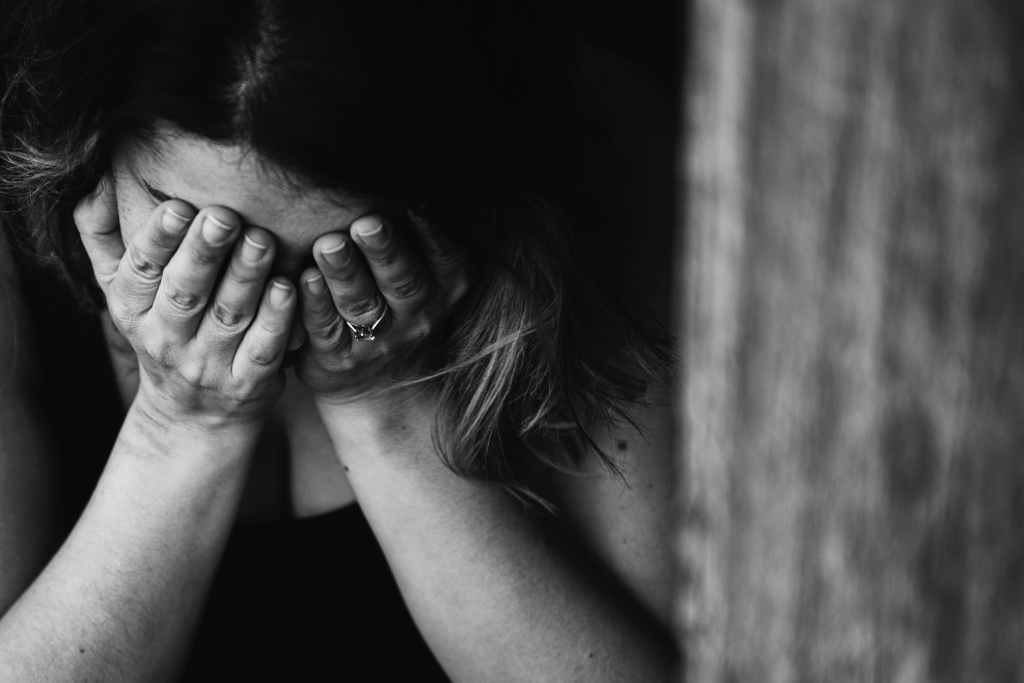
Taking proper care of yourself is one of life’s top priorities. This is true for any person, but especially true for someone suffering from Type-1 Diabetes. Although you can certainly find medical practitioners to help you navigate the complicated labyrinth of medications, treatments and methodologies required to properly balance your Diabetes, the ownership of your care ultimately falls to you. And even when people are fully aware of this, they very rarely recognize and acknowledge it.
In order to be healthy, you need to be happy. In order to be happy, you need to be healthy. As Sensei would say, these two go hand-in-hand and it’s very difficult to truly have one without the other. Over the years, I’ve found myself sacrificing my wellbeing for the betterment of others, often going as far as damaging my health, exhausting myself and/or making myself sick. Although sometimes duty, honour and obligation requires it, it’s pretty difficult helping others if you first don’t help yourself.
So what does self-care look like? I don’t necessarily mean taking your medications or frequently testing your blood, although these are every important. I mean the self-care that includes one’s mental wellbeing as well as the physical. For example, did you know that if you’re tired in the middle of the day and decide you want a nap, you really don’t need to explain yourself to anyone? (Unless you’re at work, in which case I don’t recommend trying it. And if you do, please don’t name drop me…)
In order to illustrate my point I’ll provide two examples from my personal life, which took place some years ago. The first is work. I don’t think I need to to explain that work is a necessary part of modern life. Unless you happen to have been born into a wealthy family, most of us are forced to punch a clock and usually contribute somewhere in the range of 2,100 hours a year to help line someone else’s pocket. When I used to work for a certain popular franchise, who shall remain nameless for liability reasons, I let myself fall victim to my attempts at being an all-star.
Although not always the case, most employers are not only more than happy when an employee goes above and beyond, they come to expect it without any form of additional remuneration or praise. If you happen to be a prospective go-getter, this plays havoc with your health. This was me, up until a little over a decade ago. I would never miss a shift, driving in dangerous, inclement weather, going in to work when I felt ill and even going as far as passing out twice on the job, to be brought to the hospital for diagnosis, only to return the next day.
Despite the fact I was in management (and in light of that fact), it really gave me no benefit to be sacrificing myself this way. I ignored critically low blood sugars, worked through bleeding polyps and even did the work of two people when I was short and couldn’t replace them. And it wasn’t until I finally put my foot down and tried to call in sick that I got the ever-popular retort from my boss. I’m sure you’ve all experienced it; it was a dialogue that went a little something like this:
ME: “I won’t be coming in today. I’ve been ill all morning…” BOSS: “Well, just how sick are you? I need you for tonight’s shift.” ME: “Sick enough that I don’t feel I should be coming in to work…” (Bearing in mind that Canadian Labour laws take a dim view of an employer asking about ANY medical condition, my answer was more accommodation than was required) BOSS: “Alright, fine. I’ll see if I can replace your shift. I’ll call you and let you know.” ME: “Let me know what?” BOSS: “Whether I can replace your shift or not!” ME: “Why do I need to know that?” BOSS: “Because if I can’t replace your shift, I need you to come in…” ME: “Maybe I’m not being clear. I’m calling in sick. I won’t be in tonight.” BOSS: “Well, if you’re going to be like that, you’ll have to bring me a doctor’s note.” (Also against the Labour Code) ME: “I’m not going to a hospital! I just need to get some rest and I’ll probably feel better tomorrow. THAT part, I will let you know…” BOSS: “If you aren’t sick enough to go to the hospital or see a doctor, then you aren’t sick enough to miss your shift.” (Also not a permissible statement, unless you HAPPEN to have “M.D.” after your name, but what do I know)
Any of my readers or followers from back home can probably guess at what employer this was and would likely be nodding their heads furiously right now. But given my propensity for picking my battles, I would foolishly go into work despite feeling like absolute shit. I can’t tell you the number of times I’ve worked through a shift with frequent trips to the washroom where I would accommodate either end of my anatomy (Enjoy getting THAT image out of your head). Was it worth it? Definitely not. It didn’t result in a pay increase or any advancement to my career. All it did was cause damage to an already damaged body. Not smart, on my part.
The next story is about relationships. For the most part, relationships on their own can be rough and challenging waters to navigate, especially when dealing with someone who has little concern or understanding for your wellbeing. This brings me back to my earlier comment about napping. You all know that I’m a big fan of napping, but for this story, I’m referring to the need for actual sleep.
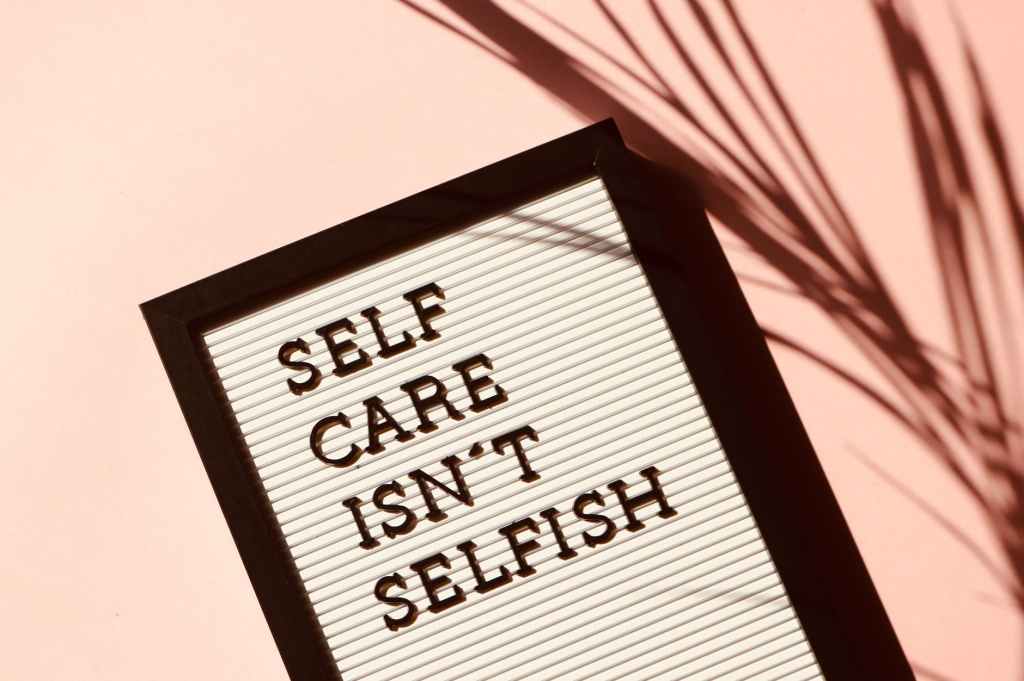
You see, as an adult, there really isn’t any reason why you should have to explain yourself, should you decide you’re tired and want to go to bed. Tired means tired, and is about the farthest thing from selfish that I can think of; next to needing rest from illness. But this was something of an alien concept to the woman I will identify simply as “Ex” (my ex-wife).
Ex had a nice, cushy daytime job, 9 to 5, Monday to Friday. I worked shift work, which often included overnights. This is not to say that she didn’t work hard AT her job, the issue mostly arose from her time at home. The scenario would involve working overnight and getting off work at 6 a.m. By the time I’d get home, it would be closer to 7 a.m. and I would sneak carefully into bed as to not wake Ex. But one’s circadian rhythm can be a bitch, and she’d often wake up less than an hour later, despite being on a day off.
Now, one would be inclined to think that any reasonable person would understand that someone who’s worked throughout the night would need more than an hour or two’s sleep. Not Ex. She’d wake me shortly after she’d have breakfast in order to “get the day started.” When I’d argue that I needed a solid period of proper sleep because I had to work overnight again that night, it would be met with argument, including but not limited to the fact that I “was not to waste her entire day off sleeping.” Nice, eh? There’s a reason WHY she’s an ex.
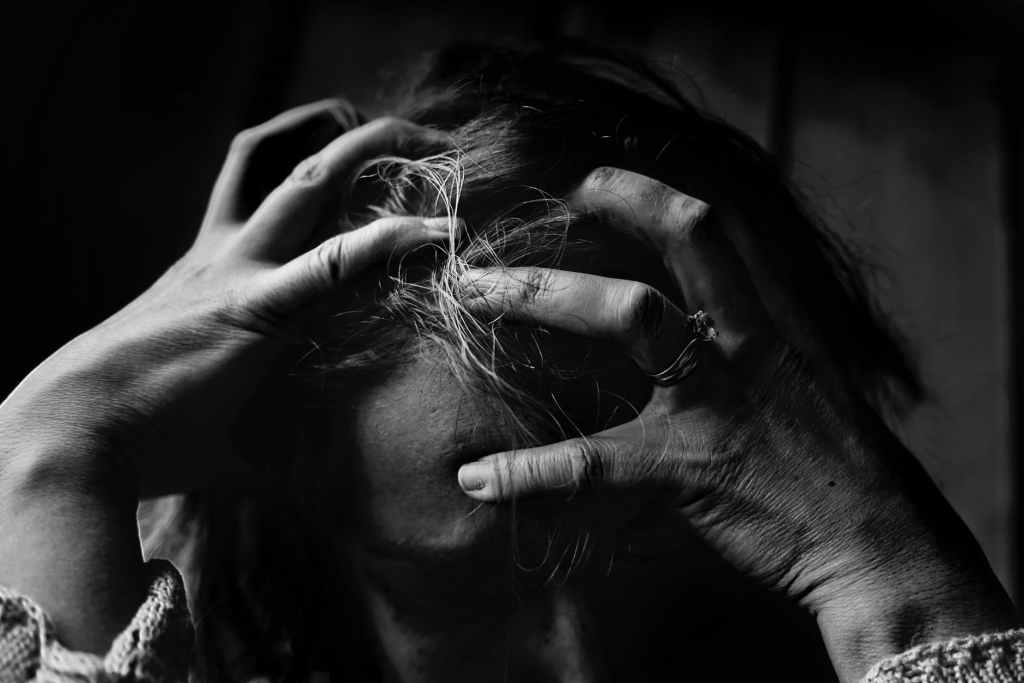
I’ve provided both these scenarios, not because I wanted to complain about these two negative aspects of years past (despite the fact that venting about it was kind of nice), but to point out that both these scenarios wreaked havoc on my health, my blood sugar levels and even my mental wellbeing. The stress and anxiety associated with always having to explain yourself for things that should be an understandable requirement of physiological survival can have permanent repercussions on your sense of self-worth, value and confidence.
That’s why it’s important to take time for yourself and do things that are uniquely for yourself. Have that nap. Run out to grab a coffee. Take an hour a day to meditate or work out. None of that makes you selfish, it simply guarantees that you’ll be in a better state of health and a better state of mind to help take care of the daily grind, whether that includes family, work or whatever. And should you encounter an obstacle in your life that prevents your self-care, whether work or personal, that makes them a cancerous cyst that you need to down a shot of whiskey and quickly slice off in one quick swipe. You’ll be all the better for it. Surround yourself with people who will not only accept your needs, but will encourage them, as well. I know I did. ☯
Depending on the style of martial art that you study, the way you develop your strikes can be integral to a solid progression towards your goals. Personally, I have always had an issue with things like brick and/or board breaking, because I’ve always seen it as a futile exercise meant only to show off or demonstrate one’s prowess in breaking through an object that’s been set up to yield. For example, my Sensei’s school of karate never involved board breaking in class. If it ever did, it predates the time I joined.
“Boards Don’t Hit Back!”
– Bruce Lee, Enter The Dragon (1973)
But while I’ve never been a fan of breaking, it can lend some specific benefits to the traditional martial artist. Other than scaring your mother’s new boyfriend into submission, that is. The first point that I’ll bring up is unfortunately a negative one. The boards and bricks that are typically used for breaking are special, in that they have a thickness and composition that makes them ideal for breaking. The boards are usually thin, about 3/4″ thick, and cut with the grain to allow an easy break.
The bricks are usually thinner than you’d usually see for any practical building application as well, and are stacked in such a way that there is usually a minuscule gap of air between each one. This is where physics comes in. So long as you strike the brick properly, The strength and force of your fist will be assisted by gravity and help to break every subsequent brick. This is where the positive point comes in. You’ll notice I specified that you need to strike the brick “properly.” That’s where the big difference comes in…
From a martial arts perspective, if you walk into a dojo on Day 1 and try to punch through a board, you risk spraining and/or damaging your wrist, tendons, muscle tissue and potentially fracturing fingers or knuckles. It takes a reasonable period of training and developing one’s striking techniques before you can properly apply them against a hard surface like a board or a brick. And even then, the amount of focus required to strike safely and keep from injuring yourself is paramount.
“Very Good. But Brick Don’t Hit Back.”
– Bolo Yeung, Bloodsport (1988)
As I mentioned in the opening, the value of breaking is not a universally shared aspect among all styles. Most traditional Okinawan martial arts styles, such as karate, don’t lend much value to breaking, although some of our hand-strengthening methods are just as brutal, if not worse. And any style that focuses primarily on weapons or grappling won’t give breaking a second (or first) thought. But some “high-flying” styles, such as Tae Kwon Do, take breaking to a whole other level.
You can see senior belts breaking boards after flowering spin kicks, or boards held high above head level. While these types of breaks look spectacular to spectators, they lend little (if any) value in an actual fight situation. That being said, the precision, speed and skill required to pull off those techniques, even if they’re only worthy of demonstration, is beyond MY skill. So I can’t help but feel a little impressed by them, despite their worthlessness.
The bottom line is that as I explained in my previous post Making An Impact, training in the martial arts for any sort of long-term period will eventually require you to hit something. Whether it’s air, wood or fire, allowing your strikes to impact a surface is an important part of learning to strike properly. I’ve always been a bigger fan of pads or bags, because you can work on your precision, strength and speed without the risk of injury associated with striking a board or brick. That, and I don’t feel the need to convince others of my skill by smashing inanimate objects in front of them. But I digress.
As far as the jury ruling on breaking, the pros would include the development of strength, accuracy and getting those knuckles calloused up for proper striking. Don’t even get me started on using a knife hand on something like a brick. I wouldn’t even use a knife hand against an opponent, unless I was striking soft tissue or cartilage. There’s too much risk of breaking fingers, which would render them useless if the fight isn’t over or you face multiple opponents.
The cons would include junior students attempting to break before gaining the experience required, resulting in injury. It’s also an effectively useless display, since you need to clean up and replace every board and brick you break. There are no such issues while using a punching bag. Another con is the fact that some schools require breaking as a part of belt grading, which can be an issue if you have all the skills and precision to respectfully earn the belt. Would breaking bricks have made me a more effective black belt? I don’t think so, although I believe some would disagree.
At the end of the day, this is simply another aspect of the martial arts that has evolved as a means of impressing others as opposed to the use of skill for the betterment of oneself or the style. Much like competition, it’s been around for a long time and isn’t in any danger of disappearing any time soon. But should you find yourself starting the martial arts and join a school that maintains the practice, bear in mind the aspects I’ve written. And try not to break your fingers… ☯
Anyone who is a regular reader of my blog knows that I’m totally being sarcastic with that title. I’ve written a handful of blog posts about proper sleep, rest and napping. And it’s something I can’t stress enough. I’m no stranger to lack of sleep, between PTSD, Diabetes and its various symptoms and the regular stresses of life making my nights shorter than they should be. But there can be a number of common reasons as to why the Sandman’s dust fell off your face early. And here are just a few…
First of all, I should point out that all the reading I’ve done on the topic has shown that most scientists are uncertain as to the WHY of sleep, with its purpose being mainly unknown. That being said, there’s a lot of evidence on the WHAT that takes place while we sleep. According to an article by HealthLine.com, one of my favourite websites, sleep allows for certain biological functions, such as cell and energy restoration, elimination of toxic waste and a bunch of aspects related to improving memories. from a Diabetes standpoint, the article also includes that sleep can help prevent insulin resistance.
Now that I’ve gotten the specifics out of the way, let’s talk about some of these reasons I mentioned in the opening paragraph. Since this is a list combining my own reasons as well as some from outside sources, I’ll link my references below for those who wish to do some further reading. Here we go:
Bad Bedtime Routine: This is a pretty basic one, but it’s surprising how many people have a terrible routine at bedtime that simply doesn’t allow them to fall asleep nicely. Bedtime should (work permitting) be around the same time every night, with a process that’s familiar to your body and allows it to recognize that sleep is forthcoming. Changing into sleepwear, brushing your teeth and ensuring a quiet environment, are good steps to prepare yourself for a good night’s sleep;
Still Plugged In: This refers to our wonderful smart devices. If you have the habit of checking social media or gaming when your head hits the pillow, it may have a measurable impact on how well you sleep. A backlit screen can interrupt your body’s production of Melatonin, which is a hormone your body starts to produce late in the day, signalling that bedtime is coming. I’m guilty of this one, as I need some noise in the background to fall asleep or my frayed nerves will jump for every bump and creek that I hear within and without the house. But if you’re not as paranoid as I am, try reading a book instead. Really, any alternative that doesn’t involve a lit screen in your eyes would be preferable;
Getting Drunk: Hey, I have a deep-rooted love for wine, so I can’t say a great deal about this one. But most of us have been here at one time or another. You’re out at a party or a social gathering and you have a couple of drinks too many, which inevitably allows you to unceremoniously black out once your head hits the pillow. But this kind of sleep is usually of diminished quality. Although alcohol may help you fall asleep and sleep deeply, it also disrupts your REM cycle, which is necessary for a restorative sleep. Not to mention that you’re taxing your body’s liver to process the alcohol while it should be doing other things;
Medical Conditions: Obviously, I know a thing or two about this one. Having Type-1 Diabetes will cause all sorts of havoc on getting a good night’s rest. Fluctuating blood sugars, Restless Leg Syndrome and an annoying insulin pump that insists on beeping and/or vibrating for every little thing can make for a choppy night. There are a variety of other conditions that can make it hard to sleep well, including depression, Narcolepsy and bodily injury that causes pain;
Diet and Exercise: Ah, my favourite go-to… It stands to reason that proper exercise will help you to fall asleep and get better rest. There are so many reasons behind this that I’ll just let y’all research this part yourself. I’m sure I ramble on enough without making it worse. But diet plays an important role as well. If you eat something that you have an intolerance for, causes heartburn or indigestion or that has spoiled, you may find yourself running to the washroom and spending half the night up;
Stress: This is the big one, and among the most common. How often have you let your head hit the pillow to suddenly start thinking about the big project at work? Or how you’ll manage to pay that bill that just came in? Or whether the person you swiped on tinder was ACTUALLY of the gender you’re seeking? Stress can play hell on your ability to sleep and can even lead to measurable physiological effects on the body. This is where calming exercises and meditation can be of definite advantage.
Sleep can be fleeting, but the take-home to all of this is to eat and exercise properly, have a structure bedtime routine and ensure a cool, dark, quiet environment to sleep in. Experts say that sleep should come easily and that if you haven’t managed to fall asleep after about 15 minutes, you should leave the bedroom and do something else; reading, meditating, etc before trying again. Rest well, my friends. ☯
The past couple of years have been particularly hard on my family and I, with work difficulties wreaking havoc on our future, my family living on the other side of the country and my father almost passing away a few months ago. My father has been suffering for years, and he feels that his passing would be a relief, but what would be particularly tragic is the fact that I would be unable to be there for my family due to the pandemic, should it happen. That, and the fact that he’s never met his second grandson, Alexander.
That’s why in the midst of all the pain and difficulties, it’s important to be happy. People walk through life, often aware that they aren’t happy but do nothing about it. An important lesson of life that people tend to forget about is the fact that happiness is a practice, not a given. It won’t happen on its own, it’s something you have to take active steps in order to achieve.
Now, I could blabber on about my usual go-to’s, how exercising regularly, maintaining a healthy diet and working on personal goals will all help to promote happiness. And these things are all true, don’t get me wrong. Keeping your fitness levels up releases a whole mess of crap inside your body that will make you feel good on its own. Getting a full night’s sleep and being well-rested will also be of great help. But ultimately, you should be trying to do one little thing that makes you smile, every day.
Personally, since I’m a YouTube addict, I’ll usually try to watch a motivational or inspirational video every morning. My thinking is that if I can start my day by seeing something positive, it will tip the scale and arm me with the positivity I need in order to tackle the negativity of the day I may face. This doesn’t always work, but for the most part, I’m successful in putting a grin on my face. This morning for example, I watched a video posted by a YouTube channel called “The Dodo” of an obese dog losing half its body weight to become healthier. It’s a small thing, took only a few moments of my time and made me smile. I’ll link it below:
Sometimes I’ll do something as simple as sit there and watch my 1-year old (who doesn’t quite walk yet) stand on his own two feet for a full minute because he’s so occupied with the toy he’s holding that he doesn’t realize what he’s doing. Then he notices he’s standing and suddenly can’t maintain balance and flops down onto his rump. Heartwarming and entertaining. Other days, it’s as simple as watching two squirrels frolicking on the tree outside my kitchen window while doing dishes.
My point is that there is still plenty of reason to smile, one simply needs to look for it. And with the current state of the world and one’s personal circumstances, it becomes important to work diligently at one’s own happiness. It won’t happen on its own. And you’ll come to find that when you’re happy and in a good mood, others around you may be a little brighter as well. Happiness can be contagious. But it’s a practice, not a given. ☯
I like to think that one is never too old to learn something new. The prospect of being unable to “teach an old dog new tricks” is something of a myth, as is the concept I’ll be speaking about today. I’ve spent decades believing this was actually a thing, and incorporating it in many, if not most of my workouts. I’m referring to a term known as “muscle confusion.” The term, which is arguably not a scientific one, describes the act of changing up your workout routine frequently in order to “confuse” your muscles in order to prevent hitting a plateau.
But how effective is it? I’ll admit that I’m a really big fan of variety in one’s workouts, if for no other reason than to keep things interesting. But if I’m training in something, I’ll keep at it until I master it. A decent article posted by Men’s Journal explained it best by saying, “One big problem with the muscle confusion principle is that you don’t spend enough time working on an exercise to really master it. It’s like training to ride a bike one day, then a skateboard the next, and then rollerblading after that. Your skills on the bike aren’t really going to get better.”
Traditional karate is really big on repetition in order to master movements, techniques and fitness methods. As Ziad K. Abdelnour once said, “Don’t practice until you get it right. Practice until you can’t get it wrong…ever.” So there’s heavy importance in doing things properly. But I would be lying if I said that we often have tons of material and new techniques piled on at the same time. But the way to prevent or get past hitting a plateau is simple: increase your weights, increase your time and push yourself harder.
An article I just read by HealthLine.com states that the theory of muscle confusion is just a myth, created to help propagate popular fitness programs. The article goes on to say that muscle confusion is hype when compared to other fitness theories that are grounded in science. I highly recommend reading the article; it has some really good information.
So despite the fact that I’ve been on board the muscle confusion train for years, every reputable source that I’ve found seems to agree that it’s a myth and the better method is to remain consistent. At the end of the day, there’s nothing wrong with changing up your routine. It’s especially important to experience new fitness routines and programs, if for no other reason than to keep things interesting and have some fun. Your chances of reaching your fitness goals will increase exponentially if you enjoy what you do. ☯
It’s no secret that people have been enjoying the added opportunity to partake in, shall we say, “adult beverages” during this whole pandemic thing. I’ve jumped on that bandwagon myself, allowing my repressed inner teenager who never got to enjoy a drunken evening out with friends in his youth to indulge a bit as I generally have nowhere to go, nothing to do and no reason to worry, should I find myself a touch over the legal limit.
So acceptable has become the hobby of enjoying a daytime drunk, that most Provincial governments have elected not to close licensed premises for fear that the alcohol withdrawals will cause an overabundance of strain on the health care system. And this is probably accurate, if we’re being true and honest. But I’m not here to discuss the pros and cons of alcohol consumption or its continued sale throughout the pandemic. I’d here to focus on the consumption of alcohol for someone who has Diabetes. Of any type.
First and foremost, I’d like to point out that every person is different, as is their management of Diabetes. Everyone’s journey is unique, despite the condition being similar. Some of this will apply to all the types and subtypes of Diabetes, with some only applying to specific ones. For example, should you have Gestational Diabetes, I pray to the Light that you aren’t consuming alcohol. But that’s a totally separate issue. Since I’m Type-1, that’s the one I’ll mostly be focusing on.
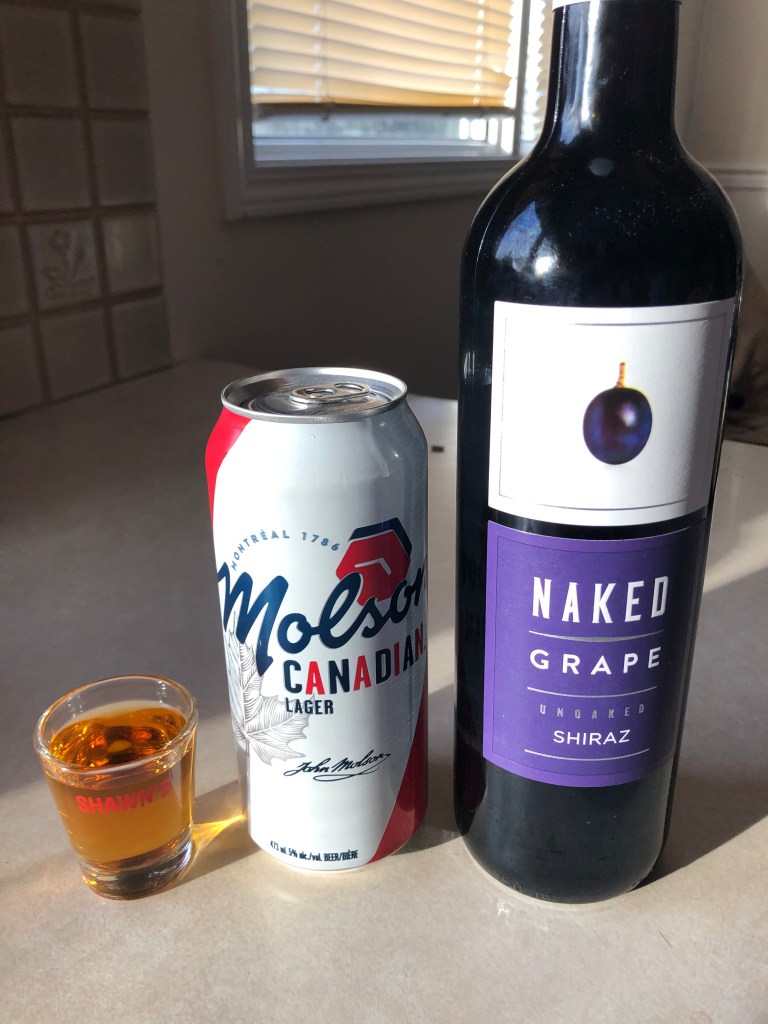
Let’s start with some basic nutritional information. Alcoholic beverages contain carbohydrates. There are some spirits or “hard alcohols” that find themselves sitting at the 0 carbs level, but most bottle drinks you purchase at your local store will contain some, if not a lot, of carbohydrates. Although every blend, type and amount will differ, I offer the following comparison through the use of a photo I took a few days ago:
Spirits, beer and wine
Now, ignoring the fact that I had all three of these items available on a sunny afternoon in order to take the photo, I’ll ask the following question: Which of these contain the most carbohydrates? Most people would likely think it would be the shot (it’s FireBall, BTW). This would be a natural conclusion, since most flavoured liquors are loaded with sugar. But believe it or not, you would be wrong. I’d like to point out that I’m using these three specific drinks/brands because they are what I had on hand and are no reflection as to whether one should consume these brands or not. This is just for educational purposes.
Let’s start with the shot. The average shot glass is approximately 1.5 fluid ounces. A small bottle (375 mL) contains approximately 10 shots. I contacted the parent company who makes FireBall and was informed that a shot sits at approximately 11 grams of carbohydrates. 11 grams, for a tiny gulp that does nothing more than burn the throat! This means that the entire bottle sits at about 110 grams of carbohydrates. Not that one would necessarily drink an entire bottle… Although I did experience this last year, as explained in my post A Decade Of Blood, Sweat And Literal Tears…, FireBall is not something typically consumed in large quantities. But it packs a solid carb-punch!
Next, we’ll discuss the beer. Believe it or not, the beer has the most carbohydrates per single drink. Sitting at approximately 25 grams of carbohydrates (this is not specific to the brand illustrated in my photo) per can, it can make having a six-pack pretty difficult as it totals at 150 grams of carbohydrates. This can range anywhere from 20 to 28 grams, depending on the brand and blend of beer you drink. It also tends to fill you more.
Finally, the wine. Ah, my beloved wine… Although nothing close to being a connoisseur, I do enjoy tasting the different blends of wine and comparing them. What’s nice is that an entire 750 mL of red wine averages between 12 to 15 grams of carbohydrates. For the entire bottle! Since one whole bottle sits at less than one shot of spirits, I tend to favour wine. Also, it’s important to bear in mind that white wine will contain significantly more carbohydrates red. But since I’m a Malbec or Shiraz man, I don’t have to deal with that issue.
If we quickly do the math, FireBall sits at 0.25 grams of carbs per millilitre. Despite the wallop packed by a can of beer, it’s only 0.05 grams of carbs per millilitre. The red wine is the big winner at the lowest amount, sitting at 0.02g/mL. Per mill, the wine is still the lowest. Per expected drink, the beer is the highest. It all depends on whether you’re having a casual drink or planning to drown your woes.
Most of this could easily be interpreted as useless facts, but the take-home lesson is that any alcoholic beverage you consume will require some blousing and calculation on your part. If you have Diabetes. Moderate alcohol consumption will likely result in increased blood sugars if you don’t bolus correctly. However, a heavy night of drinking will likely lead to hypoglycaemia, since alcohol will inhibit your liver’s ability to release glycogen and your body won’t receive the glucose it should.
These are just guidelines, but there’s a pretty good chart that’s put out by Diabetes Canada. It provides information and guidelines about the consumption of alcohol if you have Diabetes, as well as some baseline carb counts for the majority of drinks. These are guidelines only, and you should lean on your specific drink’s nutritional information combined with your specific insulin sensitivity to deal with all of it. As usual, moderation is key. Consume safely, my friends. ☯
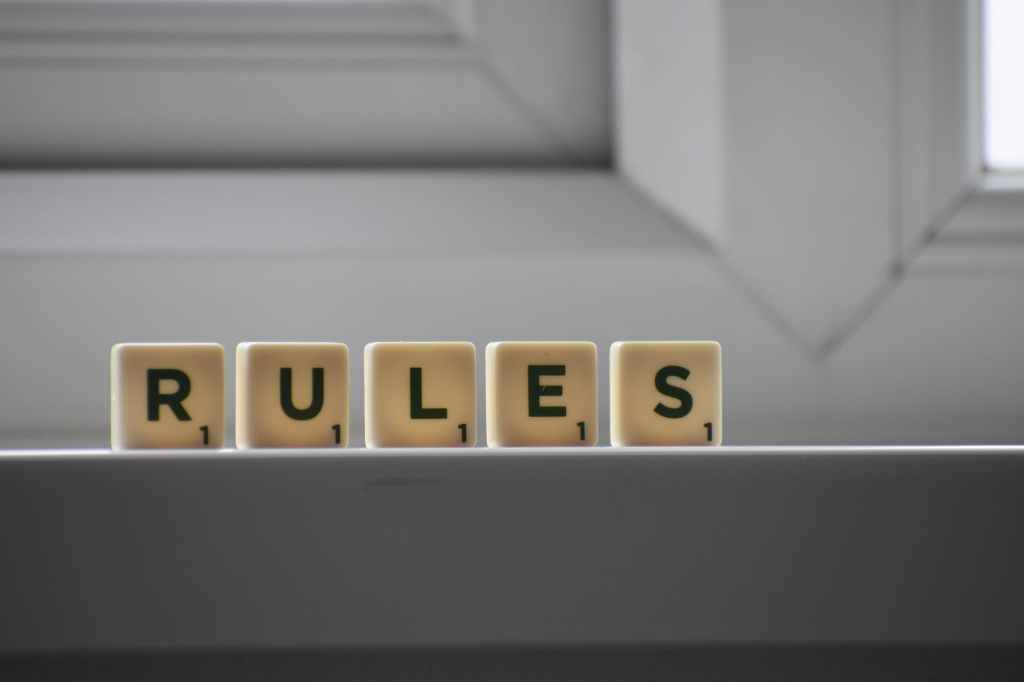
What are rules? Webster’s Dictionary defines “rules” as “a prescribed guide for conduct or action.” This prescribed guide is usually written, developed, implemented and enforced by some governing body or agency. Our modern society has a lot of rules, usually delivered in the form of regulations and/or laws. But from the simplest rules, such as “stay off the grass,” to higher laws that have been around forever, such as “thou shalt not kill,” people always seem inclined to break the rules. And why is that? Rules and laws are in place for a reason. There is a purpose behind them and without them, society would fall into total anarchy.
Just to be clear, I’m not innocent of this rebellious nature. In fact, no one is. I haven’t met a motorist yet who hasn’t at some point broken traffic laws. Just about everyone I know has dropped a piece of litter on the ground and opted not to pick it up. While the safe majority of actions people perform are not intended to be harmful and don’t result in anything nefarious, we usually live out our lives from week to week, breaking several rules without even noticing.
So, why do people break the rules? And what happens when those bent or broken rules begin to affect others? One good example I can give is a FaceBook post I recently read, that was shared by a friend of a friend. I don’t keep much of a FaceBook profile these days, so I’m unable to share the exact post or image. But as the post went, a friend shared a meme showing a twined highway where a motorist in the left lane was driving at the same speed as a slower motorist in the right lane, thereby illegally slowing down all the upcoming motorists who intended to overtake the slower vehicles.
In Canada, every individual Province has its own legislature and statutes related to the operation of a motor vehicle and/or one’s behaviour while doing so. In Saskatchewan specifically, slower vehicles are generally intended to stay in the right lane except to pass. This allows the faster-travelling vehicles to get by and is entirely the reason behind double and triple-laned highways. It allows for a smoother flow of traffic.
The meme my friend shared essentially provided a message of how wrong it was to perform this action and hinder traffic. And there are Provincial laws and statutes that make this “not okay.” But a mutual friend who commented on the post made a point of commenting how if he felt that someone was aggressively approaching behind him, he usually makes a point of slowing down in the left lane next to a slower vehicle to hinder these aggressive drivers. Oh, great. So what you’re saying is you violate a few traffic laws in order to satisfy your own inappropriate form of self-justice, which helps no one and could potentially cause a collision? Good on you, bro! Great flex!
I’m being sarcastic, in case no one gets that. Besides the illegality of that action, everyone has a story and there’s no way to know the story of motorists coming up behind this person. Maybe they’re late for work. Maybe a spouse is in labour at the hospital or a loved-one is injured or in danger. You don’t know. And now you’re being an asshole and holding them up just to make a point that not only will they not get but isn’t yours to make. This ties in to that whole “there’s suffering in the world” thing that Buddhist tend to harp about and the fact that suffering is usually caused by humanity.
This is just one example, and I’ll admit I got a little long-winded with it. But it serves to illustrate that many people find it okay to break the rules, so long as they can justify it in their minds. Rationalization of one’s personal actions are often used to get away with petty things, especially when the person believes they won’t get caught. Even though the majority of people don’t inherently mean to do wrong, the fact that they won’t get caught in the act often makes it all the more easy to do.
For others, it can be the fact that some people get something akin to a “cheater’s high” from breaking the rules and it can also provide a sense of freedom. After all, as humans, we usually don’t like to be told what to do. Even the most timid of people feel stifled and restrained by having to obey the rules. Try to interrupt my daily routine by telling me I can’t do a particular thing or go to a particular place and you’ll likely get a taste of my dark side, so I totally understand the impulse. But rules are still in place for a reason, often for the safety and security of society and should be obeyed accordingly. ☯



 The Blogging Buddhist