Sprinkle A Little Of That Goodness…

When you have Type-1 Diabetes, you have the unfortunate requirement to pay attention to everything you eat, everything you do and the activities in which you participate and monitor your body closely. Most things tend to hit us harder, and we’re not only hit with a shorter life expectancy but our organs all tend to play Russian roulette with life.

Luckily, some of the things we need to watch for do apply to non-Diabetics as well. One of these things is the intake of salt. For many years, it was believed that the best course of action was to eliminate your intake of salt as much as possible. This is a flawed logic and including salt in your diet is actually important.

First of all, let’s clarify: there’s a difference between salt and sodium. Salt is the combination of sodium and chloride, as well as trace amounts of other minerals. Sodium is a stand-alone mineral, and is usually what is measured in terms of dietary and daily intake requirements.

Salt, as I’ll refer to it for the remainder of this post, is a catch-22 seasoning. Too much can cause a score of health and medical issues. But believe it or not, completely eliminating salt from your diet can cause a number of issues for you, as well.

But since people in general tend to think that salt = bad, let’s examine some of the benefits of including salt in your diet. Some of these healthy uses of salt include:

  1. Dental Hygiene: Swishing a teaspoon of salt in a half cup of water can help with good oral health by helping with infections, mouth sores, wounds and some forms of gum disease. It’s also a dentist-recommended natural treatment to help heal canker sores, which are a real sore spot for me (see what I did there?);
  2. It’s a natural disinfectant: It’s no mystery that salt has been used for centuries as a curing and/or preserving agent, as salt prevents certain bacteria from growing and spoiling food. But soaking certain wounds (especially those on your feet) in warm salt water can help with healing;
  3. It eases sore throats: Gargling with salt water can ease swelling and irritation caused by sore throats;
  4. It can ease cramps and dehydration: I know that most people tend to think that salt dehydrates you. And this may be true, if you consume heavy amounts of it. But healthy amounts of salt will actually help you to stay hydrated and by proxy, eliminate muscle cramps during physical activities. Salt is an electrolyte and is required in order to keep you hydrated;
  5. It can help clear your sinuses: Using a saline solution can help to alleviate sinus issues caused by colds or allergies. You can find over-the-counter saline bottles at any pharmacy or if you want to be totally disgusting, you can use a netti pot to pour salt water into your sinus cavities to wash them out.

There are a few good posts that cover further benefits. WebMD has a good one and can be read here: https://www.webmd.com/a-to-z-guides/ss/slideshow-salt-uses. HealthLine.com also has a good one and can be read here: https://www.healthline.com/nutrition/salt-good-or-bad

As far as eating salt is concerned, the average person pretty much consumes their maximum recommended amount of salt through most of the foods they eat. But if you drink plenty of water throughout your day and are not faced with any outlying medical conditions that prohibit the use of salt, sprinkling a lit bit of goodness on your food is not a big deal. It’s one of those “happy medium” situations where too much is bad, but too little can be just as bad.

According to the HealthLine.com link I provided above, reduced sodium intake can lead to an increase in heart issues, LDL and Triglyceride counts as well as an increase in insulin resistance. So one would likely not want to cut out salt COMPLETELY.

Last but not least, when it comes to choosing your salt, natural salt wins over common table salt. Like most things you find in a consumer’s world, table salt is processed and has a negligible mineral content. Natural salt includes types such as sea salt and Himalayan pink salt.

With salt, much like everything else in life, moderation is key. Although you don’t want to be pouring that stuff freely onto everything you eat, you certainly don’t want to eliminate it completely either. Your doctor or health practitioner should be able to tell you if you need to reduce or increase your sodium intake and as with everything else, drink plenty of fluids along the way. ☯

To Be Born Twice…

When I take stock of my life, I realize that through time and circumstance I have experienced something of a rebirth on more than one occasion. In my youth, the path of my life and how I grew up was determined by a single diagnoses of Type-1 Diabetes at the age of 4. I’ve often reflected on how differently my life may have been had I not been diagnosed as such.

Later on, I would start my training in karate; a move that I would ultimately come to see as a rebirth. The person I became and the health I gained showed a marked departure from where I began. It also helped define the kind of drive and ambition I would have in almost everything I’d do in my life.

My chosen career, although started later than most, was most definitely a rebirth. It was almost like being under water for so many years, only to finally come up for air. When you finally find what you were meant to do, it seems like a perfect fit and everything else seems to melt away.

But sometimes, these rebirths don’t happen on their own. Sometimes you have to take yourself in hand in order to make them happen. I’ve often said that life doesn’t are about our plan. Things will happen in due course, but this doesn’t mean you should just sit back and wait for it happen.

Change may be organic to life, but POSITIVE change requires your active involvement. You can’t remake yourself by hiding away from the outside world. You are part of the living organism that is the world, and the only way to have a positive impact is through positive thinking and positive action. ☯

Getting Ahead Of The Curve

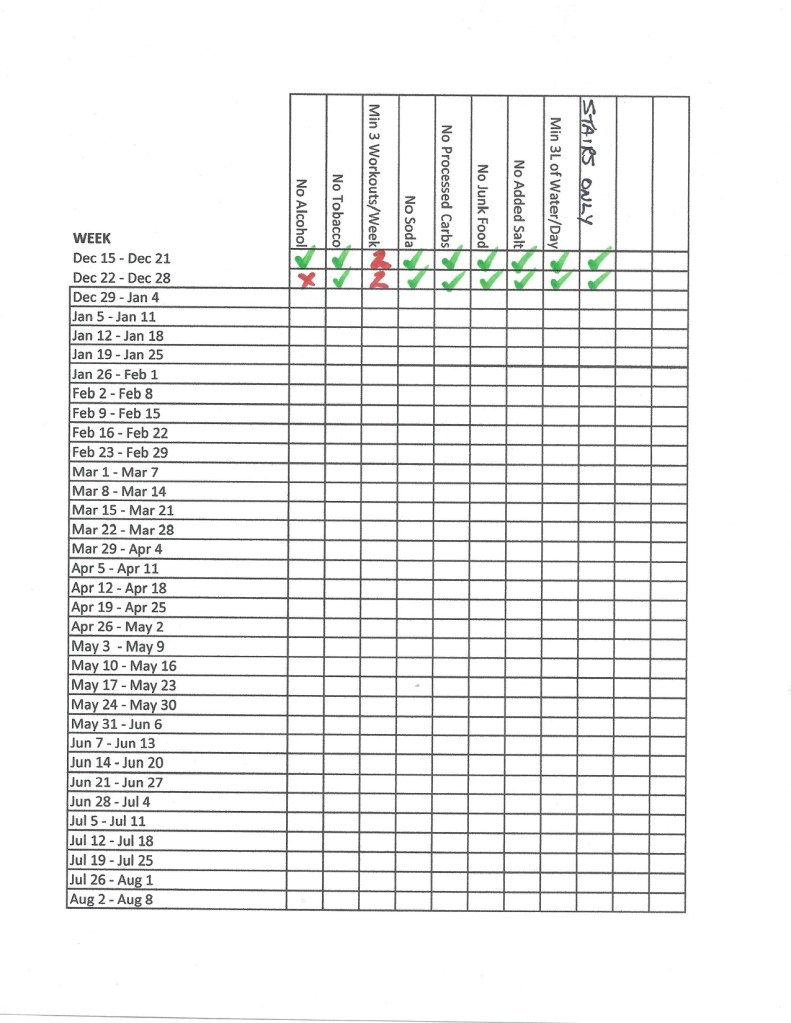
About three weeks ago, I wrote a post about what I intended to do for my New Year’s resolution. It’s pretty ambitious, considering most people will choose one thing or another, such as losing weight or eating healthier, joining a gym or quitting booze or smoking. I chose a rather elaborate spreadsheet that included the following steps:

  • No alcohol;
  • No tobacco;
  • Minimum of 3 workouts a week;
  • No soda;
  • No processed carbohydrates;
  • No junk food (yes, there’s a difference);
  • No added salt;
  • Minimum of 3 litres of water a day; and
  • Taking only the stairs where possible.

My intention had been to start it on December 29th as this is the Sunday that encompasses the January 1st week. However, I read someone else’s post about New Year’s resolutions and I was reminded of a couple of things.

Although it can be great to take yourself in hand and make a resolution in order to better yourself, if you wait until New Year’s in order to make that change it’s likely not important enough to you. The other aspect one needs to consider is, why wait?

I think the post I read said it best when they explained that if your resolution is to join a gym, why walk in as the new guy on January 1st when the new people will walk in and you’re already a regular? In that spirit, I started my New Year’s resolution on December 15th.

My first two weeks of the challenge

As you can see from the spreadsheet above, it’s pretty straightforward. At the end of the Saturday evening, I put green checks on the items I accomplished and a red “X” on the items I did not. The workouts have been rough, considering karate has been shut down for the holidays. Otherwise, I’d be hitting four workouts for both those weeks. Plus, it’s the holidays! I’ve been a little a little busy focusing on the actual holidays and on family.

Although there is already a touch of red on my ledger, the important aspect to remember is that a resolution is intended to help improve oneself. I’ve also been allowing myself a “cheat day” on Fridays. From what I’ve researched, folks have a better chance of sticking to any sort of regiment or major change in lifestyle and diet if they allow themselves a touch of indulgence once in a while.

I won’t bore all of you by posting updates on this every week, but I’ll provide some updates every few months to show my progress. We’ll see how long I can tough it out… ☯

Hindsight is 2020

Welcome to the New Year! It’s the beginning of a new decade, the return of the Roaring 20’s and the beginning of a fresh 365-day batch of opportunities. Hopefully everyone isn’t suffering from whatever celebratory choices you made last night and you can walk into the New Year with a skip in your step.

The past two years have been a bit of a challenge. After a lifetime of work, sacrifice and learning from mistakes, 2018 saw me get struck down in the prime of my chosen career by a selfish individual motivated by their own goals. I was taken away from my place of work and assigned elsewhere. I made the best of a bad situation and met some of the best people I’ve had the opportunity to work with.

2019 saw disappointment as I travelled the country in search of a different venue in which to continue my career (a fact I chronicled in my posts entitled “A Strange Odyssey” from last September) which yielded no results. A family member recently passed away and my wife and I have failed to sell our house. But through this disappointment, I was blessed with the birth of my second child, Alexander.

There have been ups and downs, happiness and disappointment, laughs and definitely some tears. But as hard as these difficulties have been, I have the benefit of knowing that there has always been some positive to go with the negative. And there usually always is!

And this is how you should face 2020. Take the time to focus on your health, your happiness and some goals for this year. And once you’ve established those goals, work hard until you achieve them. There’s really no other way to live.

And finally, a word on the title… I’ve always said that one can’t live life with regrets, that every choice you’ve made, good or bad, has inevitably led you to the wonderful and awesome person you are today. There genuinely is no way to regret that. But don’t forget to take the time to remember and contemplate some of the mistakes you’ve made in the past year. Not only will this prevent the possibility of repeating those mistakes, you may learn a little something about yourself to pave the way through a smoother year, this time around. ☯

What Goes In, Must Come Out

I thought I’d finish out 2019 with the grossest topic I can think of, because, why not? As I’ve often written, having Diabetes can lead to a heavy score of complications and we already know that our immune systems are total crap. And crap, as the turn of phrase would have it, is the focus of this post…

How often do you go to the bathroom and look at what comes out? Before most of you start wondering if I have a pitcher of eggnog or a spiced rum at my desk as I write, this is an important part of proper health. Because what comes out of you is important and can tell you a great deal about your health.

I’ve looked into a few different sources and referenced some medical practitioners only to find a batch of common consistencies that they all bring up, as it relates to going #2. Here’s what I found:

  1. It shouldn’t take forever: There are always jokes made about how if someone is taking too long in the bathroom, it’s because they’re going #2. As funny as that joke might be (I guess), the average bowel movement shouldn’t take you more than fifteen minutes. And that’s pushing it (pun intended). A healthy bowel movement should come easily with little pushing effort to move. And the time frame doesn’t include how long you waste getting past that tough level on Angry Birds;
  2. It shouldn’t hurt: The human body is an exceptionally well-designed machine, and your digestion and elimination systems are no exception. If a bowel movement is painful or difficult to pass, this can be a sign of further concern. It should be closer to spitting a grape out of your mouth, not giving birth to a rhino;
  3. It should look normal: What is normal? I’ll get to that in a bit, but the basic is it should be solid or semi-solid and have at least SOME shade of actual brown to it. Anything else can be a sign of dehydration, lack of fibre, diarrhea, food intolerances and even stress;
  4. You should be going once a day: An article posted by HealthLine.ca indicates that, “On average, a person with healthy digestion will poop anywhere between every other day to three times a day. Any less could suggest constipation […].” (https://www.healthline.com/health/digestive-health/types-of-poop#3);
  5. “Regular” is a real thing: Despite point #4, I feel there’s a hell of a difference between going every two days and possibly going three times a day. As long as your diet and health are consistent, you should have a regular regiment and even go around the same time every day. If you’re used to going every morning at 7 am after your first coffee and all of a sudden you’re running for the nearest washroom three or four times, there’s likely something amiss.

These are only general guidelines based on the articles and references I’ve found, of course. As is the case with almost everything related to one’s health, every person is different and proper health is based on your specific diet, exercise routine, outlying medical conditions and hydration.

But let’s talk consistency for a moment, shall we? Back in the late 90’s, Dr. Ken Heaton from the University of Bristol, developed a chart that outlines the different shapes and consistencies of bowel movements in order to provide a baseline of what your particular bowel movements may be telling you. It was named The Bristol Stool Chart, but is also known as the Meyers Scale.

An example of the Bristol Stool Chart as found on Wikipedia

The chart can be easily found by Googling it, and they all show the same thing, despite some differences in design and appearance. What you’re looking for is either Type 3 or 4, with all other types signifying some potential problem or issue with your elimination and/or health. If you have Type-1 Diabetes and can basically dehydrate at the drop of a hat, diarrhea can be a serious issue. Remember to drink plenty of fluids to stay hydrated.

Next is colour! The poo emoji got it right; your bowel movements should be a shade of brown. There are, however, a number of other colours that may suddenly show up in the bowl.

Black or red could be an indicator or internal bleeding, however mild or severe. Of course, red could also be an indicator that you ate something pertinent, such as beets, red berries or drinking heavy amounts of tomato juice, which can add a tinge of red to your bowel movements.

White bowel movements can indicate potential liver or gallbladder issues and shouldn’t be ignored. Green colour can be an indicator of something you ate, but is also dependent on the consistency. An article posted by MedicalNewsToday.com gets pretty descriptive and can be read here: https://www.medicalnewstoday.com/articles/320938.php#colors-of-poop

At the end of the day, the best ways to ensure proper elimination is to stay hydrated, exercise regularly and try and eliminate stress from your life (that last one isn’t the easiest). And there can always be one or more of these factors that suddenly make an appearance in your porcelain opera. It becomes a problem if colour, consistency or frequency change in such a way that it is no longer a one-off and doesn’t feel normal.

If you begin to feel pain, identify blood in your stool or have a colour or consistency change that doesn’t go back to normal after two or three days, you should go see your doctor or medical practitioner. Most people consider their bathroom trips to be an opportunity to get a few minutes of quiet time, read a chapter or play on their phones. But keeping an eye on what comes out can be a good indicator of your health. ☯

The Chains On My Mood Swings Just Snapped

One of the known side effects of extreme blood sugar levels is the occasional mood swing. The problem with mood swings is that they aren’t uniquely a Diabetes related symptom. So how does one know if one’s bad mood is related or not? That’s easy: test your blood sugar.

“I’m ready to go off the deep end because what are the highs without the lows…”

S. Tellaz

Your mood is a subjective thing, which is why it’s difficult to tell whether it’s related to a condition or simply being in a bad mood. And as people have often said, never in the history of humankind has someone calmed down at being told to calm down.

Personally, when my blood sugar has the occasional spike, I turn into what could easily be described as a “cranky-ass biatch”, to use the proper vernacular. This isn’t a common change in mood associated to high blood sugar. But like everything else with Diabetes, it can be subjective to the person.

But extreme lows have shown to cause forms of aggression as well. There’s a good article in Medical News Today that outlines a good deal of this and can be read here: https://www.medicalnewstoday.com/articles/317458.php

I remember one time, in high school, I suffered an extreme low. This was well before the advent of CGM and interstitial blood glucose testing, so my meter was the only means of checking my levels. My meter was normally kept in my locker. I remember starting to feel woozy in class, right before lunch. As teenagers can sometimes be, I was foolish in thinking I could stave it off by staying still in class until the lunch bell rang. I was wrong.

Within fifteen minutes, I couldn’t concentrate, I was groggy, sweaty and all I wanted to do was go to sleep. I remember the guy seated next to me, poking me and asking if I was okay. When the bell rang, I walked my way down to the lunch line and stood to wait. As I stood there, I felt a sense of hyper-vigilance and something akin to paranoia.

Ironically, I had forgotten my money for lunch that day, and who else but my mother walks into the school and approaches the lunch line and provides me with some cash. I can’t remember if she realized that I had forgotten to bring cash or what, but I recall having a very aggressive response to her sudden appearance at my school.

Once I had some food in my system and things returned to normal, I started having some vague recollection of the harsh words I had used on my mother. I apologized when I got home, but it definitely took some explaining to make her understand that I wasn’t in control of my own faculties.

And this is a common occurrence with a number of the relationships I have had in my youth and my teens. Many friendships and relationships have been soured or ruined due to my temper, much of which could have been attributed to my blood sugar levels. And it definitely doesn’t help to have someone saying, “You’re cranky!” That usually only results in more aggression.

These days, I’ve managed to work it out in such a way that when I begin to notice my own foul mood, I test my levels and adjust accordingly. This not only helps with maintaining a better percentage of “time in range”, but it spares my family from my moods (at least most of the time).

We can’t always tell when our mood begins to foul. And we sometimes have no choice but to depend on someone else pissing us off by telling us we’re crabby in order to realize it. Test your blood sugar levels regularly and especially if you feel as though you’re in a foul mood. ☯

It’s All In Your Head

Ah, hangovers! They’re almost synonymous with the holidays, aren’t they? With eggnog and other lovely “adult” beverages available to us over the holidays, many of us find ourselves waking up the next morning with the tell-tale headache that signifies a hangover.

But what the hell is an actual hangover? Most people assume it’s simply a headache associated with too much drinking; and they would be PARTIALY right. But there’s a lot more to it than that.

A hangover is actually a grouping of symptoms caused by over drinking. Contrary to popular opinion, they can happen anytime during the day and are not limited to first thing when waking up. The symptoms can include but are not limited to:

  • Headaches and dizziness;
  • Dehydration and thirst;
  • Stomach aches;
  • Nausea and vomiting;
  • Diarrhea; and
  • Fatigue and exhaustion.

There are many more, but people often don’t recognize them as they usually sleep through a number of them. The good news, is that hangovers generally tend to go away within one day. You normally don’t have all that long to suffer.

So, what can one do to prevent a hangover? The most obvious answer is to abstain from the consumption of alcohol. Or at the very least, drink in moderation. But the reality is that there is no cure for a hangover. Yes, you read that right! THERE IS NO CURE FOR A HANGOVER! Despite what some over-the-counter medications may have suggested, there is no magic pill to make it all go away. But there are some things you can do to alleviate symptoms:

  1. Drink plenty of fluids: Not the alcoholic ones! Get lots of water in your system to replace the fluids you’ve lost through dehydration, which could also be the cause of the stomach aches, nausea and diarrhea;
  2. Have a cup of java: Caffeine is a natural stimulant and may help alleviate some of the dizziness and grogginess associated with the hangover. Caffeine can also cause further dehydration, so be mindful with this one;
  3. Have some food: No, it isn’t to soak up excess alcohol in your stomach; that’s a myth! The booze will mine its way into your system regardless of the spicy donair you mixed it with at 3 am. But having something to eat may help to regulate blood sugar levels (even in non-Diabetics) and help to alleviate the headaches and fatigue;
  4. Sleep through it: This one has to be my favourite. If you are able to stay in bed and sleep it off, this is the natural and easiest way to get through it. Keep a glass of water on your bedside table to stave off thirst and dehydration and snooze away;
  5. Don’t take Tylenol: Sure, some painkillers can help with the pain, but stick to Ibuprofen or aspirin. Acetaminophen can have adverse effects on the liver, especially if there are still lingering traces of alcohol in your system;
  6. Don’t be a chump: Some people have heard that having a morning eye-opener or “hair of the dog”, as it’s sometimes called, can help alleviate hangover symptoms. If you drink while hungover, all you’re doing is prolonging the process of getting past it. There is NO evidence that having those two or three drinks actually help. Quit while you’re ahead, limit how much you consume and politely decline further drinks, even if you’re in a social setting.

It goes without saying that all the symptoms described above can be worsened or aggravated if you happen to have Type-1 Diabetes. I’ve written recent posts on the effects of alcohol for Diabetics, so I won’t regurgitate the same stuff over and over, but be certain to check your blood sugar often and stay on top of it.

Ultimately, moderation is key. But one needs to remember that hangover symptoms shouldn’t last more than 24 hours. If they do, it could be a sign of an aggravated medical condition or worse. If symptoms persist beyond a full day, it may be time to visit your doctor. ☯

If You Don’t Plan Ahead, You’ll Fall Behind…

As I’ve mentioned in previous posts, the Holiday season is upon us, and with it comes a bunch of fun, celebratory things that we all enjoy. These things can include, but are not limited to baked goods, carbohydrate-heavy meals and the consumption of alcohol or other high-sugar beverages such as hot chocolates and egg nog.

I’ve never been much of a fan of egg nog, myself. But it happens to contain an average of about 8 grams of carbs for every 100 millilitres you consume, with all 8 grams being pure sugar! So if you consume an average cup or glass with about 250 to 500 mL of the stuff, you’re looking at 20 to 40 grams go carbs just on that one glass of nog alone! It can add up quickly.

Eggnog with a touch of cinnamon

Baked goods and meals are a special kind of bastard, because they can be extremely difficult to calculate insulin requirements for them. A good rule of thumb is that the average “homemade” cookies or square usually runs at about 20 grams of carbs. This has been my own experience of course, and doesn’t necessarily reflect any specific baked good you may be consuming. For example, when looking at chocolate chip cookies (an old classic) you would be dealing with anywhere between 16 grams to a whopping 30 grams of carbs per cookie depending on the ingredient content and the size of dough you put on your pan.

Last but not least is the consumption of alcohol. I’ve written about this often, because alcohol is such a difficult creature to control and bolus for. Drinking, in some respects will cause your liver to work overtime and your blood glucose to drop. Other types of alcohol may cause your blood glucose to spike, depending on what extra ingredients are included. There’s also the aspect that every person is different and what causes a drop for me, may cause an increase for you or vice versa. It really falls to you to know your body and your resistance to alcohol in order to best prepare for it.

Diabetes Canada posted a fantastic chart on Diabetes.ca that provides a general guideline on the carbohydrate count for most commonly consumed alcoholic beverages. The chart can be found here: https://www.diabetes.ca/DiabetesCanadaWebsite/media/Managing-My-Diabetes/Tools%20and%20Resources/alcohol-and-diabetes.pdf?ext=.pdf

This chart is only a guideline and may not relate to exactly how your body deals with its holiday booze, so monitor yourself carefully. For example, my favourite drink of choice is a rum and diet coke, made with Kraken Rum (the best damned rum in the world). 1 ounce of Kraken Black Spiced Rum is about 1 gram of carbs. My favourite beer is a locally brewed craft IPA that has almost 22 grams of carbs per can. Quite the difference between a drink of one or the other.

The holidays can be a wonderful time of year to spend quality time with family and enjoy some of the little indulgences that you perhaps restrict during the rest of the year. The key to enjoying these indulgences is being prepared. Test your blood sugar often, know the carbohydrate count of what you’re consuming and as is the case with almost everything, moderation is key! ☯

The Open Road Has No Pharmacies…

If you’re anything like me, you tend to pre-plan most of your daily activities. I, for one, usually have my day mapped out before my head hits the pillow on the previous evening. When I wake up the next morning, I have the benefit of being able to hit the ground running with only a few adjustments or details to iron out. Even on a day off, my hours are usually filled with a number of things that need to get done, and I rarely have a moment where I can stop and say, “Wow, I have nothing to do…”

Not everyone is that organized. In fact, even while being THAT organized (and I’m no KonMari), it’s easy to overlook some details and forget things you may have needed. If you have Type-1 Diabetes, overlooking a small detail can mean the difference between healthy holidays or spending Christmas in an emergency room.

First, let’s cover the basics. Unless you were diagnosed last week, you should have a pretty good idea of how much insulin you use and how many supplies you require over a specific period of time.Every person is different, of course. But if you can’t do simple math and figure out that you use X number of insulin units in Y amount of time, therefore you need Z number of bottles, you may have a problem.

Enter: The Holidays! This is a particular time of year, when different pharmacies and businesses have strange and off hours of business, and can be closed on unexpected days. The obvious being that almost all businesses are closed on Christmas Day, of course. But every business is different.

Given that for the most part, we tend to consume higher amounts of food, baked goods and even alcoholic beverages over the holidays, we also face the fact that we may go through more insulin than we’re accustomed. Even IF you have your dosages and supplies down to a fine art, you may find yourself falling short.

Another important aspect of the holidays is the fact that many of us travel. Whether it’s to visit family or go to a warmer destination throughout the holidays, planning out your trip in relation to your Diabetes supplies can be crucial, especially when faced with the possibilities of being stranded due to mechanical breakdowns, snowstorms or other emergencies.

Back in September, I had travelled back to New Brunswick for work. I had only intended to be there for a week, but a change in plans and schedule saw me gone for almost two. I don’t mind saying, shit hit the proverbial fan! I had packed enough supplies for a full week plus a buffer, but now the extension of my stay would outlast my extra supplies.

The town I was staying at did not have a location belonging to the pharmacy I use, my prescriptions were from out-of-Province and a hospital wait to acquire a local prescription would have taken hours that I didn’t have available. I was unfortunately forced to purchase the required supplies out of pocket. And the kicker is that the pharmacy I went to didn’t even carry the pump supplies I use, so I had to purchase insulin (short and long acting), syringes and blood testing supplies (they had my Freestyle Libra sensors, but they were too expensive to pay for up front).

This was a costly lesson, but an important one. I could/should have planned for that contingency. If I had simply brought an added pump set with me, I likely could have gotten away with buying a single bottle of insulin instead of spending several hundred dollars on supplies. Even if you have a buffer, you should also bring a buffer for your buffer!

Although this applies to the entire year, be sure to consider your health and safety over the holidays by ensuring that your supplies are plenty and that you have enough to get you past the black hole in your pharmacy’s business hours. Nothing says “bah, humbug!” like waiting 8 hours in an emergency room for a short supply of insulin! ☯

Keep Your Eyes On The Prize

Most of us go through our daily lives just trying to get through the day so that our heads can hit the pillow. I’ve rather preferred to make it to the rising sun, as it means I’ve lived through the night and can rise to fight another day, but that’s just me. So, what do we rise everyday for? What is it that keeps us from just pulling the covers over our heads and staying in bed? The answer is simple: you need to have a goal.

Goals are important. Even for those who don’t think about it, having a goal can be a driving force behind what keeps you going. You’ll notice I keep saying “goal”, as in a singular goal. One of the biggest mistakes people make is trying to accomplish multiple goals at the same time. Now don’t misinterpret this as not being able to multitask; the two are very, VERY different.

There’s an old proverb that says, “If you chase two rabbits, both will escape.” This is a simple way of saying that dividing your focus on more than one goal at a time likely means you won’t accomplish any of them. It’s important to place your gaze on one goal at a time. And this goal can be simple. There’s nothing saying you need to become a millionaire. If that’s your goal, then by all means, pursue it. Hopefully you will have fixed a singular goal to accomplish it. Nothing is saying that you have to have grand goals, such as finding a cure for a chronic illness. But if such is your goal, it’s definitely one worthy of a life’s work.

Now, if you were to try becoming a millionaire AND find a cure for, oh, let’s say Diabetes… at the same time? Chances are that you’ll fall short somewhere. Focus and effort are required for any definitive goal, and no matter how simple or complicated that goal may be, the requirements are ultimately the same.

So, tackle one thing at a time. Accomplishing one goal can lead into developing the next, and so on… This guarantees that you can wake every morning with a fresh perspective and the ability to focus on your goal. ☯