The Possible Light At The End Of The Tunnel…

I was sitting in my living room last Wednesday, basking in the aftermath of a solid supper of two jalapeño cheddar burgers. I’m totally kidding. Not about eating two burgers; I totally demolished those! I’m kidding about the fact that I was basking in anything but pain. The jalapeño burgers were painful to eat, digest and think about. But I digress… Shortly after supper, while I was in the living room with my wife and infant son, I received a text from a friend of mine.

Now, one might be inclined to ask, “But Shawn, don’t you ALWAYS get texts from friends?” First of all, shaddup! Second of all, texts rarely have this level of importance or solicit as much of a reaction from me. This text message contained a link to an Edmonton CTV article indicating that there is a possibility that a cure for Diabetes may have been discovered. No, that’s not a typo. You read that right.

The article, published on November 17th by CTV News Edmonton, opens with a bold statement in its first line, “Scientists at the University of Alberta say they may have discovered a cure for Diabetes.” Apparently, their new process has already cured Diabetes in mice and the research team is hopeful that they’ll eventually be able to test it on human test subjects. You can read the article for yourself here.

The lead researcher is Dr. James Shapiro, who is a well-known rockstar in the Diabetes community as the creator of the “Edmonton Protocol” some twenty years ago. This protocol involved injecting Diabetes patients with insulin-producing islet cells in order to allow their bodies to produce and regulate blood sugars without daily injections. This was a fantastic breakthrough and an amazing step forward in Diabetes treatment. I had even looked into it myself, when it first came out.

One of the big problems is that the protocol doesn’t work for everybody. There are conditions that make the patient receptive to the treatment, and even for those who can get the treatment are usually stuck using anti-rejection meds for the rest of their lives in order to keep their bodies from rejecting the injected cells. Dr. Shapiro and his team have apparently found a way around this obstacle.

According to their new claims, the research team have somehow found a way to turn a patient’s own cells into islet-producing ones, circumventing the need for all the anti-rejection meds and side effects that accompany the Edmonton Protocol. Their current research has shown that they’ve been able to reverse the effects of Diabetes in mice to the point where the Diabetes is effectively cured. If successful in human trials, there is a very real possibility that we could see a cure for Diabetes within our lifetime.

Just reading the article brought tears to my eyes. After all, finding a cure for Diabetes is the “hopeless hope” of every T1D. And I’d be lying if I said that I even remember what life is like without Diabetes. But it’s gotta be better than this. Watching the video made even more misty-eyed (Thanks, Kristen!). As is the case with most scientific research, funding is the main issue. Dr. Shapiro requires additional funding for equipment and research in order to perfect this new treatment.

The video that accompanies the article discusses a man, whose son has Type-1 Diabetes, who has decided on a goal of raising 22 million dollars by 2022. He made a pretty good point; if every Canadian with Diabetes donated simply $22, Dr. Shapiro would be well beyond the funding required to make this work. With over 400 million people with Diabetes worldwide, it would really suck if there’s a cure on the horizon but no one could get it because of funding.

Between drying all the tears the article caused, I tried finding where one can donate for this specific cause. Unfortunately, I didn’t find anything so if one of you does, please include it in the comments so I can share it and pass it on. Diabetes has taken up such a large portion of my life and has helped mold me into the person I am today. I’ll admit that I would likely feel a bit lost if I suddenly found myself clear of it. But I’d adjust. Definitely. Read the article. In case one link wasn’t enough, HERE! ☯

World Diabetes Day 2020

I know I harp on many of these so-called “holidays” that seem to riddle the calendar with every passing month. But this one just happens to be personal to me, for obvious reasons. Every year on November 14th, which is the birthday of Sir Frederick Banting, we celebrate World Diabetes Day. November is already Diabetes Awareness Month in most medical circles, but today is a day where focus is brought to the growing number of people being diagnosed with type 1 Diabetes.

World Diabetes Day was created in 1991 but the International Diabetes Federation and the World Health Organization, and is often recognized by the signature blue circle logo and is usually accompanied by a different theme every year. But rather than get into all the hubbub that is yet another yearly holiday, I thought it would be a good idea to remind folks about the actual discovery of insulin and a bit of its history.

As most may know, insulin is a peptide hormone created by beta cells inside the pancreas. Insulin helps with the processing and regulating of carbohydrates by absorbing glucose from the blood into various tissues of the body. Beta cells release insulin into the body in response to blood sugar levels, specifically high ones. Insulin plays a number of different roles outside of this, but for the purposes of this post, I’ll keep it simple.

Although the discovery of insulin is attributed to Sir Frederick Banting and his lab assistant, Charles Best, it should be noted that the road to insulin’s discovery started over 50 years before Banting made the discovery. The relationship between the pancreas and Diabetes was therefore established during the late 1860’s and 70’s, with a number of experimental treatments never quite hitting the mark. It also surprised me to discovery just how many of these experiments were performed on dogs. Whether this is because they constitute a large mammal or because they were simply available is beyond me. Oh, how they were different times!

Starting in the early 1920’s, Banting and Best began experimenting with islet cells and injecting them into a Diabetic dog, which resulted in a dramatic drop in blood sugar levels. In January of 1922, the first injections to human patients were given and the rest is history. Banting won the Nobel Prize in Physiology or Medicine in 1923, for the discovery of insulin. He shared the prize with Charles Best and sold the patent for insulin to the University of Toronto for a dollar.

The world would be a significantly different place if insulin had never been discovered. Obviously, I wouldn’t be here. But the millions of people who have been diagnosed with Diabetes certainly wouldn’t be either, as that diagnosis was basically akin to a death sentence before insulin came along. This isn’t really a “celebratory” holiday; you won’t likely catch people throwing parties or going crazy in any significant way. I mean, good on them if they do! Hopefully, they take the time to count the carbs in their drinks while they celebrate… ☯

Remembrance Day

November 11th is well-recognized in most Commonwealth countries as a day where we take the time to recognize those who died in the line of duty during the First World War. In Canada, the day is observed with the wearing of a poppy on the outer collar or lapel in the weeks that precede Remembrance Day, couple with the calling of the roll on the day itself, observing a period of silence during the 11th hour of the 11th day of the 11th month.

For me, the day holds a special place in my heart. Most of my family has served its country in some given way, shape or form. And in a variety of uniforms, no less. My own service has come at great personal cost, in recent years. As a result, I’ve had difficulties remembering why I put on a uniform in the first place. I need only to look at the history of the world to understand why it’s so important to remember the past. Or be condemned to repeat it.

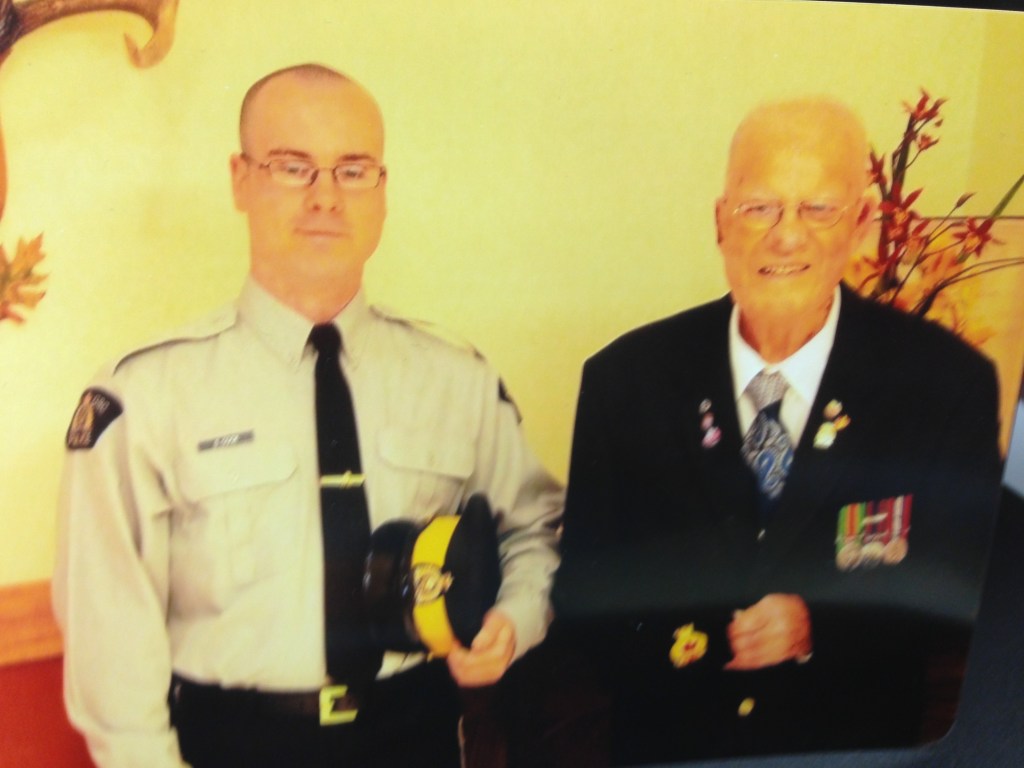
My grandfather and I in 2009. Generations of service.

It’s important to properly observe this day. If there’s one thing that pisses me off beyond reason, it’s when I see people starting to decorate for Christmas right after Halloween is done. Is Christmas an important holiday? Yes. Absolutely. But is allowing a period of remembrance and observance for those who fell in order to guarantee our freedom important, as well? I would say so.

My grandfather taught me everything I ever needed to know about honour, duty and obligation. They say that when an amputee loses a limb, they can still feel pain in that limb. Phantom pain, non-existent but felt nonetheless. Although gone, the pain is still real and very much felt. This is how I remember my grandfather. Gone, but still very much felt. I remember the stories my grandfather told me about his time on active front lines in Europe during World War II. He may have always been a simple working man from the North shore of New Brunswick. But to me, he will always be the hero who helped to keep his country free.

Today is important. No matter what country you may be reading this from, what your background or your beliefs may be, remember your heroes and remember their sacrifices. Hopefully, the world will never be foolish enough to engage in the sort of battles it did in the early 20th century. ☯

Just Something To Make You Smile

Some days, I like to let my head cool down from all the reading, research and long-winded writing I do, and simply post something funny, inspirational or cute. So, here it is! I found this online and it made me smile, so hopefully it does that for you as well.

Some of the important lessons of life can come from the most unlikely sources, even if all they do is make you grin like a fool. ☯

“Asbestos” It Gets…

It’s been a hell of a long week, with basement demolition and foundation bracing taking place within my home. It started last Wednesday, with a crew from Grasshopper Construction showing up to take down the current walls and finishings from the basement in order to expose the concrete foundation. This was to be followed with the placing of steel braces all along the foundation walls in order to shore up and solidify the concrete and prevent any heaving or caving in, since the soil in Regina is primarily composed of yellow clay and tends to shift and cause said heaving.

The “Before” photo

My wife and I agreed that it would be best for her and our infant son to take a trip to her parents’ place for the week that followed, in order to allow the baby to get his naps and stick to a routine as opposed to dealing with the cold and noise that would take place within the house. My wife also requires a wifi signal for her work-at-home job, and we knew that power and internet may be interrupted at intermittent times.

This left me with my 5-year old son, Nathan, as he had school all week and had to make the bus every morning. The first day of demolition went well, with a significant amount of the finishings removed by the end of the day. The crew were extremely efficient, keeping me updated and asking questions as required. They were also really good with cleaning as they went and at the end of every day, which made the continued use of the washer and dryer a possibility during the whole process, which was greatly appreciated.

The panoramic “After” photo

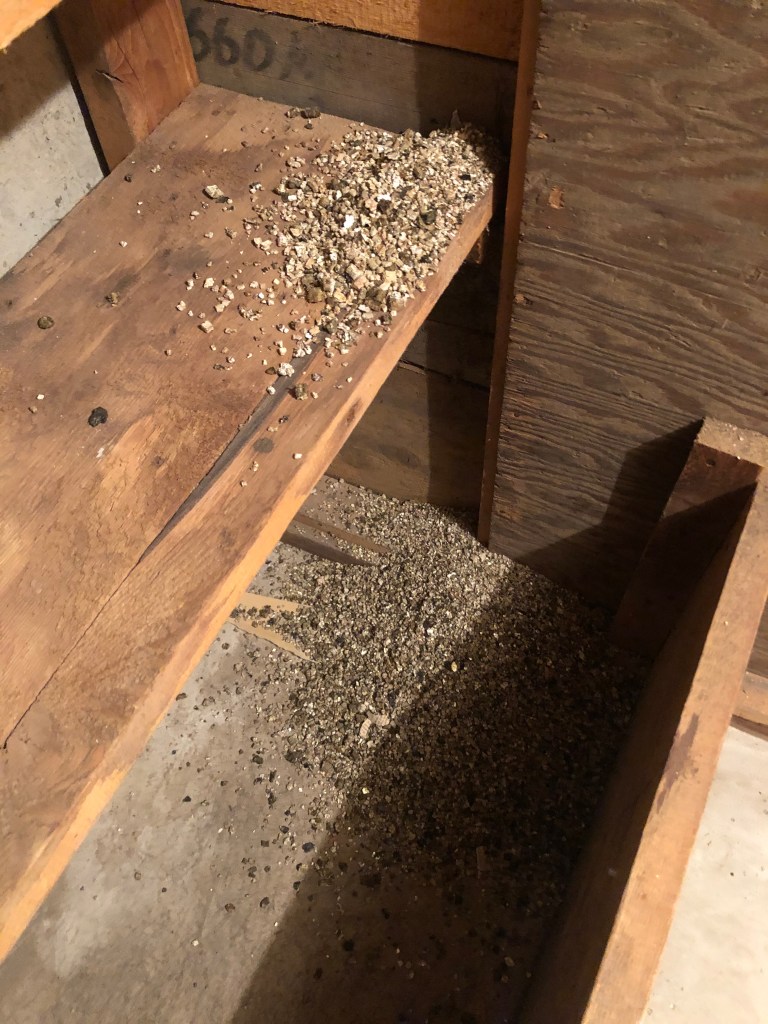
After two full days of demolition, they had about 90% of the basement demolished and on Thursday afternoon, Jeff (the owner of the company) brought me to the basement to show me that they had discovered the inner walls of our cold storage room filled with an asbestos insulation called Vermiculite. The tiles left under that wonderful orange carpet of the basement’s open area were also made of asbestos. This meant that demolition and bracing would need to stop until I could get professionals to come in and remove the asbestos.

We were already aware of the floor tiles prior to the project starting, as Jeff recognized it during his first visit. But it wasn’t a concern as it wouldn’t interfere with the bracing of the foundation walls. But the cold room unfortunately had to be demolished in order to access the section of south wall that needed to be braced. I looked up a local asbestos removal company and asked for someone to come take a look and provide an estimate. At about 4:30 pm on Thursday afternoon, one of the guys came over and assessed the cold room and floor tiles and advised he would email me an estimate of costs.

Asbestos tiles

For those who are unfamiliar with it, asbestos refers to silicate minerals that are arranged in a fine fibrous crystal form and was used for multiple residential and industrial applications in Canada towards the end of the 1870’s. It became a popular commodity, due to it’s fire and temperature resistance as well as its ability to stand up against exposure to chemicals. Given it’s physical flexibility, it was often used as a source material for floor tiles, insulation, sound-proofing and temperature control. Especially since it was so cheap. The big problem is that when asbestos is damaged or broken up, it can release microscopic “fibrils” that can potentially be inhaled.

Asbestos insulation, or “Vermiculite,” discovered once they tried tearing down this wall

The inhalation of asbestos can lead to certain forms of cancer, specifically mesothelioma. I won’t get into THAT one; y’all can use Google on that one. I’m just happy that I managed to spell it properly. I got my estimate on Friday afternoon, and was told that an asbestos crew would be there the following day (Saturday) to do the clean up. I updated Jeff and we agreed that this would work out perfectly as it would prevent any interference or delays with the foundation bracing.

The asbestos removal people were scheduled to be here at 8:00 am on Saturday morning. I got up at 7:00 am, in order to have Nathan dressed and ready in the event we needed to vacate the house for a few hours. By 8:40, I started to wonder if I had misunderstood and contacted the company. Lo and behold, they only showed up at about 10:30 as they apparently booked an earlier job before mine. Such is life.

I was not impressed with the situation. The asbestos removal guys even mentioned that the use of asbestos within the house should have been disclosed before our initial purchase of the property. But considering the original owner did a lot of his own work and on his own, he may have insulated that room himself and it may not have been a known fact. Now that all the hazardous materials had been removed, the demolition team were able to finish removing the remaining finishings and get the bracing done on the foundation walls.

This wasn’t the end of the issues, of course. Minutes into starting their work on Monday morning, the Grasshopper crew found another wall filled with Vermiculite, and had to stop work in that area. A quick call to the asbestos company saw a crew of three show up at my house within 30 minutes in order to clean it all up. I’ll admit that I was a little miffed with them and basically “ordered” them to ensure they tore apart every wall to ensure I wouldn’t have to bring them in a third time.

Thank the light that the Grasshopper crew were flexible and able to take a break to allow the asbestos team to clean up what they had missed on their previous visit. They vacated the basement and showed up to continue working without missing a beat. They somehow showed up right when he asbestos guys left and continued work before I even noticed they even came back!

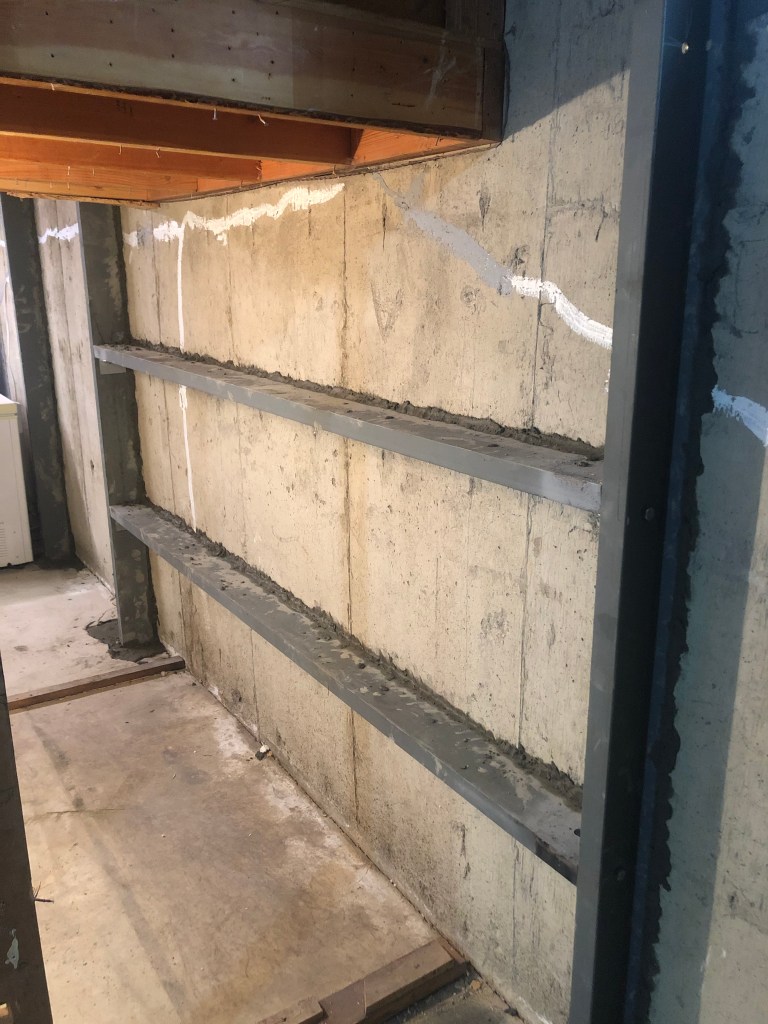
Wall braces, in all their concrete-straightening glory!

The Grasshopper crew worked over the days that followed, and I watched the progression of a heaved, cracked foundation to the neat, sealed and braced walls you see in the photograph above. A plumber and an electrician came in to reconnect certain pipes and power lines that had to be removed for the proper installation of the steel braces. All in all, the basement is looking way better than it did a month ago.

Over the next short period of time, we’ll need to decide if we’re to put our house back on the market or if fate and career will allow us to make it our permanent home. If it’s the latter, I’ve already got some ideas for the open space. Of course I do, this is me! I’m thinking pool table, maybe a mini-bar and cocktail fridge, dart board… After I get some flooring, framing and drywalling done, of course. I can hear my wife groaning already! Either way, a significant amount of stress is off my shoulders, now that I now the foundation of my home has been shored up.

Even the tight, difficult area under the floor landing, still properly and professionally braced

A really huge shout out to Grasshopper Construction, the owners Jeff and Shane, as well as Kess and Luke for their diligent and professional work and for putting up with the occasional distraction and questions from my 5-year old son Nathan. If you live in the Regina area, or know someone who does and requires foundation work or renovations, I can’t recommend these guys enough. Besides their website, which I’ve linked above, they also have a FaceBook page you can check out and see customer testimonials and photos of their work. ☯

A Type-1’s Naming Day…

Okay, I’ll be the first one to admit that maybe I need to lay off the YouTube for a while, because I personify the type of person who slips down the rabbit hole and finds way more than he expects to. Then I keep watching, and watching… And watching… But I found this video interesting, because it involves someone I’ve been watching on television over the past few months that I wasn’t even aware has Type-1 Diabetes! This catches me with a bit of egg on my face, because one of my biggest pet peeves is when someone tells me, “You don’t LOOK Diabetic…” What the fuck is someone “supposed” to look like if they have Diabetes?

The video depicts the Diabetes journey of American actress Mary Mouser, who has most recently played Samantha Larusso, the daughter to protagonist (depending on your perspective of the storyline) Daniel Larusso, in the popular web series, Cobra Kai. Now, being a long-time fan of the original Karate Kid movies, I jumped on this series without hesitation and watched both available seasons within days and am greatly anticipating the third season, which is said to be coming out in early 2021.

In the included YouTube video, Mouser describes her discovery of Type-1 and how it affected her life. She was diagnosed in 2009 at the age of 13, which I can say from having many friends in the same boat, is incredibly rough. I had the benefit of being diagnosed at the tender age of 4, which means I had barely a clue as to what the hell was going on. But you can see Mouser become visibly emotional at certain points in the video, and it definitely brings it home for me. Check it out:

Mouser talks about the tenth anniversary of her diagnosis and the video was posted on YouTube by Mouser herself, last year. I can’t help by note the similarities in the fact that although she’s only portraying it in a role, she plays a character who grew up in a karate environment. This rings true with a great deal of my own upbringing, as I grew up training in karate, as well.

I was diagnosed with Type-1 Diabetes in 1982, after passing out in a bowl of Froot Loops. Honestly. That’s what got me diagnosed. There were a number of symptoms that presented themselves for months before that incident, including weight fluctuations, severe mood swings and I even started wetting the bed again. One of the big problems with having a brother with Epilepsy, kidney failure and Fanconi Syndrome (a post for another day), is that my aches and pains often went ignored. Despite all of these symptoms, nothing appeared to be “seriously” wrong, so it was chalked up to growing pains or being a moody kid (which I was).

This wasn’t a slight on my parents’ part, it was simply the result of my brother constantly being on death’s doorstep where I was not. At least not that they knew of… Apparently, they were wrong. Imagine passing out on a Tuesday and waking up on a Wednesday… Of the following week! That’s how my journey started. And it was all downhill, from there.

When I woke from that first incident, I had severe Diabetic Ketoacidosis and my blood sugars were being slowly lowered and I was being rehydrated by way of an IV infusion. I had a number of family members present, including my parents, brother and grandparents. They already knew what the doctor hadn’t yet told me: I had Type-1 Diabetes. My life and my future were effectively changed, forever.

Over the two weeks that followed, I was taught a number of things including how to test my blood sugars, how to take insulin injections, dieting (which basically just involved avoiding sugar) and what would be involved in my day-to-day life for the rest of my life. It was hectic and stressful. I can admit that at the young age of 4, I only understood a small percentage of it. A lot of it went over my head, which created strange combination of indifference mixed with anxiety.

To my mother’s credit, she practiced injecting saline water into her own arms as opposed to practicing on an orange, which is what doctors and educators would provide, back in the day. Her perspective was that she wouldn’t allow anything to be done to her child that she hadn’t experienced herself. She bruised herself up pretty good, before starting to help me take my daily injections.

It was a disgustingly rough journey and over the years that followed, which included no less than 5 comas (the longest of which lasted almost two weeks), multiple changes in therapies and doctors and constant adjustments, I faced the inevitable lack in most of the advantages that kids my age enjoyed. I never joined sports, never had sleepovers and never enjoyed the usual social normalcies that kids my age had. But I adjusted and fought through all of it. My brother, who is now deceased, saved my life in almost every instance of the comas I mentioned, as he shared a room with me and would be the one to alert my parents that I was in distress.

In 1988, I faced a situation that no child should ever have to. I was told I was going to die. It wasn’t said in those exact words, but the reality sunk in regardless. Severe Diabetes complications including insulin resistance were causing my body to fail. Doctors really had no solution at the time, other than changing up my insulin type, which did absolutely nothing. Insulin resistance can be dangerous, since it prevents the proper use of glucose in your body.

That’s when I took matters into my own hands and joined karate. I started taking responsibility for my own diet and fitness and started to develop myself, physically. It worked for me. It may not work for everyone. But the important thing is to keep fighting and find what works for you. The nay-sayers over the years, have stated that they don’t believe that martial arts and fitness would help overcome medical complications. But the question is, how could it not? There may be no cure for Type-1 Diabetes, but you can still kick its ass. There are tons of ways to improve your health and stretch your life expectancy as opposed to what we faced, even 20 or 30 years ago. Keep fighting. Keep looking for a way.

And if Mary’s video inspired you or touched a chord, be sure to check her out on Cobra Kai, which is currently available on Netflix. There are only two seasons, with Season three coming out soon, but it’s definitely a hard-hitting show that covers martial arts, karate, the social condition and stars a lot of talented people from the 1980’s and modern day. ☯

A Little Something To Inspire…

I quote a lot of articles and posts in my blog. This is because I’m not a doctor, dietitian or fitness expert, although 32 years of intensive martial arts training HAS to count for something. But for the most part, I speak from the heart and try to be as genuine as possible while quoting sites and people that I know will add some credibility to what I say. Last weekend, I was free-falling down the YouTube rabbit one one night, since my wife was out of town and my 5-year old was fast asleep. And I found a video that moved me to tears…

Those who know me well are quite aware that I’m not a man who exudes emotion easily. But this man’s journey did it for me… The man in the video is named Vance Hinds. An assistant DA in Texas, he was living an extremely unhealthy life and weighed in at 475 pounds, which is over 265 pounds heavier than I’m currently sitting. Hinds was ironically first inspired to lose weight by a comedian named Burt Kreischer.

Although I don’t know why a comedian, of all people, would motivate someone to lose weight (I haven’t researched this person), Hinds reached out to a former professional wrestler named Diamond Dallas Page. I’m familiar with Page, having watched him wrestle throughout my 20’s and my early 30’s, and I know that he contributes a significant amount of time to helping other people achieve their weight-loss goals as a motivational coach.

I’m linking the YouTube video below. I don’t claim ownership, nor do I have any rights to this video. As I said, I just happened to land on it while surfing YouTube, one night. The video is only about 5:30 minutes and you can watch Hinds’ journey from 475 pounds to 277 pounds, for a total loss of 198 pounds. It’s pretty inspirational…

This motivates me. Here’s a guy that did it simply for the sake of improving his health and his overall lifestyle. No endorsements, no financially charged motivation; he did it for himself and his family. It brings my own journey into perspective. In 1988-89, I joined karate in order to help me overcome insulin resistance and Diabetes complications that threatened to end my life before my 20’s. I succeeded.

Now, as I move into my 40’s, I’ll admit that my own weight and living habits have fallen to the wayside. I’ve tried a number of different things to overcome these issues. And I believe that it’s important to try as many different things as possible; it allows us to find the path that’s right for us. But seeing Vance’s weight loss journey has made me realize that losing the 20 or 30 pounds I need in order to be healthier is small potatoes in comparison to what this man just went through.

When I attended the police academy in 2009, I weighed in at 185 pounds. By the time I graduated six months later, intensive training, exhaustion and diet brought me down to 165 pounds. It was the lightest I had ever weighed, at that point in my life. I’d like to say I felt great, but the exhaustion was palpable. Within two years of walking away from the academy, I broke the 200-pound threshold and I’ve been fighting to dip below it, ever since.

Obviously, Diabetes plays a significant role in how my metabolism functions and the weight I carry. That being said, I’ve seen Type-1’s who have been in the “skinny” category. Am I trying to be skinny? Fuck, no! I believe in carrying some mass, it’s one of the only way s to maintain strength. But I think that dropping some weight and finding a way to keep it off should be possible. In 2014, I was down in the low 190’s and that simply involved consistent cardio and weight workouts and a “reasonable” diet of three regulated meals a day.

Body image is an important part of who we are. You shouldn’t aspire to be who you see in magazines or on the internet, but rather who you feel you genuinely are. We can all gain inspiration from other people’s journey. The important part is finding a way to make it work for you, and to achieve the goals that you aspire to in order rot be healthy and happy. Hopefully, you all find that path. ☯

Mild Bragging Rights

I’ve been working on bring down my Hemoglobin A1C for about the past ten years. It hasn’t been easy; shift work, stress and basic lifestyle make it somewhat difficult to maintain decent blood sugars at the best of times. This was one of the main reasons behind why I decided to start on pump therapy. Over the past five years or so, I’ve been slowly creeping my way down.

For those of you who don’t speak the Diabetes dialect, Hemoglobin A1C (or simply A1C) is a measurement of the average blood glucose levels over three months by measuring the percentage of glycated hemoglobin in the blood. Anything over 6.5% is usually indicative of someone who has Diabetes. Anything below that is generally considered normal. There can be some exceptions to these levels, but it’s pretty basic and has been one of the most-used evaluations to measure how controlled someone’s blood sugar levels have been.

The big problem is that in the past five to ten years, improving A1C results have yielded to increasing one’s blood sugar’s “time in range.” That is to say, maintaining more time between 5.5 to 7.0 mmol/L. The big problem is that one’s A1C level can be manipulated over three months thought extreme highs and lows. Time in range cannot. Keeping your blood sugar in range can’t be manipulated, which is where my new pump and CGM come into play.

Auto mode on the new Medtronic 670G (or newish to me, at least) uses continuous glucose monitoring to verify my blood sugars every five minutes. That means that my blood sugar levels are measured 288 times a day, assuming the sensor and auto mode are working right. The best I’ve ever managed is about once an hour, without taking into consideration that I try to sleep for eight hours a day and work. Meaning that I may get lucky and test my blood six to eight times in the course of a day with a traditional blood glucose monitor.

Combine the fact that auto mode works to correct blood sugar levels with each and every one of those readings and you greatly increase your odds of improving your time “in range.” Listen to me, I sound like a damn infomercial. I should be getting commission from Medtronic for endorsing their products. But seriously, my insulin pump and CGM have been great tools for helping me lower my A1C’s over the past few years.

Just to give you some reference, I started out with an A1C of about 8.4% five years ago. At those levels over an extended period of time, this A1C level will eventually cause vision problems, blood vessel and organ complications, heart disease and stroke. It stands to reason that I would want to try and lower it. But considering what I wrote in the previous paragraphs, why am I still focused on A1C’s? Shouldn’t I be working on “time in range?” Yes. Yes, I should. That’s why I’m doing both.

Better time in range means a better overall A1C. So the bottom line is I’m working on both. A week ago, I visited with my endocrinologist and was advised that my A1C level was at 7.2%, which is the lowest it’s been in years. My overall goal is to get to at least 6.9%. That would be a feather in my cap, as my doctor would say, and is hopefully a goal I will be able to achieve by my next appointment in March. ☯

You Can’t Go Back Again…

If there’s one thing I know, it’s that you can’t go back again. What’s been is gone, with nothing left but what’s to come. Although I’ve always lived my life on the concept that one should never have regrets, there’s nothing wrong with missing certain aspects of one’s past. It’s encouraged, in fact. After all, as philosopher George Santayana once said, “Those who cannot remember the past are condemned to repeat it.” Of course, I believe he was referring mostly to being mindful of the lessons learned from our mistakes, so as to avoid repeating those mistakes in the future.

I was on a popular blog site this afternoon, when I came across a post about what people miss about the 90’s. The 1990’s were an exciting decade for me. I was never a fan of “boom-chick” music that seemed to be all the rave (see what I did there?) in the 90’s, preferring the more classic versions of true rock that emerged in the 1980’s, despite the hair and scrotum-strangling jeans that came with it.

It got me thinking about the specific things I miss about the 1990’s, and since I haven’t written one of my wonderful lists in quite a while, I thought this would be a fantastic opportunity. Without further ado, here is my top seven things I miss about the 1990’s:

  1. No Social Media: I’m coming’ out swinging on the first one and it may not be a popular or shared opinion. But I miss the days when social media DIDN’T rule the world. The likes of Facebook, Twitter and Instagram were barely an idea in some nerd’s brain at this point, and life seemed all the better for it. People actually did things together in groups (imagine that?) instead of spending nights up chatting online;
  2. Gaming Systems: Oh, to have an original NES system at my disposal… I use an online emulator to play some of my old favourites like Super Mario Bros. 3, but it’s just not the same. And yes, I totally get the irony of bashing on technology while admitting I use it to revisit the past. Let’s not go there! The arrival of the N64 changed gaming forever with the two best games for group parties: 007: GoldenEye and Super Mario Kart 64. It always felt as though we could play those games forever and never get tired. Games these days are all purchased on one’s phone or tablet. It lacks a certain “je ne sais quoi…”;
  3. Television Was Better: Many may argue on this point, and I’ll admit I’d have difficulty living without the miracle that is the MCU, but television in the 1990’s was LIT! TGIF lineup on Friday nights, movies that didn’t have a bunch of CGI thrown in and if you missed an episode of your favourite show, you were pretty much fucked as you couldn’t go back and rewatch it like you can on streaming services today. But the overall content just felt more real and genuine;
  4. There Were No Cell Phones: Smart phones have made our lives easier in so many ways, I’ve lost count. Emailing, scheduling, surfing the internet… Not to mention using it as a phone! But there was something liberating about knowing you could leave the house and not be pestered by texts, calls and emails at all hours of the day. Just because it’s convenient doesn’t make it good! It seems as though there’s simply no way to just “get away” these days, short of turning your phone off. And then you have to explain to folks why your phone was off and you ignored their contact. It’s a mess;
  5. Things were cheaper: I’m probably wrong about this, but the 1990’s felt like the last decade before inflation starting bending us over a log and jamming a red-hot poker up in there! Back in the mid-90’s when I got my driver’s licence (and purchased my own first vehicle), gasoline was only 56 cents per litre! Can you imagine? I had no idea how good I had it! Gasoline is currently 1.22 cents per litre, and when it dropped into the 90’s during there pandemic, people lost their fuckin’ minds! I used to work at a Catholic church’s bingo hall every Thursday night, collecting bingo cards for $15. On Tuesdays, I would walk or bike to my local corner store and purchase all four latest Superman comic titles, as well as a diet soda and a bag of chips for about $5. Financially, I was living large! Nowadays, it pretty much costs the $5 to purchase ONE comic book, let alone three of them with snacks;
  6. I Was Home: In a lot of ways, I don’t miss being a kid or a teenager. Living under someone else’s rules has never been my forte, but I had no idea how good life was. Everything was provided, I was safe and comfortable and I was with my family with my whole life ahead of me, and I had my Sensei and my karate school available to me. Although many would agree that being an adult and making your own way through life holds its own aspects of freedom, youth brought its own freedom, as well;
  7. Everything Was Fresh And New: Most people who think back on their adolescence will find memories of everything they did for the first time. Getting their driver’s licence, that first vehicle, first job, first girlfriend, first everything with said girlfriend… cough, cough… But now, the stress of adult life has watered down most things. I remember getting my first car. It was an absolute piece of shit. A two-door 1986 Toyota hatch back, 3-speed manual transmission. Yes, you read that right: 3-speed! But I loved that car to the moon and back, despite it’s poor condition and for performance. In April of 2018, I purchased a new-to-me sports coupe because my previous vehicle’s transmission exploded on the highway (you know the car, it’s the one I wrote about in Goodbye, Sweet Car…🎶). And all I could think of at the time, was how I now had a new bill to pay every month. Some of the innocence is lost.

Folks, we can’t go back again. This much is certain. But we can always look back fondly on the good things that we experienced, even if at times we didn’t realize they were good things. Every emotion, every action and every experience we went through in our past helped to define the people we are today. And unless you’re a career criminal or intentionally make other people suffer, who you are is pretty great.

What are some of the things you miss most about your adolescence? Feel free to leave your best memory in my comments section. ☯

Life, Uhh, Finds A Way…

Yes, I know Jurassic Park came out 27 years ago and most people from this generation may have heard of it, but have likely seen the newer, shittier iteration, Jurassic World. I love the work Chris Pratt has done on Parks & Rec, and definitely his portrayal of Starlord in the MCU universe. But there’s a special place in my heart for Steven Spielberg’s original interpretation of Michael Crichton’s book and I’m a HUGE Jeff Goldblum fan, hence the title. But movies aren’t the focus of today’s post. I mostly brought all this up so I could use Goldblum’s popular line from the movie as my title.

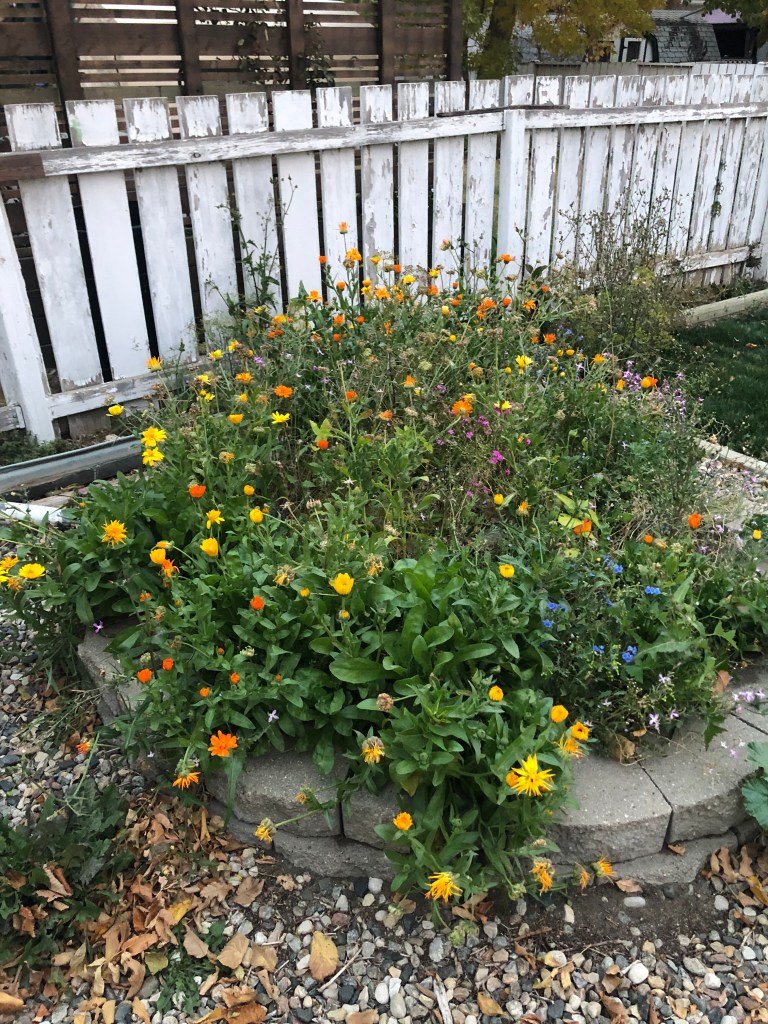
In fact, my flowers are the subject of conversation for today. At the start of August, I had written about how people are stepping outside their comfort zones and are undertaking a score of home projects, due to all the downtime everyone suddenly has as a result of COVID-19. My pet project was turning my backyard into something that didn’t look like the desert wasteland in Mad Max (another fantastic movie!) I wound up turning our barren dirt patch into a lush, green lawn and I planted a batch of flowers in a round, concrete planter that was there when we moved in.

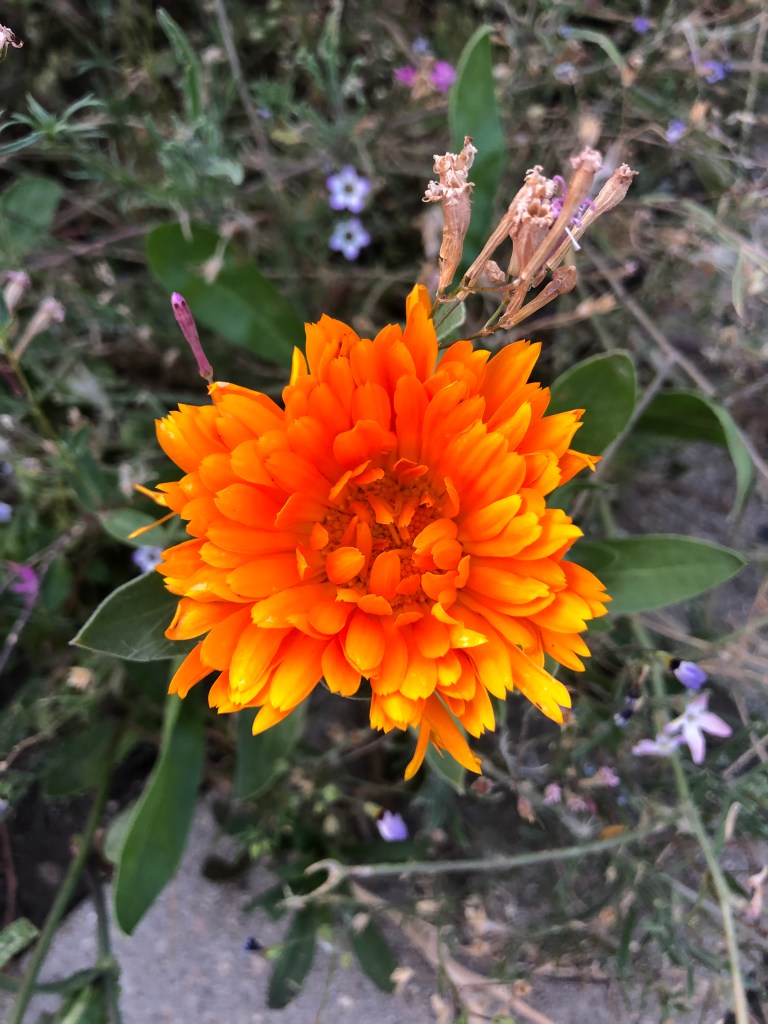
The first example of one of my blooming flowers

During this last post about my backyard, I had written how excited I was about the full growth of greenage coming out of my planter, how I was starting to see a few flowers sprouting up and couldn’t wait to see how full everything would bloom. Then, a quick day-visit from my mother-in-law confirmed that most of the green in the planter was actually an invasive weed preventing the flowers from taking hold. I was pretty miffed at the time, especially since I was foolish enough to think it was all flowers. But my wife and I worked at removing as much of the weeds as we could in order to allow the flowers free reign.

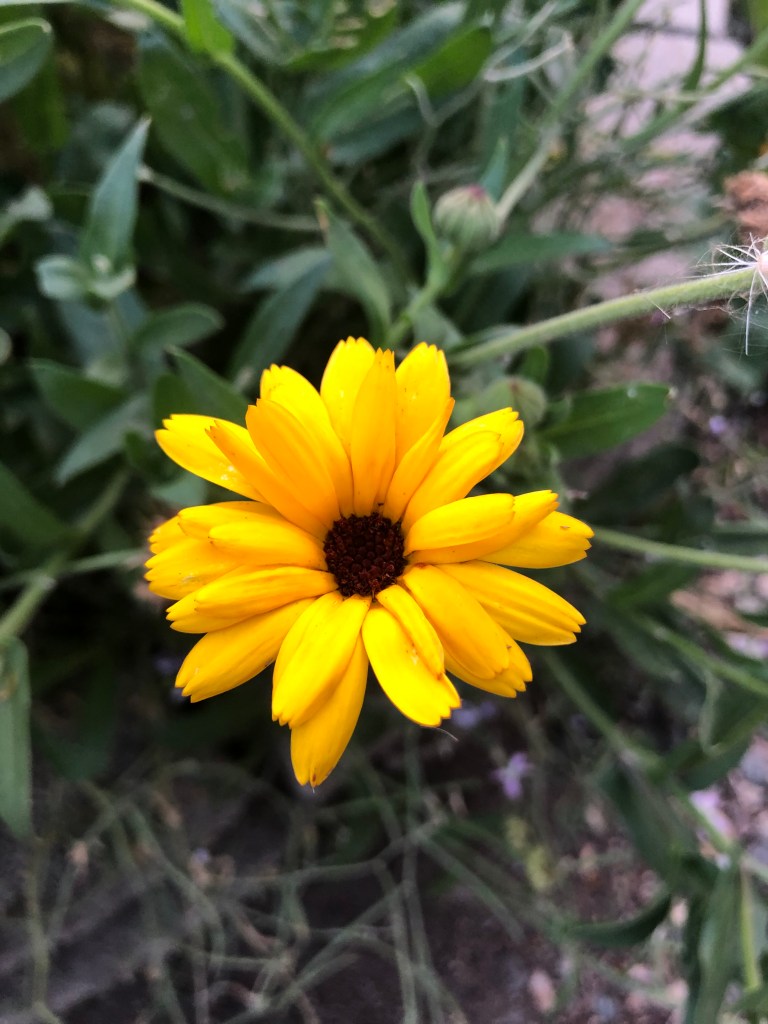
Another one of my flowers in full bloom

I’ll admit that my recent focus has been on our home’s foundation and the repairs required, as well as their inherent cost. Now that the back lawn has taken proper hold and I have my garage cleared out as a dojo space, I’ve been largely ignoring the back yard. Until I noticed sometime last week that the planter seems to be in massive bloom, despite all the dead leaves floating around it. Even with the colder weather and autumn starting to set in, my flowers seem to keep on kicking.

Look at all this life, would you?

I know, flowers aren’t really everyone’s thing and many are likely thinking, “What’s the big deal? So you planted some seeds and they sprouted…” Well, first of all, to those many, shut up! Second of all, there’s a distinctive pride to undertaking something you’ve never done before and have it be successful. Especially faced with the fact that I struggled with getting it started over the summer, but once I left it alone it bloomed quite nicely on its own. Hence, Jeff Goldblum’s line about how life finds a way.

Nathan’s favourites, “Look at the blue, Daddy!”

It’s nice to have an outside hobby that can be done during the warmer season, and I’ll admit that planting flowers and tending to them is quite peaceful. And in case you don’t get the vibe behind my blog, trying to be at peace is kind of the point. One can’t help but feel joy at the sight of so much life blooming in one’s environment. With October in full swing, and snow likely to hit the ground within the next month, these flowers likely won’t survive for too very much longer. So I thought I would share them with all of you before they disappear. Granted, if they keep on blooming through the snow, I’ll be writing a different post about how I’ve grown “super flowers.” ☯