The home of Buddhism, Martial Arts, Diabetes and health…
Author: Shawn
I am a practitioner of the martial arts and student of the Buddhist faith. I have been a Type 1 Diabetic since I was 4 years old and have been fighting the uphill battle it includes ever since. I enjoy fitness and health and looking for new ways to improve both, as well as examining the many questions of life. Although I have no formal medical training, I have amassed a wealth of knowledge regarding health, Diabetes, martial arts as well as Buddhism and philosophy. My goal is to share this information with the world, and perhaps provide some sarcastic humour along the way. Welcome!
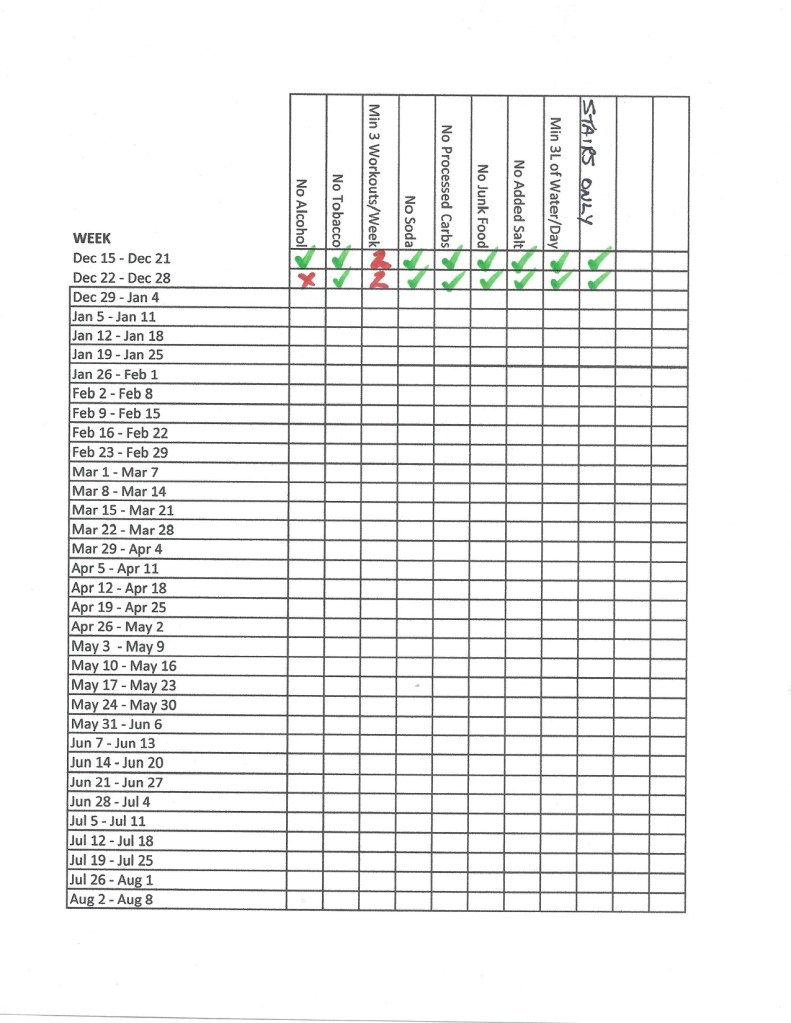
About three weeks ago, I wrote a post about what I intended to do for my New Year’s resolution. It’s pretty ambitious, considering most people will choose one thing or another, such as losing weight or eating healthier, joining a gym or quitting booze or smoking. I chose a rather elaborate spreadsheet that included the following steps:
No alcohol;
No tobacco;
Minimum of 3 workouts a week;
No soda;
No processed carbohydrates;
No junk food (yes, there’s a difference);
No added salt;
Minimum of 3 litres of water a day; and
Taking only the stairs where possible.
My intention had been to start it on December 29th as this is the Sunday that encompasses the January 1st week. However, I read someone else’s post about New Year’s resolutions and I was reminded of a couple of things.
Although it can be great to take yourself in hand and make a resolution in order to better yourself, if you wait until New Year’s in order to make that change it’s likely not important enough to you. The other aspect one needs to consider is, why wait?
I think the post I read said it best when they explained that if your resolution is to join a gym, why walk in as the new guy on January 1st when the new people will walk in and you’re already a regular? In that spirit, I started my New Year’s resolution on December 15th.
My first two weeks of the challenge
As you can see from the spreadsheet above, it’s pretty straightforward. At the end of the Saturday evening, I put green checks on the items I accomplished and a red “X” on the items I did not. The workouts have been rough, considering karate has been shut down for the holidays. Otherwise, I’d be hitting four workouts for both those weeks. Plus, it’s the holidays! I’ve been a little a little busy focusing on the actual holidays and on family.
Although there is already a touch of red on my ledger, the important aspect to remember is that a resolution is intended to help improve oneself. I’ve also been allowing myself a “cheat day” on Fridays. From what I’ve researched, folks have a better chance of sticking to any sort of regiment or major change in lifestyle and diet if they allow themselves a touch of indulgence once in a while.
I won’t bore all of you by posting updates on this every week, but I’ll provide some updates every few months to show my progress. We’ll see how long I can tough it out… ☯
Welcome to the New Year! It’s the beginning of a new decade, the return of the Roaring 20’s and the beginning of a fresh 365-day batch of opportunities. Hopefully everyone isn’t suffering from whatever celebratory choices you made last night and you can walk into the New Year with a skip in your step.
The past two years have been a bit of a challenge. After a lifetime of work, sacrifice and learning from mistakes, 2018 saw me get struck down in the prime of my chosen career by a selfish individual motivated by their own goals. I was taken away from my place of work and assigned elsewhere. I made the best of a bad situation and met some of the best people I’ve had the opportunity to work with.
2019 saw disappointment as I travelled the country in search of a different venue in which to continue my career (a fact I chronicled in my posts entitled “A Strange Odyssey” from last September) which yielded no results. A family member recently passed away and my wife and I have failed to sell our house. But through this disappointment, I was blessed with the birth of my second child, Alexander.
There have been ups and downs, happiness and disappointment, laughs and definitely some tears. But as hard as these difficulties have been, I have the benefit of knowing that there has always been some positive to go with the negative. And there usually always is!
And this is how you should face 2020. Take the time to focus on your health, your happiness and some goals for this year. And once you’ve established those goals, work hard until you achieve them. There’s really no other way to live.
And finally, a word on the title… I’ve always said that one can’t live life with regrets, that every choice you’ve made, good or bad, has inevitably led you to the wonderful and awesome person you are today. There genuinely is no way to regret that. But don’t forget to take the time to remember and contemplate some of the mistakes you’ve made in the past year. Not only will this prevent the possibility of repeating those mistakes, you may learn a little something about yourself to pave the way through a smoother year, this time around. ☯
I thought I’d finish out 2019 with the grossest topic I can think of, because, why not? As I’ve often written, having Diabetes can lead to a heavy score of complications and we already know that our immune systems are total crap. And crap, as the turn of phrase would have it, is the focus of this post…
How often do you go to the bathroom and look at what comes out? Before most of you start wondering if I have a pitcher of eggnog or a spiced rum at my desk as I write, this is an important part of proper health. Because what comes out of you is important and can tell you a great deal about your health.
I’ve looked into a few different sources and referenced some medical practitioners only to find a batch of common consistencies that they all bring up, as it relates to going #2. Here’s what I found:
It shouldn’t take forever: There are always jokes made about how if someone is taking too long in the bathroom, it’s because they’re going #2. As funny as that joke might be (I guess), the average bowel movement shouldn’t take you more than fifteen minutes. And that’s pushing it (pun intended). A healthy bowel movement should come easily with little pushing effort to move. And the time frame doesn’t include how long you waste getting past that tough level on Angry Birds;
It shouldn’t hurt: The human body is an exceptionally well-designed machine, and your digestion and elimination systems are no exception. If a bowel movement is painful or difficult to pass, this can be a sign of further concern. It should be closer to spitting a grape out of your mouth, not giving birth to a rhino;
It should look normal: What is normal? I’ll get to that in a bit, but the basic is it should be solid or semi-solid and have at least SOME shade of actual brown to it. Anything else can be a sign of dehydration, lack of fibre, diarrhea, food intolerances and even stress;
You should be going once a day: An article posted by HealthLine.ca indicates that, “On average, a person with healthy digestion will poop anywhere between every other day to three times a day. Any less could suggest constipation […].” (https://www.healthline.com/health/digestive-health/types-of-poop#3);
“Regular” is a real thing: Despite point #4, I feel there’s a hell of a difference between going every two days and possibly going three times a day. As long as your diet and health are consistent, you should have a regular regiment and even go around the same time every day. If you’re used to going every morning at 7 am after your first coffee and all of a sudden you’re running for the nearest washroom three or four times, there’s likely something amiss.
These are only general guidelines based on the articles and references I’ve found, of course. As is the case with almost everything related to one’s health, every person is different and proper health is based on your specific diet, exercise routine, outlying medical conditions and hydration.
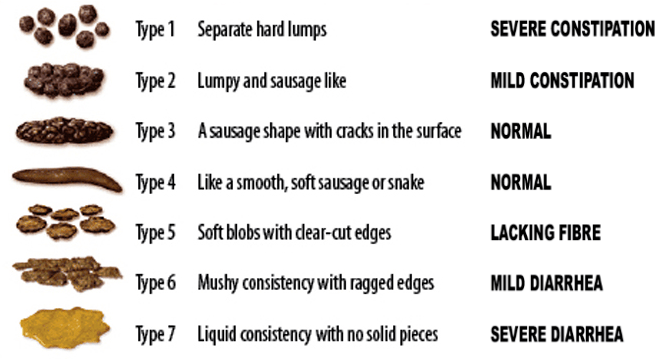
But let’s talk consistency for a moment, shall we? Back in the late 90’s, Dr. Ken Heaton from the University of Bristol, developed a chart that outlines the different shapes and consistencies of bowel movements in order to provide a baseline of what your particular bowel movements may be telling you. It was named The Bristol Stool Chart, butis also known as the Meyers Scale.
An example of the Bristol Stool Chart as found on Wikipedia
The chart can be easily found by Googling it, and they all show the same thing, despite some differences in design and appearance. What you’re looking for is either Type 3 or 4, with all other types signifying some potential problem or issue with your elimination and/or health. If you have Type-1 Diabetes and can basically dehydrate at the drop of a hat, diarrhea can be a serious issue. Remember to drink plenty of fluids to stay hydrated.
Next is colour! The poo emoji got it right; your bowel movements should be a shade of brown. There are, however, a number of other colours that may suddenly show up in the bowl.
Black or red could be an indicator or internal bleeding, however mild or severe. Of course, red could also be an indicator that you ate something pertinent, such as beets, red berries or drinking heavy amounts of tomato juice, which can add a tinge of red to your bowel movements.
White bowel movements can indicate potential liver or gallbladder issues and shouldn’t be ignored. Green colour can be an indicator of something you ate, but is also dependent on the consistency. An article posted by MedicalNewsToday.com gets pretty descriptive and can be read here: https://www.medicalnewstoday.com/articles/320938.php#colors-of-poop
At the end of the day, the best ways to ensure proper elimination is to stay hydrated, exercise regularly and try and eliminate stress from your life (that last one isn’t the easiest). And there can always be one or more of these factors that suddenly make an appearance in your porcelain opera. It becomes a problem if colour, consistency or frequency change in such a way that it is no longer a one-off and doesn’t feel normal.
If you begin to feel pain, identify blood in your stool or have a colour or consistency change that doesn’t go back to normal after two or three days, you should go see your doctor or medical practitioner. Most people consider their bathroom trips to be an opportunity to get a few minutes of quiet time, read a chapter or play on their phones. But keeping an eye on what comes out can be a good indicator of your health. ☯
One of the known side effects of extreme blood sugar levels is the occasional mood swing. The problem with mood swings is that they aren’t uniquely a Diabetes related symptom. So how does one know if one’s bad mood is related or not? That’s easy: test your blood sugar.
“I’m ready to go off the deep end because what are the highs without the lows…”
S. Tellaz
Your mood is a subjective thing, which is why it’s difficult to tell whether it’s related to a condition or simply being in a bad mood. And as people have often said, never in the history of humankind has someone calmed down at being told to calm down.
Personally, when my blood sugar has the occasional spike, I turn into what could easily be described as a “cranky-ass biatch”, to use the proper vernacular. This isn’t a common change in mood associated to high blood sugar. But like everything else with Diabetes, it can be subjective to the person.
But extreme lows have shown to cause forms of aggression as well. There’s a good article in Medical News Today that outlines a good deal of this and can be read here: https://www.medicalnewstoday.com/articles/317458.php
I remember one time, in high school, I suffered an extreme low. This was well before the advent of CGM and interstitial blood glucose testing, so my meter was the only means of checking my levels. My meter was normally kept in my locker. I remember starting to feel woozy in class, right before lunch. As teenagers can sometimes be, I was foolish in thinking I could stave it off by staying still in class until the lunch bell rang. I was wrong.
Within fifteen minutes, I couldn’t concentrate, I was groggy, sweaty and all I wanted to do was go to sleep. I remember the guy seated next to me, poking me and asking if I was okay. When the bell rang, I walked my way down to the lunch line and stood to wait. As I stood there, I felt a sense of hyper-vigilance and something akin to paranoia.
Ironically, I had forgotten my money for lunch that day, and who else but my mother walks into the school and approaches the lunch line and provides me with some cash. I can’t remember if she realized that I had forgotten to bring cash or what, but I recall having a very aggressive response to her sudden appearance at my school.
Once I had some food in my system and things returned to normal, I started having some vague recollection of the harsh words I had used on my mother. I apologized when I got home, but it definitely took some explaining to make her understand that I wasn’t in control of my own faculties.
And this is a common occurrence with a number of the relationships I have had in my youth and my teens. Many friendships and relationships have been soured or ruined due to my temper, much of which could have been attributed to my blood sugar levels. And it definitely doesn’t help to have someone saying, “You’re cranky!” That usually only results in more aggression.
These days, I’ve managed to work it out in such a way that when I begin to notice my own foul mood, I test my levels and adjust accordingly. This not only helps with maintaining a better percentage of “time in range”, but it spares my family from my moods (at least most of the time).
We can’t always tell when our mood begins to foul. And we sometimes have no choice but to depend on someone else pissing us off by telling us we’re crabby in order to realize it. Test your blood sugar levels regularly and especially if you feel as though you’re in a foul mood. ☯
I’ve always been a bit more of a loner when it comes to training. For the most part, I prefer some solitude in order to listen to my own music, have access to my own equipment and not be hindered by others who may be at a station that I want to use. Obviously, this doesn’t apply to the martial arts, which often requires the dojo setting for some aspects. I mostly mean resistance and cardio training.
Oh, I’ve had gym memberships in the past and have made wonderful use of them in the past. But I’ve always been surprised at the “muscle shirt, light lifters need not apply” culture that still seems to exist in many gyms.
I remember an incident from almost eight years ago. I had a membership at a local gym (the only gym in town, actually). I had gone in for a short cardio workout before starting a work shift and I saw a guy standing in front of the dumbbell racks and arm curling some 10-pound weights. I remember thinking that he was really into his workout and had a great sweat going.
Then I noticed three guys at the squat rack. They were your typical types that you’d see in an 80’s action movie. Sleeveless shirts, thick arms and chest and monopolizing the station they’ve chosen. They had been there for a while and were obviously very pleased with themselves.
When they took notice of the guy with the lighter weights, they started pointing and laughing. One of them even called out to the guy and asked, “Do you even lift, bro?” This is an expression that came out in the early 2000’s and has driven me crazy ever since.
Folks, the reality is that it doesn’t matter how light or how heavy your weights may be. I’ve seen some circuit workouts using very light weights that would land you on your ass and make you limp the next morning. The style and weight involved in your workout all depends on what your goal happens to be.
Looking to lose weight? Want to gain some mass? Want to gain some actual strength as opposed to size? The workout regiment you design for yourself is subjective to what you’re trying to accomplish. And if it’s your first time stepping into a gym or any other public location where folks workout, you’re already one step ahead of the person who chose to stay on the couch today.
Unfortunately, there may always be those who chose to make fun or belittle others who are trying to better themselves. Don’t let it discourage you. As Lao Tzu once said, “The journey of a thousand miles begins with one step.” The beginning you make today will provide the results and satisfaction you have tomorrow. ☯
Contrary to most people’s opinion, emergency situations of varying types are not only the norm in today’s society, they tend to happen frequently and almost daily. Whether it’s someone in medical distress or someone being attacked or harmed, it happens far more than any of us care to consider.
Although I would be far from considered the type of person to intentionally install fear in people, my field of work has given me a particularly subjective look at this type of phenomenon. And what’s worse is that if the average person knew just how much chaos takes place in their “quiet little town”, they would likely think twice about going out and/or locking their doors.
But before I get too dark and morbid, what I’m talking about is the propensity people seem to have to ignore something happening right in front of them. What I’m referring to, is a phenomenon known as the Bystander Effect.
There was a case that took place where a New York City resident was attacked and killed outside her apartment complex in 1964. There were apparently dozens of witnesses who saw the attack taking place and heard the woman crying out for help, but no one intervened despite witnessing the incident. Once the attack was over someone phoned police, who responded within two minutes.
Imagine if this was you. You’re screaming for help and despite all these people watching, no one steps in to help. It’s actually an effect that’s been documented and studied by a number of sources. I’m sure some of you may recall an incident in the early 90’s where a two-year old boy was dragged away against his will by two older boys, who subsequently killed the toddler.
Although there are a number of common sense reasons why any given person may not want to get involved in an emergent situation, the need and importance of intervening is critical. Let’s back up to that 1964 attack I mentioned earlier. That attack is said to have lasted for over 30 minutes while people watched. If someone had phoned the police right when they saw it happening, the police likely would have arrived on scene in two minutes and the victim’s life would be spared.
The biggest problem, if we examine it from today’s perspective, is that most people are more preoccupied with whipping out their cell phone to film the incident rather than help. And there’s an after-effect to the Bystander Effect known as a “diffusion of responsibility”. This is a concept that explains that the larger the crowd of onlookers, the less likely a single person will lend aid. this is because there is a tendency to believe that someone else will step in and that you won’t need to.
I’m reminded of the multiple occasions where I’ve received a call from someone stating that there was a vehicle off the road along a major highway. I’d ask the caller if there were any injuries or casualties. That question would always be met with “I don’t know, I didn’t stop…” When asked why they didn’t stop, I’d either be told that it wasn’t their problem or that it was “my job.”
I asked this question earlier on, but imagine if this was you. Wouldn’t you want someone to help? Providing aid certainly is everyone’s responsibility. If you come across something, step in and help. And if you feel the need to whip out your cell phone, take the time to dial 911. You may be saving someone’s life. ☯
Ah, hangovers! They’re almost synonymous with the holidays, aren’t they? With eggnog and other lovely “adult” beverages available to us over the holidays, many of us find ourselves waking up the next morning with the tell-tale headache that signifies a hangover.
But what the hell is an actual hangover? Most people assume it’s simply a headache associated with too much drinking; and they would be PARTIALY right. But there’s a lot more to it than that.
A hangover is actually a grouping of symptoms caused by over drinking. Contrary to popular opinion, they can happen anytime during the day and are not limited to first thing when waking up. The symptoms can include but are not limited to:
Headaches and dizziness;
Dehydration and thirst;
Stomach aches;
Nausea and vomiting;
Diarrhea; and
Fatigue and exhaustion.
There are many more, but people often don’t recognize them as they usually sleep through a number of them. The good news, is that hangovers generally tend to go away within one day. You normally don’t have all that long to suffer.
So, what can one do to prevent a hangover? The most obvious answer is to abstain from the consumption of alcohol. Or at the very least, drink in moderation. But the reality is that there is no cure for a hangover. Yes, you read that right! THERE IS NO CURE FOR A HANGOVER! Despite what some over-the-counter medications may have suggested, there is no magic pill to make it all go away. But there are some things you can do to alleviate symptoms:
Drink plenty of fluids: Not the alcoholic ones! Get lots of water in your system to replace the fluids you’ve lost through dehydration, which could also be the cause of the stomach aches, nausea and diarrhea;
Have a cup of java: Caffeine is a natural stimulant and may help alleviate some of the dizziness and grogginess associated with the hangover. Caffeine can also cause further dehydration, so be mindful with this one;
Have some food: No, it isn’t to soak up excess alcohol in your stomach; that’s a myth! The booze will mine its way into your system regardless of the spicy donair you mixed it with at 3 am. But having something to eat may help to regulate blood sugar levels (even in non-Diabetics) and help to alleviate the headaches and fatigue;
Sleep through it: This one has to be my favourite. If you are able to stay in bed and sleep it off, this is the natural and easiest way to get through it. Keep a glass of water on your bedside table to stave off thirst and dehydration and snooze away;
Don’t take Tylenol: Sure, some painkillers can help with the pain, but stick to Ibuprofen or aspirin. Acetaminophen can have adverse effects on the liver, especially if there are still lingering traces of alcohol in your system;
Don’t be a chump: Some people have heard that having a morning eye-opener or “hair of the dog”, as it’s sometimes called, can help alleviate hangover symptoms. If you drink while hungover, all you’re doing is prolonging the process of getting past it. There is NO evidence that having those two or three drinks actually help. Quit while you’re ahead, limit how much you consume and politely decline further drinks, even if you’re in a social setting.
It goes without saying that all the symptoms described above can be worsened or aggravated if you happen to have Type-1 Diabetes. I’ve written recent posts on the effects of alcohol for Diabetics, so I won’t regurgitate the same stuff over and over, but be certain to check your blood sugar often and stay on top of it.
Ultimately, moderation is key. But one needs to remember that hangover symptoms shouldn’t last more than 24 hours. If they do, it could be a sign of an aggravated medical condition or worse. If symptoms persist beyond a full day, it may be time to visit your doctor. ☯
Being selfless isn’t easy. In fact, most people don’t manage it to save their lives. And for good reason. Biologically speaking, humans are built to be selfish; not because we’re assholes but because it’s a survival mechanism. Don’t get me wrong, humans ARE assholes as well! But I digress…
Selfishness is a survival mechanism, because if our ancestors weren’t selfish with their food and gathering of basic needs, they wouldn’t have survived to evolve into what we are today. But considering the fact that we are a society of self-aware people who understand the difference between right and wrong, shouldn’t selflessness become the priority?
The average person with any modicum of common sense would assume so, but it’s still surprising how easy it is for people to remain selfish in the face of situations where they could and should be thinking of others instead. Allow me to provide an example…
Let’s say you walk into your Christmas staff party. You feel light-headed and check your blood glucose level to see that you’re running low. You walk over to the buffet table and notice that there’s only one piece of sugared food left. As you reach for it, someone else grabs for it and picks it up. You explain that you need it to raise your blood sugar. The other person shrugs and takes a bite. You ask if they have Diabetes, to which they reply that they do not. You explain that you need it to raise your blood sugar as you ARE Diabetic. The other person says something akin to it being your problem, not theirs and walks away while munching on the sugared food you needed.
So, who’s right? Does what that person did make sense? Sure, it’s easy to figure that it isn’t the second person’s problem and that since it’s a first come, first serve buffet, they’re totally entitled to that piece of food. But let’s consider that word for a moment: entitled. If it comes at the cost of someone else’s well-being, are we ever truly “entitled” to something? The second person really had no need of that piece of food, they simply wanted it. Even faced with someone else’s genuine need, they selfishly choose to keep it for themselves.
And no, this specific scenario didn’t happen to me (although something similar may have taken place to someone close to me recently). I’m merely using this example to illustrate a point.
In a modern world where we understand the difference between right and wrong and are able to realize when someone genuinely has a need for something, there’s nothing wrong with being selfless enough to step aside and let the other person have the moment. After all, there’s enough suffering in the world. We, as people, should recognize that it’s our responsibility to lessen that suffering. ☯
No matter what your plans are this Holiday Season, be safe, be warm and enjoy all the pleasures that celebrations with your families allow! Be kind and loving to each other and take the time to reflect on life and all the good things it can bring.
From my family to yours, Merry Christmas & Happy Holidays! ☯
Over the years, there has been a slow decline in some of the verbal freedoms that we’ve always taken for granted. The best example would be the fact that when I was growing up, saying “Merry Christmas” was the expected greeting you gave people during the holiday season. But in recent times, it’s become almost anathema to some people, bordering on the rude, to wish someone a Merry Christmas.
For the most part, this decline in the use of a time-honoured holiday greeting has been attributed to a difference in background and religious beliefs. I’ve lost count of how many times someone has told me, “I’m not Christian and so I consider it offensive for you to offer me greetings based on a religion I don’t practice…”
I’m paraphrasing, of course. But my question to these people has always been simple and straightforward: why? This trend has reached most branches of society, going as far as retail and business locations forbidding their staff from giving a specific greeting in favour of a generic and dry greeting of “Happy Holidays”.
That’s all well and good, but doesn’t restricting someone from using a greeting based on their own beliefs violate the same freedom the ones complaining about it are trying to maintain? Seems a tad on the hypocritical side…
I was baptized into the Catholic faith when I was a child. I was raised in an environment where my family celebrated Christmas and the birth of Christ (although most scholars have indicated this didn’t ACTUALLY happen on December 25th, but that’s for a different post). But given the changes in my life and faith since then, I consider it a sign of respect for someone to use the greeting associated with their faith.
For example, if someone from the Jewish faith were to say, “Happy Hannukah” I would respond with, “Thank you so much. And Merry Christmas.” In Canada, we have the significant freedom to exercise the faith of our choice; a choice not everyone in the world gets to enjoy. So why butt head’s against each other to try and “have it our way?”
There is room enough in this world for everyone’s faith. One of the beautiful things about faith is that it doesn’t take up any physical room. So why take up room exercising it or restricting others? Let’s take a moment this holiday season to see the beauty in everyone’ faith and appreciate the fact that time has been taken to wish us well. After all, the holidays should be about family, celebration and freedom. Merry Christmas! ☯


 The Blogging Buddhist