
Ah, Shakespeare… I never read much of his stuff through school the way many others might have. Apparently, French schools in Northern New Brunswick took issue with using English literature as a base for learning. No idea if it’s still the same today, but back when I was a student, they died on the hill that they would only refer to French-origin authors. But I digress… Despite the title, today’s topic isn’t about Shakespeare. It’s about Diabetes. Specifically, the benefits and pitfalls of an insulin pump and some of the unseen difficulties that people may not be aware of, when they see someone rockin’ an insulin pump on my hip. I recently had a couple of teenagers walk past me in a retail store and they actually asked me if I was wearing a pager? First, I was surprised they knew what a pager was. Now, I’m just disappointed that they asked, considering the tubing that juts out from the top. But anyway, moving on…
I’ve been on pump therapy for a little over ten years now, and am enjoying my third insulin pump from the same supplier. Each more advanced than the previous, my first pump was a glorified syringe; providing a basal rate throughout the day and not delivering insulin unless I manually inputted carbs for as bolus. I still had to finger prick several times a day and maintain direct, hands-on control of all aspects of my Diabetes (which one likely should anyway). When the concept of continuous glucose monitoring was brought up, I was recommended the Freestyle Libre. Referred to as “the poor man’s CGM,” it wouldn’t tether or communicate with any pump, but a simple phone app would allow you to get your interstitial fluid reading at any time. The down fall to this is that it didn’t maintain levels for you or adjust your pump, so total manual intervention was still required. But it was still a step forward from constant finger pricks.
My second pump came with a tethered CGM, which now allowed me to have communication between the pump and the CGM for direct adjustments and insulin blouses, based on what my blood sugars were at, at the time of my meal. It was a significant step forward and prevented constant finger pricks every time I ate something. Which was nice. The third pump, which is the one I’m on now, not only has a tethered CGM but uses a platform called SmartGuard, which communicates and makes micro adjustments to my blood sugars every five minutes, depending on my blood sugar levels, insulin sensitivity at certain times of day, and different carb ratios for different meals and times of the day. These adjustments, performed by the pump itself without my intervention, have significantly improved my time in range, providing better overall blood sugar control, less extremes high’s and low’s and a happier, less grumpy me (although only marginally less grumpy).
So, here comes the dark side of pumps… I’ve always written that life rarely cares about one’s plans. The only stronger advocate for this effect is Type-1 Diabetes. At the end of the day, you can do everything inherently right and still have issues. Such examples happen frequently for me, despite how closely I watch my levels and take care of myself. After all, just about ANYTHING can affect blood sugars, including things like mood, temperature and climate and just about anything else you can possibly think of. And no matter how nice a trinket the insulin pump may be, or how diligently you work towards controlling your condition, something will always come along to throw a monkey wrench into the mix.
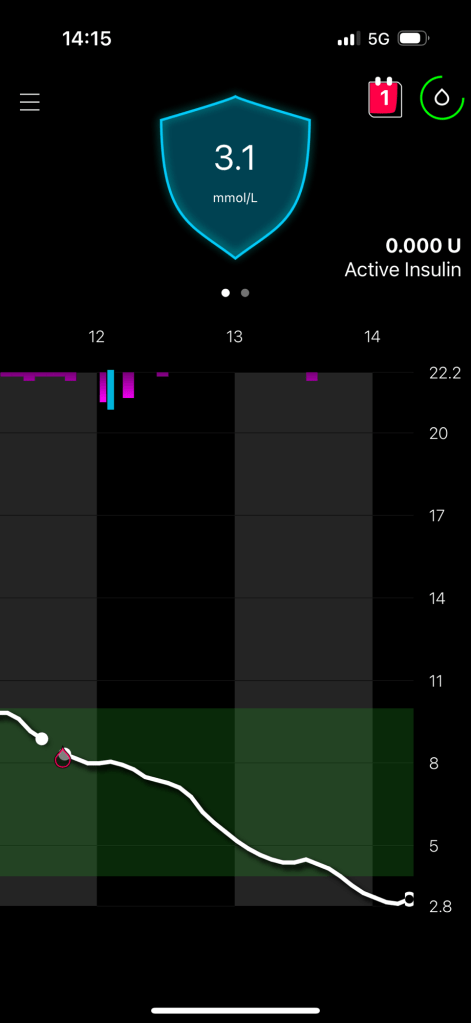
If you look at the image above, it shows a steady decline in blood sugars levels. This is from the app on my phone that monitors my pump functions, so that I don’t have to constantly remove the pump from my belt to look at it. This decline in blood sugars carried on for a couple of hours. If you look closely, you’ll note that the pump initially trie dot adjust by cutting off my basal flow shortly after the noon hour to compensate for the downward trend. Although sitting around 8.0 mmol/L isn’t a terrible level, the downward trend is what can be a concern. Once I dipped below 4.0 mmol/L, I slipped below proper range. I’ll point out that during this time period, I was at a science Centre with my family. I wasn’t engaged in stressful activity, I wasn’t exerting myself and I spent most of the visit sitting. It starts to take an upward trend shortly after the 2 o’clock hour. This is after spending over forty minutes eating an entire bag of Skittles (the large, 170g bag; not the individual 61g sachet).
It took another half hour or so for me to start to feel normal and to be able to function within what I needed to walk around, interact with my kids and get us home. It’s a not-so-frequent occurrence but it does happen; even with something as technologically amazing as the insulin pump. But low’s aren’t the only issue. Lingering high’s can also cause significant issues. High blood sugars can lead to nasty secondary issues like ketoacidosis, where your blood slowly turns acidic. Not fun. But the overall shitty feeling you have while dealing with either extreme high’s or low’s more than just suck; they can potentially endanger your life. The previous day to the scenario above, I had a blood sugar level in the mid-teens, which lingered for a significant portion of the day.

If you look at the image above, the tiny red slice accounts for the period below range I suffered while out with my family. The huge yellow portion is the approximate fourteen-and-a-half hours that my blood sugars were high. This led to a night with barely any sleep, frequent urination, constant adjustment bonuses to compensate, both manual and pump-programmed, and wondering at what point I should start to consider phoning an ambulance. Nice, eh? The icing on the cake is I ate nothing heavily sugared, drank plenty of water and fluids and didn’t do anything that should have elicited this spike. But for some reason, it happened, it lasted and it lingered. I had to deal with it during the period of the day that a reasonable person should be sleeping and getting the required rest for the day that would follow. It sucks, but such is the life of a Type-1 Diabetic. It sometimes has no rhyme or reason and just fucks with your day without warning.
This is all the more reason to be properly prepared at all times. In that extreme low scenario when I was out with my family, if I hadn’t packed my shoulder sling with some fast-acting carbs and other Diabetic necessities, I might have found myself in a difficult situation. And this is the where the “not all that glitters is gold,” comment comes in. The insulin pump is an amazing tool for Diabetes therapy. But that’s all it is; a tool. A technologically-advanced tool that makes my life ten times easier than it was two decades ago, mind you. But a tool nonetheless. And as handy and pretty as it is, it still falls to the person behind the pump to ensure proper blood sugars levels are controlled and health is maintained. Diabetes has come a long way, since I was diagnosed all the way back in 1982. I can say with sincere honesty that I can’t wait to see what the next decade will bring. After all, there’s nowhere to go but up. Stay healthy. ☯️

 The Blogging Buddhist
One thought on “Not All That Glitters…”